Head-Raising of Snake Robots Based on a Predefined
Spiral Curve Method
Xiaobo Zhang1,2,3 , Jinguo Liu1,2,* , Zhaojie Ju1,2,4and Chenguang Yang5
1 State Key Laboratory of Robotics, Shenyang Institute of Automation, Chinese Academy of Sciences,
Shenyang 110016, China; [email protected] (X.Z.); [email protected] (Z.J.) 2 Institutes for Robotics and Intelligent Manufacturing, Chinese Academy of Sciences,
Shenyang 110016, China
3 University of Chinese Academy of Sciences, Beijing 100049, China
4 Intelligent Systems & Biomedical Robotics, School of Creative Technologies, University of Portsmouth,
Portsmouth P01 3HE, UK
5 Zienkiewicz Centre for Computational Engineering, Swansea University, Swansea SA1 8EN, UK;
* Correspondence: [email protected]; Tel.: +86-135-0407-9204
Received: 12 September 2018; Accepted: 17 October 2018; Published: 23 October 2018
Abstract:A snake robot has to raise its head to acquire a wide visual space for planning complex
tasks such as inspecting unknown environments, tracking a flying object and acting as a manipulator with its raising part. However, only a few researchers currently focus on analyzing the head-raising motion of snake robots. Thus, a predefined spiral curve method is proposed for the head-raising motion of such robots. First, the expression of the predefined spiral curve is designed. Second, with the curve and a line segments model of a snake robot, a shape-fitting algorithm is developed for constraining the robot’s macro shape. Third, the coordinate system of the line segments model of the robot is established. Then, phase-shifting and angle-solving algorithms are developed to obtain the angle sequences of roll, pitch, and yaw during the head-raising motion. Finally, the head-raising motion is simulated using the angle sequences to validate the feasibility of this method.
Keywords:snake robots; head-raising; shape-fitting; phase-shifting; spiral curve
1. Introduction
A snake robot is a mobile robot with a long and slender body and plays a crucial role in search and rescue operations, inspection and maintenance [1]. Controlling such robots is difficult, and a review of their modeling, implementation, and control can be found in [2]. Generally, for given tasks such as searching a trapped person in disaster areas, tracking a flying object and repairing a damaged pipe as a manipulator, the snake robot has to move its body with different motion modes, and head-raising motion is one of them. Snake robots’ common motion modes include serpentine [3,4], traveling wave [5,6], concertina [7,8], and sidewinding [9,10] locomotion. Additionally, some researchers sought to find other motion modes such as fusion gait [11] and obstacle-aided locomotion [12]. However, these motion modes provide limited visual information. Consequently, snake robots have to raise their heads to observe their surroundings and perform their tasks. Therefore, the motion planning for head-raising of a snake robot is our research object in this paper.
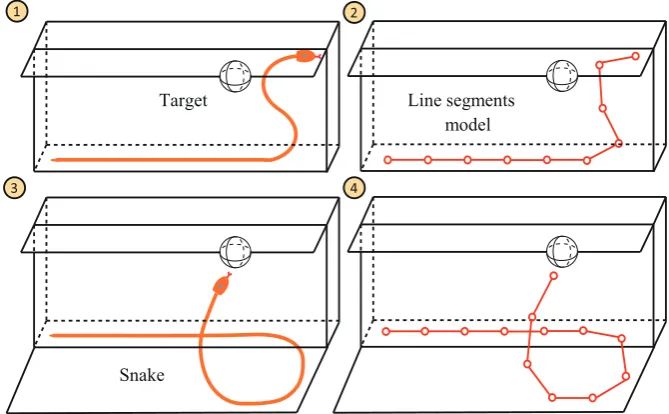
To the best of our knowledge, a few researches on head-raising motion of snake robots have been done, and they can be divided into two types: 2D (two dimensional) head-raising and 3D (three-dimensional) head-raising. This study aims at 3D head-raising. The concepts of 2D and 3D head-raising are illustrated in Figure1. It should be noted that label 2 and 4 are line segments models
of snake robots, which will be utilized in subsequent chapters for simulations. 2D head-raising can be found in [13], the authors proposed an improving serpentine input function to achieve the head-raising motion of a snake robot and analyzed the zero-moment point to assess the stability of the robot. As for 3D head-raising [14,15], to realize it is more complicated. In [14], the works were based on an assumption that the head part of the robot is not contact with the ground and regarded as a manipulator, which is able to achieve several sub-tasks in 3D environment. Therefore, essentially speaking, the researchers mainly considered tracking the trajectory of a snake robot’s head rather than the head-raising process. Inspired by the work made by Tanka et al, we currently are working on trajectory tracking of the snake robot head by improving our model. There still exists problems to be solved and a video about the trajectory tracking (Concept_of_trajectory_tracking.avi) can be seen in Supplementary Materials. In [15], the authors regarded a snake robot as a serially linked floating-base robot and divided it into base and active modules. The base modules were used to construct the support polygon for maintaining stability during the head-raising process and can be changed to active modules to allow the head to stretch to a given position and orientation. The trajectory functions of individual joints were set as parameterized cubic spline curves, and the head-raising motion was achieved by optimizing these parameters according to some criterions. In summary, existing works of head-raising attempt to find the input functions of individual joints. However, in this study, the input functions (angle sequences with respect to time) are unknown, and they are obtained by shape-fitting and phase-shifting algorithms, which will be introduced in the subsequent chapters.
Line segments model
Snake Target
2 1
[image:2.595.126.461.357.564.2]3 4
Figure 1.The concepts of 2D and 3D head-raising. Label 1 and 2 represent 2D head-raising, and label 3 and 4 show 3D head-raising.
macro configuration and the referent spline curve, real-time control could be easily accomplished. In [17], the authors presented locomotion control using a phase oscillator network, which can produce a smooth transition of the body shape of a snake robot to avoid obstacles. In [18], the researchers introduced a framework to control the shape of robots, and the framework can be divided into four steps, namely, defining the shape control point, using the shape control point to define the Bezier curves, fitting the curves and the shape of the robot, and changing the parameters of the Bezier curves to control the movement of the snake robot according to the desired gait. In [19], the authors used the shape control point method to control the position and orientation of the head of a robot. In [20], the researchers presented a planar manipulator that moves according to a variable-structure polygon function produced by neural networks. In [21], the authors introduced and used a modal approach to generate a backbone curve and thus capture a hyper-redundant manipulator’s macroscopic geometric feature. The backbone curve was represented by the linear combination of a set of shape functions with the appropriate coefficients. Then, inverse kinematics reduced to the solution of these coefficients to avoid the heavy computation required by the Jacobian pseudo-inverse method. In [22], the researchers analyzed the curvature of the sidewinding locomotion of a snake robot and developed algorithms to fit the robot’s shape to a continuous curve. In [23], the authors proposed the annealed chain fitting algorithm and keyframe wave extraction algorithm; the former maps the shape of the snake robot to a continuous backbone curve and obtains a set of joint angles, whereas the latter obtains a sequence of backbone curves. A similar modeling strategy can also be found in [24,25]. In [25], the researchers considered dynamics during the shape control of hyper-redundant manipulators.
The goal of this paper is to propose a new approach to raise a snake robot’s head in 3D environments. This mechanism allows the robot to obtain a 360◦field of view and a large working space. In this paper, inspired by the shape control method, a head-raising motion control method based on a predefined spiral curve is proposed. The robot is represented by several line segments, and the corresponding local coordinate system is established. Every line segment corresponds to a module of the snake robot, and the connection point between adjacent line segments corresponds to a joint involving three degrees of freedom, namely, roll, pitch, and yaw angles, which can be obtained by matrix transformation of the local coordinate system. The predefined curve is introduced to constrain the macro shape of the snake robot, and a phase-shifting algorithm is developed to drive the snake robot along the curve. During the phase-shifting process, the angle trajectories for the head-raising motion in a given time can be obtained. With the angle trajectories, the head-raising motion can be achieved. The contributions of this work are summarized by following remarks:
1. A new shape control curve, the predefined spiral curve, is proposed and it is utilized for 3D head-raising of a snake robot;
2. A shape-fitting algorithm is developed for adhering the line segments model of the snake robot to the predefined spiral curve;
3. Establishment rules of coordinate system are given for line segments model of the snake robot; 4. A phase-shifting and an angle-solving algorithms are presented for obtaining angle trajectories
used during head-raising motion.
The remainder of this paper is organized as follows. Section1reviews previous researches, analyses the necessity for head-raising and introduces our aim, which is raising a snake robot’s head based on a predefined spiral curve in 3D environments. Section2introduces the modeling of the head-raising motion; the mathematical expression of the predefined spiral curve is discussed in Subsection2.1, the shape-fitting and phase-shifting methods in Subsection2.2, and the establishment of the coordinate system and angle-solving algorithm in Subsection2.3. Section3explains the simulation of the head-raising motion. Section4presents the conclusions.
2. Modeling of Head-Raising Motion
segments. However, the serial line segments do not contain the complete information of the snake robot. Therefore, coordinate system is introduced. The snake robot has to move through the predefined spiral curve from initial posture to final posture, and that process is called phase-shifting. With the proposed phase-shifting and angle-solving algorithms, the angle sequences (or angle trajectories) can be used to accomplish the head-raising motion.
2.1. Predefined Spiral Curve
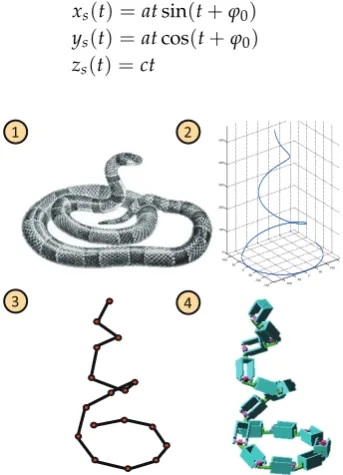
From the biological perspective, a snake’s head-raising movement is irregular, and it is difficult to completely describe its shape using a mathematical model. Based on our observations, the shape of a snake after raising its head is similar to that of a spiral curve, as described in Figure2. In addition, the spiral curve can ensure the stability of head-raising. Thus, describing the head-raising movement of a snake robot with a spiral curve is reasonable.
xs(t) =atsin(t+ϕ0) ys(t) =atcos(t+ϕ0) zs(t) =ct
(1)
-100 -50
0 50
100 1
-150 -100 -50 0 50 100 0 100 200 300 400 500
1
3
2
[image:4.595.211.383.264.502.2]4
Figure 2.The similar macro shapes of a snake (label 1), a spiral curve (label 2), the line segments model after the shape-fitting algorithm (label 3) and the simplified simulation model (label 4).
A regular spiral curve (Figure3a) can be expressed as Equation (1). It cannot be utilized to guide the movement of the robot, and has to be modified, because it cannot ensure the stability of head-raising. Then, the predefined spiral curve (Figure3b) is designed and its mathematical description satisfies Equation (2), wherexl(t),yl(t), andzl(t)represent the line part; xs(t),ys(t), andzs(t)describe the spiral curve part; anda,b, andcare the adjustment coefficients of the spiral curve. The amplitudes of
xs(t)andys(t)change equally whenais changed and unequally whenbis changed. The amplitude of
zs(t)is influenced byc.ϕ0is the initial phase of the sine and cosine functions, which correspond to the
spiral curve part, which is in contact with the ground (defined by BS, interval is(tˆ1, ˆt2)); and the rest of
the spiral curve (defined by RS, interval is(tˆ2, ˆt3)).ϕbaseis the phase value of the second interval.
xl(t) =xs(tˆ1) t∈(0, ˆt1) yl(t) =ys(tˆ1)−t+ ˆt1t∈(0, ˆt1) zl(t) =0 t∈(0, ˆt1)
xs(t) =ab(tˆ3−t)sin(t+ϕ0) t∈(ˆt1, ˆt2) ys(t) =a(tˆ3−t)cos(t+ϕ0)1 t∈(ˆt1,t2) zs(t) =0 t∈(ˆt1, ˆt2)
xs(t) =ab(tˆ3−t)sin(t+ϕ0) t∈(ˆt2, ˆt3) ys(t) =a(tˆ3−t)cos(t+ϕ0) t∈(tˆ2, ˆt3) zs(t) =ct−ctˆ2 t∈(tˆ2, ˆt3)
ˆ
t1=nllink ˆ
t2=tˆ1+ϕbase ˆ
t3=tˆ1+2ncπ
(2)
The predefined spiral curve is composed of a line part and a spiral curve part, as shown in Figure3b. The line and spiral curve parts constrain the initial and final head-raising postures of the snake robot, respectively. As shown in Figure3, compared with the regular spiral curve expressed in Equation (1), the predefined spiral curve expressed in Equation (2) introduces parameterbto ensure thatxs(t)andys(t)change unequally, interval(0, ˆt1)to construct LP,(tˆ1, ˆt2)to construct BS, and(tˆ2, ˆt3)
to construct RS. Additionally, by substituting item(ˆt3−t)fort, it can be ensured thatxs(t)andys(t) decrease aszs(t)increases. Obviously, the predefined spiral curve is appropriate for ensuring stability during head-raising.
-200-100 0 100 -200
0 200 400 600 800 1000 1200 1400
0 200 400 600
X(mm) Y(mm)
Z
(m
m
)
(a)
-200-1000 100 -200
0 200 400 600 800 1000 1200 1400
0 200 400 600
X(mm) Y(mm)
Z
(m
m
)
Line part (LP)
Spiral curve part (BS)
1
ˆ
t=t
2
ˆ
t=t
0
t=
3
ˆ
t=t
Spiral curve part (RS)
(b)
Figure 3. Spiral curves: (a) the regular spiral curve, and (b) the predefined spiral curve used in this study.
2.2. Shape-Fitting and Phase-Shifting Methods
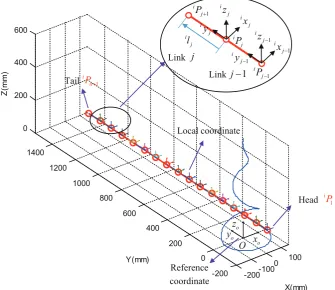
In this section, a shape-fitting and phase-shifting algorithms are developed, and the former ensures that the snake robot adhere to the predefined spiral curve and the latter drive the robot move along with the curve. Figure4shows the concepts of these methods. In Figure4, two links of robot are shown; the red one represents the robot posture at timetiand the black one corresponds to the robot posture at timeti+1. The robot moves from posture at timetito posture at timeti+1, and this process is
-100 0
100
-100 0 100
0 50 100 150 200 250
X(mm) Y(mm)
Z
(m
m
)
Head at
Phase
Head at Spiral curve
1
i
t
+
i
t
i
[image:6.595.193.406.90.302.2]S ∆
Figure 4.Concepts of shape-fitting and phase-shifting.
The details of how the shape-fitting and phase-shifting algorithms work are described in the following steps.
Step 1: Initialization
The parametersa,b,c,nc,n,llink, ˆt1, ˆt2, ˆt3,ϕ0, andϕbaseare initialized. The following constraint equation is used to ensure that line segments model of the robot do not get away from the ground.
S1+S2=
t=ˆt2
R
t=ˆt1
q ˙
xs(t)2+y˙s(t)2+z˙s(t)2dt+
t=tˆ3
R
t=tˆ2
q ˙
xs(t)2+y˙s(t)2+z˙s(t)2dt<nllink
(3)
whereS1andS2represent the arc lengths of BS and RS, respectively.
Step 2: Determination of basic posture
The snake robot is represented by line segments and the corresponding coordinate system. This section describes how the line segments of the basic posture are determined. The succeeding portion discusses the rules of building the coordinate system.
The point sets used to construct the line segments are defined as follows:
iP
snk = [iP1,iP2, ...,iPj, ...,iPn+1] j=1, 2, ...,n+1 i=1, 2, ...,nstep
iP
j= (ixsnk_j,iysnk_j,izsnk_j)
(4)
whereiPjis the position of pointjat stepiof phase-shifting.nstepis the number of phases shifted and satisfies Equation (5).
i=nstep
∑
i=1
∆Si=S1+S2 (5)
where∆Siis the arc length at stepiof phase-shifting and defined as “phase” in this study.
The basic posture is considered the initial configuration before the phase-shifting begins, as shown in Figure5and calculated as follows.
-200-100 0 100 -200
0 200 400 600 800 1000 1200 1400 0 200 400 600
X(mm) Y(mm)
Z
(m
m
)
Reference
coordinate Local coordinate
Head Link
Link j
1
j−
i j l
1
i j
P−
i j P
1
i j
P+
1
i j
x−
1
i j
y−
1
i j z− i
j x i
j z
i j y
1
i
P
Taili 1 n
P+
O xo
o
y o
[image:7.595.132.468.131.421.2] [image:7.595.185.410.507.591.2]z
Figure 5. Modeling of the robot’s basic posture composed ofnline segments and corresponding coordinate system.
We seti=1 to indicate that the line segments are in the basic posture without phase-shifting such that the point sets of the basic posture satisfy Equation (6).
1P
snk =
(xs(tˆ1) ys(ˆt1) +nllink 0) (xs(tˆ1) ys(tˆ1) + (n−1)llink 0)
. . . .
(xs(tˆ1) ys(tˆ1) + (n−j+1)llink 0)
. . . .
(xs(tˆ1) ys(tˆ1) 0)
T
(6)
Step 3: One step of phase-shifting
For programming purposes, independent variabletis regarded as a discrete vectortdand its mathematical description is expressed as follows:
td= [0,∆t1, 2∆t1, ..., ˆt1, ˆt1+∆t2, ˆt1+2∆t2, ..., ˆt3] (7)
where∆t1and∆t2are the step lengths of discretization in intervals(0, ˆt1)and(tˆ1, ˆt3), respectively.
Phase-shifting is achieved by the movement of the snake’s head (iP1) and the refreshing of
the positions of the rest of the points (iP2,iP3, ...,iPj, ...iPn+1) along with the predefined spiral curve.
First, given the phase∆Si, headiP1changes into a new positioni+1P1, during which independent
variabletis assumed to shift fromtitoti+1. ti and∆Siare known, andti+1can be obtained using
Equation (8).
∆Si=
t=ti+1
Z
t=ti
q ˙
x(t)2+y˙(t)2+z˙(t)2dt (8)
Second, we query td to identify the element nearest to ti+1 and record its index as
iInx
p1. Finally, the rest of the points (
iP
2,iP3, ...,iPj, ...iPn+1) and corresponding indices (iInxp2,
iInx
p3, ...,
iInx
pj, ...,
iInx
pn+1) can be obtained by distance judgment going throughtd from
indexiInxp1 to index 1. Distance judgment is illustrated in Equation (9). llink−eps≤
iP
j−iPj−1
≤llink+eps (9)
whereepsis utilized to deal with the error between continuous function and discrete approximation. Step 4: Iteration
Step 3 is one step of phase-shifting from stepitoi+1. On the basis of Equation (5), all of the values of phase∆Sican be computed manually. Then, step 3 is repeated until the head of the snake (i+1P1) moves to the final point of the discrete predefined spiral curve. Therefore, iteration completes
the phase-shifting process from basic posture (1Psnk) to final posture (nstepPsnk) of the snake robot (represented by line segments or point sets without considering the coordinate system in this part).
2.3. Coordinate System and Angle-Solving Algorithm
The line segments cannot contain all the information of the snake robot links or modules. Therefore, we propose an approach on establishing the coordinate system fixed on line segments.
Figure5shows the reference coordinateOxoyozo, and its origin is[0, 0, 0], withxo-axis [1, 0, 0],
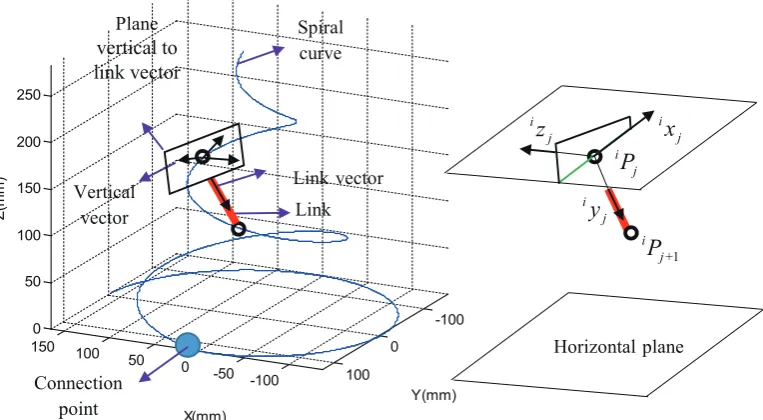
yo-axis[0, 1, 0], andzo-axis[0, 0, 1]. In determining the local coordinates, several rules are needed. Figure6shows how these rules are established and illustrates one link at stepiduring the phase-shifting process. Theiyj-axis is calculated as follows:
iy
j=
ip
j+1−ipj
ipj+1−ipj
(10)
Theixj- andizj-axes are on the plane that is vertical to the link vector shown in the left part of Figure6. Therefore, theixj- andizj-axes are not unique, and the horizontal plane is introduced to solve this problem. Moving the horizontal plane to pointiPj, the intersecting line between two planes is used to select theixj-axis, as shown in the right part of Figure6. The intersecting line has two directions. Thus, the direction is selected by determining whether the angle betweenixj- andxo-axes is acute. Afterward, theiz
-100 -50 0 50 100 150
-100
0
100 0
50 100 150 200 250
Y(mm) X(mm)
Z
(m
m
)
Spiral curve
Connection point
Plane
vertical to link vector
Link Link vector Vertical
vector
Horizontal plane i
j
P
+1 i
j
P
ij
x
ij
z
[image:9.595.113.495.94.304.2]i j
y
Figure 6.Establishment of local coordinates.
-1000
100 0
500 1000
1500 0 200 400 600
X(mm) Y(mm)
Z
(m
m
[image:9.595.178.424.597.653.2])
Figure 7.Local coordinates during entire head-raising process.
After the determination of the coordinate system, the relative rotation matrix between adjacent links can be obtained using Equation (11).
iR
P_relj = (iRPj+1)
−1(iR
Pj) j=2, 3...,n i=1, 2, ...,nstep
iR
Pj =
h
ix
j iyj izj
i
=
r11 r12 r13 r21 r22 r23 r31 r32 r33
(11)
whereiR
Pj ∈R
3×3is the orientation matrix of linkjrelative to the reference coordinate andiR
P_relj ∈
R3×3is the orientation matrix of linkjrelative toiR
Pj+1. Then, the relative roll (
iγ
j), pitch (iβj), and yaw (iαj) angle sequences can be calculated using Equation (12).
i
βj= Atan 2(−r31,
p
r112+r212) j=2, 3...,n i=1, 2, ...,nstep
iα
j =Atan2(r21/cos(iβj),r11/cos(iβj))
iγ
j =Atan2(r32/cos(iβj),r33/cos(iβj))
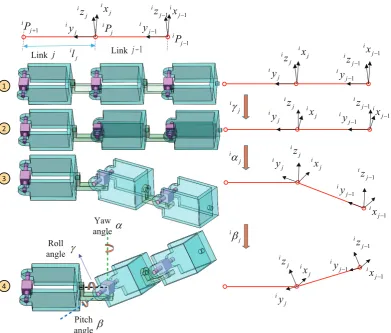
The line segments model for the snake robot is abstract, therefore we introduce a simplified Solidworks model for the subsequent simulation in Adams environment, as shown in Figure8. It is part of Solidworks model and contains three modules. This figure provides us with the line segments model (right part) and Solidworks model (left part), and it is convenient for us to understanding where local coordinates are established and how the roll, pitch, and yaw angles are solved. As mentioned before, a line segment (ilj) and a local coordinate (iPj−ixjiyjizj) represent a snake robot module, and a point (iPj) represents a joint with three degrees of freedom. The three axes are located at centers of rotating shafts and intersected at theiPj. Connecting theiPjand theiPj+1, theiljcan be determined. Equation (11) and (12) provide us with the solution of roll, pitch and yaw angles. However, it is significant to determine their rotating sequences, which are also illustrated in Figure8. It should be pointed out that the rotating sequences depend on specific models, otherwise, the rotating sequences and Equation (12) should be modified.
1 j− i j
l
i jP
1 i jP
+ 1 i jP
− Link Link j 1 i jy
− 1 i jz
− 1i j
x
− i jy
i jz
ix
j [image:10.595.101.493.263.596.2]Pitch angle
β
Yaw angleα
Roll angleγ
i jz
i jx
i jy
1 i jz
− 1 i jx
− 1 i jy
− i jx
i jz
i jy
1 i jx
− 1 i jz
− 1 i jy
− i jx
i jy
1 i jx
− 1 i jy
− i jz
1 i jz
− i jγ
i jα
i jx
1 i jx
− 1 i jy
− i jz
1 i jz
− i jβ
i jy
1 2 3 4Figure 8.Local coordinates fixed on the simplified Solidworks model and descriptions of roll, pitch and yaw angles. Label 1 corresponds to the initial configuration. Label 2, 3 and 4 describe the configurations after rotating roll angle, yaw angle and pitch angle, respectively.
3. Simulation on Head-Raising Motion
According to the proposed algorithms, the phase-shifting process can be simulated. The parameters of the predefined curve are as follows: a = 9.7, b = 1, c = 48.5, nc = 2.5,
n = 16,llink = 97 (mm), ˆt1 = 1, 552 (rad), ˆt2 = 1, 555.1 (rad), ˆt3 =1, 567.7 (rad), ϕ0=1.6022 (rad),
andϕbase =pi(rad). According to Equation (3), the arc lengths of BS (S1) and RS (S2) can be calculated
asS1 = 431.8891 (mm) andS2 = 1, 032.6 (mm). The discrete independent variable is selected as td = [0, 0.1, 0.2, . . . , ˆt1, ˆt1+0.001, ˆt1+0.002, . . . , ˆt3] with∆t1 = 0.1 and ∆t2 = 0.001. To facilitate
The snake begins to move from basic posture to final posture using the shape-fitting and phase-shifting algorithms. During the phase-shifting process, the phase∆Si in every step can be selected manually. In this test,∆Siis assumed constant and equal to(S1+S2)/nstep, where the number of total stepsnstepequals 500. Table1shows the data ofiP1,iInxp1,
iα
1,iβ1, andiγ1at steps 1, 2, 300, 499,
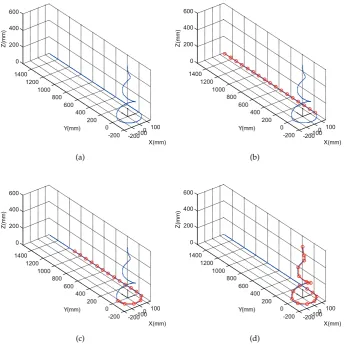
and 500, respectively. Figure9shows the phase-shifting process, including the predefined spiral curve (Figure9a) and snake posture at stepsi=1 (Figure9b),i=147 (Figure9c), andi=500 (Figure9d), corresponding to the snake head att=tˆ1,t=ˆt2, andt=tˆ3, respectively.
-200-100 0 100 -200
0 200 400 600 800 1000 1200 1400
0 200 400 600
X(mm) Y(mm)
Z
(m
m
)
(a)
-200-1000 100 -200
0 200 400 600 800 1000 1200 1400
0 200 400 600
X(mm) Y(mm)
Z
(m
m
)
(b)
-200-100 0 100 -200
0 200 400 600 800 1000 1200 1400
0 200 400 600
X(mm) Y(mm)
Z
(m
m
)
(c)
-200-100 0 100 -200
0 200 400 600 800 1000 1200 1400
0 200 400 600
X(mm) Y(mm)
Z
(m
m
)
[image:11.595.128.476.196.541.2](d)
Figure 9. Phase-shifting process: (a) predefined spiral curve, (b)i =1,t = tˆ1, (c)i =147,t = tˆ2, (d)i=500,t=tˆ3.
We assume that the head-raising motion time is 50 s, that is,ttime ∈(0, 50). With Equation (12) and numerical derivation, the roll (iγj), pitch (iβj), and yaw (iαj) angle sequences; relative angular velocity (iγ˙j,iβ˙j,iα˙j); and angular acceleration (iγ¨j,iβ¨j,iα¨j) can be obtained, as shown in thez-axis of Figure10. Thex- andy-axes represent the joint ID (ID=1, 2, . . . , 15) and time, respectively. As the snake head moves fromt= ˆt1tot= tˆ2, the absolute value ofiγ1initially increases before the third joint point
moves tot=tˆ1and subsequently becomes constant because the first two links are constrained to a
semicircle. Meanwhile, the absolute values ofiα1andiβ1are zero. Similarly, the motion of the snake
head moving fromt=tˆ2tot=tˆ3can be divided into two stages. Before the third joint point moves to t=tˆ2, the absolute value ofiγ1initially decreases in the first stage and then subsequently increases in
the second stage. In the meantime, the absolute value ofiα
1increases at varying speed. The absolute
value ofiβ1initially increases, subsequently decreases, and finally increases. Unsmooth angles are
5 10
15 0 20
40 60 0 0.5 1 1.5 2 2.5 time(s) joint ID p it ch a n g le (r a d ) 0 10 20 0 20 40 60 -3 -2 -1 0 time(s) joint ID y a w a n g le (r a d ) 0 10 20 0 20 40 60 -1 -0.5 0 time(s) joint ID ro ll a n g le (r a d ) 0 10 20 0 20 40 60 -0.1 0 0.1 0.2 0.3 time(s) joint ID p it ch a n g le ve lo ci ty( ra d /s) 0 10
20 0 20
40 60 -0.4 -0.2 0 0.2 0.4 time(s) joint ID ya w a n g le v e lo ci ty (r a d /s ) 0 10
20 0 20
40 60 -0.1 -0.05 0 0.05 0.1 time(s) joint ID ro ll a n g le v e lo c it y (r a d /s) 0 10
20 0 20
40 60 -1 -0.5 0 0.5 time(s) joint ID p it ch a n g le a cce le ra ti o n (r a d /s 2) 0 10
20 0 20
40 60 -0.4 -0.2 0 0.2 0.4 time(s) joint ID ya w a n g le a c ce le ra ti o n (r a d /s 2) 0 10
20 0 20
40 60 -0.4 -0.2 0 0.2 0.4 time(s) joint ID ro ll a n g le a cc e le ra ti o n (r a d /s 2) i j
β
iβ
ɺ
ji j
β
ɺɺ
ij
γ
i j
γ
ɺ
iγ
ɺɺ
ji j
α
i jα
ɺ
i jα
ɺɺ
2 ˆt=t
2
ˆ
t=t
2
ˆ
[image:12.595.136.457.95.634.2]t=t
Table 1.Data during phase-shifting process.
Stepi HeadiP1(mm) HeadIndex ofiInxp Yaw Angle Pitch Angle Roll Angle 1
i
α1(rad) iβ1(rad) iγ1(rad)
1 (151.8,−12.8, 0) 15,520 0 0 0
2 (151.3,−15.7, 0) 15,541 −0.0047 0 0
..
. ... ... ... ... ...
300 (57.3,−61.8, 188.1) 22,544 −0.8964 0.2259 −0.3775
..
. ... ... ... ... ...
499 (−0.546, 0.015, 606.7) 31,174 −2.5001 2.1308 −0.8348
500 (−0.0036,−0.003, 609.4) 31,230 −2.5309 2.1658 −0.8225
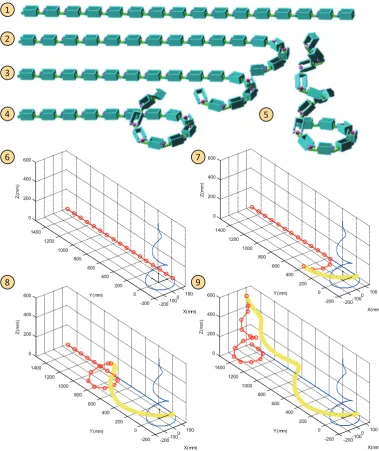
Distinguishing between the phase-shifting and head-raising processes is important. The phase-shifting process is used to obtain the joint trajectory and does not exist in reality if the snake robot has no active wheels with which to move its body along the predefined spiral curve. Meanwhile, the head-raising process is the actual head-raising motion produced using the joint trajectory, and in this case, the tail of the snake robot is fixed. Figure11 shows the two kinds of simulations of head-raising process. Those simulations are in kinematic level and do not take dynamic factors into consideration. The Simulation in labels 1–5 are implemented in Adams, and the roll, pitch and roll angles are integrated into spline curves to guide the model’s movement. The simulation in labels 6–9 are carried out using Matlab, based on the following algorithm:
(1) Determine the basic posture as Equation (6), and set motion stepi=1;
(2) Proceed to motion stepi=2. The linknis fixed. Calculate the position of linkn−1 on the basis of angles2αn,2βn, and2γn;
(3) Make an iteration to calculate all of the positions of the links, that is, linkj=n−2,n−3, . . . , 1, on the basis of angles(2αn−2,2βn−2,2γn−2),(2αn−3,2βn−3,2γn−3), . . . ,(2α1,2β1,2γ1);
(4) Proceed to motion stepi=i+1 and repeat steps 2 and 3 untili=nstep.
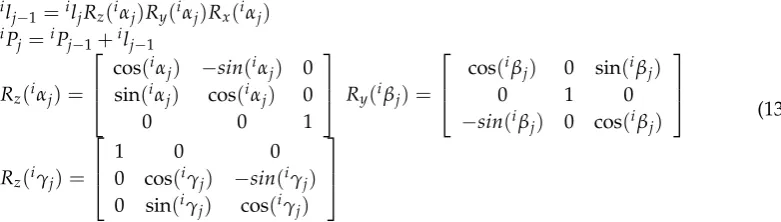
In this algorithm, step 2 is important. During the phase-shifting and head-raising processes, their link vectorsilj, as shown in Figure5, are same in orientation and different in position. Therefore, the position of joint pointiPjcan be obtained as follows:
il
j−1=iljRz(iαj)Ry(iαj)Rx(iαj)
iP
j =iPj−1+ilj−1
Rz(iαj) =
cos(iαj) −sin(iαj) 0 sin(iαj) cos(iαj) 0
0 0 1
Ry(
iβ
j) =
cos(iβj) 0 sin(iβj)
0 1 0
−sin(iβj) 0 cos(iβj)
Rz(iγj) =
1 0 0
0 cos(iγj) −sin(iγj) 0 sin(iγj) cos(iγj)
(13)
Considering that the method of head-raising should be adaptive to deal with different situations, more simulations are implemented as described in Figure12, where different parameters of the predefined spiral curves are adopted and they are listed in Table2. In Figure12, only final postures are shown, and more detailed simulations can be found in Supplementary Materials. Compared with the result in Figures11and12a, the radius of the supporting part BS becomes larger when increasing the value of parametera(Figure12b–d); the height of every circle becomes larger if the parameterc
increases (Figure12b–d). When changing the parameterb, the amplitudes ofxs(t)andys(t)change unequally. Additionally, the LP part changes accordingly (Figure12c,d) when changing the parameters
llink andn, and it should be noted thatϕ0is set to ensure the initial phases of the sine and cosine
5
1
2
3
4 5
6 7
-200-100 0 100 -200
0 200 400 600 800 1000 1200 1400 0 200 400 600
X(mm) Y(mm)
Z
(m
m
)
-200-100 0 100 -200
0 200 400 600 800 1000 1200 1400 0 200 400 600
X(mm) Y(mm)
Z
(m
m
)
-200-100 0 100 -200
0 200 400 600 800 1000 1200 1400 0 200 400 600
X(mm) Y(mm)
Z
(m
m
)
8 9
-200-100 0 100 -200
0 200 400 600 800 1000 1200 1400 0 200 400 600
X(mm) Y(mm)
Z
(m
m
[image:14.595.106.486.90.542.2])
Figure 11.Head-raising motion process. Labels 1–5 show different states from initial posture to final posture of head-raising in Adams environment. Label 1 is the initial posture and label 5 is the final posture. Label 2 corresponds to the case that the robot forms a supporting configuration. Label 3 and 4 are intermediate states. The labels 6–9 are head-raising simulations of line segments model, implemented in Matlab environment. The labels 6–9 correspond to labels 1, 2, 4 and 5, respectively.
Table 2.Parameters of predefined spiral curves used in head-raising simulations shown in Figures11
and12.
Figure Number a b c nc ϕ0(rad) n llink(mm)
Figure11 9.7 1 48.5 2.5 0.5 pi 16 97
Figure12a 9.7 1 20 1.5 0.5 pi 16 97
Figure12b 60 1 60 0.8 0.5 pi 16 97
Figure12c 20 1 60 0.9 1.5 pi 12 50
-200-100 0 100 -200
0 200 400 600 800 1000 1200 1400 0 200 400 600
X(mm) Y(mm)
Z
(m
m
)
(a)
-200 0
200
-200 0 200 400 600 800 1000 1200 1400 0 200 400 600
X(mm) Y(mm)
Z
(m
m
)
(b)
-50 0 50 100
-100 0 100 200 300 400 500 600
0 50 100 150 200
X(mm) Y(mm)
Z
(m
m
)
(c)
-100 0
100
-100 0 100 200 300 400 500 600
0 50 100 150 200
X(mm) Y(mm)
Z
(m
m
)
[image:15.595.85.514.88.504.2](d)
Figure 12. Head-raising motion process with different parameters of the predefined spiral curve, and the parameters are listed in Table2.
4. Discussion and Conclusions
However, there are some problems to be solved in the future work. First, the predefined spiral curve is a piecewise function and has unsmooth points, thus leading to sharp changes in motion trajectories. Second, our model considers only kinematic planning, that is, the dynamic problem is not considered. Dynamic constraints are important factors for successful implementation of our model on a real robot, and will be added into an improved model in the future work. At the same time, experimental verification will be carried out in the next phase of research, after finishing the design and construction of the platform. The greatest challenge to use our model on a real robot is that the robot has to overcome the gravity during the head-raising, and the actuation system must be equipped with motors which have adequate torques to drive the snake modules. The work in [13] is a successful example although they adopted a different method to raise the robot’s head. When designing the prototype, lightweight materials can be used to enable the robot with lighter gravity and stronger driving power. More importantly, our model is adaptive. As illustrated in Figure12, by decreasing the height, the cycle number and increasing the radius of supporting part, it is feasible for the robot to raise its head while satisfying the dynamic constraints. In some specific situations such as exploring the moon, and searching for resources underwater, the gravity will decrease or be compensated. Then, it will be easier for the robot to raise their head. Third, the head-raising motion forms of snake in the natural world can change over time. To accomplish that, the predefined spiral curve should be made time varying without influencing the stability of the robot body, and this principle will also be the focus of the future research.
Supplementary Materials:The following are available online athttp://www.mdpi.com/2076-3417/8/11/2011/ s1, Video S1: Concept_of_trajectory_tracking.avi; it introduces the concept of trajectory tracking using an improved model in our future work. Video S2: PS_Fig9.avi; it describes the process of phase-shifting (Figure9). Video S3: HR_Fig11.avi; it shows the process of head-raising using the line segments model of the snake robot (Figure11). Video S4: SA_Fig11.avi; it shows the simulation of head-raising in Adams environment (Figure11). Video S5: HR_Fig12a.avi; it displays the head-raising process of Figure12a. Video S6: HR_Fig12b.avi; it displays the head-raising process of Figure12b. Video S7: HR_Fig12c.avi; it displays the head-raising process of Figure12c. Video S8: HR_Fig12d.avi; it displays the head-raising process of Figure12d.
Author Contributions:Conceptualization, J.L. and Z.J.; Formal analysis, X.Z. and J.L.; Funding acquisition, J.L.; Investigation, J.L., X.Z., Z.J. and C.Y.; Methodology and Simulation, X.Z.; Software and Programming, X.Z.; Supervision, J.L., Z.J. and C.Y.; Validation, J.L.; Writing—original draft, X.Z.; Writing—review and editing, Z.J., C.Y. and J.L.
Funding:This work was partially supported by the National Science Foundation of China (Grant No. 51775541), Research Fund of China Manned Space Engineering (Grant No. 030201), Engineering and Physical Sciences Research Council (EPSRC) (Grant No. EP/S001913/1). And the APC was funded by the National Science Foundation of China (Grant No. 51775541).
Conflicts of Interest:The authors declare no conflict of interest.
Abbreviations
The following abbreviations are used in this manuscript:
Appendix A
[image:17.842.161.665.153.496.2]TableA1shows all the symbols utilized in this paper.
Table A1.Symbols utilized in this paper.
Symbol Definition
xl(t) xvalue of line part in the predefined spiral curve yl(t) yvalue of line part in the predefined spiral curve zl(t) zvalue of line part in the predefined spiral curve xs(t) xvalue of spiral curve part in the predefined spiral curve ys(t) yvalue of spiral curve part in the predefined spiral curve zs(t) zvalue of spiral curve part in the predefined spiral curve
a Adjustment coefficient of the spiral curve, which can be used to change the amplitude ofxs(t)andys(t)equally b Adjustment coefficient of the spiral curve, which can be used to change the amplitude ofxs(t)andys(t)unequally c Adjustment coefficient of the spiral curve, which can be used to change the amplitude ofzs(t)
ϕ0 Initial phase of the sine and cosine functions nc Cycle number of the spiral curve
llink Length of the snake robot modules n Number of the snake robot modules
t Independent variable divided into three intervals:(0, ˆt1),(tˆ1, ˆt2)and(tˆ2, ˆt3) ys(t) yvalue of spiral curve part in the predefined spiral curve
LP Line part of the predefined spiral curve, corresponding to interval(0, ˆt1)
BS The base of the spiral curve part, which is in contact with the ground and corresponds to interval(tˆ1, ˆt2) RS yThe base of the spiral curve part, which is in contact with the ground and corresponds to interval(ˆt2, ˆt3)
ˆ
t1 Value oftconnecting LP and BS ˆ
t2 Value oftconnecting BS and RS ˆ
t3 End value oft
ϕbase The phase value of interval(tˆ1, ˆt2) ti yDiscrete value of simulation time
i Index value of simulation step
j Index value of pointPin line segments model of the snake robot iP
j Position of pointjstepiof phase-shifting process nstep Number of phases shifted
ix
snk_j xvalue ofiPj iy
Table A1.Cont.
Symbol Definition
iz
snk_j zvalue ofiPj
∆Si Arc length at stepiand defined as “phase” iP
snk Point set at stepi td yDiscrete vector oft
∆t1 Step length of discretization in interval(0, ˆt1)
∆t2 Step length of discretization in interval(tˆ1, ˆt3)
iInx
pj Index value of element intd, which is nearest toti+1during phase-shifting process
eps Threshold utilized to deal with the error between continuous function and discrete approximation Oxoyozo Reference coordinate
ix
j xcoordinate axis fixed on the snake modulejat stepi iy
j ycoordinate axis fixed on the snake modulejat stepi iz
j zcoordinate axis fixed on the snake modulejat stepi il
j Link vector connectingiPjandiPj+1
iP
j−ixjiyjizj yLocal coordinate fixed on linkj−1 iα
j Yaw angle of jointjat stepi i
βj Pitch angle of jointjat stepi i
γj Roll angle of jointjat stepi i˙
αj Yaw angular velocity of jointjat stepi iβ˙j Pitch angular velocity of jointjat stepi i˙
γj Roll angular velocity of jointjat stepi i¨
αj Yaw angular acceleration of jointjat stepi iβ¨j Pitch angular acceleration of jointjat stepi i¨
γj Roll angular acceleration of jointjat stepi ttime Head-raising motion time
iR
Pj Orientation matrix of linkjwith respect to the reference coordinate at stepi
iR
P_relj Orientation matrix of linkjwith respect to
iR
References
1. Transeth, A.A.; Pettersen, K.Y.; Liljebäck, P. A survey on snake robot modeling and locomotion.Robotica 2009,27, 999–1015. [CrossRef]
2. Liljebäck, P.; Pettersen, K.Y.; Stavdahl, Ø.; Gravdahl, J.T. A review on modelling, implementation, and control of snake robots.Robot. Auton. Syst.2012,60, 29–40.
3. Liu, J.; Wang, Y.; Li, B.; Ma, S. Path planning of a snake-like robot based on serpenoid curve and genetic algorithms. In Proceedings of the 5th World Congress on Intelligent Control and Automation, Hangzhou, China, 15–19 June 2004; pp. 4860–4864.
4. Saito, M.; Fukaya, M.; Iwasaki, T. Serpentine locomotion with robotic snakes.IEEE Control Syst. Mag.2002, 22, 64–81. [CrossRef]
5. Chen, L.; Wang, Y.; Ma, S.; Li, B. Analysis of traveling wave locomotion of snake robot. In Proceedings of the 2003 IEEE International Conference on Robotics, Intelligent Systems and Signal Processing, Changsha, China, 8–13 October 2003; pp. 365–369.
6. Kalani, H.; Akbarzadeh, A.; Safehian, J. Traveling wave locomotion of snake robot along symmetrical and unsymmetrical body shapes. In Proceedings of the 41st International Symposium on Robotics and 6th German Conference on Robotics, Munich, Germany, 7–9 June 2010; pp. 62–68.
7. Liu, J.; Wang, Y.; Li, B.; Chen, L.; Ma, S. Serpentine locomotion with robotic snakes.Chin. J. Mech. Eng.2005, 41, 108–113. [CrossRef]
8. Virgala, I.; Dovica, M.; Kelemen, M.; Prada, E.; Bobovsky. Snake robot movement in the pipe using concertina locomotion.Jixie Gongcheng Xuebao/Chin. J. Mech. Eng.2005,41, 108–113. [CrossRef]
9. Chen, L.; Wang, Y.; Ma, S.; Li, B. Study of lateral locomotion of snake robot.Robot2003,25, 246–249. 10. Tanev, I.; Ray, T.; Buller, A. Evolution, robustness, and adaptation of sidewinding locomotion of simulated
snake-like robot. InGenetic and Evolutionary Computation Conference; Springer: Berlin, Germany, 2004; pp. 627–639.
11. Wang, K.; Gao, W.; Ma, S. Snake-like robot with fusion gait for high environmental adaptability: Design, modeling, and experiment.Appl. Sci.2017,7, 1133. [CrossRef]
12. Sanfilippo, F.; Azpiazu, J.; Marafioti, G.; Transeth A.A.; Stavdahl, Ø.; Liljebäck, P. Study of lateral locomotion of snake robot.Appl. Sci.2017,7, 336. [CrossRef]
13. Ye, C.; Ma, S.; Li, B.; Wang, Y. Head-raising motion of snake-like robots. In Proceedings of the 2004 IEEE International Conference on Robotics and Biomimetics, Shenyang, China, 22–26 August 2004; pp. 595–600. 14. Tanaka, M.; Matsuno, F. Modeling and control of head raising snake robots by using kinematic redundancy.
J. Intell. Robot. Syst.2014,75, 53–69. [CrossRef]
15. Cappo, E.A.; Choset, H. Planning end effector trajectories for a serially linked, floating-base robot with changing support polygon. In Proceedings of the 2004 American Control Conference, Portland, OR, USA, 4–6 June 2014; pp. 4038–4043.
16. Wu, W.; Hong, Y.; Wang, G. Geometrical spline approach to shape control of super redundant planar manipulator.Mach. Tool Hydraul.2004,4, 70–72.
17. Nor, N.M.; Ma, S. Body shape control of a snake-like robot based on phase oscillator network. In Proceedings of the 2013 IEEE International Conference on Robotics and Biomimetics, Shenzhen, China, 12–14 December 2013; pp. 274–279.
18. Liljebäck, P.; Pettersen, K.Y.; Stavdahl, O.; Gravdahl, J.T. A control framework for snake robot locomotion based on shape control points interconnected by Bézier curves. In Proceedings of the 2012 IEEE/RSJ International Conference on Intelligent Robots and Systems, Algarve, Portugal, 7–12 October 2012; pp. 3111–3118.
19. Tanaka, M.; Tanaka, K. Shape Control of a snake robot with joint limit and self-collision avoidance.IEEE Trans. Control Syst. Technol.2017,25, 1441–1448. [CrossRef]
20. Liu, J.; Wang, Y.; Ma, S.; Li, B. Shape control of hyper-redundant modularized manipulator using variable structure regular polygon. In Proceedings of the 2004 IEEE/RSJ International Conference on Intelligent Robots and Systems, Sendai, Japan, 28 September–2 October 2004; pp. 3924–3929.
22. Burdick, J.W.; Radford, J.; Chirikjian, G.S. A “sidewinding” locomotion gait for hyper-redundant robots. Adv. Robot.1995,9, 195–216. [CrossRef]
23. Hatton, R.L.; Choset, H. Generating gaits for snake robots by annealed chain fitting and keyframe wave extraction.Auton. Robot.2010,28, 271–281. [CrossRef]
24. Tavakkoli, S.; Dhande, S.G. Shape synthesis and optimization using intrinsic geometry.J. Mech. Des.1991, 113, 379–386. [CrossRef]
25. Mochiyama, H.; Shimemura, E.; Kobayashi, H. Shape control of manipulators with hyper degrees of freedom. Int. J. Robot. Res.1999,18, 584–600. [CrossRef]
c