http://wrap.warwick.ac.uk
Original citation:
Sinclair, Jane, Boyatt, Russell, Foss, Jonathan G. K. and Rocks, Claire (2014) A tale of two modes : initial reflections on an innovative MOOC. In: Learning Technology for Education in Cloud. MOOC and Big Data :Third International Workshop, LTEC 2014, Santiago, Chile, September 2-5, 2014. Proceedings. Communications in Computer and Information Science, Volume 446 . Berlin Heidelberg: Springer, pp. 49-60. ISBN 9783319106700.
Permanent WRAP url:
http://wrap.warwick.ac.uk/65550
Copyright and reuse:
The Warwick Research Archive Portal (WRAP) makes this work by researchers of the
University of Warwick available open access under the following conditions. Copyright ©
and all moral rights to the version of the paper presented here belong to the individual
author(s) and/or other copyright owners. To the extent reasonable and practicable the
material made available in WRAP has been checked for eligibility before being made
available.
Copies of full items can be used for personal research or study, educational, or not-for
profit purposes without prior permission or charge. Provided that the authors, title and
full bibliographic details are credited, a hyperlink and/or URL is given for the original
metadata page and the content is not changed in any way.
Publisher’s statement:
The final publication is available at Springer via
http://dx.doi.org/10.1007/978-3-319-10671-7_5
A note on versions:
The version presented here may differ from the published version or, version of record, if
you wish to cite this item you are advised to consult the publisher’s version. Please see
the ‘permanent WRAP url’ above for details on accessing the published version and note
that access may require a subscription.
innovative MOOC
Jane Sinclair, Russell Boyatt, Jonathan Foss and Claire Rocks
AbstractMassive Open Online Courses (MOOCs) are offered by many universities, with hundreds thousands of people worldwide having registered for one or more of the many available courses. Despite the potential that has been claimed for these courses to transform education, in practice the majority are deeply conservative in maintaining the educational status quo. Lacking innovative pedagogic foundation and with the need for approaches that scale, many courses rely heavily on very tra-ditional methods such as mini-lectures and quizzes. In particular, learner support is proving to be insufficient for many participants. This paper reports initial results and experience from developing and presenting a MOOC which provides both “tra-ditional” and supported modes. We present the motivation and objectives for the course, discuss initial results and reflect on lessons learned in the process.
1 Introduction
Massive Open Online Courses (MOOCs) have recently shot to prominence with top universities competing to provide free online courses for all via platforms such as Coursera [8] and edX [11]. The term “MOOC” was originally coined to describe a connectivist approach to learning in which each participant sets their own learning goals and works, through social interaction and the development of digital artefacts, to generate knowledge in a network [24, 7]. The term is now used more broadly, encompassing widely differing perspectives on learning theory, pedagogy, support and even the meaning of the basic terms “massive”, “open” and “course” [4]. The predominant model has become the Coursera/edX type course (or xMOOC) [27, 9] with these and similar platforms signing up rapidly increasing numbers of university partners [23, 8] and now offering hundreds of courses free of charge to anyone who
Jane Sinclair, Russell Boyatt, Jonathan Foss and Claire Rocks
Department of Computer Science, University of Warwick, Coventry, CV4 7AL, UK. e-mail: {J.E.Sinclair, Russell.Boyatt, J.Foss, C.L.Rocks}@warwick.ac.uk
wishes to sign up. Many universities have invested substantially in providing this type of MOOC [34] despite a lack of evidence as to their effectiveness (and for what purposes) and dearth of knowledge on suitable pedagogy [4].
The rapid rise of the MOOC has been driven by high expectations of what they can achieve. It has been suggested that these courses will greatly reduce tuition costs by reducing teaching staff levels [34]; that they can democratise education by making high class tuition freely available for all [22]; that they can solve ed-ucational needs for developing countries by removing monetary and geographical limitations [19]; that they represent a disruptive educational technology which can challenge and reshape existing norms [35] and that they “challenge universities’ conventional societal role as purveyors of knowledge and credentials” [30].
Despite the envisaged potential for disruption and transformation of higher edu-cation, the majority of courses at the moment follow a fairly typical xMOOC model. Although there are differences between platforms, these large courses generally fea-ture pre-recorded video lecfea-tures or mini presentations from subject experts, with quizzes (or other automated assessment), forum discussions and (sometimes) peer assessment. Material is often derived from courses taught in the university, as in, for example, the Software Engineering MOOC from Berkeley [13]. At one level, this is seen as a major benefit (since anyone, anywhere can now access modules simi-lar to those studied by students enrolled at the university). However, such modules offer little flexibility to anyone who is not fully fluent in the digital literacies and independent learning skills required or who simply finds themself unable to cope with the pace and lack of support. This dissemination of pre-packaged, standardised fare is referred to by Lane and Kinser as the “MacDonaldization of Higher Educa-tion” [21]. Students who do succeed in their course are likely to find their reward is a MOOC certificate rather than an award of university level credits [3].
In recognition of the limitations, initiatives are emerging to address aspects of pedagogy and adaptivity. The “E-learning and Digital Cultures” MOOC from the University of Edinburgh was delivered on the Coursera platform but is noted for its tutor presence through live video conferencing [18]. Other work has attempted to account for different learning styles [16]. A more recent platform, NovoED [26] aims to support online courses with greater interaction. Supported by a number of major universities such as Stanford, NovoED incorporates real time feedback from learning analytics and aims to provide a social and collaborative experience.
Learning analytics provides a powerful predictive tool which can accurately iden-tify students in danger of dropping out [1]. However, the question still remains as to what, in practice, can be done to assist students in danger and to support them in continuing with the course. This is an area of active research, the challenge being to find effective pedagogy and technical support which allows the limited staff effort combined with some model of peer support to be harnessed for maximum impact.
course put it: “Too few helpful students, and the questions of the confused majority will not be answered quickly enough, and the faculty are too outnumbered by the 100,000 students to keep up” [17]. The completion rate was 0.9%. Although many people who register for a MOOC generally do not even start the course, high drop-out rates may well be related to the fact that there are not enough participants who feel confident with the course material to answer questions in peer support forums.
Lack of support is frustrating to students in courses taken as spare time activities for those with interest and self-motivated learning skills. It becomes critical when the role of a MOOC is taken beyond that of the “take it or leave it” learning resource. For example, a program introduced by San Jose State University and Udacity to run remedial courses in popular subjects ended in a failure rate of up to 71% [10]. Yet there is an indication that introductory and remedial classes with large enrolments are being perceived as particularly suitable for MOOC treatment [12]. In reality, students with remedial needs or those who just beginning their independent learning journey may not be equipped with the skills necessary to thrive in a MOOC.
There have been a number of initiatives to provide a more learner-focussed model of support. Vihavainen et al. [32] report on a programming MOOC in which a high level of support was provided by on-campus degree students. In a framework the authors call “Extreme Apprentice”, the students providing tutor support were given credits towards their own degree for the work on the MOOC. Over 16% of students who registered completed at least 90% of the course tasks.
MOOCs can also be used as part of a more traditional tutored class such as a “flipped classroom” where students learn the basics from online presentations and use the face-to-face sessions to provide instructor input for problem solving and discussion [5, 28]. This model of MOOC is about using staff time more beneficially rather than trying to provide education with one instructor per 50,000 students [34]. Whatever method of support is chosen it needs to be scalable and sustainable. Most universities have a great resource in terms of their PhD students who are often very experienced in helping out with on-campus undergraduate teaching. The “Ex-treme Apprentice” model of tuition-for-credit is appealing but does not transfer to PhD students who do not have credit-based assessment.
This paper reports on a computing MOOC offered in two separate, simultane-ous modes. The first mode follows a “standard” approach, with all materials freely accessible and support provided via forums (mainly peer supported). The second approach adds support via regular real-time tutorial sessions and a tutor-monitored forum. For the second mode a (modest) payment was required. Engagement and achievements of students on each mode can thus be directly compared.
2 The Computing for Teachers MOOC: context
In September 2014 a new computing curriculum is being introduced in UK schools. Computing will be a required subject for all children both in primary and secondary schools. Previously, many schools taught IT skills only. Despite the changes, there has been no formal, central initiative to train the teachers who will be required to teach the new curriculum. The University of Warwick (as part of the Network of Ex-cellence organised by the UK’s Computing at Schools organisation [6]) runs face to face activities and continuing professional development (CPD) sessions for teach-ers. This reaches a limited number of participants and is geographically restrictive. Supported in part by an award from Google’s Computer Science for High Schools program a MOOC was developed for the needs of UK teachers. In practice, regis-tration was open to all so there is a small number of non-teacher and non-UK partic-ipants. The course is aimed at teachers with no previous computing experience and provides preparation for teaching at a UK KS4 level (ages 14 to 16). Course content was based on the UK Teaching Agency’s requirements for trainee computer science teachers [31]. There are three basic concerns for teachers approaching the subject.
• Computing conceptsAreas of knowledge needed, covered at appropriate level. • ProgrammingText based language suitable for KS4 assignments.
• Teaching issuesAddressing issues of how to teach computing in the classroom.
The MOOC was designed to incorporate three strands relating to these aspects. The “Concepts” strand covered material relating to the Teaching Agency document; the “Programming” strand introduced practical programming in Python with lots of practical exercises and hands-on tasks; the “Teaching” strand made use of teach-ers’ expertise to create resources on pedagogy and lesson planning.
The MOOC started in October 2013 and was presented as an initial introductory session followed by 8 main sessions spaced 2 weeks apart with an additional break over Christmas. The introduction helped participants find their way in the online learning environment and ensured everyone had a suitable programming environ-ment to work with before the main work of the course began. Fortnightly release of materials allowed enough time for busy teachers to engage with the materials and attempt the exercises without leaving it too long and risking loss of momentum.
3 The Computing for Teachers MOOC: development
This section outlines some of the design and development issues faced.
3.1 Platform and programming language
Choice of platform influences what is provided and so, to some degree, the pedagogy and approach adopted. The University of Warwick is a partner in the Future Learn initiative (developed by the UK’s Open University) [14]. However, at the time the CfT MOOC was being developed Future Learn was still at an early stage. It was therefore decided to use the learning environment, Moodle [25] as a framework for organising materials. Moodle is a VLE rather than a MOOC platform but local expertise was available to help create an environment adapted to our needs.
Although it would be possible to host videos locally, it was decided to use a hosting service to take of this. Vimeo [33] was chosen as a straight-forward and low cost hosting solution. For the real-time programming labs, Google Hangouts [15] were used, providing support for voice, video, text and screen communication.
The language taught was Python, chosen as an accessible but powerful text-based programming language. Introductory videos clearly explained how to install Python on different operating systems. Information on different development environments was also provided. However, in order to make the barrier to getting started as low as possible we provided a web-based environment using Skulpt [29] which provides immediate type-and-run functionality without the need for installation of any kind.
3.2 Different modes
The MOOC was offered in two different modes.
3.3 Resources provided
The following were made available for each main teaching session.
• Computing conceptsvideo, slides, quiz.
• Programmingvideo, slides, quiz, lab sessions and solutions.
• Teaching issuesvideo or audio recording from teachers or support organisation.
Additional exercise and solutions were made available where appropriate. Forums and links to further resources were also provided. We had not originally planned to provide transcripts of videos but, following a request from a hearing-impaired stu-dent the process of transcription was begun (although this remains to be completed).
4 Initial results
The course is still in its first delivery. The results given here provide a preliminary perspective based on evaluation of the first two sessions. Data is being collected both through Moodle’s own logging system and via our own evaluation forms completed by participants at the start of the course and after every session.
Registration
Registration was allowed up to the launch of session 2. From this point, further requests to join were turned down. We were prepared to accept up to 100 registration on the supported mode, but, as shown in Figure 1, only 30 participants signed up.
Registrations Never logged in Traditional 618 73
Supported 30 0
Total 648 73
Fig. 1 Registrations on the two different modes of the MOOC
Participants’ background
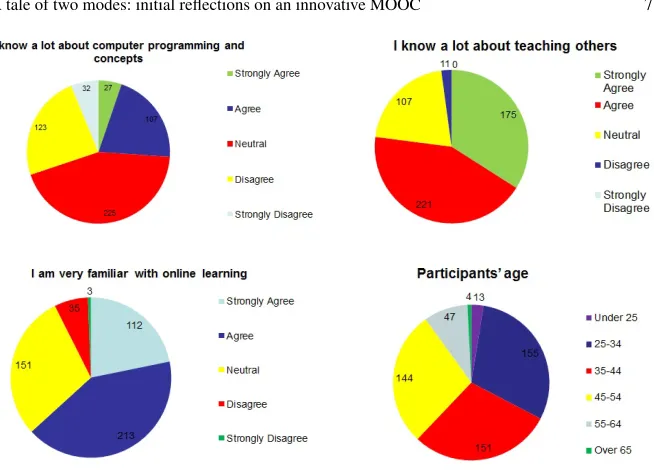
Over 90% of participants were UK-based teachers. Figure 2 shows other participant information taken from the pre-course survey. Nearly a quarter of the participants thought they had good knowledge of computing already. Over three quarters were confident about teaching. About two thirds were familiar with online learning.
Participation
[image:7.612.222.379.430.476.2]Fig. 2 Indicative background information from the pre-course survey
Students could access each quiz as many times as they wished (perhaps completing part of it and returning later) but they could submit each quiz only once. Figures for
Header Concepts Programming Labs
Transcript Slides Transcript Quiz Slides Transcript Quiz Lab A Lab B Lab C
Session 1 146 260 173 597 266 70 448 547 371 322
Session 2 71 179 124 458 173 94 383 376 236 220
Session 3 64 74 n/a n/a 67 n/a n/a 297 210 200
Session 4 63 90 n/a 278 91 n/a 133 146 121 122
Fig. 3 Preliminary participation figures for the first four sessions
[image:8.612.140.467.79.314.2] [image:8.612.142.456.397.464.2]course. However, these have proved surprisingly popular and we have received a number of comments on how useful they are.
[image:9.612.181.421.184.238.2]Scores
Figure 4 shows the results obtained in each quiz. Each participant is allowed only one submission for each quiz. As this is the first run of the course, and the first time
Concepts Programming
No. submitted Ave. score/10 No. submitted Ave. score/10
Session 1 142 7.74 126 7.86
Session 2 119 9.04 105 7.61
Session 4 78 7.64 41 8.93
Fig. 4 Quiz scores from sessions 1 to 4
we have set quizzes at this level, the scores may be assessing our success in question setting as much as the participants’ ability to answer. However, the figures suggest that participants who submit quiz solutions are generally taking the task seriously and obtaining good results. Although numbers decrease from one session to the next, it is interesting to note that some participants are still working on the earlier material and quiz submissions continue to be received. There is no cut off date for this (until the very end of the course) and some participants are obviously still making progress although they are now many weeks behind the release of materials.
Qualitative feedback
A full analysis of qualitative feedback will be conducted once the run of the course is ended. Here we provide some indicative extracts from the feedback gathered via the end of session evaluations for the first three sessions. Over 98% of respondents agreed or strongly agreed to each of the statements that the materials were at the right level, were well produced and provided a good introduction to the topics. Pos-itive comments common to a number of submissions include:
• gentle introduction (not too intimidating) but non-patronising and with enough material to challenge;
• good use of simple examples and avoidance of jargon; • the programming practicals and quizzes;
• good to see the ”faces” behind the course.
There are also some very useful observations on areas for improvement including:
• shorter videos (the longest is 24 minutes) and snappier presentations; • increased volume on audio recordings;
• provision of handy look-up guide/index to topics covered and where; • use most recent version of Python used.
Skulpt environment meant using Python 2.7. In fact, the situation is even worse in that Skulpt has certain features relating to the print statement which are neither fully 2.7 nor 3. A mapping of all the topics to be covered and a guide of where to find them plus an easy syntax guide were also commonly requested, showing learners’ need to gain a high level view and to quickly reference things they need.
5 Reflections
Although we have so far gathered preliminary results only, some useful insights have already been gained.
Effectiveness of supported mode
The limited interest in the supported mode (only 30 registrations) was surprising. The cost was very low (for the additional services offered) and it had been thought that many schools would be keen to sponsor teachers to learn the necessary skills for the teaching they will soon be expected to do. Teachers would have the added benefit of a certificate attesting to their programming skills as evidenced by the assignment. Hangout sessions were set up with 5 participants to 1 tutor. However, the take-up has been low and in practice 1 or 2 dedicated participants join their tutor for each hangout. We will be exploring the reasons for this in the end of course survey, however, factors suggested so far include difficulty with the timings (teachers often have to attend evening events), lack of progress with the work and a dislike (or disinclination to get started with) the hangout technology.
Environment choices made
Moodle provides a good learning environment which is familiar to many teachers. ”Doing it yourself” also provides a lot of flexibility and control. However, it does mean that the MOOC development team is not just responsible for developing learn-ing materials but also takes on many other decisions and responsibilities, from video hosting to dealing with user registration. When time is short this can be an onerous task. The use of an external video hosting site proved to be a good decision, relieving the team of one aspect of management.
Although Skulpt is very useful as an initial web-based environment for getting started with no installation required, it has proved to be limiting. The problem of the version of Python supported was mentioned above. Also, there are issues with sup-porting certain aspects such as file handling which mean that moving on to running “real” Python becomes necessary. With hindsight, it may be better simply to do this at the start of the course.
Costs
to support the hangouts and monitor course queries and forum questions. The team also met weekly for management meetings and MOOC troubleshooting. Obviously, it is hoped that most of the materials will be reusable and subsequent runs of the course will be much less effort-intensive, however, the amount of time needed ini-tially should not be underestimated.
We were grateful for support from a university film crew to help produce a good quality introductory video for each session. However, the time they could offer was limited and all of the teaching videos were produced and edited by members of the MOOC team themselves using standard capture and editing software. Resources needed included: equipment and software for video and audio recording, lecture capture and editing; server; video hosting facility; Moodle platform; programming environment; resource email account.
A rough estimate of costs incurred in developing and running this relatively small MOOC is£22,000. This is a conservative figure based on estimates of time spent and does not include the overheads that would normally be charged to a project.
Lessons learned
Although the CfT team members are experienced in teaching computer science, producing and delivering this MOOC has required development of new skills. The different audience, level and mode of delivery have necessitated the development of completely new teaching materials, rather than simply reworking a course deliv-ered to undergraduates. We have experimented with the use of a number of different technologies and platforms and gained experience in lecture capture, audio record-ing and innovative use of graphics tablets. These are all very useful skills to brrecord-ing back in to the university context and to incorporate in undergraduate and postgrad-uate teaching.
There is also a lot to learn about MOOC teaching. Good pace, very short chunks of teaching materials and practical activities are proving important for participants. In addition, we have been surprised by the popularity of transcripts. Conversely, the lack of take-up for the supported mode and low attendance at hangouts indicate that this has not been a particularly effective means of support.
Members of the CfT team have not been given remission from other duties so all work on the MOOC has been fitted in around existing commitments. This has proved to be very difficult to sustain at times and on occasion, the delivery of ma-terials for a MOOC session has continued to the last moment. Further, development of a MOOC is very different to the individual face-to-face courses we are used to presenting. It requires project management and forward planning to a degree we perhaps underestimated at the outset.
Learners’ progress
to engage very late into the course but have since been making good progress. Un-like many courses where it seems that, once behind, participants generally drop out, many of our teachers are coming back to the course and moving at their own pace as and when they can. Thus the usual learning analytics predictors of drop out may not be entirely applicable in this case. It may be that the temporal structure usually associate with a MOOC may not be helpful in all cases.
Because of the shortage of time, for many of our participants the overriding need is to have material to deliver in the classroom. Developing their own wider under-standing of the topic is seen as a luxury for which there may not be time. While learning the fundamental concepts of computing and the basics of programming should be achievable for all, it still requires time to become familiar with ideas and practice the practical aspects. Schools expecting teachers to learn these new skills must recognise the need to allow the necessary time. Otherwise there is a real risk of the topic being badly taught by teachers who have not had time to gain confidence in a new area.
6 Conclusions
Overall, the CfT MOOC is proving successful, but there are a number of aspects which require reconsidering for a future run. The supported version has not proved popular and, although a full evaluation will be conducted when this run of the course is over, it is likely that we would not repeat this part. Any additional resources may be better-placed in supporting all participants with active monitoring a responses to the programming forum and additional “community building” activities such as weekly topical discussion threads to encourage active engagement .
The British Computer Society is currently piloting a scheme to offer accreditation for teachers moving into computing and a we hope that in future it will be possible to gain automatic accreditation for successful participants in our course.
We are also considering further ways to best support teachers, for example with a “mini MOOC” with reduced content to be offered in a short time period, for example during a week in the summer holidays, or with a MOOC directed at school students.
References
1. R. Barber and M. Sharkey. Course correction: using analytics to predict course success. In Proceedings of the 2nd International Conference on Learning Analytics and Knowledge, pages 259–262. ACM, 2012.
2. Y. Belanger and J. Thornton. Bioelectricity: A quantitative approach. duke universitys first mooc. Technical report, Duke University, 2013. Accessed 19/03/13.
3. P. J. Billington and M. P. Fronmueller. Moocs and the future of higher education. Journal of Higher Education Theory & Practice, 13, 2013.
5. D. O. Bruff, D. H. Fisher, K. E. McEwen, and B. E. Smith. Wrapping a mooc: Student perceptions of an experiment in blended learning. Journal of Online Learning & Teaching, 9(2), 2013.
6. Computing at School. http://www.computingatschool.org.uk/. Accessed 10/03/14.
7. D. Cormier and G. Siemens. The open course: Through the open door–open courses as re-search, learning, and engagement.Educause Review, 45(4):30–32, 2010.
8. Coursera. https://www.coursera.org/. Accessed 19/03/13.
9. J. Daniel. Making sense of moocs: Musings in a maze of myth, paradox and possibility. Journal of Interactive Media in Education, 3, 2012.
10. K. Devlin. MOOC Mania Meets the Sober Reality of Education.Huffington Post, 19 August 2013.
11. edX. https://www.edx.org/. Accessed 19/03/13.
12. P. Fain and R. Rivard. Outsourcing public higher ed.Inside Higher Ed, 13 March 2013. 13. A. Fox. What was it like to teach a mooc?
http://www.armandofox.com/2013/01/14/what-was-it-like-to-teach-a-mooc/, 2013. Accessed 10/03/14. 14. Futurelearn. http://futurelearn.com/. Accessed 19/03/13.
15. Google Hangout. http://www.google.com/+/learnmore/hangouts/. Accessed 10/03/14. 16. F. Gr¨unewald, C. Meinel, M. Totschnig, and C. Willems. Designing moocs for the support
of multiple learning styles. In Scaling up Learning for Sustained Impact, pages 371–382. Springer, 2013.
17. J. Kern. Learning from harvard: Mooc story. http://elearningindustry.com/subjects/concepts/item/450-learning-from-harvard-mooc-story-pt4. Accessed 19/03/13.
18. J. K. Knox. The Forum, the Sardine Can and the Fake: contesting, adapting and practicing the Massive Open Online Course.Selected Papers of Internet Research, 3, 2013.
19. D. Koller. What we’re learning from online education. TED Talk, June 2012. http://www.youtube.com/watch.
20. S. Kolowich. The professors who make the MOOCs.The Chronicle of Higher Education, 25 March 2013.
21. J. Lane and K. Kinser. MOOCs and the McDonaldization of Global Higher Education. edu-cation, 30536:1, 2012.
22. T. Lewin. Instruction for masses knocks down campus walls. New York Times, Newspaper article, 2012.
23. T. Lewin. Universities abroad join partnerships on the web.The New York Times, 21 February 2013.
24. A. McAuley, B. Stewart, G. Siemens, and D. Cormier. Massive Open Online Courses. Digital ways of knowing and learning. The Mooc Model For Digital Practice. 2010.
25. Moodle. https://moodle.org/. Accessed 10/03/14. 26. NovoED. https://novoed.com/. Accessed 10/03/14.
27. C. O. Rodriguez. MOOCs and the AI-Stanford like courses: Two successful and distinct course formats for massive open online courses.Learning, 2012.
28. C. Sandeen. Integrating MOOCS into Traditional Higher Education: The Emerging MOOC 3.0 Era.Change: The Magazine of Higher Learning, 45(6):34–39, 2013.
29. Skulpt. www.skulpt.org. Accessed 10/03/14.
30. B. Stewart. Massiveness + openness = new literacies of participation? Journal of Online Learning & Teaching, 9(2), 2013.
31. Teaching Agency, UK Department for Education. Subject knowledge requirements for entry into computer science teacher training. http://www.education.gov.uk/. Accessed 10/03/14. 32. A. Vihavainen, M. Luukkainen, and J. Kurhila. Multi-faceted support for mooc in
program-ming.SIGITE 12, 2012.
33. Vimeo. www.vimeo.com. Accessed 10/03/14.
34. J. R. Young. Inside the coursera contract: How an upstart company might profit from free courses.The Chronicle of Higher Education, 19 July 2012.