warwick.ac.uk/lib-publications
Original citation:
Allik, Jüri, de Vries, Reinout E. and Realo, Anu. (2016) Why are moderators of self-other agreement difficult to establish? Journal of Research in Personality, 63 . pp. 72-83.
Permanent WRAP URL:
http://wrap.warwick.ac.uk/79977
Copyright and reuse:
The Warwick Research Archive Portal (WRAP) makes this work by researchers of the University of Warwick available open access under the following conditions. Copyright © and all moral rights to the version of the paper presented here belong to the individual author(s) and/or other copyright owners. To the extent reasonable and practicable the material made available in WRAP has been checked for eligibility before being made available.
Copies of full items can be used for personal research or study, educational, or not-for-profit purposes without prior permission or charge. Provided that the authors, title and full bibliographic details are credited, a hyperlink and/or URL is given for the original metadata page and the content is not changed in any way.
Publisher’s statement:
© 2016, Elsevier. Licensed under the Creative Commons Attribution-NonCommercial-NoDerivatives 4.0 International http://creativecommons.org/licenses/by-nc-nd/4.0/ A note on versions:
The version presented here may differ from the published version or, version of record, if you wish to cite this item you are advised to consult the publisher’s version. Please see the ‘permanent WRAP URL’ above for details on accessing the published version and note that access may require a subscription.
Why are Moderators of Self-Other Agreement Difficult to Establish?
Jüri Allik, Reinout E. de Vries, Anu Realo
PII: S0092-6566(16)30048-4
DOI: http://dx.doi.org/10.1016/j.jrp.2016.05.013
Reference: YJRPE 3553
To appear in: Journal of Research in Personality
Received Date: 5 February 2016 Revised Date: 15 May 2016 Accepted Date: 23 May 2016
Please cite this article as: Allik, J., de Vries, R.E., Realo, A., Why are Moderators of Self-Other Agreement Difficult to Establish?, Journal of Research in Personality (2016), doi: http://dx.doi.org/10.1016/j.jrp.2016.05.013
Running head: MODERATORS OF SELF-OTHER AGREEMENT
Why are Moderators of Self-Other Agreement Difficult to Establish?
Jüri Allik 1,2
Reinout E. de Vries 3,4
Anu Realo 1,5
1
Department of Psychology, University of Tartu
2
The Estonian Academy of Sciences
3
Department of Social and Organizational Psychology, Vrije Universiteit Amsterdam
4
Department of Psychology, University of Twente
5
Department of Psychology, University of Warwick
Corresponding author:
Jüri Allik
Department of Psychology
University of Tartu
Näituse 2, Tartu 50409
Estonia
Abstract
Agreement between the self and other rated personality profiles was studied in two samples
involving 11,096 speakers of two languages, Dutch and Estonian, who completed two different
personality questionnaires, the NEO-PI-3 and HEXACO-PI-R. An outstanding agreement was
achieved in the most occasions: in only 4-6% of dyadic pairs was the correlation between two
randomly paired profiles higher than the actually observed correlation between true pairs. As in
previous studies, we found that age and sex of participants and length of acquaintance had no
significant effect on the level of self-other agreement. However, intimate knowledge helped
married and unmarried couples in both samples be more accurate in their personality judgments;
family members, in turn, had knowledge that made them more accurate than two people who
were just acquaintances or friends. We believe that these outcomes can be explained by the
contention that the judgment of another’s personality is a relatively simple task, which is
accomplishable for most people most of the time. In other words, because judging another
person’s personality is an easy task, we are not able to determine “good targets,” “good judges,”
or “good traits.” Perhaps it is only “good information” which determines the closeness of the
target-judge relationship, and which has a small but reliable impact on the level of self-other
agreement. This explains why it is so difficult to find individual differences in the ability to
judge another person’s personality.
Keywords: Personality traits; self-other agreement; moderator variables; NEO-PI-3;
Why are Moderators of Self-Other Agreement Difficult to Establish?
Although Louis Thurstone was optimistic about the development of factorial methods of
analysis that could give us the tools by which to reduce the complexities of social and
psychological phenomena to a limited number of elements (Thurstone, 1934), most personality
researchers have remained quite skeptical about the possibility of being able to decipher
personality structure. Even Gordon Allport, the founder of modern trait psychology, believed
that the structure of personality, that is, what personality psychologists have attempted to
establish, is incredibly complex: “Since traits, like all intervening variables, are never directly
observed but only inferred, we must expect difficulties and errors in the process of discovering
their nature. The incredible complexity of the structure we seek to understand is enough to
discourage the realist, and to tempt him to play some form of positivistic gamesmanship”
(Allport, 1966, p. 3). It took many years before it became widely accepted that the huge
personality lexicons expressed across the world’s languages could be reduced to five (Goldberg,
1993) or six (Ashton et al., 2006; De Raad et al., 2014) independent dimensions. In other words,
even though there are thousands of adjectives to describe personality dispositions in almost every
spoken language, people use these words as if there were only five or six self-sufficient
categories (De Raad et al., 2014; John, Angleitner, & Ostendorf, 1988; Lee & Ashton, 2008).
If personality structure, traditionally, looked incredibly complex from the viewpoint of
researchers, then it was also not realistic to expect that a layperson could manage to solve the
same task without facing serious problems. One of the leaders in the field, David Funder,
expressed the opinion that “the accuracy of personality judgment is an extremely complex
outcome which happens only when favorable circumstances are met. It is not necessary to
assume, as Funder wrote, that the personality judgements are usually accurate, or even often
accurate. All that is required is that lay perceivers have ever, even once, achieved accuracy in
personality judgement (Funder, 1999, p. 119).
According to the Realistic Accuracy Model (RAM), to make an accurate personality
judgment, four conditions need to be satisfied (Funder, 1995, 1999, 2012). First, the person being
judged must do something relevant to exhibit the trait. Second, the trait-relevant behavior must
be available to the judge. Third, the trait-relevant, available behavior must be registered. Fourth,
the trait-relevant, available, and detected information must be utilized correctly to make accurate
inferences about that trait (Funder, 2012). This means that personality judgment can be only
conditional – at least four groups of moderating variables determine the degree to which
personality judgments are accurate. Because the path to an accurate personality judgment is
fundamentally uncertain, it is likely that success or failure in judgment also depends on some
moderating variables. Yet, at a minimum, accuracy of judgment can be achieved with the
co-occurrence of a particular set of favorable circumstances: a “good target,” who possesses “good
traits,” who is observed by a “good judge,” whose judgments are based on a “good information,”
and who thus applies the right inferences (Funder, 2012).
Unexpectedly, individual differences in judgeability – perhaps the most interesting among
moderator variables – have been surprisingly difficult to establish (e.g., Funder, 1999; Haselton
& Funder, 2006; D. J. Schneider, Hastorf, & Ellsworth, 1979). For example, already in 1937,
Gordon Allport asked the famous question: “Who are these people?” (Allport, 1937, p. 443;
Human & Biesanz, 2013), meaning people whose actions, thoughts, and feelings are easier to
and Biesanz were obliged to admit that “despite some very interesting and important findings
regarding judgeability, there still is not a clear answer to the question of who these people are”
(Human & Biesanz, 2013, p. 248).
Similar problems were encountered in an attempt to identify who the “good judges” of other
people’s personality are. Although some subtle individual differences in the ability to judge
others’ personality have been observed, no large between-individual differences have been
discovered in the judgment of personality traits (Bayne, 1985; Christiansen, Wolcott-Burnam,
Janovics, Burns, & Quirk, 2005; Ickes, Buysse, et al., 2000; Letzring, 2008; McLarney-Vesotski,
Bernieri, & Rempala, 2011; Taft, 1955). There are, of course, individual differences in empathic
accuracy – another name for self-other agreement – but they do not seem to be either large or
systematic (Davis & Kraus, 1997; Ickes, 1997). The only notable moderating factor for making
judgments seems to be judges’ intelligence: individuals with higher cognitive abilities tend to
achieve slightly higher accuracy than those with lower cognitive abilities (Davis & Kraus, 1997;
Murphy & Hall, 2011; Realo et al., 2003; Taft, 1955). In general, however, the ability to judge
other people’s personality seems to be very egalitarian: it matters very little how old you are,
what your sex is (Ickes, Gesn, & Graham, 2000), or how intelligent you are (R. Mõttus, Allik, &
Pullman, 2007). Although, for example, it was reported that people with elementary education
may have a small advantage over those who have university degrees in judging personality
(Kraus, Cote, & Keltner, 2010), this advantage is neither large nor convincingly explained. Thus,
the identification of a distinctive group of people who are “good judges” has remained tentative
at best.
Yet, the idea that some traits are easier to judge than others is one of the most stubborn ideas
readily assessed from an external viewpoint than less visible traits, such as Neuroticism
(Connelly & Ones, 2010; Connolly, Kavanagh, & Viswesvaran, 2007; Kenny & West, 2010;
McCrae et al., 2004). According to the self-other knowledge asymmetry (SOKA) model, for
instance, the self should be more accurate than others for traits low in observability (e.g.,
Neuroticism), whereas others should be more accurate than the self for traits high in
evaluativeness (e.g., Openness) (Vazire, 2010). Visibility of traits seems to provide a
straightforward explanation why greatest interjudge agreement is typically on the traits that seem
most observable, and lowest agreement is achieved on those traits that are not so directly
observable from the vantage point of an external viewer (Funder & Dobroth, 1987; John &
Robins, 1993). However, self-other agreement cannot be explained by the fact that people see
themselves differently to how they are seen by other people: the disparity between self and
external perspectives is unrelated to the visibility (or observability) of personality traits when
correcting for other factors (Allik, Realo, Mõttus, Borkenau, et al., 2010; Allik, Realo, Mõttus,
Esko, et al., 2010; Paunonen, 1989). That is, a far more important factor in self-other agreement
is interindividual variance, not trait visibility. Approximately one-half of the variance in
agreement level is explained by the standard deviation of the sum scores of the subscales:
self-observer agreement is higher in the subscales on which individual differences are larger. After
correction for the range of variance, differences in self-observer agreement are substantially
diminished, although not entirely absent (Allik, Realo, Mõttus, Esko, et al., 2010). In other
words, if we take into account the size of individual variation, then judges who know their target
well reach more or less equal level of agreement on all personality traits usually studied by
Although the idea that there are “good” targets, judges, and traits – clearly distinct from
“bad” targets, judges, and traits – is very popular, very little solid evidence speaks in its favor.
When reviewing the facts, Chaplin (1991) concluded that moderator effects in personality
judgments are small and can only be detected in very large samples with predictors that are
strongly related to the criteria (Chaplin, 1991). For example, in most cases, moderator variables
are not able to transform a weak form of self-other agreement into a strong one (Chaplin, 1991).
Based on the evidence, thus, individual differences in self-other agreement seem to be relatively
small and, hence, difficult to detect. A telling example is the effect of the type and length of
acquaintance. Although acquaintance length increases accuracy in personality judgment, there is
evidence that familiarity may also have a negative effect on self-other agreement (Kenny &
West, 2010). The effect of length of acquaintance is neither very consistent nor large (Bernieri,
Zuckerman, Koestner, & Rosenthal, 1994; Biesanz, West, & Millevoi, 2007; Gnambs, 2013;
Kenny, 2004; Kurtz & Sherker, 2003; Story, 2003). This means that observing the target acting
in hundreds or even thousands of similar situations improves judgement accuracy only
marginally (Kenny, 2004).
However, it is understandable that the accuracy of personality judgments would increase
with the intimacy of the relationship. We can say, as it turns out, much less about friends and
acquaintances compared to the information what we have about our family members or partners.
Observing targets in situations that are not available to acquaintances allows judges to access
new information about their personality (Ambady & Rosenthal, 1992; Borkenau, Mauer,
Riemann, Spinath, & Angleitner, 2004; Kenny, 2004; Levesque & Kenny, 1993; Swann & Gill,
1997). For instance, those who have intimate relationships are more knowledgeable about
2014). It was noticed, for example, that family members achieve stronger agreement on
personality traits than those who are just friends or acquaintances (Connolly et al., 2007).
Typically, spouses and partners spend a lot of time together in very different situations, they
become familiar with each other’s thoughts and feelings, and get used to reactions that are not
necessarily available to everyone (South, Oltmanns, Johnson, & Turkheimer, 2011). Correlations
between spouses’ ratings of personality are often higher than correlations between family
members, friends, or acquaintances (Beer & Watson, 2008; De Vries, Lee, & Ashton, 2008;
McCrae et al., 2004). Social Investment Theory (Roberts, Wood, & Smith, 2005) posits that
normative personality traits develop through investment in social institutions, such as age-graded
social roles. It is obvious that the roles of friends, family members, and romantic partners in
personality judgment differ by the type of situation witnessed and the amount of information
accumulated. Even if information about personality dispositions is mostly in the public domain,
different facets of personality are expressed differently across social roles. If there is a chance of
finding the elusive moderators of self-other agreement, then level of relational closeness or
intimacy is perhaps the most promising place to look for it.
One reason why it is difficult to find individual differences in self-other agreement is that the
task of judging personality is a relatively simple one, in most cases at least. Perhaps not
perfectly, but most healthy people can judge whether someone is talkative or reticent, friendly or
reserved, vulnerable or impervious, dependable or unreliable. Not all mathematically or
computationally complex attributes are necessarily difficult to judge. For example, analytically it
is a tedious or seemingly entirely impossible mission to establish the area or volume of irregular
shapes or bodies. Nevertheless, Archimedes solved such a problem posed to him by Hiero of
German mechanic Jakob Amsler invented a disarmingly simple device—the planimeter—to
measure the area of irregular shapes like pieces of land on a map (Runeson, 1977). Considering
the topic of this paper, even if personality structure turns out to be very complex, individuals
may nevertheless possess smart mechanisms or at least simple heuristics which help them to
evaluate not only their own but also other people’s personality traits. Judgment of personality
may not require sophisticated skills, which involve diligence or prolonged practice to achieve
perfection. For instance, it is likely that only a tiny fraction of people has enough talent to learn
to play the violin well or to juggle five balls simultaneously. Personality judgments may not be
like these sophisticated skills. They may more closely resemble the dexterity needed to ride a
bike, a task that most people can indeed accomplish (notwithstanding, of course, the falls and
resultant bruises in the early stages of learning). There is no doubt, however, that some
judgments concerning other people are difficult to make. For example, research suggests that
most people, irrespective whether they are laypeople or professionals in the detection of lying,
cannot tell from an individual’s demeanor if she or he is telling the truth or not (Ekman,
O'Sullivan, & Frank, 1999). In detecting lying, judges range no more widely than would be
expected by chance, and the best judges are no more accurate than a stochastic mechanism (Bond
& DePaulo, 2006, 2008). Nevertheless, it seems to be relatively easy to judge the personality
traits; at least those that are usually included in popular omnibus personality questionnaires.
Indeed, it is not very complicated to tell the difference between people who are, relative to an
average, outspoken or reserved, emotional or unemotional, hardworking or lackadaisical, open or
closed, agreeable or antagonistic, or fair or unfair, which are the typical dispositions measured by
A series of demonstrations in which ordinary participants could quite accurately describe the
personality of those whom they had never met before provided evidence that personality
judgment is easier than initially thought. It takes only 5-10 minutes and few dozen observable
acts (e.g., making a comment, citing a proverb, presenting a request, etc.) to be able to make
reasonably accurate personality judgments (Albright, Kenny, & Malloy, 1988; Borkenau &
Liebler, 1992; Kenny, Horner, Kashy, & Chu, 1992; Levesque & Kenny, 1993; Realo et al.,
2003; Shevlin, Walker, Davies, Banyard, & Lewis, 2003; Zebrowitz & Collins, 1997). What is
more, ordinary laypeople can deduce personality traits with considerable accuracy based on the
strength of a handshake (Bernieri & Petty, 2011; Chaplin, Phillips, Brown, Clanton, & Stein,
2000), how people smell (Sorokowska, Sorokowski, & Szmajke, 2012), how they say ‘hello’
(McAleer, Todorov, & Belin, 2014), and what their offices and bedrooms look like (Gosling,
2008; Gosling, Ko, Mannarelli, & Morris, 2002).
Another line of evidence suggesting that personality judgments may be less demanding than
initially thought comes from meta-analyses on observer accuracy. The main conclusion of these
analyses is that, for most personality traits, targets and informants tend to achieve self-other
agreement in the range of .40 – .50 (Connelly & Ones, 2010; Connolly et al., 2007; Kenny &
West, 2010; Watson, Hubbard, & Wiese, 2000). For example, a meta-analysis which integrated
findings based on 44,178 target individuals rated across 263 independent samples estimated
mean corrected self-other correlations at .40 (Neuroticism), .51 (Extraversion), .39 (Openness to
Experience), .40 (Agreeableness), and .44 (Conscientiousness) (Connelly & Ones, 2010). These
values could have even been higher if incidental acquaintances and strangers had been excluded.
Median cross-observer trait agreement in cross-cultural studies was found to be .45, .48, .46, .36,
respectively (McCrae et al., 2004). Almost identical levels of self-other agreement were found in
North American samples and those collected elsewhere (McCrae et al., 2004).
These reported values are the mean trait correlations. Trait correlations cannot tell, allegedly
at least, the percentage of self-informant pairs who reach or fail to reach agreement in their
judgments. However, mean trait (across pairs of judges) and profile correlations (across traits)
are basically the same measures of agreement (Allik, Borkenau, Hrebícková, Kuppens, & Realo,
2015). In this study, it was possible to prove that if normativeness is separated from
distinctiveness of personality scores and individual profiles are ipsatized, then mean profile
agreement becomes identical to mean trait agreement. Analogously, we can always decompose
agreement between two personality profiles into the individual contributions of traits from which
these profiles are assembled. This explains why mean profile correlations are typically also in the
range of .40 to .50, or even slightly higher (Allik, Realo, Mõttus, & Kuppens, 2010; Borkenau &
Zaltauskas, 2009; Dobewall, Realo, Allik, Esko, & Metspalu, 2013; Kenny & Winquist, 2001;
McCrae, 2008; Pelham, 1993). Although these values are clearly above the level of statistical
significance, they are less impressive when we consider that correlations between two randomly
paired profiles can be in the same range.
The Present Study
The main aim of this study is to examine how easy and widespread accurate personality
judgments are. We investigate self-other agreement in two large samples (total N = 11,096) of
participants who speak two different languages, Dutch and Estonian, and completed two
different personality questionnaires, the NEO PI-3 and HEXACO-PI-R. Millions of people
worldwide take personality tests each year. Judging one’s own or somebody else’s personality
employment counseling. Selling personality tests and interpreting the results are a multi-million
business for the testing industry. Besides commercial use, academic psychologists have, in recent
years, been able to collect personality data from hundreds of thousands of participants in
individual countries (Obschonka, Schmitt-Rodermund, Silbereisen, Gosling, & Potter, 2013) or,
indeed, from all over the world (Gebauer et al., 2015; Lippa, 2010) by using tools provided by
the Internet. Thus, personality judgment has become a part of everyday life, and is not just a
curiosity of psychological laboratory experiments, which are, in any case, known to be prone to
bias and error (Robbins & Krueger, 2005). Our purpose is to demonstrate that if we choose two
people who know each other well then they, as a rule, can reach remarkably accurate personality
judgments of the target person. In doing so, we also demonstrate that the correlation observed
between self- and other-rated personality profiles is clearly above that observed between two
randomly paired profiles, in other words, the level of chance. We argue that an outstanding level
of agreement between self and other personality judgment is achieved mainly because
personality judgment is a mundane task, which can be accomplished relatively easily based on
available information without the need for sophisticated cognitive skills. Because personality
judgments can be shown to be effortless, no moderators can seriously enhance or obstruct these
judgments.
Methods
Estonian Sample
Participants in the Estonian sample came from the Estonian Biobank cohort, whose data
were collected by the Estonian Genome Centre (EGC) of the University of Tartu (Leitsalu et al.,
population (aged over 18 years). The current number of participants—close to 52,000—
represents a large proportion, approximately 5%, of the Estonian adult population. The age
structure of the sample is well matched to the age structure of the entire population. A portion of
the participants who donated blood samples for DNA were also asked to answer personality
questionnaires. Some of these data have been analyzed in previous publications (Allik,
Borkenau, Hrebickova, Kuppens, & Realo, 2015; Allik, Realo, Mõttus, Esko, et al., 2010; Rene
Mõttus et al., 2015). Personality data were collected from a smaller subsample of the gene
donors. After removing incomplete data, there were 3,345 participants (1,984 females and 1,361
males) in the Estonian sample with a mean age of 46.4 years (SDage = 17.0, ranging from 18 to
91 years) who completed the self-report of the Estonian version of the NEO Personality
Inventory-3 (NEO PI-3; McCrae, Costa, & Martin, 2005). The Estonian version of the NEO PI-3
is a slightly modified version of the NEO PI-R (P. T. Costa, Jr. & McCrae, 1992; Kallasmaa,
Allik, Realo, & McCrae, 2000). Like the original NEO PI-R, the NEO PI-3 has 240 items that
measure 30 personality facets, which are grouped into the five FFM domains – Neuroticism (N),
Extraversion (E), Openness to Experience (O), Agreeableness (A), and Conscientiousness (C) –
such that each domain score is a composite of six facet scores. The items are answered on a
five-point scale (0 = false/strongly disagree to 4 = true/strongly agree).
All 3,345 participants nominated somebody who knew them well and these informants were
asked to rate the personality of the participant using the other-report version of the Estonian
NEO PI-3. Of the informants, 2,331 were female (71.1%) and 948 were male (66 did not report
their gender). The mean age of informants was 41.8 (SD = 15.9) years. The informant
example, how long they had known the target. The mean length of acquaintance was 23.2 years
(SD = 15.1).
Dutch Sample
The Dutch sample consisted of 2,198 first year personality psychology students (81.7%
female; Mage=20.2; SDage=2.8), who, as part of their course work, filled out personality
inventories and recruited a well-acquainted other to obtain informant-reports on their personality.
The sample of well-acquainted informants consisted of 41.2% friends, 35.9% family members,
and 22.9% intimate partners, who, on average, had known the target person for 10.6 years
(SD=8.0). Parts of the dataset have been used in other studies (e.g., De Vries, Ashton, & Lee,
2009; De Vries, Wawoe, & Holtrop, in press, Studies 1 and 4). Both self- and other-ratings were
obtained using the Dutch 200-item HEXACO Personality Inventory-Revised (HEXACO-PI-R),
which measures six personality domains – Honesty-Humility (H), Emotionality (E), Extraversion
(X), Agreeableness (A), Conscientiousness (C), and Openness (O) –each of which is comprised
of four subscales (de Vries, Ashton, & Lee, 2009; De Vries et al., 2008). In total,
HEXACO-PI-R thus has 24 facet scales, each of which is, in turn, measured by 8 items. In addition, there is a
25th facet scale – Altruism – which is interstitial in the personality space, spanning
Honesty-Humility, Emotionality, and Agreeableness. In order to make HEXACO-PI-R profiles maximally
comparable to those of NEO PI-3, we used the first 24 facet scales in the analysis. For
convenience, we also changed the usual order of the HEXACO-PI-R facet scales, arranging them
as NEOA(H)C, which is a more familiar order for NEO PI-3 users.
Results
Trait-by-trait correlation. Firstly, we computed trait-by-trait correlations for all facet scales.
The average self-other correlations across all facets were .46 and .49 for the Estonian and Dutch
samples, respectively (p < .0001). These two values are in the typical range for self-other
agreement reported in the literature (Connelly & Ones, 2010; De Vries et al., 2008; McCrae et
al., 2004).
In both samples and instruments, a substantial fluctuation in the level of agreement can be
observed. For example, for HEXACO-PI-R facets, the lowest self-other agreement was found for
H1: Sincerity (r = .31) and the highest for C1: Organization (r = .66). Even from this example, it
is difficult to see why a tendency to be genuine in interpersonal relations is so much less visible
or difficult to judge than a tendency to seek order, particularly in one’s physical surroundings.
Self-other agreement was higher in the subscales in which individual differences were larger (cf.;
Allik, Realo, Mõttus, Esko, et al., 2010). Indeed, self-other trait agreement correlated
significantly with the combined self and other standard deviation of mean scores: r = .71 and .51,
respectively, for NEO PI-3 and HEXACO-PI-R.
Thus, differences in self-other trait correlation may be caused by a restricted variance.
Assuming that the unrestricted variance for all subscales is equal to the maximally observed
variance, it would be possible to calculate the correction for the observed self-observer
correlation according to the formula known as the Thorndike Case 2 (Thorndike, 1949). The red
broken line in Figure 1 shows self-other agreement corrected for restricted variance separately
for NEO PI-3 and HEXACO-PI-R.
Insert Figure 1 about here
After the correction, the standard deviation of self-other correlations was slightly reduced
However, several changes in correlation were not in the direction that would be expected from
the trait observability. For example, before the correction one of the lowest agreements was for
the NEO PI-3’s O6: Values. After correcting for restricted variance it jumped from .37 to .55
which was above the average. Thus, a relatively low self-other correlation on openness to values
was not because external judges cannot observe someone’s readiness to reexamine his or her
social, political, and religious values but mainly because there was not enough variation between
respondents’ answers.
Correlation between profiles. Apart from a trait-by-trait approach, it is also possible to
compute the correlation between two profiles of K traits (K = 30 for the NEO PI-3 and K = 24 for
the HEXACO-PI-R). Although it is believed that trait-by-trait correlations have a substantively
different meaning to correlations between two profiles, they are mathematically strongly related.
Moreover, when done on both normalized and ipsatized scores, they are identical (Allik,
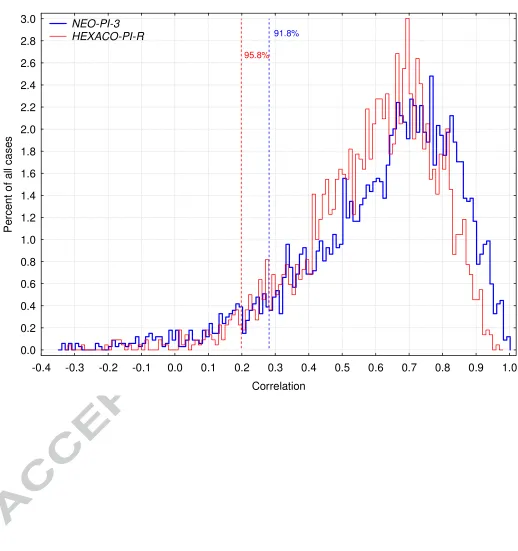
Borkenau, Hrebícková, et al., 2015). Figure 2 demonstrates the histograms of the self-other
profile correlations for the Estonian and Dutch samples.
Insert Figure 2 about here
The mean correlations were .613 and .595 for NEO PI-3 and HEXACO-PI-R, respectively,
which is, expectedly, higher than the mean trait-by-trait correlations (Allik, Borkenau,
Hrebícková, et al., 2015). Although a correlation of about .60 may seem impressive, it is less so
if the correlation between two randomly paired personality profiles is not zero, but falls, say,
somewhere close to .40, leaving a very narrow margin between genuine accurate perception and
In order to decide whether the mean profile correlations .613 and .595 are sufficiently above
the level of chance, we need to establish a distribution of correlation coefficients between
randomly paired personality profiles. One possible way of constructing this distribution is to pair
each self-rated personality profile with every N-1 or “wrong” other-rated profile in the sample.
Thus, in each sample, along with N true self-other pairs, we can form N·(N-1) "wrong" pairs of
profiles between two arbitrarily connected self- and other-rated profiles. For each target, we can
compute the mean and standard deviation correlations between N-1 arbitrarily linked profiles. If
we subtract the mean correlation of the arbitrary pairings from the true self-other correlation, and
divide the obtained difference by the standard deviation of the arbitrary pairings, then we have
the difference between true and arbitrary pairings in the units of the standard normal distribution.
The mean correlation between two arbitrarily paired profiles was .281 and .198 for NEO
PI-3 and HEXACO-PI-R samples, respectively (see vertical lines in Figure 1). Thus, the mean
differences between profiles were reduced to .332 and .397, respectively. If we divide these
values by the respective standard deviations of the correlations of the arbitrary pairings, then we
convert these values into units of the standard normal distribution, or z-values. The z-values were
1.395 and 1.724 for NEO PI-3 and HEXACO-PI-R samples, respectively. This means that in
91.8% and 95.8% of all cases, for Estonian and Dutch samples, respectively, the correlation
between the profiles of true pairs is higher than the correlation between the personality profiles
of two randomly paired individuals.
The fact that the true profile correlation can be confused with the correlation of two
randomly paired profiles in only 4-8% of cases is remarkable. It is remarkable because the raw
profile scores contain distinctive information—how much the individual is above or below
is similar to an average person, in general (Cronbach & Gleser, 1953; Gage & Cronbach, 1955).
In order to separate distinctiveness scores from normative scores (the degree to which a profile
reflects an average profile), all data were normalized by transforming them into T-scores (with a
mean equal to 50 and a standard deviation equal to 10). The Estonian sample was standardized in
four separate groups of participants (males and females, each divided into two groups: one
younger and one older than 30 years). Since participants in the Dutch sample were almost
exclusively younger than 30 years, their data were standardized by target sex only. After
standardization, the profile correlations dropped substantially, as was expected. In the Estonian
sample, the mean correlation between profiles dropped from .613 to .444, and in the Dutch
student sample from .595 to .473. Because the mean correlation between two randomly paired
distinctive or t-scored profiles is close to zero, the distinctiveness of the true correlation from
random pairing becomes even greater. The mean difference between true and random
correlations in z-scores was 1.56 and 1.782 for NEO PI-3 and HEXACO-PI-R samples,
respectively. Translating these scores into probabilities, we can state that true profile pairs can be
confused with an arbitrary pairing in only 5.9% and 3.7% of all cases for NEO PI-3 and
HEXACO-PI-R samples, respectively. This means that self-other agreement is above the level of
chance in 94%-96% of cases.
Moderator variables. Among potential moderator variables, age of targets is perhaps one of
the most interesting. For example, it is logical to expect that a young person is more difficult to
judge than a person of advanced age, whose personality is no longer likely to change much.
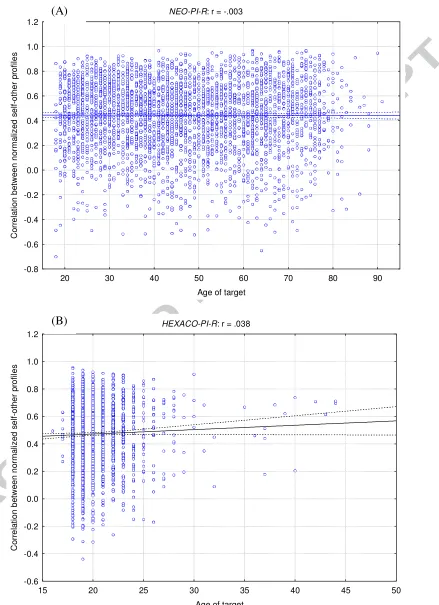
Figure 3 (A: Estonian sample and B: Dutch sample) demonstrates the extent to which distinctive
self-other profile agreement depends on target age. Although personality traits change with age
self- and other-ratings remained at the same level. These near-zero correlations were not
significant. Based on these negative findings, we can conclude that age of targets plays no
prominent role in the agreement between judges (cf.; McCrae & Costa, 1982). A mature person’s
personality is no more judgeable than that of a young individual, whose personality is still fluid
and prone to changes.
Insert Figure 3 about here
Next, we analyzed the impact of gender on self-other agreement. According to popular
belief, women are more empathically accurate than men (cf.; Klein & Hedges, 2001; Laurent &
Hodges, 2009). If true, this would mean that women are also better judges of another person’s
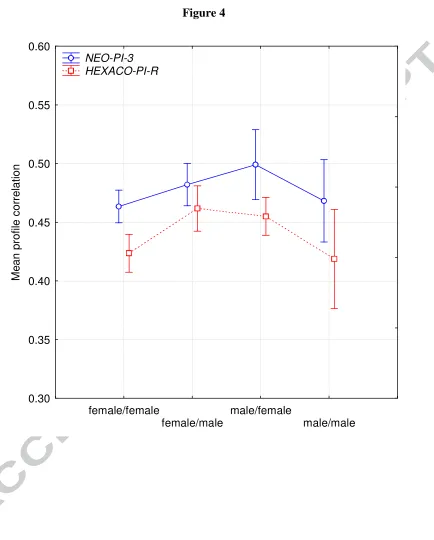
personality. We analyzed all target-judge gender combinations: female-female, female-male,
male-female, and male-male, where the first position denotes target , and the second, judge.
Figure 4 demonstrates the mean profile correlations for these four target-judge combinations.
Insert Figure 4 about here
Figure 4 demonstrates that women are not superior to men in judging others’ personality. In
general, the gender of targets and judges is irrelevant. In the Dutch sample, an ANOVA gave a
nonsignificant result: F(3,2194)=1.83, p = .140, η² = .002. Although, in the Estonian sample, the
gender combination of target-judge pairs was statistically significant – F(3,3275) = 4.23, p =
.005, η² = .004 – the effect size η² (eta-square) explained only about 0.4% of the total variance.
In sum, there appears to be a small advantage when judging personality in opposite gender
Whether length of acquaintance affects self-other agreement has been disputed for quite
some time. For example, according to some estimates, the level of self-other agreement increases
about ∆r = .05 for every 5 years of acquaintance (Biesanz et al., 2007). Informants in our two
samples reported that they had known the target for an average of 21.3 and 10.6 years in the
Estonian and Dutch samples, respectively. There was no correlation between length of
acquaintance and agreement in the NEO PI-3 sample: r(3277) = .02, p = .256. However, in the
Dutch sample, there was a minor positive correlation between length of acquaintance and
self-other agreement: r(2198) = .048, p = .023. Nevertheless, from both theoretical and practical
viewpoints, an increase in agreement ∆r = .01 for every 10 years of acquaintance does not seem
very meaningful. If there is an improvement with length of acquaintance, then it happens in the
very early stages of acquaintance, after which a plateau is reached (cf., Biesanz et al., 2007;
Gnambs, 2013; L. Schneider, Schimmack, Petrican, & Walker, 2010).
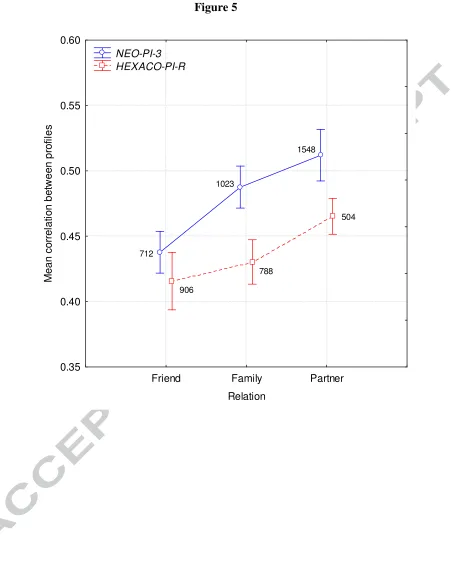
Relationship. How does the type of the relationship between the judge and the target
influence self-other agreement in personality? In both samples, the relationship between judge
and target was classified into three categories: (1) friends and acquaintances, (2) family members
(parents, children, and siblings), and (3) partners (including spouses). These three categories
were arranged in order according to the mean scores in response to the statement “I know this
person well.” In both samples, informants stated that they knew members of their family better
than friends or acquaintances. Similarly, informants from both the Dutch and Estonian samples
thought that, on average, they knew their partners or spouses better than they knew members of
their family. An ANOVA confirmed this association at an extremely high level of significance:
F(2,3251) = 1472. 95, p < .00001, η² = .475 and F(2,2195) = 199.65, p < .00001, η² = .154
for the three different categories of relationship between judge and target – friends, family, and
partners. As expected, the observed differences in the similarity of profiles were highly
significant. An ANOVA revealed that spouses or partners reached a much better agreement than
members of family who, in turn, achieved a greater consensus than friends or acquaintances:
F(2,3280) = 9.28, p = .00001, η² = .006. The same pattern was observed in the Dutch sample:
F(2,2195) = 18.59, p < .00001, η² = .017. The observed pattern is clear: the more closely or
intimately you know the target, the stronger the agreement between self and informant
personality judgments.
Insert Figure 5 about here
Discussion and Conclusions
Although no description of a person is possible without trait attributes, it is also believed that
traits themselves yield little beyond what has been called the “psychology of the stranger”
(McAdams, 1995). Just as all cats are gray in the dark, people lack individuality when described
by a universal set of personality dispositions. According to this point of view, trait attributes used
when judging personality are too impersonal to capture the uniqueness of each individual. In this
study, for the first time, we constructed a statistical distribution with which we were able to
calculate how often agreement between self- and other-rated personality profiles is confused with
agreement occurring from a random pairing of two unrelated profiles. The results from two large
samples, one Dutch and one Estonian, and two conceptually different personality instruments,
NEO PI-3 and HEXACO-PI-R, demonstrated that in no more than 4-6% of cases could true
vast majority of cases, a true agreement between self-rated and other-rated profiles could be
achieved. Two clear implications deserve mention at this point. First, individual profiles across
universal sets of personality dispositions are unique, such that one individual can be
distinguished from others. Second, a judge who knows her or his target well can describe this
unique disposition profile remarkably accurately and far beyond the level of randomly occurring
agreement.
In spite of the unusual power we had in this study (the total number of participants was over
11,000), the search for a variable, which could seriously moderate self-other agreement was
largely unsuccessful. Just as in many previous studies, we were not able to identify a distinctive
group of people who are “good targets” for personality judgments of knowledgeable others. For
example, it did not matter whether target persons’ personality was still in development or already
“set like plaster” by 30 years of age as William James argued in 1890 (James, 1890, p. 105) –
self-other agreement was effectively at the same level (for a debate of the plaster hypothesis see
P. T. Costa & McCrae, 2006; Roberts, Walton, & Viechtbauer, 2006). We also failed to identify
who “good judges” are. As an example, in spite of popular lore that women are generally better
judges of personality, we found men equally capable of judging another person’s personality. We
also did not find a coherent grouping of traits on which agreement is slightly better than on
others. Some researchers have proposed distinguishing surface traits, which are more amenable
for external inspection, from other traits which are more deeply buried within the person
(Asendorpf & Van Aken, 2003; Epstein, 2010; Kandler, Zimmermann, & McAdams, 2014;
Swider, Zimmerman, Charlier, & Pierotti, 2015). However, as variation in agreement is
relatively modest, this distinction would not seem to hold. For example, it was easier for
Impulsiveness and Sentimentality, which are also manifestations of neurotic tendencies. It is also
possible that achieving agreement on traits related to moral character is more complicated than
on more observable traits but our data provided no convincing evidences in favor of this proposal
(cf., Cohen, Panter, Turan, Morse, & Kim, 2013).
Two judges seem to achieve at least satisfactory agreement on virtually all personality traits
included in the major questionnaires, but this agreement may be even stronger on some traits. It
is not immediately apparent how visibility or social desirability could lead to this pattern of
agreement (Allik, Realo, Mõttus, Borkenau, et al., 2010). Personality traits belonging to the one
dimension may have very different levels of visibility, indicating that this is not a consistent
attribute of personality traits. Analogously, the mean values of the facet scales belonging to the
same dimension may have very different standard deviations. Nevertheless, the range of
interindividual variance in facet scores explains the largest portion of variance in the level of
self-other agreement (see also Allik, Realo, Mõttus, Esko, et al., 2010). Thus, differences in the
level of agreement are mainly “technical,” depending on a selection of appropriate items that
allow for sufficient individual variation in answers. There is no good explanation why, for
example, the standard deviation of O2: Aesthetics, a facet scale of the NEO PI-3, is about two
times higher than that of O6: Ideas. It is hard to believe that variability in a deep appreciation for
art and beauty—the main content of the O2: Aesthetics—is inherently larger than variability in
the readiness to re-examine social and political values—the main content of the openness to new
ideas. This is, thus, an unresolved issue, which needs to be studied further.
It could be argued that our failure to find moderators of self-other agreement is an
exaggeration or an overstatement. Indeed, nobody can say that there is no evidence in favor of
very interesting and important findings, there still is not a clear answer to the question of who
these good targets and judges are (Human & Biesanz, 2013, p. 248). If we accept a conclusion
that moderator effects in personality judgments are small and can only be detected in very large
samples (Chaplin, 1991) then we may need a more general explanation for a failure to find
moderators effect. By any means this study is not conclusive but a cautious attempt to provide a
tentative answer to a question why moderators of self-other agreement are difficult to establish.
One possible explanation for why it was so difficult to find reliable individual differences or
other moderators of the accurate personality judgments is that judging another person’s
personality is a rather trivial task, which does not need special practice or sophisticated social
skills. After analyzing evidences, it seems that the complexity of personality judgments has been
overestimated. Instead of the complexity thesis, it is more plausible to talk about the fundamental
simplicity of personality judgments. Usually, people know a lot about the personality—the way
in which they think, feel, and act in a variety of everyday situations—of those with whom they
interact on a daily basis. It is correct, of course, that the person being accurately judged must
exhibit his or her traits, which must be available to the judge, who must register this information
and make valid conclusions on its basis (Funder, 2012). However, this study demonstrates, along
with many similar findings, that if we more or less randomly take two people from the general
population who know each other sufficiently well, in most cases, a level of consensus in judging
personality traits, which is considerably above chance, is achieved. This means that, in most
cases, trait relevant information was available, which was registered, processed, and adequately
used to make valid trait inferences.
What our data seem to suggest is that our daily life contains an abundance of information
information about his or her personality dispositions. We can refer here to a vast amount of
literature on so-called zero acquaintances and thin slices of experience (Albright et al., 1988;
Ambady & Rosenthal, 1992; Beer & Wayson, 2008; Borkenau & Liebler, 1992; Borkenau et al.,
2004; Hirschmüller, Egloff, Schmukle, Nestler, & Back, 2015; Leikas, Verkasalo, & Lönnqvist,
2013; Tackett, Herzhoff, Kushner, & Rule, 2016). All these data, together with the present study,
seem to indicate that personality judgments are not very sophisticated, and that they do not
require huge amounts of practice to be carried out successfully. We are not aware of any study in
which at least moderate self-other agreement was not achieved on the majority of personality
traits studied (Connelly & Ones, 2010; Connolly et al., 2007; Kenny & West, 2010; McCrae et
al., 2004; Watson et al., 2000). This means that lay perceivers have achieved accuracy in
personality judgement more than once in the lifetime. If somebody laughs frequently and talks a
lot, then it does not require above average intelligence to conclude that this person might be an
extravert. If a person is consistently critical and antagonistic, it is very likely that he or she would
receive rather low scores on agreeableness. If somebody we know is never late for appointments
and he or she keeps things in perfect order, then we are likely to consider him or her to be
conscientious. There is no doubt that these simple conclusions require data as well as some basic
logic. Judgment of personality requires simple skills and competencies that the majority of the
population possesses. Without these skill and competencies, it would be very complicated to
function normally in social environments (Haselton & Funder, 2006).
Although judging another person’s personality is not a complicated task and is one in which
most people appear to have around the same level of skill, a close relationship between judge and
target, nevertheless, seems to make agreement stronger: a relationship that is more intimate
previous literature. Relatives and family members usually achieve stronger self-other agreement
than those who do not know their targets as well (Connelly & Ones, 2010; Connolly et al., 2007).
It is also true that spouses typically achieve higher levels of self-other correlations than siblings
(Beer & Watson, 2008; McCrae et al., 2004). A general rule is that agreement between self- and
informant-ratings increases with degree of acquaintanceship – that is, a close or intimate
relationship increases level of agreement (Connelly & Ones, 2010; De Vries et al., 2008; Kenny,
2004; Kenny, Albright, Malloy, & Kashy, 1994; Letzring, Wells, & Funder, 2006; Paunonen,
1989; Starzyk, Holden, Fabrigar, & Macdonald, 2006). However, there is evidence that
consensus between judges does not always increase with higher levels of acquaintanceship
(Kenny, 2004). The effect of acquaintanceship is in accordance with the RAM, which predicts
that information quantity and quality are positively related to objective knowledge about the
targets, which, in turn, leads to increased levels of judgment accuracy (Beer & Brooks, 2011;
Funder, 1995, 2012). As our results indicate, the quantity of information has nothing to do with
the length of acquaintanceship. Some sources of information seem to be more informative than
others, in spite of the fact that a huge amount of personality information is freely available.
However, it does not really matter how long a person has not had access to a relevant piece of
information.
Most likely, several factors contribute independently to the observed friend-family-partner
agreement gradation. First, this ranking may correspond to degrees of target-judge similarity.
Judges are likely to use projection, assuming that their target has a similar personality profile –
assumed similarity – which can be estimated by the extent to which people judge other
individuals as consistent with how they judge themselves (de Vries, 2010; Kenny & West, 2010).
profiles are similar to some extent. For example, family members have personality profiles that
are more similar to each other, compared with two genetically unrelated individuals, because of
shared genes (Jang, Livesley, & Vernon, 1996; Kandler, Riemann, Spinath, & Angleitner, 2010).
Married or dating couples may be more similar to each other due to assortative mating, implying
that people seek mates with personality traits similar to themselves (Luo & Klohnen, 2005;
McCrae et al., 2008).
If there is a deficit in relevant information, then informants have a tendency to fill the gap
with assumed information. Unfortunately, our study did not ask informants to rate their own
personality as well. For this reason, we cannot estimate directly assumed similarity, or the extent
to which targets were described in a similar way to which judges viewed themselves. Although it
is logical to assume that a shortage of information can be compensated for with assumed
information (Beer & Watson, 2010; Beer, Watson, & McDade-Montez, 2013; Human &
Biesanz, 2011; Kenny & Kashy, 1994; Lee et al., 2009; Paunonen & Kam, 2014; Rogers &
Biesanz, 2015), a previous study has shown that assumed knowledge is almost irrelevant in
self-other agreement (de Vries, 2010). In the present study, we also demonstrated that the ratio
between normativeness and distinctiveness in self-other agreement remained approximately the
same for a group of friends, family members, and partners. This means that we still have a very
limited understanding what married or unmarried couples have that family members do not; and
what family members have that friends and acquaintances do not. One possible candidate is an
access to some privileged information. For example, it was found that self-other agreement was
higher among judges exposed to information about thoughts and feelings of the target than for
judges exposed to information about hobbies and activities (Andersen, 1984). These results were
achieved higher distinctive accuracy than participants, who were engaged in behaviors or
discussing these behaviors (Letzring & Human, 2014). Thus, besides observing behaviors it is
beneficial to know about thoughts, feelings, and motives that are behind the observed conducts.
If this line of reasoning is true then married or unmarried couples are expected to know more
about thought and feelings of their partners than family members usually do; family members, in
turn, are expected to know more about one another’s views and motives than friends and
acquaintances usually do.
Studies have shown that observers’ ratings of personality may predict performance behaviors
better than do self-ratings (Connelly & Hülsheger, 2012; Kolar, Funder, & Colvin, 1996; Vazire,
2010). For example, it was proposed that the predictive advantages of other-ratings may stem
from use of observers who have a frame of reference more closely aligned with the criterion
(“narrower scope”) or observers having greater accuracy than targets themselves (“clearer lens”)
(Connelly & Hülsheger, 2012). Unfortunately, the used study format – there was no performance
to predict – did not allow to decide which of the two ratings, self- or other-ratings was more
accurate. Nevertheless, it is possible to speculate about “narrower scope” and “clearer lens”
hypotheses as potential explanations for the friend-family-partner gradient. Because the both
hypotheses represent variants of the “good target” or “good judge” type of explanations, we take
a liberty to be skeptical towards them. In the meantime, we can notice that the accuracy gradient
corresponds to a general pattern of social relations (Fiske, 1992). It seems that the social
relationships are organized on the basis of interpersonal distance from very close relations
between married or unmarried couples and members of nuclear family to remote contact with
strangers and impersonal orders, requests, and memos from organizations and institutions (Realo,
in close or intimate relations and progressively less important in more distant relationships, it
could be a potential constraint we are looking for.
Finally, it was encouraging to see how similar the data obtained from two different samples
using two different personality instruments were. The participants in each sample spoke
languages belonging to two different language groups: Indo-European and Finno-Ugric. The
mean age of participants had a disparity of more than 21 years. The two instruments,
HEXACO-PI-R and NEO PI-3, conceptualize the space of personality traits differently, by assuming that
there are five independent personality dimensions on the one hand, and six on the other.
Nevertheless, the basic findings were strikingly similar, and it can be almost certainly excluded
that this was due to some kind of statistical fluke or method bias. In both samples, the percentage
of target-judge pairs who achieved satisfactory agreement between personality profiles was very
similar. In both samples, demographic information – age and sex – had a negligible moderating
effect on self-other agreement. The same was true for duration of acquaintance: neither Dutch
nor Estonian participants benefitted from knowing their targets for a longer period. However,
intimate knowledge helped married and unmarried couples in both samples be more accurate in
their personality judgments. Family members, in turn, had knowledge that made them more
accurate than two people who were just acquaintances or friends, again similarly in both the
Dutch and Estonian samples. The type of relationship aside, most other moderating variables
(including individual differences) had a negligible effect on self-other agreement.
To conclude, because judging another person’s personality is a rather simple task, it seems
increasingly unlikely that researchers will be able to make a reliable distinction between “good
Authors Note
Jüri Allik, Department of Psychology, University of Tartu, Estonia and the Estonian
Academy of Sciences; Reinout E. de Vries, Department of Experimental and Applied
Psychology, Vrije Universiteit Amsterdam and Department of Psychology, University of
Twente, the Netherlands; Anu Realo, Department of Psychology, University of Warwick, UK
and Department of Psychology, University of Tartu, Estonia.
Preparation of this manuscript was supported by the University of Tartu (SP1GVARENG)
and by institutional research funding (IUT2-13) from the Estonian Ministry of Education and
Science to Jüri Allik. Anu Realo was a Visiting Professor at the Health, Medical, and
Neuropsychology Department at the Faculty of Social and Behavioral Sciences at Leiden
University during the writing of this article. We are grateful to the Estonian Genome Centre of
the University of Tartu and its director, Andres Metspalu, for help in collecting the data and the
kind permission to use the data in the current study. The assistance of Liisi Kööts-Ausmees in
organizing the data file prior to analysis is also gratefully acknowledged.
Correspondence concerning this article should be addressed to Jüri Allik, Department of
Psychology, University of Tartu, Näituse 2, Tartu 50409, Estonia. Electronic mail may be sent to
References
Albright, L., Kenny, D. A., & Malloy, T. E. (1988). Consensus in personality judgments at zero
acquaintance. Journal of Personality and Social Psychology, 55(3), 387-395.
doi:10.1037/0022-3514.55.3.387
Allik, J., Borkenau, P., Hrebickova, M., Kuppens, P., & Realo, A. (2015). How are personality
trait and profile agreement related? Frontiers in Psychology, 6.
doi:10.3389/fpsyg.2015.00785
Allik, J., Borkenau, P., Hrebícková, M., Kuppens, P., & Realo, A. (2015). How are Personality
Trait and Profile Agreement Related? Frontiers in Psychology, 6.
doi:10.3389/fpsyg.2015.00785
Allik, J., Laidra, K., Realo, A., & Pullmann, H. (2004). Personality development from 12 to 18
years of age: Changes in mean levels and structure of traits. European Journal of
Personality, 18(6), 445-462. doi:10.1002/per.524
Allik, J., Realo, A., Mõttus, R., Borkenau, P., Kuppens, P., & Hřebíčková, M. (2010). How
People See Others is Different from How People See Themselves: A Replicable Pattern
across Cultures. Journal of Personality and Social Psychology, 94, 168-182. doi:DOI:
10.1037/a0020963
Allik, J., Realo, A., Mõttus, R., Esko, T., Pullat, J., & Metspalu, A. (2010). Variance determines
self-observer agreement on the Big Five personality traits. Journal of Research in
Personality, 44(4), 421-426. doi:10.1016/j.jrp.2010.04.005
Allik, J., Realo, A., Mõttus, R., & Kuppens, P. (2010). Generalizability of self-other agreement
from one personality trait to another. Personality and Individual Differences, 48(2),
128-132. doi:10.1016/j.paid.2009.09.008
Allport, G. W. (1937). Personality: A psychological interpretation. New York: Holt, Rinehart &
Winston.
Allport, G. W. (1966). Traits revisited. American Psychologist,, 21(1), 1-10.
Ambady, N., & Rosenthal, R. (1992). Thin slices of expressive behavior as predictors of
interpersonal consequences: A meta-analysis. Psychological Bulletin, 111, 256-274.
doi:10.1037/0033-2909.111.2.256
Andersen, S. M. (1984). Self-knowledge and social inference: II. The diagnosticity of
cognitive/affective and behavioral data. Journal of Personality and Social Psychology,
46(2), 294-307. doi:10.1037/0022-3514.46.2.294
Asendorpf, J. B., & Van Aken, M. A. G. (2003). Personality-Relationship Transaction in
Adolescence: Core Versus Surface Personality Characteristics. Journal of Personality,
71(4), 629-666. doi:10.1111/1467-6494.7104005
Ashton, M. C., Lee, K., de Vries, R. E., Perugini, M., Gnisci, A., & Sergi, I. (2006). The
HEXACO model of personality structure and indigenous lexical personality dimensions
in Italian, Dutch, and English. Journal of Research in Personality, 40(6), 851-875.
doi:10.1016/j.jrp.2005.06.003
Bayne, R. (1985). The good judge of personality: A review. Bulletin of the British Psychological
Society, 38(FEB), A46-A46. Retrieved from <Go to ISI>://WOS:A1985ACT1200242
Beer, A., & Brooks, C. (2011). Information quality in personality judgment: The value of
personal disclosure. Journal of Research in Personality, 45(2), 175-185.
doi:10.1016/j.jrp.2011.01.001
Beer, A., & Watson, D. (2008). Asymmetry in judgments of personality: Others are less
differentiated than the self. Journal of Personality, 76(3), 535-559.
doi:10.1111/j.1467-6494.2008.00495.x
Beer, A., & Watson, D. (2010). The effects of information and exposure on self-other agreement.
Journal of Research in Personality, 44(1), 38-45. doi:10.1016/j.jrp.2009.10.002
Beer, A., Watson, D., & McDade-Montez, E. A. (2013). Self-Other Agreement and Assumed
Similarity in Neuroticism, Extraversion, and Trait Affect: Distinguishing the Effects of
Form and Content. Assessment, 20(6), 723-737. doi:10.1177/1073191113500521
Beer, A., & Wayson, D. (2008). Personality judgment at zero acquaintance: Agreement, assumed
similarity, and implicit simplicity. Journal of Personality Assessment, 90(3), 250-260.
doi:10.1080/00223890701884970
Bernieri, F. J., & Petty, K. N. (2011). The influence of handshakes on first impression accuracy.
Bernieri, F. J., Zuckerman, M., Koestner, R., & Rosenthal, R. (1994). Measuring person
perception accuracy: Another look at self-other agreement. Personality and Social
Psychology Bulletin, 20(4), 367-378. doi:10.1177/0146167294204004
Biesanz, J. C., West, S. G., & Millevoi, A. (2007). What do you learn about someone over time?
The relationship between length of acquaintance and consensus and self-other agreement
in judgments of personality. Journal of Personality and Social Psychology, 92(1),
119-135. Retrieved from <Go to ISI>://000243249300010
Bond, C. F., Jr., & DePaulo, B. M. (2006). Accuracy of deception judgments. Personality and
Social Psychology Review, 10(3), 214-234. Retrieved from <Go to
ISI>://WOS:000240159400002
Bond, C. F., Jr., & DePaulo, B. M. (2008). Individual differences in judging deception: Accuracy
and bias. Psychological Bulletin, 134(4), 477-492. doi:10.1037/0033-2909.134.4.477
Borkenau, P., & Liebler, A. (1992). Trait inferences: Sources of validity at zero acquaintance.
Journal of Personality and Social Psychology, 62(4), 645-657. Retrieved from <Go to
ISI>://A1992HM48500010
Borkenau, P., Mauer, N., Riemann, R., Spinath, F. M., & Angleitner, A. (2004). Thin slices of
behavior as cues of personality and intelligence. Journal of Personality and Social
Psychology, 86(4), 599-614. Retrieved from <Go to ISI>://000220317200006
Borkenau, P., & Zaltauskas, K. (2009). Effects of Self-enhancement on Agreement on
Personality Profiles. European Journal of Personality, 23(2), 107-123.
doi:10.1002/per.707
Chaplin, W. F. (1991). The next generation of moderator research in personality psychology.
Journal of Personality, 59, 143-178.
Chaplin, W. F., Phillips, J. B., Brown, J. D., Clanton, N. R., & Stein, J. L. (2000). Handshaking,
gender, personality, and first impressions. Journal of Personality and Social Psychology,
79(1), 110-117. Retrieved from 10909881
Christiansen, N. D., Wolcott-Burnam, S., Janovics, J. E., Burns, G. N., & Quirk, S. W. (2005).
The good judge revisited: Individual differences in the accuracy of personality
Cohen, T. R., Panter, A. T., Turan, N., Morse, L., & Kim, Y. (2013). Agreement and similarity in
self-other perceptions of moral character. Journal of Research in Personality, 47(6),
816-830. doi:10.1016/j.jrp.2013.08.009
Connelly, B. S., & Hülsheger, U. R. (2012). A Narrower Scope or a Clearer Lens for
Personality? Examining Sources of Observers' Advantages Over Self-Reports for
Predicting Performance. Journal of Personality, 80(3), 603-631.
doi:10.1111/j.1467-6494.2011.00744.x
Connelly, B. S., & Ones, D. S. (2010). An Other Perspective on Personality: Meta-Analytic
Integration of Observers' Accuracy and Predictive Validity. Psychological Bulletin,
136(6), 1092-1122. doi:10.1037/a0021212
Connolly, J. J., Kavanagh, E. J., & Viswesvaran, C. (2007). The convergent validity between self
and observer ratings of personality: A meta-analytic review. International Journal of
Selection and Assessment, 15(1), 110-117. Retrieved from <Go to
ISI>://000244740900012
Costa, P. T., Jr., & McCrae, R. R. (1992). Revised NEO Personality Inventory (NEO-PI-R) and
NEO Five-Factor Inventory (NEO-FFI) professional manual: Odessa, FL: Psychological
Assessment Resources.
Costa, P. T., & McCrae, R. R. (2006). Age Changes in Personality and Their Origins: Comment
on Roberts, Walton, and Viechtbauer (2006). Psychological Bulletin, 132(1), 26-28.
Retrieved from ISI:000234946500002
Cronbach, L. J., & Gleser, G. (1953). Assessing similarity between profiles. Psychological
Bulletin, 50(6), 456-473. doi:10.1037/h0057173
Davis, M. H., & Kraus, L. A. (1997). Personality and empathic accuracy. In W. Ickes (Ed.),
Personality and empathic accuracy (pp. 144-168). New York: Guilford Press.
De Raad, B., Barelds, D. P. H., Timmerman, M. E., De Roover, K., Mlacic, B., & Church, A. T.
(2014). Towards a Pan-cultural Personality Structure: Input from 11 Psycholexical
Studies. European Journal of Personality, 28(5), 497-510. doi:10.1002/per.1953
de Vries, R. E. (2010). Lots of Target Variance: An Update of SRM Using the HEXACO
Personality Inventory. European Journal of Personality, 24(3), 169-188.