http://wrap.warwick.ac.uk/
Original citation:Athanasopoulos, Thanos (2013) Efficient upgrading in network goods : is commitment always good? Working Paper. Coventry, UK: University of Warwick, Department of Economics. (Warwick economics research papers series (TWERPS))
Permanent WRAP url:
http://wrap.warwick.ac.uk/56586
Copyright and reuse:
The Warwick Research Archive Portal (WRAP) makes this work of researchers of the University of Warwick available open access under the following conditions. Copyright © and all moral rights to the version of the paper presented here belong to the individual author(s) and/or other copyright owners. To the extent reasonable and practicable the material made available in WRAP has been checked for eligibility before being made available.
Copies of full items can be used for personal research or study, educational, or not-for-profit purposes without prior permission or charge. Provided that the authors, title and full bibliographic details are credited, a hyperlink and/or URL is given for the original metadata page and the content is not changed in any way.
A note on versions:
The version presented here is a working paper or pre-print that may be later published elsewhere. If a published version is known of, the above WRAP url will contain details on finding it.
Efficient Upgrading in Network Goods: Is
Commitment Always Good?
Thanos Athanasopoulos
No 1006
WARWICK ECONOMIC RESEARCH PAPERS
E¢ cient Upgrading in Network Goods: Is
Commitment Always Good?
Thanos Athanasopoulos
1March 30, 2013
2Abstract
The frequency of upgrades in technology markets is not socially optimal when the quality improvement is negligible and smaller than the adoption cost of the new product. In monop-olies, the literature has identi…ed a su¢ cient factor for e¢ cient upgrading: the …rm’s power to commit to whether it will upgrade or not in the future. This is not true when an entry threat applies. In fact, it could even be that commitment is a factor of ine¢ ciency when the market is open to competition. As shown in this paper, the incumbent’s commitment adds an additional source of ine¢ ciency while an entry threat could dissolve social optimality.
1
Introduction
Although technological advancement is desirable, it may come at a cost for the society as a whole. Consider for example the software market for personal computers. The frequency at which better versions appear in the market creates an issue of ‘technically induced needs’. Even though customers of the older version may be satis…ed with the product they own, they are forced to buy the newer version due to forward incompatibility. So, the frequency at which these products are upgraded is ine¢ cient when the learning cost of upgrading is higher than the bene…t of the quality improvement. Two questions arise: When is upgrading not socially optimal? What is the reason of this ine¢ ciency?
Ellison-Fudenberg (2001) have tried to answer a similar question in a monopolistic en-vironment. They explore a …rm’s incentives to provide an upgrade of its durable network good. The authors show that ine¢ ciency could arise due to the monopolist’s inability to commit to whether he will choose to upgrade in the next period or not. Commitment em-powers the incumbent to preannounce the advent of the new product. He will choose to commit not to upgrade if the cost of adoption for the old users is greater than the gains
1Department of Economics; University of Warwick
2I would like to express my gratitude to Claudio Mezzetti and Daniel Sgroi for all the fruitful conversations
from the quality improvement. If the monopolist lacks the power to commit, he will always upgrade. This forces the users of the old version to either incur the cost of upgrading or su¤er from incompatibility while the society may be better-o¤ without the new product. The authors conclude that of the many factors not in their model, the role of actual and potential competition could be the most notable.
This paper evaluates the role of actual and potential competition as factors of ine¢ ciency when the entrant can o¤er a product that is backward compatible with the incumbent’s
previously introduced version3. When entry deterrence is possible, the incumbent monopolist
always upgrades and this fact could be not socially optimal. When entry is guaranteed, the incumbent may commit not to sell the upgrade because otherwise, competition would hurt his total pro…ts. If the entrant can practice price discrimination between the old and new users, there may be ine¢ cient upgrading, independently of whether the incumbent can commit or not. The same potential ine¢ ciency occurs if the entrant cannot exercise price discrimination when the incumbent lacks commitment power. If the incumbent can commit to whether he will choose to upgrade or not in the future, there is also an additional potential ine¢ ciency: the entrant sells the new product only to the new comers, although upgrading by all the customers is optimal. Thus, forbidding the incumbent to commit raises the social welfare. To sum up, potential or actual competition may be a reason of too frequent upgrades and although commitment is socially optimal in monopolies, this is no longer true when the market is open to competition.
These results may shed light on situations where incumbent …rms, under entry threat, commit not to upgrade in the future period. The superior product is then introduced by the entrant and purchased by either the whole market or only the new users. The model is tested against real world applications in the software market industry.
2
Related literature
Software products are network goods4. They are characterized by externalities; that is, a
user’s utility is an increasing function of the number of existing buyers of the good. Other
features of software products are durability5 and rapid technological progress.
The literature has long ago highlighted a monopolist’s time inconsistency problem when
3A famous example of an entrant …rm o¤ering backward compatibility with the incumbent monopolist’s
product comes from the late 80s. In the market for spreadsheet software, Lotus was the dominant player. Microsoft with Excel 3 in 1991 achieved compatibility with the previously introduced version of Lotus 1-2-3. A similar example comes from the early 90s in word processing software with Microsoft Word o¤ering backward compatibility with the WordPerfect previous versions.
4For an excellent survey in network goods, see Economides (1996).
he sells a durable good. He has an incentive to lower the price of the product to capture the lower valuation customers, who have not already bought it when it was initially introduced. These consumers anticipate this behaviour and will indeed withhold their purchase of the good until the reduction in price takes place. The monopolist cannot extract as much pro…t as he would by precommitting to a ‡at price. This problem was introduced by Coase (1972). A strand in the literature has developed models focusing on the robustness of the
Coase conjecture6. Leasing the durable good, distorting the technology or using buyback
procedures are strategies that can boost the monopolist’s pro…ts7. If, nevertheless, he is
unable to do so, he may reduce the product durability or make use of planned obsolescence8.
Another strand in the literature deals with the introduction of new durable goods in an environment where network externalities are present. Most of these papers consider a
monopolistic scenario9. In a competitive setting, there are papers dealing with endogenous
R&D processes by an incumbent and an entrant …rm and their aim is to highlight the
competitors’ incentives to invest into a new technology10. Endogenizing the R&D process
may provide useful insights with respect to the …rms’optimal behaviour. In particular, Hoppe and Lee (2003) analyze the e¤ects of durability on the pricing and innovation behaviour of an incumbent and a potential entrant. To deter entry, the incumbent may charge a lower price compared to the price under no such threat. In their welfare analysis, they identify limit pricing as a source of potential ine¢ ciency. The present work di¤ers as it considers how durability as well as network externalities and costly technology adoption may a¤ect the incumbent’s decision to upgrade his product under the threat of entry.
The paper that is closest to the present work is, as already mentioned, Ellison and Fudenberg (2001) and serves as our departure point. This piece of research is structured as follows: Section 3 presents the model. Section 4 analyzes the social optimum and is compared with the market outcome when the incumbent enjoys and lacks the power to commit, respectively. Section 5 gives one real world application of the model and section 6 concludes.
3
The Model
Consider an industry where a software, durable product of quality q1 is currently supplied
by a monopolist. He is considering of whether to upgrade his product or not in the next
6See, for example Stokey (1981), Bulow (1982). 7See, for example, Fudenberg and Tirole (1998). 8See, for example, Grout and Park (2005).
period by selling a good of superior qualityq2. The choice of upgrading does not involve any
cost of development as it is assumed that previous investment provides the incumbent the technology to launch the new product. The incumbent knows that there is a serious threat
of entry by a …rm that can also develop a good of the same quality q2 after bearing a …xed
cost of development F (F 0)11.
In a two period environment, the incumbent sets the price for his products while he is
able to o¤er an upgrade price to the old users12. If he has commitment power, he also has
an additional simultaneous choice to make: whether to commit to upgrade or not.
The potential entrant chooses to enter at the end of the …rst period. If entry occurs, the two …rms engage into price competition (a la Bertrand) both incurring zero marginal cost of production for all the product versions. I investigate both cases that the entrant can o¤er an upgrade price to the old users or not.
On the demand side, consumers are assumed identical and arrive in constant ‡ows t
(t = 1;2). Customers’ utility is assumed to be linear in income and positively dependent
on network e¤ects captured by the parameter . So, if the buyer joins a network of mass x
(including himself), the network bene…t is x:In addition to the monetary cost, consumers
also incur a cost of learning the new technology. Each consumer incurs a costcthe …rst time
he starts to use the product followed by an additional upgrade costcu (wherecu < c) when
learning to use the new version. Moreover, they do not incur any switching costs.
Customers who arrive in the market in the …rst period need to decide whether to buy the good immediately or, depending on their expectations, wait and make their decision in the next period. These expectations are fully aligned in equilibrium; that is, consumers possess perfect foresight.
In the second period and if there is an upgrade in the market, the old customers are not guaranteed to buy it because of the durability of the initial version. These customers’ purchasing decision given announced prices resembles a coordination game and can have multiple equilibria. Following the literature, old consumers are assumed to coordinate to the Pareto optimal outcome. In the similar coordination problem related to the new customers’ purchasing decisions, the standard assumption is that buyers with the same preferences act as if they were a single player. Thus, after observing the prices, they coordinate to what is best for all of them. All consumers make their purchasing decisions simultaneously. Also
note that the same discount factor applies to all the agents in the economy.
11The case F=0 can be motivated by the fact that in principle, in software markets, the cost of development
could be close to zero. It could also be that the potential entrant can costlessly imitate the incumbent’s new technology.
The model makes the strong assumption that the competitors’superior quality products are compatible. So, a buyer of a high quality good can interact with all the superior product buyers, independently of whether they purchase it from the incumbent or the entrant …rm. Backward compatibility makes the upgraded good buyers able to open and save a document that was created with the lower quality product. Thus, the high quality good buyers are part of a network which also consists of the low quality good users. On the other hand, non-forward compatibility prevents the buyers of the initial product to work with documents that are created with the upgraded version.
4
Results
4.1
Social Welfare
I consider the problem faced by a planner who maximises social surplus. He needs to decide whether upgrading or selling the initial version for two periods is socially bene…cial.
Think …rst of the case where the entrant can costlessly develop the high-quality good. Since customers’utility is linear in money, we can derive social welfare by summing over all
the agents where I normalize the size of the market in period two by setting 1+ 2 = 1.
If the superior product is introduced, the planner is indi¤erent of who sells it in the market because of the assumed perfect compatibility between the competitors’new products. If the whole market purchases the upgrade, the total social welfare is:
WU = 1(q1+ q2+ 1+ c cu) + 2 (q2+ c):
The …rst part of the expression above captures the social surplus from the fact that period one customers upgrade in period two after having initially purchased the lower quality good.
Note that 1 is the network bene…t the old customers enjoy in period one where the size of
the market is 1 and is the period one customers’bene…t by joining a network of size1in
period two. The second part of the expression captures the total discounted social surplus from the new customers’purchase of the superior good. If the upgrade is sold in the market but only the period two customers buy it, the total welfare is:
WI = 1[(1 + )q1+ (1 + ) 1 c] + 2 (q2 + c):
(1 + ) 1 is the total discounted network bene…t from the period one customers. Notice
in both periods. Period two customers belong to a network of size 1+ 2 = 1 because of
backward compatibility. Thus, the parameter in the second part of the expression captures
the bene…t from being a part of this network.
If the higher quality good is not used, the social welfare is given by the expression:
WN = 1[(1 + )q1+ 1+ c] + 2 (q1+ c):
Note that in this case, old and new consumers join a network of size 1 in period two.
Comparing the above expressions yields the next proposition that summarizes the socially
e¢ cient outcome. Let q=q2 q1 denote the quality improvement.
Proposition 1 The socially e¢ cient outcome is a) keep the lower quality good in the market for two periods if a > cu and q < 1cu or if < cu and q < 1;b) use the incompatible
regime, that is, introduce the upgraded product but only the period two potential customers
purchase it if q > 1 and q+ 2 < cu and c) upgrade and everyone buys the new
product in period two if > cu and q > 1cu or if < cu and q > cu 2:
Think of the case that the network e¤ects are large compared to the upgrade costs
( > cu). It is then bene…cial for the society to maintain the lower quality good if the upgrade cost for the old users exceeds the gain in every customer’s second period utility
( q < 1cu) and it is socially e¢ cient for the whole market to upgrade if the sign of the
inequality is reversed ( q > 1cu). When network e¤ects are small ( < cu), the …rst best
is to withhold the superior product when the loss from incompatibility is greater than the
utility bene…t the new users enjoy from the upgraded version( q 2 < 1 2). It may also be
optimal if the upgrade is introduced and everyone buys it when the quality improvement and
the gains from a larger network are greater than the upgrade cost( q+ 2 > cu), whereas
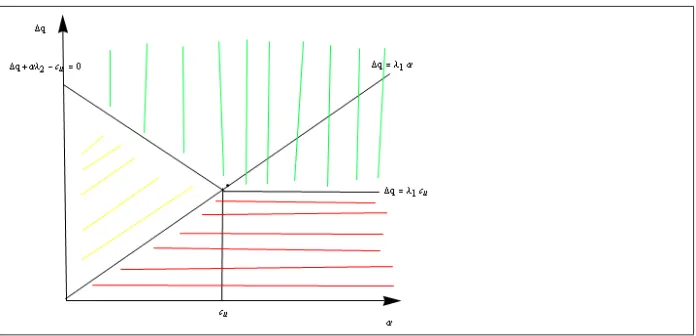
it is optimal if only the new buyers purchase it when the last inequality is reversed. Figure 1 (in the next page) provides a graphical representation of the socially optimal outcome.
Figure 1: The socially optimal outcome: The red area indicates values in the parameter space where no upgrade is optimal. The yellow area represents parameter values where it is socially optimal if only the new customers upgrade. The green area captures the case where upgrading by the whole market is e¢ cient.
4.2
Market outcome/ Incumbent’s commitment
I consider a scenario of potential entry when the incumbent already acquires the technology that allows him to commit to choose to upgrade in the following period. I analyze …rst the
case where the entrant has to bear zero cost to develop the superior product (F = 0) while
he may have the ability to price discriminate between the old and the new customers or not. Then, I look at the case where the entrant needs to invest a strictly positive development cost (F >0).
4.2.1 Zero development cost for the entrant who can price discriminate
The entrant is considered to be able to costlessly develop the superior good(F = 0)and this
fact allows her to always enter the market13. If the incumbent commits to upgrade, in the
second period, Bertrand competition drives all the prices to zero14. This is no longer true
if he commits to keep the initial product. In this case, the entrant can exploit the quality improvement and charge a strictly positive price either to the whole market or only to the new
comers15. Since the …rst period potential customers’expected outside opportunity is higher
under the incumbent’s commitment to sell the superior version, he could charge them more if he committed to maintain the initial product in the market. Thus, the incumbent could
13The same result of certain entry can be alternatively generated if the entrant needed to bear a …xed
cost F to develop the product (plus any other costs for advertisement) and she could o¤er an upgrade with su¢ ciently smaller adoption cost than the incumbent’s superior product.
be better-o¤ if he committed not to upgrade. The next proposition states the incumbent’s choice and the equlibrium market outcome for the di¤erent parameter values.
Proposition 2 a) If q+ 2 cu <0or if q+ 2 cu 0and 2 < cu;the incumbent
commits not to upgrade in period two. For the parameter values given …rst, the entrant sells the higher quality good only to the new potential customers whereas in the latter scenario, he sells it to everyone in the market, b) if 2 cu; the incumbent commits to sell the high
quality good in period two. All the customers upgrade by buying the superior product by either of the competitors.
Note that under most parameter values, the incumbent commits not to upgrade because if he did, actual competition would lower his total pro…ts. Commitment to keep the initial version allows him to set a higher price for the lower quality software good in period one. He only commits to launch the superior product when the network bene…t from upgrading
is higher than the cost of learning the superior product ( 2 cu). The proposition above
suggests that in equilibrium, the higher quality good is always sold in period two and is purchased either by the whole market or only by the new customers. This fact already highlights the potential ine¢ ciency that may arise in this market as it could be socially bene…cial if there is no upgrade in the economy. The next proposition summarizes the potential ine¢ ciency:
Proposition 3 It is socially optimal if there is no upgrade and nevertheless, a) all the
old and new customers buy the superior product if q + 2 cu 0, q < 1cu (these
parameter values imply thata cu). More precisely, the whole market purchases the upgrade
from either of the competitors if 2 cu and only from the entrant if 2 < cu;b) only the
new potential customers upgrade by purchasing the entrant’s product if q+ 2 cu <0;
q < 1(these parameter values imply that < cu).
The society would be better-o¤ if the initial version is sold for both periods when the
network bene…t is relatively large ( cu) and the upgrade cost for the old users exceeds the
gain in every customer’s second period utility ( q < 1cu). Nevertheless, in this case, the
superior product is always sold and everyone buys it if the quality improvement and the gains
from a larger network are greater than the upgrade costs ( q+ 2 cu 0). For relatively
small network bene…t compared to the upgrade cost ( < cu), the …rst best is to withhold
the high quality product from the market if the loss from incompatibility is greater than the
utility bene…t the new users enjoy from the upgraded version ( q 2 < 1 2). However, the
entrant sells the superior product and only the new potential customers purchase it when the
0). Therefore, in markets where we expect to see the threat of entry, ine¢ ciency may occur
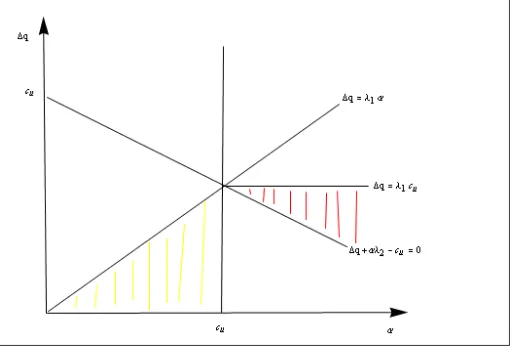
[image:11.612.179.435.137.310.2]as a result of actual competition even when the incumbent can commit to his future actions. Figure 2 represents diagrammatically the potential ine¢ ciency that may arise in the market.
Figure 2: Market outcome and e¢ ciency: The red and yellow shaped areas in the parameter space represent ine¢ cient upgrading by the whole market and the new users, respectively.
4.2.2 Zero development cost for the entrant who cannot price discriminate
If the entrant is unable to o¤er upgrade prices to the old customers, the analysis if the incumbent commits to upgrade leads to the same prices set by the competitors in periods
one and two, respectively16. If the incumbent monopolist commits not to upgrade, the
entrant may need to decide whether to serve all the market in period two or sell the superior
product only to the new comers17. The next proposition summarizes the incumbent’s choices
as well as the market outcome.
Proposition 4 a) If q+ 2 cu <0or if q+ 2 cu 0; q 1+ 2 < cu; 2 < cu;
the equilibrium outcome is that the incumbent commits not to upgrade and the entrant serves
only the new comers, b) If q+ 2 cu 0; q 1+ 2 cu 0; 2 < cu; the incumbent
commits not to upgrade and the entrant serves the whole market. c) If q+ 2 cu 0;
2 > cu;the incumbent’s pro…t by commiting to upgrade is equal to his pro…ts if he commits
not to upgrade. In such a situation, the incumbent is assumed to commit to bring the higher quality good and the whole market is served by either of the competitors.
The proposition above suggests that in equilibrium and similar to the case that the entrant can exercise price discrimination, the higher quality good is always sold and is purchased either by the whole market or only by the new customers. Note that under most parameter values, the incumbent commits not to sell the higher quality good because if he used the upgrade, actual competition would lower his total pro…ts. The next proposition highlights the potential ine¢ ciency that may arise in the market.
Proposition 5 It is socially optimal for the lower quality good to be in the market in period
two and nevertheless, a) the higher quality product is sold to the whole market if q+ 2
cu 0, q 1+ 2 cu 0; q < 1cu. In particular, if 2 < cu;all the customers upgrade
to the entrant’s product while if 2 cu;the whole market upgrades to the entrant’s superior
good, b) the incumbent commits not to upgrade and the entrant sells the higher quality good
only to the new customers if q + 2 cu < 0; q < 1 or if q + 2 cu 0;
q 1 + 2 < cu; 2 < cu and q < 1cu. It is also optimal for everyone to upgrade but
the entrant sells it only to the new potential customers if q+ 2 cu 0; q 1+ 2 < cu;
< cu.
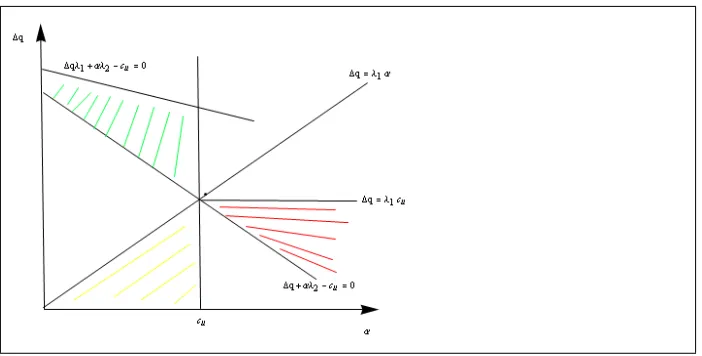
Thus, there may be an upgrade in the market even though the sociey would be better-o¤ without it for the same parameter values as in the case the entrant can price discriminate. There is also an additional ine¢ ciency: when the quality improvement is relatively large and the network e¤ect as well as the period one market size are relatively small, the …rst best is everyone to upgrade and nevertheless, the entrant sells the superior good only to the new buyers. Figure 3 represents the potential ine¢ ciency that may arise in the market.
4.2.3 Positive development cost for the entrant
Consider now the case that the potential entrant needs to pay a …xed cost(F >0)to develop
the superior good. If the incumbent commits to upgrade, the potential entrant is deterred to
enter the market18. If the incumbent commits not to upgrade, the analysis is identical with
the scenario that the entrant can costlessly come up with the high-quality good under the
condition that her development cost is not prohibitively high and this guarantees her entry19.
The incumbent …rm compares the pro…t gained by its commitment to either withhold the high quality good or sell it in period two and the next result summarizes his choice as well as the market outcome. Note that these results are independent of whether the entrant can o¤er upgrade discounts or not.
18The post-entry game is analyzed in the appendix.
Figure 3: Market outcome and e¢ ciency: The red and yellow shaped areas in the parameter space represent ine¢ cient upgrading. The green area represents the additional ine¢ ciency when the upgrade is purchased only by the new comers while it is socially optimal for everyone to upgrade.
Proposition 6 The incumbent monopolist always commits to sell the superior product in period two. This fact deters the potential entrant from entering the market. More precisely, if
q+ 2 cu 0;all the market purchases the upgrade. On the other hand, if q+ 2 cu
<0; only the new customers purchase the incumbent’s upgrade version.
The incumbent …rm’s choice to always commit to upgrade may be socially ine¢ cient as it could be socially optimal if there was no upgrade in the market. This potential ine¢ ciency is highlighted in the next result.
Proposition 7 It is socially optimal for the low quality good to be sold in the market in both periods and nevertheless, a) the incumbent commits to sell the upgrade and the whole market
buys it when q+ 2 cu 0and q < 1cu, b) the incumbent commits to sell the superior
good and only the new customers purchase it when q+ 2 cu <0 and q < 1.
4.3
Market outcome/ Non-commitment for the incumbent
In this subsection, I will discuss the case where the incumbent …rm faces the threat of entry and cannot commit to its future actions.
Consider …rst the case where the potential entrant can costlessly develop the higher quality good and can also o¤er an upgrade price for the old customers. Due to Bertrand competition, the incumbent’s second period pro…ts are zero independently of whether he decides to sell the low or the superior product. In this scenario, he will choose to sell the upgrade in the market because otherwise, the entrant would enjoy positive pro…ts. Therefore, there will be a high quality good in period two sold by both competitors. This may be socially ine¢ cient because, as already explained, it could be optimal for the society if there is no upgrade. In fact, the ine¢ ciency range is the same as in the commitment case analyzed in the previous subsection (proposition 3). If the entrant cannot o¤er an upgrade price for the old
customers, the range of ine¢ ciency is the same except for the case where q+ 2 cu
0; q 1 + 2 cu < 0; < cu: For these parameter values, when the incumbent can commit to his future choice, the market outcome is that the entrant upgrades and only the new customers buy it. When the incumbent lacks commitment power, the new version is purchased by both the old and the new consumers and this fact is socially optimal. Therefore, contrary to the monopolistic environment where social optimality is achieved under the incumbent …rm’s commitment power, lack of commitment may raise the social welfare when the market is open to competition.
Consider now the situation where the innovation cost for the entrant is positive. The entrant …rm would not invest in developing the higher quality good. To see this fact, consider the post entry game. The incumbent would be indi¤erent between selling the lower or the superior product because (due to Bertrand competition) his pro…ts would be zero in both cases. He would then prefer to upgrade because this would guarantee that the entrant would incur losses. The potential entrant anticipates the incumbent’s post entry behaviour and she rationally does not pay the …xed development cost. This fact allows the incumbent to be the sole supplier of the upgrade in the second period. Thus, the range of ine¢ ciency appears to be exactly the same as in the case where the incumbent can commit to his future actions.
Commitment for the incumbent
No commitment for the incumbent
Monopoly Social e¢ ciency Ine¢ ciency: The
monopolist always
upgrades even
though it could be socially optimal if there is no upgrade in the market
Potential
Competi-tion (F>0)
Ine¢ ciency: The
same range as in the monopoly case un-der no commitment
Ine¢ ciency: Same
range as in the
monopoly
non-commitment case Actual competition/
Upgrade discounts
from the entrant
Ine¢ ciency: The
same range as in the monopoly case un-der no commitment
Ine¢ ciency: Same
range in the
monopoly
non-commitment case
Actual
competi-tion/ No upgrade
discounts from the entrant
Ine¢ ciency: The
range of ine¢ ciency is larger than the
monopoly
non-commitment case.
More precisely, the entrant may sell the
superior product
only to the new cus-tomers even if it is socially optimal for everyone to upgrade
Ine¢ ciency: Same
range as in the
monopoly
non-commitment case
5
Applications
frequent new versions sold either by the same …rm or a competitor.
The leading example that suits proposition 2a) comes from the spreadsheet market for personal computers. Lotus was holding an almost monopolistic position in that market in IBM machines with its product 1-2-3 version 2.1 and its market share was above 80 percent in 1988. In 1989, Lotus announced its 1-2-3 version 2.2 for IBM computers. Although it had already developed a superior product (1-2-3 version 3), Lotus committed not to upgrade in the Windows platform. At the same time, Microsoft was working on Excel 3 and in 1991 it was available as an application in the Windows platform. Microsoft o¤ered backward compatibility with Lotus 1-2-3 Release 2.2 and upgrade prices for the old Lotus users. Many consumers switched from 1-2-3 to Excel 3 and in 1993, Excel market share exceeded 70 percent. Proposition 3b) suggests that the switch may had been ine¢ cient.
Although the model matches well with the real world example identi…ed above, there are other reasons that may a¤ect an incumbent monopolist’s decision of upgrading when he faces an entry threat. For example, it may be the case that he is unsure about the quality improvement introduced by the entrant …rm. It could also be that the new platform’s success (Windows) was ex-ante questionable. Athough these situations are acknolwledged to be possible, they are not considered in this paper.
6
Conclusion
This paper serves as a small step towards understanding the role of entry threat in the frequency of upgrades in network, durable goods. The message of this work is that better versions of such products may arise too often and this ine¢ ciency may be explained due to potential or actual competition. Going one step further, it is suggested that it may be bene…cial for the society if the incumbent is forbidden to commit to whether he will upgrade or not. This fact comes to a sharp contrast with the monopolistic scenario where the …rst best is achieved under the …rm’s commitment power.
7
Appendix
7.1
Prices and market outcome if the incumbent commits to
up-grade and the entrant can price discriminate (and F=0)
net utility if they buy either of the competitors’superior good isq2+ c p
0
2; q2+ c p2
wherep02; p2 are the entrant’s and the incumbent’s price choices, respectively. Old consumers
are assumed to coordinate to a ’reluctant rule’; that is, they buy a product independently of what the other period one customers do. So, they will upgrade to the entrant’s superior good even if all the other period one customers either stick to the incumbent’s initial or upgrade version if:
q2 + cu p 0
u maxfq1+ 1; q2+ cu pug;
where pu; p
0
u are the competitors’upgrade price choices. Since Bertrand competition drives
all prices to zero, the new comers purchase the superior product for free from either of the competitors. Nevertheless, the old customers may or may not upgrade, depending on
the parameter values. If q+ 2 cu < 0; the old customers stick to the incumbent’s
initial version. If q+ 2 cu 0; the whole market upgrades again for free to either
the incumbent’s or the entrant’s high-quality product. Working back in period one, the incumbent sets a price for the initial version to attract the incoming customers. If period one potential customers choose to wait and not buy, they expect (like the incumbent monopolist) a competitor in the following period who will sell a similar superior quality good. Thus, they expect to face a zero price (due to Bertrand competition) if they wait and make their purchase decision in period two. On the contrary, if period one potential customers buy the initial
version and expect to upgrade in period two (when q+ 2 cu 020), they will do so by
paying a pricep1. Nevertheless, this choice further depends on whether their total discounted
expected net payo¤ from buying in period one and upgrading with the rest of the market in period two is at least equal to their discounted expected net payo¤ from waiting to make
their purchase decision in period two. Thus, the incumbent chooses a price p1 for the lower
quality good that satis…es the equality:
q1+ q2+ 1+ c cu p1 = (q2+ c)
20In a richer model, although the incumbent commits to upgrade, qualityq
2may not be directly observable
in period one. This means that the incumbent monopolist may not be able to commit to the speci…c characteristics of the superior product but he can assure consumers that the initial product will be indeed upgraded. Consumers form expectations about the high-good quality,qe
2;which are based on past experience.
The initial good of qualityq1may be itself an upgrade and the quality di¤erential with the previous version
is available information to all period one potential customers. This quality improvent can be used as a proxy for the expected magnitude of the upgrade in period two, qe. In period two, the incumbent sells a product such that its actual qualityq2is equal to the expected qualityq2e:Although adding uncertainty with respect
or equivalently, p1 = q1 + 1 c(1 ) cu: Similarly, if old customers expect not to
upgrade (when q+ 2 cu <0), they are willing to pay a pricep1 such that their total
expected discounted bene…t from buying the initial product and not upgrading is greater than or equal to their expected surplus if they postpone their decision for period two. Thus, the equilibrium period one price is set by the incumbent monopolist such that:
q1+ q1+ 1+ 1 c p1 = (q2+ c);
orp1 =q1+ q1+ 1 2 c(1 ) q2.
7.2
Prices and market outcome if the incumbent commits not to
upgrade and the entrant can price discriminate (and F=0)
Consider now the case that the incumbent commits not to upgrade. The new customers are assumed to act as if they are a single player. Thus, their net utility if they buy the entrant’s
upgrade product isq2+ c p
0
2;wherep
0
2 is her price choice. If they all decide to purchase
the incumbent’s initial version, their net utility isq1+ 2+ 1x1 c p
0
1;where x1 is the
old customers’fraction that sticks to the old product and p01 is his price choice. Thus, the
new comers will decide to upgrade to the entrant’s good if:
q2+ c p
0
2 q1+ 2+ 1x1 c p
0
1
Old customers prefer the entrant’s version even if all the other period one consumers stick to the old product if:
q2+a cu p 0
u q1+ 1+ 2x2;
wherex2 is the new consumers’fraction that buys the old good andp
0
u is the entrant’s price
choice. If q+ 2 cu <0;old customers don’t upgrade in period two independently of the
entrant’s upgrade price. Bertrand competition leads to prices p02 = q, p01 = 0; p0u = 0 and
the new customers purchase the new product. If q+ 2 cu 0; period one comers are
willing to upgrade and this depends on the price set by the entrant. Bertrand competition
leads to equilibrium pricesp02 = q+ 1; p
0
1 = 0; p
0
u = q+ 2 cu and all the customers
upgrade. Going back to period one, the the incumbent sets a price to attract the period one potential customers. In period one, the incoming potential customers expect a competitor that will sell an upgraded version of the initial product in the following period. Thus, their outside opportunity is to wait and make their purchase in the second period by paying a
two (when q+ 2 cu 0), they are willing to buy the initial version if their expected total net bene…t is higher than their discounted payo¤ from postponing their decision for the following period. Thus, the period one price set by the incumbent is given by the equality:
q1+ q2+ 1+ c cu ( q+ 2 cu) p1 = (q2+ c q);
or equivalently p1 = q1 + 1 c(1 ) 2: If old customers expect not to upgrade in
period two (when q+ 2 cu <0); they are willing to buy the initial product by paying
a price p1 that satis…es the equality:
q1+ q1+ 1+ 1 c p1 = (q2+ c q)
orp1 =q1+ 1 2 c(1 ):
7.3
Market outcome when the entrant has zero development cost
and is unable to o¤er an upgrade discount under the
incum-bent’s commitment
If the incumbent commits to upgrade, in period two, perfect compatibility between the supe-rior products and backward compatibility of the new version ensure that the new potential customers join a network of size 1 if they buy from either the incumbent or the entrant.
Their net utility if they buy the entrant’s or the incumbent’s superior good isq2+ c p
0
2;
q2+ c p2 wherep
0
2; p2 are the entrant’s and the incumbent’s price choices, respectively.
The old consumers will buy the entrant’s product even if all the other period one customers either stick to the incumbent’s initial or upgrade version if:
q2+ cu p 0
2 maxfq1+ 1; q2+ cu pug;
where pu is the incumbent’s price choice for the old consumers who upgrade in period two.
Bertrand competition drives all the prices to zero. If q+ 2 cu <0; the old customers
stick to the incumbent’s initial version and the new comers purchase the superior good for
free by either of the competitors. If q+ 2 cu 0; the whole market upgrades again
for free to either the incumbent’s or the entrant’s high-quality product. In period one, the incumbent sets a price for the initial version to attract the incoming customers, who correctly anticipate, in equilibrium, the second period play. Thus, their outside opportunity in period one is to buy the high quality good in period two by facing a zero price. If the old consumers
satis…es the equality:
q1+ q2+ 1 + c cu p1 pu = (q2+ c)
or equivalently,p1 =q1+ 1 c(1 ) cu;wherepu =p
0
2 = 0:If the period one consumers
expect not to upgrade (when q+ 2 cu <0), the equilibrium period one price satis…es
the equality:
q1+ q1+ 1+ 1 c p1 = (q2+ c);
or p1 =q1+ q1 + 1 2 c(1 ) q2. Consider now the case that the incumbent
commits not to upgrade. The new customers choose the entrant’s superior good if:
q2+ c p
0
2 max
n
q1+ c p
0
1;0
o
wherep02; p01 are the entrant’s and the incumbent’s period two price choices for the high and
the initial version, respectively. Old consumers prefer the entrant’s version and do not stick to the incumbent’s initial product if:
q2+a cu p 0
2 q1+ 1+ 2x2
or equivalently
q+ 2 2x2 cu p 0
2 0;
where x2 is the new consumers’ fraction that buys the old good. If q + 2 cu 0;
q > q+ 2 cu; q+ 2 cu 2 q;Bertrand competition leads top
0
2 = q+ 2 cu
and p01 = 0 and the equilibrium market outcome is that everyone upgrades. Otherwise, the
equilibrium prices are p02 = q and p01 = 0 with potentially di¤erent equilibrium market
outcomes dependent on the parameter values. To be more precise, if q+ 2 cu <0or if
q+ 2 cu 0; q > q+ 2 cu; q+ 2 cu < 2 q;old customers do not upgrade
and the new comers purchase the entrant’s superior product, whereas if q+ 2 cu 0;
q < q+ 2 cu; everyone upgrades in period two. In the initial stage, the incumbent
sets a pricep1 for the lower quality good such that the potential customers buy it and do not
wait until period two to make their purchase decision. Old customers’outside opportunity in
period one is to purchase the superior entrant’s product by paying a pricep002 = qin period
two. If old customers expect to upgrade in period two ( q+ 2 cu 0; q > q+ 2 cu;
q+ 2 cu 2 q); the equilibrium period one price satis…es the equation:
q1+ q2+ 1+ c cu p1 p
0
2 = (q2+ c p
00
2); where p
0
2 = q+ 2 cu; p 00
or equivalently p1 = q1 + 1 c(1 ) 2. They are also expected to upgrade if
q+ 2 cu 0; q < q+ 2 cu. In this case, the equilibrium period one price is given by the equality:
q1+ q2+ 1+ c cu p1 p
0
2 = (q2+ c q); wherep
0
2 = q
orp1 =q1+ 1 c(1 ) cu:If the old customers expect not to upgrade (if q+ 2 cu <0
or if q+ 2 cu 0; q > q+ 2 cu; q+ 2 cu < 2 q), the period one equilibrium
price satis…es the equation:
q1+ q1+ 1+ 1 c p1 = (q2+ c q)
and thus, p1 =q1+ 1 c(1 ) 2.
7.4
Post entry game and equilibrium market outcome when the
entrant needs to bear strictly positive development cost and
the incumbent commits to upgrade
Think of the hypothetical post-entry scenario when the entrant needs to bear a …xed positive development cost when the incumbent commits to upgrade. Note that I consider the case where the entrant is able to o¤er upgrade prices to the old users. Under the assumption of compatibility between the rival …rms’products, the new customers’net utility if they buy the
high-quality product by either the incumbent or the entrant isq2+ c p2; q2+ c p
0
2,
respectively. The old consumers’net payo¤ from upgrading is independent of the other old or new customers’choices. Thus, they upgrade to the incumbent’s superior product even if every other old customer either chooses the entrant’s high-quality or the incumbent’s initial version when:
q2 + cu pu max
n
q2+ cu p 0
u; q1+ 1
o
:
wherepu; p
0
u are the the competitors’price choices. If q+ 2 cu <0;the old consumers
will not buy the upgraded version independently of the rival …rms’price choices. Bertrand
competition leads to prices, p2 = F2 21, p
0
2 =
F
2
22: New customers would purchase the
superior good from the incumbent and thus, the potential entrant would incur losses after entry. Thus, she will optimally choose not to invest. Similarly, think of the post-entry game
if q+ 2 cu 0;when old customers upgrade. Bertrand competition leads to equilibrium
21for being any small positive number
22when, without loss of generality, I assume that the development cost is not prohibitively high: F <
prices p2 = F2 ; p
0
2 =
F
2; pu =
F
1 ; p
0 u =
F
1 and the whole market upgrades to the
incumbent’s high quality product. Thus, the potential entrant would be better-o¤ if she stayed out of the market. In any case, the incumbent remains the sole supplier in period two and this allows him to extract consumers’surplus. Going back to period one, the incumbent needs to attract the potential customers into buying the initial version of the product. Old customers create expectations, which are correct in equilibrium. Thus, their net payo¤ from waiting to buy the superior good in period two is zero. If they expect to upgrade in period
two (when q+ 2 cu 0); the equilibrium period one price is given by the expression:
p1 =q1+ 1 c+ q2+ cu pu;
where pu = q + 2 cu: If they expect to upgrade (when q + 2 cu < 0); the
equilibrium price p1 is such that:
p1 =q1+ q1+ 1+ 1 c:
7.5
Post entry game and equilibrium market outcome when the
entrant needs to bear strictly positive development cost and
the incumbent commits not to upgrade
I analyze the scenario where the entrant can o¤er upgrdade prices to the users of the old version.
Case 1 q+ 2 cu <0; 2 q F 0:
In period two, Bertrand competition leads to the entrant’s and the incumbent’s
equilib-rium prices being p02 = q; p01 = 0; respectively: The market equilibrium outcome is that
only the new customers buy the entrant’s superior good and the old customers stick to the
old product. The incumbent in period one will set a price p1;such that:
q1+ 1+ q1 + 1 c p1 (q2+ c p
00
2);
where the left hand side of the inequality is the customers’net utility from purchasing the lower quality good in period one and retaining it in period two. Note that if all consumers wait and purchase the entrant’s superior good in period two, the price they would face is
p002 = q: Thus, the equilibrium price in period one satis…es the above inequality as equality
and is given by the expression:
The incumbent’s and the entrant’s equilibrium pro…ts are:
I = 1[q1 (1 )c+ 1 2];
E = 2 q F; 2 q F 0;
respectively.
Case 2 q+ 2 cu 0; 1( q+ 2 cu) + 2 q F 0:
In period two, Bertrand competition leads to the pricesp02 = q; p0u = q+ 2 cu;set
by the entrant and p01 = 0 set by the incumbent. The market equilibrium outcome is that
everyone upgrades to the entrant’s superior good. In period one, the incumbent will set a
price p1; such that:
q1+ q2+ 1+ c cu p1 p
0
2 (q2+ c p
00
2);
where p002 = q is the entrant’s price if the old customers wait and purchase the superior
product in period two. Thus, the equilibrium prices as well as the competitors’pro…ts are given by the expressions:
p1 =q1+ 1 c(1 ) 2; p
0
2 = q+ 2 cu; p 0
1 = 0;
I = 1[q1 + 1 c(1 ) 2];
E = 1( q+ 2 cu) + 2 q F:
References
[1] Bensaid, B., and Lesne, J.P. (1996), “Dynamic Monopoly Pricing with Network Exter-nalities”, International Journal of Industrial Organization, 14, 837-855.
[2] Bulow, J. (1986), “An economic theory of planned obsolescence”, Quarterly Journal of Economics, 101, 729-749.
[3] Cerquera, D. (2006), “Durable Goods, Innovation and Network Externalities”, Center for European Economic Research Discussion Paper No. 07-086.
[5] Coase, R (1972), “Durability and Monopoly”, Journal of Law and Economics, 15, 143-149.
[6] Economides, N. (1995), “The Economics of Networks”, International Journal of Indus-trial Organization, Elsevier, 14, 673-699.
[7] Ellison, G. and Fudenberg, D. (2000), “The Neo-Luddite’s Lament: Excessive Upgrades in the Software Industry”, RAND Journal of Economics, 31, 253-272.
[8] Fishman, A. and Rob, R. (2000), “Product innovation by a durable-goods monopoly”, RAND Journal of Economics 31, 237-252.
[9] Farrell, J. and Saloner G. (1986), “Installed Base and Compatibility: Innovation, Prod-uct Preannouncement and Predation”, American Economic Review, 76, 940-955.
[10] Fudenberg, D., and Tirole, J. (1998), “Upgrades, tradeins, and buybacks”, RAND Jour-nal of Economics 29, 235-258.
[11] Fudenberg, D., and Tirole, J. (2000), “Pricing a network good to deter entry”, Journal of Industrial Economics 48, 371-390.
[12] Hoppe, H and Lee, I. (2003), “Entry Deterrence and Innovation in Durable Goods Monopoly”, European Economic Review, 47, 1011-1036.
[13] Katz, M. and Shapiro, C. (1985), “Network Externalities, Competition and Compati-bility”, American Economic Review, 75, 424-440.
[14] Katz, M. and Shapiro, C. (1986), “Technology Adoption in the Presence of Network Externalities”, Journal of Political Economy, 94, 822-884.
[15] Katz, M. and Shapiro, C. (1992), “Product Introduction with Network Externalities”, Journal of Industrial Economics, 40, 55-84.
[16] Katz, M. and Shapiro, C. (1994), “Systems Competition and Network E¤ects”, Journal of Economic Perspectives, 8, 93-115.
[17] Stokey, N. (1981), “Rational Expectations and Durable Goods Pricing”, Bell Journal of Economics, 12, 112-128.
[19] Waldman, M. (1996), “Planned obsolescence and the R&D Decision”, RAND Journal of Economics 27, 583-595.