warwick.ac.uk/lib-publications
Original citation:Sinclair, Timothy J.. (2016) Robert W. Cox's method of historical structures redux. Globalizations . doi: 10.1080/14747731.2016.1143662
Permanent WRAP URL:
http://wrap.warwick.ac.uk/78208
Copyright and reuse:
The Warwick Research Archive Portal (WRAP) makes this work by researchers of the University of Warwick available open access under the following conditions. Copyright © and all moral rights to the version of the paper presented here belong to the individual author(s) and/or other copyright owners. To the extent reasonable and practicable the material made available in WRAP has been checked for eligibility before being made available.
Copies of full items can be used for personal research or study, educational, or not-for profit purposes without prior permission or charge. Provided that the authors, title and full bibliographic details are credited, a hyperlink and/or URL is given for the original metadata page and the content is not changed in any way.
Publisher’s statement:
“This is an Accepted Manuscript of an article published by Taylor & Francis in Globalizations on 18 February 2016, available online: http://dx.doi.org/10.1080/14747731.2016.1143662”
A note on versions:
The version presented here may differ from the published version or, version of record, if you wish to cite this item you are advised to consult the publisher’s version. Please see the ‘permanent WRAP url’ above for details on accessing the published version and note that access may require a subscription.
1 Robert W. Cox’s Method of Historical Structures Redux
Timothy J. Sinclair University of Warwick
Key words: Robert W. Cox; historical structures; American hegemony; method; social forces; world order;
Abstract
This article argues that Cox’s Method of Historical Structures (MHS), although a highly useful tool for understanding the world, should be adapted to make it more effective as a framework for understanding world order in the twenty-first century. The advent of the method helped rejuvenate critical scholarship in international relations and
international political economy during the 1980s. It offered a way out of the excessively structural approaches that had dominated critical thinking in the 1960s and 1970s. Cox’s method enabled the unpacking of a structure, so that the components that made up any particular configuration could be considered analytically. Providing guidance on how to look at an historical order, and how to consider the component features of that structure, proved to be a revelation for many critical scholars of international relations. Surprisingly, given Cox’s highlighting of the distinction between critical and problem-solving theory introduced in the same Millennium article, what really distinguishes Cox’s approach, and why it has had the impact it has, is the pragmatism of the method. The MHS offers the possibility of a more closely reasoned analysis of world order than was previously available. It was the practical and somewhat systematic quality of the MHS that made it influential because it offered to facilitate empirical research by critical scholars. Thirty-five years on, the Method looks less satisfactory and this article offers some suggestions for its development.
Biography
Timothy J. Sinclair is Associate Professor of International Political Economy at the University of Warwick in England. A former official in the New Zealand Treasury where he worked on public expenditure and the privatization of government agencies, his research focuses on the politics of global finance and approaches to global governance theory. He co-edited Robert W. Cox’s collected works, Approaches to World Order (Cambridge University Press 1996), and Sinclair’s book on the US credit rating agencies, The New Masters of Capital: American Bond Rating Agencies and the Politics of
2 Robert W. Cox’s Method of Historical Structures Redux
Timothy J. Sinclair1
The publication in 1981 of Robert W. Cox’s essay, “Social Forces, States, and World Orders: Beyond International Relations Theory” was a watershed moment in the
development of critical thinking about international relations and international political economy. The context for the article was Cox’s disenchantment with the structural Marxist approach that emerged in the late 1960s and his reaction to the popularity of a non-historical version of Realist thinking in the United States, stimulated by publication of Kenneth Waltz’s 1979 book, Theory of International Politics.
The publication of “Social Forces” was crucial to emerging critical thinking in the study of international relations and international political economy because it offered a deeper historical lens than was characteristic of scholarly theorizing in the field of international relations since World War II. The field was largely preoccupied with the immediate problems of managing American hegemony in the context of the cold war with the Soviet Union. Historical works remained firmly historical. Cox bridged the gap between history and the new field of international relations, suggesting that the immediate problems of the world could be put into a deeper context (Cox 2013, chapter 8, passim).
Although the Method of Historical Structures (and Cox’s subsequent investigation into Gramsci also published in Millennium, in 1983) are key moments in the evolution of critical thinking in international relations, the Method is not without its problems. This article is concerned with contemporary use of the Method in research. I offer an analysis of the Method, including a discussion of its purpose, and an assessment of the strengths and limitations of the Method. I should clarify that, like Cox, I am not an advocate of a universal or singular purpose to theorising international relations, although like him I am cognizant of a dominant way of thinking about international relations closely tied to hegemonic forces.
After this discussion I turn to adapting the method, and consider the scope of the
ontology implicit in the MHS, its original purpose, and offer some clarification of agency in the MHS. Finally, in a restatement of a now-reconfigured MHS, I reconsider the purpose of the framework and give a sense of what the ‘new’ MHS looks like.
What I do not do in the text that follows is offer an evaluation of the foundations of the approach or a comparison with other ways of thinking about the same issues. This is
3 intentional. While those are valid and interesting tasks, they are not the purpose of this article. Here the focus is on updating an established framework that might have some utility for those engaged in empirical and historical research.
Method of Historical Structures
The Method of Historical Structures emerges out of Cox’s apparent frustration with the conventional ontology of international relations, which draws a sharp distinction between state and civil society, and focuses on states as if they are essentially alike. For Cox, the basic unit of international relations is the relationship between state and society, or what he calls the “state/society complex” (Cox with Sinclair 1996, p. 86). Rather than there being a singular state form around which all of international relations takes place, there are likely to exist a “plurality of forms of state, expressing different configurations of state/society complexes” suggests Cox (Ibid.). Reinforcing this sense of ontological complexity, Cox implores the reader to look at world order “in the whole” but without “reifying a world system” (Ibid. p. 87), not forgetting that change is a key feature. Cox further suggests we do not underrate state power, but do not neglect social forces either (ibid.).
The purpose of the MHS is the generation of critical understanding of some aspect of the world, of an “initial subdivision of reality” (ibid. p. 85). This understanding of a feature of the world is a stepping stone to broader understanding or a “larger picture,” and not an end in itself, as it might be for what Cox calls problem-solving approaches (Ibid. p. 89). Problem-solving theory, suggests Cox, dominates our thinking in the social sciences, takes the parameters of the world as it finds them, and seeks to identify and address “particular sources of trouble” (ibid., 88). Problem-solving theory is premised on holding constant all other matters outside the area of concern. This gives it incisive but narrow analytical power which may exaggerate the veracity of problem-solving thinking in the minds of many.
So how do we explore state/society complexes as the “constituent entities of a world order,” but avoid the static, timelessness of Neorealism, in which motivations are assumed to be fixed (Ibid. p. 96)? Cox suggests the way to do this is by embracing an historical materialism that actually enlarges the realist perspective through its concern with relationships between structure, which he sees as economic relations, and
superstructure (or the “ethico-political sphere”). These relationships explain why
state/society complexes differ, producing the variety of historical forms we encounter in the world.
What are the basic premises of this approach? Cox identifies five main features (Ibid. p. 97). First, action takes place within a “framework for action” which limits and
4 institutions. An historical structure does not determine action but “constitutes the
context” within which action takes place. Cox’s structure can be read as a constraint but also more actively (but less clearly) as constituting action too, so the historical structure does more than limit pre-given agents. Last, frameworks for action, or historical
structures, should not be considered in terms of their need for equilibrium maintenance, but more dynamically, in terms of identifying the contradictions and conflicts within them which create the possibility for transformation of the framework for action.
There are two elements that make up the MHS. Each is organized by Cox in the form of a graphic ‘triangle,’ as he put it. These triangles may have greatly aided the
communication of the method, and the popularity of the approach. It is the first of these ‘triangles’ that allows the analyst to map out a particular historical structure (Figure 1). The structure does not determine action, “but imposes pressures and constraints” creating and limiting what can be done in the circumstances (Ibid. p. 98). Rival structures are possible, and may push back against a specific structure.
Keeping in mind that Cox’s thinking developed in response to 1960s structural Marxism and to the emergence of Neorealism in the 1970s, we need to be clear that Cox’s
triangles are not analogous to circuit diagrams. Cox did not think of the ontology he laid out in the triangles as fixed or immutable. Nor do they provide the basis for the
inference of law-like axioms about social life. They are intended to help undertake more rigorous concrete investigations. The concrete investigations are the things that matter, but like any intellectual undertaking these are better when their guiding assumptions, in this case ontology, are made explicit.
Figure 1.
ideas
↙↗ ↖↘
material ← institutions capabilities →
Cox categorises circumstances as material capabilities, ideas and institutions. What determines the relationship between them are empirical conditions, and cannot be assumed in advance. Material capabilities are dynamic productive (and destructive) technologies, physical plant and natural resources. Ideas are intersubjectively shared notions such as diplomatic immunity. These ideas are what Searle calls social or institutional facts (Searle 2010, p. 10). Unlike Searle, Cox suggests that although these ideas are durable they are historical. Ideas come and go, albeit slowly. Cox also identifies a crucial second category of ideas. These are competing “images of social order” held by different groups (Ibid. p. 99). There may be several, and they tend to be cast in
5 100). Their partiality can be overcome by juxtaposing related structures. Rather than assuming equilibrium and an abstract model of a smoothly functioning social system, the dialectical character of historical structures can be highlighted by identifying them within historical circumstances and by detecting rival structures.
A little confusingly, Cox suggests the Method of Historical Structures can then be “applied” via a second triangle to “three levels, or spheres of activity” (Ibid.; Figure 2). These spheres consist of social forces, or what he terms the “organization of
production,” forms of state as derived from the study of state/society complexes, and world orders, or the configuration of forces which define the “problematic of war or peace for the ensemble of states” (Ibid.). Like the elements of the first structure the spheres or levels are interrelated. He cites E.H. Carr’s discussion of industrial workers as a new social force, and how this comes to stimulate imperial acquisition (Ibid. pp. 100-101). The key to understanding the relationship of the two triangles is that the first triangle (the forces) is applied to each of the elements or spheres of the second triangle. In order to understand forms of state the analyst needs to consider the configuration of material capabilities, ideas and institutions it contains. The broader categories of the second triangle of spheres can then be considered in relation to each other for a “fuller representation of historical process” (Ibid. p. 101). Like the forces, the broader spheres do not exist in a linear relationship to each other and we discover how they are linked by historical and empirical study.
Figure 2.
social forces
↙↗ ↖↘
forms of ← world state → orders
The breadth of the approach is impressive. Contrast the scope of the Method of
Historical Structures if you will with what were then, and still are, the dominant models of social science, which seek law-like understandings of small fields of human
behaviour. Cox’s ambition has been inspirational to more than one generation of students who have found themselves studying international relations but were frustrated by the limits of the orthodox view.
The non-deterministic character of Cox’s understanding of how things relate to each other in an historical structure, and the necessity of empirical and historical research in order to see what is important at specific times, is a great strength of the approach because it undermines inadequate models of social life that assume a mechanistic and ahistorical understanding of our world. Cox’s approach makes it quite clear that this sort of understanding is not enough.
6 analysis allows the researcher to examine how an historical structure, a limited thing in itself, works. Moving these structures to the spheres of Figure 2 allows the theorist to see how these little systems work together to produce broader interactions and contradictions, laying the ground for transformation.
There is no denying that as a simple matter of exposition the juxtaposition of the two triangles is a source of confusion to many readers. Cox asks us to fit Figure 1 into the elements or spheres of Figure 2. This was perhaps not the best way to organize the Method. It works, but the relationship of these two is a less than optimal approach.
Many people will want to dispute Cox’s ontological choices. Production is considered broadly and inclusively. But where is reproduction and gender relations? Are they not part of history? I think the best response to this problem is to suggest that Cox’s categories are not exhaustive as he sets them out in 1981, but are open to redefinition and adaptation over time. One approach to this issue would be to say that the researcher simply elaborates upon the framework given the particular context. I think this is what we do almost all the time. But reproduction, as a basic category of social life, is neglected in the classic formulation of the Method of Historical Structures given in 1981. I see nothing in Cox’s views which would be hostile to acknowledging this. Indeed he makes it clear that theory changes as history does, and critical theory must be directed at itself as much as at the world. In the most developed statement (1987) of his views Cox says that reproduction comprises part of ‘material capabilities’ as set out in the 1981 Millennium outline of his Method (see in particular endnote 7, page 6 of Cox 1987). While this may have made sense at the time, it does not seem so convincing now. Being explicit about reproduction puts it on a better ontological (and political) footing.
The last problem is that of agency. Agency, in the form of “history” is everywhere in the MHS, as you would expect. The problem is that it falls between the cracks. The structure and the ontology is clear and visible. How things move and why, is not. It is this element that I think is probably unsatisfactory to contemporary audiences. Bieler and Morton have suggested that the best interpretation of Cox’s approach to agency and structure, when his subsequent work is considered, is that he “develops explanations of
regularities in human activity within particular historical limits” (Bieler and Morton 2001, p. 21). What those explanations are, their conceptual sources, is flexible and open, and I suggest potentially allow for the use of problem-solving theory where the analyst finds these relevant.
Adapting the Method of Historical Structures
Broadening the ontology of the first triangle of forces could renew the relevance of the MHS, and making things explicit is, other things equal, good scholarship. Although we could argue that gender issues are implicit in the 1981 framework, ‘material capabilities’ could be transformed to incorporate reproductive dynamics as well as productive ones. This assumes that reproductive technologies (such as the advent of IVF) and the
7 As noted, Cox discusses ideas in terms of rival collective images and intersubjectively held norms. Intersubjectivity, or social facts, which have become a major area of social science theorizing, do not sit well with class consciousness, and actually are more like institutions than ideas, given that Cox considers institutions more broadly than mere organizations. Thinking of social facts as ideas gives the false impression that they are somehow voluntary or idiosyncratic. In the new schema ideas will only refer to
consciously held ideas, not social facts.
The broader categories of the spheres’ triangle may be easier to live with for some. To others it may seem – ironically - rather state-centric. Instead of “forms of state” why not stick with the broader category of state/society complex? Surely this would work better here. Or perhaps we could use “forms of state” but add more categories to reflect social complexity? Cox’s sphere of “social forces” is relatively narrowly understood by him as “engendered by the production process” (Ibid. p. 100). But surely this is not enough to capture the other social issues of gender, race, sexual orientation, disability, age and so on that seem central to life in advanced societies but are not easily reducible to
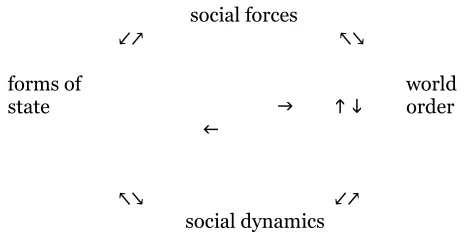
production. This is an issue that Marxist scholars have grappled with for decades and I am not aware of a perfect solution. Even when Cox first published this article it is not clear that the phenomenon of apartheid would have fitted adequately into the social forces sphere. I suggest we add a fourth sphere to be called ‘social dynamics’. Into this would fit the vast range of human conflict and cooperation not reducible to production. Struggles by social movements about things like human rights and the biosphere are manifestly consequential, and need to be recognised as such. Note that I have not made a separate category for ‘the environment.’ While we are material beings as well as social ones, the struggle over how to address the environment is part of the social dynamic, and how we resolve it will not be reducible to material necessity alone. Note that in adding this fourth sphere of interaction I have changed the second triangle of spheres or levels into a diamond, neatly ending a source of thirty-five years of confusion if this innovation is adopted. From two triangles we now have the triangle and the diamond.
When Cox developed the Method of Historical Structures he was very conscious of his purpose. If only all scholars were equally as self-aware of their intent. He distinguished between problem-solving and critical theory and it was clear that the purpose of MHS is associated with critical theory. It is premised on the ongoing process of historical change and on the conscious pursuit of change in the interests of improving the lives of most people. But this stark divergence between problem-solving and critical theory is
troublesome and in my experience unattractive to those looking for a means of changing the world. Critical theory’s objective of transforming the world needs to start
somewhere. Transformation is too distant to be very practical and being practical should be an objective for critical theory, unless we are willing to accept that this approach to theory is entirely abstract.
8 more innovative ontology and thus can include actors and phenomena ignored by
problem-solving (Schechter, p. 248). In contexts like this critical theory may have a more immediate relevance than it once had, and that relevance can build support for maintaining and developing critical theory. A widening of Cox’s purpose for the MHS makes sense.
For those not already sympathetic to Marxist thinking, Cox’s approach may seem highly structural. This is ironic given that Cox was responding to excessive structuralism in both Marxist and Realist scholarship in vogue at the time he was writing. But in the context of the time, the 1981 Millennium article’s attempt to rethink structurally was critical thinking as it opposed mainstream thought, which, like Hollywood movies, gives all the attention to the action. Cox makes it clear again and again that how things work out depends on circumstances. His agency is in the facts on the ground, and structure does not determine outcome so much as limit the range of possibilities. Cox’s
understanding of historical structures is that they are “persistent social practices” which are made (and transformed) by “collective human activity” (Cox, 1987, p. 4). Is this approach to agency adequate, or does it leave us with an analytical system that is
fundamentally structure-centric? The answer may lie in reading Cox’s “lines of force” in terms of the explicitly dialectical political analysis of hegemony (and
counter-hegemony) provided by Gramsci. This highlights just how political structures are, and how vulnerable to erosion they remain.
Historical Structures Redux
When Cox’s “Social Forces” article was published in 1981 it was an exciting moment in the emergence of critical international relations scholarship. Here was a framework offering researchers a method to do historically-informed empirical investigation that offered to go well beyond the broad categories of existing critical thinking. There is no doubt that Cox’s work on international organizations in the 1960s and 1970s, and his subsequent work on critically theorising international relations and international
political economy, has been very influential (see Randall Germain’s article in this issue). He supervised numerous graduate students at York University who have gone on to undertake research on a wide array of phenomena. Despite this breadth of impact, the results, in terms of completed research closely tied to the Method Historical Structures, did not match the initial enthusiasm for the 1981 article. Some of that can be put down to the incredible flowering of critical international relations theory during the 1980s and 1990s. Scholars were spoilt for choice. It may also be the case, as I contend, that there were problems with the Method which undermined use of the framework to create new knowledge. These problems were three-fold. First, the possible perception that the approach was more structural and determinist than was the case. Second, a seemingly narrow ontology. Last, potential confusion between the purpose of the two ‘triangles’ and how they related to each other.
In thinking about the Method of Historical Structures Redux I have tried to give attention to these three problems. The seeming lack of agency in the approach can be addressed by invoking Gramsci, because the language of hegemony and
9 to remind readers of the link between history, lines of force as Cox terms them, and agency. Agency is very much a lived experience in the Coxian schema, rather than a capacity or box to fill with content. To try to do this a priori with agency is, in the
Coxian universe, a mistake of hyperstructuralism. In MHS Redux the ontology has been clarified by moving intersubjectivity to the institutions category in Figure 3, and by distinguishing reproduction and production. On the spheres or levels side (Figures 2 and 4) I have added the new social dynamics level to integrate a key feature of social life given insufficient attention in the classic version of the Method of Historical Structures. Familiarity and use is probably the best route to overcoming confusion about the
relationship of forces and spheres. The key insight is that multiple sets of forces exist within each sphere or level, competing for hegemony. ‘Forces’ provide the static or synchronic analysis, while the broader ‘spheres’ analysis allows us to think in terms of diachronic potential, as the latent contradictions between forces can be made explicit.
Let us consider what the MHS Redux looks like as depicted in Figures 3 and 4. Figure 3 sticks to the broadest outlines of Cox’s ontology of forces, but is adapted as discussed above. Instead of ‘ideas’ we now have ‘competing ideas’ which should highlight the focus on the conflict between different collectively held ideas. The conflict between ideas is more apparent in this treatment. As noted, I have moved intersubjectively held ideas from ‘ideas’ to link up with ‘institutions’. I did this because intersubjective notions are not ideas in the classic sense but really operate as what Searle calls social facts. These norms and assumptions structure our lives well away from the competition and controversy of competing ideas. I have kept ‘institutions’ in the title of this force even though social facts are really the same phenomenon in order to capture the everyday understanding of institutions as organizations. Social facts alone might have been abstruse. The last category of forces in the bottom left corner of Figure 3 has been modified from Cox’s material capabilities to distinguish productive and reproductive matters. Reproductive issues have been teased out of their implicit location in ‘material capabilities’. Although ‘production’ and ‘material’ can and are interpreted by Marxists in all-encompassing ways, I think it is best to acknowledge the distinctiveness of household and gender dynamics, as these are such large dimensions of our lives.
Figure 3.
competing ideas
↙↗ ↖↘
productive ← institutions and & reproductive → social facts capabilities
10 Figure 4.
social forces
↙↗ ↖↘
forms of world state order
↖↘ ↙↗
social dynamics
How should we actually go about using the modified Method of Historical Structures in research? We need to be clear about what it will be useful for, and where it will not be useful. It is unlikely to help us produce law-like generalizations about social life. Apart from the obvious observation that Cox is hostile to such knowledge in the absence of a critical theory context, the MHS Redux is best understood as a framework for theorizing consequential phenomena. An example might be contemporary China. We want to understand the rise of China and it is clearly so important we can justify studying it in its own right. But the uniqueness of China as a phenomenon is not going to help us create law-like theories we can apply to other phenomena. But that does not matter. It is important enough to understand China itself. So Cox’s MHS is an aid to theorizing the world, but a world whose historical complexity and uniqueness is the starting (and ending) point. In this sense the MHS is not seeking to produce highly parsimonious knowledge, although highly parsimonious knowledge may prove useful to the understanding of forces in the first triangle. Once the researcher understands and
embraces the lack of common ground between the form of understanding Cox seeks and that sought by problem-solving social science she can then undertake her analysis in the two moments. The first, the forces, is the static or synchronic understanding of how things fit together (eg. Thatcherism) while the spheres of Figure 4 allows for
understanding of the broader context and incorporates potential contradictions between elements (Thatcherism vs Soviet Communism, for example).
Conclusions
In this article I have argued that Cox’s Method of Historical Structures (MHS), although a useful tool for understanding the world, can and should be adapted to make it more effective as a framework for interpreting world order in the twenty-first century. Cox’s method helped rejuvenate critical scholarship in international relations and
11 structural approaches that had dominated critical thinking in the 1960s and 1970s. Cox’s approach enabled the unpacking of a structure, so that its components could be considered analytically. Providing guidance on how to look at a particular order and how to specify and consider the component features of structures proved a revelation. The MHS offers the possibility of a more closely reasoned analysis of world order than was previously available. Surprisingly, what really distinguishes Cox’s approach, and why it has had the impact it has, is its pragmatism. But thirty-five years on the Method looks less satisfactory than it did. Some of that promise has not been realised. I identified problems with the MHS and suggested some reconfiguring of the framework to acknowledge issues that were never resolved adequately in the classic formula.
The MHS Redux improves on the classic formulation because it acknowledges the core reality of human reproduction and gender relations. This was implicit in the classic model, but it is better made explicit given the scope and depth of this aspect of human life. Sorting out the confusion between competing ideas and intersubjective norms is useful. These two quite different phenomena are not reducible to ‘ideas,’ which gives the false impression of a battle of ideologies, and the rise of constructivism, and especially the work of John Searle has made it clear just how significant is intersubjectivity and social facts. Adding ‘social dynamics’ to the second ‘spheres’ triangle gives weight to what are huge human struggles that many Marxists neglected historically.
In offering these adaptations I have also sought to clarify ways in which the MHS can be used in research. One of the glaring weaknesses of critical scholarship in contrast to orthodoxy has been the seeming reluctance to offer guidance on how to do research especially to those new to scholarship. Perhaps this is motivated by a desire to ensure choice is maintained and to avoid the ‘training’ mentality characteristic of problem-solving social science. In addition to the possibility of better integration of Cox’s two triangles - or what in this reformulation becomes the triangle and the diamond - a positive outcome of this development of Cox’s method would be greater integration of problem-solving research on specific institutions, mechanisms and relationships within a wider context of diachronic research into context. For me this would truly capitalise on the flexibility and openness of Cox’s original formulation and make critical insight
stronger and more persuasive. Then as now the exciting potential of the Method of Historical Structures lies in the ability of the framework to jump the divide between problem-solving and critical theory, integrating problem-solving synchronic insights into a broader diachronic critical purpose. The depth of understanding this offers versus more sectarian approaches which eschew insights from other methods makes Cox’s MHS worth pursuing. The potential to offer more relevant and useful knowledge, as suggested by Schechter, while perhaps a surprising observation, is really in keeping with the pragmatism inherent in the approach from the beginning. In this sense the Method of Historical Structures Redux seeks to fulfil the potential of Cox’s classic 1981
12 References
Bieler, Andreas and Adam David Morton, “The Gordian Knot of Agency-Structure in International Relations: A Neo-Gramscian Perspective.” European Journal of International Relations. Volume 7, Number 1, 2001, pp. 5-35.
Cox, Robert W. “Social Forces, States, and World Order: Beyond International Relations Theory (1981).” Robert W. Cox with Timothy J. Sinclair. Approaches to World Order. Cambridge: Cambridge University Press, 1996.
___. Gramsci, “Hegemony, and International Relations: An Essay in Method (1983).” Robert W. Cox with Timothy J. Sinclair. Approaches to World Order. Cambridge: Cambridge University Press, 1996.
___. Production, Power, and World Order: Social Forces in the Making of History. New York: Columbia University Press, 1987.
___. Universal Foreigner: The Individual and the World. Singapore: World Scientific, 2013.
Germain, Randall. “Robert W. Cox and the Idea of History: Political Economy as Philosophy.” In this issue.
Schechter, Michael G. “Our Global Neighborhood: Pushing Problem-Solving to its Limits and the Limits of Problem-Solving Theory.” Approaches to Global Governance Theory. Edited by Martin Hewson and Timothy J. Sinclair. Albany, NY: State University of New York Press, 1999.
Searle, John R. Making the Social World: The Structure of Human Civilization. Oxford: Oxford University Press, 2010.