http://www.scirp.org/journal/opj ISSN Online: 2160-889X
ISSN Print: 2160-8881
DOI: 10.4236/opj.2017.78B001 Aug. 10, 2017 1 Optics and Photonics Journal
A PSpice Circuit Model for Single-Photon
Avalanche Diodes
Yuchong Tian, Junjie Tu, Yanli Zhao
Wuhan National Laboratory for Optoelectronics, Huazhong University of Science and Technology, Wuhan, China
Abstract
In this paper, we present an improved circuit model for single-photon ava-lanche diodes without any convergence problems. The device simulation is based on Orcad PSpice and all the employed components are available in the standard library of the software. In particular, an intuitionistic and simple voltage-controlled current source is adopted to characterize the static beha-vior, which can better represent the voltage-current relationship than tradi-tional model and reduce computatradi-tional complexity of simulation. The derived can implement the self-sustaining, self-quenching and the recovery processes of the SPAD. And the simulation shows a reasonable result that the model can well emulate the avalanche process of SPAD.
Keywords
Single-Photon Avalanche Diodes, Circuit Model, Orcad PSpice
1. Introduction
Weak signal detection has been well developed over the past several decades [1]. There are many active devices applied to it, typically photo multiplier tubes (PMT), avalanche photodiodes (APD) etc. However it’s unpractical to adapt PMT and ordinary APD in many areas. Because PMT needs complex circuit and high bias voltage to drive it, while the gain of ordinary APD is too low to reach the requirement of detecting single photon. But single-photon avalanche dio-des(SPAD) can be operated in Geiger model (the reverse bias voltage beyond breakdown voltage) with high gain and sensitivity, Which make them widely utilized in many areas such as quantum cryptography [2], biological imaging [3], laser ranging [4], ultrasensitive spectrum measurement [5], and fluorescent de-cays [6], etc. Long-time operation in Geiger model will cause irreversible dam-How to cite this paper: Tian, Y.C., Tu, J.J.
and Zhao, Y.L. (2017) A PSpice Circuit Model for Single-Photon Avalanche Dio-des. Optics and Photonics Journal, 7, 1-6. https://doi.org/10.4236/opj.2017.78B001
DOI: 10.4236/opj.2017.78B001 2 Optics and Photonics Journal haviors. A basic SPAD model is proposed in [8], which consists of a breakdown voltage source, a fixed diode resistance, a n-MOS switch and two fixed capacit-ances. The model is simple enough but can’t guarantee accuracy. Based on the basic model, an improved Spice model was presented in [9]. All of the compo-nents are available in standard Orcad PSpice library, a piecewise linear voltage generator is adopted to replace the fixed source and resistance in traditional model. It certainly improves the simulation accuracy, but falls into convergence problems for the current-voltage (I - V) curve is not continuously differentiable. A model established in hardware describe language overcome the convergence problems [10], but it not intuitionistic and convenient for designer to use.
In this paper, an enhanced SPAD model is proposed with Orcad PSpice. A voltage controlled current source (VCCS) is used to replace the piecewise linear voltage generator in [9]. It can intuitively express the relationship between vol-tage and current, and reduce the computational complexity for adopting poly-nomial fitting to rebuild the static I - V curve. What’s more important is the use of continuously differentiable curve will not cause convergence problems.
2. Enhanced SPAD Circuit Model
In this paper, we present an improved SPAD model based on the traditional models implemented in [8] [9]. As shown in Figure 1 is the structure of the model. It consists of a VCCS ISPAD, replaced the piecewise linear voltage genera-tor in [9], a junction capacitance CAC, two stray capacitances CCS and CAS, two voltage-controlled switches S1 and STRIG, a current-controlled switch SSELF, two resistances R1 and R2, three external interfaces “Cathode”, “Anode” and “Pho-ton”, and one internal port “Sub”. All these component are from the standard library of Orcad PSpice and can be easily used by designers. The core parts of the SPAD model are ISPAD and capacitances, the former mimics the static behavior while the latter emulates the dynamic behavior. Among them, junction capacit-ance controls the quenching and recovery time, while stray capacitcapacit-ances affect the signal extraction. Moreover, the switch S1guarantees that the avalanche process can only be triggered in Geiger model, avoiding incident photon. With the STRIG and SSELF, the model can implement avalanche processes.
DOI: 10.4236/opj.2017.78B001 3 Optics and Photonics Journal Figure 1. The improved SPAD model. The “Sub” connected to the ground.
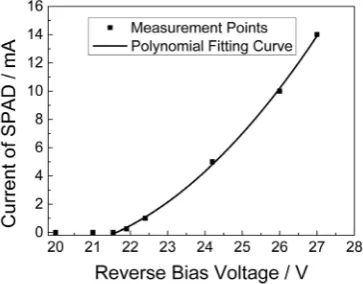
Figure 2. The measurement of I - V characteristic and the 2nd order Po-lynomial fitting curve.
the static I - V behavior, however, since the curve is not continuously differenti-able function, the convergence problems will cause terrible consequences. There- fore, this paper presents a new means to rebuild the character, through making polynomial fitting of the measurement points and encoding the parameters into a VCCS to characterize the static I - V relationship. It has the following advan-tages: 1) The fitting curve is a continuous differentiable function that will avoid the convergence problems in simulation. 2) VCCS is an intuitionistic represen-tation of I-V relationship than voltage generator. 3) The codes input to ISPAD are very simple which have no complicated judgment statement as show in Equation (1)
2
0 1 1 2 2
n n n
a + ∗ +a b a ∗b + ⋅⋅⋅ +a ∗b (1)
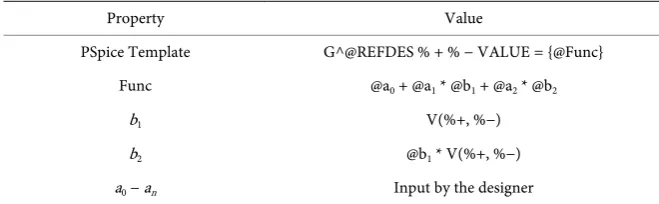
Among them, “bn” is nth order of the voltage ISPAD (n = 1, 2, 3…); “a0” is the constant term, and “an” are the coefficients of corresponding terms (n = 1, 2, 3…). The coefficients are calculated in MATLAB, from which also reducing the computational complexity. The PSpice properties of ISPAD is shown in Table 1. The PSpice Template is written in algebraic equation macro model and the property “Func” represents the fitting polynomial.
DOI: 10.4236/opj.2017.78B001 4 Optics and Photonics Journal
a0 − an Input by the designer
there is no current flow through the diode model. A short pulse source simulates single photon to trigger the “Photon” input port. Once triggered, the switch STRIG gets close due to the voltage division of R1 and R2. Then, the current sharply rises to macroscopic level, which beyond the threshold level of SSELF and makes it closed. With the suppression of QPC, the current will drop slowly but not be cut off unless it is lower than threshold, even STRIG is opened. When the current is lower than the threshold, the SSELF opens. With the charging of capacitances the model returns back to the initial state, waiting for the next photon trigger.
3. Model Simulation and Validation
In the simulation, this paper uses the I - V characteristics of a Si SPAD reported in [11] to construct fitting function. According to the characteristics of the measurement points, we use 2nd order polynomial to fit the static current-vol- tage curve as show in Figure 2. The current limiting resistance RL in PQC is 100 kΩ and the signal extracting resistance RS is 50 Ω.
Figure 3(a) reports the avalanche signal voltage across RS as a function of the time when excess voltage Vex(Vex=VA − VB) increases from 3 V to 5 V. As shown in figure, the avalanche voltage increases as the Vex increases. The phenomenon of avalanche signal is as we expected, a burst rise is generated in the first place, then it drops gradually until the current is lower than threshold. It significantly simulates the self-sustaining and self-quenching process.
Figure 3(b) shows the cathode voltage at the photon pulse frequency of 200 kHz, from which we can observe the recovery process after each avalanche trig-gering. Initially, the voltage is at a high level. Once triggered, the voltage rapidly falls down to a low level and gradually recovers to the high level during a few microseconds due to the recharge of capacitances. This period is the recovery time of every avalanche effect.
4. Conclusion
[image:4.595.208.538.89.191.2]DOI: 10.4236/opj.2017.78B001 5 Optics and Photonics Journal
(a) (b)
Figure 3. (a) The avalanche signal voltage through Rs at different excess voltage Vex; (b) The voltage waveform of cathode at the photon pulse frequency of 200 kHz.
static and dynamic behaviors, including self-sustaining, self-quenching and re-covery process.
References
[1] Meng, X., Tan, C.H., Dimler, S., David, J.P. and Ng, J.S. (2014) 1550 nm In-GaAs/InAlAs Single Photon Avalanche Diode at Room Temperature. Optics Ex-press, 22, 22608-22615. https://doi.org/10.1364/OE.22.022608
[2] Bennett, C.H., Bessette, F., Brassard, G., Salvail, L. and Smolin, J. (1992) Experi-mental Quantum Cryptography. Journal of Cryptology, 5, 3-28.
https://doi.org/10.1007/BF00191318
[3] Kostamovaara, J., Tenhunen, J., Kögler, M., Nissinen, I., Nissinen, J. and Keränen, P. (2013) Fluorescence Suppression in Raman Spectroscopy Using a Time-Gated CMOS SPAD. Optics Express, 21, 31632-31645.
https://doi.org/10.1364/OE.21.031632
[4] Warburton, R.E., McCarthy, A., Wallace, A.M., Hernandez-Marin, S., Hadfield, R.H., Nam, S.W. and Buller, G.S. (2007) Subcentimeter Depth Resolution Using a Single-Photon Counting Time-of-Flight Laser Ranging System at 1550 nm Wave-length. Optics Letters, 32, 2266-2268. https://doi.org/10.1364/OL.32.002266 [5] Soper, S.A., Mattingly, Q.L. and Vegunta, P. (1993) Photon Burst Detection of
Sin-gle Near-Infrared Fluorescent Molecules. Analytical Chemistry, 65, 740-747. https://doi.org/10.1021/ac00054a015
[6] Rech, I., Luo, G., Ghioni, M., Yang, H., Xie, X.S. and Cova, S. (2004) Photon-Ti- ming Detector Module for Single-Molecule Spectroscopy with 60-ps Resolution. IEEE Journal of Selected Topics in Quantum Electronics, 10, 788-795.
https://doi.org/10.1109/JSTQE.2004.833975
[7] Ghioni, M., Cova, S., Zappa, F. and Samori, C. (1996) Compact Active Quenching Circuit for Fast Photon Counting with Avalanche Photodiodes. Review of Scientific Instruments, 67, 3440-3448. https://doi.org/10.1063/1.1147156
[8] Cova, S., Ghioni, M., Lacaita, A., Samori, C. and Zappa, F. (1996) Avalanche Photo-diodes and Quenching Circuits for Single-Photon Detection. Applied Optics, 35, 1956-1976. https://doi.org/10.1364/AO.35.001956
DOI: 10.4236/opj.2017.78B001 6 Optics and Photonics Journal Submit or recommend next manuscript to SCIRP and we will provide best service for you:
Accepting pre-submission inquiries through Email, Facebook, LinkedIn, Twitter, etc. A wide selection of journals (inclusive of 9 subjects, more than 200 journals)
Providing 24-hour high-quality service User-friendly online submission system Fair and swift peer-review system
Efficient typesetting and proofreading procedure
Display of the result of downloads and visits, as well as the number of cited articles Maximum dissemination of your research work