ISSN Online: 2327-5960 ISSN Print: 2327-5952
Increasing the Pensionable Age: What Changes
Are OECD Countries Making? What
Considerations Are Driving Policy?
Hila Axelrad
1, Kevin J. Mahoney
21Center on Aging & Work, Boston College, Chestnut Hill, MA, USA 2School of Social Work, Boston College, Chestnut Hill, MA, USA
Abstract
The average age of retirement used to be low in most countries due to nu-merous policies introduced 30 to 40 years ago which encouraged lower re-tirement ages. However, in response to the growth of the older segment of the population, increased life expectancy, the need for skilled workers, and the precarious financial state of public pension systems, pension reforms have been implemented in the U.S. and Europe, and are now geared towards im-proving employment rates for older workers, increasing retirement ages and pension eligibility. This paper surveys recent changes in retirement age and maps the changes that have occurred in the last decades using data from 34 OECD (The Organization for Economic Co-operation and Development) countries. This paper then reviews the arguments for and against these changes, the criteria for setting a certain retirement age, and the differences in statutory retirement age by gender, occupation, employment status, and other factors unique to particular countries. The purpose of this paper is to analyze current trends in terms of raising the pensionable age.
Keywords
Retirement, Retirement Age, International Comparison, Policy, Early Retirement
1. Introduction
In the last decade, the trend of decreasing retirement age and early exit from the labor market [1] [2] has begun to change [3] [4]. In response to the growth of the older segment of the population and the unstable financial state of many of the public pension systems [5] [6] [7], the costs of early retirement have come under increased scrutiny. Such costs have led to a string of pension reforms in How to cite this paper: Axelrad, H. and
Mahoney, K.J. (2017) Increasing the Pen-sionable Age: What Changes Are OECD Countries Making? What Considerations Are Driving Policy? Open Journal of Social Sciences, 5, 56-70.
https://doi.org/10.4236/jss.2017.57005
Received: May 13, 2017 Accepted:July 9, 2017 Published: July 12, 2017
Copyright © 2017 by authors and Scientific Research Publishing Inc. This work is licensed under the Creative Commons Attribution International License (CC BY 4.0).
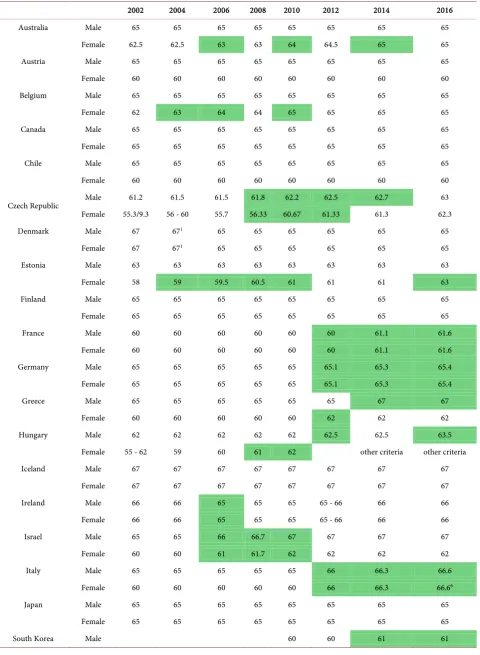
57 Europe since the 1990s, cutting back on pay-as-you-go pension benefits and troducing multi-pillar pension systems with supplemental occupational and in-dividual pensions in addition to the traditional unfunded retirement insurance [8] [9]. Public policy is now geared toward improving employment rates for older workers [3] [4] and extending working years. According to the Organiza-tion for Economic Co-operaOrganiza-tion and Development (OECD), by 2050, the aver-age pensionable aver-age in OECD countries will reach nearly 65 for both sexes: an increase of nearly 2.5 years for men and 4 years for women compared to 2010. For example, Australia, Denmark, France, and Germany implemented measures to increase their normal retirement age from sixty-five to sixty-seven (Table 1) [10]. However, life expectancy is projected to grow at a faster rate than these in-creases in pension age [11]. In general we can say that social security systems in different countries were designed and influenced by each country’s prevailing culture, social priorities and economic capacity at the time [12] [13]. It is crucial to understand differences between country’s retirement ages as well as which cohort(s) will pay for future pensions.
The two major benefits of raising the retirement age are reducing the long term deficit in the social security pension funds and promoting general eco-nomic gains [6]. But doing so can also increase the burden on public programs that provide a safety net for those who cannot, or prefer not to, keep working. In Austria, and Australia, for example, pension reforms increased the age of eligi-bility, reduced early retirement, but also increased disability insurance claims and enrollment in other social insurance programs [14] [15].
The motivations driving all these various governments are similar; people are living longer and therefore, are drawing retirement benefits for longer periods. Extended payouts have placed significant strain on pension programs, and as a result, benefit cuts and higher ages of eligibility for retirement benefits are be-coming the norm. Absent tax increases or benefit cuts, these types of changes may be necessary. Without addressing this issue, governments will not be able to pay for more people needing retirement funds for longer periods of time.
This paper documents the changes that have occurred in the last decade using data from the 34 OECD countries: Australia, Austria, Belgium, Canada, Chile, Czech Republic, Denmark, Estonia, Finland, France, Germany, Greece, Hun-gary, Iceland, Ireland, Israel, Italy, Japan, South Korea, Luxembourg, Mexico, Netherlands, New Zealand, Norway, Poland, Portugal, Slovakia, Slovenia, Spain, Sweden, Switzerland, Turkey, UK and U.S. (Table 1). This manuscript provides a review of the changes in retirement age in those countries, the arguments for and against these changes, the criteria for setting a certain retirement age, and the differences in the statutory retirement age between males and females. The contribution of this paper is bringing together the current changes in the retire-ment ages and analyzing the reasons behind these increases.
Table 1. Changes in retirement age through time.
2002 2004 2006 2008 2010 2012 2014 2016
Australia Male 65 65 65 65 65 65 65 65
Female 62.5 62.5 63 63 64 64.5 65 65
Austria Male 65 65 65 65 65 65 65 65
Female 60 60 60 60 60 60 60 60
Belgium Male 65 65 65 65 65 65 65 65
Female 62 63 64 64 65 65 65 65
Canada Male 65 65 65 65 65 65 65 65
Female 65 65 65 65 65 65 65 65
Chile Male 65 65 65 65 65 65 65 65
Female 60 60 60 60 60 60 60 60
Czech Republic Male 61.2 61.5 61.5 61.8 62.2 62.5 62.7 63
Female 55.3/9.3 56 - 60 55.7 56.33 60.67 61.33 61.3 62.3
Denmark Male 67 671 65 65 65 65 65 65
Female 67 671 65 65 65 65 65 65
Estonia Male 63 63 63 63 63 63 63 63
Female 58 59 59.5 60.5 61 61 61 63
Finland Male 65 65 65 65 65 65 65 65
Female 65 65 65 65 65 65 65 65
France Male 60 60 60 60 60 60 61.1 61.6
Female 60 60 60 60 60 60 61.1 61.6
Germany Male 65 65 65 65 65 65.1 65.3 65.4
Female 65 65 65 65 65 65.1 65.3 65.4
Greece Male 65 65 65 65 65 65 67 67
Female 60 60 60 60 60 62 62 62
Hungary Male 62 62 62 62 62 62.5 62.5 63.5
Female 55 - 62 59 60 61 62 other criteria other criteria
Iceland Male 67 67 67 67 67 67 67 67
Female 67 67 67 67 67 67 67 67
Ireland Male 66 66 65 65 65 65 - 66 66 66
Female 66 66 65 65 65 65 - 66 66 66
Israel Male 65 65 66 66.7 67 67 67 67
Female 60 60 61 61.7 62 62 62 62
Italy Male 65 65 65 65 65 66 66.3 66.6
Female 60 60 60 60 60 66 66.3 66.66
Japan Male 65 65 65 65 65 65 65 65
Female 65 65 65 65 65 65 65 65
59
Continued
Female 60 60 61 61
Luxembourg Male 65 65 65 65 65 65 65 65
Female 65 65 65 65 65 65 65 65
Mexico Male 65 65 65 65 65 65 65 65
Female 65 65 65 65 65 65 65 65
Netherlands Male 65 65 65 65 65 65 65.2 65.5
Female 65 65 65 65 65 65 65.2 65.5
N. Zealand Male 65 65 65 65 65 65 65 65
Female 65 65 65 65 65 65 65 65
Norway Male 67 67 67 67 67 67 67 67
Female 67 67 67 67 67 67 67 67
Poland Male 65 65 65 65 65 65 65 65
Female 60 60 60 60 60 60 60 60
Portugal Male 65 65 65 65 65 65 66 66.2
Female 65 65 65 65 65 65 66 66.2
Slovakia Male 60 62 62 62 62 62 62 62
Female 53 - 572 62 55.3 56.8 623 j623 623 62
Slovenia Male 58 - 654 58 - 654 58 - 654 62.5 58 - 654 58 - 654 65 65 Female 54 - 574 54.7 - 624 55.3 - 62.34 56 56.7 - 634 57.3 - 634 65 65
Spain Male 65 65 65 65 65 65 65.2 65.3
Female 65 65 65 65 65 65 65.2 65.3
Sweden Male 65 65 65 65 65 65 65 65
Female 65 65 65 65 65 65 65 65
Switzerland Male 65 65 65 65 65 65 65 65
Female 63 63 64 64 64 64 64 64
Turkey Male 60 60 60
Female 58 58 58
UK Male 65 65 65 65 65 65 65 65
Female 60 60 60 60 60 61 62 63
U.S. Male 65 65 65 65 66 66 66 66
Female 65 65 65 65 66 66 66 66
The gray shading indicates an increase in Pensionable Age. (1) 65 from July 2004. (2) According to the number of children raised. (3) The retirement age for certain women is rising gradually to age 62 by 2015. (4) According to the years of contribution. (5) 67, changed to 65 from July04. (6) Lower age (65 and seven months) for women in the private sector. Source: Processed by the authors by using data from Social Security U.S.A (International Social Security Association) [57].
2. How Was the Retirement Age Determined?
Otto von Bismarck, the Prussian chancellor who implemented the world’s first modern welfare state in the 1880, was the first major government official to spell out a new role for government in securing the welfare of wage earners after their careers in a highly organized, industrial society. This new ideology spread through Europe before World War I, and arrived in the U.S. in 1935 [16].
There was no scientific or gerontological basis for setting the retirement age in the past [6]. Factors such as cost, life expectancy, ability to work and find em-ployment were considered. Pension age was set at seventy when Bismarck im-plemented the pension insurance in 1989 [17], later on and until 1972, retire-ment was mandatory at the age of 65 [18]. In the US the age of sixty five was se-lected, the reason for selecting the age of 65 was simply general consensus [6] as many other institutions like the union army veterans, post office letter carriers and clerks, Railroad etc. grant pensions had selected sixty-five years of age [19]. Additionally, the US, as many other countries, experienced declining labor force participation rates of men older than sixty-four since the end of the nineteenth
century [19]. The prevailing notion among different researchers and policy
makers was that worker’s productivity declines significantly after the age of 60 or 65 as physical ability, mental alertness, and cooperativeness tend to fail [19] [20] so the retirement age was set between these ranges, although current studies showed that older workers are not necessarily less productive [21].
However, it should be remembered that full retirement is not always based solely on age. Qualifying to receive an old-age benefit is usually conditional on two requirements: attainment of a specified pensionable age and completion of a specified period of contributions or covered employment (for example Greece, Luxemburg, U.S.), since programs are financed entirely or largely from con-tributions (usually a percentage of earnings) made by employers, workers, or both. These contributions are compulsory in most instances for defined catego-ries of workers and their employers.
Some old-age pension systems account for periods during which persons, for reasons beyond their control, were not in covered employment by awarding cre-dits toward the required minimum contribution period. Crecre-dits can be awarded for reasons such as disability, involuntary unemployment, military service, edu-cation, child raising, or training. In the UK, for example, contributions may be credited for periods the insured cared for a child or an elderly or disabled rela-tive or if the insured received certain benefits. Other systems disregard these pe-riods and may proportionately reduce benefits for each year below the required minimum; for example, in Poland, non-contributory years (meaning years spent raising children or while receiving certain benefits) must not exceed 33.3% of contributory years. Persons with only a few years of coverage may receive a re-fund of contributions or a settlement in which a proportion of the full benefit or earnings is paid for each year of contribution.
61 (Czech Republic, Poland and Spain). For example in Spain, the required period of contribution is gradually rising from 35 years and 6 months to 37 years by 2027. The changes in the required period of contribution may also differ by gender—in Czech Republic the coverage years are gradually rising from 30 to 35 years for men, and at least 20 years of coverage for women (with no expected raise). In Poland men will need at least 25 years of coverage, women will need at least 21 years of coverage, and this is gradually rising to 25 years by 2022.
Another common requirement is total or substantial withdrawal from the la-bor force. Some countries require complete or substantial retirement to become eligible for a pension (for example, Luxembourg and Portugal). Other countries pay a retirement pension at a certain age regardless of whether workers retire or not (Canada, Finland, Hungary, Italy, Norway). Other countries use a hybrid system with a retirement test, under which the benefit may be withheld or re-duced for those who continue working, depending on the amount of earnings or, less often, the number of hours worked (Ireland and Spain). In the U.S., for ex-ample, Social Security beneficiaries age 62, age of earliest eligibility, until the age of eligibility for full benefits, have their benefits reduced if their earnings are above a certain threshold, but after the age of full retirement benefits, there is no
penalty for continuing to work1. Universal systems usually do not require
re-tirement from work for receipt of a pension. On the other hand, provident funds, which were created to provide financial security and stability, pay the benefit when the worker is temporarily or no longer fit to work or at retirement.
3. The Criteria for Setting a Certain Retirement Age
The old-age benefit in most countries (for example Switzerland and Turkey) is a wage-related, periodic payment. However, some countries pay a universal fixed amount that bears no relationship to any prior earnings; others supplement their universal pension with an earnings-related pension. Provident fund systems make a lump-sum payment (Poland) usually a refund of employer and employee contributions plus accrued interest. In programs that have individual accounts, options for benefits include purchasing an annuity (Estonia) making withdraw-als from an account regulated to guarantee income for an expected lifespan; programmed withdrawals, or a combination of the two; and deferred annuity [22]. But age is not the only criteria for setting an official age for receiving re-tirement benefits: Public pension schemes sometimes distinguish on the basis of gender. Women often have earlier statutory retirement ages [23], even though they generally have a longer life expectancy [22]. Reduced retirement age for women can be seen in Israel [24] and Turkey, but no difference in the retirement age and conditions in countries like Belgium, Finland and the Netherlands. In other countries there are no differences between men and women in retirement age, but there are differences in terms and conditions—for example, the required years of coverage (as in Poland).
Among the rationales for reduced age of eligibility for retirement benefits for females is the fact that wives are typically a few years younger than their hus-bands. Because couples often prefer to retire at the same time such policies would make the wife’s benefits available at an earlier age [6]. Such policies also assume that retirement benefits should be available at an earlier age for working women because they face age barriers in the labor market more frequently and at earlier ages then do working men [6]. In some countries, the reason for reduced retirement age is being a mother. The retirement age is reduced according to the number of children raised (Czech Republic, Turkey) or reduced for mothers who have children with disabilities (Turkey).
Although the norm has been for the differential to be about five years, there is now an emerging international trend toward equalizing the statutory retirement age [22] presumably due to women’s gains in equality rights. Additionally, the retirement age takes into account life expectancy, which is higher for women [25]. Thus, since men tend to work more years and their life expectancy is shorter than women’s, they receive a pension for fewer years compared to women [26].
In some instances, eligibility for pension benefits is determined by resident status or citizenship. The person must be a resident of the country for a certain number of years (for example, Australia, Denmark, Estonia, the Netherlands and Sweden). Universal old-age pension is an example for a system that usually does not require a minimum period of covered employment or contributions, but do require a minimum period of prior residence (Denmark, Iceland).
Some countries, such as Germany and Spain, pay a full pension before the regular retirement age if the applicant experienced involuntary unemployment for a period near retirement age. In Portugal, there is reduced retirement age for unemployed persons who are no longer entitled to receive unemployment bene-fits. Also the type of employment can effect retirement age. In Turkey, for exam-ple, there are different conditions placed on the minimum number of days of paid contributions for civil servants and self-employed (9000 days of paid con-tributions, instead of 7200 days).
Another criterion is disability when some countries pay a full pension before the regular retirement age if the applicant has an assessed degree of disability (Germany, U.S.).
Occupation is relevant in other countries that pay a full pension before the regular retirement age, if the worker works in an especially arduous, strenuous environment or an unhealthy or hazardous occupation [23]. For example, the qualifying conditions are reduced for persons, who have worked in hazardous or dangerous work (Hungary, Spain). Other occupations with reduced ages of eli-gibility include miners (Poland), some categories of seamen (Iceland) and sea-farers and civil aviation flight crews (Belgium).
4. Reasons for Increasing the Retirement Age
63 reflected in longer life expectancies [27] and therefore longer periods drawing on pensions. Other reasons that are often mentioned are the crisis in public pension programs, issues of supply and demand in the labor market, savings and retire-ment security of the older population, and the improved education level which is correlated with the ability to work longer.
4.1. The Demographic Challenge
Longer life expectancies [6] [28] are used as a justification for increasing retire-ment age as they are putting a burden on the financing system because benefits are being paid out for a longer period than in the past. In addition, fewer work-ers are dying before reaching retirement age; these workwork-ers had been a “free lunch” for the retirement system. Now fewer workers contribute without receiv-ing at least some benefits. Increasreceiv-ing the retirement age will reduce the amount of time in which benefits are paid out, and increase the probability that a worker will receive no benefit, thus easing the stress in the system [10].
Many countries are facing this challenge of a rapidly ageing population. Life expectancy increased continuously over the past few decades; the period of time that seniors live after reaching retirement age grew from 13.4 years for men in 1958 to 18.5 in 2010. The OECD analysis of United Nations data projects life expectancy to be 20.3 years in retirement, even after the higher retirement ages are phased in [29].
Life-expectancy adjustment of the pension benefits can be seen as a substitute for increases in the pension age, in that many people can voluntarily work longer as life expectancy increases to make up for the lower yearly pension payments [30]. In the US, the amendment increasing the Full Retirement Age by two years was adopted in 1983, though the change only took effect 2003, and the full in-crease to 67 will not be realized until 2027 [31]. Phasing in the inin-creased age of retirement gave people time to plan ahead. Furthermore, the change had no immediate effect and did not affect current retirees; all of these factors made it more politically palatable [32].
4.2. Crisis in Public Pension Programs
Public pension programs in many OECD countries are in financial trouble [6] part of this is because when pension systems were first implemented benefits were paid to individuals who had not contributed over a lifetime. But some of the problem came because many countries chose not to pfund. Pension re-forms in some OECD countries [7] [33], link contributions of individuals and benefit rights accumulation.
4.3. Greater Demand for Older Workers
Older workers are in greater demand because fertility was low in subsequent generations and the talents of older workers are needed [6] [28]. Additionally, a decrease in physically demanding jobs and improved educational levels [34] al-lows many people to work longer [10] [22]. Health is better among the elderly than in previous generations, thereby allowing a longer work life for many [10]. The long-predicted wave of baby boomer retirements has begun to hit compa-nies, leaving employers scrambling to find replacements for their departing six-ty-something workers [35].
The demand for skilled older workers will remain high given that there are fewer younger workers to replace them [10]. On the other hand, many older in-dividuals are underutilized relative to their potential productivity, and a higher pensionable age could contribute to a better and longer use of the skills and
abil-ities of older workers [10] [36].The elderly stand to gain in noneconomic ways
because employment may contribute to an older person’s mental acuity and provide a sense of usefulness and social connection [10].
Whereas there had been some resistance from employers, Conen, Henkens and Schippers (2014) [37] who analyzed case studies among Dutch organizations found that employers have started to adjust to the rise in the official retirement age in terms of health and safety regulations, and increasing training for senior workers [38].
4.4. Saving and Retirement Security
One challenge of an aging population may be a growing number of increasingly long-lived individuals who outlive their retirement resources and will then rely on the social safety net to meet late-life needs. Raising retirement ages is one of the options for enhancing retirement security [39]. Working longer should im-prove the retirement savings of individuals, reducing the possibility of exhaust-ing their resources in old age [10] [40].
4.5. Improved Education Level
Education levels have improved in labor markets around the world [34], re-search indicates that better educated people have lower morbidity rates from the most common acute and chronic diseases, independent of basic demographic and labor market factors [22], and a correlation exists between higher education and the ability to work longer [10]. Therefore, and as a result, the increase in the workers’ education level could be a justification for increasing the retirement age.
The concept of active ageing implemented by the European Union suggested that older workers should have sufficient access to further education and train-ing to help them remain active in the labor market [41].
re-65 sources that could be split between workers and retirees [10].
5. Early Retirement
There are workers who choose, for different reasons, to retire before the statuto-ry retirement age is reached. “Early retirement” is an opportunity for phased reduction in the retirement benefits available earlier than the normal retirement age [42]. It is an opportunity to receive some benefits earlier. A reduced pension, in some instances, may be claimed up to five years before the statutory retire-ment age [22]. For example in Japan the pension is reduced by 42% to 11% (de-pending on the age at which the pension is awarded) when retiring before the official retirement age. On the other, in the US pension benefits is reduced for each month the insured is younger than the full retirement age, however the pension is increased by 8% a year for each year after one reaches full retirement age the insured defers retirement -up to the age of 70 years old.
Early retirement has broader implications for organizations and society as it represents an “off time” event (i.e., the timing of the event is inconsistent with the societal norms). As a result, from the human resource management perspec-tive, organizations and society, more broadly, must account for the influence that early retirements have on other members of the organization or society [43]. Early retirement is also seen as a much appreciated social achievement which increases personal well-being, particularly among employees who suffer from work-related health problems [44].
A procedures distinction is made between workers that retire voluntarily, usually due to a strong preference for retirement, and involuntary retirees, who are forced to retire by such factors as health problems, weak employment condi-tions, and organizational pressures that induce them to leave their jobs [45].
As times changed, policymakers have started to increase not only the eligibili-ty age of retirement, but also the eligibilieligibili-ty age for early retirement [22]. For example, in Spain involuntary early retirement age is gradually rising from the age 61 and two months to age 63 by 2027 and voluntary early retirement age is rising from the 63 and two months to age 65 by 2027.
6. Arguments against Increasing the Retirement Age
The policy of increasing retirement age encountered in a widespread resistance from unions [46], women’s rights organizations and others. In addition to dis-puting many of the contentions about increasing the retirement age, and the as-sumptions upon which they are made, the opponents’ claim that the reduced benefits will increase the poverty rate because many of those at risk—the poor, the less educated, those with health problems, and those who work in physically demanding jobs—have no choice but to retire early [10].
to reap fewer benefits [10]. In the U.S. for example, the average for the full pop-ulation hides crucial differences between racial groups in quality of life, ability to work and longevity. Increasing the normal retirement age will make it more dif-ficult for some Americans to experience a healthy and active retirement; Blacks will be disproportionately affected, in part because they are more likely to velop adverse health conditions that limit their ability to work and to report de-clining health. The average black American will experience physical limitations before the official retirement age of 67 [47].
Another reason for opposition is that older workers have more difficulty finding new employment and, when they do, often earn less than they did in previous jobs [10]. Women’s rights organizations point out that women are dis-criminated against in the workplace [48]: they have a more difficult time getting a job, and when they do, they are paid less than a man doing the same work. These organizations feel that compelling women to work additional years will sentence them to more years of being a member of the working poor communi-ty, compelling many to rely on Social Security to supplement their income [32].
7. Summary and Conclusions
The growth of the older segment of the population together with increased life expectancy led policymakers to rethink the length of working life and pension eligibility age. As a result, in 24 of the 34 countries we examined, pension re-forms increasing retirement ages were implemented or planned to be imple-mented in the near future.
Current data indicate that raising the retirement age may prevent serious challenges to the pension systems. In a situation where life expectancy is rising and people are living longer—and generally in good health—many older indi-viduals want to or need to work. It should be also desirable from the employers’ point of view, as shortage of workers becomes a serious problem in many places [49]. It therefore may be necessary to increase the retirement age.
With that being said, we should take into consideration the employers’ point of view, as some employers may associate their ageing staff with higher labor costs and lower productivity [50] [51] while others are realizing their depen-dence on the skills of older workers. Employers that expect a larger cost- prod-uctivity gap might consider wage subsidies an effective measure to extend work-ing lives [50].
67 Countries can also implement other measures, together with or instead of in-creasing the retirement age. For example Sweden has not increased retirement age in recent years [52] [53] but created incentives for workers to remain em-ployed longer [54]. Such incentives, like canceling the concept of “full pension” and implementing a new formula in which additional years one is gainfully em-ployed increase the pension that person earn [55], or the option of drawing part of the worker pension while (s)he continues to work part-time, with his remain-ing pension entitlement continuremain-ing to grow [56], might prolong workremain-ing life without implementing a raise in the retirement age.
The implications for policy makers are clear: first, there is a need to support changes that increase confidence in the solvency of the pension system while maintaining adequate protections; second, there is a need to analyze how each proposed change affects vulnerable populations and advocate for their protec-tion. Finally, there is a need to educate and help people understand any changes in the law so they can plan ahead and decide about the optimal time to retire given their particular needs and preferences.
Acknowledgements
The authors would like to extend their sincere appreciation to Dr. Matthew S. Rutledge for his valuable comments and suggestions to improve the quality of the paper.
References
[1] Deacon, B. (2000) Eastern European Welfare States: The Impact of the Politics of Globalization. Journal of European Social Policy, 10, 146-161.
https://doi.org/10.1177/a012487
[2] D’addio, A.C. and Von Nordheim, F. (2014) Towards an Integrated Agenda to De-liver Effective Higher Retirement Ages: An Issues Note from the Pension Perspec-tive. Paper Presented at the Background Note for the Workshop on “Delivering Longer Working Lives and Higher Retirement Ages”, Brussels.
[3] Fisher, G.G., Chaffee, D.S. and Sonnega, A. (2016) Retirement Timing: A Review and Recommendations for Future Research. Work, Aging and Retirement, 2, 230- 261. https://doi.org/10.1093/workar/waw001
[4] Robinson, P. (2005) Working Later: Raising the Effective Age of Retirement Insti-tute for Public Policy Research.
[5] Disney, R. (2000) Crises in Public Pension Programmes in OECD: What Are the Reform Options? The Economic Journal, 110, 1-23.
https://doi.org/10.1111/1468-0297.00505
[6] Moore, K.L. (2001) Raising the Social Security Retirement Ages: Weighing the Costs and Benefits. Arizona State Law Journal, 33, 543.
[7] Wagner, H. (2005) Pension Reform in the New EU Member States: Will a Three- Pillar Pension System Work? Eastern European Economics, 43, 27-51.
[8] Börsch-Supan, A.H. (2012) Entitlement Reforms in Europe: Policy Mixes in the Current Pension Reform Process. NBER, Working Paper No. 18009.
https://doi.org/10.3386/w18009
Intro-duction to the Special Issue. Work, Aging and Retirement, 1, 237-242.
https://doi.org/10.1093/workar/wav017
[10] Templin, B.A. (2011) Social Security Reform: Should the Retirement Age Be In-creased? Oregon Law Review, 89, 1179. http://ssrn.com/abstract=1720402
[11] Organization for Economic Co-Operation and Development (2011) Pensionable Age and Life Expectancy, 1950-2050. OECD Pension at a Glance. Organization for Economic Co-Operation and Development, Paris, 19-37.
[12] Fehr, H. and Uhde, J. (2013) On the Optimal Design of Pension Systems. Empirica, 40, 457-482. https://doi.org/10.1007/s10663-013-9214-2
[13] Podger, A., Stanton, D. and Whiteford, P. (2014) Designing Social Security Systems: Learning from Australia and Other Countries. Public Administration and Develop-
ment, 34, 231-250. https://doi.org/10.1002/pad.1689
[14] Staubli, S. and Zweimüller, J. (2012) Does Raising the Retirement Age Increase Em-ployment of Older Workers? University of Zurich Department of Economics, Zürich.
[15] Atalay, K. and Barrett, G.F. (2015) The Impact of Age Pension Eligibility Age on Retirement and Program Dependence: Evidence from an Australian Experiment.
Review of Economics and Statistics, 97, 71-87.
https://doi.org/10.1162/REST_a_00443
[16] Atchley, R.C. (1982) Retirement as Social Institution. Annual Review of Sociology, 8, 263-287. https://doi.org/10.1146/annurev.so.08.080182.001403
[17] Börsch-Supan, A. and Wilke, C.B. (2004) The German Public Pension System: How It Was, How It Will Be (No. W10525). National Bureau of Economic.
http://www.nber.org/papers/w10525
[18] Berkel, B. and Börsch-Supan, A. (2004) Pension Reform in Germany: The Impact on Retirement Decisions. FinanzArchiv: Public Finance Analysis, 60, 393-421.
https://doi.org/10.1628/0015221042396096
[19] Costa, D.L. (1998) The Evolution of Retirement: An American Economic History, 1880-1990. University of Chicago Press, Chicago, 6-31.
https://doi.org/10.7208/chicago/9780226116228.001.0001
[20] Lazear, E.P. (1979) Why Is There Mandatory Retirement? The Journal of Political Economy, 87, 1261-1284. https://doi.org/10.1086/260835
[21] Axelrad, H. and James, J.B. (2016) Employers’ Attitudes toward Older-Worker Job Seekers: A Comprehensive Review with Recommendations for Action. Emerald Group Publishing Limited, Bingley, 489-512.
https://doi.org/10.1108/978-1-78635-448-820161020
[22] Cutler, D.M. and Lleras-Muney, A. (2012) Education and Health: Insights from In-ternational Comparisons (No. w17738). National Bureau of Economic Research. [23] Holzmann, R. (2000) The World Bank Approach to Pension Reform. International
Social Security Review, 53, 11-34. https://doi.org/10.1111/1468-246X.00061
[24] Borowski, A. (2015) Israel’s Long-Term Care Social Insurance Scheme after a Quar- ter of a Century. Journal of Aging and Social Policy, 27, 195-214.
https://doi.org/10.1080/08959420.2015.1022101
[25] Organization for Economic Co-Operation and Development (2016) Life Expectancy at Birth. Organization for Economic Co-Operation and Development, Paris. [26] Top, D.C. and Savu, L. (2014) Considerations Regarding the Equalization of the
Re-tirement Age for Men and Women at 65 Years. Fiat Iustitia, 8, 240-243.
69
Challenge: Fewer Children and Living Longer. Social Security Bulletin, 66, 37-45. [28] Rürup, B. (2002) The German Pension System: Status Quo and Reform Options.
Social Security Pension Reform in Europe. University of Chicago Press, Chicago,
137-170. http://www.nber.org/books/feld02-2
https://doi.org/10.7208/chicago/9780226241913.003.0007
[29] Brandon, E. (2010) Why the Retirement Age Is Increasing? U.S. News and World Report, Washington DC, 15 November 2010.
[30] Olsen, H. and Manfredi, T. (2013) Ageing and Employment Policies: Norway 2013: Working Better with Age. Organization for Economic Co-Operation and Develop-ment, Paris.
http://www.oecd.org/els/norway-2013-9789264201484-en.htm
[31] Olshansky, S.J., Goldman, D.P. and Rowe, J.W. (2015) Resetting Social Security.
Daedalus, 144, 68-79. https://doi.org/10.1162/DAED_a_00331
[32] Yeshiva World News–Israel Desk, Jerusalem (2014) Israel Likely to Raise Retire-ment Age in 2015 State Budget. The Yeshiva World News, Brooklyn, 26 February 2014.
http://www.theyeshivaworld.com/news/headlines-breaking-stories/215523/israel-lik ely-to-raise-retirement-age-in-2015-state-budget.html
[33] Settergren, O. (2001) The Automatic Balance Mechanism of the Swedish Pension System. Wirtschaftspolitische Blätter, 4, 339-349.
[34] Osterman, P. (2008) College for All? The Labor Market for College Educated Workers. Change the Magazine of Higher Learning, 40, 22-31.
[35] Tishman, F.M., Van, L.S. and Bruyère, S.M. (2012) Employer Strategies for Res-ponding to an Aging Workforce. Rutgers, New Brunswick.
http://www.heldrich.rutgers.edu/sites/default/files/products/uploads/NTAR_Emplo yer_Strategies_Report.pdf
[36] Axelrad, H., Luski, I. and Malul, M. (2016) Behavioral Biases in the Labor Market, Differences between Older and Younger Individuals. Journal of Behavioral and Ex-perimental Economics, 60, 23-28. https://doi.org/10.1016/j.socec.2015.11.003
[37] Conen, W., Henkens, K. and Schippers, J. (2014) Ageing Organizations and the Ex-tension of Working Lives: A Case Study Approach. Journal of Social Policy, 43, 773- 792. https://doi.org/10.1017/S0047279414000336
[38] Brunello, G. and Comi, S. (2013) The Side Effect of Pension Reforms on Training: Evidence from Italy. IZA Discussion Papers 7755. Institute for the Study of Labor (IZA). http://hdl.handle.net/10419/89976
[39] Institute of Medicine (US) Committee on the Long-Run Macroeconomic Effects of the Aging U.S. Population (2012) Aging and the Macroeconomy: Long-Term Im-plications of an Older Population. Financial Analysts Journal, 69, 106-107.
[40] Munnell, A.H. and Steven, S.A. (2008) Rounding out the Picture. Brookings Institu-tion Press, Washington DC, 142-148.
http://www.jstor.org/stable/10.7864/j.ctt6wph6r
[41] European Commission (2001) Guidelines for Member States’ Employment Policies for the Year 2002. European Commission, Brussels, 50.
[42] Korczyk, S.M. and Rix, S. (2004) Is Early Retirement Ending? American Association of Retired Persons Public Policy Institute, Washington DC.
[43] Wang, M. and Shultz, K.S. (2010) Employee Retirement: A Review and Recom-mendations for Future Investigation. Journal of Management, 36, 172-206.
https://doi.org/10.1177/0149206309347957
So-cial Networks. In Discoveries in the Economics of Aging, University of Chicago Press, 225-250. https://doi.org/10.1515/9783110295467.337
[45] Fernández, J., Alcover, C. and Crego, A. (2013) Psychosocial Profiles of Early Reti-rees Based on Experiences during Post-Working Life Transition and Adjustment to Retirement. Revista De Psicología Social, 28, 99-112.
https://doi.org/10.1174/021347413804756032
[46] Ebbinghaus, B. and Hassel, A. (2000) Striking Deals: Concertation in the Reform of Continental European Welfare States. Journal of European Public Policy, 7, 44-62.
https://doi.org/10.1080/135017600343269
[47] Ghilarducci, T. and Moore, K. (2015) The Racial Morbidity Gap: Implications for Raising the Retirement Age.
http://www.economicpolicyresearch.org/images/docs/research/retirement_security/ Moore_Racial_Morbidity_Gap.pdf
[48] Mesa, A.A. and Montecinos, V. (1999) The Privatization of Social Security and Women’s Welfare: Gender Effects of the Chilean Reform. Latin American Research Review, 34, 7-37.
[49] Fernandes, D. (2016) Baby Boomer Retirements May Slow Mass. Economic Growth. Boston Globe, Boston, 17 February 2016.
[50] Henkens, K. and Schippers, J. (2012) Employers’ Attitudes and Actions towards the Extension of Working Lives in Europe. International Journal of Manpower, 33, 648-665. https://doi.org/10.1108/01437721211261804
[51] Henkens, K. and Schippers, J. (2008) Labor Market Policies Regarding Older Workers in the Netherlands. In: Taylor, P., Eds., Ageing Labor Forces: Promises and Prospects, Edward Elgar, Cheltenham, UK.
[52] Weaver, K. and Willén, A. (2014) The Swedish Pension System after Twenty Years: Mid-Course Corrections and Lessons. OECD Journal on Budgeting, 13, 1A.
https://doi.org/10.1787/budget-13-5jxx3sx58x9t
[53] Redaymulvey, G. (2000) Gradual Retirement in Europe. Journal of Aging and Social Policy, 11, 49-60. https://doi.org/10.1300/J031v11n02_06
[54] Laun, T. and Wallenius, J. (2015) A Life Cycle Model of Health and Retirement: the Case of Swedish Pension Reform. Journal of Public Economics, 127, 127-136.
https://doi.org/10.1016/j.jpubeco.2013.11.002
[55] Olofsson, G. (2001) Age, Work and Retirement in Sweden-Views, Policies and Strategies of Key Actors. Proceedings of the Swedish Case for the “Millennium Project” Conference, Tokyo, 29-30 November 2001, 29-30.
[56] Barr, N. (2006) Pensions: Overview of the Issues. Oxford Review of Economic Poli-cy, 22, 1-14. https://doi.org/10.1093/oxrep/grj001
[57] Social Security Administration (US).
Submit or recommend next manuscript to SCIRP and we will provide best service for you:
Accepting pre-submission inquiries through Email, Facebook, LinkedIn, Twitter, etc. A wide selection of journals (inclusive of 9 subjects, more than 200 journals)
Providing 24-hour high-quality service User-friendly online submission system Fair and swift peer-review system
Efficient typesetting and proofreading procedure
Display of the result of downloads and visits, as well as the number of cited articles Maximum dissemination of your research work