The analytical framework for identifying
and benchmarking systemically
important financial institutions in Europe
Karkowska, Renata
University of Warsaw
September 2014
Online at
https://mpra.ub.uni-muenchen.de/58819/
1
UW Faculty of Management
Working Paper Series
No 4 / September 2014
T
HE
A
NALYTICAL
F
RAMEWORK
F
OR
I
DENTIFYING
A
ND
B
ENCHMARKING
S
YSTEMICALLY
I
MPORTANT
F
INANCIAL
I
NSTITUTIONS
I
N
E
UROPE
Renata Karkowska
University of Warsaw, Faculty of Management Poland
JEL classification: C1, F36, F65, G21, G32, G33
2
UW FM Working Paper Series are written by researchers employed at the Faculty of Management of UW and by other economists, and are published by the Faculty.
DISCLAIMER: An objective of the series is to get the research results out quickly, even if their presentations are not fully polished. The findings, interpretations, and conclusions expressed in this Working Paper are those of their author(s) and do not necessarily the views of the Faculty of Management of UW.
© By the Author(s). The papers are written by the authors and should be cited accordingly.
Publisher: University of Warsaw, Faculty of Management Press Address:
Str.: Szturmowa 1/3; 02-678 Warsaw, Poland Telephone: +48 22 55 34 164
Fax: +48 22 55 34 001
This paper can be downloaded without charge from:
http://www.wz.uw.edu.pl/serwisy,witryna,1,dzial,326.html
Information on all of the papers published in the UW Faculty of Management Working Paper Series can be found on Faculty of Management Website at:
http://www.wz.uw.edu.pl/serwisy,witryna,1,dzial,326.html
3
The Analytical Framework For Identifying
And Benchmarking Systemically Important
Financial Institutions In Europe
Renata Karkowska1
University of Warsaw, Faculty of Management Poland
ABSTRACT
The aim of this article is to identify systemically important banks on a European scale, in accordance with the criteria proposed by the supervisory authorities. In this study we discuss the analytical framework for identifying and benchmarking systemically important financial institutions. An attempt to define systemically important institutions is specified their characteristics under the existing and proposed regulations. In a selected group of the largest banks in Europe the following indicators ie.: leverage, liquidity, capital ratio, asset quality and profitability are analyzed as a source of systemic risk. These figures will be confronted with the average value obtained in the whole group of commercial banks in Europe. It should help finding the answer to the question, whether the size of the institution generates higher systemic risk? The survey will be conducted on the basis of the financial statements of commercial banks in 2007 and 2010 with the available statistical tools, which should reveal the variability of risk indicators over time. We find that the largest European banks were characterized by relative safety and without excessive risk in their activities. Therefore, a fundamental feature of increased regulatory limiting systemic risk should understand the nature and sources of instability, and mobilizing financial institutions (large and small) to change their risk profile and business models in a way that reduces the instability of the financial system globally.
JEL classification: C1, F36, F65, G21, G32, G33
Keywords: banking, Systematically Important Financial Institutions, SIFI, systemic risk, liquidity, leverage, profitability
1
4
Contents
1. INTRODUCTION……….5
2. CONCEPT AND THE ROLE OF SYSTEMATICALLY IMPORTANT INSTITUTIONS………5
2.1 Criteria for the classification and categories of systematically important institusions………..7
3. RESEARCH METHODOLOGY………...12
4. RESULTS……….13
5. CONCLUSIONS………..17
5 1 INTRODUCTION
Crisis of 2007-2008 revealed a serious lack of information on the size and condition of the financial
markets and institutions at the sector level. It turned out that the supervisory authorities do not have
sufficient sources to identify global markets and mega financial institutions of systemic importance -
Systematically Important Financial Institutions (SIFI’s). Determination of systemically important
institutions has become a priority of regulatory authorities, but the problem turned out to be more
difficult than previously thought. Statements of practitioners and academics present position, that the
amount of the assets is not the only prerequisite for systemically important institutions category.
Cooperation between the Financial Stability Board, Committee on the Global Financial System, Basel
Committee on Banking Supervision, the Committee of Payment and Settlement Systems aimed to
identify global systemically important institutions, and thereby reduce systemic risk.
Given the above, the study is to compare the risks taken in the largest banks (in terms of total assets) out of the other banks in Europe. The study was put hypothesis that the risk taken by the largest banks in Europe is not higher than in other banks. Therefore, we should pay special attention to look at smaller banks, which dealing as the group may contribute much more to the instability of banking sector. More important will be the risk of SIFI’s substitutability of their services and international relations, in the light of the potential danger of bankruptcy of one of the largest banks.
The rest of the paper is organized as follows. In section 2 we present SIFI definition and terminology. In section 3 we show research methodology. In section 4 we calculate risk ratio for the largest banks in Europe. In section 5, we discus results. Finally, section 5 concludes.
2 CONCEPT AND ROLE OF SYSTEMICALLY IMPORTANT NSTITUTIONS
From the point of view of present analysis it seems important issue of the definition of systemically
important banks. In recent years the doctrine of the bank "too big to fail" is based on the belief that
some banks because of their size and importance of the financial sector should be funded in the event
of risk of bankruptcy. This is due to the belief that the collapse of one bank could cause serious
disturbances in the functioning of the financial system. The existence of an institution whose activities
have a significant share in the domestic or international market, means that any disruption of the
functioning of the entity prevents proper functioning of other entities. What in the further
consequently cause accumulation of systemic risks and problems with public finances of countries.
6
phenomenon of financialisation of the economy, ie separation of rotation of cash transactions from material goods and services markets within the meaning of real economic transactions,
risks generated by Too Big to Fail (TBTF) institutions.
Until September 2008, the general principle of Too Big To Fail was valid in relation to global capital
groups - too big to fail, or to be able to finance its liquidation. The costs of bankruptcy systemically
important institutions are so heavy that they can not be covered by public finance of home,or host
country.
The concept of systemically important institutions established in the course of deliberations on
identifying the situation when and what kind of financial institution may lead to the materialisation of
systemic risk. Mega-institutions have such a large network of connections that bankruptcy would
cause significant disturbance of the whole financial system.
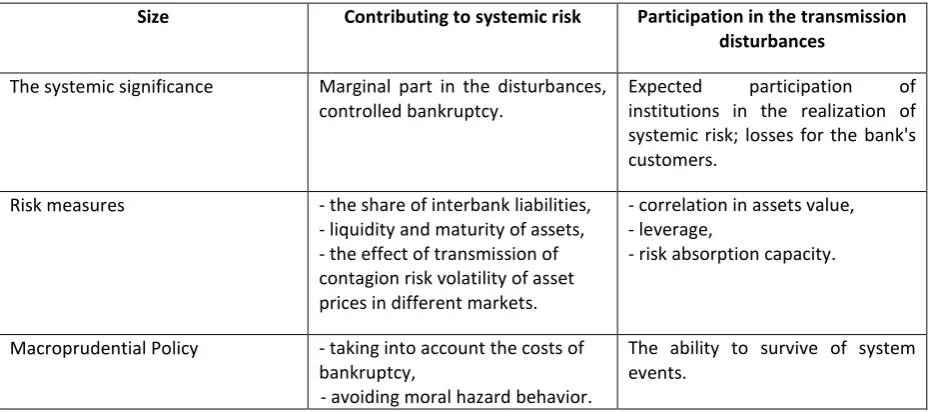
A proposal for the concept of systemically important institutions is presented in Table 1 Weistroffer
[image:7.595.66.531.421.627.2](2011).
Table 1 The size of the concept of systemically important financial institutions
Size Contributing to systemic risk Participation in the transmission
disturbances
The systemic significance Marginal part in the disturbances, controlled bankruptcy.
Expected participation of institutions in the realization of systemic risk; losses for the bank's customers.
Risk measures - the share of interbank liabilities, - liquidity and maturity of assets, - the effect of transmission of contagion risk volatility of asset prices in different markets.
- correlation in assets value, - leverage,
- risk absorption capacity.
Macroprudential Policy - taking into account the costs of bankruptcy,
- avoiding moral hazard behavior.
The ability to survive of system events.
Source: own study based on Weistroffer (2011).
Systemically important institutions are those whose effects can have negative effects on the functioning of the financial system on an international scale.
7
Given the lack of clear definition of systemically important institutions is considered the market
benchmark, as a quantification of the size might indicate the existence of systemic risk. It seems that
these indicators should be fairly stable in the face of daily market volatility, and be an utilization to the
long term strategy. At the same time encourage the boards to the use of prudential norms and do not
take steps manipulation.
According to the literature and guidelines Financial Stability Board (FSB) and the Basel Committee on Banking Supervision (BCBS) basic indicators, indicating danger to systemic risk, can be identified based on the following criteria:
size (the total value of the position calculated for the purposes of the leverage ratio under Basel III in relation to the total of the items),
international links (the sum of receivables/liabilities from financial institutions relative to total receivables from financial institutions of all banks),
degree of substitutability of services and infrastructure (the value of assets that the bank holds in custody as depositary with respect to their values for all banks included in the study),
complexity (nominal value of derivative transactions with OTC, the value of assets in the trading book),
transjurisdictional activity – foreign receivables/liabilities to the claims of all banks included in the survey (BIS, 2011, s. 4-10).
The methodology involves the use of 20% by weight for each of the indicators.
The size of Sistematicaly Important Financial Institutions
Frequently as a measure of determining the meaning of the mega-institution adopts the size of assets,
equity, and market turnover. However, in the course of research on systemic risk criterion of the
institution gives way to the interrelation of entities, the liquidity gap, or the size of the leverage against
the entity (Karkowska, 2012). According to the typology adopted by the ECB as large banks are
referred to those which are asset size greater than 0.5% of the consolidated total assets of the banks of
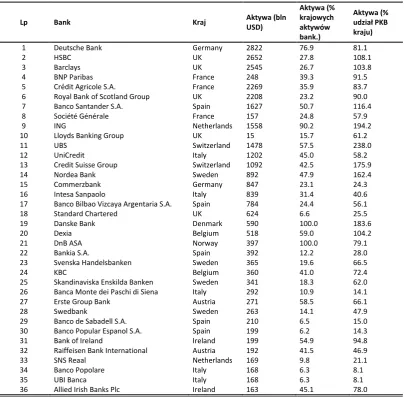
the European Union. Table 2 provides a summary of the banks in Europe (from the group of the 100
largest banks in the world according to BIS), in which the share of assets in relation to gross domestic
8
serious dimensions. It should be noted that in all these countries the share of large banks is more than
half the assets of the banking system, which in the context of systemic risk can be an important source
of risk. This statement also reflects the strong processes of consolidation of the banking system in
developed countries of Europe and the dominance of large institutions. Nearly 30% of the total
number of banks in each of the analyzed developed countries are capital banking groups (see Table 2).
[image:9.595.97.502.242.640.2]Descriptive statistics for a selected group of the largest banks in Europe are presented in Appendix 1.
Table 2 Statement of the largest banks in Europe (from the group of the 100 largest banks in the world): the value of assets in the domestic banking system and GDP. Geographical breakdown, as of the second quarter of 2012.
Lp Bank Kraj Aktywa (bln
USD) Aktywa (% krajowych aktywów bank.) Aktywa (% udział PKB kraju)
1 Deutsche Bank Germany 2822 76.9 81.1 2 HSBC UK 2652 27.8 108.1 3 Barclays UK 2545 26.7 103.8 4 BNP Paribas France 248 39.3 91.5 5 Crédit Agricole S.A. France 2269 35.9 83.7 6 Royal Bank of Scotland Group UK 2208 23.2 90.0 7 Banco Santander S.A. Spain 1627 50.7 116.4 8 Société Générale France 157 24.8 57.9 9 ING Netherlands 1558 90.2 194.2 10 Lloyds Banking Group UK 15 15.7 61.2 11 UBS Switzerland 1478 57.5 238.0 12 UniCredit Italy 1202 45.0 58.2 13 Credit Suisse Group Switzerland 1092 42.5 175.9 14 Nordea Bank Sweden 892 47.9 162.4 15 Commerzbank Germany 847 23.1 24.3 16 Intesa Sanpaolo Italy 839 31.4 40.6 17 Banco Bilbao Vizcaya Argentaria S.A. Spain 784 24.4 56.1 18 Standard Chartered UK 624 6.6 25.5 19 Danske Bank Denmark 590 100.0 183.6 20 Dexia Belgium 518 59.0 104.2 21 DnB ASA Norway 397 100.0 79.1 22 Bankia S.A. Spain 392 12.2 28.0 23 Svenska Handelsbanken Sweden 365 19.6 66.5 24 KBC Belgium 360 41.0 72.4 25 Skandinaviska Enskilda Banken Sweden 341 18.3 62.0 26 Banca Monte dei Paschi di Siena Italy 292 10.9 14.1 27 Erste Group Bank Austria 271 58.5 66.1 28 Swedbank Sweden 263 14.1 47.9 29 Banco de Sabadell S.A. Spain 210 6.5 15.0 30 Banco Popular Espanol S.A. Spain 199 6.2 14.3 31 Bank of Ireland Ireland 199 54.9 94.8 32 Raiffeisen Bank International Austria 192 41.5 46.9 33 SNS Reaal Netherlands 169 9.8 21.1 34 Banco Popolare Italy 168 6.3 8.1 35 UBI Banca Italy 168 6.3 8.1 36 Allied Irish Banks Plc Ireland 163 45.1 78.0
Source: own study based on BIS database
This is the approach of Financial Stability Board and the Bank for International Settlements, annually
updating statistics 100 largest banks in the world. For comparative scale of the phenomenon, these
values are presented in the form of the indicator, relative to GDP, or market capitalization.
9
important. Bankruptcy larger institutions causes higher losses in scale economies than less. In other
words, the larger the institution in terms of assets, capitalization, etc.., ceteris paribus, the stronger the
impact of systemic risk. On the other hand, it should be considered whether limiting the size of
financial entities, will serve the security of the financial system. Empirical research on whether the
costs of maintaining a large financial institution outweigh the benefits of economies of scale, are
varied. And the impact of the size of the entity on its share of systemic risk in the world seems to be
still unresolved and require further research.
International links
Interconnectedness of financial institutions is generally measured by share of assets and liabilities in
the system of intra-system, for example. Value of the credit exposure of the institution to the rest of
the system and its contribution to systemic risk. What is the contribution of credit risk to the rest of the
system, and thus the potential involvement of the institution in the systemic event. The Basel
Committee also proposes to use the interbank funding rate, ie. share of the funding coming from
sources other than retail deposits in total liabilities. They also reflect claims and liabilities in the
interbank financial markets and the allocation of credit risk between financial institutions. Due to the
allocation / risk diversification and liquidity interconnectedness can bring benefits to the diverse
structure of the financial system.
The substitutability of services and infrastructure
Substitutability of the financial institution is particularly difficult to measure. It should not be wrongly
identified with market dominance. Although the Basel Committee proposes the use of the indicator
complex assets under custody, whether the payments settled through payment systems, but it would be
more appropriate analysis of scenarios and the likelihood that an institution may exit the of the market
and no longer offer their services. Measurement of substitutability of services in this way requires (a) a
consistent definition of what constitutes a market system, and (b) of the definition of the market share
of systemic importance.
In the assessment of substitutability should not be limited to financial intermediaries, but also to
markets, or payment systems, which can play an important systemic role at the national level or
international level, in the financial system and the whole economy (FSB et al, 2009, p. 2). The author's
research suggests that the cause of systemic disorders may be, for example, repo market, intensively
developing since the security deposits requirement in derivative transactions. Supervisors have a
strong basis in supporting the smooth functioning and flexibility of the market. During the crisis, it
turned out that the infrastructure transaction settlement had basic flaws that could lead to serious
instability in times of market stress (Karkowska, 2013). An example the above is the bankruptcy of
10
meant that money market funds instead of money would receive a collateral Bear Stearns, which in the
absence of the possibility of liquidation would lead to a run on the financial market (Acharya,
Richardson, 2009, p. 297).
The complexity of the components of the financial system
Complexity relates generally to the organizational structure of the institution, but its sources also refer
to the complex structure of assets. The Basel Committee shall adopt the latter view and measure the
complexity of the notional value of OTC derivatives, especially those whose valuation is not directly
observable in the market. Such an approach to measures of complexity based on the assumption that
the more complicated harder to sell assets and more complex corporate structures are more difficult to
solve. In both cases, finding appropriate indicators it is rather difficult to determine.
Transjurisdictional activity (the activity of company on a global scale)
The activity of a global financial institution is generally measured by the level of cross-border claims and liabilities. The Basel Committee also proposes as an auxiliary measurement of non-domestic revenues. Generally it is assumed that banks conducting its activities globally are a particular threat to the stability of the global financial system, in relation to those that are active only in the domestic market. Globally active banks are often higher than domestic and through foreign financing exposure may result in wider transnational contagion channel systemic risk.
On the other hand, the measurement of the global activity of banks is a typical example of how to
determine the relevance of systemic institutions should not be used for comparative purposes for the
regulatory authorities. For the assignment of regulatory burdens for cross-border claims and liabilities
implies the risk of causing unintended side effects. If, through the regulation of SIFI’s banks globally
operating will generate higher marginal costs in their cross-border activities, than their local
competitors, it will be less competitive, automatically. Čihák (2011) and Mayer (2011) argue that
systemic immunity increases with increasing cross-border linkages, at least to a point. After crossing
the optimum point, the resistance decreases again until your financial institution does not restore the
kind of "elasticity". In connection with the sovereign debt crisis in some EU Member States, large
cross-border institutions could help create a more flexible banking system in the euro area and to
provide a stable basis for financing. Opinions on the risks arising from the activities of the global
banks are divided.
11
As a systemically important intermediaries can be distinguished also offering payment services, risk management, and investment programs. Frequently as single entities may mean little, but their lack of substitutability nature may introduce a system in crisis. Brunnermeier (2009) introduces the categories of financial institutions in the context of the spread of channels disorders:
systemically important financial institutions, which because of its size and concentration of activity is considered to be dominant in the relevant market according the classical doctrine of "too big to fail".
large and complex financial institutions, ie. insurance companies or pension funds, usually regarded as irrelevant systemic internationally. However, that may have a significant economic impact on the economy within national legislation, in the event of disruption of business.
small size in terms of assets and irrelevant for a single entity, and analyzed in terms of groups which may have significant systemic importance, due to the high level of correlation of assets and risk taking. An example of this type of category
SIFI’s are investment funds, ie., cash and hedge funds.
small entities, but significant activity conducted financial transactions. An example of what can be brokers nationwide.
On the one hand, the new prudential standards support the safety of banks and the entire financial system stability. On the other hand, the new regulations by the fact that impose stricter prudential standards for banks hinder their functioning and inhibit the growth of banking. They should therefore be made reasonably.
3 RESEARCH METHODOLOGY
12
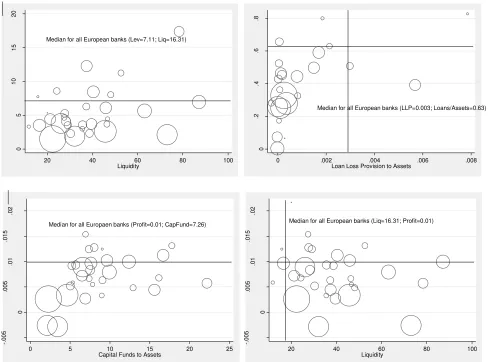
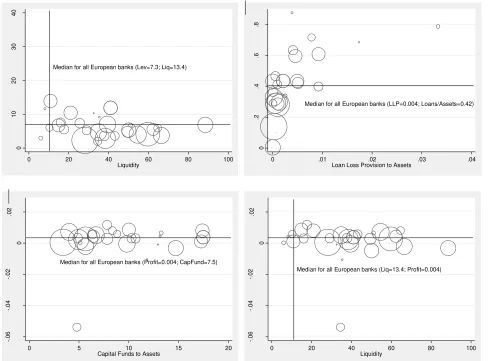
turn, in newly appointed group of European banks there was estimated the following indicators, ie.: Leverage ratio=Equity/Total Assets, Profitability=Profit before tax/Total Assets, Liquidity=Liquid Assets/Deposits, Capital Ratio, Credit Asset Quality=Loan Loss Provisions/Total Assets, Loans/Total Assets of bank, as a source of potencial systemic risk signals. The results for the 36 largest banks in Europe were compared with the results averaged (median indicator) for 3963 banks in Europe, which should help in finding the answer to the question, whether in fact the entity size generates a higher risk? The research will be conducted on the basis of the financial statements of commercial banks available in the Bankscope database, for the period of 2007 and 2010. It should reveal the variability of risk indicators over time. The time analysis was chosen because of the comparative activities of the largest banks in the time before the crisis (2007) and after the financial crisis (2010). To better understand the study, and the effective analysis, the results of the study are presented in graphical form.
3 RESULTS
13
Figure 1 Indicator analysis of the activities of the largest banks in Europe in 2007.
Median for all European banks (Lev=7.11; Liq=16.31)
0
5
10
15
20
20 40 60 80 100
Liquidity
Median for all European banks (LLP=0.003; Loans/Assets=0.63)
0
.2
.4
.6
.8
0 .002 .004 .006 .008
Loan Loss Provision to Assets
Median for all Europaen banks (Profit=0.01; CapFund=7.26)
-.
005
0
.005
.01
.015
.02
0 5 10 15 20 25
Capital Funds to Assets
Median for all European banks (Liq=16.31; Profit=0.01)
-.
005
0
.005
.01
.015
.02
20 40 60 80 100
Liquidity
14
15
Figure 2 Indicator analysis of the activities of the largest banks in Europe in 2010.
Median for all European banks (Lev=7.3; Liq=13.4)
0
10
20
30
40
0 20 40 60 80 100
Liquidity
Median for all European banks (LLP=0.004; Loans/Assets=0.42)
0
.2
.4
.6
.8
0 .01 .02 .03 .04
Loan Loss Provision to Assets
Median for all European banks (Profit=0.004; CapFund=7.5)
-.
06
-.
04
-.
02
0
.02
0 5 10 15 20
Capital Funds to Assets
Median for all European banks (Liq=13.4; Profit=0.004)
-.
06
-.
04
-.
02
0
.02
0 20 40 60 80 100
Liquidity
16
In conclusion, the study showed that the risk taken by the largest banks in Europe is not higher than in other banks. Therefore, we should pay special attention to look at smaller banks, which in the group may contribute to the instability of the sector. By confronting the results with the averages for the whole of Europe in terms of liquidity risk, leverage, and profitability, these banks were characterized by relative safety. Thus, the more important may be the risk of substitutability their services and international relations in the light of the potential danger of bankruptcy of one of the largest banks.
5 CONCLUSIONS
Given the methodology of the activities undertaken by the Financial Stability Board would doubt the
legitimacy of providing only the largest banks on SIFI’s lists. It seems economic repercussions of
system scenarios should also include insurance company, investment and pension funds, or other
entities, which according to the above categories may be source of systemic risk? Should be consider
whether the publication of systemically important entities not turn attention of investors and
supervisors of smaller entities, being able to disrupt the financial system. In the light of this study, the
risk taken by the largest banks in Europe are not essential as the banking instability indicators.
The basis of the regulations limiting systemic risk is to understand the nature and sources of SIFI instability. The advantage of the methodology developed by the Basel Committee should be to mobilize financial institutions to change their risk profile and business models in a way that reduces the instability of the financial system globally. A financial institution’s contribution to systemic risk is generally reflected in its liabilities to the rest of the system, i.e. to other financial institutions, and in its possible impact on asset and credit markets. It thus captures how important an institution is for the deposit system and how vulnerable it is to a systemic shock.
REFERENCES
1. Acharya V.V., M. Richardson (2009), Restoring Financial Stability. How to Repair a Failed System, Wiley Finance, New Jersey
2. BIS (2011), Global systemically important banks: assessment methodology and the additional loss absorbency requirement. Rules text, Basel Committee on Banking Supervision, Basel, November 2011
3. Brunnermeier M., et. al. (2009), The Fundamental Principles of Financial Regulation. Geneva Reports on the World Economy 11, International Center for Monetary and Banking Studies, Geneva.
4. Cihák, Martin; Sònia Muñoz and Ryan Scuzzarella (2011). The Bright and the Dark Side
17
5. FSB, IMF, BIS (2009), Guidance to Assess the Systemic Importance of Financial Institutions, Markets and Instruments: Initial Considerations. Report to G20 Finance Ministers and Governors, Financial Stability Board, International Monetary Fund, Bank for International Settlements, October.
6. Karkowska R. (2013), Czy rynek repo może stać się przyczyną kolejnego kryzysu?,
Prace i Materiały Wydziału Zarządzania Uniwersytetu Gdańskiego.
7. Karkowska R., Olszak M. (2012), Leverage and funding gap of EU banks and the business cycle, w: Perspektywy integracji ekonomicznej i walutowej w gospodarce
światowej. Dokąd zmierza strefa euro?, Wydawnictwo NBP i WNE, Warszawa.
8. Mayer, Thomas, Jochen Möbert and Christian Weistroffer (2010). Macroeconomic
imbalances and the Eurosystem. Global Economic Perspectives. Deutsche Bank. June 2011.
18
Appendix 1 Indicator analysis of for the activities of the largest banks in Europe in 2007, based on the database Bankscope
Bank name Country name Average Assets Capital Funds/ Total
Assets Leverage
Liquid Assets/Deposits
Loans/Total Assets
LLP/Total Assets
Profit before Tax/Total Assets
Deutsche Bank AG GERMANY 2 380 301 056 2,27 1,5 22,45 0,33 0 0
BNP Paribas FRANCE 1 679 249 920 4,65 2,63 45,65 0,28 0 0
UBS AG SWITZERLAND 1 414 399 360 2,13 2,13 73,01 0,26 0 0
Société Générale FRANCE 1 394 032 768 3,45 1,9 32,1 0,25 0 0
Royal Bank of Scotland UNITED KINGDOM 1 376 651 008 6,59 3,81 26,11 0,4 0,01
HSBC Bank plc UNITED KINGDOM 849 587 264 6,02 4,9 48,56 0,36 0,01
Raiffeisen Centrobank AG AUSTRIA 849 587 264 6,51 5,33 20,11 0,06 0 0,02
ING Bank NETHERLANDS 669 304 384 9,93 5,64 63,08 0,27 0,01
Crédit Agricole S.A. FRANCE 590 790 528 12,38 6,97 87,15 0 0 0,01
Lloyds TSB Bank Plc UNITED KINGDOM 527 250 080 7,63 3,51 16,49 0,74 0,01
Banco Bilbao Vizcaya Argentaria SA SPAIN 482 156 192 9,64 6,09 45,98 0,59 0 0,01
Banco Santander SA SPAIN 477 009 120 16,69 8,48 40,39 0,44 0 0,01
Intesa Sanpaolo ITALY 449 784 192 15,59 12,27 37,46 0,5 0 0
Danske Bank A/S DENMARK 421 235 200 6,51 4,41 21,3 0,46 0 0,01
Commerzbank AG GERMANY 418 591 200 6,92 3,68 39,57 0,39 0,01 0
UniCredit ITALY 341 399 968 22,18 17,39 78,44 0,08 0 0,01
KBC Bank BELGIUM 296 706 752 7,54 4,1 28,28 0,45 0 0,01
Allied Irish Banks IRELAND 232 846 304 5,72 3,55 35,6 0,51 0,01
Skandinaviska Enskilda Banken AB SWEDEN 212 935 632 5,04 2,3 30,31 0,43 0 0,01
Bank of Ireland IRELAND 209 866 688 5,22 2,33 38,77 0,42 0,01
DNB Bank ASA NORWAY 208 674 624 8,05 5,25 27,72 0,66 0 0,01
Svenska Handelsbanken SWEDEN 204 869 488 7,39 3,5 29,05 0,52 0 0,01
Banca Monte dei Paschi di Siena ITALY 167 369 648 9,07 6,27 37,32 0,51 0 0,01
Standard Chartered Bank UNITED KINGDOM 157 282 496 16,15 8,59 24,22 0,3 0,01
Swedbank AB SWEDEN 138 467 840 7,41 3,7 46,44 0,36 0 0,01
Nordea Bank AB SWEDEN 135 370 960 17,77 11,26 52,72 0,28 0 0,01
Erste Group Bank AG AUSTRIA 128 891 944 12,9 8,04 48,12 0,33 0 0
Banco Popular Espanol SA SPAIN 108 494 768 6,93 4,69 27,56 0,63 0 0,02
Dexia Banque Internationale LUXEMBOURG 86 529 216 8,99 3,02 35,48 0,17 0 0
SNS Bank NETHERLANDS 71 263 064 7,84 4,46 46,73 0,48 0,01
Barclays Bank S.A. SPAIN 40 551 892 5,34 3,3 11,82 0,8 0 0,01
Banca Popolare Commercio e Industria ITALY 16 326 954 9,05 7,75 15,88 0,83 0,01 0,01