The Expert Group on Future
Skills Needs Statement of
Activity 2013
Table of Contents
Foreword ... 2
Members of the Expert Group on Future Skills Needs ... 4
Introduction... 5
Research and Analysis Resources ... 5
EGFSN Research and Analysis in 2013 ... 6
Addressing Future Demand for High-Level ICT Skills ... 6
Assessing the Demand for Big Data/Data Analytics Skills in Ireland 2013-2020 ... 7
Future Skills Needs of the Manufacturing Sector to 2020 ... 8
National Skills Bulletin 2013 ... 9
Monitoring Ireland’s Skills Supply – Trends in Education and Training Outputs 2013... 10
Regional Labour Markets Bulletin 2013 ... 11
Other Activities & Policy Inputs by the EGFSN in 2013 ... 12
Guidance for Higher Education Providers on Current and Future Skills Needs of Enterprise - Springboard 2013 Call ... 12
Submission to the Department of Education and Skills on the Development of a New Digital Strategy for Schools ... 12
National Skills Database ... 13
Implementation of Recommendations in EGFSN Reports ... 14
Manufacturing Skills ... 14
Food and Beverage Sector ... 14
Addressing ICT Skills Recruitment Difficulties of Foreign Owned and Indigenous Companies ... 15
Dissemination of Future Skills Needs of Enterprise and Other Labour Market Information ... 16
Progress on the National Skills Strategy 2020 targets ... 17
Progress on headline targets ... 17
Progress towards achieving the National Skills Strategy targets ... 19
Upskilling 500,000 people within the Labour Force ... 19
Forthcoming EGFSN Publications ... 22
Freight Transport/Distribution/Logistics Sector ... 22
Marine Skills ... 22
Hospitality Sector ... 22
The National Skills Bulletin 2014 ... 23
Monitoring Ireland’s Skill Supply: Trends in Education and Training Output 2014 ... 23
Foreword
Research and analysis around future skill requirements is vital to ensure that enterprises have the necessary talent for business growth and development, that education and training providers can align programme provision with these skills needs and that individuals can make informed decisions about career choices with the knowledge that will enable them to progress to future employment.
During 2013 the Expert Group on Future Skills Needs (EGFSN)/Forfás
undertook research into the demand for high level ICT roles to 2018 and the future demand for Data Analytics roles across the economy, both deliverable items under the Action Plan for Jobs 2013.
Addressing Future Demand for High-Level ICT Skills forecasts 44,500 potential jobs for ICT
professionals up to 2018 within both the ICT sector and across other sectors of the economy. The report contains recommendations to ensure that Ireland maintains a strong competitive advantage when it comes to attracting mobile ICT investment and encouraging entrepreneurs to set up, grow and locate their ICT businesses in Ireland. The findings of the EGFSN report fed into the update of the Government’s ICT Skills Action Plan, published on 14 March 2014, a collaborative Plan between Government, industry and the education system to increase the supply of domestic high-level ICT skills to meet the demands of enterprise.
Big data and analytics is a relatively new area and globally, there is a reported shortage of big data and data analytics talent. The EGFSN/Forfás report Accessing the Demand for Big Data/Data
Analytics in Ireland 2013-2020 maps out relevant current and planned education and training
provision, identifies gaps between supply and demand, and recommends actions required to build up Ireland’s big data and analytics talent pool, to achieve the Government’s ambition to position Ireland as a leading country in Europe in Big Data.
During the year the EGFSN continued to monitor skills trends and demand through the annual reports National Skills Bulletin 2012 and the Vacancy Overview 2012. The latest research indicated that while shortages are low in number and primarily confined to niche skill areas they persist in the areas of ICT, high tech manufacturing (especially bio-pharma and medical devices), agri-food, sales, marketing, business, finance and healthcare. Multilingual skills are a key aspect of some of these shortages.
The Monitoring Ireland’s Skills Supply 2012 provided an overview of the supply of skills from the Irish education system. A detailed analysis of the economic status of Ireland’s graduates in the skills supply report found that young adults with a level 8 honours degree qualification or higher were more likely to be in employment than their counterparts with level 6/7 qualifications (higher certificate/ordinary degree).
West, and assists in informing regional education and training provision, labour market policies, immigration and career guidance.
The EGFSN/Forfás provided the Guidelines for Higher Education Providers on Current and Future
Skills Needs of Enterprise for the Springboard 2013 Call, which identified skills in demand by
employers, from the EGFSN research. The guidelines are designed to ensure the relevance of these programmes for jobseekers, to encourage engagement by education providers with the employers in the curriculum design, delivery and work placements, in order to improve employment outcomes from the courses. Approximately 6,000 free part-time higher education places were made available under Springboard 2013.
The EGFSN continuously engages with businesses, Government Departments, including the Department of Education and Skills, the Department of Jobs Enterprise and Innovation and the Department of Social Protection and a wide range of stakeholders to communicate key messages arising from our research. This engagement informs education and training providers on the
alignment of programmes to meet enterprise skills needs, advise on skills shortages for employment permits, assists individuals to make informed decisions around employment opportunities and career choice and underpins labour market activation programmes. We disseminate our findings via our website www.egfsn.ie, direct mailing of our reports to interested parties, presentations at conferences and providing our findings to guidance associations, further and higher education and training providers, industry groups and policy makers.
I would like to thank the members of the Expert Group on Future Skills Needs for their ongoing commitment to this important work. I would also like to thank Forfás and the Skills and Labour Market Research Unit, SOLAS, for the research and analysis work that they provide to the group.
Una Halligan
Members of the Expert Group on Future Skills Needs
Ms. Una Halligan Chairperson
Ms. Marie Bourke Head of Secretariat and Department Manager, Forfás
Ms. Inez Bailey Director, National Adult Literacy Agency
Mr. Peter Baldwin Assistant Secretary, Department of Education and Skills
Mr. Ray Bowe IDA Ireland
Ms. Liz Carroll Training and Development Manager, ISME
Mr. Ned Costello Chief Executive, Irish Universities Association
Ms. Margaret Cox Managing Director, I.C.E. Group
Mr. Bill Doherty Executive Vice President, EMEA, Cook Medical
Mr. Tony Donohoe Head of Education, Social and Innovation Policy, IBEC
Dr. Bryan Fields Director, Curriculum Development / Programme Innovation, SOLAS
Ms. Sonia Flynn EMEA Director for User Operations, Facebook
Ms. Anne Forde Principal Officer, Department of Education and Skills
Mr. Joe Hogan Founder, Chief Technology Officer & VP Openet Labs & IP Management
Mr. Jerry Moloney Director of Skills, Enterprise Ireland
Mr. Frank Mulvihill Former President of the Institute of Guidance Counsellors
Dr. Brendan Murphy President, Cork Institute of Technology
Mr. Dermot Nolan Principal Officer, Department of Public Expenditure and Reform
Mr. Alan Nuzum CEO, Skillnets
Mr. Muiris O’Connor Higher Education Authority
Dr. Peter Rigney Industrial Officer, ICTU
Mr. Martin Shanagher Assistant Secretary, Department of Jobs, Enterprise and Innovation
Mr. Martin D. Shanahan Chief Executive, Forfás
Introduction
The Expert Group on Future Skills Needs (EGFSN) has the task of advising Government on future skills requirements and associated labour market issues that impact on enterprise and employment growth.
Specifically, the Group carries out analysis in order to:
Advise Government on projected skills needs at national and sectoral levels and make recommendations on how best to address identified needs;
Advise Government on associated priority education and training requirements and the most cost effective ways of responding to them;
Advise Government on any skills requirements that cannot be met internally at a given time and that so require to be met through inward migration;
Advise Government on the content, delivery and outcomes of education and training programmes elsewhere that support excellence and value for money and on adaptations necessary to incorporate such developments here;
Respond to any request for advice from the Minister for Education and Skills on training programmes that are supported through the National Training Fund; and
Report on progress made in the implementation of its recommendations.
The Group is composed of representatives of business, employees, education, training, Government departments and State agencies.
In accordance with its mandate, an annual report is to be provided to the Minister for Education and Skills and the Minister for Jobs, Enterprise and Education not later than the end of March following the year to which the report refers. In conformance with this requirement this Statement of Activity provides details of the Group’s output and activity in 2013, forthcoming work in 2014, and
information on the Group’s research and analysis resources.
Research and Analysis Resources
Marie Bourke, Department Manager in Forfás is Head of Secretariat to the EGFSN and manages the work of the group. Research, analysis and administration support to the EGFSN is provided by Forfás and the Skills and Labour Market Research Unit, SOLAS.
EGFSN Research and Analysis in 2013
Addressing Future Demand for High-Level ICT Skills
The ICT sector is of strategic importance to Ireland, both in terms of the numbers of high skilled professionals employed and its significant contribution to Ireland’s export performance – accounting for €70 billion in exports per annum.
The EGFSN/Forfás report, Addressing Future Demand for High-Level ICT
Skills, was published in November 2013 as a deliverable item under the
Government’s Action Plan for Jobs 2013, and forecasts the demand for high-level ICT skills over the period 2013–2018, for high–level ICT skills at NFQ Levels 8/9/10, and at progression levels NFQ 6/7, arising both within the broad ICT sector and across other sectors of the economy.
The demand for high-level ICT skills continues to increase both in terms of the numbers required and the right skillsets. A key factor for Ireland will be to ensure an adequate supply of ICT talent and skills from the domestic supply pool and global talent, to meet the needs of foreign-owned and indigenous enterprises. The range of technology skills that will be needed is broad and employers will seek to meet this demand through hiring new graduates as well as experienced people. Due to rapidly changing technological trends changing skillsets and demand for new skills are emerging. Areas of demand include cloud computing, mobile devices and technology, Big Data analytics, IT security, social technologies, micro and nano-electronics.
Promising signs of skills supply exist as the output of computer graduates in Ireland has increased by 25% over the last two years and a doubling of graduate output is now expected to be achieved by 2015 - three years ahead of the Action Plan target of 2018. This comes as a result of the
implementation of the Government ICT Skills Action Plan which is a collaboration between Government, Industry and the education system.
Assessing the Demand for Big Data/Data Analytics Skills in Ireland 2013-2020
A forthcoming report by the EGFSN/Forfás, Assessing the Demand for Big Data and Analytics Skills in Ireland 2013-2020, forecasts the annual demand for big data and analytics roles across the
economy. The study is a key Forfás deliverable in the Action Plan for Jobs 2013. Data analytics involves the mining, analysis, interpretation and utilisation of data, including Big Data. The value of big data and analytics is becoming apparent across countries and is resulting in a growing demand for relevant skills.
The study’s objective is to advance recommendations on measures to build up the big data and analytics talent pool through domestic graduate output, continuing professional development within industry, and, where necessary, attraction of talent from abroad including expatriate talent. Employment demand across three main groupings, namely deep analytical talent, big data and analytics savvy roles (market research analysts, business and functional managers whose roles require interpreting and using data to drive business performance) and supporting technology roles are considered in the research.
The Irish Government has set an ambition for Ireland to become a leading country in Europe in Big Data. It is envisaged that this will help create significant additional employment in the economy. This would require achieving the scale of the ambition as set out in the high growth Scenario in this study. Under this Scenario, 21,000 potential job vacancies could arise from expansion and
replacement demand in the period up to 2020 - comprising 3,630 for deep analytical roles and 17,470 for big data savvy roles. There would also be a further 8,780 potential job openings for supporting technology staff. Current employment demand for big data and analytics skills is estimated at 35,080.
For Ireland to become a leading country in such services it is essential that the necessary skills capability base is developed to drive data analytics business performance within existing
enterprises, new start-ups and potential new foreign direct investment. The achievement of this outcome requires an improved understanding among private and public sector senior executives, of the potential of data and analytics for driving business performance. An enterprise-wide approach to managing data analytics capabilities is essential – including defining analytical skills
requirements; up-skilling and nurturing of workforce talent; providing clear career progression path opportunities and deploying analytical talent effectively to support business goals.
The report makes a series of specific recommendations in the following areas:
Building up the supply of analytics talent
Nurturing analytics talent within industry
Enhancing the employability of graduates and delivering relevant skills
Appealing to the broadest possible talent pool
Inspiring the next generation of analytics talent and
Future Skills Needs of the Manufacturing Sector to 2020
The manufacturing sector is a fundamental driver of the economy in Ireland. There were around 206,000 people employed in manufacturing in 2011, accounting for 11.4 per cent of total employment. Manufacturing exports were approximately €92.9 billion in 2011. The sector has experienced huge changes in recent years, a significant decline in employment and erosion of cost competitiveness. The Government’s
Action Plan for Jobs 2012 requested Forfás to develop a long term vision
for the Manufacturing sector and a strategic plan to realise this vision (Forfás Making it in Ireland published February 2013). In tandem with the wider strategy research by Forfás, the EGFSN was requested to undertake
a detailed assessment of manufacturing skills needs and use of the new
structures for training and skills development to address both the immediate needs of the
manufacturing sector and to anticipate longer term needs. The objective of this work is to address
the skills required across six sub-sectors of manufacturing over the period 2012-2020 - Medical
Devices, Bio-Pharma/ Pharma-chem, Food and Beverages, ICT hardware, Engineering and Consumer Products sectors.
There is a challenge for manufacturing enterprises in attracting the top graduate talent as many of the graduates are sought after for other sectors. Future employment scenarios for the sector are highly dependent on both improvements in domestic competitiveness and a favourable international environment for trade. Replacement demand for the sector is estimated in the region of 4,000 to 5,000 per annum regardless of whether employment expands or not and there are upskilling requirements for existing employees at both occupational and qualifications level.
Skills and competencies needed within manufacturing are rising across virtually all occupations due to factors such as scientific and technological advances, automation, regulatory requirements, new ICTs and the drive for continuous improvement. There are some skills shortages currently within the sector, though not of significant scale. Many of the skills shortages primarily relate to key persons with experience to drive business growth. Current and future shortages are in areas such as toolmaking, where we recommend an accelerated apprenticeship scheme to produce 55-60
toolmakers per annum to 2016, in-company training for machinists and for consideration to be given to an apprenticeship/traineeship for CNC machining/programming. There is a demand in the short term for approximately 250 mechanical engineers with skills related to automation, development and design until increased enrolments in engineering programmes result in increased supply in 2-3 years’ time. Support is recommended for up to 200 places on taught postgraduate courses
specifically to address critical shortages across a number of engineering disciplines including validation, polymer, quality, automation and supply chain engineering.
National Skills Bulletin 2013
The National Skills Bulletin 2013, published in July 2013, is the ninth in a series of reports produced annually by the Skills and Labour Market Research Unit in SOLAS on behalf of the EGFSN. The report provides an overview of the Irish labour market at occupational level.
Labour Force
Some labour market indicators point towards improvements in the Irish labour market (decline in the unemployment rate and increase in employment), however, challenges continue to exist with a further contraction of the labour force and a lower participation rate, as well as
persistently high unemployment rates for certain segments of the labour market (e.g. persons previously employed in skilled trades and elementary occupations, younger age cohorts and persons with low education attainment).
Labour Market Transitions
An analysis of transitions, presented for the first time in this year’s Bulletin, suggests a large volume of activity in the Irish labour market. It is estimated that during 2012 there were over a million transitions between employment, unemployment and economic inactivity, as well as
between and within occupations. The analysis points to the flexibility of the Irish labour market, but also to the difficulties facing lower skilled persons in securing sustainable employment.
Skills Shortages
Although the shortages continue to be primarily confined to niche skill areas and in most instances remain of low magnitude, this year’s Bulletin highlights the persistence of skills shortages in the areas of ICT, science, engineering, sales, marketing, business, finance and healthcare.
Vacancies were most frequent for sales & customer care, caring, leisure & other service related, elementary occupations, followed by science & engineering professionals, business professionals, administrative occupations, and science & engineering associate professionals.
Language skills were a prerequisite for many newly advertised vacancies, particularly in sales customer care activities, but also at professional level (e.g. engineering, finance); a variety of languages were in demand, particularly German, but also French, Italian, Spanish and Dutch. During 2012, employers continued to source skills from outside the European Economic Area (EEA) area. There were approximately 3,000 new employment permits issued, which is a 10% decline compared to 2011. Work permits issued to ICT experts accounted for over a third of all work permits; while almost 300 work permits were issued to healthcare professionals.
Monitoring Ireland’s Skills Supply – Trends in Education and Training Outputs
2013
This report, published in July 2013, is the eigth a series of annual reports produced by the Skills and Labour Market Research Unit of FÁS on behalf of the Expert Group on Future Skills Needs. The report provides an
indication of the supply of skills to the Irish labour market from the formal education and training system by examining outflows from the education system across levels 1-10 of the National Framework of Qualifications (NFQ).
Demographic Profile
Demographic data shows that the size of school-going age cohorts (both
children and young adults) is expected to continue to grow and, together with increased
participation and retention rates within the education and training system, Ireland will continue to ensure a supply of graduates, skills and labour for the workforce into the future.
Enrolments
Postgraduate enrolments totalled 33,600 in 2011, which is a small decline on the previous year; this relates to a decline in postgraduate certs/diploma enrolments as there were modest increases in masters and PhD programmes.
Graduates
Graduate Output: there were 41,400 graduates at levels 6-8 in 2011, an increase of 3% on 2010; output increased across all levels, with a 10% increase at level 6 and increases of 3% and 2% at levels 7 and 8 respectively.
Promising signs exist for computing at higher level with a 25% increase in the number of graduates at level 8, continuing the upward trend in computing graduate numbers observed in the previous year; strong growth in CAO acceptances and enrolments for computing courses suggest that this trend will continue in the medium term.
Levels 3: More than 60,000 awards were made at level 3, of which almost 59,000 were Junior Certificates; the number of Junior Certificate sits rose by 3% between 2011 and 2012; in contrast, at just over 1,000 in 2012, the number of FETAC awards declined by almost two thirds when compared to 2011.
Lifelong Learning
There were 170,000 award holders in 2012, representing a 6% decrease (or 10,600 fewer
learners) when compared to 2011, but a 30% increase compared to 2008. The most notable changes over the period 2011-2012 were increases in the number of major awards and specific purpose awards holders, but declines in the number of minor award holders and supplemental award holders. The number of major award holders grew by 13% (4,700 additional learners) to reach 42,600 in 2012, their highest level to date.
Monitoring Ireland’s Skills Supply serves as a valuable tool in the EGFSN’s role in advising the Irish
Regional Labour Markets Bulletin 2013
The Regional Labour Markets Bulletin 2013, published March 2014, is the second in an annual series of reports examining regional labour markets in Ireland. The report presents labour market data relevant to each region, a profile of key businesses and industries, potential job opportunities and current and potential skills supply.
Key Findings
Employment: in quarter 1 2013:
Dublin and the West region had the highest employment rates at 62%, followed by the Mid East and South West regions (61%);
at least 30% of persons in each region were employed in high skilled occupations (managers, professionals and associate professionals); the share in Dublin was even higher at 48%; when compared to quarter 1 2012, the West and South West region had the highest rate of
employment growth at 4% each, compared to a 1% change nationally and a 4% decline for the Mid East region.
Unemployment: in quarter 1 2013:
the highest rates were in the South East (18.4%) and the Midland region (17.1%), while the lowest rates were in the South West (11.1%) and Dublin (11.3%);
Dublin accounted for approximately one quarter of total national unemployment (70,000 persons), although it has a lower than average unemployment rate;
unemployed persons had been mostly employed in skilled trades and elementary occupations across all regions.
Sectoral: in quarter 1 2013, industry was the largest sector in each region except Dublin, the Mid East and the Midland regions; human health was the largest in Dublin, while wholesale and retail was the largest in both the Mid East and the Midland regions.
The Dublin, South West and Mid East regions combined accounted for two thirds of all high tech manufacturing in Ireland.
Public Employment Service (PES) vacancies: although the highest number of PES vacancies was advertised for the Dublin region, the distributions of vacancies by occupational group varied little across regions, with most vacancies advertised for elementary, personal service and associate professional (mainly sales) occupations, and comparatively few for managers, professionals, admin/secretarial and operatives.
Live Register: the number of persons on the Live Register has increased in all regions since early 2008; when compared with August 2012, however, there was a 5% decline in the number of persons on the Live Register in August 2013; in terms of regions, the South-West region experienced the greatest decline at 7%, compared to a 2% decline for the Midland region.
Other Activities & Policy Inputs by the EGFSN in 2013
Guidance for Higher Education Providers on Current and Future Skills Needs of
Enterprise - Springboard 2013 Call
Springboard is a multi-annual fund which provides free part-time higher education courses, to assist the unemployed and previously self-employed to upskill or reskill in areas of current and future skills need.
The first phase of Springboard was launched in May 2011 by the Minister for Education and Skills and offered 5,875 free, part-time places in higher education in areas of identified skills need in Ireland. In 2012, a second Springboard call allocated a further €24.4m for an additional 6,000 part-time higher education places.
On 27th February 2013 the HEA issued a third Springboard call. The call was accompanied by a
document produced by Forfás, Guidance for Higher Education Providers on Current and Future
Skills Needs of Enterprise, based on skills shortages identified by the EGFSN. The guidance
document provided detailed information on current and future enterprise skills opportunities in order to enable providers to ensure that programmes were aligned with the needs of enterprise. Key areas of focus for Springboard 2013, outlined in the guidance document included: mechanical and manufacturing engineers; validation, quality, polymer, supply chain and automation engineers; ICT computing and electronic engineering; international sales professionals with foreign languages; international project management; regulation and compliance for financial services; business analysts for all sectors with skills to be effective consumers of big data insights.
In June 2013 the Minister for Education and Skills announced a further 6,000 free part-time higher education places to provide re-training opportunities for jobseekers under the Springboard call, encompassing over 200 courses focusing on growth areas as outlined in the Guidance document.
Submission to the Department of Education and Skills on the Development of a
New Digital Strategy for Schools
In December 2013, the Minister for Education and Skills announced a public consultation process on the use of technology in teaching and learning in primary and post primary schools. It is envisaged that the outcomes of this process will help inform policy making in this area.
The new Digital Strategy for Schools will address policy challenges and opportunities arising from major developments in curricular reform, digital publishing, digital content, cloud services, portable computing, student devices and broadband for schools. It will address future proofing, make specific recommendations and detail an implementation plan.
National Skills Database
The National Skills Database (NSD), developed and maintained by the Skills and Labour Market Research Unit (SLMRU) of SOLAS, collates all available information on the supply and demand of skills in Ireland. It represents an effective tool for timely analysis and forecasting of the labour market at sectoral and occupational level. Potential imbalances between the demand and supply of skills can be assessed using the wide range of indicators gathered in the NSD.
During 2013 the NSD was updated to include the latest statistics and information on the following: Employment
Education and training output
Immigrant labour force
Notified job vacancies (for example: The Irish Times, Irish Jobs.ie, JobsIreland.ie)
Labour force forecasting model
Occupational employment forecasting models
Implementation of Recommendations in EGFSN Reports
Ongoing monitoring of progress on implementation of recommendations, including a review of sectoral studies after completion, is undertaken by the EGFSN. Sectoral reports are widely disseminated to stakeholders. Those identified with the responsibility of implementing the
recommendations are formally notified and invited to inform the EGFSN six months after publication of the report of progress on implementation.
Manufacturing Skills
The EGFSN/Forfás report Future Skills Requirements of the Manufacturing Sector to 2020 refered to earlier highlights current and future shortages in areas such as toolmaking, machinists, supervisors, polymer technicians and across a number of engineering disciplines.
Since the publication of the report in April 2013 there have been a number of measures actioned including:
First Polymer Training Skillnet developed a Level 6 Certificate in Polymer Technology in response to industry needs identified in the EGFSN Manufacturing Sector report.
Plastics Ireland secured funding under Springboard for a certificate in Polymer Technology, to address the strong demand for polymer technicians.
A new network in the Engineering sector as recommended by the EGFSN was established in July 2013 following a Skillnets call for proposals for new training networks, this network is promoted by the Institute of Industrial Engineers.
As recommended in the Springboard Guidelines, a range of courses relevant to the manufacturing sector have been made available under the Springboard initiative in 2013 including: 324 places at Level 6; 1,065 places at Levels 7-9; and 114 places on cross–enterprise courses which could also be applied in a manufacturing environment.
Forfás, in conjunction with IDA, Enterprise Ireland and the Department of Jobs, Enterprise and Innovation made a submission in August 2013 to the Department of Education and Skills’ review of the apprenticeship system, reflecting recommendations in the EGFSN manufacturing sector report.
Food and Beverage Sector
The EGFSN/Forfás report Future Skills Requirements of the Food and Beverage Sector was published in November 2010. The main skills gaps identified in the report were for operative upskilling, specialised craft training, supply chain management, graduate in-house marketing/ management development, middle and senior management development programmes on leadership,
Since the publication of the report progress on implementation of a number of recommendations in the report has been achieved:
Skillnets through its two main food networks, Taste 4 Success Skillnet and Rural Food Skillnet, provided training to approximately 3,700 employed and unemployed trainees from January 2012 to August 2013.
In August 2013 Skillnets established an additional national training network for the Food and Beverage Sector. The FDII Skillnet is promoted by Food & Drink Industry Ireland, a business sector within IBEC.
In 2012 within the food, drink and catering sector, 51 courses were delivered to 356 participants under the Skills for Work programme.
Programmes in the Food and Beverage field are available under the Springboard and Momentum labour market initiatives, aimed at unemployed individuals.
For employees 113 initiatives are on offer from the enterprise development agencies (e.g. EI’s Lean Start, Lean Plus & Lean Transform programmes).
Addressing ICT Skills Recruitment Difficulties of Foreign Owned and Indigenous
Companies
During 2011, the EGFSN and Forfás were requested to undertake research on recruitment difficulties relating to high-level ICT skills, within both the ICT sector and from other sectors such as
international financial services, banking and business services. The findings of the research were compiled in a paper entitled Addressing High-Level ICT Skills Recruitment Needs, published in January 2012. In response to these findings, in January 2012 the ICT Action Plan was published by the Department of Education and Skills (in conjunction with the HEA, Forfás and the EGFSN), which outlines a range of initiatives to meet these skills needs.
One of the key targets outlined in the ICT Action Plan was the doubling annually of ICT honours degree undergraduate programmes to provide output of 2,000 graduates by 2018. In order to achieve this target ICT conversion programmes were provided by higher education providers in partnership with industry. In 2012 more than 700 places on Level 8 higher diploma ICT skills conversion programmes were made available. A second phase of the conversion programmes was rolled out in 2013, with a further 769 places available over 15 courses.
Dissemination of Future Skills Needs of Enterprise and
Other Labour Market Information
During 2013, the EGFSN continued to engage with stakeholders to ensure that key labour market information was disseminated to all relevant parties. The Chairperson and Secretariat presented on a wide range of labour market issues and participated at conferences and fora throughout the year, including: IT Tralee Careers Information Session, National Association of Principals and Deputy Principals Conference, European Social Fund Conference, City & Guilds Roundtable, The Association of Higher Education Careers Services Work Placement Professionals’ Conference 2013, a number of Education and Training Boards and second level guidance counsellors.
In addition, the Group’s output continues to be disseminated to guidance counsellors, students (secondary level, further education and training, and higher education), parents and teachers, through the targeted websites such as CareersPortal, Qualifax and Career Directions to inform their target audiences.
Published reports by the EGFSN are sent to over 1,300 stakeholders. An e-alerts system is also in place to electronically distribute the group’s reports to over 2,000 subscribers. Briefing
presentations on reports are made available on the EGFSN website.
Progress on the National Skills Strategy 2020 targets
The EGFSN is mandated, by the Department of Education and Skills, to report annually on progress made on reaching the targets set out in the National Skills Strategy for 2020.
The key proposals in the National Skills Strategy (NSS) for 2020 are that:
48 per cent of the labour force should have qualifications at National Framework of Qualifications (NFQ) levels 6-10 – i.e. from higher/advanced certificate to PhD level;
45 per cent should have qualifications at NFQ levels 4 and 51 – Awards equivalent to higher secondary level education; and
The remaining 7 per cent are likely to have qualifications at NFQ levels 1 to 3 (equivalent or
below Junior Certificate) while aiming to make the transition to higher levels of educational attainment.
In order to achieve these objectives, action is required at a number of levels:
An additional 500,000 individuals within the workforce will need to progress by at least one level on the NFQ. More specifically, the targets will entail up-skilling 70,000 from NFQ levels 1 & 2 to level 3; 260,000 up to levels 4 & 5; and 170,000 to levels 6 to 10.
The proportion of the population aged 20-24 with NFQ level 4 or 5 awards should be increased to 94 per cent, either through completion of the Leaving Certificate or through equivalent, more vocationally oriented programmes. The retention rate at Leaving Certificate should reach 90 per cent by 2020.
The progression rate to third level education will have to increase from 55 to 72 per cent.
Progress on headline targets
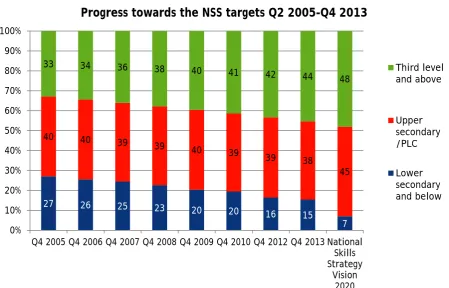
Ireland continues to make progress towards achieving the National Skills Strategy (NSS)targets. It is estimated that 44% hold third level qualifications, 38% have obtained higher secondary/Further Education and Training qualifications, while the proportion of those holding lower secondary or below stands at 15%.
1 It should be noted that the CSO education data for post Leaving Certificate (PLC) education level also includes some
Figure 1 Labour Force by Educational Attainment and NSS Target
Source: CSO Quarterly National Household Survey
The percentage of those in the labour force with Higher Education qualifications (NFQ Levels 6-10) has increased from 33% in Q4 2005 to 44% in Q4 2013. Specifically, there are approximately 274,000 more people in the labour force in Q4 2013 with Higher Education Level qualifications than there were in Q4 2005.
In relation to Levels 4 & 5 (Higher Secondary including Leaving Certificate), the percentage rate in Q4 2013 has declined to 38%, from 40% in Q4 2005. In absolute terms, the number of those within the labour force with Higher Secondary education has increased by around 6,000 since Q4 2005. There remains a challenge in closing the gap with the National Skills Strategy target at these levels.
Progress at Levels 1-3 (Junior Certificate and below) continues, with the percentage of the labour force at these levels falling from 27% in Q4 2005 to 15% in Q4 2013. Specifically, there over 210,000 less people in the Labour Force with only a Junior Cert qualification or below compared with 2005. Some of this decline is due to people moving up to higher levels in the National Framework of Qualifications. Other factors include older cohorts with a lower qualifications profile retiring from the labour force, and declining participation rates amongst those at these lower qualification levels.
27 26 25 23
20 20 16 15
7
40 40 39
39 40
39 39
38
45
33 34 36 38 40
41 42 44
48 0% 10% 20% 30% 40% 50% 60% 70% 80% 90% 100%
Q4 2005 Q4 2006 Q4 2007 Q4 2008 Q4 2009 Q4 2010 Q4 2012 Q4 2013 National Skills Strategy
Vision 2020
Progress towards the NSS targets Q2 2005-Q4 2013
The percentage of the population aged 20-24 with at least Higher Secondary or equivalent level education increased from 86% in 2005 to 92% by 2012, compared to the 2020 target of 94%.
In terms of progression and retention rates, the share of early school leavers in Ireland declined to 9% in Q4 2012, from a rate of 13% in 2006. Of the total cohort of students who entered first year of second level in 2006, approximately 90% went on to the Leaving Certificate examination.
The following table summarises progress in each of the headline National Skills Strategy targets.
Progress towards achieving the National Skills Strategy targets
NSS Target
National Skills Strategy Baseline2
Current
Position Progress Data source
48 % of Labour Force at levels 6-10 33 % 44% +11 % CSO QNHS
45 % of Labour Force at levels 4-5 40 % 38% -2% CSO QNHS
7 % will be at levels 1-3 27 % 15% +12 % CSO QNHS
94% of 20-24 population should have at
least NFQ Levels 4/5 86% 92%3 +6%
SLMRU, SOLAS analysis based on CSO data
The retention rate at Leaving Certificate
should reach 90 % by 2020. 81.3% 90 % +8.7 %
Department of Education
The progression rate to Third Level should
increase to 72% 55% 69% +14%
Higher Education
Authority (HEA)4
Upskilling 500,000 people within the Labour Force
At present, there is no data available which shows whether a person has moved up the National Framework of Qualifications in a given year. The most appropriate measurement of progress towards the National Skills Strategy is by the CSO Quarterly National Household Survey data on educational attainment presented previously, which reflects the output of education and training activity in the State.
Within the NSS targets the level of awards is outlined in the following sections.
2 NFQ Profile of the Labour Force Targets are measured from a baseline year of Q2 2005.
The 94 per cent target for 20-24 year olds is from a baseline year of 2005 The retention rate target is from a baseline year of 1996
The progression rate target is from a baseline year of 2004
3 Excludes individuals who did not state their level of educational attainment
Further Education and Training
The number of FETAC award holders5 in 2012 totalled just over 170,000. This figure represents a 6% decrease (or 10,600 fewer learners) when compared to 2011, but a 30% increase compared to 2008. In 2012there were increases in the number of major awards and specific purpose awards holders, and declines in the number of minor award holders and supplemental award holders.
Figure 2 FETAC Award Holders by Type of Award 2007-2012
Source: FETAC Statistics
In 2012, there were 42,600 major award holders, the breakdown of award levels is set out in the table below.
Further Education and Training Major Awards 2007-2012, NFQ Levels
Level 1 Level 2 Level 3 Level 4 Level 5 Level 6 Total
2007 - - 1,051 1,675 13,481 6,552 22,759
2008 12 53 1,417 1,777 14,196 6,974 24,429
2009 72 194 2,499 1,674 17,438 6,895 28,772
2010 170 281 2,602 1,373 20,504 6,834 31,764
2011 264 539 3,428 1,180 23,485 8,961 37,857
2012 314 666 1,080 2,246 26,666 11,621 42,593
Source: QQI
5 Note, the total award holders figure for 2012 is not the sum of the four award types holders shown above as some people
achieve awards of more than one award type, e.g. a major award and a minor award.
2007 2008 2009 2010 2011 2012
Supplemental 456 717 1,281 1,327 946 730
Specific Purpose (Special Purpose) 24,157 17,176 16,087 11,337 10,785 15,134
Component (Minor) 95,276 93,910 135,804 141,046 140,870 122,876
Certificates (Major) 22,759 24,429 28,722 31,764 37,857 42,593
0 20,000 40,000 60,000 80,000 100,000 120,000 140,000 160,000 180,000 200,000
Higher Education
Overall graduate output in 2012 was 60,6466, overall graduation numbers have risen by 8% since 2007.
Between 2007 and 2013 a significant drop in numbers graduating at level 6 occurred. Level 7 graduate numbers also declined, at a smaller rate, between 2007 and 2011 however between 2011 and 2012 level 7 graduate numbers rose by 25%.
[image:22.595.83.517.287.662.2]There were 43,500 graduates at levels 6-8 in 2012, an increase of 7% on the previous year. Just over 17,000 students graduated at levels 9 and 10 in 2012, a slight decline on 2011, however graduate numbers at these levels are up 16% on 2007 figures.
Figure 3 Graduate output from Higher Education 2005-2012, NFQ Levels
Source: HEA
Data does not include approximately awards made at independent, private third level colleges in Ireland in 2012.
6 Includes distance and e-learning.
2005 2006 2007 2008 2009 2010 2011 2012
Level 10 808 966 1,055 1,092 1,210 1,222 1,447 1,532
Level 9 12,075 12,600 13,597 14,085 14,762 16,899 16,200 15,526
Level 8 24,659 25,518 26,071 26,150 25,742 26,798 27,368 29,060
Level 7 10,284 9,468 9,340 9,178 8,734 9,146 7,702 9,602
Level 6 7,190 6,623 6,321 4,792 3,923 4,157 5,553 4,926
Forthcoming EGFSN Publications
Freight Transport/Distribution/Logistics Sector
The freight transport/distribution/logistic sector is of strategic importance to Irish trade. There are 6,430 enterprises employing 37,000 people with a turnover of €4.6bn in the land transport sub-sector and 1,030 enterprises, with 14,700 employed and a turnover of €3.8bn in the warehousing and support activities for the transport sub-sector.
Under the Action Plan for Jobs 2014 the EGFSN/Forfás will undertake research aimed at identifying current and planned skills and talent needs of the Freight Transport/Distribution/Logistics Sector and how any gaps can be addressed including through the domestic education supply and continuing professional development.
It is anticipated this report will be available in quarter 4 2014.
Marine Skills
In July 2012, the Taoiseach Enda Kenny launched Harnessing Our Ocean Wealth - An Integrated
Marine Plan for Ireland, prepared by the Inter-departmental Marine Co-ordination Group.
Harnessing Our Ocean Wealth sets out a roadmap for the Government's vision, high level goals and
integrated actions across policy, governance and business to enable Ireland's marine potential to be realised.One of the actions specified in the plan is the need to identify future skills needs and labour market supply and demand trends in the marine/maritime area and under the Action Plan for
Jobs 2014 the EGFSN/Forfás will undertake this analysis.
It is anticipated this report will be available in quarter 4 2014.
Hospitality Sector
It is anticipated that overseas visitor numbers will increase by 4% in 2014 with total tourism revenue increasing by 12% - also driven by increased spending in the domestic market. This will offer
additional employment opportunities in the Hospitality sector for those with the right skillsets. under the Action Plan for Jobs 2014 the EGFSN/Forfás will undertake research focused on identifying workforce skills and competency requirents for the Hospitality sector in Ireland up to 2020 and actions to ensure the availability of the right skill base to help drive growth of the domestic Hospitality Sector.
The National Skills Bulletin 2014
Produced annually by the Skills and Labour Market Research Unit in SOLAS, the National Skills Bulletin provides an overview of employment trends and demand for skills in Ireland. The Bulletin draws on data on employment, vacancies, job announcements and immigration and other
qualitative information held in the National Skills Database, to identify imbalances in the Irish labour market at occupational level.
The next edition of the National Skills Bulletin is scheduled for publication in mid-2014.
Monitoring Ireland’s Skill Supply: Trends in Education and Training Output 2014
Undertaken annually by the Skills and Labour Market Research Unit of SOLAS on behalf of the EGFSN, this report examines the numbers of students entering and leaving the education/training system in Ireland and reports on:
The demographic profile of the school age population
Junior and leaving cert trends
Further education and training awards
Higher education trends
Where graduates go
Adult lifelong learning participants
It is envisaged that the next edition of the report will be published in mid-2014.
Regional Labour Markets Bulletin 2014
The Regional Labour Markets Bulletin is produced annually by the Skills and Labour Market Research Unit in SOLAS on behalf of the EGFSN. It provides an overview of the Irish labour market at regional level, by supplying an analysis of the key labour market indicators for each of Ireland’s eight administrative regions: Border, Dublin, Mid East, Midland, Mid West, South East, South West and West.
Appendix 1: Publications by the Expert Group on Future
Skills Needs (2007 – 2014)
Report Publication Date
Regional Labour Markets Bulletin 2013 March 2014
Guidance for Higher Education Providers on Current and Future Skills Needs of Enterprise: Springboard 2014
February 2014
Addressing Future Demand for High-Level ICT Skills November 2013
Monitoring Ireland’s Skills Supply: Trends in Education and Training Outputs 2013
July 2013
National Skills Bulletin 2013 July 2013
Future Skills Requirements of the Manufacturing Sector to 2020 April 2013 The Expert Group on Future Skills Needs Statement of Activity 2012 April 2013 Guidance for Higher Education Providers on Current and Future Skills Needs
of Enterprise: Springboard 2013
February 2013
Vacancy Overview 2012 February 2013
Regional Labour Markets Bulletin 2012 January 2013
Monitoring Ireland’s Skills Supply: Trends in Education and Training Outputs 2012
July 2012
National Skills Bulletin 2012 July 2012
Key Skills for Enterprise to Trade Internationally June 2012
EGFSN Statement of Activity 2011 April 2012
Vacancy Overview 2011 February 2012
Guidance for Higher Education Providers on Current and Future Skills Needs of Enterprise (Forfás report based on EGFSN identified future skills needs)
February 2012
Addressing High–Level ICT Skills Recruitment Needs: Research Findings January 2012 Monitoring Ireland’s Skills Supply: Trends in Education and Training Outputs July 2011
National Skills Bulletin 2011 July 2011
EGFSN Statement of Activity 2010 May 2011
Developing Recognition of Prior Learning: The Role of RPL In the Context of the National Skills Strategy Upskilling Objectives
April 2011
Vacancy Overview 2010 March 2011
Future Skills Needs of Enterprise within the Green Economy in Ireland November 2010 Future Skills Requirements of the Biopharma-Pharmachem Sector November 2010
Monitoring Ireland's Skills Supply - Trends in Education and Training Outputs 2010
National Skills Bulletin 2010 July 2010
Future Skills Needs of the Wholesale and Retail Sector May 2010
EGFSN Statement of Activity 2009 April 2010
Future Skills Requirements of the Food and Beverage Sector November 2009
Skills in Creativity, Design and Innovation November 2009
Monitoring Ireland’s Skill Supply – Trends in Education and Training Outputs 2009
November 2009
National Skills Bulletin 2009 July 2009
A Quantitative Tool for Workforce Planning in Healthcare: Example Simulations
June 2009
EGFSN Statement of Activity 2008 June 2009
A Review of the Employment and Skills Needs of the Construction Industry in Ireland
December 2008
Statement on Raising National Mathematical Achievement December 2008
National Skills Bulletin 2008 November 2008
All-Island Skills Study October 2008
Monitoring Ireland’s Skills Supply: Trends in Education/Training Outputs 2008 July 2008
The Expert Group on Future Skills Needs Statement of Activity 2007 June 2008 Future Requirement for High-Level ICT Skills in the ICT Sector June 2008
Future Skills Needs of the Irish Medical Devices Sector February 2008
Survey of Selected Multi-National Employers’ Perceptions of Certain Graduates from Irish Higher Education
December 2007
The Future Skills and Research Needs of the International Financial Services Industry
December 2007
National Skills Bulletin 2007 November 2007
Monitoring Ireland’s Skills Supply: Trends in Educational/Training Outputs June 2007