Off-branch polaritons and multiple scattering in semiconductor microcavities
P. G. Savvidis,1 C. Ciuti,2J. J. Baumberg,1,*D. M. Whittaker,3 M. S. Skolnick,4and J. S. Roberts51
Department of Physics & Astronomy, University of Southampton, SO17 1BJ, United Kingdom 2Physics Department, Swiss Federal Institute of Technology Lausanne, CH-1015 Lausanne-EPFL, Switzerland
3Toshiba Research Europe Ltd, Cambridge, CB4 4WE, United Kingdom 4Department of Physics, University of Sheffield, Sheffield S3 7RH, United Kingdom
5Department of Electronic and Electrical Engineering, University of Sheffield, Sheffield, S1 3JD, United Kingdom 共Received 6 March 2001; revised manuscript received 3 May 2001; published 25 July 2001兲
Angle-resolved measurements show unexpected emission resonances of the polaritons in a semiconductor microcavity. These resonances appear when more than one in-plane polariton mode is macroscopically occu-pied. The new resonances observed in angle-resolved luminescence do not lie on the expected polariton branches and possess different dispersion relations with negative effective mass. The experimental results can be well explained using an interacting polariton model that treats multiple scattering. The k dispersion of the luminescence resonances is reproduced using the Bogolubov approximation that deals with the macroscopic coherence of the signal, pump, and idler modes. This model also explains many puzzling features such as the stimulation of resonant Rayleigh scattering in the backward direction. In addition, the use of nonresonant control beams for coherent control of the polaritons is shown both experimentally and theoretically. The rich complexity of new phenomena in optically excited semiconductor microcavities can be attributed to the distinctive anti-Hermitian or anomalous coupling between polaritons.
DOI: 10.1103/PhysRevB.64.075311 PACS number共s兲: 78.47.⫹p, 71.36.⫹c, 42.50.⫺p, 42.65.⫺k
I. INTRODUCTION
Exciton polaritons are the normal modes of the strong light-matter coupling in semiconductor microcavities.1 Such half-light half-matter quasiparticles have sharply distorted energy dispersions and a pronounced nonlinear behavior, in-herited from the cavity photon and quantum well exciton components, respectively. After the first nonlinear emission studies under nonresonant pumping,2,3a significant accelera-tion of research has been devoted to the regime of resonant excitation.4 –14Indeed, the dynamics of interacting polariton particles can now be directly monitored using resonant opti-cal pulses and performing angle-resolved measurements. Re-cently, huge polariton amplification has been seen in angle-resolved ultrafast pump-probe experiments.4 Lower-branch polaritons with a specific in-plane wave vector kp are in-jected by a resonant pump pulse, while a probe weakly ex-cites the k⫽0 polariton mode. The probe beam has been found to stimulate the parametric conversion of two pump polaritons into the pair of polaritons at the wave vectors 0
共signal兲and 2kp共idler兲. This process occurs for the ‘‘magic’’ wave vector kp, which allows energy-momentum conserva-tion for the polariton-polariton scattering. Under continuous-wave excitation without a probe beam, the spontaneous acti-vation of such a process has been observed, and very efficient parametric oscillation of the polariton modes has been achieved.8,12 In this situation, not only the pumped mode but also the signal and idler modes exhibit a macro-scopic coherence, although the phase of each varies sepa-rately. The three polariton ‘‘condensates’’ can, in principle, drastically modify the spectral properties at other wave vec-tors and produce collective excitations with peculiar disper-sions. A situation of this kind is seen in a very different system, namely, the Bose condensate in superfluid helium,
whose collective excitations have been very successfully de-scribed by Bogolubov.15
In this paper, we present angle-resolved emission mea-surements from a semiconductor microcavity excited in this polariton parametric amplification regime. New polariton resonances are clearly resolved in spectral, temporal, and an-gular data. The extra emission branches are absent when the probe is switched off. Their energy is found to be off the normal polariton branches, and their dispersions are also anomalous. Within the model of interacting polaritons
共treated as interacting bosons6,14兲, we successfully reproduce these experimental observations. The multiple wave mixing of the polaritons is found to reproduce the strong coherent emission at the wave vectors k⫽⫺kp,3kp and explain the observed spectral structure. The angular dispersion of the incoherent luminescence can be explained by applying the Bogolubov approach to the polariton system in the presence of signal, pump, and idler ‘‘condensates.’’ Five new pair-polariton branches arise in the present conditions, which can now intuitively explain most experiments. Perhaps the most interesting general feature of this paper is the contrast be-tween the Hermitian coupling bebe-tween photon and exciton, which gives rise to the polaritons, and the anomolous anti-Hermitian-like coupling between polariton pairs, which gives rise to the many anomalous features observed here. Anti-Hermitian or anomalous coupling, which occurs in parametrically interacting systems, is particularly easy to study here and, unlike the microwave version,16 naturally gives rise to a quasiparticle picture in optically driven micro-cavities.
and showing coherent control, are detailed in Secs. V and VI, before we conclude.
II. EXPERIMENTAL SETUP AND SAMPLE
The semiconductor microcavity sample used in these ex-periments was grown by metalorganic vapor-phase epitaxy and is made of top 共bottom兲 distributed Bragg reflectors
共DBR’s兲 consisting of 17 共20兲 alternating /4 layers of GaAs/Al0.18Ga0.82As. Two pairs of three 100 Å In0.06Ga0.94As quantum wells are sandwiched between the DBR’s and are placed at the two intracavity field antinodes. The optical cav-ity length is⬃3ex/2 and varies across the sample. The cav-ity mode energy is thus tunable by scanning the position on the sample used for measurements, allowing access to both positive and negative detunings,⌬⫽ex⫺cav, of the
cav-ity resonance at normal incidence, cav(⫽0), from the
lowest exciton energy ex. For resonance at normal inci-dence (⌬⫽0) used in all these experiments, a normal-mode splitting of ប⍀⬃7 meV is achieved with lower polariton and upper polariton linewidths of 0.56 meV and 1.2 meV, respectively.
The strong-coupling regime is achieved when the sample is placed inside a wide field-of-view cold-finger cryostat and is cooled to a temperature of⬃10 K. Transform-limited ul-trashort pulses, derived from a Ti:sapphire laser with a rep-etition rate of 76 MHz, are spectrally filtered by a spatial light modulator and grating arrangement to resonantly excite the lower polariton branch. Pump-probe measurements are performed in the transmission geometry and the light emitted by the sample in a general direction, is collected in a cone of ⫾0.14° and is coupled into a multimode fiber. Polariza-tion of the pump and probe beams is kept co-circular, to inject polaritons of one particular spin and avoid unwanted polarization effects that can affect the analysis. The pump incidence angle is p⫽16.5°, while the probe is at normal incidence, ⫽0°, unless otherwise stated. The relation be-tween the incident angle and the in-plane wave vector k is simply k⫽(/c)sin, where is the optical frequency and c the speed of light. Both pump and probe beams have an-gular widths of ⬃1°. A liquid-nitrogen-cooled charge-coupled device and a monochromator with a spectral resolu-tion of 0.035 meV, are used to analyze the time-integrated emitted light. Far-field images of the emission are acquired by projecting the emission on a screen placed behind the sample.
III. EXPERIMENTAL RESULTS
In the specific pump-probe geometry discussed above, the probe beam shows a net gain of 10 when the pump pulse arrives at the same time. When the probe is strong enough, the pump depletion is macroscopic and can be directly ob-served as a decrease of the incoherent luminescence around the pump angle. In this regime, we also observe sharp emis-sion around the pump back-scattering angle, ⫽⫺16.5°, seen as a new beam emerging from the sample as well as the idler 共Fig. 1兲. Note that the relative emission intensity, re-corded on these images at different angles, is only qualitative
and depends on the camera angle at which the image was taken.
This emission spectrum at ⫺kp exhibits new energy peaks that exist clearly off the polariton branches and show dramatically nonlinear features. Figure 2共a兲presents several emission spectra at ⫽⫺16.5°, normalized to the pump power. At low pump intensities, the emission is peaked at the pump energy and has a linear dependence on the pump power. This is the well-known resonant Rayleigh scattering of the pump beam. When increasing the pump intensity, three new resonances appear in the spectrum with a strong superlinear dependence on the pump power. These features are completely absent when the probe beam is switched off
[image:2.612.367.509.57.415.2]lower polariton branch. Remarkably, some of the measured peak energies are completely off branch.
The appearance of new emission resonances does not oc-cur only at ⫽⫺16.5°. Another relatively intense emission is shown in Fig. 2共c兲for the angular range between 43° and 50°. Switching on the probe produces additional peaks, which are clearly resolved关also plotted on Fig. 1共a兲兴. These enhancements at ⫺kp,0,kp,2kp, and 3kp are maximized when the pump and probe arrive almost simultaneously
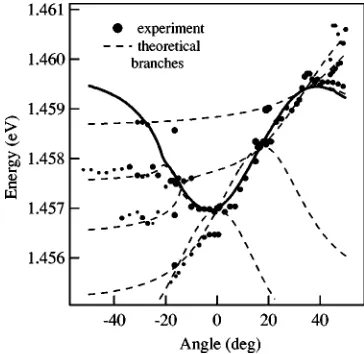
共theoretically, the buildup time of the signal is seen to favor timing the probe to arrive on the leading edge of the pump pulse兲, and possess similar fast temporal responses con-trolled by the 5 ps lifetime of the photon component in the microcavity. Their complete dependence on the injected probe suggests that the macroscopic occupation of the signal and idler modes共whose occupation number f becomes much larger than 1兲is responsible for the observed emission. For a full picture, we have systematically measured the peak ener-gies from the luminescence spectra in the whole range be-tween ⫾50° 共Fig. 3, with theoretical fits to be discussed later兲. The observed energies (points) clearly demonstrate the appearance of new emission branches whose energy dis-persion is very peculiar. To proceed theoretically requires a full treatment of multiple polariton scattering.
IV. THEORETICAL ANALYSIS
A. Introduction
The observed parametric amplification of the polariton modes has been successfully described within the interacting polariton model. The gain spectral, temporal, and angular
properties have been very well reproduced through a set of three equations for the signal, pump, and idler modes.6,17The dynamics predicted by the polariton Hamiltonian is indeed very reliable, encouraging an extension of the treatment to the multiple-scattering regime. In this section, we present the dynamical equations for the coherent occupation of the po-lariton modes. These equations involve all the in-plane wave vectors k and represent a generalization of the three mode equations for the polariton parametric amplifier.
Macroscopic occupation of three different k states along the dispersion introduces strong parametric coupling be-tween polariton pairs which satisfy energy-momentum con-servation. The restricted phasematching conditions result in new pair-polariton branches that are distinct from the origi-nal lower polariton dispersion. These new polariton branches are ‘parametric mirrors’ induced by the specific occupations of the microcavity. As we shall see, each branch is induced by a specific pair of polaritons.
B. Coherent multiple scattering
Before considering the dynamical equations, we briefly review the polariton Hamiltonian.6 When considering only the case of resonant pumping of the lower polariton branch, we can enormously simplify our description by neglecting the nonlinear contribution due to the upper branch, which is energetically well separated. The destruction operator for a lower polariton with in-plane wavevector k is pk⫽Xkbk ⫹Ckak, where bkand akare the exciton and photon Bose operators, respectively, and Xk and Ck the corresponding Hopfield coefficients (Xk⬎0 and Ck⬍0). The lower polar-iton Hamiltonian is H⫽HL P⫹HeffP P⫹Hqm. The free term HL P⫽兺kEL P(k) pk
†
[image:3.612.345.527.57.234.2]pk, contains the lower polariton energy dispersion EL P(k). The polariton-polariton interaction is due to the exciton-exciton interaction and exciton-photon satura-tion. Namely, we have
FIG. 2. 共a兲and共b兲Emission as a function of pump power col-lected at⫺16.5°, normalized to the pump power共increasing from 0.2 mW to 2.4 mW in steps of 0.4 mW兲, both with and without probe. Inset shows the schematics of reflected (R), transmitted (T), and back-scattered共dashed兲directions of the incident pump beam. 共c兲 Normalized emission spectra, with and without probe in the angular range between 43° and 50°, at 2.4 mW pump.
HP P eff⫽1
2 k,k
兺
⬘,qX 2 A Vk,k⬘,q
P P
pk⫹q †
pk†⬘⫺q pk pk⬘, 共1兲
where X is the two-dimensional exciton radius and A is the macroscopic quantization area. The interaction po-tential is Vk,k
⬘,q P P ⫽
兵关2ប⍀R/nsatX2兴(兩Ck⫹q兩Xk⬘⫹兩Ck⬘兩Xk⫹q) ⫹(6e2/⑀X)Xk⫹qXk⬘其Xk⬘⫺qXk, with nsat⫽7/(16X
2) the exciton saturation density, and⑀the quantum well dielectric constant. Notice that Vk,k
⬘,q P P
is positive and represents a re-pulsive interaction. The cavity system interacts with the ex-ternal electromagnetic field through the standard quasimode coupling Hamiltonian, Hqm⫽兰d⍀兵兺kgCk pk
† ␣ k,⍀ ⫹H.c.其. The operator␣k,⍀destructs an external photon with in-plane wavevector k and frequency ⍀. When an external optical field is applied,␣kcan be replaced by its mean value
具
␣k典
, which represents the classical value of the field.An applied optical field with the in-plane wave vector k0, drives a polarization
具
pk0典
of the corresponding polariton mode. The coupled dynamics of every具
pk典
is given by the Heisenberg equations of motion generated by the interacting polariton Hamiltonian. Such equations become closed when the three-polariton expectation values are factorized in prod-ucts of three-polariton polarizations. It is convenient to con-sider the rescaled quantity Pk⫽(X/冑
A)具
pk典
. The quantity兩Pk兩2 represents the coherent density of polaritons in the k mode in units of X⫺2. The equation forPkreads
iប d
dtPk⫽关E ˜
L P共k兲⫺i␥k兴Pk
⫹
兺
k⬘,k⬙⫽k Ek,k
⬘,k⬙ int P
k⬘⫹k⬙⫺k
쐓 P
k⬘Pk⬙⫹Fk共t兲.
共2兲
The coupling energy is defined as
Ek,k
⬘,k⬙ int ⫽1
2共Vk⬘,k⬙,kÀk⬘ P P ⫹
Vk
⬘,k⬙,k⬙⫺k P P
兲.
The repulsive polariton interaction is responsible for the blueshift of the polariton branch seen in experiments, namely,
E ˜
L P共k兲⫽EL P共k兲⫹
兺
k⬘Ek,kshi f t⬘兩Pk⬘兩2, where Ek,k
⬘
shi f t⫽ Vk,k
⬘,0 P P ⫹
Vk,k
⬘,k⬘⫺k P P
. Finally, the applied exter-nal field produces the driving term Fk(t)⬀g兩Ck兩2⍀k(t), where ⍀k(t) is the k component of the applied extracavity field.
Equation共2兲actually describes the coherent multiple scat-tering of resonantly excited polaritons. The driving field
Fk(t) excites polaritons at specific wave vectors. In our con-figuration, the external field excites the wave vector 0 and kp
共with a small angular width around each兲. Due to the polariton-polariton interaction, the coherent occupation at
generic wave vectors k
⬘
and k⬙
can be scattered into the wave vectors k and k⬘⫹
k⬙⫺
k. As these wave vectors canscatter into other ones, this gives rise to a sort of multiple-scattering cascade. As a first application, we have solved Eq.
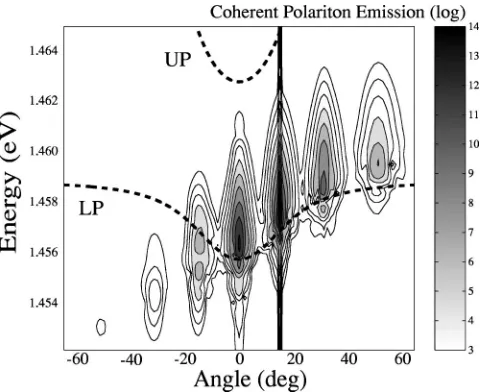
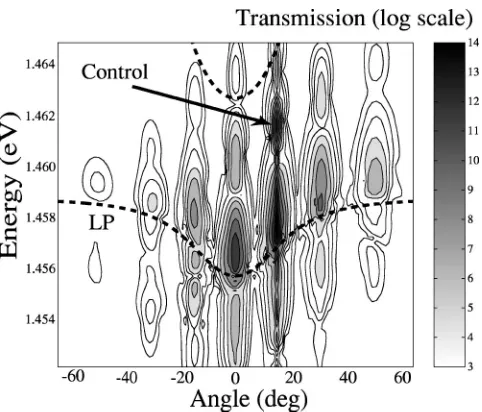
共2兲by considering the excitation pulses and material param-eters corresponding to the experiment. A contour plot of the quantity Tk()⫽兩Ck兩2兩Pk()兩2 is plotted as a function of emission angle and energy ប 共Fig. 4兲.Tk() represents the polariton coherent density at the wave vector k and en-ergy ប, weighted by the photon fraction 兩Ck兩2, and is pro-portional to the coherent transmission. Apart from the pump transmission, strong emission occurs at the signal and idler angles. Relatively intense emission beams are also observed around -kpand 3kp. One component at k⫽⫺kpis spectrally off branch and presents a well-developed splitting, which matches the experimental spectra at ⫽⫺16.5°. Similarly the spot around 3kp accounts for the strong emission near 50°. The calculation also shows very weak emission around
k⫽⫺2kp, which is not resolved in the current experiment.
C. Dispersion of the emission branches
[image:4.612.318.558.56.252.2]macroscopically occupied. In our configuration, we can take Spol⫽兵0,kp,2kp其. The Bogolubov approach essentially consists of two approximations. The first approximation is obtained by neglecting all scattering channels that do not have the macroscopically occupied modes as initial states. This means that we consider only the processes 兵k
⬘
,k⬙
其→兵k,k⬘⫹
k⬙⫺
k其, where k⬘
,k⬙
苸Spol, that is they are macroscopically occupied. The second step consists in neglecting the quantum fluctuations of these macros-copically occupied modes. Mathematically, this corresp-onds to the approximation p†k(t) p†k⬘⫹k⬙⫺k(t) pk⬘(t) pk⬙(t)⯝pk†(t) pk†⬘⫹k⬙⫺k(t)
具
pk⬘(t)典具
pk⬙(t)典
. With these assump-tions, the equation of motion for the polariton operator pk(t) readsiប d
dtpk共t兲⫽关E˜L P共k兲⫺i␥k兴pk共t兲⫹Fk共t兲
⫹
兺
k⬘,k⬙苸 Spol
Ek,kint⬘,k⬙Pk⬘共t兲Pk⬙共t兲 pk⬘⫹k⬙⫺k †
共t兲.
共3兲
The coupling to the external electromagnetic field is respon-sible, not only for the radiative loss␥k, but also for a
quan-tum fluctuation Langevin force Fk(t)
⫽兰d⍀ g Ck쐓e⫺i⍀t␣k,⍀(0). Finally, the evolution of the macroscopically occupied modes can be approximated with the expression P¯k⬘exp关⫺(i/ប)E˜LP(k
⬘
)t兴, where P¯k⬘ is a slowly varying function of time.The polariton operator pk(t) is coupled to the operator pk†⬘⫹k⬙⫺k(t), where k
⬘
,k⬙
苸 Spol. The wave vector k⬘⫹
k⬙
⫺k corresponds to the process兵k
⬘
,k⬙
其→兵k,k⬘⫹
k⬙⫺
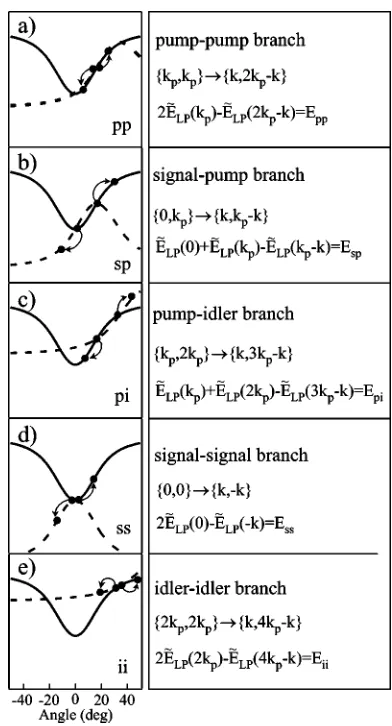
k其.For the particular set Spol⫽兵0,kp,2kp其, pk(t) is coupled to 5 wave vectors kpp, ksp, kpi, kss, and kii, each of which correspond to different processes共Fig. 5兲. Namely,
共i兲 pump-pump scattering is兵kp,kp其→兵k,kpp其, with kpp ⫽2kp⫺k. The condition of energy conservation is E˜L P(k) ⫽Ep p(k), where the pump-pump branch is defined as
Ep p共k兲⫽2E˜L P共kp兲⫺E˜L P共kpp兲.
共ii兲 signal-pump scattering is 兵0,kp其→兵k,ksp其, with ksp ⫽kp⫺k. The corresponding branch reads
Es p共k兲⫽E˜L P共0兲⫹˜EL P共kp兲⫺E˜L P共ksp兲.
共iii兲 pump-idler scattering is 兵kp,2kp其→兵k,kpi其, with kpi ⫽3kp⫺k. The related branch
Epi共k兲⫽E˜L P共2kp兲⫹˜EL P共kp兲⫺E˜L P共kpi兲.
共iv兲signal-signal scattering is兵0,0其→兵k,kss其, with kss⫽ ⫺k. The signal-signal branch dispersion reads
Ess共k兲⫽2E˜L P共0兲⫺E˜L P共kss兲.
共v兲 idler-idler scattering is 兵2kp,2kp其→兵k,kii其, with kii ⫽4kp⫺k. The corresponding energy branch has the disper-sion
Eii共k兲⫽2E˜L P共2kp兲⫺E˜L P共kii兲.
The full set of scattering processes and the corresponding wave-mixing dispersion branches are depicted in Fig. 5. Fi-nally, we point out that the signal-idler scattering gives rise to the same branch as the pump-pump scattering, because E
˜L P(0)⫹E˜L P(2kp)⫽2E˜L P(kp).
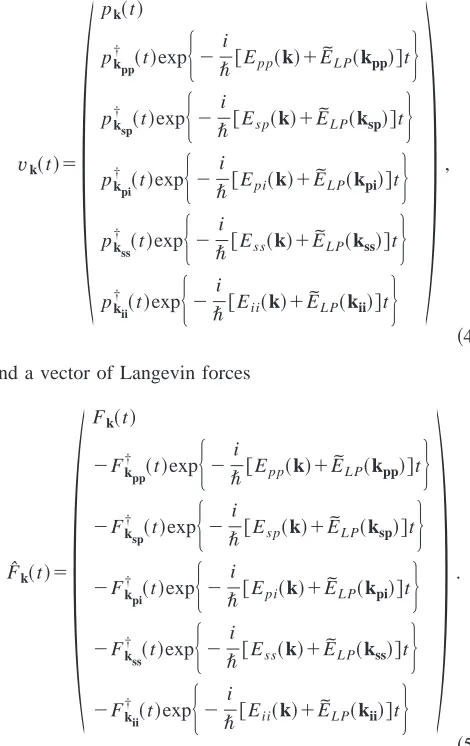
[image:5.612.338.534.53.416.2]In order to go further, it is convenient to define the fol-lowing vector of polariton operators
vk共t兲⫽
冢
pk共t兲pk
pp
† 共t兲exp
再
⫺ iប 关Ep p共k兲⫹E˜L P共kpp兲兴t
冎
pk
sp
† 共t兲exp
再
⫺ iប 关Es p共k兲⫹E˜L P共ksp兲兴t
冎
pk
pi
†
共t兲exp
再
⫺ iប 关Epi共k兲⫹E˜L P共kpi兲兴t
冎
pk
ss
† 共
t兲exp
再
⫺ iប 关Ess共k兲⫹E˜L P共kss兲兴t
冎
pk
ii
†共
t兲exp
再
⫺ iប 关Eii共k兲⫹˜EL P共kii兲兴t
冎
冣
,共4兲 and a vector of Langevin forces
Fˆk共t兲⫽
冢
Fk共t兲⫺Fk
pp
† 共
t兲exp
再
⫺ iប 关Ep p共k兲⫹E˜L P共kpp兲兴t
冎
⫺Fksp † 共
t兲exp
再
⫺ iប 关Es p共k兲⫹E˜L P共ksp兲兴t
冎
⫺Fk
pi
† 共t兲exp
再
⫺ iប 关Epi共k兲⫹E˜L P共kpi兲兴t
冎
⫺Fk
ss
† 共t兲exp
再
⫺ iប 关Ess共k兲⫹E˜L P共kss兲兴t
冎
⫺Fk
ii
†
共t兲exp
再
⫺ iប 关Eii共k兲⫹˜EL P共kii兲兴t
冎
冣
.共5兲 This way, the polariton dynamics are described by the opera-tor system of equations
iប d
dtvk共t兲⫽Mkvk共t兲⫹Fˆk共t兲, 共6兲 where the sparse matrixMkis a non-Hermitian matrix. The diagonal elements ofMkare the wave-mixing branch energy dispersions, namely,
共Mk兲11⫽E˜L P共k兲,
共Mk兲22⫽Ep p共k兲,
共Mk兲33⫽Es p共k兲,
共Mk兲44⫽Epi共k兲,
共Mk兲55⫽Ess共k兲,
共Mk兲66⫽Eii共k兲. 共7兲 The ordinary polariton branch E˜L P(k) is directly coupled to the other five ones. The corresponding off-diagonal matrix elements are
共Mk兲12⫽Ek,kp,kp int P¯
kp 2⫹2E
k,0,2kp int P¯
0P¯2kp
共Mk兲13⫽2Ek,0,kp int P¯
0P¯kp,
共Mk兲14⫽2Ek,kp,2kp int P¯
kpP¯2kp,
共Mk兲15⫽Ek,0,0 int P¯
0 2 ,
共Mk兲16⫽2Ek,2kp,2kp int P¯
2kp
2 . 共8兲
D. Anti-Hermitian or anomalous coupling
The off-diagonal elements of the coupling matrix satisfy the relation
[image:6.612.57.292.60.433.2]共Mk兲1n⫽⫺共Mk兲n1쐓 , 共9兲 which is characteristic of the parametric or anti-Hermitian or anomalous coupling. All the other matrix elements of (Mk) are zero. Such a system of operatorial equations is the starting point to calculate many-operator expectation values that provide access to experimental observables such as the photoluminescence. To obtain the energy resonances of the emission spectra, we simply have to find the eigenvalues of the complex matrixMk, which are shown as dashed lines in Fig. 3, overlaying and in excellent agreement with the ex-perimental data. Since this matrix has been obtained by per-forming a cw approximation, the comparison with the pulsed experiment has to be done by fitting an average value for the pump, signal, and idler coherent densities兩Pkp兩2,兩P0兩2, and
兩P2kp兩2. The total density is constrained by the observed blueshift of the original lower polariton branch. A good fit is obtained by using a signal to pump density ratio
兩P0兩2/兩P2kp兩2⯝0.08 and an idler to pump ratio兩P0兩2/兩P2kp兩2
⯝0.04. These values are consistent with the time-resolved solutions of the coherent wave mixing whose spectra are shown in Fig. 4.
Because of the anomalous coupling关Eq.共9兲兴, the behavior of the eigenvalues is very different to the case of Hermitian coupling. The situation is schematically depicted in Fig. 6. In the case of a matrix with Hermitian coupling, two quasireso-nant levels anticross. With increasing interaction, the real part of the eigenvalues repel and at the same time, the imagi-nary共damping兲parts tend to a mean value. This is the clas-sical anticrossing between two coupled damped harmonic oscillators, and is exactly the situation for the coupling of the excitons and photons in the microcavity. In the case of anti-Hermitian coupling for the off-diagonal terms, the behavior is opposite. With increasing interaction, the real parts of the eigenvalues attract, while the imaginary parts split apart. This means that one mode is overdamped, while the other one is narrowed and can undergo amplification. The anti-Hermitian coupling is characteristic of parametric or ‘anoma-lous’ coupling between two oscillators.
dis-persion and are completely off the branches of the unperturbed lower polariton dispersion. They are not exactly at the resonant Rayleigh scattering energy either, as sug-gested in recent experiments.7,18 Polariton branches, corre-sponding to different scattering channels cross and anti-Hermitian coupling, leads to their attraction and the flattening of the dispersion in that region 共as for the mea-sured dispersion around k⫽0, Fig. 3兲. The emission is ex-pected to be particularly intense at these crossing points be-tween branches. The branch, corresponding to the pump-pump scattering channel, completely overlaps with the perturbed polariton dispersion in the entire region between 0° and 35° 关Fig. 5共a兲兴and is responsible for the strong para-metric luminescence observed in the absence of a probe beam.10On the other hand, its crossing with the branch cor-responding to the pump-signal scattering channel, is respon-sible for the bright emission spot at the pump back-scattering angle of⫺16.5° degrees, seen in Fig. 2. This is the origin of the enhanced coherent backscatter observed universally in semiconductor microcavities. In addition, the crossing point between the pump-signal and signal-signal branches is also exactly at the pump back-scattering angle of ⫺16.5°, and results in the buildup of efficient low-energy off-branch emission at that angle.
The lower-energy emission peak at k⫽0, seen in the
ex-periment 共Fig. 3兲, and seen as a shoulder in the full theory
共Fig. 4兲, is produced by subsequent scattering from the ⫺kp mode. In the multiple-wave-mixing equations, the
multiple-scattering is accounted for at all orders. However in the matrix approach, we have truncated the multiple-scattering cascade by considering only the channels having pump, signal, and idler as initial states. By including macro-scopic populations also at ⫺kp and 3kp, we would find a
next generation of additional channels. However at wave vectors k⬍0, many of the new pair-polariton modes from the matrix approach are clearly visible in the experiments
and account for the much stronger emission seen at negative angles.10Despite the evident success of this dispersion mode analysis, we are unable, at the present stage, to calculate the precise intensity of luminescence from the different branches. Such issues will be addressed elsewhere. It is clear, however, that where modes cross, the emission is substan-tially enhanced.
We also find a vanishing or even negative branch disper-sion around ⫽35°. This suggests that it is possible to im-mobilize共or bring to a dead stop兲polaritons in that region, or even in the case of negative dispersion, to reverse the direc-tion of their propagadirec-tion. This corresponds to a light-induced negative effective mass for the polaritons! The ability to use injected pulses to control the mass of polaritons, indicates the possibility of controlling their wave packets subsequent to their excitation. The analysis of the wave-packet propaga-tion of signal, idler, and off-branch polaritons will also be left to another publication.
V. ANGULAR DISPERSION OF STIMULATED GAIN
From the preceding analysis, it is clear that coherent mac-roscopic occupations at different points on the dispersion re-lation, modify the quasiparticle dispersion. More specifically, the polariton-polariton interaction introduces local distor-tions and nonlocal changes to the dispersion with the appear-ance of new branches that are theoretically predicted and experimentally observable.
In this section we demonstrate that such multiple scatter-ing is not limited to the particular pump-probe configuration discussed so far. The distortions of the occupied dispersion relation provide an explanation of why the probe gain can be observed even when energy-momentum conservation should not allow scattering to signal and idler. In addition, the data show that elastic scattering of pump photons 共that breaks k conservation兲can be stimulated. These results can be attrib-uted to the off-branch scattering developed above.
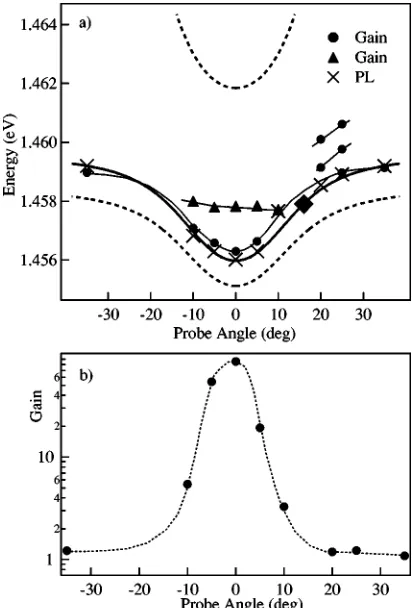
The experimental conditions are modified by allowing the probe angle to vary while keeping the pump angle fixed at p. Instead of the expected narrow range of probe angles, which can evoke a stimulated response, the injection of a small polariton population is found to affect the polariton scattering at most angles. Figure 7 shows emission spectra taken in the probe transmission direction, when both pump and probe beams are incident at the same⫽0 time delay. In addition, pump photoluminesce共PL兲and linear probe trans-mission spectra are recorded when each beam is individually blocked. The linear transmission spectra共dashed兲agree well with the transfer-matrix model, yielding dispersivelike fea-tures at large incident angles. The pump luminescence spec-tra共thin lines兲in the regime of parametric polariton scatter-ing, are well described by the recently developed theory,14in which injection of a large polariton population rigidly blue-shifts the entire lower polariton dispersion. The extracted peak emission energies for the PL and the probe gain are plotted in Fig. 8 共a,⫻) and show good agreement with this rigid shift共which is of the order of the polariton linewidth兲. However the probe is found to be amplified for a large range of probe angles 关Fig. 8共b兲兴 at different energies. That stimulated scattering does not just occur to the ground state
of the lower polariton branch, but is due to the distortion of the dispersion relation from multiple scattering, which pro-duces extra solutions for energy and momentum conserva-tion. This is also responsible for a number of new gain peaks that are clearly observed at higher energies 关Fig. 8共a兲兴. Per-haps most surprising is the observation that the elastic scat-tering at the pump energy共dashed vertical lines in Fig. 7兲is strongly enhanced by the injection of a weak probe pulse. The extracted positions of this stimulated peak (䉱 in Fig. 8兲 confirm that this signal is degenerate with the pump wave-length. Rayleigh scattering, which breaks in-plane momen-tum conservation but conserves photon energy, is normally attributed to scattering off disorder within the quantum well in-plane potential. To be invoked for the results observed, such a model would suggest the unlikely scenario that in-plane disorder is amplified by the occupation of the large-diameter polariton states. Instead we suggest this effect arises from pump-signal scattering关Fig. 5共b兲兴in which near-degenerate scattering of the signal on the flattened bottom of the polariton dispersion共Fig. 3兲causes near-degenerate scat-tering of the pump. Further theoretical and experimental work is in progress to test this suggestion. Once again, how-ever, time-resolved spectroscopy allows direct observation of multiple scattering, which is smeared out and difficult to dis-entangle in cw experiments.
VI. COHERENT CONTROL THROUGH OFF-BRANCH EXCITATION
The effect of macroscopically coherent populations, posi-tioned along the dispersion relation, has a fundamental effect
in producing new pair-polariton modes. These off-branch features are not only significant in emission, but also in ex-citation. We demonstrate this by showing that the spectrum of the pump pulse is crucial in controlling the multiple scat-tering.
Normally, due to the filtering effect of the microcavity, little difference is expected when pumping with a 100 fs pulse共10 nm bandwidth, which is tuned to overlap only with the lower polariton兲, and a 5 ps pulse 共0.2 nm bandwidth, matched to the lower polariton linewidth兲. This assumes that light, which is not resonant with the lower polariton, merely reflects off the microcavity.19 However, due to the multiple scattering that produces new off-branch modes, we find that this is not the case, and the two different excitation condi-tions produce very different results. To simplify our experi-ment, we spectrally divide the pump pulse into a 5 ps pulse, which is resonant with the lower polariton branch, and a second higher-energy 5 ps 共‘‘control’’兲pulse. We limit our-selves to the case where the control pulse is tuned to 1.4618 eV, halfway in-between the upper and lower polaritons at this angle, which minimizes possible overlap with the bare polar-iton branches. Surprisingly, the off-resonant control pulse de-creases the parametric gain of the signal共Fig. 9兲. More sur-prisingly, the idler is nearly completely suppressed—the
FIG. 7. Spectra taken in transmission geometry for the range of probe angles shown, pumpp⫽16.5° held constant. PL spectra of
[image:8.612.334.540.57.361.2]the pump alone 共thin兲, linear probe transmission spectra without pump共dashed兲, and multistructured gain peaks observed when both pump and probe beam are incident at the same time delay共solid兲. The pump and probe powers are 1 mW and 70W. Each vertical tick corresponds to a tenfold increase in intensity.
relative suppression ratio for the signal and the idler beams can be as high as 25. This method of coherently controlling the emission in different directions by applying a control beam, can provide an effective means of manipulating the polariton populations and can possibly be used for switching applications.
To study this kind of process, we have calculated the co-herent wave mixing including the second control pump pulse. In Fig. 10, we show the time-resolved results for the signal at⫽0°. With just the pump pulse共dashed兲, the trans-mitted probe pulse without pump共dotted兲is amplified by a factor of 10 and slightly time-delayed due to the developing stimulation. When the second control pulse is also included
in the calculation, the signal gain decreases by a factor of
⬃2. This effect is optimized for simultaneous control and pump pulses as found experimentally. The origin of the gain quenching can be understood by inspecting Fig. 11, which shows the computed angle-resolved transmission spectra. We point out that Fig. 11 is calculated with the same parameters as Fig. 4, where the second control pulse is not included. Remarkably, Fig. 11 shows that the virtual population cre-ated by the second pump, produces additional wave-mixing processes, which compete with the normal parametric fis-sion. In fact, we see the appearance of a whole hierarchy of additional spots with respect to Fig. 4. However, unlike the experiments, the predicted idler suppression is comparable to that of the signal. Work is in progress to identify if this is due to higher-order multiple scattering, or coupling to the upper polariton branch, or higher-k excitons. However both the ex-perimental and theoretical results confirm that extreme care has to be taken when exciting these microcavities, since ab-sorption through multiple scattering arises at energies off the main polariton branches.
VII. CONCLUSIONS
[image:9.612.318.559.54.260.2]In conclusion, we have presented experimental and theo-retical results describing the angle-resolved emission from semiconductor microcavities in the regime of polariton para-metric amplification. Above the stimulation threshold, signal and idler modes have a macroscopic and coherent popula-tion. Multiple scattering, involving the signal or idler modes, gives rise to additional strong emission beams at wave vec-tors ⫺kp共pump back scattering兲and 3kpwith new spectral peaks. Such emission exhibits a hierarchy of new pair-polariton branches, with their anomalous dispersions lying off branch with respect to the unperturbed lower polariton dispersion. The observed features are well reproduced by equations describing the coherent multiple scattering of the polariton matter modes. Such equations represent a generali-zation to all k states of the three mode equations for the
FIG. 9. 共a兲 Coherent control: a second control pump beam is simultaneously applied at a higher nonresonant energy, opening an efficient scattering channel for the idler polaritons. The pump and control powers are 2 mW and 1 mW.共b兲Strength of signal and idler emission and 共c兲 their ratios, as a function of the control pulse power.
[image:9.612.71.277.58.230.2]FIG. 10. Coherent control: calculated signal transmission as a function of time for the same parameters as in Fig. 4 for no pump pulses 共dotted curve兲, main pump pulse共dashed curve兲, and both pump and control pulses共solid curve兲. The control pump pulse at 1462 meV decreases the gain even though it is nonresonant. The power ratio between pump and control pulses is Ipum p/Icontrol⫽2.
[image:9.612.69.281.481.662.2]polariton parametric amplifier.6The nonlinear resonances are also observed in the incoherent luminescence, which allows us to monitor their peculiar angular dispersion, including negative mass pair polaritons. The behavior of the emission branches can be qualitatively described by adopting the Bogulobov scheme to the polariton system in the presence of ‘‘condensates’’ at the pump, signal, and idler wave vectors. The present results give insight into both the nonlinear optics of interacting polariton matter, and the nature of anti-Hermitian coupling. The development of strong pair scatter-ing in the polariton system, produces these new off-branch
dispersions, which will be a general feature of all such strongly excited systems.
ACKNOWLEDGMENTS
We acknowledge the support of the University of Southampton, Coherent UK Ltd, and Hitachi Europe Ltd. This work was partly supported by HEFCE JR98SOBA, EC CLERMONT HPRN-CT-1999-00132, and EPSRC GR/ N18598. C.C. wishes to thank A. Quattropani, P. Schwendi-mann, and B. Deveaud for many interesting discussions and their kind support.
*Email address: [email protected]
1C. Weisbuch, M. Nishioka, A. Ishikawa, and Y. Arakawa, Phys. Rev. Lett. 69, 3314共1992兲.
2Le Si Dang, D. Heger, R. Andri, F. Boeuf, and R. Romestain, Phys. Rev. Lett. 81, 3920共1998兲.
3P. Senellart and J. Bloch, Phys. Rev. Lett. 82, 1233共1999兲. 4P.G. Savvidis, J.J. Baumberg, R.M. Stevenson, M.S. Skolnick,
D.M. Whittaker, and J.S. Roberts, Phys. Rev. Lett. 84, 1547 共2000兲.
5R. Huang, F. Tassone, and Y. Yamamoto, Phys. Rev. B 61, R7854 共2000兲.
6C. Ciuti, P. Schwendimann, B. Deveaud, and A. Quattropani, Phys. Rev. B 62, R4825共2000兲.
7R. Houdre´, C. Weisbuch, R.P. Stanley, U. Oesterle, and M. Il-egems, Phys. Rev. Lett. 85, 2793共2000兲.
8R.M. Stevenson, V.N. Astratov, M.S. Skolnick, D.M. Whittaker, M. Emam-Ismail, A.I. Tartakovskii, P.G. Savvidis, J.J. Baum-berg, and J.S. Roberts, Phys. Rev. Lett. 85, 3680共2000兲. 9G. Dasbach, T. Baars, M. Bayer, A. Larionov, and A. Forchel,
Phys. Rev. B 62, 13076共2000兲.
10P.G. Savvidis, J.J. Baumberg, R.M. Stevenson, M.S. Skolnick, D.M. Whittaker, and J.S. Roberts, Phys. Rev. B 62, R13278 共2000兲.
11A.I. Tartakovskii, D.N. Krizhanovskii, and V.D. Kulakovskii, Phys. Rev. B 62, R13298共2000兲.
12J.J. Baumberg, P.G. Savvidis, R.M. Stevenson, A.I. Tartakovskii, M.S. Skolnick, D.M. Whittaker, and J.S. Roberts, Phys. Rev. B
62, R16247共2000兲.
13P. Senellart and J. Bloch, Phys. Rev. B 62, R16263共2000兲. 14
C. Ciuti, P. Schwendimann, and A. Quattropani, Phys. Rev. B 63, 041303共2001兲.
15N.N. Bogolubov, Lectures on Quantum Statistics 共Gordon and Breach, New York, 1967兲.
16W.H. Louisell, Coupled Mode and Parametric Electronics 共Wiley, New York, 1960兲.