Electron-electron scattering in a double quantum dot: Effective mass
approach
S. Yu. Kruchinin,1,a兲A. V. Fedorov,1,b兲A. V. Baranov,1T. S. Perova,2and K. Berwick3 1
Saint-Petersburg State University of Information Technologies, Mechanics and Optics, 49 Kronverksky Avenue, 197101 St. Petersburg, Russia
2
Department of Electronic and Electrical Engineering, Trinity College, University of Dublin, Dublin 2, Ireland
3
Department of Electronic and Communications Engineering, Dublin Institute of Technology, Dublin 8, Ireland
共Received 10 June 2010; accepted 20 July 2010; published online 10 September 2010兲
We present a theoretical description of the first-order scattering of interacting electrons and holes in a double quantum dot. Assuming infinitely high walls, strong confinement, and a two-band approximation, we derive general expressions for the two-particle matrix elements of the screened Coulomb potential. We also determine the selection rules for different scattering channels and consider special cases where the corresponding matrix elements can be represented by simple analytical expressions. Numerical calculations of the matrix elements and an analysis of their dependence on the geometrical and material parameters of the double quantum dot have also been performed. ©2010 American Institute of Physics.关doi:10.1063/1.3477766兴
I. INTRODUCTION
Semiconductor nanocrystals, or the so-called quantum dots, with the characteristic linear sizeR0comparable to the exciton Bohr radiusrBof the corresponding bulk crystal, are
of great interest because of unusual electronic structure and optical properties.1 Depending on a relative magnitude be-tweenR0andrB, they may be classified into two regimes: for R0ⰇrB, a weak-confinement regime where the exciton
center-of-mass motion is quantized, and forR0ⰆrB, a strong
confinement one where the motions of the electron and the hole are separately quantized. In principle, due to the size-confinement effect in quantum dots, the energy spectra of quasiparticles, such as electrons, holes, phonons, and exci-tons, are transformed. Moreover, the confinement also modi-fies the interactions between the quasiparticles and external field and between the quasiparticles themselves. In this con-nection, studies of such interactions, together with the inher-ent electronic structure, are of considerable importance. In addition, the systems containing quantum dots are expected to be promising materials for some applications in optoelec-tronics.
Resonant energy transfer due to Coulomb interaction in ordered structures of quantum dots共QDs兲has received much attention in recent theoretical2–6and experimental7–9 investi-gations. This phenomenon has been studied using several different approaches, including tight-binding2 and pseudopotential5 calculations, a quantum-electrodynamical approach3,10 and using an effective mass approximation.4,6 Previous theoretical treatments have been primarily directed to the investigation of resonant energy transfer involving in-terband transitions, although variations in the size and
mate-rial used in creating the QDs can enable resonance between the states in the electron-hole pair and a single charge carrier, as well as between electron or hole states. Thus, interdot energy transfer processes accompanying the intraband tran-sitions can be induced by Coulomb coupling. A simple analysis of the electron-electron interaction Hamiltonian for a double QD shows that these processes do exist and that they will manifest themselves through the modification of the optical properties of the double QD. For the incoherent energy transfer regime,6,11 these processes result in line broadening and an intensity change in the optical spectra, e.g., either an increase or quenching of the luminescence. In the coherent energy transfer regime,12where the transfer rate overcomes the phase relaxation rate, the processes can lead to the appearance of fine structure in the optical spectra due to the quantum entanglement effect.13
Previous theoretical and experimental studies confirm the validity of the simple dipole-dipole approximation and use an effective screening constant for the calculation of the two-particle matrix elements of Coulomb interaction in spherical direct-band semiconductor QDs 共e.g., Refs. 2, 5, and7兲. For instance, the difference between squared matrix elements calculated with the point dipole approximation and that using a pseudopotential calculation is less than 3% even at quasicontact interdot distances.5Thus, one can expect that the problem symmetry will allow simple expressions de-scribing interdot energy transfer processes accompanied by intraband transitions to be obtained. Doing so will allow the theory of electron-electron interactions for QD systems using a simple, two-band effective mass approximation to be de-veloped.
In this paper, we present the theory of first-order scatter-ing of charge carriers in a double QD. We perform our cal-culations under the following assumptions: electrons and holes are strongly confined in QDs with infinitely high po-a兲Electronic mail: [email protected].
b兲Electronic mail: [email protected].
tential walls, the interaction of electrons and holes in adja-cent QDs is described by the Coulomb potential with an effective screening constant, and the energy spectrum of the charge carriers is described by a two-band effective mass approximation. These simplifications allow us to derive gen-eral expressions for the matrix elements that define the prob-ability amplitudes for all significant two-particle processes. In Sec. II, we obtain expressions for the matrix elements of the electrostatic interaction potential. In addition, we discuss the selection rules defining various specific scattering chan-nels. In Sec. III, we provide the results of numerical calcu-lations of the matrix elements and their dependence on the geometric and material parameters for a double quantum dot. A short summary and concluding remarks are given in Sec. IV.
II. COULOMB MATRIX ELEMENTS IN A DOUBLE QD SYSTEM
The Hamiltonian for direct electron-electron interaction in a double QD with infinitely high potential walls can be written as
Hint=
冕冕
d3rId3rIII†共rI兲II†共rII兲V共rI,rII兲I共rI兲II共rII兲.共1兲
Here, the integration is performed over the volume of the quantum dots, V共rI,rII兲 is the potential of the electron-electron interaction, the coordinates of the electron-electrons r␣共␣ = I , II兲belong to the corresponding QDs, numbered I and II, and␣and† are field operators, which can be represented as the sum of the electron共c兲and hole 共v兲components
␣†共r
␣兲=␣,c
† 共r
␣兲+␣,v共r␣兲,
共2兲
␣,c
† =
兺
k ak
†⌿
k ⴱ共r
␣兲, ␣,v=
兺
k
dk⌿k共r␣兲.
Here 共ak, ak
†兲
and 共dk, dk
†兲
are the creation and annihilation operators for electrons and holes, respectively, and ⌿k共r␣兲
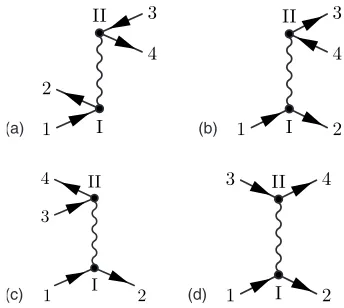
are the electron and hole wave functions. Substitution of Eq. 共2兲into Eq. 共1兲 and rewriting Eq.共1兲using normal-ordered products of field operators14,15 give the sum of terms that describe a variety of processes, viz., scattering of electrons and holes, creation and annihilation of electron-hole pairs, forward scattering, and others. We do not consider the ex-change interaction since it is negligibly small in the QD-matrix systems16 studied. Real scattering processes can be represented by the diagrams depicted on Fig.1.
We assume that the electrostatic interaction of two spherical QDs can be described by the screened Coulomb potential
V共rI,rII兲=
e2 兩r+rI−rII兩
. 共3兲
Here,ris the vector directed from the center of QD II to the center of QD I, vectorsrIandrIIoriginate from the center of the corresponding QD, and dielectric screening is taken into account by the effective dielectric constant . In general, should be treated as a fitting parameter associated with the
dielectric constant of the matrixMand the quantum dots,I and II. In the following analysis, it should be understood that the dielectric constants of the materials should be re-placed by the squares of their refractive indices.
Approximate expressions for can be derived as fol-lows. The dielectric screening of the lIth andlIIth multipole terms generated by interaction between the charge distribu-tions within the spherical QDs I and II is given by the fol-lowing expression:4,17,18
lIlII=
M flI共I/M兲flII共II/M兲
. 共4兲
Here,␣andMare the dielectric constants of quantum dot ␣ and the matrix, respectively, lI and lII are the multipole moments, and
fl共␣/M兲=
2l+ 1 共␣/M+ 1兲l+ 1
共5兲
is a field factor describing the screening of thelth pole by the QD material and the matrix.4,17,18A consideration oflIlIIas a
function oflI andlII, for typical values of the dielectric con-stants␣andM, shows that it varies slowly withlIIfor fixed values of lI and vice versa 共see Appendix for details兲. This property oflI,lIIallows us to use a single effective dielectric
constant =l
I
⬘,l
II
⬘, where lI
⬘
and lII⬘
are the moments of the multipole term, which provide the main contribution to the electrostatic interdot interaction. In particular, for interband-interband dipole-allowed transitions, the main term in the multipole expansion corresponds to dipole-dipole interac-tion, so we have the momentslI⬘
= 1 andlII⬘
= 1, and the effec-tive dielectric constant should be taken as(a) (b)
[image:2.612.349.521.47.201.2](c) (d)
⬅11=
共I+ 2M兲共II+ 2M兲
9M
. 共6兲
If the interband transition in the first QD is dipole-allowed but in the second QD is dipole-forbidden, the leading term will correspond to dipole-quadrupole interaction, and we should use the following effective dielectric constant:
⬅12=
共I+ 2M兲共2II+ 3M兲
15M
. 共7兲
In the Appendix, we discuss the arguments for this model of dielectric screening in more detail and give explicit expres-sions for the effective dielectric constants for different types of interaction. We also show that when the values of the dielectric constants of the QDs and the matrix are close enough, the screening of dipole-dipole and dipole-multipole interactions between two spherical QDs can be approximated by the same dielectric constant, as it has been done in our previous work.6,11
To simplify the expression for the matrix element of the interaction potential, we start from the Fourier expansion
1
兩r+rI−rII兩= 4
冕
d3q
共2兲3
eiqជ共r+rI−rII兲
q2 ,
which allows us to rewrite the matrix element in the follow-ing form:
M⬅ 具2,4兩V兩1,3典= e 2
22
冕
d 3qeiqrS21I 共q兲S43II共−q兲, 共8兲
where
Sij␣共q兲=
冕
d3r␣e iqr␣⌿i ⴱ共r
␣兲⌿j共r␣兲, ␣= I,II. 共9兲
In a two-band effective mass approximation,19 the wave function of strongly confined electrons and holes in a spheri-cal QD with infinitely high potential walls has the following form:20
⌿k共r␣兲 ⬅⌿,i共r␣兲=u共r␣兲i共r␣兲,
whereuis the Bloch amplitude共=c,v兲,
i共r␣兲=Rnili共r␣兲Ylimi共␣,␣兲,
is the envelope wave function,
Rnili共r␣兲=
冑
2
R␣3
jli共nilir␣/R␣兲 jli+1共nili兲
共10兲
is the radial part,Ylimi共␣,␣兲is a spherical harmonic, jliis a
spherical Bessel function, nili is the nith root of equation jli共x兲= 0, and R␣ is the radius of the QD. It should be noted
that the important part of an intradot Coulomb interaction is taken into account by the effective mass approach.
Let us expressr␣ as the sum of the radius vectors of an elementary cellrk␣ and of the electron inside the cellr␣
⬘
. Byusing the following properties of the envelope and Bloch functions:
i共rk␣+r␣
⬘
兲 ⬇i共rk␣兲, u1共rk␣+r␣⬘
兲=u1共r␣⬘
兲,we can replace the integral over the volume,V␣, of the quan-tum dot, by the sum of the integrals over the volumes⍀of elementary cells. This allows us to representSij␣ as the
prod-ucts of the integrals over coordinates in the envelope space and the Bloch space
Sij␣=sij␣Uij␣,
where
sij␣=⍀
兺
k␣eiqrk
␣iⴱ共rk␣兲j共rk␣兲,
Uij␣=
1 ⍀
冕
⍀d3r
␣
⬘
eiqr␣⬘ui
ⴱ共r ␣
⬘
兲uj共r␣
⬘
兲.After the replacement of the sum over the elementary cells with the integral over the volume of the nanocrystal, we obtain
sij␣=
冕
d3r␣e iqr␣i ⴱ共r
␣兲j共r␣兲. 共11兲
The expansion of the plane waveeiqr␣in terms of cal waves, expressing the integral of product of three spheri-cal functions through Clebsch–Gordan coefficients21and not-ing the spherical symmetry of quantum dots, allows us to transform the integration over the angular coordinates of vector r␣in Eq.共11兲into the following sum:
sij␣共⫾q兲=
冑
2lj+ 1
2li+ 1l
兺
␣=0li+lj
共⫾i兲l共2l+ 1兲C lj0,l␣0
li0 C
ljmj,l␣0
limi
⫻
冕
0
R␣
dr␣r2jl␣共qr␣兲Rnⴱili共r␣兲Rnjlj共r␣兲, 共12兲
whereCljmj,l␣0
limi is the Clebsch–Gordan coefficient.
In the long-wave approximation,qaⰆ1, where a is the lattice constant of the semiconductor, we can decompose
eiqr␣⬘into a Taylor series and estimate the integralsUij␣of the Bloch amplitudes. When the functions of the initial and final state belong to the same energy band, the first nonzero term of Uij␣ is 1. Then we have
Uij␣共i=j=兲 ⬇
1
⍀
冕
⍀d3r␣⬘
兩u共r␣⬘
兲兩2= 1. 共13兲Otherwise, for interband transitions, we obtain
Uij␣共i⫽j兲 ⬇ iq
⍀
冕
⍀d3r␣⬘
uiⴱ共r
␣
⬘
兲r␣⬘
uj共r␣⬘
兲=iqri,j␣ .
共14兲
The matrix element of the radius-vector inside the elemen-tary cell between Bloch functionsr
2,1
␣ can be expressed via
the Kane parameter P␣=ប2/m0具S␣兩/z兩Z␣典=ប
冑
Ep,␣/共2m0兲 and the energy gapEg,␣as follows:兩rc␣v兩=P␣/Eg,␣, 共15兲
Using Eqs. 共13兲 and 共14兲, we obtain the following ex-pression for matrix element共8兲:
Mᐉ␣= e 2
22
冕
d3q q2e
iqr
ᐉ ␣s
21 I 共q兲
s43II共−q兲, ᐉ= 0,1,2. 共16兲
Here, we introduce the indexᐉthat determines the number of interband transitions involved in scattering, the upper index
␣inMᐉ␣denotes the QD共I or II兲number where the interband interaction occurs,ᐉ␣is the function that determines the mu-tual orientation ofqandrc␣v,
␣0= 1, 1␣= ⫾iqr␣cv, 2␣=共qrcv
I 兲共qr
vc
II兲 ,
where erc␣v are the dipole moments of the interband transi-tions. In this and other similar expressions for interband-intraband transitions共ᐉ= 1兲, the plus sign is used when the interband transition occurs in the first quantum dot 共␣= I兲 and a minus sign for the opposite case 共␣= II兲. Integration over the angles betweenq andrand change in the integra-tion order ofrandqallow us to evaluate the integral overq
analytically. We obtain the following expression:
Mᐉ␣=e 2
Xᐉ␣
rᐉ+1, 共17兲
X0␣=I0, X1␣= ⫾I1nrrc␣v,
X2␣=I1rcv
I rcv
II
−I2共nrrcv
I 兲共n
rrcv
II兲 .
Herenr=r/r,
Iᐉ= 2
l
兺
I=0l1+l2
兺
lII=0
l3+l4
CI+CII−
⫻
冕
0
RI
冕
0RII
drIdrIIrI2rII2RIRIIQlᐉI,lII, ᐉ= 0,1,2 共18兲
are the multipole amplitudes that come from the integration over the coordinates of the envelope wave functions,
C␣⫾=共⫾i兲l␣共2l␣+ 1兲
冑
2lj+ 1 2li+ 1Clj0,l␣0
li0
Cljmj,l␣0
limi
, 共19兲
R␣=Rn ␣
⬘l␣⬘ ⴱ 共
r␣兲Rn␣l␣共r␣兲, 共20兲
QlᐉI,lII=rᐉ+1
冕
0
⬁
dqqᐉjᐉ共qr兲jlI共qrI兲jlII共qrII兲
= 2ᐉ−33/2
冉
rIr
冊
lI冉
rIIr
冊
lII⫻⌫
冋
共2ᐉ+lI+lII+ 1兲/2lI+ 3/2,lII+ 3/2,1 −共lI+lII兲/2
册
⫻F4
冉
lI+lII 2 ,
2ᐉ+lI+lII+ 1 2 ;lI+
3 2,lII
+3 2;
rI2 r2;
rII2
r2
冊
, 共21兲whereF4共a,b;c,c
⬘
;x;y兲is the Appel’s fourth hypergeomet-ric function,22F4共a,b;c,c
⬘
;x;y兲=兺
k,l=0
⬁ 共
a兲k+l共b兲k+l
共c兲k共c
⬘
兲l xkylk!l!, 共22兲
共a兲k=⌫共a+k兲/⌫共a兲is a Pochhammer symbol.
Next, we introduce orientational factors that are indepen-dent of the values of the transition dipole moments,
0=I0, 1␣= ⫾I1cos␣, 2=I1sinIsinIIcos +共I1−I2兲cosIIcosII; 共23兲
the matrix elements can be rewritten in the following way:
M0=e 2
0
r, M1 ␣=e2
1␣
r2rcv
␣, M
2=
e2
2
r3rcv
I r
cv
II.
Hereafter, we omit the superscripts ␣in the expressions for intraband-intraband 共ᐉ= 0兲 and interband-interband 共ᐉ= 2兲 transitions.
It should be noted that the infinitely high potential walls approximation significantly reduces the probability of transi-tion between the states with different principal quantum numbersni, so in this paper, our consideration is restricted to
transitions between the states, which differ only by the an-gular moment values. This limitation stems from the or-thogonality of the radial wave functions共10兲byniand thus
from the elimination of the terms proportional to共r␣/r兲2k,k
= 0 ,⬁ 关see Eqs.共21兲and共22兲兴. The transitions between the states with different principal quantum numbers can be con-sidered more precisely in the approximation of finite poten-tial walls by replacing the radial parts of the envelope wave functions and extending the integration limits in Eq.共18兲, as discussed in our previous work.6 In order to maintain the spherical symmetry of the task, one must neglect the pres-ence of the wave function of the first QD in the second QD and vice versa. For example, the integration overrIshould be performed inside the QDs共0⬍rI⬍RI兲and inside the spheri-cal layer of matrix共RI⬍rI⬍r−RII兲.
When the quantum numbers of the initial and final states are the same 共1=2,3=4,i=兵ni,li,mi其兲, we have a
dipole-allowed transition, and the functionIᐉ is reduced to
Iᐉ,a=共2ᐉ− 1兲!!, 共24兲
where 共2ᐉ− 1兲! ! = 1 · 3 · 5 · . . . ·共2ᐉ− 1兲 is a double factorial function. For instance, Eq. 共24兲 gives I0,a= 1, I1,a= 1, and
I2,a= 3, and the matrix element for dipole-allowed, interband-interband transitions takes the well-known form4,12
M2,a=
e2 r3关rcv
I rcv
II
−共3nrrcv
I 兲共n
rrcv
II兲兴
. 共25兲
Let us consider the selection rules defined by expres-sions共17兲and共18兲. Condition
Clj0,l␣0
li0
Cljmj,l␣0
limi ⫽
0 共26兲
implies the following selection rules for the transitions due to Coulomb interaction:
兩lj−l␣兩ⱕliⱕ兩lj+l␣兩,
mi=mj.
Additional selection rules arise from the condition ⌫共1 −共lI +lII兲/2兲⫽⬁ 关see Eq. 共21兲兴, which implies 共lI+lII兲/2 = a half-integer number. This condition will be satisfied only when lI and lII have opposite parities. Since Eq. 共26兲 should also be satisfied, we conclude that the matrix element is nonzero when the sums of the angular moments of the initial and final states have opposite parities, i.e., in two cases: 共1兲 l1+l2= an odd number and l3+l4 = an even number and 共2兲 l1+l2= an even number and l3 +l4= an odd number.
It is useful to derive expressions for the squared modulus of matrix elements averaged by directions of transition di-pole moments and their maximal values,
兩M0兩2= max兩M0兩2=e 4兩I0兩2
2r2 , 共27兲
兩M1␣兩2=1 3
e4
2 兩I1兩2
r4 兩rcv
␣兩2, max兩M 1
␣兩2=e 4
2 兩I1兩2
r4 兩rcv
␣兩2, 共28兲
兩M2兩2=13 e 4
2r6兩rcv
I 兩2兩r
cv
II兩2
兵
兩I1兩2−13共I1ⴱI2+I1I2ⴱ兲+ 1 3兩I2兩
2
其
, max兩M2兩2= e4
2r6兩rcIv兩2兩rIIcv兩2兩I1−I2兩2. 共29兲
Conditions for 兩Mᐉ兩2 maximality over the angular variables are determined by the orientation factors ᐉ 关see Eq. 共23兲兴. Intraband-intraband transitions共ᐉ= 0兲 do not depend on lat-tice orientation because they do not include any coordinates of Bloch space and because QDs are spherically symmetric. Forᐉ= 1, there are two conditions:共1兲␣= 0 and共2兲␣=, i.e., 兩M1兩2 is maximal when the transition dipole moment is parallel to the vector r connecting the centers of the QDs. For ᐉ= 2, we have four orientations of the transition dipole moments, which maximize the matrix element: 共1兲 I= 0,
II= 0; 共2兲I= 0,II=;共3兲I=,II= 0; and共4兲 I=,II =, i.e., both vectorsrI andrIIshould be parallel tor.
It is convenient to designate the real transitions in a double QD by a notation commonly used in the theory of Auger processes in bulk semiconductors and heterostructures23,24 共CVVC, CVCC, CCCC,…兲. The letters C and V denote the conduction and the valence bands, re-spectively, but in this context the first two letters describe the transition in the first QD and the last two in the second QD. The matrix elements共17兲, with respective values for the in-dex ᐉ, describe the probability amplitudes of the processes listed in TableI.
The expressions for the matrix elements obtained in this section allow the determination of important parameters that characterize the resonant interaction of two QDs. For ex-ample, the rate of resonant energy transfer between two non-degenerated states is given by the expression
␥= 2 ប2兩Mᐉ兩
2 ⌫
⌫2+⌬2=
⍀ᐉ2 2
⌫
⌫2+⌬2, 共30兲
where⌫is the transition dephasing rate and⌬is the detuning between the transition frequencies of two interacting
sys-tems. The parameter⍀ᐉ= 2兩Mᐉ兩/ប, following from a density matrix description of interacting two-level systems,12 plays an important role in the theory of resonant energy transfer. This is the frequency characterizing the oscillations of the excited states population in resonantly interacting two-level systems. The relationship between⍀ᐉ, the population relax-ation rate ␥II of the final state, and the transition dephasing rate ⌫determines the regime of resonant coupling: incoher-ent irreversible共⍀ᐉⰆ␥II,⌫兲, incoherent reversible共␥II⬍⍀ᐉ ⬍⌫兲, or coherent共⍀ᐉⰇ␥II,⌫兲. Notice that Eq.共30兲based on the Fermi’s Golden Rule is valid for the description of the energy transfer rates in the following cases: ⍀ᐉⰆ␥II,⌫ and
␥II⬍⍀ᐉ⬍⌫.
In the next section, we perform numerical calculations to determine max⍀ᐉ, assuming that the mutual orientation of the dipole moments of the interband transitions satisfies one of the conditions for maximality of Mᐉ.
III. NUMERICAL RESULTS
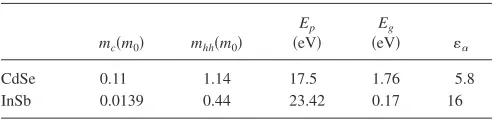
Let us consider the transition rate dependencies on geo-metric parameters for double QDs of two different materials: CdSe and InSb. The relevant material parameters are listed in Table II. Hereafter, we assume that the matrix material is SiO2, so the dielectric constant at typical transition frequen-cies isM= 2.13共Ref. 28兲.
We perform the calculations for materials with different band gaps because it is expected that the energy gap value will significantly affect the relative magnitudes of the matrix elements for different types of transitions. Among the intraband-intraband processes mentioned in Table I, only CCCC and VVVV are of interest for certain QD materials. The effective masses of electrons and holes in CdSe and InSb differ significantly, mv/mc⬃10, so the energy
[image:5.612.314.558.72.174.2]reso-nance conditions for CCVV and VVCC processes lead to unrealistic values for quantum dot radii for the lowest al-lowed transitions. Due to the similarity of the expressions for the energy spectrum in the conduction and valence bands in
TABLE I. Correspondence between the matrix elements共17兲and the tran-sitions in a double QD.
Intraband-intraband transitions
M0: CCCC, CCVV, VVCC, VVVV
Interband-intraband transitions
M1I: VCCC, CVCC, CVVV, VCVV
M1II: CCVC, CCCV, VVCV, VVVC
Interband-interband transitions
M2: CVVC, VCCV
TABLE II. Material parameters of CdSe共Refs.25and26兲and InSb共Ref.
27兲.mhh=mvis the heavy hole effective mass. mc共m0兲 mhh共m0兲
Ep
共eV兲
Eg
共eV兲 ␣
[image:5.612.63.296.231.366.2] [image:5.612.313.560.695.756.2]a two-band approximation, CCCC and VVVV processes will have the same values for the interaction matrix elements, and so they will be considered together.
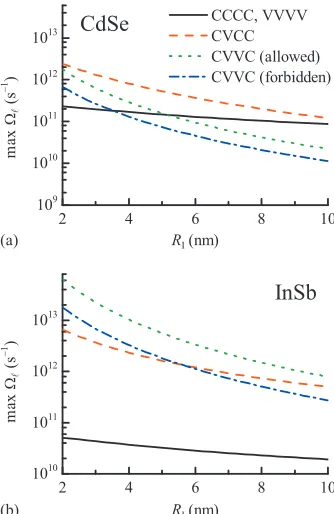
Figures2共a兲and2共b兲show the dependencies of max⍀ᐉ on the distance between the surfaces of interacting QDs共R
=r−RI−RII兲 for the lowest allowed transitions. The depen-dency onR will not be the same as that on center-to-center distance r, but it is more convenient for comparison of the calculated results for QD pairs with different radii. For CdSe QDs, we see that the dominant process is CVCC. Thus, the interband-intraband processes can be considered as another effective mechanism of resonant energy transfer as well as interband-interband processes. For InSb, the frequencies⍀ᐉ for CVVC and CVCC have much higher values than in CdSe since InSb has higher values of transition dipole moments than CdSe. At the same time, the rates of intraband-intraband processes in InSb QDs are lower than in CdSe.
It should be noted that resonant electrostatic interaction of charge carriers inside QDs cannot be considered as a re-laxation mechanism itself since the total energy of the inter-acting particles is conserved, and so these transitions are fully reversible in the absence of the bath. Transitions be-tween single-particle states due to electrostatic correlations play an important role as relaxation mediators because they can bring the system into the states with a much faster relax-ation rate than the initial state.
Let us consider the dependency of max⍀ᐉon the radius of the first QD at the fixed intersurface distance depicted in
Fig. 3. This figure shows that the max⍀ᐉ for intraband-intraband transitions decreases much more slowly than that for other processes with increasingRI. We also observe the domination of dipole-allowed CVVC process in InSb QDs, but CVCC process is also effective and overcomes dipole-forbidden CVVC process in QDs withRIⱗ6 nm.
IV. CONCLUSION
In this paper, we have studied the probability amplitudes for electron-electron scattering processes in a double QD un-der strong confinement. We assume that the electrostatic in-teraction between the QDs is described by the Coulomb po-tential and dielectric screening is taken into account by the effective dielectric constant. We discuss the expressions for this effective dielectric constant and determine the bound-aries of its possible variations if used as a fitting parameter. Numerical calculations have been performed for the depen-dencies of the matrix elements on interdot distance, QD size, and material parameters. It has been shown that in some cases, the interband-intraband and intraband-intraband tran-sitions can have higher rates than the commonly considered interband-interband transitions.
ACKNOWLEDGMENTS
[image:6.612.352.519.47.304.2]Three of the authors 共S.Yu.K., A.V.F., and A.V.B.兲 are grateful to the RFBR 共Grant Nos. 00333 and 09-02-01439兲 and the Ministry of Education and Science of the Russian Federation 共Grant Nos. 2.1.1/1933 and 2.1.1/1880兲 for partial financial support of this work.
FIG. 2. Parameter max⍀ᐉ as a function of the intersurface distance for different types of electronic transitions in a double QD: CCCC, VVVV, CVCC, and CVVC. We consider that the first QD radius has a fixed value
RI= 4 nm, and the second QD radius RII always satisfies the resonance
condition I共RI兲=II共RII兲, where ␣ is the corresponding transition
fre-quency. CCCC transition:兵c110;c100其I,兵c100;c120其II,RII= 6 nm; CVCC transition: 兵c100;v100其I, 兵c100;c110其II, RII= 3.85 nm; dipole-allowed
CVVC transition:兵c100;v100其I,兵v110;c110其II,RII= 5.72 nm; and
dipole-forbidden CVVC transition:兵c100;v100其I,兵v110;c100其II,RII= 5.68 nm.
FIG. 3. Parameter max⍀ᐉas function of the first QD radiusRIat
intersur-face distance ofR= 1 nm. As before,RIIis calculated from the resonance
[image:6.612.91.258.50.304.2]APPENDIX: DIELECTRIC SCREENING OF TWO ELECTROSTATICALLY COUPLED QDS
The assumption that the interaction between two spheri-cal QDs is described by the Coulomb potential with effective dielectric constant offers many advantages. In particular, it simplifies the consideration of higher multipoles and allows a straightforward generalization of many-body theory for or-dinary solids14,29to QD solids. The simplicity of the expres-sions for probability amplitudes of electron-electron scatter-ing makes the ordered structures of spherical QDs a good model system for the investigation of various effects con-nected with electronic correlation, such as resonant energy transfer and carrier multiplication.30However, the applicabil-ity of the effective dielectric constant derived for dipole-dipole interactions when transitions in one of the quantum dots are not dipole-allowed, i.e., the envelope angular mo-menta of the initial and final states are different, is question-able.
The first reason for the usage of the same effective di-electric constant is that the charge distribution inside the QD remains spherically symmetric for all envelope states. So, according to classical electrostatics,31the potential generated by two oppositely charged, spherically symmetric charge dis-tributions can still be described by the point dipole located at the center of the sphere. Possible deviations from the point dipole approximation, arising from the asymmetry between the envelope wave functions of the electrons and holes, will be small if the transition occurs between states with the same principal quantum numbers.
A second reason is that the effective dielectric constant describing the screening of the interaction between the lIth andlIIth multipoles in spherical QDs,4,17,18
lIlII共I,II,M兲=
M
flI共I/M兲flII共II/M兲
,
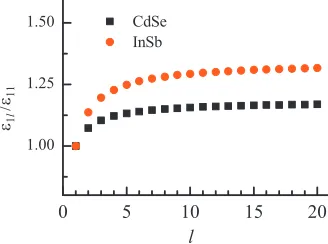
varies slowly over the lowest multipole momentslIandlIIfor typical values of the dielectric constants of semiconductors and glasses. This is clearly seen in Fig.4, which depicts the ratio of effective dielectric constants for dipole-multipole and dipole-dipole interactions 1l/11 共l= 1 , . . . , 20兲. Note that the closer the values of␣andM, the slower the value
of1lwill vary overl. The upper limit of1l/11is given by the expression
lim
l→⬁
1l
11
=3共II+M兲 2II+ 2M
,
so we have1⬁/11⬇1.18 for a double QD made from CdSe and1⬁/11⬇1.34 for a double QD made from InSb. Thus, in order to approximately consider the static screening of interactions in spherical QDs formed from direct-band semi-conductor, it is sufficient to assume thatfl␣for anyl␣is equal
to the field factor of the first leading term, e.g., fl␣⬇f1 for dipole-allowed transition and fl␣⬇f2 for dipole-forbidden transition.
If both transitions are dipole-allowed, the leading term in the multipole expansion of the potential 共3兲 corresponds to dipole-dipole interaction. Thus, the effective constant is de-termined by the expression
11=
共I+ 2M兲共II+ 2M兲
9M
. 共A1兲
This situation is realized for interband-interband transitions. If one of the transitions is dipole-forbidden共i.e., angular mo-ments of initial and final states are different兲, the leading term will correspond to dipole-quadrupole interaction, so one should use the following effective dielectric constant:
12=
共I+ 2M兲共2II+ 3M兲
15M
. 共A2兲
Finally, if both transitions are dipole-forbidden, we have
22=
共2I+ 3M兲共2II+ 3M兲
25M
.
The effective dielectric constant for different multipole terms varies between 12 and1⬁=共I+ 2M兲共II+M兲/6M,
so when␣ⰇM, one may treatas an adjustable parameter
to achieve a better agreement between calculations and ex-perimental results for dipole-multipole interactions.
Similarly, in case of real intraband-intraband transitions, the leading term will correspond to quadrupole-quadrupole interaction, so the effective screening constant varies be-tween22and
2⬁=共
2I+ 3M兲共II+M兲
10M
.
1S. V. Gaponenko, Optical Properties of Semiconductor Nanocrystals
共Cambridge University Press, Cambridge, 1998兲.
2G. Allan and C. Delerue,Phys. Rev. B 75, 195311共2007兲.
3D. L. Andrews and J. M. Leeder,J. Chem. Phys. 130, 184504共2009兲. 4R. Baer and E. Rabani,J. Chem. Phys. 128, 184710共2008兲.
5C. Curutchet, A. Franceschetti, A. Zunger, and G. D. Scholes,J. Phys.
Chem. C 112, 13336共2008兲.
6S. Yu. Kruchinin, A. V. Fedorov, A. V. Baranov, T. S. Perova, and K.
Berwick,Phys. Rev. B 78, 125311共2008兲.
7C. R. Kagan, C. B. Murray, and M. G. Bawendi,Phys. Rev. B 54, 8633
共1996兲.
8L. Xu, J. Xu, Z. Ma, W. Li, X. Huang, and K. Chen,Appl. Phys. Lett.89,
033121共2006兲.
9K. Nishibayashi, T. Kawazoe, M. Ohtsu, K. Akahane, and N. Yamamoto,
Appl. Phys. Lett. 93, 042101共2008兲.
[image:7.612.91.255.51.173.2]10G. D. Scholes and D. L. Andrews,Phys. Rev. B 72, 125331共2005兲.
FIG. 4. Ratios of effective dielectric constants1l/11for the first 20
mul-tipole terms for double QDs of CdSe and InSb. The dielectric constants for CdSe and InSb are listed in Table II; the matrix material is SiO2 共M
11S. Yu. Kruchinin, A. V. Fedorov, A. V. Baranov, T. S. Perova, and K.
Berwick,Phys. Rev. B 81, 245303共2010兲.
12V. M. Agranovich and M. D. Galanin, Electronic Excitation Energy
Transfer in Condensed Matter共North-Holland, Amsterdam, 1982兲.
13A. Nazir, B. W. Lovett, S. D. Barrett, J. H. Reina, and G. A. D. Briggs,
Phys. Rev. B 71, 045334共2005兲.
14A. L. Fetter and J. D. Walecka,Quantum Theory of Many-Particle
Sys-tems共McGraw-Hill, New York, 1971兲.
15H. Haken, Quantum Field Theory of Solids: An Introduction共
North-Holland, Amsterdam, 1983兲.
16A. Franceschetti and A. Zunger,Phys. Rev. Lett. 78, 915共1997兲. 17C. J. F. Böttcher,Theory of Electric Polarization, 2nd ed.共Elsevier,
Am-sterdam, 1973兲, Vol. 1.
18L. Bányai and S. W. Koch,Semiconductor Quantum Dots共World
Scien-tific, Singapore, 1993兲.
19The effective mass approximation is commonly used approach for
ana-lytical calculations of the eigenfunctions and eigenvalues of semiconduc-tor electronic subsystem including semiconducsemiconduc-tor nanostructures. See, for example, E. L. Ivchenko and G. E. Pikus,Superlattices and Other
Het-erostructures共Springer-Verlag, Berlin, 1997兲.
20Al. L. Efros and A. L. Efros, Sov. Phys. Semicond. 16, 772共1982兲.
21Quantum Theory of Angular Momentum, edited by D. A. Varshalovich,
A. N. Moskalev, and V. K. Khersonskii 共World Scientific, Singapore, 1988兲.
22A. P. Prudnikov, Y. A. Brychkov, and O. I. Marichev,Special Functions,
Integrals and Series, Vol. 2共Gordon and Breach, New York, 1990兲.
23M. Takeshima,Phys. Rev. B 26, 917共1982兲.
24V. N. Abakumov, V. I. Perel, and I. N. Yassievich,Nonradiative
Recom-bination in Semiconductors共North-Holland, Amsterdam, 1991兲.
25S. Ninomiya and S. Adachi,J. Appl. Phys. 78, 4681共1995兲. 26D. J. Norris and M. G. Bawendi,Phys. Rev. B 53, 16338共1996兲. 27O. Madelung,Semiconductors: Data Handbook, 3rd ed.共Springer,
Ber-lin, 2004兲.
28L. M. Landsberger and W. A. Tiller,Appl. Phys. Lett. 49, 143共1986兲. 29G. D. Mahan,Many-Particle Physics, 2nd ed.共Plenum, New York, 1990兲. 30R. D. Schaller, J. M. Pietryga, and V. I. Klimov,Nano Lett. 7, 3469