JOURNAL OF FOREST SCIENCE, "&, 2002 (1): 17
At the present time, there is increasing support for a return to close-to-nature and sustainable methods of management within the whole of Europe. One of the pos-sibilities for close-to-nature management is the selection forest system, which can fulfil both wood-producing and non-wood-producing functions of forests and provide long-term stability without serious changes in the forest. The selection system of forest management has been known and generally studied for many years although its expansion outside its original range is minimal. Once the selection system has become the new aim of management, the effects are not instantaneous because the complex structure develops over a long period of time. Accelera-tion of the process is possible by means of an active ap-proach to converting forests managed under systems involving coupes to selection forests. At present the in-troduction of selection systems is the subject of much debate, but the discussion is only theoretical because long-term experience with conversions is missing. Stands of a suitable species composition, structure and condi-tion for natural regeneracondi-tion can be gradually converted to a selection forest. The main condition for attaining the selection forest is that it will require a suitable system of management be adopted in forest stands and be applied consistently over a long time. According to SCHÜTZ (1999) conversion is the most difficult stage requiring consis-tency and the resolution of a forest manager. According to the author, the main reasons for a lack of knowledge about conversion are as follows: it is a long-term task, there are greater risks in transition to a large-scale system
of management and the mistake of premature felling of stands.
In former Czechoslovakia Hugo Konias and his succes-sor Vladimír Zakopal were instrumental in researching these problems. Konias carried out conversions of spe-cies composition and also conversions to the selection system of management in selected localities of Opoèno region from 1933. The main goal was to increase the sta-bility of trees through new management measures and changes in species composition. Only where the species composition was considered suitable were stands con-verted to selection forest. In the region of Opoèno, some of these converted stands remain that are now most interesting as they have been developing for almost 70 years, particularly those areas that have been the sub-ject of long-term research.
This paper evaluates the development of conversions of forest systems involving coupes to the selection for-est in the Opuky experimental area where conversion star-ted in 1933. This long-term study makes it possible to evaluate stand development in detail.
SITE AND STAND CONDITIONS
The Opuky research area was established in 1958 to monitor conversion of a forest managed under systems involving coupes to the selection forest. The stand is si-tuated in Eastern Bohemia (about 5 km from Dobruka) on a very gentle SW slope at an altitude of 380 m. Parent rock of the site consists of green slates, the soil being
classi-Conversion of a forest managed under systems involving coupes
to a selection forest on an example of the Opuky research area
J. S
OUÈEKFGMRI, Jílovitì-Strnady, Research Station Opoèno, Czech Republic
ABSTRACT: This paper evaluates the development of growing stock, number of trees and diameter distribution of the standing volume in the Opuky locality where conversion to a selection forest has been the aim of management over a long period of time. With respect to species composition, the stand is divided into two plots. The initial condition and develop-ment of both plots differed. The favourable initial composition of the stand has gradually deteriorated due to delay in nat-ural regeneration and therefore recruitment of young trees over a long period. The total number of trees on both plots has been low for target diameter of 51 cm. On the other hand, the growing stock has exceeded the model condition. The propor-tion of broadleaved species in the stand gradually increases, reducing the possibility of conversion to a selecpropor-tion forest in future.
fied as Luvic Cambisol of medium depth with a medium content of nutrients. The locality is situated in Forest Region No. 26 (foothills of the Orlické hory Mts.), it has a special purpose forest category due to forest research. The original typological classification 3K1 (acid oak-beech stand) was later changed to degradation 3H1 (clay oak-beech stand) under pine. In the management group of stands 421 (spruce management on acid sites), the tar-get species composition should be as follows: Norway spruce 5070%, beech 2030%, larch 10%, sycamore 10%, silver fir, grand fir, oak, Douglas fir, lime, hornbeam, ash. Site class is low (spruce 7, pine 4) which corresponds to absolute height classes: spruce 24 m, pine 26 m, larch 30 m, broadleaves 2224 m. Mean annual temperature of the locality is 7.6°C (in the growing season 13.8°C). An-nual precipitation averages 644 mm, 61% of the precipita-tion occurs in the growing season.
The whole stand has been repeatedly measured since 1930. In 1958, all trees of d.b.h. > 7 cm were numbered and measured. The original stand was divided into two plots according to the prevailing species composition: plot A of 1.1 ha and plot B 1.08 ha. The parent stand originated by combined regeneration: spruce, pine and larch were planted, silver fir and broadleaves regenerated naturally. According to management records, in 1998 the stand age was 145 years, the actual age of dominant and co-domi-nant trees fluctuated from 131 to 148 years (the mean val-ue of 137 years was determined on the basis of increment bores of 50 co-dominant trees). The age of the original stand trees in the lower layers ranged from 60 to 130 years (autumn 1998). Repeated opening up of the stand by incidental felling since the small pole stage en-couraged regeneration of dispersed younger groups.
The considerable height and diameter differences of the stand led Konias to start the conversion as early as in 1933 (KONIAS 1950). In gaps, broadleaves were planted to modify species composition, on favourable sites natural regeneration occurred. Beating up of poor natural rege-neration was carried out by planting spruce, silver fir, beech and lime whereas oak regenerated naturally.
METHODS
Diameters (d.b.h.) were measured with a calliper in two directions to the nearest 0.1 cm, heights of particular trees by a hypsometer to the nearest 0.5 m. Repeated invento-ries of trees were carried out in 1958, 1966, 1974, 1989, 1994 and 1998. The recruitment was recorded in 1966 and 1974, new recording of the recruitment was carried out in 1994 and 1998. Felling were carried out at the end of the periods under study, total volume of harvested timber was calculated from inventory (special measurements on the fallen trees were not made). Incidental felling reached min-imum volumes during the study period. Based on repeat-ed measurements, basic characteristics of trees were calculated (mean tree diameter, basal area, volume, slen-derness ratio and particular increments), stand character-istics were determined summarising particular data for the area, all characteristics being converted to 1 ha. Trees were grouped into diameter classes at 4 cm intervals (start-ing from 6 cm). With respect to site and climatic condi-tions the target diameter of the stand was set to 51 cm.
RESULTS
The main stand on plot A was formed by Norway spruce and Scots pine. Spruce was regularly distributed in the stand, pine created smaller groups. Participation of other species was small, lower layers were formed by spruce, silver fir and broadleaves. Species composition was more favourable on plot B. Larch occurred as a dominant tree while the mixture of spruce and pine represented co-domi-nant trees. Spruce, silver fir and broadleaves occurred as subdominant and intermediate trees. The position of spruce in all stand layers decreased its share in the grow-ing stock as compared with its count (Table 1).
[image:2.595.70.540.591.755.2]By the time of recording in 1998, after 40 years of man-agement, the number of conifers on both plots decreased, however, on plot A more markedly (Table 1). With the exception of spruce on plot B, the number of conifer spe-cies decreased. A marked decrease occurred particularly
Table 1. The proportion of species according to the number and growing stock on plots A and B in 1958 and 1998
Plot A Plot B
Species Number (%) Volume (%) Number (%) Volume (%)
1958 1998 1958 1998 1958 1998 1958 1998
Spruce 57.0 48.2 48.0 65.0 28.7 30.8 19.6 32.4
Fir 3.2 1.2 0.8 0.2 21.1 8.1 7.1 4.9
Pine 31.2 9.6 48.7 21.0 15.1 7.1 29.8 11.8
Larch 1.1 0.4 1.9 1.1 19.8 16.8 41.5 42.1
Beech 1.1 21.7 0.1 8.2 1.0 8.1 0.1 2.2
Oak 5.8 9.4 0.5 3.3 12.8 22.5 1.8 6.1
Other broadleaves 0.4 9.6 0.0 1.2 1.6 6.6 0.1 0.5
Conifers 92.5 60.2 99.4 87.3 84.6 62.8 98.0 91.2
in pine and silver fir due to impaired tree health and result-ing minimum increment. The proportion of beech and oth-er broadleaves (particularly lime) was affected by planting at the beginning of conversion, the change in oak from natural regeneration was not so marked. Reduction of conifers was markedly demonstrated only in their num-ber. Spruce always dominated in the growing stock. The volume proportion of spruce increased in spite of the de-crease in its number, due to its dominant position in the stand. Less marked changes in the volume proportion of broadleaves are given by their predominance in the sub-dominant layer as they were introduced in 1933.
NUMBER OF TREES
The initial numbers of trees, as well as species compo-sition, on both plots were different. In 1974, the numbers of trees on both plots became equal (Fig. 1). The total number of trees on plot A changed minimally during forty years, felled trees being gradually replaced by recruits. On plot B, the number of trees decreased at first quickly due to sanitation felling, later on, however, the decrease
slowed by the inclusion of the recruitment. The total num-ber of trees on plot B decreased by 210 trees. The propor-tion of recruitment gradually increased on both plots, amounting to 55% of the number of trees on plot A and 38% on plot B (both in 1998).
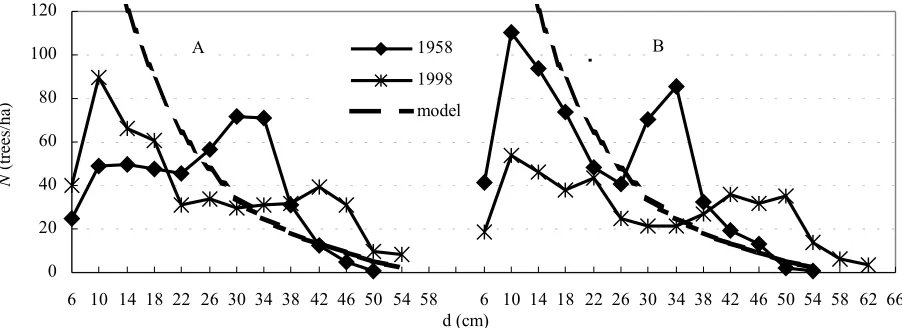
The initial curves of tree frequencies show two peaks on both plots (Fig. 2). This fact demonstrates the connec-tion of stand components of various age each with its peak of frequency. The age range of younger components of mature stand on plot B was larger and a more favour-able diameter distribution confirms this. The irregular course of the curves shows marked age differences be-tween particular stand parts. On plot A, trees of d.b.h. 3034 cm made up the most numerous proportion, where-as on plot B, trees of smaller diameter predominated (1014 cm). The initial curve on plot B approaches better to the model condition of a selection forest.
[image:3.595.63.345.62.240.2]Frequency curves from 1998 were flattened in medium and large diameters and elongated in large diameters as compared with the initial state (1958). The number of small-sized trees on plot A increased by the inclusion of re-cruits. A peak formed by medium-sized trees shifted to
Fig. 1. Tree numbers on plots A and B. Num-bers by the lines within the graph give per-centage of recruitment from the total tree numbers
21 29
54 55
11
8
38 38
300 400 500 600 700
1950 1960 1970 1980 1990 2000
Year
V (m
3 /ha)
A B
N
(trees/ha)
Fig. 2. Tree numbers according to diameter on plots A and B in d.b.h. classes. The model represents the state for target diameter 51 cm (A =163, q = 1.36)
0 20 40 60 80 100 120
6 10 14 18 22 26 30 34 38 42 46 50 54 58 6 10 14 18 22 26 30 34 38 42 46 50 54 58 62 66
d (cm)
N
(ks.ha-1)
1958 1998 model
A B
N
[image:3.595.59.510.552.716.2]large-sized trees. The surplus of these trees could not be felled because of the risk of windthrow. On plot B, the num-ber of small-diameter and medium-diameter trees decreased in consequence of felling and diameter shifts. A marked peak is missing in the curve (Fig. 2). Scarce recruits did not suffice to replace the gradual decrease of trees by felling. The curve on plot B from 1998 does not show a marked peak of frequency. The final form of the curve on plot A approaches to the model condition in selection forests. The number of small-diameter trees increased as compared with the initial state (1958), however, on plot B recruitment was less successful and numbers did not reach the initial state. On both plots, large-diameter trees > 40 cm are in excess of the model and, on the contrary, small-diameter and medi-um-diameter trees are missing (lack of management nega-tively affected natural regeneration).
GROWING STOCK
The initial growing stock of both plots was different and in the course of recording, growing stocks and their differences on both plots increased (Fig. 3). The growing
stocks of both plots were very close after felling in 1966 and 1974. At first, the growing stocks of the stand were influenced by recruits minimally, and subsequently, irre-spective of the number of trees, could not markedly affect the volume of the total growing stock. The recruitment on particular plots contributed differently to the number of trees and to the volume of growing stock. On plot A in 1998, the recruitment accounted for 55% of the number of trees but only 12% of the volume. On plot B in 1998, the recruitment accounted for 38% of the number of trees but only 6% of the volume.
The original symmetrical distribution of the growing stock, according to diameter classes, gradually changed to a right-hand asymmetric distribution (Fig. 4). In 1958, both curves culminated in the diameter class of 34 cm. After 40 years the peak of the curve shifted to the diameter class of 42 cm on plot A and to 50 cm on plot B. The more marked shift of the curve peak on plot B was caused by the lower volume of harvested mature trees in the later periods. The sum of the small-diameter tree volume did not marked-ly change at the beginning and at the end of monitoring on plot A; on plot B the sum moderately decreased.
0 20 40 60 80 100
6 14 22 30 38 46 54 62 6 14 22 30 38 46 54 62
d (cm)
V
(m
3/ha)
1958 1998
[image:4.595.79.420.62.242.2]A B
Fig. 4. Curves of standing volume on plots A and B in d.b.h. classes
12 10
3 0
6 5
1 0
150 200 250 300 350 400 450
1950 1960 1970 1980 1990 2000
Year
V
(m
3 /ha)
A
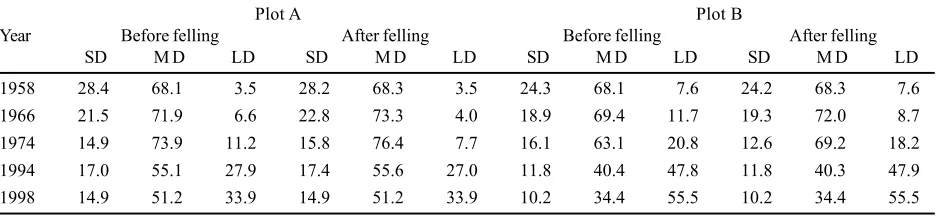
[image:4.595.85.526.568.731.2]Optimum distribution of the growing stock is described by particular authors variously in relation to site and stand conditions, target diameter and inventory limit. Usually a ratio of 20:50:30 is used for growing dimensions (small-diameter, medium-diameter and large-diameter trees). A model proportion for this small target diameter (51 cm) can markedly differ. With an increasing target diameter the proportion of small- and medium-diameter trees de-creases at the expense of large-diameter trees.
The initial share of large-diameter trees was low on both plots, particularly on plot A. The proportions of diameter classes changed during the period under study. General-ly, the proportion of large-diameter trees increased at the expense of small-diameter trees. Recruits did not marked-ly affect the proportion of small-diameter trees and their share in the stand growing stock gradually decreased.
The distribution of growing stock on plot A gradually approached the optimum distribution, the condition in 1994 being nearest to the model. The initial condition on plot B was more favourable due to the higher proportion of large-sized trees. Their share, however, steadily in-creased at the expense of trees of smaller diameters in consequence of low fellings. This unfavourable situation was caused not only by the large size of the original grow-ing stock of both plots but also by its old age. Relatively large numbers of big trees cannot be arbitrarily felled due to an increased risk of windthrows.
DISCUSSION
In Bohemia there has been a persistent long-term study of the conversion of forest managed under systems in-volving coupes to selection forest. The problems were researched particularly by ZAKOPAL (1958, 1965, 1981) and TRUHLÁØ (1977, 1995). Foreign publications relating to these problems are relatively rare, partial results being published for example by: MITSCHERLICH (1952), FAVRE
(1994), SCHMITT (1994), HLADÍK (1992) and SANIGA and SZANYI (1998).
The species composition of the stand did not corre-spond to the theoretical ideas on the composition of se-lection forests formed by a mixture of silver fir, spruce and beech. Some authors admit the admixture of heliophilous trees although they are aware of the difficulty of
regener-ating the species below the canopy of a parent stand (MITSCHERLICH 1952; TREPP 1974). Also the stand mix-ture did not fully correspond to site conditions. Over the years the species composition better approached the site conditions, however, the approach caused further devia-tions from the model of selection forest. The share of broadleaved species in the growing stock will increase due to their growth by volume and of the need to regener-ate the original stand. It will be very difficult to include the present rate of broadleaves into the subsequent man-agement. Some modern authors recognise there are prob-lems in increasing the proportion of broadleaved species in selection forests (e.g. FAVRE 1994).
The number of trees in selection forests determines the course of the tree frequency curve. This course also de-pends on site conditions, diameter range and target diam-eter. In selection forests of appropriate structure, the number of trees is not markedly changed in the course of time, trees removed by felling are continuously replaced by recruits and diameter shifts (SCHÜTZ 1999). The
aver-age number of trees found on long-term research plots in selection forests of the corresponding diameter range fluctuates from 450 to 700 trees per ha (MITSCHERLICH
1952; SCHÜTZ 1999). Similar results were found by SA -NIGA and SZANYI (1998) during model calculations of the
number of trees and growing stock in selection forests in Slovakia. SCHMITT (1994) evaluated a stand of the similar
species composition near Munich. The number of trees and the share of recruits corresponded to tree numbers found in the Opuky area. Here the number of trees on plot A fell into the given interval, the final number of trees on plot B was, however, lower. Models for selection forests of the corresponding structure and target diameter give higher numbers of trees (KNOKE 1998). MITSCHERLICH
(1952) and HLADÍK (1992) give information on
a similar problem of decreasing numbers of trees. Plots stud-ied by the authors gradually lost their selection structure and changed to a single-layer forest. TRUHLÁØ (1995)
re-ported decreasing tree numbers, 20% reduction of trees over 13 years did not endanger the stand structure.
While the growing stock in selection forests changes according to site and stand conditions, the proportion of large-sized trees is also important because of felling. Fel-ling frequency is important because too low or high
vol-Table 2. The percentage proportion of diameter classes in the growing stock
Plot A Plot B
Year Before felling After felling Before felling After felling
SD M D LD SD M D LD SD M D LD SD M D LD
1958 28.4 68.1 3.5 28.2 68.3 3.5 24.3 68.1 7.6 24.2 68.3 7.6
1966 21.5 71.9 6.6 22.8 73.3 4.0 18.9 69.4 11.7 19.3 72.0 8.7
1974 14.9 73.9 11.2 15.8 76.4 7.7 16.1 63.1 20.8 12.6 69.2 18.2
1994 17.0 55.1 27.9 17.4 55.6 27.0 11.8 40.4 47.8 11.8 40.3 47.9
1998 14.9 51.2 33.9 14.9 51.2 33.9 10.2 34.4 55.5 10.2 34.4 55.5
[image:5.595.57.525.78.186.2]umes of harvested timber can threaten the selection forest structure and stand stability. According to SCHÜTZ (1999), on various sites various types of selection forest can occur in a balanced state with a variable target diameter and thus also a variable growing stock. The standing volume in se-lection forests of appropriate structure fluctuates between 250 and 750 m3/ha. The growing stock in the Czech
Repub-lic conditions should be lower with respect to climatic con-ditions and smaller target diameter. In Slovakia, SANIGA
and SZANYI (1998) found by means of modelling optimum growing stocks ranging from 250 to 520 m3/ha.
ZAKOPAL (1958, 1965, 1981) found that, in surrounding areas with forest conversions, the growing stock of the majority of areas fell into the given intervals, gradually increasing in the course of monitoring. Model studies for selection forests of low target diameter give consider-ably lower growing stocks which should not exceed 300 m3 for the given diameter (KNOKE 1998; SCHÜTZ 1969).
Here the results found on both plots show the gradual increase in growing stocks has exceeded the model state. This has occurred because of the dominant position of the original stand and age distance between the parent stand and the recruitment. FAVRE (1994) found in the course of 100-year monitoring in selection stands situa-ted on northern slopes minimum fluctuations in the grow-ing stock whereas on southern slopes, the growgrow-ing stock doubled during the same period. The proportion of large-sized trees increased in both variants (FAVRE 1994). SCHÜTZ (1969) found a relationship between the opti-mum growing stock, volume increment and growing stock distribution under various target diameters. With an in-crease in the growing stock the increment and proportion of small- and medium-diameter trees decreased.
CONCLUSION
The results of monitoring in the Opuky research area confirm that regardless of adequate diameter and height differences in the stand conversions require consider-able long-term management. To achieve proper conver-sion, the most important factor is a sufficient age differentiation within the tree population and long-term management according to selection system principles. For the majority of parameters, the studied stands reach mod-el values for smod-election forests, however, with respect to the determined target diameter of 51 cm the number of trees is insufficient and, on the other hand, the growing stock is too high. In the studied stand, it will not be pos-sible to carry out speedily the necessary growing stock reduction because of the windthrow risk. The recruitment has not yet fully replaced felled trees in spite of sufficient numbers. The proportion of broadleaved species gradu-ally increases on both plots. This will reduce the possibil-ity of achieving and then preserving the selection forest structure for a long time yet. Regular and consistent man-agement is the most important condition for the success of conversion to selection forest.
A c k n o w l e d g e m e n t
I thank BRUCE LOWE, BSc., for useful comments on the manuscript and revising the English.
R e f e r e n c e s
FAVRE L.A., 1994. Naturgemässe Waldwirtschaft in Couvet. In: HERMANN G. H. (Hrsg.), Ökologische Waldwirtschaft: Grundlagen, Aspekte, Beispiele Stiftung Ökologie und Land-bau. Heidelberg, C.F. Müller: 232249.
HLADÍK M., 1992. Vývoj truktúry a produkcie zmieaného smrekovo-jed¾ovo-bukového porastu pri uplatòovaní zásad výberného hospodárskeho spôsobu. Acta Fac. For. Zvolen.,
34: 205221.
KNOKE T., 1998. Analyse und Optimierung der Holzproduk-tion in einem Plenterwald zur Forstbetriebsplanung in un-gleichaltrigen Wäldern. Forstl. Forsch.-Ber., München, Nr. 170: 182.
KONIAS H., 1950. Lesní hospodáøství. Zvyování døevní produkce a ozdravìní lesù na Opoèensku. Praha, Brázda: 140. KORPE¼ ., SANIGA M., 1993. Výberný hospodársky
spô-sob. Písek, Matice lesnická a Praha, VZ, LF: 128. MITSCHERLICH G., 1952. Der Tannen-Fichten-(Buchen)
Plenterwald. Schriftenreihe Bad. Forstl. Versuchsanst.,
Freiburg, 8: 42.
SANIGA M., SZANYI O., 1998. Modely výberkových lesov vo vybraných lesných typoch a geografických celkoch Slo-venska. [Výskumná správa 4/1998/A.] Zvolen, TU: 50. SCHMITT M., 1994. Waldwachstumskundliche
Untersuchun-gen zur Überführung fichtenreicher Baumhölzer in naturnahe Mischbestände mit Dauerwaldcharakter. Lehrstuhl f. Wald-wachstumskunde des Universität München: 223 + pøíl. SCHÜTZ J.P., 1969. Etude des phénomenes de la croissance en
hauter et en diametre du sapin (Abies alba Mill.) et de ¾épicéa
(Picea abies Karst.) dans deux peuplements jardinés et une
forêt vierge. Zürich, Bühler Buchdruck: 115.
SCHÜTZ J.P., 1999. Die Plenterung und ihre unterschiedlichen Formen. Script zu Vorlesung Waldbau II und Waldbau IV. (Deutsche Übersetzung von Th. Fillbrandt.) Zürich, ETH-Zentrum: 126.
TRUHLÁØ J., 1977. Soubor porostù v pøevodu na les vý-bìrný na kolním lesním podniku VZ Brno ve Køtinách.
Lesnictví, 23: 651666.
TRUHLÁØ J., 1995. Results of conversions to the selection forest in the Masarykùv les training forest enterprise.
Lesnictví-Forestry, 41: 97107.
TREPP W., 1974. Der Plenterwald. Die Plenterung ein Licht-wuchsbetrieb bester Schutz- und Wohlfahrtswirkungen und
höch-ster nachhaltiger Erträge. Luzern, HESPA, 24, Nr. 66: 65.
ZAKOPAL V., 1958. Pøevody hospodáøských zpùsobù paseèných na výbìrné. I. Studie o pøírùstních monostech èeskoslovenského výbìrného lesa. VÚLHM, VS Opoèno: 125. ZAKOPAL V., 1965. Zhodnocení vývoje pøevodù paseèných tvarù na výbìrné na Opoèensku. Práce VÚL ÈSSR, è. 30: 225271. ZAKOPAL, V., 1981. Poznatky získané realizací Koniasova
pìstebního smìru na Opoènì. Lesnictví, 27: 591620.
Pøevod lesa paseèného na les výbìrný na pøíkladu výzkumné plochy Opuky
J. SOUÈEK
VÚLHM, Jílovitì-Strnady, Výzkumná stanice Opoèno, Èeská republika
ABSTRAKT:Práce hodnotí vývoj poètu stromù, porostní zásoby a tloukového rozdìlení zásoby na lokalitì Opuky, kde se dlouhodobì realizuje pøevod na les výbìrný. Plocha je rozdìlena na dvì èásti s ohledem na rozdílnou døevinnou skladbu. Výchozí stav a vývoj obou ploch se liil. Pøíznivý výchozí stav porostu se vlivem vìkového odstupu dorostu do kmenovi-ny postupnì zhoroval. Pro cílovou tlouku 51 cm byl poèet stromù na obou plochách nízký, porostní zásoba naopak pøevyovala modelový stav. Podíl listnatých døevin v porostu se postupnì zvyuje, to omezuje monosti pøevodu v budoucnu.
Klíèová slova: les výbìrný; pøevod; smrk; døevinná skladba; cílová tlouka
Práce hodnotí vývoj poètu stromù, porostní zásoby a tloukového rozdìlení zásoby na lokalitì Opuky, kde se realizuje pøevod na les výbìrný ji od roku 1933. Sledo-vaný porost se nachází v nadmoøské výce 380 m na velmi mírném JZ svahu. Geologické podloí tvoøí zelené bøidlice, na kterých se vytvoøila støednì hluboká kambizem luvická se støedním obsahem ivin. Lokalita se nachází v lesní oblasti 26 (Pøedhoøí Orlických hor). Výchozí typologická klasifikace 3 K1 byla novìji upravena jako degradaèní sta-dium 3 H1 pod borovicí.
Celý porost byl opakovanì mìøen od roku 1930, v roce 1958 byla v centrální èásti zaloena pokusná plocha pro sledování pøevodù. Mateøský porost tvoøila smìs smrku, borovice a modøínu v úrovni, jedle a listnáèe se vyskyto-valy v podúrovni. Tabulkový vìk mateøského porostu v roce 1998 dosahoval 145 let, skuteèný vìk zjitìný z vývrtù kolísal v rozmezí 131148 let. Mateøský porost byl ji od stadia tyèkovin opakovanì proøeïován, to umonilo skupinovitý výskyt následného porostu.
Porost byl v roce 1933 rozpracován skupinovitou seèí, vzniklé mezery byly zalesnìny kombinovanou obnovou, listnaté døeviny se vysazovaly pro úpravu druhové sklad-by. Pøi zaloení výzkumné plochy se oèíslovaly a zmìøily stromy s tloukou nad 7 cm ve výèetní výce, opako-vané mìøení probìhlo v letech 1966, 1974, 1989, 1994 a 1998. Ve stejných letech se realizovaly tìby. Dorost do kmenoviny byl podchycen v letech 1966, 1974, 1994
a 1998. Výchozí plocha 2,18 ha byla rozdìlena podle døevinné skladby na dvì èásti se srovnatelnou výmìrou. Výchozí stav a vývoj obou ploch se liil. Poèet stromù na ploe A zùstal bìhem 40 let zachován, na ploe B po-klesl o tøetinu. Pøíznivý výchozí stav porostu se vlivem vìkového odstupu dorostu do kmenoviny postupnì zhoroval. Køivky rozdìlení tloutìk se zmìnily. Nejpoèet-nìjí byly dlouhodobì úrovòové stromy, poèet slabých stromù na obou plochách nedosahuje modelového sta-vu. Distribuce tloutìk na ploe A je po 40 letech pøíz-nivìjí vlivem vyího podílu dorostu. Pro cílovou tlouku 51 cm byl poèet stromù na obou plochách nízký, porostní zásoba naopak pøevyovala modelový stav. Pøes znaèný podíl dorostu na poètu stromù jeho podíl na zá-sobì byl dlouhodobì nízký. Rozdìlení zásoby podle tloukových stupòù se na ploe A blíí modelovému sta-vu pro výbìrné lesy, s ohledem na zvolenou cílovou tlouku je podíl silných sortimentù vysoký. Sledované hodnoty spadají do irího rozpìtí udávaného pro vý-bìrný les, pro danou cílovou tlouku vak neodpovída-jí. Podíl listnatých døevin v porostu se postupnì zvyuje, to omezuje monosti pøevodu v budoucnu.
Pøevod na les výbìrný je dlouhodobá záleitost, ani dostateèná výková a tlouková variabilita na poèátku nezaruèuje úspìch. Dùleitým pøedpokladem je také pravidelná tìba upravující nejen tloukové, ale i pros-torové rozdìlení stromù.
Corresponding author:
Ing. JIØÍ SOUÈEK, Výzkumný ústav lesního hospodáøství a myslivosti, Jílovitì-Strnady, Výzkumná stanice Opoèno,
Na Olivì 550, 517 73 Opoèno, Èeská republika