Novel natural extracts of higher plants have a variety of characteristics, including insecticidal, antifungal, antiviral and antibacterial activity, repellence of pests, antifeedant effects, insect growth regulation, toxicity to nematodes, mites and other agricultural pests. The insecticidal activity of many plants has been demonstrated (Carlini & Grossi-de-Sa 2002). The deleterious effects of plant extracts on insects can be manifested in several ways, including toxicity, mortality, and reduction of reproduction, fecundity and fertil-ity. The plant substances contain components that are toxic to insects through a novel mode of action. In addition to the obvious implication of discovering a new target site against which to design insecticides, mechanisms of resistance now
existing in insects may not confer cross-resistance to these plant extracts.
The citrus leafminer (CLM), Phyllocnistis cit-rella Stainton (Lepidoptera: Gracillariidae), is an important pest of citrus and related rutaceae and ornamental plants almost worldwide. CLM mines leaves, surface tissue of young shoots and stems, and less frequently the fruit (Sponagel & Diaz 1994). It also causes indirect damage to young leaves by predisposing them to infection by can-ker; thus, controlling CLM is a vital component of canker management (Belasque et al. 2005). The first record of CLM from southern and northern Iran, with a dramatic increase and widespread dispersal, was noted in 1961 and 1994, respectively. The pest has five to nine generations/year, with
Efficacy of
Bacillus thuringiensis
, Mineral Oil, Insecticidal
Emulsion and Insecticidal Gel Against
Phyllocnistis citrella
Stainton
(
Lepidoptera: Gracillariidae
)
Behnam Amiri-BeSheli
College of Agriculture Sciences, University of mazandaran, Sari, iran
Abstract
Amiri-BeSheli B. (2008): Efficacy of Bacillus thuringiensis, mineral oil, insecticidal emulsion and insecticidal gel against Phyllocnistis citrella Stainton (Lepidoptera: Gracillariidae). Plant Protect. Sci., 44: 68–73.
The efficacy of Bacillus thuringiensis, mineral oil, insecticidal emulsion (garlic extract, plant detergent soap and food additive) and insecticidal gel (plant oil and plant extracts) to control the citrus leafminer, Phyllocnis-tiscitrella, was examined in laboratory conditions 24, 48, 72 and 96 h after treatments. Leaves of citrus with second and third instars of leafminer larvae were used in all experimental tests. There were significant differ-ences in larvae mortality between control and treatments (P < 0.0001), but no significant differences were found among treatments. Larvae mortality (%) in IE, IG, BT and MO was 67.83 ± 9.10, 62.45 ± 8.10, 49.08 ± 6.70 and 37.70 ± 8.50, respectively. The levels of mortality of larvae 96 and 72 h after treatments were higher than after 48 and 24 hours. The results indicate that 3 days is the maximum period of efficacy for all tested insecticides. In conclusion, the present study showed that under heavy infestation, use of synthetic insecticides is necessary to prevent reinfestation by the citrus leafminer.
peak periods in early summer and early autumn. Preliminary field trials with selected insecticides indicate the superiority of Dimilin (diflubenzuron) over Diazinon, Zolone (Phosalone) and Ekamet (Etrimfos) in controlling CLM in northern Iran, but it is not totally effective (Jafari 1996). There is no biological control plan of CLM, but some stud-ies are underway for planned extension activitstud-ies using biorational insecticides. Several different insecticides, such as Avant, Buprofezin and Py-riproxifen were used (Amiri Besheli 2006 a), but these may interfere with the control of the pest by natural enemies. Although biological control is the best option for control, an effective control of CLM is very complicated because of its high migration ability from outside of orchards, high fertility, the epidermis of the citrus leaf presents substantial protection, and the difficulty of direct contact of the chemical with the larval body. Fur-thermore, CLM has a long history of resistance to many insecticides, and development of resistance against a chemical sometimes makes it difficult to obtain sufficiently high control (Mafi & Oh-bayashi 2006).
Recently, the use of biorational insecticides (any type of natural or synthetic material active against pest populations) has very much increased. Bacil-lus thuringiensis subsp. krustaki is a soil bacte-rial insecticide most widely used for controlling Lepidoptera larvae populations; it is safe for many non-target insects with a minimal environmental impact (Lacey et al. 2001). Because CLM larvae are protected inside the mine, it was suggested that mineral oils could act as a surfactant, reduce
the surface tension and increase the penetration of the Bacillus thuringiensis suspension through the epidermis of the citrus leaf (Dias et al. 2005). Bacillus thuringiensis and Bacillus thuringiensis plus mineral oil are active against the leafminer, demonstrating that these biopesticides penetrate into leaf mines, thereby killing the larvae (Amiri Besheli 2007). Therefore, the aim of this study was to evaluate the toxicity of the commercial formulation of Bacillus thuringiensis (BT) as a biorational insecticide, mineral oil (MO) as a selec-tive pesticide, insecticidal emulsion (IE, composed of garlic extract, plant detergent soap and food grade oil), and insecticidal gel (IG, composed of plant extracts and plant detergent soap) as natu-ral products and plant secondary metabolites on second and third instars larvae of the CLM in laboratory conditions.
MAtErIAls And MEthOds
Laboratory bioassay and experimental design
.
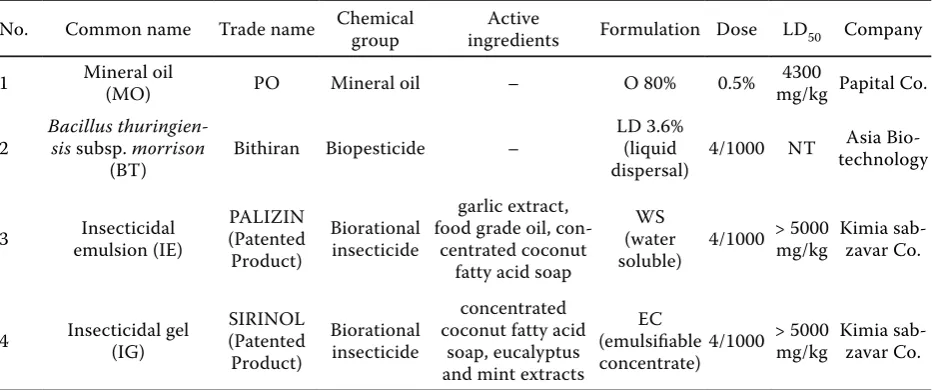
[image:2.595.65.532.561.756.2]The toxicity of commercial biorational insecticides (Table 1) to the citrus leafminer was tested in the laboratory of toxicology at Sari Agricultural and Natural Resources University in 2006. Newly grown leaves were sampled from citrus trees cv. Thomson of different orchards in the Sari district in Northern Iran. The bioassay method (leaf-dip method) was devised to test the toxicities of the four biorational insecticides. Leaves were examined in a laboratory with the aid of a stereo-microscope. The numbers of larvae, pre-pupae, pupae and adult leaf miners on leaves ≥ 10 mm in length were
Table 1. Biorational insecticides used in this experiment
No. Common name Trade name Chemical group ingredientsActive Formulation Dose LD50 Company
1 Mineral oil (MO) PO Mineral oil – O 80% 0.5% mg/kg Papital Co.4300
2 Bacillus thuringien-sis subsp. morrison
(BT) Bithiran Biopesticide –
LD 3.6% (liquid
dispersal) 4/1000 NT
Asia Bio-technology
3 emulsion (IE)Insecticidal PALIZIN (Patented Product)
Biorational insecticide
garlic extract, food grade oil,
con-centrated coconut fatty acid soap
WS (water
soluble) 4/1000 > 5000 mg/kg
Kimia sab-zavar Co.
4 Insecticidal gel (IG) SIRINOL (Patented Product)
Biorational insecticide
concentrated coconut fatty acid
soap, eucalyptus and mint extracts
EC (emulsifiable
concentrate) 4/1000 > 5000 mg/kg
recorded. For the assay, only leaves with actively feeding second or third instars leaf miner larvae were completely excised with petioles and used for the bioassays. To keep the leaves turgescent, each petiole was covered by wet cotton. Leaves were dipped separately for approximately 10 s into each of the pesticides (Table 1); dipping into distilled water served as control. After dipping, the leaves were air-dried for approximately 2 h and placed at the bottom of plastic Petri dishes (9 cm diameter × 2.5 cm high) that were lined with wet
filter paper and covered with a plastic lid. Each of the treatments was replicated four times; in each replicate four leaves were used. The numbers of live and dead larvae in each replicate were counted in the laboratory under a stereomicroscope 24, 48, 72 and 96 h after the treatment.
Statistical analysis. The data of experiment
were analysed by a completely randomised design using factorial arrangements of treatments (four replicates for each treatment). Variables measured per replicate of each treatment were the average number of mines per leaf, larval mortality (the proportion of larvae that were dead). Normality was assessed using probability plots. The normal
distribution was approximated for the number of dead larvae per leaf when these data were recipro-cally transformed using ArcSin √y/100. Mortality data were corrected using Abbott’s formula (Ab-bott 1925). The analysis of data was performed on each dependent variable using the ANOVA procedure. Mean separation was determined us-ing the Tukey’s test.
rEsults
There were significant differences (P < 0.001) among different biorational insecticides and time of evaluation used in the study (Tables 2 and 3), but the interaction effects of insecticides and times were not significant. These results showed that each insecticide and time had an independ-ent and separate effect on percindepend-entage of larval mortality.
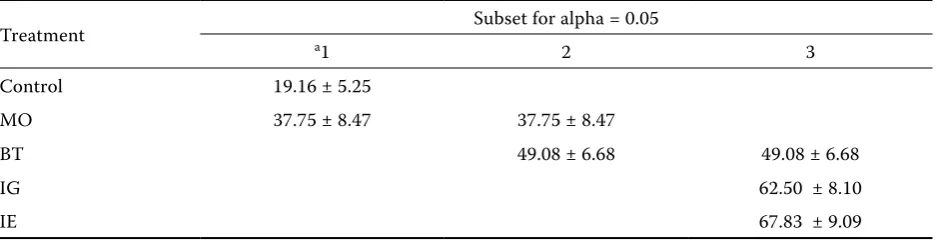
[image:3.595.64.532.443.529.2]The percentage of larvae mortality achieved by IE, IG, BT and MO was 67.83 ± 9.10, 62.45 ± 8.10, 49.08 ± 6.70 and 37.70 ± 8.50, respectively (Table 3). There were significant differences in larval mortality between control and treated vari-ants (P < 0.0001).
Table 2. ANOVA of different biorational insecticides on citrus leaf miner larval mortality
Source Type III – sum of squares df Mean square F Significance
Treatment (A) 0.017 4 0.004 10.706 **
Day (B) 0.016 3 0.005 13.872 **
Treatment × day 0.002 12 0.000 0.524 ns
Error 0.016 40 0.0000
**significantly different (P < 0.01); ns–not significantly different
Table 3. Larval mortality (%) of CLM after treatment (means) with different biorational insecticides – Tukey’s test (mean ± SD)
Treatment a Subset for alpha = 0.05
1 2 3
Control 19.16 ± 5.25
MO 37.75 ± 8.47 37.75 ± 8.47
BT 49.08 ± 6.68 49.08 ± 6.68
IG 62.50 ± 8.10
IE 67.83 ± 9.09
[image:3.595.64.533.617.738.2]Significant differences in mortality of CLM larvae were also found between the lengths of the period after treatment (Table 4). The percentage mortality of the 96 and 72 h post treatments (71.9 ± 5.9 and 54.4 ± 6.3) were considerably higher than those of the 48 and 24 h post treatments (25.2 ± 6.8 and 37.4 ± 7.8). Thus, the 96 and 72 h post treatment periods were more effective than the 48 and 24 h ones on mortality of CLM.
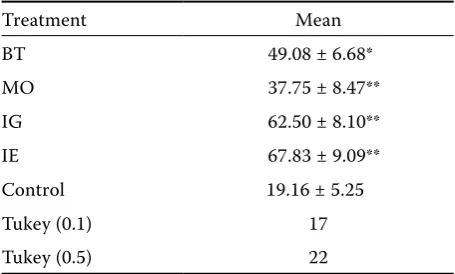
Among the different biorational insecticides tested, IE with 67.83 ± 9.10 and IG with 62.45 ± 8.10 were more effective than BT with 49.08 ± 6.70 and MO with 37.70 ± 8.50 percentage of larval mortality of CLM (Table 5).
are important as fruit-bearing branches. The con-comitant problems of the use of chemical and synthetic insecticides in developing countries makes it necessary to test alternative and more traditionally oriented methods for pest control. The present work revealed the effect on CLM larvae of four biorational insecticides, including insecticidal emulsion, insecticidal gel, Bacillus thuringiensis and mineral oil. These insecticides had significant insecticidal activity against the larvae, but the IE and IG were more effective than BT and MO. The IE and IG are used against a wide range of pests. However, they have very low toxicity against vertebrate and mammals (with an LD50 of over 10 000 mg/kg). These results suggest that there may be different compounds in IE and IG possessing different bioactivities.
Pesticides may be applied to protect new flushes of growth when the leaves are most vulnerable to CLM damage. However, the best foliar insec-ticides keep leaves free of leaf miner infestations for only two weeks (Michaud & Grant 2003). Recently, Mafi and Ohbayashi (2006) found that the percentage corrected mortality of eggs of the citrus leafminer exposed to insecticides (dipping method bioassay) ranged from 3% to 44%, while all tested insecticides gave almost over 90% mortality to the first instar larvae of the citrus leafminer. It is important to select chemicals that are less toxic to the natural enemies to take advantage of both the activity of natural enemies and the control effect of insecticides for suppressing the infestation by CLM.
[image:4.595.63.291.131.232.2]The results of the present study showed that IE, IG, BT and MO are active against the leafminer, demonstrating that these biopesticides penetrate into leaf mines, killing the larvae as observed by Shapiro et al. (1998), while the oil in IE, IG and MO might reduce the infestation by acting as an oviposition deterrent in the field (Liu et al. 1999). The IE, IG and MO solutions tested in the current experiment had two different effects on CLM mortality. First, they had insecticidal activity when applied against CLM at the recommended dose. Second, they increased the efficacy of the commercial formulations of IE, IG, BT and MO by helping them to penetrate the plant cuticle, and then enhanced the activity of the active ingredient of these biorational insecticides when applied to the pest, probably due to increased penetration through the stomata into the mines. Since larvae of CLM preferentially mine the abaxial surface of Table 5. Mean comparison between the effects of
biora-tional insecticide on percentage of CLM larval morality – LSD test (mean ± SD)
Treatment Mean
BT 49.08 ± 6.68*
MO 37.75 ± 8.47**
IG 62.50 ± 8.10**
IE 67.83 ± 9.09**
Control 19.16 ± 5.25
Tukey (0.1) 17
Tukey (0.5) 22
[image:4.595.63.291.523.660.2]significantly different * P < 0.05, **P < 0.01
Table 4. Effect (means) of different times of evaluation after treatment on percentage of larval mortality of CLM (Tukey’s test; P < 0.01)
Time (h) a Subset for alpha = 0.05
1 2 3
24 25.2 ± 6.8
48 37.4 ± 7.8 37.4 ± 7.8
72 54.4 ± 6.3 54.4 ± 6.3
96 71.9 ± 5.9
ameans followed by the same number are not significantly
different
dIscussIOn
leaves, enhanced stomatal infiltration is especially useful against CLM.
The petroleum oil spray residues reduced in-festations of CLM by preventing oviposition and its effects depended on concentration of oil and time of spraying. Raga et al. (2001) reported that petroleum oil added to Abamectin and Lufenuron pesticides provided a significant increase in ef-fect against CLM larvae. However, the efficacy of petroleum-derived spray oils used as oviposition deterrents to control citrus leafminer is related to time of spraying, the amount of oil dose and the persistence of oil molecules on sprayed surfaces. Therefore, the petroleum oils alone or combined with a microbial agent as emulsifier have a syner-gistic and less harmful effect for the environment and are recommended for use in IPM programs (Khyami & Ateyyat 2002).
It has been shown that neonicotinoid, pyrethroid and growth regulator insecticides have a signifi-cant, negative impact on some predators which are appearing to be the most important biological control agents of leafminers. Thus, it is necessary to be aware about the effect of these pesticides on beneficial insects and, instead, recommend the use of biorational insecticides, such as BT (Grafton & Gu 2003). In addition, the toxicity of pesticides such as Avant was higher than Pyriproxyfen and Buprofezin (Amiri Besheli2006b). Yet treatments with IE, IG, BT and MO are relatively much safer than conventional organophosphorus insecticides like Buprofezin, Avant and Pyriproxifen (Maha & Abdalla 1999). The high toxicity of the IE and IG may be due to penetration through stomata into the mines. Since CLM preferentially mine the abaxial surface of leaves, enhanced stomatal infiltration is especially useful against this pest. The low toxicity of the mineral oil (MO) in this study may be due to different factors including cuticle properties, ambient temperature, and the molecular size and volume of oil molecules.
The results of this study indicated that plant-based compounds such as IE and IG may be effective alternatives to conventional synthetic insecticides for the control of CLM. For further understanding it is necessary to investigate the third generation pesticides such as growth regulators (IGRs) and biorational insecticides in combination with min-eral oil, to get much more suitable results under field conditions. Since the population density of CLM is very low in spring, it is not necessary to control CLM before late June in most parts of the
citrus growing regions in Northern Iran. On the other hand, it is really important to protect the new shoots of the young or top grafting citrus trees against infestation by summer generations of CLM.
references
Abbott W.S. (1925): A method of computing the ef-fectiveness of an insecticide. Journal of Economic Entomology, 18: 265–267.
Amiri Besheli B. (2006a): The survey of the effect of some insecticides and mineral oils against citrus leafminer Phyllocnistis citrella Stainton (Lepidoptera: Gracillariidae) in Sari District. Journal of Agricul-tural Science and NaAgricul-tural Resources (AgriculAgricul-tural Sciences), 4: 53–62.
Amiri Besheli B. (2006b): Toxicity evaluation of Avant, Buprofezin and Pyriproxifen pesticides against
Phyllocnistis citrella Stainton (Lepidoptera: Gracil-lariidae). Pakistan Journal of Biological Science,9: 2483–2487.
Amiri Besheli B. (2007): Efficacy of Bacillus thurin- giensis and mineral oil against Phyllocnistis citrella
Stainton (Lepidoptera: Gracillariidae). International Journal of Agricultural & Biology, 9: 893–896. Belasque J.JR., Parra-Pedrazzoli A.L., Rodrigues
Neto J., Yamamoto P.T., Chagas M.C.M., Parra J.r.p., Vinyard B.T., Hartung J.S. (2005): Adult cit-rus leafminers (Phyllocnistis citrella) are not efficient vectors for Xanthomonas axonopodis pv. citri. Plant Disease, 89: 590–594.
Carlini C.R., Grossi de Sa M.F. (2002). Plant toxic proteins with insecticidal properties. A review on their potentialities as bioinsecticides. Toxicon, 40: 1515–1539.
Dias C., Carsia P., Simoes N., Oliveira L. (2005): Efficacy of Bacillus thuringiensis against Phyllocnistis citrella (Lepidoptera: Phyllocnitidae). Journal of Eco-nomic Entomology, 98: 1880–1883.
Grafton C.E., Gu P. (2003): Conserving vedalia bee-tle, rodolia cardinalis (Mulsant) (Coleoptera: Coc-cinellidae), in citrus: A continuing challenge as new insecticides gain registration. Journal of Economic Entomology, 96: 1388–1398.
Jafari M.I. (1996): Report of the Workshop on Citrus Leafminer (Phyllocnistis citrella) and its Control in the Near East. Safita (Tartous), Syria, 30 Sept.–3 Oct. Khyami H., Ateyyat M. (2002): Efficacy of Jordanian
Lacey I.A., Fruteos R., Kaya H.K., Vail P. (2001): In-sect pathogens as a biological control agent: do they have a future? Biological Control, 21: 230–248. Liu Z., Beatie G., Jiang L., Watson D.M. (1999):
Vol-umes of petroleum spray oil required for control of
Phyllocnistis citrella Stainton (Lepidoptera: Gracil-lariidae) in mature citrus orchards. Journal of the Australian Entomological Society, 38: 141–146. Mafi S.A., Ohbayashi N. (2006): Toxicity of
insecti-cides to the citrus leafminer, Phyllocnistis citrella, and its parasitoids, Chrysocharis pentheus and Sympiesis striatipes (Hymenoptera: Eulophidae). Applied Ento-mology and Zoology, 41: 33–39.
Maha A.F., Abdalla E.F. (1999): Genotoxicity evalu-ation of Buprofezin, Petroleum oil and Profenofos in somatic and germ cells of male mice. Journal of Ap-plied Toxicology, 18: 301–305.
Michaud J.P., Grant A.K. (2003): IPM-compatibility of foliar insecticides for citrus: Indices derived from
toxicity to beneficial insects from four orders. Journal of Insect Science, 3: 1–8.
Raga A., Satol M.E., Souza M.F., Siloto R.C. (2001): Comparison of spray insecticides against citrus leaf-miner. Arquivos Do Instituto Biologico (Sao Paulo), 68: 77–82.
Shapiro J.P., Schroeder W.J., Stansly P.A. (1998): Bioassay and efficacy of Bacillus thuringiensis and an organosilicone surfactant against the citrus leafminer (Lepidoptera: Phyllocnistidae). The Florida Entomo-logist, 81: 201–210.
Sponagel K.W., Diaz F.J. (1994): El minador de la hoja de los cítricos Phyllocnistis citrella Un insecto plaga de importancia económica en la citricultura de Hon-duras. La Lima Cortes. Fundación Hondureña de In-vestigación Agrícola, FHIA: 1–31.
Received for publication July 18, 2007 Accepted after corrections April 14, 2008
Corresponding author:
Dr. Behnam Amiri-BeSheli, University of Mazandaran, College of Agriculture Sciences, P.O. Box 578, Sari, Iran