ePrints Soton
Copyright © and Moral Rights for this thesis are retained by the author and/or other
copyright owners. A copy can be downloaded for personal non-commercial
research or study, without prior permission or charge. This thesis cannot be
reproduced or quoted extensively from without first obtaining permission in writing
from the copyright holder/s. The content must not be changed in any way or sold
commercially in any format or medium without the formal permission of the
copyright holders.
When referring to this work, full bibliographic details including the author, title,
awarding institution and date of the thesis must be given e.g.
AUTHOR (year of submission) "Full thesis title", University of Southampton, name
of the University School or Department, PhD Thesis, pagination
Questions of Function Examined through Simulation
Jason Noble
Submitted for the degree of D. Phil.
University of Sussex
I hereby declare that this thesis has not been submitted, either in the same or different form, to this
or any other university for a degree.
Seth Bullock and Ezequiel Di Paolo have probably had the greatest immediate influence on the
thesis, and so deserve to be acknowledged first: thanks, guys.
I remain grateful to Dave Cliff for taking me on as a student in the first place, back when I was
full of wild-eyed ALife enthusiasm. Dave’s devotion as a supervisor is rivalled only by his skill as a rock-climber. He is also very good company—cheers, Dave.
Thanks also to Mike Scaife, who kindly agreed to take up the slack when Dave moved on.
Mike has been a level-headed and pragmatic presence during the frantic final year of my D.Phil. The research community in the School of Cognitive and Computing Sciences at Sussex has
been extremely supportive, and has gone some way towards restoring my faith in academia. There
are too many people to mention individually, but some names stand out. A big thank you to Jo Brook, Julian Budd, Ron Chrisley, Stephen Eglen, Inman Harvey, Phil Jones, Adrian Thompson
and Mike Wheeler, plus all the members of the ALERGIC, E-Intentionality, CogPhi and EvoComm discussion groups. I would also like to thank Linda Thompson and Magdalena Portmann, without
whom nothing in COGS would work.
But it’s not over yet. There’s a large group of people, some of them at Sussex and some not, without whom I couldn’t have done it. Their contributions to the thesis range from philosophy
to beer to just being patient with me (sometimes all three at once), and I want to thank them all: Argiri Arfani, Guillaume Barreau, Tom “the Cincinnatti Kid” Beament, Hilan Bensusan, Vicki
Carruthers, Sirem Erkek (my en tatlı bebek), Berkan Eskikaya, Sevan Ficici, Ronald Lemmen, Mar Muriana-L´opez, Sean Noble, Manuel de Pinedo Garc´ıa (“Market Diner, befor´e!”), Jorge
Ram´ırez-Uresti, Oli Sharpe, Tim Taylor, and Richard Watson.
Many people at SAB 96, EvoLang II, ALife VI, and SAB 98 were also helpful. Thanks. Thank you to John Maynard Smith and Peter Caryl for the advice and encouragement, and
thanks to Bruce MacLennan for being such a good sport about chapter 5.
For their financial support I would like to thank the Association of Commonwealth Universities and the British Council, who were foolish enough to take me on as a Commonwealth Scholar. At this point I should probably also thank Mum and Dad, who gave a lot more than just cash.
Finally, my undying gratitude goes to various Australian record companies who, through inaction,
Parts of the thesis are based on work that has been previously presented or published. Chapter 4
borrows heavily from a paper presented at the Fourth European Conference on Artificial Life (No-ble, 1997). Chapter 5 is based on a paper published in the Proceedings of the Fourth Conference
on the Simulation of Adaptive Behavior (Noble & Cliff, 1996)—Dave Cliff was a co-author of this paper but all of the work actually presented in the chapter is my own. Chapter 7 is based on a
paper published in the Proceedings of the Sixth Conference on Artificial Life (Noble, 1998b) and
presented at the Second International Conference on the Evolution of Language (Noble, 1998a); an extended version of the work is currently in press in the journal Adaptive Behavior. Chapter 8
is based on a paper published in the Proceedings of the Fifth Conference on the Simulation of
Questions of Function Examined through Simulation
Jason Noble
Summary
Simulated evolution is used as a tool for investigating the selective pressures that have influenced the design of animal signalling systems. The biological literature on communication is first re-viewed: central concepts such as the handicap principle and the view of signalling as manipulation are discussed. The equation of “biological function” with “adaptive value” is then defended, along with a workable definition of communication. Evolutionary simulation models are advocated as a way of testing the coherence of a given theory. Contra some ALife enthusiasts, simulations are not alternate worlds worthy of independent study; in fact they fit naturally into a Quinean picture of scientific knowledge as a web of modifiable propositions. Existing simulation work on the evo-lution of communication is reviewed: much of it consists of simple proofs of concept that fail to make connections with existing theory. A particular model (MacLennan & Burghardt, 1994) of the evolution of referential communication in a co-operative context is replicated and critiqued in detail.
Evolutionary simulations are then presented that cover a range of ecological scenarios; the first is a general model of food- and alarm-calling. In such situations signallers and receivers can have common or conflicting interests; the model allows us to test the idea that a conflict of interests will lead to an arms race of ever more costly signals, whereas common interests will result in signals that are as cheap as possible. The second model is concerned with communication during aggressive interactions. Many animals use signals to settle contests, thus avoiding the costs associated with fighting. Conventional game-theoretic results suggest that the signalling of aggression or of strength will not be evolutionarily stable unless it is physically unfakeable, but some recent models imply that cost-free, arbitrary signals can be reliable indicators of both intent and ability. The simulation, which features continuous-time perception of the opponent’s strategy, is an attempt to settle the question. The third model deals with sexual signalling, i.e., elaborate displays that are designed to persuade members of the opposite sex to mate. The results clarify the question of whether such displays are the pointless result of runaway sexual selection, or whether they function as honest and costly indicators of genetic quality.
The models predict the evolution of reliable communication in a surprisingly narrow range of circumstances; a serious gap remains between these predictions and the ethological data. Future directions for simulation work are discussed.
Submitted for the degree of D. Phil.
University of Sussex
1 Introduction 1
1.1 Ways of explaining animal behaviour . . . 1
1.2 Theoretical models and functional explanations of animal communication . . . . 3
1.3 The use of computer simulations . . . 4
1.4 Problems in defining communication . . . 5
1.5 Human language . . . 6
1.6 Overview . . . 7
1.6.1 Outline of the thesis . . . 7
1.6.2 Original contributions . . . 9
2 The biological literature 10 2.1 Darwin on communication . . . 10
2.1.1 Signalling of emotional state . . . 11
2.1.2 Sexual advertisement signalling . . . 11
2.2 The ethological view . . . 12
2.2.1 Derived activities . . . 12
2.2.2 Ritualization . . . 14
2.2.3 Ethology and group-selection thinking . . . 15
2.3 The rise of behavioural ecology and sociobiology . . . 15
2.3.1 Group selection or selfish genes? . . . 16
2.3.2 Animals as maximizers and the application of game theory . . . 17
2.3.3 A new perspective on signalling . . . 19
2.3.4 Reinterpretation of the ethological data . . . 21
2.4 Zahavi’s handicap principle . . . 22
2.4.1 Paradoxical logic of the theory . . . 22
2.4.2 Controversial status and variant interpretations . . . 23
2.4.3 Variable costs and benefits for signallers . . . 25
2.5 Dawkins and Krebs on communication . . . 26
2.5.1 Information or manipulation? . . . 26
2.5.2 Two kinds of signal co-evolution . . . 28
2.6 Receiver psychology . . . 29
2.6.1 Sensory biases . . . 31
2.6.2 Information requirements of receivers . . . 32
2.7 Communication and sexual selection . . . 32
3 Conceptual issues in the study of communication 36
3.1 The concept of function in biology . . . 36
3.2 Communication and related concepts . . . 39
3.2.1 Some problem cases . . . 39
3.2.2 Attempts to define animal communication in terms of behaviour . . . 41
3.2.3 The role of information . . . 43
3.2.4 Intentional communication? . . . 45
3.2.5 Millikan’s alternative classification scheme . . . 47
3.3 A functional definition of communication . . . 50
4 Artificial life as a method for studying evolution 54 4.1 Some matters of terminology . . . 55
4.1.1 Artificial life . . . 55
4.1.2 Models and simulations . . . 56
4.2 This thing called science . . . 57
4.3 Artificial life as science . . . 57
4.3.1 Does artificial life qualify? . . . 57
4.3.2 The concept of emergence . . . 59
4.4 Artificial life and the return of the analytic-synthetic distinction . . . 60
4.4.1 Confusion between the analytic and synthetic modes . . . 64
4.5 A sound methodology for artificial life . . . 65
4.5.1 In the footsteps of theoretical biology? . . . 65
4.5.2 Connections with Millikan . . . 68
5 Artificial life and communication 70 5.1 Previous attempts to simulate the evolution of communication . . . 71
5.1.1 Overview . . . 71
5.1.2 Problems with the earlier work . . . 74
5.1.3 Common and conflicting interests . . . 75
5.2 MacLennan and Burghardt’s work . . . 76
5.2.1 Description of the simulation . . . 76
5.2.2 A replication . . . 79
5.2.3 Extension and critique . . . 81
5.2.4 Lessons to be learned . . . 86
6 A program of simulations 88 6.1 The question of what to model . . . 88
6.2 When is it proper signalling? . . . 90
6.3 Getting the most out of simulations . . . 92
7 Co-operative and competitive signalling 94 7.1 Background . . . 94
7.1.1 Explaining food and alarm calls . . . 94
7.1.3 Putting artificial-life models of communication in perspective . . . 96
7.1.4 Conflicts of interest . . . 96
7.2 A simple signalling game . . . 98
7.2.1 Stable strategies in the simple game . . . 99
7.2.2 Evolutionary simulation model . . . 100
7.3 A game with variable signalling costs . . . 102
7.3.1 Stable strategies in the variable-signal-cost game . . . 102
7.3.2 Evolutionary simulation model . . . 104
7.3.3 Discussion . . . 109
7.4 Variations on the continuous-signal-cost game . . . 110
7.4.1 Noise and uncertainty . . . 110
7.4.2 Exploitation of sensory biases and mutational lag . . . 111
7.4.3 The effects of spatial arrangement . . . 113
7.4.4 Insistent signallers . . . 114
7.5 General discussion . . . 115
8 Aggressive signals as ritualized intention movements 119 8.1 Signalling in animal contests . . . 120
8.1.1 Game theory: hawks and doves . . . 120
8.1.2 Conventional signals of strength or aggression . . . 121
8.1.3 Sustainable bluffing . . . 123
8.1.4 Intention movements and ritualization . . . 123
8.2 Description of the model . . . 124
8.3 Hypotheses . . . 127
8.4 Results . . . 128
8.5 Variations on the model . . . 134
8.6 Discussion . . . 138
9 Honest signalling and sexual selection 142 9.1 Signalling of environmentally determined quality . . . 143
9.2 Signalling of genetically determined quality . . . 144
9.3 Zahavi vs. Fisher: Measuring sexual signalling . . . 148
9.4 Description of the model . . . 149
9.5 Results . . . 153
9.5.1 Environmentally determined quality . . . 154
9.5.2 Genetically determined quality . . . 155
9.5.3 Fisherian runaway sexual selection . . . 163
9.6 Discussion . . . 165
10 Conclusions 168 10.1 Biological implications . . . 170
10.2 Limitations of the thesis . . . 172
Bibliography 175 A Cooperative and competitive communication: derivations of game-theoretic results 189
A.1 The simple signalling game . . . 189
A.1.1 Expected payoffs in an honest and trusting population . . . 189
A.1.2 Conditions for evolutionary stability of the honest and trusting strategy . 189 A.1.3 Other possible ESSs . . . 191
A.2 The variable-signal-cost game . . . 192
A.2.1 Stability of soft-signalling honest-and-trusting strategies . . . 192
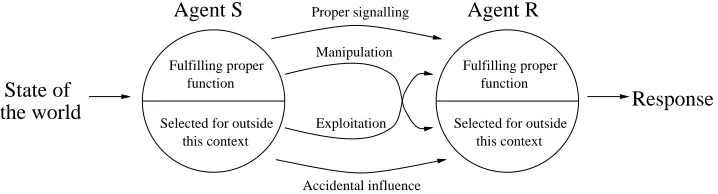
3.1 Possible influence interactions between two animals . . . 52
4.1 The proposed isomorphism between artificial life models and reality. . . 58
5.1 Effect on rate of fitness increase of varying the number of global symbols . . . . 86
7.1 Communication scenarios classified by their fitness effects for each participant . . 97
7.2 Extended form of the simple signalling game . . . 98
7.3 Communication index—honest initial conditions . . . 102
7.4 Communication index—non-signalling initial conditions . . . 103
7.5 Communication index—continuous simulation, honest initial conditions . . . 104
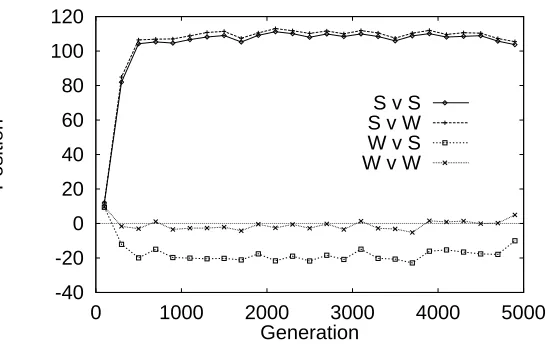
7.6 Communication index—continuous simulation, non-signalling initial conditions . 105 7.7 Communication index over generational time . . . 106
7.8 Cost of high-state signals—continuous simulation, honest initial conditions . . . 106
7.9 Cost of high-state signals—continuous simulation, honest initial conditions, cross-sectional view . . . 107
7.10 Threshold value—continuous simulation, honest initial conditions . . . 107
7.11 Threshold value—continuous simulation, honest initial conditions, cross-sectional view . . . 108
7.12 Cross-sectional view: costs of high and low signals, and reception threshold . . . 108
7.13 Predicted results according to game-theoretic model . . . 109
7.14 Communication index—uncertain payoff variant, difference values . . . 111
7.15 Communication index—sensory bias variant, difference values . . . 112
7.16 Communication index—mutational lag variant, difference values . . . 113
7.17 Communication index—spatial variant, difference values . . . 114
7.18 Mean fitness—spatial variant, difference values . . . 115
7.19 Communication index—insistent signallers variant, difference values . . . 116
7.20 Communication index—handicap principle variant, difference values . . . 116
8.1 Course of a hypothetical contest over an indivisible resource . . . 125
8.2 A pattern observed in some contests . . . 129
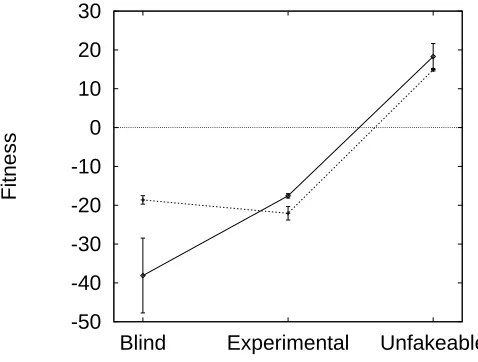
8.3 Mean fitness by experimental condition . . . 130
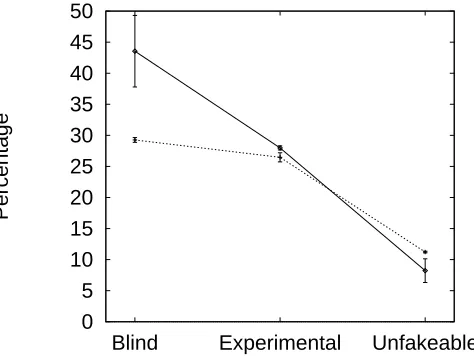
8.4 Percentage of contests resolved by all-out fighting, by experimental condition . . 131
8.5 Typical behaviour through the course of a contest . . . 132
8.6 Evolution of typical behaviour at a particular time-step . . . 132
8.7 Correlation between position of contestant and fighting ability of opponent . . . . 133
8.8 Opening moves by fighting ability—continuous case . . . 134
8.10 Percentage of contests won by the weaker animal . . . 135
8.11 Mean fitness in experimental and variant conditions . . . 137
9.1 Male advertisement as a function of viability . . . 150
9.2 Function for determining the survival cost of advertisement and preference traits . 151
9.3 Expressed advertisement trait values in the environmentally determined quality condition . . . 154
9.4 Preference values in the environmentally determined quality condition . . . 155
9.5 Correlation between expressed advertisement and underlying viability in the envi-ronmentally determined quality condition . . . 156
9.6 Male-female survival ratio in the pure epistasis handicap condition . . . 157 9.7 Correlation between expressed advertisement and underlying viability in the pure
epistasis handicap condition . . . 158 9.8 Male-female survival ratio in the conditional handicap condition . . . 158
9.9 Preference values in the conditional handicap condition . . . 159
9.10 Correlation between expressed advertisement and underlying viability in the con-ditional handicap condition . . . 159
9.11 Correlations between the three traits over generational time . . . 160 9.12 Male-female survival ratio in the strategic advertisement condition . . . 162
9.13 Expressed advertisement trait values in the strategic advertisement condition . . . 163
9.14 Correlation between expressed advertisement and underlying viability in the strate-gic advertisement condition . . . 164
5.1 Rates of fitness increase and final mean fitness scores. . . 80
5.2 Entropy statistics . . . 81
5.3 Effect of random-order updating . . . 82
7.1 Payoff matrix for the simple game . . . 99
7.2 Genetic specification of strategies in the simple game . . . 101
8.1 Payoff matrix for the hawk-dove game . . . 124
A.1 Payoffs in an honest and trusting population . . . 190
A.2 Expected payoffs against the honest and trusting strategy . . . 190
A.3 Expected payoffs against blind optimism . . . 191
A.4 Change in expected payoffs for mutant strategies against a background population of soft-signalling honest-and-trusting players . . . 193
Introduction
While going about their business of survival and reproduction, most animals influence, and are
influenced by, the behaviour of other animals. In some cases we describe this as communication.
For example, vervet monkeysCercopithecus aethiops use vocal alarm signals to warn their fel-low troop members of the approach of three or four distinct kinds of predators. Mantis shrimps
Gonodactylus bredini wave their claws to threaten other mantis shrimps in disputes over territory.
Male T´ungara frogsPhysalaemus pustulosus produce distinctive sounds in order to advertise their size and attract females. Why do animals exhibit these sorts of behaviours? Such communication systems, i.e., dispositions to produce and respond to certain signals, did not spring up overnight:
they evolved by a process of natural selection. If we want to know why a particular
communica-tion system exists, we have to examine the pressures that are likely to have shaped its evolucommunica-tion, and to determine the adaptive purpose that it serves. For instance, why do mantis shrimps produce
threat signals, instead of attacking immediately or doing nothing—what is the selective advantage
of the behaviour? Why do threatened shrimps pay any attention to the threat? What would happen to a mutant shrimp that behaved differently to the established norm? The aim of this thesis is to
use a particular style of computer simulation as a tool with which to cast light on such questions.
1.1
Ways of explaining animal behaviour
The thesis will be concerned, then, with questions of adaptive purpose or function. To describe
the function of something is one way of explaining it: one might explain a can-opener to a curious
child by saying that its function was to open cans. However, functional explanations are by no means the only explanations that can be offered of animal behaviour. Tinbergen (1963) suggested
that there were four independent questions that could be asked about any particular feature of an animal’s morphology or behaviour. Tinbergen’s four questions concerned mechanism, ontogeny,
phylogeny and function. The reader may ask, with some justification, why only one of those questions will be addressed here.
The question of mechanism means asking how the behaviour or trait is physically realized; in
vervet processes the incoming visual information, recognizes a certain patch of yellow as an
ap-proaching leopard, stimulates muscles in the vocal tract so as to make the appropriate sound, etc.
The flight behaviour of the vervets that hear the warning would have to be explained in a similar way. Providing a complete mechanistic account of vervet communication would require a marriage
of ethology and neuroscience. Extreme technical difficulties in recording the activity of neurons, nerve fibres and muscles in living, unrestrained animals would have to be overcome. There could
be only limited help from first principles (i.e., analysis of the computational requirements of the task) because the various elements of the system, such as leopard recognition, are likely to be
multiply realizable. Mechanistic explanations will not be considered here because of the nature of
the chosen research tool: the thesis is essentially a theoretical one and does not involve the sort of detailed empirical work necessary to provide a mechanistic explanation for any given
commu-nication system. Whilst it is conceivable that a sufficiently detailed, physically realistic computer
model could be used to test well-defined mechanistic theories, the computer simulations employed in the current project are, on the contrary, quite simple and abstract.
The question of ontogeny is about the way a trait or behaviour develops over the lifetime of the animal. An ontogenetic account of the vervet monkey’s communication system requires
a description of such morphogenetic details as the way the vocal tract develops in the embryo
and the growth of the relevant neural modules. An ontogenetic explanation would also describe the way in which young vervets learn to adjust their use of the warning signals in the light of
feedback concerning their early efforts.1As with mechanistic explanations, the practical problems of investigating ontogeny will be left to field biologists and neuroscientists.
The question of phylogeny concerns evolutionary history. A phylogenetic explanation of vervet monkey alarm signals would involve specifying the evolutionary predecessors of the current
behaviour patterns: for instance, perhaps ancestral vervet monkeys gave an undifferentiated alarm
call when confronted with any dangerous situation, and then later came to differentiate by giving increasingly specific calls in response to each of the types of predators commonly encountered. Or
perhaps the original alarm call was given only in response to leopards, and the other calls evolved
separately and independently. However, evolution is famously difficult to observe in action, and investigating phylogeny necessarily has the flavour of detective work. Phylogenetic questions have
traditionally been the domain of palaeontologists, but in the case of behavioural traits such as com-munication (as opposed to physical traits) the problems of determining phylogeny are particularly
acute: after all, patterns of behaviour do not fossilize. In these cases the comparative method—in which the behaviour and, sometimes, the actual genomes of related species are compared—is the
only way to test theories of phylogeny. Returning to the vervet monkey example, if we were to
examine several closely related species and find that in each case only a generalized alarm call ex-isted, this would lend a degree of support to the theory that the current differentiated calls evolved
from a single ancestral call.
The complexities of phylogenetic investigation will not be dealt with here. However, whereas
1This is not meant to appear as pre-judgement of an empirical question: it is, of course, possible in principle that
the thesis must be completely silent on mechanism and ontogeny, there is in fact some crossover
between the question of function, with which we will be concerned, and the question of phylogeny.
This is because a phylogenetic theory cannot propose evolutionary predecessors for a behaviour without regard for the functional value of those predecessors. For instance, whatever the
compar-ative or palaeontological evidence, we would be suspicious of a theory that suggested that vervet monkey alarm calls were derived from earlier calls that were designed to attract predators.
In-termediate forms in the evolution of any modern trait must themselves have had adaptive value, and thus analyses in terms of function may help to restrict the space of plausible phylogenetic
hypotheses.
Tinbergen’s question about function (originally presented as the third in the list) refers to the selective advantage that a trait has for the animal; the question has also been described as one of
“survival value”, “adaptive value” or of “ultimate function”. The latter term hints at the appeal
of this style of explanation: to give the function of an evolved behaviour is to answer the “why?” question. It is the goal of the current project to say something about why animals communicate in
certain ecological contexts and not in others. Of course, in the broad scientific effort to understand animal behaviour, concentrating on function to the exclusion of the other three questions would
be folly. Knowing why a behaviour persists tells us almost nothing about how it is physically
achieved, or what its antecedents were. However, as Grafen (1990b) notes, “we can understand something without understanding everything”, and an emphasis on the question of function is not
new: the field of behavioural ecology (Krebs & Davies, 1981, 1997) can be defined by its reliance on this approach.
1.2
Theoretical models and functional explanations of animal communication
In biology, as we shall see in chapter 2, verbal arguments and mathematical models of evolution
have been prevalent in discussions of the function of communication behaviour. For example, Dawkins and Krebs (1978; Krebs and Dawkins, 1984) have argued that communication is best
seen as the manipulation of one animal by another; the function of signalling behaviour is thus to
cause the receiver(s) of the signal to do something of benefit to the signaller. In contrast, Zahavi (1975, 1977, 1987, 1991) has repeatedly insisted that communication systems are kept honest because of the cost of the signals produced. Zahavi refers to this as “the handicap principle”,
and it implies that the function of a signal is to provide—due to its being costly to produce—an
accurate index of some quantity of interest to the receiver. Models of both processes have been put forward, e.g., Noble (1998b) and Grafen (1990a) respectively. The two positions are, at least on
the face of it, incompatible, but there is as yet no consensus in the literature as to which account
best describes reality.
Readers with a taste for empirical evidence may immediately wonder what good could come
from the continuation of this sort of abstract theoretical debate. Surely some experiment or ob-servation could settle the question? The answer must be that the obob-servation of communication
behaviour in modern animals is often insufficient to decide between conflicting theories concern-ing the evolved function of that behaviour. Whilst it is true that careful empirical explication of the
mechanisms underlying a particular communication system can sometimes make the function of
mel-lifera) is an excellent example—determining the selective advantage of signalling and response
behaviours is often not so simple.
Returning again to the alarm signals of vervet monkeys, it might seem obvious that the function of the communication system is to help the monkeys avoid predation. At one time, when the
theory of group selection was held in higher regard than it is today, this explanation would have been accepted. However, the orthodox position in evolutionary biology (Williams, 1966; Dawkins,
1976; Maynard Smith, 1993) now says that animals are best understood as products of their selfish genes: animals do not do things for the good of the species, but in order to propagate copies of
their genetic material. From this viewpoint, avoiding predation is likely only to be the function of
the response behaviour. The function of the signalling behaviour is not so obvious: why should a monkey that has spotted an approaching leopard warn its conspecifics? Giving the alarm signal
may well increase the risk to the signaller, by drawing the leopard’s attention to itself.
The point here is not that the function of the alarm signal now becomes completely mysterious: several theories, such as kin selection and reciprocal altruism, provide candidate explanations. The
point is that the switch from group-selectionist to selfish-gene thought was not inspired by empir-ical observations, but by theoretempir-ical arguments about how evolution really works. While each
theory or viewpoint implies very different things about the evolutionary process, and about the
evolutionary history of particular species, the two theories would not necessarily make different predictions about the likely alarm-signal behaviour of modern vervet monkeys. This rather
ex-treme example of the under-determination of theory by data provides a paradigm case for the sort of argument that will be made in this thesis: when the data we have access to (i.e., ethological
ob-servations of modern animals) are incomplete, then choices between competing theoretical models must sometimes be made on the basis of non-empirical criteria, such as the internal consistency
of the model, and the fit between the model and other, well-established theories. In our current
theoretical understanding of animal communication, there are problems like the one above, where more than one model can account for what is observed, and there are also problems where a model
can account for one phenomenon only at the cost of making something else inexplicable. The
issue is surely complicated by the fact that communication is a co-evolutionary process, in which the advantage of using any one communication strategy will depend on the current distribution of
strategies in the population. It is hoped that this thesis will contribute to the process of selection between, and improvement of, the existing theoretical models.
1.3
The use of computer simulations
The simulations presented will involve the explicit modelling of individual organisms interacting
in a shared environment (although both the organisms and the environment will be very simple). Artificial evolution will be incorporated: organisms that are more successful, where success is
defined by a criterion analogous to energy accumulation, will have a greater likelihood of passing on their genetic material to the next generation. Variation will be introduced through mutation,
i.e., the occasional random alteration of the transmitted genetic information.
Conditions that influence the evolution of communication between organisms can thus be
ex-plored. If a mutation leads to proto-communicative behaviour in a newly-generated individual,
behaviour will be perpetuated. Possibly the communication system will become more complex
through the accumulation of further mutations. The simulation method permits exploration of the
conditions for such developments. If we envisage evolved signalling systems as points in a space of possible strategies, a simulation might help us to conclude—for example—that there will be no
evolutionary path to communication if the organisms’ sensory systems are thus rather than so, or if the benefits of dishonesty are above a certain threshold, etc.
Through varying the initial conditions (i.e., the genetic makeup of the organisms in the first generation), we can look at the conditions for both the stability and the emergence or origin of
munication. Conditions for stability are examined by starting with a population that already
com-municates. Conditions for the emergence of communication, on the other hand, are examined by starting with a population in which there is no signalling behaviour—this logic is based on the
evo-lutionary axiom that any modern communicating organism must have had a non-communicating
ancestor.
Theories about the function of communication in a particular ecological context are easily
tested: the simulation is constructed such that the hypothesized selective advantages for signalling and for responding are in fact available to the simulated organisms. If communication evolves
under these conditions, then the theory is supported; if not, our confidence in the theory is reduced.
For example, we could test the idea that vervet monkeys give alarm calls for the benefit of other troop members, despite there being a fitness cost to the signaller in doing so.
The simulation method is inspired by recent work in the area known variously as artificial life or the simulation of adaptive behaviour—for introductory reviews, see Langton (1989) and Meyer
(1994) respectively. Simulation is not new as a research tool in biology, but conventional biological simulations tend to model whole populations, abstracting away from the individual organism, and
they tend to be extensions of simple game-theoretic models, thus incorporating radical simplifying
assumptions such as random mating and the absence of a spatial distribution. Communication is self-evidently about interactions between individuals mediated by an environment, and it is hoped
that artificial-life-inspired methods will better reflect these key aspects of the phenomenon.
It is worth stressing that the simulation results will not be presented as a substitute for empiri-cal evidence. If a simulation establishes the plausibility of a particular hypothesis about function,
that is not the same thing as establishing its truth. The claim here is only that simulation meth-ods can demonstrate the logical coherence (or indeed incoherence) of a particular model, and that
they may suggest new hypotheses for empirical investigation: the shift from group-selectionism to selfish-gene thinking mentioned above illustrates that it is only when we have a particular
theo-retical picture in mind that we know whether to view an empirical observation as surprising or as
unproblematic. These issues are explored at much greater length in chapter 4.
1.4
Problems in defining communication
Animals influence each other’s behaviour in many different ways. Pinning down exactly which
kinds of influence that we wish to call communication can be a troublesome business. It is uncon-troversial to say that vervet monkeys are communicating when one gives a leopard alarm and the
others scramble for the safety of the trees. But is a camouflaged insect signalling to its predators?
certain definitions of communication that have been adopted in the biological literature. Intuitions
differ about how such borderline cases should be treated; mimicry and deception are two other
notable problem areas.
This definitional problem is despite the fact that in ordinary language we have a clear idea of
what we mean by communication, or at least an archetypal image: a sender imparts information to a receiver via some sort of signalling channel, e.g., one person says truthfully to another, “It’s
raining outside.” This has been dubbed the conduit metaphor (Reddy, 1979; Lakoff & Johnson, 1980).
The logic of the thesis requires measuring the existence and degree of communication in the
evolutionary simulations that will be presented. In order to do so, it will be necessary to take sides in the debate about just what constitutes communication; a definition will be defended in
chapter 3. The discussion will not be pre-empted here, but the definition argued for is based on
the work of Millikan (1984, 1993), and turns out to be not far removed from the imagery of the conduit metaphor. Alternative definitions of communication—notably those phrased in terms of
behavioural influence, information transmission, or the intent to communicate—will be considered and rejected.
1.5
Human language
One of the reasons we study the evolution of animal signalling systems is the suspicion that they
may have something to tell us about the origins of human language. The way in which vervet mon-keys use apparently arbitrary sounds to denote different kinds of predators, for instance, is certainly
reminiscent of the arbitrary connection between words and their referents. Could language have had its beginnings in something like an alarm call system amongst our savannah-dwelling primate
ancestors? Possibly, but caution is called for: speculating on the origin of language has a long and
disreputable history.2Whilst it is more than reasonable to suggest thatHomo sapiens is descended from creatures that did not have language but possessed only relatively primitive signalling
sys-tems, it would be a mistake to thereby suppose that human language is merely another—albeit
complex—animal signalling system. Human language is very different from all other forms of animal communication, and our very familiarity with our own linguistic abilities, combined with a laudable desire not to be species-chauvinist, can sometimes lead us to underestimate the distance
between ourselves and the rest of the animal kingdom.
One major difference is that human language has recursive syntax: complex meanings can be built up by combining smaller units. Animal communication, on the other hand, either consists
only of atomic meaning-units, as in an alarm call system, or has some “syntactic” structure but does not appear to utilize that structure for the purpose of constructing complex meanings, e.g., bird or whale song. Syntax makes human language an extremely expressive system, and therefore
allows us to do such complicated things as talking about past and future events, talking about conditional relationships, combining arbitrary actions, properties and objects, and producing and
understanding sentences that we have never heard before. There is no evidence for anything like
2Bickerton (1994) informs us that as long ago as 1866, the members of the Linguistic Society of Paris were so tired
this kind of sophistication in the communication behaviour of any other animal species (Hauser,
1996). Unsurprisingly, discussions of the evolution of language are often, at heart, discussions of
the evolution of syntax.
A second difference is that human language is overwhelmingly a learned system, whereas most
animal communication systems are innate. Of course, the human ability to process and produce syntactically structured utterances, i.e., to use grammar, does seem to be innate, as Chomsky
(1957, 1968, 1975) has argued. However, we flesh out this capability by rapidly learning many thousands of words in one or more natural languages, a feat that no other animal has achieved.
Oliphant (1997) even suggests that it is this ability to learn a large vocabulary by imitation, rather
than the ability to use syntax, that stands as the “cognitive bottleneck” that explains why no other animals have comparable communication systems.
Finally, human language is problematic because some of its basic features may not have had
communication as their original function. Chomsky argued that our linguistic talents derive from the presence in our brains of a “language organ” that at one time allowed us to carry out
combina-torial calculations in the service of some other activity, and which has since been co-opted for the purpose of communication. Other authors (Dennett, 1991a; Bickerton, 1994) have also suggested
that language originated in the re-application of some older ability. If any of them are correct in
their suspicions then it would be a mistake to conclude that language has been shaped by the same selective pressures as simpler animal communication systems.
It is therefore safe to say, at the very least, that human language is an exceptional case of animal communication. The thesis will not take up a position in the debate on whether human
language is “continuous” with animal communication—this is left as a matter for others to argue over. Instead, a case will be made that coming up with functional explanations for the simpler
forms of animal communication is not as unproblematic as some syntax-oriented theorists might
suppose. The thesis will not deal with the complexities of syntax nor with learned communication; it will be seen in chapter 2 that this nevertheless leaves significant problems to be explored, mostly
around the issue of how reliability is maintained in a signalling system. The question of language
is touched upon briefly, however, in relation to the concepts of communication, information and intentionality in chapter 3. The temptation to indulge in idle speculation about language origins
will be resisted as strongly as possible.
1.6
Overview
1.6.1 Outline of the thesis
The simulation models presented in later chapters do not represent ad hoc ideas on the function of communication, but rather test and extend existing theories. Therefore in chapter 2 the biological
literature on communication is reviewed, with specific reference to theories of function. Central
concepts such as Zahavi’s handicap principle, and Krebs and Dawkins’s view of signalling as manipulation, are discussed. The modelling techniques used in theoretical biology, e.g., game theory and population genetics, and the implied theoretical stance, in which evolution is seen as
an optimization process, are also considered.
the notion of function in biology, and to settle on a workable definition of communication. In both
instances the work of Millikan (1984, 1993) proves useful. Chapter 3 also covers the concepts of
information and intentionality, both relevant to the problem of defining communication.
Chapter 4 presents arguments justifying the use of computer simulation as a tool for
investigat-ing evolutionary phenomena. Evolutionary simulation models are advocated—within the frame-work of a Quinean view of science—as a way of testing the coherence and consistency of a given
evolutionary theory. Simulation models are shown to be, approximately speaking, analytic tools and not alternate worlds worthy of study in and of themselves, as some of the recent work in
arti-ficial life would have them. The relationship between computer simulation models and the older
tradition of mathematical modelling in biology is explicated, and connections are drawn between simulated evolution and the notion of biological function in Millikan’s work.
Chapter 5 reviews existing work in the artificial life and simulation of adaptive behaviour
literature in which computer simulations are used to model the evolution of communication. Given the perspective taken in chapter 4, it is argued that much of this work consists of isolated proofs
of concept, and could be improved upon by closer attention to links with existing theory. In order to illustrate the point, a simulation model of the evolution of communication by MacLennan and
Burghardt (1994) is replicated and critiqued in detail.
Chapter 6 is a pause in the argument. Many of the theories reviewed in chapter 2 are worthy of investigation through the construction of evolutionary simulation models, but space and time
preclude doing this exhaustively. This chapter argues for the choice of problems and hypotheses in the subsequent modelling chapters; the choices made are of necessity somewhat arbitrary, but an
attempt is made to cover a range of ecological contexts. There is an emphasis on situations where the function of a signalling system is controversial. Simulations allow the investigation of many
factors that are closed to, or difficult to capture with, traditional mathematical treatments, e.g., the
effects of distributing the population in space: chapter 6 also justifies the selection of certain of these factors for closer attention.
Chapters 7, 8 and 9 consist of original simulation work. The evolved priorities of animals
have famously been summarized as “the four Fs”: feeding, fighting, fleeing, and reproduction. The evolutionary simulations presented will model animal communication systems relevant to all
four of these categories.
Chapter 7 deals with communication about feeding and fleeing, i.e., food and alarm calls.
With respect to these calls, it is clear that signallers and receivers can have common or conflicting interests. Being informed of the presence of food or predators is usually beneficial, but it may
or may not pay to so inform one’s conspecifics. This provides convenient grounds for testing
an aspect of Krebs and Dawkins’s (1984) theory: the idea that a conflict of interests will lead to an “arms race” of ever more costly signals and ever more sceptical reception strategies, whereas
common interests will result in signals that are as cheap as possible while still being detectable. Chapter 8 is concerned with communication during aggressive interactions, e.g., aggressive
posturing, threats, bluffs, and signals by which animals assess each other’s strength. Fighting is energetically expensive and carries a risk of injury or death; it is intuitively plausible that animals
might evolve to use signals to settle fights and thus avoid these costs. However, conventional
evolutionarily stable, unless the signal is unfakeable in some way. In contrast, a few recent models
imply that cost-free, arbitrary signals can be reliable indicators of fighting ability. A simulation
model, featuring continuous-time decision making and perception of the opponent’s “intention movements”, is constructed in an attempt to settle the question.
Chapter 9 deals with sexual signalling, the elaborate displays or signals produced by one sex (typically the male) in order to persuade members of the opposite sex to mate. The basic
contro-versy in the literature is over whether these displays are the “pointless” result of runaway sexual selection (Fisher, 1930), or whether they function as costly-and-therefore-honest indicators of
ge-netic quality (Zahavi, 1975). While mathematical models have indicated that both processes are
plausible, there is disagreement as to their relative importance. Models of the costly-indicator theory have almost all failed to incorporate heritable variation in male quality. A simulation is
presented in which that defect is corrected, and in which both mechanisms can be evaluated in a
common framework.
Chapter 10 presents the conclusions and limitations of the thesis. Overall, the simulation and
game-theoretic models presented predict the evolution of stable communication in a surprisingly narrow range of circumstances. It would appear that there is a serious gap between these
predic-tions and the ethological data—possible explanapredic-tions for the discrepancy are offered. Promising
directions for future simulation work are also discussed.
1.6.2 Original contributions
The main contributions of the thesis can be placed on a continuum between philosophy and
theo-retical biology. In the former category there is a an application of Millikan’s (1984, 1993) ideas in order to construct a defensible definition of communication. The thesis also presents an argument
for the use of evolutionary simulation models as a research tool—in biology and possibly in other
disciplines—that supplements traditional methods such as game theory and population genetics. This builds on a program of research first suggested by Miller (1995).
Moving towards the scientific end of the spectrum, there is a critical review of recent work on the evolution of communication within the new field of artificial life. This includes the replication
of a seminal model by MacLennan and Burghardt (1994).
The core contribution of the thesis consists of three original evolutionary simulation models. However, the purpose of these models cannot be briefly summarized or distilled into a memorable
slogan: each of the chapters detailing a model (chapters 7, 8 and 9) explores specific technical
points from the theoretical-biology literature. Krebs and Dawkins’s (1984) conspiratorial whis-pers theory is modelled in the context of food and alarm calls. Krebs and Dawkins’s ideas have
been of some influence in biological thinking on communication, but few explicit models of their theories have been constructed. Enquist’s (1985) and Hurd’s (1997b) controversial views on
sig-nalling during contests are opposed to more traditional game-theoretic views (Maynard Smith, 1982)—evolutionary simulation methods have not previously been applied to this issue. Finally,
a simulation of sexual signalling is developed. Iwasa, Pomiankowski, and Nee’s (1991) model of
handicap signalling of heritable quality is tested with some of its restrictive assumptions relaxed; this has been highlighted by Andersson (1994), in a major review of the sexual-selection literature,
The biological literature
The purpose of this chapter is to review theories from biology concerning the function of animal
communication, i.e., ideas on why animals have evolved to communicate.1 The review proceeds
in a roughly historical fashion, starting with some of Darwin’s thoughts on animal signals. The mathematical modelling techniques that have often been used to justify theories of function, and
certain relevant aspects of the history of ideas in evolutionary biology, are also discussed.
The biological literature includes a wealth of painstaking empirical studies of the communi-cation systems of different species (see Hauser, 1996, for a comprehensive review of work on auditory and visual communication systems). The work of von Frisch (1967) on the dance
“lan-guage” of honeybees has already been mentioned; other notable examples include Tinbergen’s
(1953) descriptions of sexual and aggressive signalling behaviour in herring gullsLarus argenta-tus, Cheney, Seyfarth and Marler’s (1980; Cheney & Seyfarth, 1982, 1990) work on the alarm calls
of vervet monkeys and other primates, and Møller’s (1988, 1989, 1991) ingenious experiments on
sexual advertisement signals in passerine birds.2 However, the goal of the thesis is to construct simple models that capture general principles in the evolution of communication and thus help to
extend, refine or refute existing theory. The goal is not to build detailed computer simulations of communication systems in particular species (although this would also be a worthwhile project).
Therefore empirical studies will only be covered here inasmuch as the authors contribute to theo-ries concerning the selective advantage of communication.
2.1
Darwin on communication
Questions about the selective advantage of communication would have been almost unintelligible
prior to the publication of Darwin’s The Origin of Species (1859), in which he presented his theory of natural selection. Darwin saw that his theory applied not just to physical traits like wings or
weaponry but also to behavioural traits such as social activity and communication. Animals could be expected to vary: for example, in wing length, or in their tendency to vocalize. Any variation
1The structure of this chapter owes much to Hauser (1996), in particular to his discussion of the history of biological
thought regarding the evolution of communication. The influence of review articles by Harper (1991) and Johnstone (1997) must also be acknowledged.
that gave a fitness advantage—that is, resulted in the animal leaving a relatively larger number
of offspring—would be preserved. The animal’s progeny would tend to inherit the variant trait,
thus inheriting the fitness advantage, and over generational time the proportion of the population exhibiting the variation would increase.
2.1.1 Signalling of emotional state
Darwin was a keen naturalist, and he observed on many occasions that animals appeared to
com-municate with each other. According to the logic of his theory, he believed that this communica-tion behaviour must have some selective advantage, i.e., it must have a funccommunica-tion. Darwin believed
that one important function of communication was the accurate transmission of information about some aspect of an animal’s internal state. He developed a theory of “expression” (Darwin, 1872)
in which he argued that animals, including man, had undergone selection for the unambiguous communication of their emotional state. A central element of the theory was the principle of
an-tithesis, which maintained that pairs of signals indicating opposing emotional states were likely to
be of opposite physical form. For example, dominant or aggressive animals produce low-pitched vocalizations and attempt to make themselves appear larger (through hair-bristling, etc.), whereas
submissive or fearful animals produce high-pitched sounds and attempt to make themselves look
smaller. Darwin expected this kind of relationship to be universal, because there is a necessary connection between—in the current example—large size, dominance, and low-pitched
vocaliza-tions.
However, the principle of antithesis is really a theory of signal form, and not one of signal
function. The implication in Darwin’s work is that there is some inherent selective advantage in the honest transmission of internal states. So presumably we can expect an animal that expresses
its fear and submission to be more successful than one that does not, perhaps because the former
will escape attacks from dominant animals while the latter will be perceived as antagonistic and be punished accordingly. Similarly, a male that expresses his confident, dominant state should
be fitter than one that does not, perhaps because he will receive uncontested access to a group of females whereas the latter male will have to fight for such access. Effectively, Darwin asks us to
believe that honesty is the best policy; in section 2.3 we will meet a challenge to this view.
2.1.2 Sexual advertisement signalling
Darwin also developed the theory of sexual selection (1871). Sexual selection is a distinct sub-set of natural selection; the idea is that evolution is an exam with two papers: in order to have
offspring an animal must not only survive to adulthood, but, in a sexual species, it must gain
mating opportunities with members of the opposite sex. This latter kind of selection, whereby fitness advantages accrue to those animals most attractive to the opposite sex, is termed sexual
selection. Darwin’s insight was that sexual and natural selection could potentially exert
oppos-ing evolutionary pressures. If, for some reason, females came to prefer males with elaborate and costly ornaments, such as the peacock’s tail, then sexual selection would push towards yet more
costly ornaments, because males with longer tails experience greater mating success. At the same time, natural selection would push for less costly ones, because males with longer tails are more
Darwin believed that sexual selection gave rise to another kind of communication, in which
one sex produced signals (ornaments, songs, dances, etc.) that had the function of attracting the
other—he observed that these signals were typically produced by males to attract females. Darwin (1871, p. 56) went as far as suggesting that human language had originated in this kind of sexual
advertisement signalling:
When we treat of sexual selection we shall see that primeval man, or rather some early progenitor of man, probably used his voice largely, as does one of the gibbon-apes of the present day, in producing true musical cadences, that is in singing; we may conclude. . . that this power would have been especially exerted during the courtship of the sexes. . . The imitation by articulate sounds of musical cries might have given rise to words expressive of various complex emotions.
As has been pointed out many times since, the main weakness in Darwin’s theory of sexual selection was that he provided no explanation for the female preferences that male sexual signals
were designed to exploit. In primeval humans, why should the females have found male singing attractive? Darwin apparently thought of these preferences as something akin to an innate aesthetic
sense, and offered no theory as to their function. In sections 2.4 and 2.7 we will review more recent
ideas on sexual selection.
2.2
The ethological view
Ethology came to prominence as a discipline in the 1940s and 50s, and defined itself in opposition
to comparative psychology. Whereas the comparative psychologists studied animals in controlled laboratory settings and were working towards a general theory of learning, the ethologists believed
that animal behaviour could only be studied by observing animals in their natural environment. Tinbergen, Lorenz and von Frisch are generally considered the founders of ethology.
The ethologists followed Darwin in assuming that the function of most animal communication
systems was to accurately convey information about internal states. However, they went into more detail concerning the evolutionary origin of signalling systems. A clarification is necessary here:
the origin of any particular signalling system is properly a question of phylogeny, as discussed in section 1.1. But general theories of how communication systems get started are relevant to
the question of function. Recall that function has been equated with selective advantage (a move justified in chapter 3); in order to understand the selective advantages inherent in a
communica-tion scheme, we must consider what the earliest signallers and receivers stand to gain against a
background of no communication.
The two key concepts in the ethological picture of the evolution of communication
(Tinber-gen, 1952, 1964) are “derived activities”—non-signals which provide the raw materials for signal
evolution—and the subsequent “ritualization” of the nascent signal. Tinbergen credits Selous (1901, 1933) and Huxley (1923) with these notions.
2.2.1 Derived activities
Derived activities are actions or cues that are associated with a specific internal state and are thus predictive of an animal’s future behaviour. For example, a male monkey might place one hand
as a derived activity that was predictive of an attempt to copulate. The ethologists suggested that
derived activities are the precursors of signals.
Tinbergen (1964) also uses the phrase “derived movements”, but this is a historical accident. Tinbergen presented a typology of signals based on form: movements and postures, brightly
coloured structures, scent signals, sounds, and tactile signals. He focused on movements because, at the time that he was writing, they were relatively better understood from an evolutionary
view-point (i.e., through comparative analysis). The discussion here will also emphasize movements, but the idea is supposed to apply to actions in any modality.
Why might there be incidental correlations between observable (derived) activities and internal
state or future behaviour? One straightforward possibility is that the derived activity is the first element of some complex response, e.g., if a snake rears up as the initial step in the act of striking.
In this case the derived activity would be an “intention movement”. Tinbergen (1964) noted that
the form of many animal signals was suggestive of their having originated as intention movements:
. . . many signaling [sic] movements resemble incomplete versions of movements which themselves have another function. For instance, many threat postures involve the first stages of fighting in which the weapons are brought into a position of readiness; birds point the bill at an opponent or lift the carpal joints; fish may open their mouths; many mammals bare their teeth.
Intention movements have not been selected for per se; they are simply a physically necessary step in performing an action. A mammal that intends to bite an opponent must bare its teeth before
doing so. Intention movements thus provide information about future behaviour, and it is not difficult to see how such movements, coupled with the complementary ability to recognize them,
might provide the seeds for the evolution of a communication system.
Indeed, Tinbergen seemed to think that it was obvious that intention movements could provide the basis for signal evolution; he was more interested (Tinbergen, 1964) in the idea that movements
expressing motivational conflict could also provide the raw materials. The ethologists subscribed
to a “pneumatic” theory of motivation: animals were seen as possessing several innate drives; pressure on each drive built up at varying rates depending on the circumstances of the animal; the pressure was released and the drive satiated with the performance of an appropriate behaviour. For
instance, Lorenz (1967) discussed at length the drive for aggression. He believed that aggression
inevitably builds up over time, but at a faster rate if an animal is crowded or stressed. When the aggressive drive reaches a certain level, it finds expression in behaviour such as an unprovoked
attack on a conspecific.
Tinbergen suggested that animals often find themselves with two or more drives simultane-ously activated: in a mating situation, for example, both sexual and aggressive or territorial
in-stincts might come into play. He argued that such conflict between drives could be expressed as an observable derived activity, representing some sort of behavioural compromise. The possible
outcomes listed by Tinbergen are summarized below.
1. The successive combination of heterogeneous components: typified by the zigzag dance of the male stickleback which moves alternately towards and away from the female.
ag-gressive posture (raised carpal joints, used prior to wing-beating) and escape tendencies (lateral orientation and facing away).
3. Compromise movements: for example, facing side-on to the the opposing animal. This is found in mammals, birds and fishes, and Tinbergen assumed that it represents a compromise between an aggressive approach and a retreat.
4. Redirected movements: such as attacking another, typically less dominant, animal.
5. “Displacement” or “extraneous” movements: for example, unexpected feeding behaviour when there is apparently a conflict between attacking and escaping.
Like intention movements, these movements have not been directly selected for, i.e., they have no function. They are, however, on the way to acquiring one. Whether a derived activity
is a simple intention movement or the expression of motivational conflict, the result—in the eyes
of the ethologists—is the same. The activity is more or less reliably associated with a particular internal state, and possibly the performance of a particular behaviour in the near future. Therefore the activity could convey information to an appropriately equipped observer, and the stage is set
for it to be transformed into a true signal through the process of ritualization.
2.2.2 Ritualization
Ritualization is what happens when an initially irrelevant movement such as teeth-baring or a sideways stance, or indeed an action in some other modality, such as the release of a pheromone,
starts to be of informational value to other animals. The ethologists, assuming along with
Dar-win that the transmission of information carried an inherent selective advantage, thought that the original cue—the derived activity—would be exaggerated or stylized in the interests of reducing
ambiguity. Thus the term “ritualization”.
In short, the original proto-signals are expected to evolve to become more efficient at trans-mitting information. A signal implies a receiver, and while the ethologists were interested in the
problem of responsiveness to signals, their account of ritualization nevertheless focuses on the way the signal itself is shaped over evolutionary time. Tinbergen, noting that such speculation
was dangerous in the absence of experimental work, offered the following hypothetical selection pressures on the ritualization process.
1. General improvement: signals will become bigger, louder, brighter, etc., so as to be more easily perceived. This is balanced by selection pressure to avoid predation by other animals that can also detect the signal (Huxley, 1923).
2. Intra-specific distinctness: signals within one species will evolve to become easily distin-guished from one another, i.e., ambiguity will be reduced. This relates to the suggestion by Morris (1957) that animal signals are characterized by a “typical intensity” (i.e., they have a stereotypical form) in order to make their accurate recognition easier.
3. Inter-specific distinctness: initially similar signals present in different species may diverge so that they are distinctly species-specific—this is especially important for signals associated with mating, as a way of avoiding fruitless cross-species copulations.
calls in response to hawks are under the same pressure to give a distinct and noticeable call that is nevertheless hard for the predator to locate. There may also be selection pressure for alarm-calling species living in the same area to give similar calls, and thus benefit from each other’s vigilance. This principle contradicts Lorenz’s (1935) earlier idea that signal forms were essentially arbitrary.
5. Indirect selection effects: a wide variety of unrelated selective pressures may have some effect on the form taken by a ritualized signal. Tinbergen gives the example of the kittiwake gull, in which the facing-away displays of the chicks are influenced by their precarious cliff-side habitat.
To reiterate, the implicit but central hypothesis in ethology concerning the function of animal
communication systems is that they are for transmitting accurate information about an animal’s motivational state and likely future behaviour (this may strike some readers as the only possible
function for animal communication systems; in section 2.3 we will meet an argument that it is
not). However, the above list of selection pressures acting on the ritualization process suggests several secondary functions: for instance, the function of a particular mating call might be to communicate a readiness to mate while at the same time, through some acoustic peculiarity of the
signal, to fail to attract the interest of local predators.
2.2.3 Ethology and group-selection thinking
The reason that the ethologists never questioned the idea that honest communication is necessarily a good thing was because they assumed that the process of natural selection occurred primarily
at the level of the group. That is, they believed that animals behaved in the interests of the group
or even of the species, rather than acting in accordance with their own interests. For instance, Huxley (1966) argued that the function of the ritualization of signals used in animal confrontations
was to promote more efficient information exchange and thus to “reduce intra-specific damage”.
Tinbergen also worked within a group-selectionist perspective, as evidenced by his definition of communication (1964):
One party—the actor—emits a signal, to which the other party—the reactor—responds in such a way that the welfare of the species is promoted.
Note that for both Tinbergen and Huxley it is reasonable to suppose that an animal might signal
at some cost to itself, e.g., give an alarm signal that increases its own degree of risk, purely for the
benefit of others in its group. Given this perspective, there is no reason to imagine that there might sometimes be a selective dis-advantage to honest signalling.
2.3
The rise of behavioural ecology and sociobiology
The ethological view of signal evolution was challenged in the 1970s, by the new disciplines of behavioural ecology and sociobiology. Both of these disciplines were concerned with adaptive
explanations of social behaviour. An argument was made that, far from maximizing information
transmission, many animal signals should be expected to maximize ambiguity about the signaller’s internal state and future behaviour. To understand the logic behind this argument, it is necessary
2.3.1 Group selection or selfish genes?
Although Darwin’s original presentation of the theory of natural selection (1859) properly suggests that the struggle for existence is a struggle between individuals, and although the modern synthesis
(Fisher, 1930; Wright, 1931; Haldane, 1932) of evolutionary theory with Mendelian genetics
does likewise, the ethologists were not the only post-Darwinian scientists to fall into the trap of imagining that selection operates primarily at the level of the group or species. For reasons that are
beyond the scope of this work, the group-selectionist view steadily gained credence, culminating in the publication of a notorious book by Wynne-Edwards (1962), who maintained that many animals
sacrificed their own fitness for the sake of the group. Wynne-Edwards believed that this occurred mainly in the service of population control, e.g., that birds deliberately refrain from breeding when
their population density is high, in order to avoid over-taxing the group’s food supply.
Williams (1966) was so irritated with what he saw as the fallacious logic of Wynne-Edwards’s book that he published Adaptation and Natural Selection as a refutation. Williams did not present
original experiments or observations but rather used logical arguments and simple mathematical models. Taking Wynne-Edwards’s example in which birds supposedly refrain from having
off-spring in order to prevent a population crash, Williams asks us to imagine the introduction of a mutant that does not possess this altruistic tendency to limit its offspring for the general good, but
instead has as many offspring as it can. The selfish mutant will, almost by definition, be fitter than
the altruists. Although the population as a whole may suffer food shortages and even extinction, the selfish, fast-breeding mutants will always leave relatively more progeny than the altruists, and
thus will come to represent a larger and larger proportion of the population. The somewhat
un-palatable message of Williams’s work is that animals are just as susceptible to the tragedy of the commons3as are selfish, individually rational humans.
Selection at the group level is certainly possible in principle: E. O. Wilson (1975), citing mod-els by Levins (1970) and Boorman and Levitt (1972, 1973), described the conditions under which
it can occur. If a large meta-population is distributed across many small, local populations that
are relatively reproductively isolated, and if the rate of extinction of these local populations is especially rapid when few altruists are present, then group selection can potentially counteract
in-dividual selection. An example would be selection for lower rates of reproduction, and thus lower levels of virulence, in parasitic micro-organisms. Populations of parasites that kill their host too
quickly—through rapid increase in their own numbers—will become extinct before transmitting themselves to other hosts, whereas “altruistic” parasites that breed at a slower rate will manage to
infect more host organisms before their current host dies, and will thus do better in the long run.
Selection over the groups of micro-organisms living in different host bodies would counteract the effect of selection for individuals with higher reproductive rates. However, Wilson argued that this
sort of case was exceptional, and that, contra Wynne-Edwards, altruistic restraint from breeding
was unlikely to occur in large, stable, inter-breeding populations such as seabird colonies and rab-bit warrens. In the years following the publication of Williams (1966), group selection came to be
seen as a minor force in evolution.4 Biologists realized that they could no longer explain animal
3A situation in which selfishness on the part of individuals leads to disaster for the group or society, so named
because of over-grazing of common lands by individual farmers in mediaeval times.
4More sophisticated versions of a theory of group selection have since been defended by, for example, Wade (1978)
behav