Abstract—The advancement in wireless technology has
followed diverse evolutionary path all aiming at achieving a better performance and efficiency in mobile environment such as voice, data, file sharing, video and much more. The deployment of wireless network over the years has been on the increase due to continuous improvement in IEEE 802.11 standards. This brings about enhanced data rate and a rise in Wireless Fidelity (WIFI) coverage thus increasing the handling capability for different bandwidth applications per time. Radio propagation is of great importance in wireless networks due to the high cost required to set up a wireless system. It is possible to employ different propagation models depending on factors such as the concerned environment and frequency of operation among others. Signal coverage, antenna gain and bit error rate can be predicted through classification of the radio channel employed. This paper reviewed different propagation models
Index Terms— Signal strength, WIFI, propagation medium
I. INTRODUCTION
VER the years, the growth and demand for wireless services has brought a radical change in the way people communicate in terms of voice, data, social networking, etc thus enormously impacting on our daily lifestyle. It is important to know that advancement in technology comes with its own significant challenges which are posed on the design stage of the network infrastructure. Pathloss is one of the vital radio propagation attributes of an environment and a good understanding of it helps in effective radio network planning since wireless fidelity network are majorly faced with frequent call drops, poor network interconnectivity and network congestion.
Path loss is an electromagnetic wave that propagates through the space between the transmitting antenna and the receiving antenna in communication system. This brings about undesirable dwindling of radio signals due to effects of reflection, refraction, diffraction, scattering and absorption. These effects are influenced by the condition of the environment, frequency of operation, distance between the transmitter and receiver [1].
Manuscript received August 11, 2016; revised August 29, 2016.
O. O. Oni is with Department of Electrical and Information Engineering Covenant University, P.M.B. 1023 Ota, Ogun State. Nigeria (email: [email protected]) .
F.E Idachaba is with the department of Electrical and Information Engineering. Covenant University Ota (email [email protected]).
Wireless network in homes, offices and underground impedes indoor signal propagation due to obstructions in different types of building structure and the position of access points within the building. This brings about losses depending on the type of building material employed [2].
Therefore, the basic principle of any wireless system design is based on using the most appropriate propagation model in optimizing the coverage area and minimizing interference [3].The maximum distance at which two radios can operate and sustain a connection is of vital importance in telecommunication since the range of access points can be affected by various factors like the number of used antennas, its gain, transmitting power of the access point and many others.
II. PROCEDURE FOR PAPER SUBMISSIONPREDICTION OF
SIGNAL PROPAGATION
The strength of any wireless communication systems depends on the radio wave transmission path between the transmitter and receiver. By predicting the distance radio signal can go before installation, it ensures that connection are not made at areas of low needs since the signal strength, range and coverage area of an access point is affected by right placement [4]. The different approaches which can be employed in the design of an outdoor and indoor access point location include manual site survey deployment or the use of signal propagation models.
There are different available models that can be used to attain the desired propagation behavior in different conditions, but the three major models for characterizing path loss are:
1) Theoretical Model: This model is usually based on physical assumption of some ideal conditions.
2) Empirical Model: These are sets of equations developed based on diverse field measurement data for situations that can occur at any specific case. One of the main drawbacks is that they cannot be used for different environments without modification, because they are accurate for environments with the same characteristics in which the measurements were made.
3) Deterministic mode: This is based on the use of numerical methods to analyze the set of rays between the transmitter and receiver through different paths. It can predict accurate signal propagation. The only drawback could be the existence of excessive overhead computations which may be unnecessary.
Review of Selected Wireless System Path loss
Prediction Models and its Adaptation to Indoor
Propagation Environments
O.O. Oni and F.E. Idachaba, Members, IAENG
III. PROPAGATION MODELS
Free space propagation model is the simplest model characterized by its ability to propagate without obstruction and atmospheric effects like- reflection and diffraction, since electromagnetic waves differ in energy according to their wavelength. Assuming the total transmits power at the source is Pt, whose gain in a particular direction is Gt, the
radiated power density ρ at given distance d will be given by
𝜌 =
𝑃
𝑡𝐺
𝑡4𝜋𝑑
2𝑊𝑎𝑡𝑡 𝑚
2… … … 1
If the receive antenna is located at a distance d, and gain is Gr and the effective area is A
𝐴 = 𝐺
𝑡𝜆
24𝜋
… … … 2
The received power Pr at the terminal of the receive
antenna is given as
𝑃
𝑟= 𝜌. 𝐴 = 𝑃
𝑡𝐺
𝑡𝐺
𝑟(
𝜆
4𝜋𝑑
)
2
… … . . … … … 3
Therefore Free Space path loss
𝐿
𝑝is given by the ratio of the received power to transmit power𝐿
𝑝=
𝑃
𝑟𝑃
𝑡𝐺
𝑡𝐺
𝑟… … . . … … … 4
By combining equation 3 and 4 we have:
𝐿
𝑝= (
𝜆
4𝜋𝑑
)
2
… … . . … … … 5
In decibel,
𝐿
𝑝is given as𝐿
𝑝(𝑑𝐵 )= 10𝑙𝑜𝑔[(
4𝜋𝑑
𝜆
)]
2
… … . . … … … 6
𝐿
𝑝(𝑑𝐵 )= 32.5 + 20 log 𝑓
+ 20log
(𝑑) … … . . … … … 7
Where the signal wavelength𝜆 =
𝑐𝑓
, 𝑐 = 3 ∗
10
8(𝑚 𝑠
)
Frequency (f) is measured in MHz and distance (d) is measured in km
A. Okumura Model
This model is mostly used for prediction of mobile transmission in urban area.It operates between frequency range of 150MHz to 1500MHz. Okumura model is divided into three different categories which are urban, suburban and rural areas.
The urban area was first built and defined as large settlement with high building having two or more storeys, or big villages having buildings close to each other and huge trees. This was used as the basis for the rest categories.
Rural area is an Open space with no tall trees or building in path while the suburban areas includes some obstacles near the mobile, villages, scattered trees and houses along the highway.
Okumura carried out extensive field measurements test with different range of frequency, transmitter height and transmitter power thus states that, the signal strength decreases at much greater rate with distance than that predicted by free space loss [5,6].This model serves as a base for Okumura Hata model.
The empirical path loss formula devised by Okumura, expressed in terms of dB at carrier frequency
𝑓
𝑐 and distance𝑑
is given by𝐿 = 𝐿
𝑝+ 𝐴
𝜇𝑓, 𝑑 −
𝑏−
𝑟− 𝐺
𝑎𝑟𝑒𝑎 ...8
Where
Aμ is the medium of path loss relative to free space
hb is base station antenna height
hr is receiver antenna height
Garea is the medium of path loss relative to free space
Okumura derived
𝑏 and
𝑟
𝑏= 20 log
𝑏
200
, 30𝑚 <
𝑏<
100𝑚 … … … (9)
𝑟=
10 log
𝑟3
,30𝑚 <
𝑏100𝑚 … .10
20𝑙𝑜𝑔(
𝑟/3), 3𝑚 <
𝑟< 10𝑚
B. Okumura Hata Model
This model is also referred to as Hata model. It employs the empirical mathematical relationship given by Okumura to describe graphical path loss information for urban, suburban and rural environment. It operates within the frequency range of 150MHz to 1500MHz and is only suitable for microcell planning where antenna is above roof point [7]
Okumura-Hata model for the terrains are calculated as follows
𝐿
𝑝(𝑢𝑟𝑏𝑎𝑛 )= 69.55 + 26.16 𝑓 − 13.82𝑙𝑜𝑔
10
𝑏− 𝑎
𝑚+ [ 44.9
− 6.55𝑙𝑜𝑔
10(
𝑟)]𝑙𝑜𝑔
10(𝑑) … … … . .11
Where
𝑎
𝑚= 𝑐𝑜𝑟𝑟𝑒𝑐𝑡𝑖𝑜𝑛𝑓𝑎𝑐𝑡𝑜𝑟𝑓𝑜𝑟𝑚𝑜𝑏𝑖𝑙𝑒𝑎𝑛𝑡𝑒𝑛𝑛𝑎
𝑎
𝑚 (𝑢𝑟𝑏𝑎𝑛 )= 3.2(log 11.75
𝑟)
2𝑎
𝑚 (𝑠𝑢𝑏𝑢𝑟𝑏𝑎𝑛 /𝑟𝑢𝑟𝑎𝑙 )= (1.1 log 𝑓 − 0.7)
𝑟−
1.56𝑙𝑜𝑔𝑓 − 0.8 … … … … 13
Path loss for Suburban area is given as
𝐿
𝑝(𝑠𝑢𝑏𝑢𝑟𝑏𝑎𝑛 )= 𝐿
𝑝(𝑢𝑟𝑏𝑎𝑛 )− 2[𝑙𝑜𝑔
10 𝑓28
]
2
−
5.4 … … … .14
Path loss for rural area is calculated as𝐿
𝑝(𝑟𝑢𝑟𝑎𝑙 )= 𝐿
𝑝(𝑢𝑟𝑏𝑎𝑛 )− 4.78[𝑙𝑜𝑔
10(𝑓)]
2+
18.33𝑙𝑜𝑔
10𝑓 − 40.94 … … … 15
C. Cost-231 Hata Model
This model is an extension of Okumura-Hata model and is simply designed to operate in a higher frequency range between 1500MHzto 20000MHz for predicting path loss in mobile wireless systems in urban area. It also offers correction factors for frequency use in suburban and rural areas.
COST-231 Hata model is calculated using
𝑃𝐿
𝑑𝐵= 46.3 + 33.9𝑙𝑜𝑔
10(𝑓) − 13.82𝑙𝑜𝑔
10(
𝑏)
− 𝑎
𝑚+ 44.9 − 6.55𝑙𝑜𝑔
10(
𝑟𝑙𝑜𝑔
10𝑑
+ 𝐶
𝑚 𝑑𝐵… … … . .16
Where,
L=Median Path loss in decibel f= frequency in MHz
𝑏=Base Station antenna height above ground level in m d= distance between transmitter and receiver in km
𝑟= receiver antenna height in mThe correction parameter
𝑎
𝑚is defined by equation 12 and 13Parameter
𝐶
𝑚 𝑑𝐵 𝑠𝑢𝑏𝑢𝑟𝑏𝑎𝑛 =0𝑑𝐵Indoor radio propagation is not influenced by profile of the surrounding environment unlike the outdoor propagation. For example, wifi signals are majorly affected by the internal layout of the building and the materials used for construction as the signal transmitted gets to the receiver through diverse paths due to reflection, refraction and diffraction of radio wave.
These phenomenon leads to multipath fading and shadowing as a result of additional paths created beyond the direct line of sight between the transmitter and receiver. Propagation losses vary depending on the properties of the materials in the propagation medium [8].
The Table 1 shows the attenuation for building materials at 2.4GHz [9]
IV. INDOOR PROPAGATION ENVIRONMENTS
The performance of indoor high frequency capacity wireless communication is restricted by propagation characteristics due to the fact that transmitter and the receiver either with direct line of sight or no line of sight are surrounded by different kinds of objects which have adverse effect on the propagation characteristics of radio medium.
Indoor channels are dependent on the physical attribute of buildings, construction materials and other structures. This poses difficulties for wireless communications as penetration loss degrade the signal strength which eventually contributes to the overall loss in communication links [10].
However, regardless of the issues end users demand good coverage as well as quality of service since access points can be installed in every possible point in the environments ranging from offices, restaurants, airport, and multi-story buildings among others.
V. MATHEMATICAL MODELING OF INDOOR PROPAGATION
ENVIRONMENTS
This can either be empirical (Statistical) or theoretical (deterministic) or a combination of the two.
Empirical models are developed with measurements which consider all environmental effects. This model helps to increase the accuracy of the prediction as well as reduce the complexity of the computations.
Theoretical models are based on principles of radio wave propagation and can be applied to different environment without affecting its precision of the model. Although the algorithm used is usually complex and lacks computational efficiency. Therefore, the implementation of this model is restricted to indoor environment or microcells. [12].
However both models show that average received signal power decreases logarithmically with distance.
A. Log-distance Path Loss Model
In both outdoor and indoor environments, the average large scale path loss for a random transmitter to receiver separation is expressed as a function of distance by the use of path loss exponent n. The value of n depends on the accurate propagation environment. However reducing the value of n lowers the signal loss, ranging from 1.2 to 8[11].
TABLE I
ATTENUATION OF BUILDING MATERIALS
Materials Range Losses (dB)
Wooden door and non tinted
glass
Low 2-4
Brick wall and marble
medium 5-8
Concrete
wall high 10-15
Metals
and mirror Very high ˃15
r relative permeability r
w, W energy density 1 erg/cm3 101 J/m3
N, D demagnetizing
factor
1 1/(4)
Vertical lines are optional in tables. Statements that serve as captions for the entire table do not need footnote letters.
aGaussian units are the same as cgs emu for magnetostatics; Mx =
The average path loss PL(d) for transmitter and receiver separated at distance d is given as
𝑃𝐿 𝑑 ∝
𝑑
𝑑
𝑜𝑛
… … … . . … … . .17
𝑃𝐿
(𝑑𝐵 )= 𝑃𝐿 𝑑
𝑜+ 10𝑛 log(
𝑑
𝑑
𝑜) … … … … 18
Path loss exponent n indicates the rate at which path loss increases with distance d while the close reference distance𝑑
𝑜 is determined from taking measurement which is close to the transmitter.B. Log- Normal Shadowing
The effect of random shadowing takes place over a large number of measurement positions with the same transmitter to receiver separation. However log normal distribution is realized when there are different levels of clutter on the propagation path. The variation in environmental clutter at different point having the same transmitter to receiver separation is not accounted for in log distance path loss model. Thus, this leads to measured signals which are quite different from the average value predicted by using the log-distance path loss model. To account for these variations, the average path loss PL(d) for a transmitter and receiver with separation d thus becomes
𝑃𝐿
(𝑑𝐵 )= 𝑃𝐿 𝑑
𝑜+ 10𝑛 log(
𝑑
𝑑
𝑜)
+ 𝑋
𝜍… … … … 19
Where
𝑋
𝜍 is a zero mean Gaussian distributed random variable with standard deviation𝜍
.C. Two Ray Model
This model is based on electromagnetic waves and do not rely on measurements but depend largely on the information of the indoor environment in order to achieve accurate prediction of signal propagation within the building.
It is basically used to predict path loss when the signal received is made up of direct line of sight component and multipath component formed by a single ground reflection.
Figure. 1. The two Ray Model
From Figure 1, the transmitting antenna height ht and
receiving antenna height hr are placed at distance d from
each other. The received signal Pr for isotropic antennas is
obtained by adding the contribution from each ray, can be expressed as
𝑃
𝑟= 𝑃
𝑡 𝜆4𝜋
[
1
𝑖1
𝑒
−𝑗𝑘𝑖1
+ ┌(𝛼)
1𝑖2
𝑒
−𝑗𝑘𝑖2
]
2..
20Where
𝑃
𝑡 is the transmitter power,i1is the direct line ofsight distance between the transmitter and receiver, i2 is the
distance through reflection on the ground and
┌𝛼
is the reflection coefficient which depends on the angle of incidence𝛼
and polarization.Reflection coefficient is given as
┌ 𝜃 =
cos 𝜃 − (𝜀
𝑟− 𝑠𝑖𝑛
2
𝜃)
𝑎
cos 𝜃 + (𝜀
𝑎 𝑟− 𝑠𝑖𝑛
2𝜃)
… … … … . .21
Where
𝜀
𝑟is Relative dielectric constant of the reflected surface, a =1 or 1𝜀 for vertical or horizontal polarization and
𝜃
=90 -𝛼
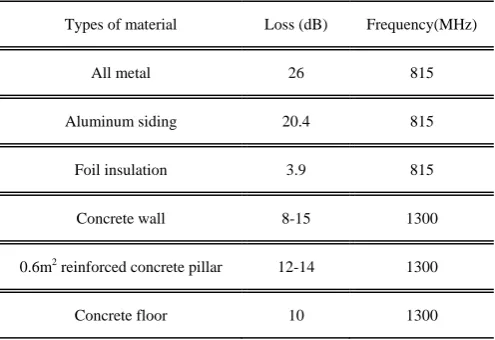
[image:4.595.305.553.390.560.2]Table 2 presents the average signal loss measurement for radio path obstructed by different building materials [10]
TABLE II
AVERAGE SIGNAL LOSS MEASUREMENT FOR RADIO PATH OBSTRUCTED BY DIFFERENT BUILDING MATERIALS
Types of material Loss (dB) Frequency(MHz)
All metal 26 815
Aluminum siding 20.4 815
Foil insulation 3.9 815
Concrete wall 8-15 1300
0.6m2 reinforced concrete pillar 12-14 1300
Concrete floor 10 1300
From the discussions presented, transmission can only be said to have been accomplished when the transmitted signal is received at the receiver in sufficient levels well above the minimum detectable level. The path loss plays a critical role in the end to end transmission of signals as the system designer must select the right gain values for the transmitters, the receivers and the antenna gains to counter the effect of the path loss in the environment. The accurate estimation of the path loss depends on the use of the right path loss estimation models taking into account the impact of the environment and the type modification introduced by the environment on the signal as it propagates through the environment.
presence of furniture in the indoor environment and the attenuation introduced by the walls and the building materials.
VI. SIGNAL FLOW GRAPH FOR INDOOR LOCATIONS
Wall 1
Transmitter Wall 2 Wall 3 Reciever Distance
Gain
Signal under the influence of free space pathloss , reflection, and
refraction
Attenuation introduced by Wall
Minimum Detectable signal level of the recievers
[image:5.595.50.281.125.331.2]
Figure. 2. Signal flow graph for indoor locations
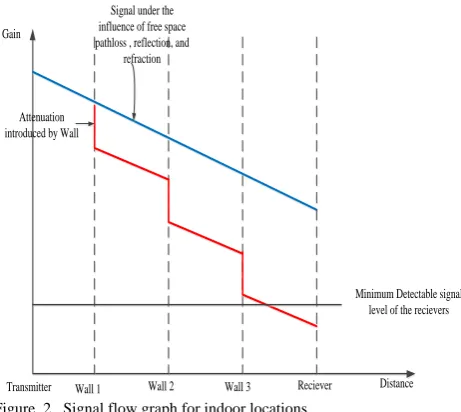
The diagram in Figure 2 shows the signal flow graph for indoor environment. The signal from the transmitter under the effect of the free space path loss and the associated reflection and refraction of the indoor environment can be designed to get to the receiver at a value above the minimum detectable signal level of the receiver.
However, the introduction of wall partitions will introduce additional path loss to the signal shown in Tables 1 and 2. From the diagram in figure 2, this path loss will result in a sharper decline in the signal strength such that the same receiver at the location after wall 3 will not be able to receive the signal which it was able to receive with the free space transmission.
Strategies at mitigating this problem range from increasing the transmitter power, shortening the receiver distance or eliminating the walls. These strategies are not realizable for office complexes as the location of the office is defined and the transmitters are built in standard transmit specifications.
VII. WIRELESS WALL MOUNTED SIGNAL BOOSTERS WITH
SECTOR ANTENNAS
The use of wireless wall mounted signal boosters can be used to provide a cost effective solution to the poor signal reception at the receiver location. The booster block diagram is shown in Figure 3
Wireless Wall Mounted Signal
Booster
Omni Directional
Antenna
Sector Antenna
Figure. 3. Wireless Wall Mounted Signal booster
The Wireless Wall Mounted signal booster shown in figure 3 comprises of a bidirectional transceiver connected to an Omni directional antenna for connecting the signal booster to the signals from the transmitter while the sector antenna links the signal booster to the receiver. The system is designed to be a standalone device which can be installed by users in their office without affecting the transmissions of other users within walls 1 and 2. The resulting signal flow diagram is shown in figure 4.
Wall 1
Transmitter Wall 2 Wall 3 Reciever Distance
Gain
Signal under the influence of free space pathloss , reflection, and refraction
Attenuation introduced by
Wall
Minimum Detectable signal level of the
recievers Effect of the Wireless Wall
Mounted Signal Booster
Figure. 4. Signal flow graph with the signal booster on wall 3
The signal flow graph in figure 4 shows that the addition of the signal booster took the signal level at the receiver to a point above the minimum detectable signal level thus enabling the receiver to successfully receive and decode the signal.
VIII. CONCLUSION
The continuous evolution of wireless communications has led to the use of higher frequencies, smart antenna/Multiple Input Multiple Output systems, smaller cell sizes and frequency reuse to increase capacity and Quality of service. The choice of the most suitable propagation model employed helps to minimize the effect of interference. Signal boosters can be installed at specific locations in the building to counter the effect of large path loss introduced by walls. The booster working with the transmitters will extend the reach of the transmission and improve the received signal quality at the receivers thus improving the transmission.
REFERENCES
[1] Magdy F. Iskander and Zhengqing Yun, “Propagation Prediction Models for Wireless Communication Systems” IEEE transactions on microwave theory and techniques, Vol. 50, no. 3, march 2002 [2] Punit Vyas and Manish Korde, “Optimization of Empirical Pathloss
Models of WiMax at 4.5 GHz Frequency Band” IOSR Journal of Electronics and Communication Engineering, Vol. 9, Issue 1, Ver. II ,Jan. 2014
[3] T.S Rappaport, Wireless Communications: Principles and Practice, 2nd edition, New Delhi, Prentice Hall, 2005.
[image:5.595.308.541.181.383.2][5] S. R. Saundrs M. Hata, “Empirical Formula for Propagation Loss in Land Mobile Radio Services”, IEEE Transactions on Vehicular Technology Conference Proceedings, Vol. 29, August 1980. [6] A.Medeisis and A. Kajackas, “The use of Universal Okumura-Hata
Propagation Predication Model in Rural Areas”, Vehicular Technology Conference Proceedings, Vol.3, May 2000.
[7] Olasunkanmi F. Oseni, Segun I. Popoola, Robert O. Abolade, Oluwole A. Adegbola,”Comparative Analysis of Received Signal Strength Prediction Models for Radio Network Planning of GSM 900 MHz in Ilorin”, Nigeria International Journal of Innovative Technology and Exploring Engineering, Vol.4 Issue 3, August 2014 [8] Tapan K. Sarkar, Zhong Ji, A Survey of Various Propagation Models
for Mobile Communication
[9] John davies, kemisola ogunjemilua, An investigation into signal strength of 802.11n WLAN
[10] Rapport T.S, wireless communications principles and practice, prentice Hall,2002
[11] NeskovicA.,and Paunovic G.,” Modern approaches in modeling of mobile radio systems propagation environment”, IEEE communication survey
[12] Aki R., TummalaD., ”indoor propagation modeling at 2.4GHz for IEEE 802.11 networks and emerging technologies , international muti conference on wireless communication”, jul. 2006