Abstract—With a rising concern about safety issues recently, demands for measures to reduce industrial accidents are increasing. In particular, safety management is essential task of project management in shipbuilding industry that is regarded as one of the most dangerous sectors. In order to manage safety, risk caused by several hazards should be properly estimated. Risk estimation criteria can be commonly applied regardless of the types of ships to be built and specific shipyards. In this regard, first of all, we classified risk estimation criteria that can be applied to shipbuilding domain and proposed an approach that allows to generate risk estimation logics by representing risk estimation criteria as XML.
Index Terms—risk, safety, shipbuilding, XML
I. INTRODUCTION
Industries make efforts to reduce industrial accidents for improvement of safety management systems [1, 2]. Especially, in case of shipbuilding domain, there are many risks during building various types of ships and offshore plants. One of the reasons that these risks are happened is that the building target is a heavy assembly structure. Also, most of these tasks are risky tasks and they are performed at the outdoor worksites. Therefore, these tasks should be managed and monitored systematically in view of safety. In this regard, safety management standard manuals that can be applied in shipbuilding process were defined and published. These manuals contain various hazard information that can be occurred while each task is performed. Thus, general risk estimation criteria can be extracted from the safety management manuals. These risk estimation criteria can be commonly applied regardless of the type of ship and specific shipbuilding worksites. Meanwhile, since safety management standard can be changed according to changes in technology that is applied in tasks, these changes have to
Manuscript received July 18, 2016. This work was supported by Electronics and Telecommunications Research Institute (ETRI) grant funded by the Korea government. [16ZC1910, Development of Smart HSE System for Shipbuilding and Plant].
Youhee Choi is a senior researcher in the Electronics and Telecommunications Research Institute, Daejeon, 34129, KOREA (e-mail: [email protected]).
Jung-Ho Park is a principal researcher in the Electronics and Telecommunications Research Institute, Daejeon, 34129, KOREA (e-mail: [email protected]).
Byungtae Jang is a principal researcher in the Electronics and Telecommunications Research Institute, Daejeon, 34129, KOREA (e-mail: [email protected])
be applied to risk estimation criteria. In view of this aspect, the safety management system should have a flexible architecture that can reflect changes of risk estimation logics easily. To do this, it is necessary to separate risk estimation logics from specific worksites dependent data access logics. Therefore, we propose an approach that allows to generate risk estimation logics by representing risk estimation criteria as XML The rest of this paper is organized as follows. Several related researches are presented in Section II. Section III presents the XML elements for representing risk estimation criteria. Section IV presents XML files as examples and an example of generated risk estimation logic. The paper concludes with future work and conclusions in Section V.
II. RELATED RESEARCHES A. Hazards classification in shipbuilding process
Table I shows major hazards of each principal steps in shipbuilding process [3, 4].
The first task of shipbuilding process except design task in shipyards is the material procurement that includes preparation and processing such as coating or cutting of steel plates. During the task, since cranes or forklifts are used to transfer steel plates, it can cause crash with forklifts or cranes. Also, since the steel plate is blasted and coated with primer, it can cause exposure of toxic substances and fire or explosion. The second task is the piece assembly that includes welding plates to form structural components of the ship. During the task, since steel plates are welded, it can cause electric shock by contact with welding rods and exposure of toxic substances. The third task is the sub block assembly that includes joining into various units and subassemblies. During the task, since major task is welding and lifting units by cranes, it can cause electric shock and exposure of toxic substances and crash with steel units during lifting and falling in case of high place work. The fourth task is the block assembly that includes joining assemblies to form larger units or blocks. Since major tasks are similar to the third task, it can cause similar hazards with the third task. The fifth task is the painting that includes painting blocks. During the task, since toxic combustible paints are used, it can cause hazards such as fire or explosion and exposure of toxic substances. The sixth task is the outfitting that includes installation of outfit components. During the task, since major tasks are welding and high place work, it can cause
XML-based Modeling of Risk Estimation
Criteria to Support Safety Management in
Shipbuilding
hazards such as fall and exposure of toxic substances. The seventh task is the erection that includes lifting blocks onto the ship. During the task, since heavy blocks are lifted by cranes and welded, it can cause hazards such as falls, crash with cranes and blocks.
B. Existing researches about safety management
Operational safety management systems have been developed and applied to dangerous facilities and factories. These systems can be easily integrated with fundamental infrastructures such as networks, electrical systems. Furthermore, the structure of the target site of these systems doesn‟t change greatly as process goes on. On the other hand, in case of shipbuilding and construction domain, the target site of safety management is continuously changed and there are temporary structures that are temporary installed for work such as walk plates, scaffolds, and so on. Thus, in case of construction domain, there are several studies for the safety management system of construction worksites. There is a study for the development of a prototype for safety management based on real-time ultra wide band tracking technology [5]. There is another approach proposing statistical model to address risks that are the result of concurrent activities using real-time tracking data [6].
There are many existing researches managing safety based on BIM (Building Information Model) in construction industry. There is a study introducing the integration of construction and safety management based on BIMs and rule-based algorithms based on OSHA fall protection regulations [7]. There is another approach offering a framework for structuring JHA knowledge about activities, job steps, and hazards [8]. There is other approach proposing construction safety ontology to integrate safety knowledge with BIM for automated hazard analysis and safety task scheduling [9]. Also, there is an approach using BIM to represent received wireless sensor data for real-time monitoring [10]. Most of existing researches focus on real time location tracking technology and representing and integrating 3D model like BIM with several information that are required to manage safety.
III. XML-BASED MODELING OF RISK ESTIMATION CRITERIA A. Classification of risk estimation criteria in shipbuilding domain
Since risk estimation criteria are to estimate degree of risk that incidents can occur, the criteria should be varied according to kinds of incidents. Kinds of incidents can be determined by physical characteristics of worksites or kinds of tasks.
Therefore, first of all, we identified criteria of risk estimation by considering physical characteristics of worksites for each hazard zones that are classified based on kinds of incidents as shown in Table II. Also, we categorized these criteria as specific types of conditional sentences that can be used to implement the criteria, although comparison targets are different.
Openings and worksites over 2 meters in height can be
classified as the fall hazard zone as shown in Table II. Risk degree of the fall hazard zone can be determined if safety guards for preventing falling have been installed. In this respect, the risk estimation logic of this case can be implemented using the „is_installed/is_not_installed‟ function category. In case of the crash hazard zone, since major reasons of crash incidents are related with tasks for moving materials using cranes or forklifts, the field of cranes or passage routes of trucks or forklifts can be classified as the crash hazard zone. Risk degree of the crash hazard zone can be determined if tasks for using cranes, forklifts or trucks are being performed. In case of this, the risk estimation logic can
be implemented using the
„is_the_hazardous_task_ongoing/is_not_the_hazardous_tas k_ongoing‟ function category. In case of choking hazard zone, sealed zones and toxic gas access zones can be classified as the choking hazard zone. Risk degree of the choking hazard zone can be determined whether safety equipment such as ventilators were installed and operated. In case of this, the risk estimation logic of this case can be implemented using the „is_installed/is_not_installed‟ or „is_operated/is_not_operated‟ function category. In addition, risk degree can be determined whether tasks using toxic gas are being performed. In case of this, the risk estimation logic
can be implemented using the
„is_the_hazardous_task_ongoing/is_not_the_hazardous_tas k_ongoing‟ function category. In case of fire/explosion hazard zone, inflammable access zone such as painting booths and high temperature equipment area can be classified as the fire/explosion hazard zone. Risk degree of the fire/explosion hazard zone can be determined whether safety equipments such as fire extinguishers were installed and fire or spark producing operations are being performed. Toxic hazard zone is the zone that equipments which can produce toxic substances are used. Risk degree of the zone can be determined whether tasks using the equipment are being performed. As a whole, most of risk estimation logics can be implemented using three kinds of comparison function categories such as „is_installed‟, „is_operated‟ and „is_the_hazardous_task_ongoing‟.
Secondly, due to characteristics of tasks, there are tasks that have hazards fundamentally. Therefore, we identified criteria of risk estimation for major risky tasks as shown in Table III.
Heavy equipment task in Table III means that the task using every kind of cranes, forklifts, or heavy vehicles. Since this type of the task causes nearby workers damage, proper operations are required according to standard safety procedures. Therefore, checking is needed whether essential procedures for safety are performed. . In this respect, the risk estimation logic of this case can be implemented using the „is_complied_with_standard
personal safety equipment for preventing fall in terms of working methods. In case of the painting task, the criteria can be whether mechanical ventilation system was installed and is properly operated. Also, the criteria can be whether the density of oxygen gas and inflammable gas is measured and workers wear suitable safety equipment. In case of electricity task, the criteria can be whether inspection is performed for preventing electric shock and fire. As a whole, most of risk estimation logics can be implemented using four kinds of comparison function categories such as „is_complied_with_standard‟, „is_inspected‟, „is_operated‟ and „is_measured‟.
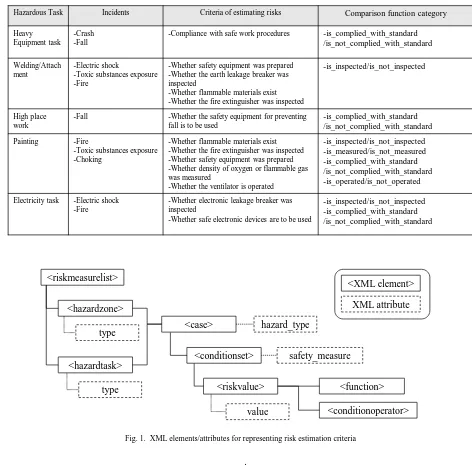
B. XML elements for representing risk estimation criteria Fig. 1 shows XML elements that are necessary for representing the risk estimation criteria.
First of all, we defined <riskmeasurelist> element as a root element to express a list of risk estimation criteria. The element contains <hazardzone> element and <hazardtask> element. We defined the <hazardzone> element to represent zone-based risk estimation criteria. This element has an attribute „type‟ to represent a kind of hazard zone such as a fall hazard zone, a crash hazard zone, a choking hazard zone, and so on. We defined the <hazardtask> element to represent risky task based risk estimation criteria. This element has an attribute „type‟ to represent a kind of risky task such as a heavy equipment task, a welding task, a painting task, and so on. The <hazardzone> element and the <hazardtask> element have one or more <case> elements to represent risk estimation criteria of each hazard type. We defined the attribute „hazard_type‟ of the <case> element to represent a kind of hazard such as an opening, a scaffolding, stairs, and so on. The <case> element contains one or more <conditionset> elements to represent criteria whether each safety measure was performed properly. We defined the attribute „safety_measure‟ of the <conditionset> element to represent a kind of safety_measure such as guardrails, install_states, ladder handles, and so on. The <conditionset> element contains one or more <riskvalue> element to represent criteria to determine a degree of risk. The <riskvalue> element has an attribute „value‟ to represent a degree value of risk such as „1‟, „2‟, „3‟, and so on. We defined the <function> element to represent each unit of criteria. The <function> element can have values such as „is_installed‟, „is_inspected‟ or „is_complied_with_standard‟ as mentioned in Table. II, III. In order to represent a degree of risk that is determined according to logical combination of each unit of criteria, we defined the <conditionoperator> element to represent logical operator „AND‟ as „&&‟ and „OR‟ as „||‟.
C. The architecture of the safety management system for shipbuilding worksites
Fig. 2 shows the architecture of the safety management system for shipbuilding worksites
First of all, Risk Estimation Generator generates the specific risk estimation logic based on the risk estimation criteria XML. This logic is formed as main logic of the Risk Estimation Service. The Risk Estimation Service uses the
Data Collector to extract specific data for risk estimation. The Data Collector implements the comparison function of the XML in accordance with data structure of legacy ERP system in specific shipbuilding sites. Task based Safety Management Service allows to manage safety based on estimation result of risks that occur while at work. Zone based Safety Management Service allows to manage safety based on estimation result of risks when workers access to risk zones.
IV. EXAMPLES
This section describes example XML files that are represented based on the XML elements for the risk estimation criteria of the safety management system for shipyards in Section III.
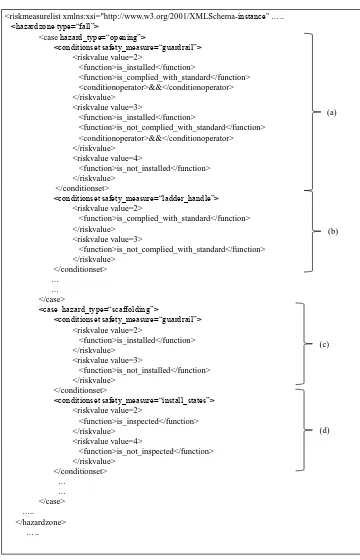
Fig. 3 shows an example of XML representing some risk estimation criteria in case of the fall hazard zone type.
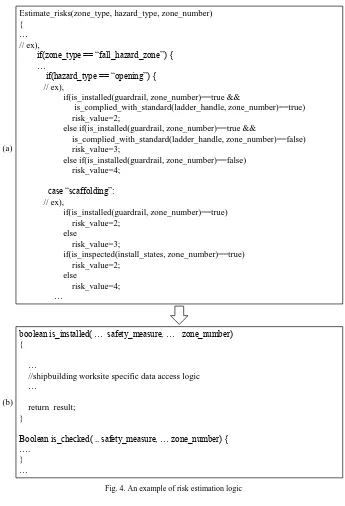
The (a) part of the XML in Fig. 3 represents that risk values can be determined by whether a guardrail which is one type of the safety measures in case of „opening‟ was installed and it is complied with standard specification in case of „opening‟ hazard type. It represents that the risk value is determined to 2 as a minor danger if a guardrail was installed and it is complied with standard. It represents that the risk value is determined to 3 as a major danger if a guardrail was installed but it is not complied with standard. Also, the risk value is determined to 4 as a serious danger if it was not installed. The (b) part of the XML in Fig. 3 represents that risk values can be determined by whether a ladder handle which is the other type of safety measures in case of „opening‟ is complied with standard specification. It represents that the risk value can be determined to 2 as a minor danger if the installed ladder handle is complied with standard and if not, the risk value can be determined to 3 as a major danger. The (c) part of the XML in Fig. 3 represents that risk values can be determined by whether a guardrail which is the one type of safety measures in case of „scaffolding‟ was installed. It represents that the risk value can be determined to 2 as a minor danger if it was installed and if not, the risk value can be determined to 3 as a major danger. The (d) part of the XML in Fig. 3 represents that risk values can be determined by the safety measure whether installation status of the scaffolding was previously inspected in case of „scaffolding‟. It represents that the risk value can be determined to 2 as a minor danger if it was inspected and if not, the risk value can be determined to 3 as a major danger. Fig. 4 shows an example of the risk estimation logic that is generated based on the XML.
As shown in (a) of Fig. 4, the risk estimation logic can be generated based on the XML file that contains risk estimation criteria information of the hazard. Each comparison functions such as „is_installed(…)‟ or „is_inspected(…)‟ can be implemented according to specific data access logic of the specific safety management system as shown in (b) of Fig. 4.
V. CONCLUSION
applied to shipbuilding process and defined XML elements for representing risk estimation criteria. Also, we proposed an approach that allows to generate risk estimation logics based on the XML. This approach enables to be able to apply to various shipyards or other domain by separating risk
estimation logics from the specific worksite dependent data access logics. In the future, it is needed to study an approach that supports generating the specific worksite data access logic
TABLEI
MAJOR HAZARDS OF PRINCIPAL STEPS IN SHIPBUILDING
Principal steps Descriptions of the steps Hazards
Material procurement -Preparation and processing(Coating or cutting) of steel plates
-Crash with forklifts or cranes -Toxic substances exposure -Fire/explosion
Piece assembly -Welding plates to form units -Electric shock
-Toxic substances exposure
Sub block assembly -Joining into various units and subassemblies -Electric shock
-Toxic substances exposure -Crash with steel units -Fall
Block assembly -Joining assemblies to form larger units or blocks -Electric shock
-Toxic substances exposure -Crash with steel blocks
-Crash with cranes, forklifts or transporters -Fall
Painting -Painting by brush, roller or spray gun -Crash with forklifts or cranes -Toxic substances exposure -Fire/explosion
-Fall
Outfitting -Installation of outfit components -Electric shock
-Toxic substances exposure -Fall
Erection -Lifting blocks onto the ship -Crash with cranes -Crash with blocks -Toxic substances exposure -Fire/explosion
-Fall
TABLEII
RISK ESTIMATION CRITERIA FOR EACH HAZARD ZONES IN SHIPBUILDING
Hazard zones Criteria of classifying zone Criteria of estimating risks Comparison function category Fall Hazard
Zone
-Opening ,
-Worksites over 2 meters in height -Scaffolding
-Installation states of safety guards -is_installed/is_not_installed
Crash Hazard Zone
-The field of cranes and any other type of equipment performing the functions of a crane
-Passage route of trucks or forklifts
-Status of performing tasks using cranes
-Status of performing tasks using trucks or forklifts
-is_the_hazardous_task_ongoing /is_not_the_hazardous_task_ongoing
Choking Hazard Zone
-Sealed zone -Toxic gas access zone
-Installation states of safety equipment(Ventilator, …) -Status of performing tasks using toxic material
-is_installed/is_not_installed , is_operated/is_not_operated -is_the_hazardous_task_ongoing /is_not_the_hazardous_task_ongoing Fire/Explosion
Hazard Zone
-Inflammable access zone -High temperature equipment area
-Status of performing fire or spark producing operations
-Installation states of safety equipment(fire extinguisher,… )
-is_the_hazardous_task_ongoing /is_not_the_hazardous_task_ongoing -is_installed/is_not_installed
Toxic Hazard Zone
-Toxic substances discharger area -Status of performing tasks using toxic substances discharger
TABLE III
RISK ESTIMATION CRITERIA FOR EACH HAZARD ZONES IN SHIPBUILDING
Hazardous Task Incidents Criteria of estimating risks Comparison function category
Heavy Equipment task
-Crash -Fall
-Compliance with safe work procedures -is_complied_with_standard /is_not_complied_with_standard
Welding/Attach ment
-Electric shock
-Toxic substances exposure -Fire
-Whether safety equipment was prepared -Whether the earth leakage breaker was inspected
-Whether flammable materials exist -Whether the fire extinguisher was inspected
-is_inspected/is_not_inspected
High place work
-Fall -Whether the safety equipment for preventing fall is to be used
-is_complied_with_standard /is_not_complied_with_standard
Painting -Fire
-Toxic substances exposure -Choking
-Whether flammable materials exist -Whether the fire extinguisher was inspected -Whether safety equipment was prepared -Whether density of oxygen or flammable gas was measured
-Whether the ventilator is operated
-is_inspected/is_not_inspected -is_measured/is_not_measured -is_complied_with_standard /is_not_complied_with_standard -is_operated/is_not_operated
Electricity task -Electric shock -Fire
-Whether electronic leakage breaker was inspected
-Whether safe electronic devices are to be used
-is_inspected/is_not_inspected -is_complied_with_standard /is_not_complied_with_standard
<riskmeasurelist>
<hazardzone>
<conditionset>
<conditionoperator> <function> <riskvalue>
<hazardtask>
<case> type
<XML element>
XML attribute
type
hazard_type
safety_measure
[image:5.595.57.529.85.551.2]value
Fig. 1. XML elements/attributes for representing risk estimation criteria
.
Risk Estimation Criteria XML
Risk Estimation Logic Generator
Safety Management System
Task based Safety Management
Service Risk Estimation
Service
Zone based Safety Management
Service Data Collector
Legacy ERP System
[image:5.595.121.497.546.702.2]<riskmeasurelist xmlns:xsi="http://www.w3.org/2001/XMLSchema-instance" ….. <hazardzone type=“fall”>
<case hazard_type=“opening”>
<conditionset safety_measure=“guardrail”> <riskvalue value=2>
<function>is_installed</function>
<function>is_complied_with_standard</function> <conditionoperator>&&</conditionoperator> </riskvalue>
<riskvalue value=3>
<function>is_installed</function>
<function>is_not_complied_with_standard</function> <conditionoperator>&&</conditionoperator> </riskvalue>
<riskvalue value=4>
<function>is_not_installed</function> </riskvalue>
</conditionset>
<conditionset safety_measure=“ladder_handle”> <riskvalue value=2>
<function>is_complied_with_standard</function> </riskvalue>
<riskvalue value=3>
<function>is_not_complied_with_standard</function> </riskvalue>
</conditionset> …
… </case>
<case hazard_type=“scaffolding”>
<conditionset safety_measure=“guardrail”> <riskvalue value=2>
<function>is_installed</function> </riskvalue>
<riskvalue value=3>
<function>is_not_installed</function> </riskvalue>
</conditionset>
<conditionset safety_measure=“install_states”> <riskvalue value=2>
<function>is_inspected</function> </riskvalue>
<riskvalue value=4>
<function>is_not_inspected</function> </riskvalue>
</conditionset> …
… </case> ….. </hazardzone>
…..
(a)
(b)
(c)
[image:6.595.115.475.46.606.2](d)
Estimate_risks(zone_type, hazard_type, zone_number) {
… // ex),
if(zone_type == “fall_hazard_zone”) { …
if(hazard_type == “opening”) { // ex),
if(is_installed(guardrail, zone_number)==true &&
is_complied_with_standard(ladder_handle, zone_number)==true) risk_value=2;
else if(is_installed(guardrail, zone_number)==true &&
is_complied_with_standard(ladder_handle, zone_number)==false) risk_value=3;
else if(is_installed(guardrail, zone_number)==false) risk_value=4;
case “scaffolding”: // ex),
if(is_installed(guardrail, zone_number)==true) risk_value=2;
else
risk_value=3;
if(is_inspected(install_states, zone_number)==true) risk_value=2;
else
risk_value=4; …
boolean is_installed( … safety_measure, … zone_number) {
…
//shipbuilding worksite specific data access logic …
return result; }
Boolean is_checked( .. safety_measure, … zone_number) { ….
} … (a)
[image:7.595.124.469.49.555.2](b)
Fig. 4. An example of risk estimation logic
References
[1] M. Golparvar-Fard, F. Peña-Mora, C.A. Arboleda, and S.H. Lee, “Visualization of construction progress monitoring with 4D simulation model overlaid on time-lapsed photographs”, Journal of Computing in Civil Engineering 23, 2009.
[2] M. Kiviniemi, K. Sulankivi, K. Kahkonen, T. Makela, and M.L. Merivirta. (2011). BIM-based Safety Management and Communication for Building Construction. VTT Technical Research Centre of Finland.
[Online] Available:
http://www.vtt.fi/inf/pdf/tiedotteet/2011/T2597.pdf
[3] ILO. ILO Encyclopaedia of Occupational Health and Safety. (Fourth Edition) [Online] Available: http://www.ilocis.org/en/contilo.html. [4] KOSHA. (2004). Shipbuilding safety and health material. Available:
http://www.kosha.or.kr.
[5] A. Carbonari, A. Giretti, and B. Naticchia, “A proactive system for real-time safety management in construction sites”, Automation in Construction, vol.20, 2011, pp.686-698.
[6] S. Isaac and T. Edrei, “A statistical model for dynamic safety risk control on construction sites”, Automation in Construction, vol.63, 2016, pp.66-78.
[7] S. Zhang, J. Teizer, J. Lee, C. M. Eastman, and M. Venugopal, “Building Information Modeling (BIM) and Safety: Automatic Safety Checking of Construction Models and Schedules”, Automation in Construction, vol.29, 2013, pp.183-195.
[8] H.-H.Wang and F. Boukamp, “Ontology-based representation and reasoning framework for supporting job hazard analysis”, ASCE J. Comput. Civ. Eng. 25 (6), 2011, pp.442–456.
[9] S. Zhang, F. Boukamp, and J. Teizer, “Ontology-based semantic modeling of construction safety knowledge:Towards automated safety planning for job hazard analysis (JHA)”, Automation in Construction, vol. 52, 2015, pp.29–41.