Abstract—In this study, we investigated the concentration of trace elements in the digestates in a laboratory batch anaerobic
digester. Many of these trace elements are important macro and
micro nutrients. The availability of these nutrients for microbes
responsible for anaerobic digestion and substrate toxicity have to
be controlled in biogas production. The analyzed substrates were
characterized at various concentrations in the following trace
elements; potassium, phosphorus, manganese, copper, calcium,
molybdenum, zinc, cobalt, iron, aluminum, silver, nickel and
cadmium. Trace elements like copper, silver, nickel, cadmium,
zinc have been reported to be inhibitory and toxic under certain
conditions in biochemical reaction depending on their
concentrations. These trace elements lower biogas production
above threshold concentration due to accumulation of organic
acid as a result of methanogenic bacterial inhibition. There was
no deficit of nutrients detected in the anaerobic digesters
analysis.
Keywords— Anaerobic digestion, Co-digestion, Mesophilic Temperature, Trace Elements
Manuscript received April 13, 2016; revised April 2016. This work was supported in part by University of Johannesburg, Process Energy Environmental station (PEETS) and City of Johannesburg South Africa.
Anthony Njuguna Matheri; is with Department of Chemical Engineering; University of Johannesburg; Doornfortein, Johannesburg 2028 South Africa; Cell: +27616986335 ([email protected])
Mohamed Belaid; Senior lecturer and HOD at Department of Chemical Engineering; University of Johannesburg; Doornfortein, Johannesburg 2028 South Africa; Tel: +27115596402 ([email protected])
Tumisang Seodigeng; Senior lecturer at Department of Chemical Engineering; Vaal University of Technology; Private Bag X021-Vanderbijilpark-1911, Andries Potgieter Blvd South Africa; Tel: +27169509734 ([email protected])
Jane Catherine Ngila; Professor and HOD at Department of Analytical Chemistry; University of Johannesburg; P.O. Box 17011, Doornfortein, Johannesburg 2028 South Africa; Tel: 27115596169 ( [email protected])
I. INTRODUCTION
HE economic development of developed and developing countries depend on the large extent on power generation. With the fast depletion of the scarce non-renewable energy sources such as fossil fuel and coal which has led to human health problems, environmental degradation and major factor of the global climate change scenario, the commercial production of biogas and other alternative energy sources such as solar energy, wind energy, hydropower, geothermal will definitely give a good drive for the development of the economy. Biogas is used in the form of fuel, electricity and heat. It is desirable to create a sustainable world class energy system which has zero carbon emissions [1-3]. Biomass fermentation increases biogas demand as a renewable energy and resolves waste management problems. The most popular types of substrates are animal manure, food waste, municipal sewage sludge, vegetable, fruit waste and municipal solid waste. Municipal solid waste, food waste and vegetable/fruit waste generate more methane compared to municipal sewage sludge and animal waste thus the need for co-digestion to increase efficiency of biogas production [4]. There is high increasing energy crops use as substrate in biogas production which run into deficit trace elements with regards to manures from cattle, chicken or pig. However, variety of organic waste such as food waste, abattoir waste, kitchen waste are assumed to supply sufficient concentration and quantities of micro nutrients [5]. The co-digestion of manures and other substrates increase carbon to nitrogen (C/N) ratio and concentration of micro and macro nutrients that leads to increase in biogas production [6-8].
Biogas is a mixture of gases such as methane, carbon dioxide, hydrogen sulphide, ammonia and trace amounts of oxygen, carbon monoxide and hydrogen. It is produced by break down of organic materials using microbial under controlled conditions (parameters). The organic source is composed of biodegradables such as municipal solid waste, agricultural waste, industrial waste and animal waste [9, 10].
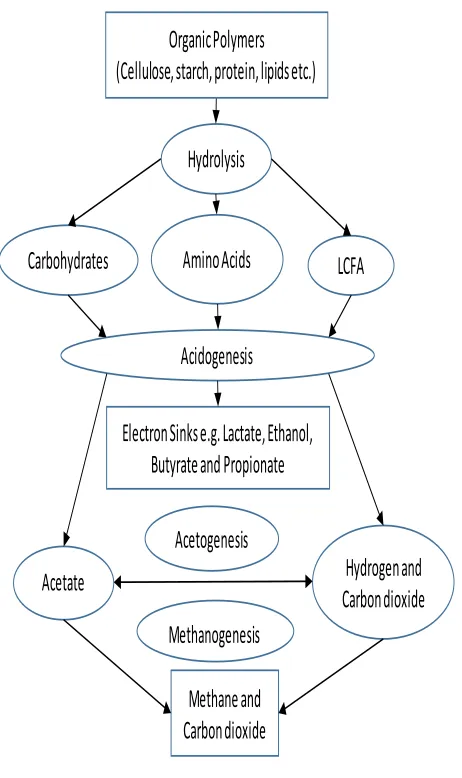
Anaerobic digestion of organic material takes place in series of four fundamentals steps: hydrolysis, acidogenesis, acetogenesis and methanogenesis. Fig. 1 shows degradation steps of anaerobic digestion process. In hydrolysis step, large organic polymers such as fats, proteins and carbohydrates are broken into fatty acids, amino acids and simple sugar respectively. This step is carried out by bactericides.
The Role of Trace Elements on Anaerobic
Co-digestion in Biogas Production
Anthony Njuguna Matheri1, Member, IAENG, Mohamed Belaid2, Member, IAENG, Tumisang Seodigeng3, Jane Catherine Ngila4
Hydrolysis is followed by acidogenesis where low alcohol and organic acids are produced through fermentation process utilized by fermentative bacteria. This includes volatile fatty acids (acetic acid, butyric acid and propionic acid), gases like carbon dioxide, ammonia and hydrogen and aldehydes. In the third step (acetogenesis), the products of acidogenesis are converted to acetate, carbon dioxide and hydrogen by acetogenic bacteria. Methanogenesis is the final stage whereby methanogenes bacteria converts hydrogen, acetic acid and carbon dioxide to methane and carbon dioxide [11-13].
LCFA
Acetogenesis
AminoAcids
Carbohydrates
Hydrolysis
Acetate
Hydrogen and
Carbon dioxide
Electron Sinks e.g.Lactate, Ethanol,
Butyrate and Propionate
Methaneand
Carbon dioxide
OrganicPolymers
(Cellulose, starch, protein, lipids etc.)
Acidogenesis
[image:2.612.60.291.219.608.2]Methanogenesis
Fig. 1. Degradation steps of anaerobic digestion process.
The effective production of biogas requires optimal: temperature, partial pressure, pH, hydraulic retention time, nature of substrate, C/N ratio, stirring intensity, trace elements concentration, microbes balance and digester size [4, 14].
Methane formation by methanogens is the necessary process stage because the bacteria responsible for the process are inhibited by their own products [15]. Biogas yield is determined by the content of micro and macro elements which are responsible of methanogenesis and metabolic processes. Trace elements can be inhibitory, stimulatory or even toxic in the digestates depending on the concentration [13, 16, 17]. These co-factors in enzymes decompose larger organics to smaller molecules [4]. The most important trace elements in micro nutrients mostly involved in anaerobic digestion efficiency are cobalt, nickel, molybdenum and selenium. These elements are always supplied with feedstock and their deficiency leads to poor performance of anaerobic digestion [3, 5]. The investigated micro nutrients composed of zinc, molybdenum, manganese, copper, nickel and cobalt. The macro nutrients composed of potassium, calcium and iron were investigated. The negative influence of trace elements is determined by concentration in the substrate and pH of digestates. The fermentation under presence of trace elements are effective under high pH [4, 18, 19]. Toxic elements such as cadmium, phosphorus, chromium and lead can reduce efficiency and amount of methane formation. Toxic effect of trace metals is mostly attributed by replacing naturally occurring elements with enzyme prosthetic groups or due to disruption of enzyme function and restructure by bindings of trace metals with thiols and other groups on protein molecules [18]. Selected elements that speed up metabolism of biogas formation include potassium, calcium, magnesium, zinc, iron, zinc, cobalt and copper, but their concentration cannot exceed the threshold standards [4]. Equation 1 shows a simplified generic of anaerobic digestion process [20].
CH
CO
O
H
C
6 12 63
23
4 (1)
Previous work done on the trace metals concentration has been reported by [5, 21, 22] as shown in Table I.
Justification by knowledge of importance and general functions of selected trace elements in various general metabolism processes in methanogenesis are shown in Table II. These elements are involved in decomposition of numerous enzymes compounds to smaller molecules [5].
TABLE I
RECOMMENDED CONCENTRATION OF TRACE ELEMENTS IN ANAEROBIC DIGESTION [5].
Weiland
(2006) Bischofsberger (2005) Mudrack and kunst (2003) Seyfried at al. (1990) Takashima Speece (1990)
Element Symbol Concentration (mg/l)
Boron B - - - - -
Calcium Ca - - - - >0.54-40
Cobalt Co 0.003-0.06 0.06 0.003-0.06 0.003-0.06 >0.00059-0.12
Chromium Cr - 0.005-50 - - -
Copper Cu - - - - -
Iron Fe 1-10 - 1-10 1-10 >0.28-50.4
Magnesium Mg - 0.005-50 - - 360-4800
Manganese Mn - 0.005-50 - - -
Molybdenum Mo 0.005-0.05 0.05 0.005-0.05 0.005-0.05 >0.00096-0.048
Nickel Ni 0.005-0.5 0.006 0.005-0.5 0.005-0.5 0.0059-5
Lead Pb - 0.02-200 - - -
Sulphur S - - - - 0.32-13000
Selenium Se - 0.008 - 0.008 0.079-0.79
Tungsten W - - - 0.1-0.4 0.018-18.3
Zinc Zn - - - - -
TABLE II
THE IMPORTANCE AND FUNCTIONS OF TRACE ELEMENTS [5].
Element General function (microorganisms) Element General function (microorganisms)
Boron cofactor of enzymes Manganese activate enzymes of bacteria
Calcium membrane permeability stabilizes methane producing bacteria
influence toxic effects of other
metals redox reaction
enhance toxic effects of other
metals cofactor of various enzymes
Chromium glucose metabolism Molybdenum inhibitor of sulphate reducing bacteria
Cobalt metallic enzyme activator cofactor of various enzymes
can inhibit metabolism Nickel synthesis of coenzymes
Copper metallic enzyme activator cofactor of urease
can inhibit metabolism Selenium hydrogenase in methane producing bacteria
reduce other metals toxicity Sulphur
cofactor and components of many proteins and metabolic compounds
pigment Zinc metallic enzyme activator
Iron redox property stimulates cell growth
electron acceptor can exacerbate toxic effects of other metals and inhibit metabolism
II. MATERIALANDMETHODS
Cow dung, pig waste, chicken droppings and grass clippings were collected at the farm in Gauteng Province. Waste characterization was done to ascertain the composition. This included physical and chemical composition with regards to C/N ratio, volatile solids, total solids and elemental analysis for carbon, nitrogen, sulphur, hydrogen and trace elements in accordance with the standard methods (APHA 2005) [24].
[image:4.612.52.238.311.492.2]To determine biogas production rate, a batch digester was fed with the co-digested substrates and inoculum under pre-set conditions of 37 0C and pH of 7 as shown in Fig. 2. The digesters were flushed with nitrogen to expel the oxygen and create an anaerobic condition. They were then immersed in the water bath and kept under the set conditions. The gas produced was measured using downwards displacement method whereas liquid samples were analyzed on a daily basis until the end of retention time in accordance with the standard methods [25]. Fig. 2 shows the biogas digestion set up.
Fig. 2. Biogas Production Set-up (1 Digester, 2 T-union, 3 Measuring cylinder, 4 Water bucket, 5 Thermostatic water
bath)
III. RESULTSANDDISCUSSION
In this study, cow dung, pig waste and chicken droppings all co-digested with grass clippings were evaluated for the purpose of getting the methane potentials and bio-chemical kinetics at optimum temperature (37 0C) and initial pH of 7. Table III shows the substrate characterization of the substrates.
TABLE III
SUBSTRATE CHARACTERIZATION
Substrate C H N S
VS (%)
TS (%)
C/N ratio
Grass clippings 19.10 1.04 0.9
3 0.00 64.08 87.8
8 20.54 Chicken
manure 63.67 0.85
3.1
1 2.25 11.75 18.7
4 20.47
Cow dung 14.87 1.65
0.8
4 3.66 78.72 91.5
5 17.70
Pig dropping 42.26 0.70 2.6
2 0.00 55.70 76.8
0 16.16
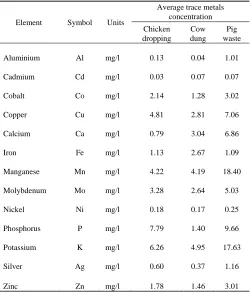
The composition of trace elements in substrates were to be determined before setting up the biogas digestion process and during digestion. This was done on substrate characterization. Maximum and minimum concentration varied with various substrates. Trace elements concentration evaluated in the digestates samples are presented in Table IV.
[image:4.612.310.560.373.665.2]Trace elements such as zinc and copper, magnesium, calcium and potassium are essential for microbial growth [4]. Microorganisms are able to accumulate trace elements in them thus reducing their concentration in the digestates [26]. High level of trace elements can reduce the efficiency of biogas production. copper, cadmium, lead, nickel and zinc exert toxic effect and inhibiting anaerobic digestion [4].
TABLE IV
TRACE ELEMENTS AVERAGE ABUNDANCE
Element Symbol Units
Average trace metals concentration
Chicken dropping
Cow dung
Pig waste
Aluminium Al mg/l 0.13 0.04 1.01
Cadmium Cd mg/l 0.03 0.07 0.07
Cobalt Co mg/l 2.14 1.28 3.02
Copper Cu mg/l 4.81 2.81 7.06
Calcium Ca mg/l 0.79 3.04 6.86
Iron Fe mg/l 1.13 2.67 1.09
Manganese Mn mg/l 4.22 4.19 18.40
Molybdenum Mo mg/l 3.28 2.64 5.03
Nickel Ni mg/l 0.18 0.17 0.25
Phosphorus P mg/l 7.79 1.40 9.66
Potassium K mg/l 6.26 4.95 17.63
Silver Ag mg/l 0.60 0.37 1.16
Zinc Zn mg/l 1.78 1.46 3.01
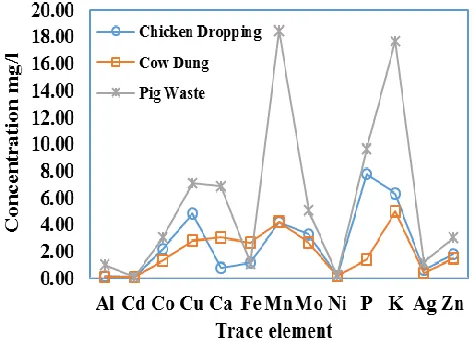
Potassium––The potassium content evaluated ranged from 6-18 mg/l. The highest potassium noted was 17.63 mg/l in the pig waste and low on the cow dung. The toxic threshold for potassium has been estimated to be 3000 mg/l [4].
Fig. 3. Trace elements concentration in substrates
Calcium––Appropriate pH in substrate is determined by
optimum content of alkaline-forming minerals as well as neutralization anions. Calcium is a pH adjusting mineral. In this study, the calcium toxic concentration was below the threshold of 2800 mg/l as specified by [4, 21].
Manganese––The concentration ranged from 4-19 mg/l. The
manganese in the digestates was below recommended threshold concentration of 50 mg/l in accordance to [4]. It was the most abundant trace element in the digesters.
Phosphorus––The phosphorus concentration ranged from
1-10 mg/l. It was reported high in pig waste and low in cow dung.
Cobalt––The cobalt concentration ranged from 1-4 mg/l. It
acts as metallic enzyme activator and could inhibit metabolism above threshold concentration.
Copper––The threshold for copper concentration is 400
mg/l. As seen in this study, it ranged from 2-8 mg/l. Above the threshold concentration, copper will inhibit the biogas production [4].
Molybdenum––It was found to range from 5-6 mg/l in
concentration. The value was higher than the one recommended by [4].
Zinc––The zinc concentration ranged from 1-3 mg/l. It was above the recommended threshold of 1 mg/l recommended by [4]. Above threshold, zinc inhibits methane formation and enhance methane formation below threshold. Good co-digestion enhance its suitability.
Iron––The iron concentration in the digester ranged from 1-3 mg/l. The threshold of iron concentration as specified by [21] is 10 mg/l.
Nickel––The nickel concentration in the digester ranged
from 0.10-0.25 mg/l. It improves methane yield and maintains
process stability. The toxic threshold of nickel is reported to be 10 mg/l [4]. In our findings, the nickel was below the threshold to stimulate biogas production.
Aluminium––The aluminium concentration in the digester
ranged from 0.01-1.01 mg/l. There was no recommendation found for aluminium concentration in the literature.
Silver––The silver concentration in the digester ranges from
0.06-1.16 mg/l. In the literature there was no recommendation found for silver concentration.
Cadmium––The cadmium level ranged from 0.03-0.07 mg/l.
The threshold below 0.18 mg/l pose no threat to anaerobic digestion [4]. Co-digestion of the substrate enhance reduction of cadmium concentration.
According to the observation, pig waste had higher level of trace elements followed by chicken droppings and lastly cow manure on average abundance concentration. This was attributed by their feeding habit in the respective animals and their stomach compartment. Cows are ruminant’s animals with four compartment stomach. Fermentation starts in their stomach and there is tendency of microbial activity leading to reduction of trace elements. Chicken and pigs have one stomach compartment. There is little fermentation process taking place in their stomach and this leads to presence of high concentration of trace elements. The abundance of trace metals did not show deficiency compared to the recommendation in the biogas production literature. Well monitored trace elements and co-digestion of the substrates enhanced process stability and improved biogas production rate.
IV. CONCLUSION
The concentration of trace elements investigated were within permissible limits suitable for biogas production. In general, co-digestion of organic substrate improves the abundance of trace elements thus increasing the concentration of micro and macro nutrients. The main inference from the above discussion is that trace elements maybe inhibitory, stimulatory and even toxic to anaerobic digestion, where the extent depends on elements concentration. The concentration of trace metals in the digester should be monitored under retention time to guarantee the efficiency of methane formation. Further comprehensive research to determine the optimum concentration for micro and macro nutrients and their interaction with microbial activity in anaerobic digestion is required.
ACKNOWLEDGEMENTS
us to work in their laboratories. Dr. Robert Huberts for assisting with some of the equipment for analysis.
REFERENCES
[1] H. Allan ―Grass productivity‖. Island Press Conservation Classics Series, Washington DC, 1998: p. 56-89.
[2] G.K. Latinwo and S.E. Agarry, Modelling the Kinetics of Biogas Production from Mesophilic Anaerobic Co-Digestion of Cow Dung with
Plantain Peels. International Journal of Renewable Energy Development
(IJRED), 2015. 4(1): p. 55-63.
[3] M. Lebuhn, F. Liu, H. Heuwinkel, A.Gronauer, Biogas production from mono-digestion of maize silage-long-term process stability and
requirements. Water science and technology, 2008. 58(8): p. 1645.
[4] M. Bożym, I. Floozak, P. Zalanowska, J. Wojdalski, M. Klimkiewicz., et
al.,An analysis of metal concentrations in food wastes for biogas
production. Renewable Energy, 2015. 77: p. 467-472.
[5] A. Schattauer, E. Abdoun, P. Weiland, M. Plochl, M. Heiermann.,,
Abundance of trace elements in demonstration biogas plants.
Biosystems engineering, 2011. 108(1): p. 57-65.
[6] R. Braun, E. Brachtl, and M. Grasmug, Codigestion of proteinaceous
industrial waste. Applied biochemistry and biotechnology, 2003. 109
(1-3): p. 139-153.
[7] P. Weiland, Anaerobic waste digestion in Germany–Status and recent
developments. Biodegradation, 2000. 11(6): p. 415-421.
[8] L. Zhang, Y.W. Lee, and D. Jahng, Anaerobic co-digestion of food waste and piggery wastewater: focusing on the role of trace elements.
Bioresource technology, 2011. 102(8): p. 5048-5059.
[9] A.S. Sambo, B. Garba, and B.G. Danshehu, Effect of some operating
parameters on biogas production rate. Renewable Energy, 1995. 6(3): p.
343-344.
[10] S. Dangoggo, M. Aliyu, and A. Atiku, The effect of seeding with bacteria on biogas production rate. Renewable energy, 1996. 9(1): p. 1045-1048.
[11] R. Sundararajan, S. Jayanthi, and R. Elango, Anaerobic digestion of organic fractions of municipal solid waste and domestic sewage of Coimbatore. Indian Journal of Environmental Health, 1997. 39(3): p. 193-196.
[12] I. Angelidaki, H.V. Hendriksen, I.M. Mathrani, J.E. Schmidt, A.H. Sorensen, B.K. Ahring., The biogas process. Lecture notes for: Energy
from biomass (6362). 1996.
[13] A. Mudhoo. and S. Kumar, Effects of heavy metals as stress factors on anaerobic digestion processes and biogas production from biomass.
International Journal of Environmental Science and Technology, 2013.
10(6): p. 1383-1398.
[14] A.N. Matheri, M. Belaid, S. Tumisang, C.J. Ngila., The Kinetic of
Biogas Rate from Cow Dung and Grass Clippings. 7th IIENG
International Conference of latest trends in Engineering and Technology (ICLTET’2015) Pretoria, South Africa, November 2015. , 2015. [15] E. Nettmann, et al., Polyphasic analyses of methanogenic archaeal
communities in agricultural biogas plants. Applied and environmental microbiology, 2010. 76(8): p. 2540-2548.
[16] J.K. Oleszkiewicz and V.K. Sharma, Stimulation and inhibition of
anaerobic processes by heavy metals—a review. Biological Wastes,
1990. 31(1): p. 45-67.
[17] S.S Şengör., et al., Influence of heavy metals on microbial growth kinetics including lag time: mathematical modeling and experimental
verification. Environmental Toxicology and Chemistry, 2009. 28(10): p.
2020-2029.
[18] Y.R. Chen, J.J. Cheng, and K.S. Creamer, Inhibition of anaerobic digestion process: a review. Bioresource technology, 2008. 99(10): p. 4044-4064.
[19] I.J. Kugelman and P.L. McCarty, Cation toxicity and stimulation in
anaerobic waste treatment. Journal (Water Pollution Control
Federation), 1965: p. 97-116.
[20] T.R. Sreekrishnan, S. Kohli, and V. Rana, Enhancement of biogas production from solid substrates using different techniques––a review.
Bioresource technology, 2004. 95(1): p. 1-10.
[21] M. Takashima, R.E. Speece, and G.F. Parkin, Mineral requirements for
methane fermentation. Critical Reviews in Environmental Science and
Technology, 1990. 19(5): p. 465-479.
[22] P. Weiland, Anforderungen an Pflanzen seitens des
Biogasanlagenbetreibers, TLL-Jena, Eigenverlag, 12. Thüringer
Bioenergietag, 2006: p. 26-32.
[23] B. Demirel and P. Scherer, Trace element requirements of agricultural biogas digesters during biological conversion of renewable biomass to
methane. Biomass and Bioenergy, 2011. 35(3): p. 992-998.
[24] A.P.H.A and F.W. Environmental., Standard methods for the
examination of water and wastewater. American Public Health
Association (APHA): Washington, DC, USA, 2005.
[25] Copyright., H., Hach standards http://www.hach.com/quick.search-download.search.jsa?keywords=METHOD%20OF%20ANALYSIS%20F
OR%20METALS Accessed 2015.
[26] L.E. De‐Bashan, P. Magallon, H. Antoun, Y. Bashan., Role of glutamate dehydrogenase and glutamine synthetase in chlorella vulgaris during assimilation of ammonium when jointly immobilized with the microalgae‐growth‐promoting bacterium azospirillum brasilense1.
Journal of Phycology, 2008. 44(5): p. 1188-1196.