42.1
Boolean Satisfiability in Electronic Design Automation
Jog0
P.
Marques-Silva
Departments of Informatics Technical University of Lisbon, ISTANESCCadence European Labs Lisbon, Portugal
jpms@ inesc.pt
Karem
A.
Sakallah
Department of EECS University of MichiganAnn Arbor, Michigan
karem
62
eecs. umich .edu
Abstract
Boolean Satisjiability (SAT) is often used as the under- lying model f o r a signijicant and increasing number of applications in Electronic Design Automation (EDA) as well as in many other jields of Computer Science and Engineering.
In
recent years, new and efJicient algorithms for SAT have been developed, allowing much larger prob- lem instances to be solved. SAT “packages” are currently expected to have an impact on EDA applications similar to that of BDD packages since their introduction more than a decade ago. This tutorial paper is aimed at intro- ducing the EDA professional to the Boolean satisjiability problem. Specijically, we highlight the use of SAT models to formulate a number of EDA problems in such diverse areas as test pattern generation, circuit delay computa- tion, logic optimization, combinational equivalence check- ing, bounded model checking and functional test vector generation, among others. In addition, we provide an overview of the algorithmic techniques commonly used f o r solving SAT, including those that have seen widespread usein
specijic EDA applications. We categorize these algorithmic techniques, indicating which have been shown to be best suited f o r which tasks.1 Introduction
Recent years have seen a tremendous growth in the number of R&D groups at Electronic Design Automation (EDA) companies, universities and research laboratories, that have started using Boolean Satisfiability (SAT) mod- els and algorithms for solving different problems in EDA. Despite SAT being an NP-complete decision problem, SAT algorithms have seen dramatic improvements in recent years, allowing larger problem instances to be solved in different application domains [4, 24, 27, 421. Moreover, dedicated SAT algorithms that target solving instances from EDA problems have been proposed [26,
Permission to make digital or hard copies of all or part of this work for personal or classroom use is granted without fee provided that copies are not made or distrib- uted for profit or commercial advantage and that copies bear this notice and the full citation on the first page. To copy otherwise, to republish, to post on servers or to redistribute to lists, requires prior specific permission and/or a fee.
DAC 2000. Los Angeles, California @Zoo0 ACM 1-58113-187-9/00/0006..$5.00
371. These algorithms exploit the specific structure of most instances from EDA problems and incorporate techniques for solving SAT problems in digital circuits. It is reason- able to expect further improvements to SAT algorithms as more attention is focused on the practical application of SAT to real design problems in EDA.
The main purpose of this paper is to review existing applications of SAT to EDA, and to survey modern SAT algorithms, emphasizing solutions that have been shown effective for EDA applications.
The paper is organized as follows. Section 2 intro- duces the definitions used throughout the paper, emphasiz- ing Conjunctive Normal Form (CNF) formulas and the representation of circuits in CNF. Afterwards, we review algorithms for Boolean Satisfiability, giving emphasis to the algorithms that are recognizably more suitable for EDA applications, and address the extension of the well- known recursive learning paradigm to CNF formulas. Sec- tion 5 addresses specific solutions for solving SAT in com- binational circuits. Section 6 reviews recent work that has shown promise for solving SAT in EDA applications. Sec- tion 7 concludes the paper.
2 Definitions
A conjunctive normal form (CNF) formula cp on n binary variables xl, .
. .
, x,, is the conjunction of m clausesol,
...,
om
each of which is the disjunction of one or more literals, where a literal is the occurrence of a variable x or its complement x’.
A formula cp denotes a unique n- variable Boolean function f ( x l ,...,
x n ) and each of its clauses corresponds to an implicate off Clearly, a func- tion f can be represented by many equivalent CNF formu- las. The satisfiability problem (SAT) is concerned with finding an assignment to the arguments of f ( x , ,...,
x n ) that makes the function equal to 1 or proving that the func- tion is equal to the constant 0.' p =
FI :R
(a) Consistent assignments
x = NOT(wl)
x = BUFFER(wl)
(x + W I ) ' (-& + Y W , )
( J + W , ) ' ( X + l W ] )
[image:2.612.336.557.89.258.2](b) With property z = 0
Figure 1: Example circuit and CNF formula
cpx
I
[image:2.612.109.269.91.261.2]I
Gate typeI
Gate functionI
Table 1: CNF formulas for simple gates
vbew a CNF formula for a gate as a set of clauses, the CNF formula cp for the circuit is defined by the set union (or
conjunction) of the CNF formulas of each gate. Hence, given a combinational circuit it is straightforward to create the CNF formula for the circuit as well as the CNF for proving a given property of the circuit.
SAT algorithms operate on CNF formulas, and conse- quently can readily be applied to solving instances of SAT associated with combinational circuits.
3 SAT Applications in EDA
This section briefly surveys the application of SAT models to EDA applications. (See [31] for a more detailed account of some of the earlier applications.) One of the most well-know applications is Automatic Test Pattern Generation (ATPG) [20, 25, 381. Other applications in
11 Input arg: Current decision level d
I1 Output arg:
I1 Return value: SATISFIABLE or UNSATISFIABLE
11
SAT ( d ,
& p )
Backtrack decision level
p
if (Decide ( d ) != DECISION)
return SATISFIABLE;
while (TRUE) {
if (Deduce ( d ) != CONFLICT) {
if (SAT ( d + 1,
p
) == SATISFIA'BLE)return SATISFIABLE;
elseif
( p
!= d1 1
d == 0 ) {Erase ( d ) ; return UNSATISFIABLE;
1
1
if (Diagnose ( d ,
p )
== CONFLICT) {1
return UNSATISFIABLE;
1
Figure 2: Generic backtrack search SAT algorithm
testing include delay fault testing [7] and redundancy identification and elimination [ 171.
Besides testing, SAT models have been used in circuit de1a.y computation [28, 361, FPGA routing [29, 301, logic synthesis [12] and, recently, in crosstalk noise analysis [8]. SAT models have also been used for functional vector generation [ 131.
With respect to circuit verification, SAT models have found several applications. Combinational equivalence checking can easily be cast as an instance of SAT, and dif- ferent approaches have been proposed [16, 19, 261. Addi- tional work has included processor verification [6] and bounded model checking 151.
SAT can also be used for solving linear integer opti- mization problems [3], with immediate potential applica- tions in solving covering problems [9], in computing prime implicants of Boolean functions [22] and in physi- cal design problems [35]. An example of a SAT-based covering algorithm is described in [23].
4 Algorithms for Satisfiability
Over the years several approaches have been pro- posed for solving SAT, including local search [32], back- track search [ l l ] , continuous formulations [33] and algebraic manipulation [ 15, 341. Of these, only backtrack search has proven useful for solving instances of SAT from EDA applications, in particular for applications where the objective is to prove unsatisfiability. In this sec- tion we review modern backtrack search algorithms for
SAT and describe recent extensions of the recursive learn- ing paradigm [ 191 to solving SAT.
4.1 Backtrack Search
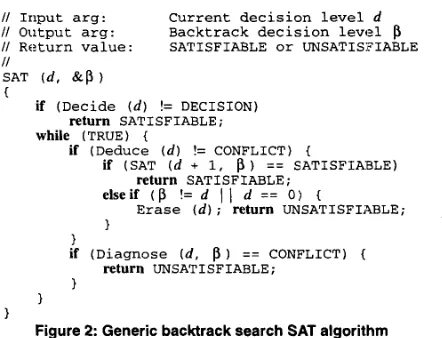
The overall organization of a generic backtrack search
[image:2.612.89.312.286.474.2]I
b y y 3 = ]Figure 3: Example circuit
ducts a search through the space of the possible assign- ments to the problem instance variables. At each stage of the search, a variable assignment is selected with the D e c i d e ( ) function. A decision level d is associated with each selection of
an
assignment. Implied necessary assign- ments are identified with the D e d u c e ( ) function, which in most cases corresponds to straightforward derivation of implications [ 10,411. Whenever a clause becomes unsatis- fied the D e d u c e ( ) function returns a conflict indication which is then analyzed using the Diagnose ( ) function. The diagnosis of a given conflict returns a backtracking decision levelb ,
which denotes the decision level to which the search process is required to backtrack to. The E r a s e ( ) function clears implied assignments that result from each assignment selection. Different organizations of SAT algorithms can be modeled by this generic algorithm. Currently, all of the most efficient SAT algorithms [4, 27, 421 are characterized by several of the following key prop- erties:1 . The analysis of conflicts can be used for implementing Non-chronological Backtracking search strategies. Hence, assignment selections deemed irrelevant can be skipped over during the search [4,27,42].
2. The analysis of conflicts can also be used for identifying and recording new implicates of the Boolean function associated with the CNF formula. Clause Recording plays a key role in recent SAT algorithms, but in most cases large recorded clauses are eventually deleted [4, 27, 421.
3. Other techniques have been developed. Relevance- Bused Learning
[4]
extends the life-span of large recorded clauses that will eventually be deleted. Conjict-Induced Necessary Assignments [27] denote assignments to variables which are necessary for preventing a given conflict from occurring again during the search.Before running the SAT algorithm, different forms of preprocessing can be applied [U]. This in general is denoted by a Preprocess ( ) function.
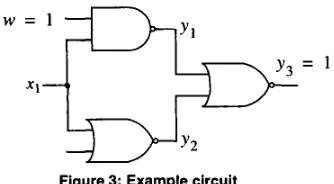
The techniques that characterize modern backtrack search SAT algorithms are based on the ability to analyze the causes of conflicts during the search and deriving explanations for those conflicts. For example, let us con- sider the example circuit of Figure 3, where w = 1 and y 3 = 0 , and x 1 is assigned value 1. Clearly, this assign- ment yields a conflict, since y, and y2 are both assigned
Assignments: {
z
= 1, U = 0 ) o1 = ( U+
x+
Y W )w2
= ( x + 7 y )o3
= ( W + Y+-d
Figure 4: Recursive learning on clauses
value 0, and these assignments are inconsistent with the assignment of node y 3 . This conflict will hold as long as the assignments x 1 = 1 , w = 1 and y3 = 0 hold. Hence, in order to prevent this conflict at least one of the assignments must be complemented. As a result, the clause
4.2
Recursive Learning
+
l w+
y 3 ) can be derived.Recursive learning has been extensively used in EDA [19]. Moreover, in 1261 the recursive learning para- digm has been extended to CNF formulas. Next, we briefly describe how this can be done in practice.
For any clause w
in
a CNF formula cp to be satisfied, at least one of its yet unassigned literals must be assigned value 1. Recursive learning on CNF formulas consists of studying the different ways of satisfying a given selected clause and identifying common assignments, which are then deemed necessary for the clause to become satisfied and consequently for the instance of SAT to be satisfiable. Clearly, and because conflict diagnosis can also be imple- mented, each identified assignment needs to be adequately explained. Consequently, with each identified assignment a clause that describes why the assignment is necessary is created. Let us consider the example CNF formula of Fig- ure 4. In order to satisfy clause 03, either w = 1 ory = 1
.
Considering each assignment separately leads to the implied assignment x = 1 ; for w = 1 due to 0, and for y = 1 due to w2. Hence, the assignment x = 1 is necessary if the CNF formula is to be satisfied. One suffi- cient explanation for this implied assignment is given by the logical implication ( z = 1) A ( U = 0 ) 3 ( x = l),which can be represented in clausal form as ( -LZ
+
U+
x ).
Consequently, this clause represents a new implicate of the Boolean function associated with the CNF formula and so
it can be added to the CNF formula. This new clause also implies the assignment x = 1 as long as z = 1 and u = 0 , as intended. As with recursive learning for combi- national circuits, recursive learning for CNF formulas can be generalized to any recursion depth. The proposed recur- sive learning algorithm is further detailed in [26].
[image:3.616.95.262.90.182.2]procedure might eventually re-derive some of the already derived necessary assignments.
5 Solving
SAT on Combinational Circuits
It is generally accepted that the utilization of CNF models and SAT algorithms has important advantages:
I . Existing, and extensively validated SAT algorithms, can
2. New improvements and new SAT algorithms can be
In contrast, the utilization of CNF formulas and asso- ciated SAT algorithms is also characterized by several drawbacks:
1. As observed in [39], the structural information of the circuit, often of crucial importance, is lost.
2. In many EDA problems, a large number of instances of
SAT has to be solved for each circuit. Hence, mapping a given problem description into SAT can represent a significant percentage of the overall running time [25].
3. Computed input patterns are in general overspecified. Overspecification can be a serious drawback in different applications, including circuit testing and binate constraint solving.
With the purpose of addressing these problems, in
[39, 401 a new dynamic data structure, i.e. an extended implication graph, is proposed for solving instances of
SAT in combinational circuits. Despite the promising results of [39, 401, utilizing a new data structure requires dedicated algorithms. Hence new search pruning tech- niques, developed for example in the context of SAT algo- rithlms, will have to be adapted to the circuit graph data structure.
In this section we illustrate how to utilize structural information in SAT algorithms [37]. To a generic SAT algorithm we add a layer that maintains circuit-related information, e.g. fanidfanout information as well as value justification relations. The proposed approach allows usiing any SAT algorithm to which this layer can be added.
The
main advantages of the proposed approach is that some of the previously mentioned drawbacks, i.e. inacces- sibi lity to structural information and overspecification of input patterns, are eliminated. The main contribution over the work of [39] is that data structures used for SAT need not be modified, and so existing algorithmic solutions forS A T
can naturally be augmented with the proposed layer for handling structural information. Moreover, the approach proposed in this paper is significantly simpler than the one in [39], since only minor modifications to S A T algorithms are required.Let
C
denote a property of a combinational circuitC
which is to be satisfied to an objective value o. This satisfi- ability problem is denoted by ( C , o) and can be mapped into an instance of SAT, (p.
The following information is associated with each variable x of (p, that also represents abe used instead of dedicated algorithms.
easily applied to each target application.
P
P
x = NAND(w,, ..., wa)
k:
::
::
::
-:
::
:l
Table 2 Threshold values on assigned inpul:s
I
w ; = 1I
Gate
I
w ; = oI
Table 3: Justification counters associated with gate inputs
circuit node x of
C
:1. F l ( x ) denotes the fanin nodes of x. 2. FO(x) denotes the set of fanout nodes of x.
3. u,(x) denotes the threshold value on the number of suitable assigned inputs (of x) that are necessary for justifying value v on node x.
4. t,(x) denotes the actual counter of assigned inputs (of x) that are involved in justifying the value v on node x.
Note that the value assigned to each variable x is denoted by v(x)
.
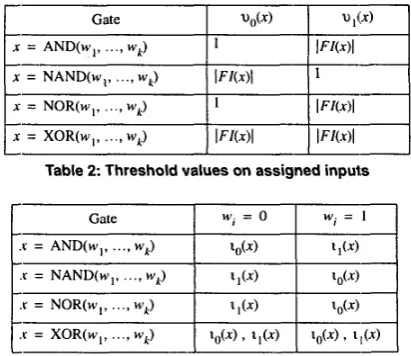
Moreover, observe that each circuit node x, with assigned value v, becomes justified wheneverTable 2 contains a few examples of threshold values on thie number of assigned inputs required for justifying a given node. For example, for an AND gate at least one inpul assigned value 0 justifies the assignment of value 0 to x, whereas for value 1 all inputs must be assigned value
1. Hence, uo(x) = 1 and u,(x) = IFl(x)l. As another example, observe that for an XOR gate justification of any assigned value requires assignments to all gate inputs; hence uo(x) = u,(x) = IFl(x)l. For other simple gates this information can also be easily derived, and in all cases we have uo(x),
uI(x)
E { 1, I F l ( x ) l } .For any simple gate with output x, we can associate with each fanin node w the counters that must be updated as thl: result of assigning a value v to w. For example, for
an AND gate an assignment of 0 to a fanin node w incre- ments to(x) by 1, and an assignment of 1 to fanin node w increments tl(x) by 1. These relations are illustrated in Table 3 for a few example gates. Note that for the XOR
gates, both counters are updated when an input node becomes assigned.
[image:4.617.341.547.91.269.2]Y E ( 0 , l ) .
Given the previous definitions, a SAT algorithm can be adapted so that the information regarding justification can be properly maintained. Moreover, the fanin informa- tion can be used for implementing structure-based heuris- tic decision making procedures, e.g. simple or multiple bucktracing [ 11. With respect to the algorithm of Figure 2, functions Deduce ( ) and Diagnose ( ) have to invoke dedicated procedures for updating node justification infor- mation. Additionally, the Decide ( ) function now tests for satisfiability by checking for an empty justification frontier instead of checking whether all clauses are satis- fied. These are the only required modifications to the gen- eral SAT algorithm. In addition, the Decide ( ) function can optionally be modified to perform backtracing given the fanin information associated with each variable.
We should note that the data structures described above operate in much the same way as justification works in combinational circuits [l]. The main difference is that in our approach justification and value consistency are for- mally dissociated; value consistency is handled by the SAT algorithm and justification by the new added layer.
Moreover, we should observe that by taking into account the circuit structure information, the recursive learning procedure described in Section 4.2 can be made simpler, since only clause justifications of nodes in the fanin of a given unjustified node need to be considered.
SAT has led to the proposal of dedicated reconfigurable hardware architectures [2, 431 that, despite being signifi- cantly less sophisticated than software algorithms, can achieve significant speedups for specific classes of instances.
7 Conclusions
This paper surveys applications of SAT models to EDA applications, and briefly describes the core tech- niques that characterize modern SAT solvers, capable of solving large and hard instances of SAT. In addition, the paper describes different recently proposed techniques, that show promise for EDA applications. Among these, we address the extension of recursive learning to CNF for- mulas, adapting SAT solvers to combinational circuits, equivalency reasoning and randomization.
Despite the large number of practical EDA applica- tions that can be mapped into SAT instances, and despite the improvements in the effectiveness of SAT algorithms, SAT is an NP-complete problem. Most (if not all) SAT solvers are still unable to solve many practical problem instances, many of these from EDA applications. The recent increase in the number of EDA applications utiliz- ing SAT models further motivates a continuing effort towards improving SAT algorithms.
References
6
Recentwork
Recent research work on SAT algorithms has included equivalency reasoning [2 13 and randomization with restarts [14]. Both approaches show great promise for EDA applications.
Equivalency reasoning targets the simplification of CNF formulas, either before or during the search, its main objective being the identification of equivalency clauses ( x
+
-y).
(-LT+
y), that indicate that x and y must always be assigned the same value. Hence, variable y can be replaced by variable x , and one variable is eliminated.Randomization [21] can be viewed as the process of introducing a certain degree of uncertainty in selecting branching variables and values during the search. The addition of randomization allows for repeatedly restarting the search each time a given limit number of decisions is reached. Restarts with randomization allow searching dif- ferent regions of the search space and have been shown to yield dramatic improvements on satisfiable instances.
With respect to SAT algorithms for EDA applications, recent work has also attempted to exploit the fact that in many applications SAT solvers tend to be used iteratively and/or incrementally. Specific techniques for the iterative use of SAT algorithms [25] or the incremental formulation of problem instances [ 181 have been proposed.
Finally, the interest of the EDA community in solving
[l] M. Abramovici, M. A. Breuer and A. D. Friedman, Digital Systems Testing and Testable Design, Computer Science Press, 1990.
[2] M. Abramovici, J. De Sousa, D. Saab, “A Massively-Paral- le1 Easily-Scalable Satisfiability Solver Using Reconfig- urable Hardware,” to appear in Proceedings of the Design Automation Conference, June 1999.
[3] P. Barth, “A Davis-Putnam Based Enumeration Algorithm for Linear pseudo-Boolean Optimization,” Technical Report MPI-1-95-2-003, Max-Planck-Institut fur Informatik, 1995. [4] R. Bayardo Jr. and R. Schrag, “Using CSP Look-Back Techniques to Solve Real-World SAT Instances,” in Pro- ceedings of the National Conference on Art$cial Intelli- gence (AAAI-97), 1997.
[5] A. Biere, A. Cimatti, E. Clarke and Y. Zhu, “Symbolic Model Checking without BDDs,” in Proceedings of TACAS, LNCS 1579, March 1999.
[6] M.N. Velev and R.E. Bryant, “Superscalar Processor Verifi- cation Using Reductions of the Logic of Equality with Uninterpreted Functions to Propositional Logic,” in Pro- ceedings of CHARME, LNCS 1703, September 1999. [7] C.-A. Chen and S. K. Gupta, “A Satisfiability-Based Test
Generator for Path Delay Faults in Combinational Circuits,” in Proceedings of the Design Automation Conference, June 1996.
[8] P. Chen and K. Keutzer, “Towards True Crosstalk Noise Analysis,” to appear in Proceedings of the International Conference on Computer-Aided Design, November 1999. [9] 0. Coudert, “On Solving Covering Problems,” in Proceed-
[IO] M. Davis and H. Putnam, “A Computing Procedure for Quantification Theory,” Journal of the Association for Com- puting Machinery, vol. 7, pp. 201-215, 1960.
[ 1 :I] M. Davis, G. Logemann and D. Loveland, “A Machine Pro- gram for Theorem-Proving,” Communications of the ACM,
vol. 5 , pp. 394-397, July 1962.
[ 121 L. Entrena and K.-T. Cheng, “Sequential Logic Optimiza- tion by Redundancy Addition and Removal,” in Proceed- ings of the International Conference on Computer-Aided Design, November 1993.
[I31 F. Fallah, S. Devadas and K. Keutzer, “Functional Vector Generation For HDL Models Using Linear Programming and 3-Satisfiability,” in Proceedings of the Design Automa- tion Conference, June 1998.
[14.] C. P. Comes, B. Selman and H. Kautz, “Boosting Combina- torial Search Through Randomization,” in Proceedings of the National Conference on Arti3cial Intelligence, July 1998.
[I51 J. F. Groote and J P. Wamers, “The Propositional Formula Checker HeerHugo,” Technical Report SEN-R9905 (CWI), January 1999.
[I61 A. Gupta and P. Ashar, “Integrating a Boolean Satisfiability Checker and BDDs for Combinational Equivalence Check- ing,” in Proceedings of the International Conference in VLSI Design, January 1998.
[I71 J. Kim, J. Marques-Silva, H. Savoj and K. A. Sakallah, “RID-GRASP: Redundancy Identification and Removal Using GRASP”, in International Workshop on Logic Syn- thesis, May 1997.
[IS] J. Kim, J. Whittemore, J. Marques-Silva and Karem A. Sakallah, “On Applying Incremental Satisfiability to Delay Fault Testing,” to appear in Proceedings of the Design, Automation and Test in Europe Conference, March 2000. [I91 W. Kunz and D. Stoffel, Reasoning in Boolean Networks,
Kluwer Academic Publishers, 1997.
[20] T. Larrabee, “Test Pattern Generation Using Boolean Satis- fiability,” IEEE Transactions on Computer-Aided Design,
vol. 1 1 , no. 1, pp. 4- 15, January 1992.
[21
I
C.-M. Li, “Equivalency Reasoning to Solve a Class of Hard SAT Problems,” Submitted for publication. (Available fromhttp://www.research.att.com/-kautz/challengelcli.ps.)
[221 V. Manquinho, A. Oliveira and J. Marques-Silva, “Models and Algorithms for Computing Minimum-Size Prime Impli- cants,” in Proceedings of the International Workshop on Boolean Problems, September 1998.
[23:1 V. Manquinho and J. Marques-Silva, “On Using Satisfiabil- ity-Based Pruning Techniques in Covering Algorithms,” in
Proceedings of the Design, Automation and Test in Europe Conference, March 2000.
[24]1 J. Marques-Silva and K. A. Sakallah, “GRASP-A New Search Algorithm for Satisfiability,” in Proceedings of the International Conference on Computer-Aided Design,
November 1996.
[25] J. Marques-Silva and K. A. Sakallah, “Robust Search Algo- rithms for Test Pattem Generation,” in Proceedings of the Fault-Tolerant Computing Symposium, June 1997. [26] J. Marques-Silva and T. Glass, “Combinational Equivalence
Checking Using Satisfiability and Recursive Learning,” in
Proceedings of the Design and Test in Europe Conference,
March 1999.
[27] J. Marques-Silva and K. A. Sakallah, “GRASP: A Search Algorithm for Propositional Satisfiability,” in IEEE Trans- actions on Computers, vol. 48, no. 5, pp. 506-521, May
1999.
[28] P. McCeer, A. Saldanha, P. R. Stephan. R. K. Brayton and A. L. Sangiovanni-Vincentelli, “Timing Analysis and Delay-Test Generation Using Path Recursive Functions,” in
Proceedings of the Intemational Conference on Computer- Aided Design, November 1991.
[29] G.-J. Nam, K. A. Sakallah and R. Rutenbar, “Satisfiability Based FPGA Routing,” in Proceedings of the International Conference on VLSI Design, January 1999.
[30] G.-J. Nam, K. A. Sakallah, and R. A. Rutenbar, “Satisfiabil- ity-Based Layout Revisited: Detailed Routing of Complex FPGAs Via Search-Based Boolean SAT,” in International Symposium on Field-Programmable Gate Arrays,. February 1999.
[31] A. Saldanha and V. Singhal, “Solving Satisfiability in CAD Problems,” in Proceedings of the Cadence Technical Con- jerence, May 1997.
[32] B. Selman, H. Levesque and D. Mitchell, “A New Method for Solving Hard Satisfiability Problems,” in Proceedings of the National Conference on Artifkial Intelligence (AAAI-
[33] Y. Shang and B. W. Wah, “A Discrete Lagrangian-Based ‘Global-Search Method for Solving Satisfiability Problems,” .Journal of Global Optimization, Jan. 1998.
[34] M. Sheeran and G. Stalmarck, “A Tutorial on Stalmarck’s ‘Proof Procedure for Propositional Logic,” in Proceedings of ,!he International Conference on Formal Methods in Com- puter-Aided Design, November 1998.
[35] :N. Sherwani, Algorithms for VLSI Physical Design Automa- !ion, Kluwer Academic Publishers, 1995.
[36] IL. G. Silva, J. P. Marques-Silva, L. M. Silveira and K. A. :Sakallah, “Satisfiability Models and Algorithms for Circuit ]Delay Computation,” in Workshop on Timing Issues in the Specification and Synthesis of Digital Systems, December
1997.
[37] I,. G. Silva, L. Silveira and J. Marques-Silva, Algorithms lor Solving Boolean Satisfiability in Combinational Cir- cuits, in Proceedings of the Design and Test in Europe Con- ference, March 1999.
[38] I? R. Stephan, R. K. Brayton and A. L. Sangiovanni-Vincen- telli, “Combinational Test Generation Using Satisfiability,”
A‘EEE Transactions on Computer-Aided Design, vol. 15, no.
9, pp. 1 167- 1 176, September 1996.
[39] I? Tafertshofer, A. Ganz and M. Henftling, “A SAT-Based Implication Engine for Efficient ATPG, Equivalence Check- ing, and Optimization of Netlists,” in Proc. of the Int’l Conj
on Computer-Aided Design, pp. 648-657, November 1997. [40] 1’. Tafertshofer e A. Ganz, “SAT Based ATPG Using Fast
Justification and Propagation in the Implication Graph,” in
Proceedings of the ACMLEEE Intemational Confirence on
Computer-Aided Design (ICCAD), November 1999. [41] It. Zabih and D. A. McAllester, “A Rearrangement Search
Strategy for Determining Propositional Satisfiability,” in
Proceedings of the National Conference on Artijicial Intelli- gence, pp. 155-160, 1988.
[42] €1. Zhang, “SATO: An Efficient Propositional Prover,” in
Proceedings of International Conference on Automated Deduction, July 1997.
[43] F! Zhong, P. Ashar, S. Malik and M. Martonosi, “Using Reconfigurable Computing Techniques to Accelerate Prob- lems in the CAD Domain: A Case Study with Boolean Sat- isfiability,” in Proceedings of the Design Automation Conference, June 1998.