INTERNATIONAL
COUNCIL FOR
SCIENCE
INTERGOVERNMENTAL
OCEANOGRAPHIC
COMMISSION
WORLD
METEOROLOGICAL
ORGANIZATION
WORLD CLIMATE RESEARCH PROGRAMME
Report of the 3rd meeting of
CLIVAR Atlantic Implementation Panel
7-8 September 2001
Paris, France
December 2001
WCRP Informal Report No.
CLIVAR is a component of the World Climate Research Programme (WCRP), which was established by WMO and ICSU, and is carried out in association with IOC and SCOR. The scientific planning and development of CLIVAR is under the guidance of the JSC Scientific Steering Group for CLIVAR assisted by the CLIVAR International Project Office. The Joint Scientific Committee (JSC) is the main body of WMO-ICSU-IOC formulating overall WCRP scientific concepts.
Bibliographic Citation
INTERNATIONAL CLIVAR PROJECT OFFICE, 2002: Report of the 3rd meeting of
Contents
Action Items 3
Background 5
Introduction 5
Review of Action Items from the CLIVAR SSG-10 6
Report from the CLIVAR Tropical Atlantic Workshop 6
Update on the Status and Plans for PIRATA 7
Review of the CLIVAR Science Implementation in the Tropical Atlantic
8
Overview of VAMOS and its interaction with the Atlantic Panel 10
ICPO Support to Atlantic Implementation Panel 10
Update on Arctic Sub-arctic Ocean Flux Array 11
Process Studies and Experiments in the Atlantic Sector 12
Updates on selected sustained observations 12
CLIVAR Atlantic interaction with the Carbon Cycle Science Planning
13
Brief Discussion on relevant items 13
Next Meeting 13
List of Attendees (Appendix 1) 14
Agenda (Appendix 2) 15
Action Items
1 Write a letter to the CLIVAR SSG Chairmen, A. Busalacchi and J. Willebrand, informing on the approval of I. Wainer and C. Reason as new members of the Atlantic Panel.
(M. Visbeck and R. Boscolo)
2 Write a short report of the CLIVAR Tropical Atlantic Variability Workshop held in Paris,3-6 September, for the next issue of CLIVAR Exchanges.
(S. Garzoli & Scientific Committee)
3 Prepare a short document including key figures on the advances of Tropical Atlantic Variability science and implementation during the last 3 years.
(S. Garzoli & Scientific Committee)
4 Prepare a workshop report that documents issues and recommendation made by the working groups at the Tropical Atlantic Variability workshop particularly listing:
• Recommendations to CLIVAR WGSIP
• Recommendations to CLIVAR WGCM
• Recommendations towards enhancement of sustained observations
• Recommendations towards process studies
(S. Garzoli & Scientific Committee)
5 Write a letter to the P.I.s/groups/countries involved in the PIRATA extensions encouraging the enhancement of moored buoy observations in the Tropical Atlantic. The groups are encouraged to submit a white paper to the CLIVAR Atlantic Panel highlighting the scientific justifications for the proposed PIRATA extension in order to obtain CLIVAR endorsement.
(I. Wainer and A. Busalacchi)
6 Provide input to the next meeting of WGCM on the role of MOC on the Atlantic climate variability. Propose to perform perturbation experiments of MOC in climate modelling.
(R. Sutton, T. Delworth and F. Schott)
7 Monitor the promised progress on the surface drifters deployment in the Tropical Atlantic region.
(R. Boscolo)
8 Invite the chairman of the TAV workshop WG on climate impact and predictability to provide the Atlantic panel with more details on the possible workshop on predictability to be held in 2003 for CLIVAR endorsement.
(Y. Kushnir)
9 Report on the status of surface winds analysis products in the Tropical Atlantic region, highlighting the problems and biases for the different products.
(I. Wainer, Y. Kushnir, J. Hurrell and G. Reverdin)
10 Maintain updated and improve the web page on the CLIVAR related activities in the Atlantic (www.clivar.org/organization/atlantic/IMPL). Enhance the system to also show the timeline of the Atlantic observations and process studies in the layout of the maps in order to highlight the CLIVAR implementation.
(R. Boscolo)
11 Co-ordinate the flow of information related to CLIVAR Atlantic onto CLIVAR SPRINT. Charge to R. Boscolo to be the point person for CLIVAR Atlantic projects.
(R. Boscolo)
12 Write an encouraging letter to ASOF Steering Committee stating the relevance of ASOF project to CLIVAR.
(P. Koltermann and M. Visbeck)
13 Provide inputs to VACS initiated West African Monsoon Experiment and enhance collaboration and linkages between VACS and CLIVAR Atlantic activities.
14a Encourage further planning and preparation of implementation plans for two process studies in the tropical Atlantic (NTA and STA) region combining STC variability with upper ocean dynamics, air-sea flux measurement and atmospheric boundary layer studies.
14b Prepare a statement on how to encourage and endorse process research studies in the Atlantic.
(M Visbeck, A. Busalacchi and R. Boscolo)
15 Recommend to COOP to help with the implementation of a high resolution XBT line at 30°S, possibly including end-point geostrophic transport moorings and hydrographic sections in the S. Atlantic.
(P. Koltemann and F. Schott)
16 Continue to lobby the ARGO SSG and COOP for S. Atlantic coverage of ARGO floats. And to consider implementing a process by which real time data for science research have a specific data policy.
(F. Schott, D. Legler and P. Koltermann)
17 Recommend to the US hydrography Panel to co-ordinate the resurvey of the Atlantic such that line occupations are all done around 2004 and consider high priority to a 5 year repeat of the hydrographic line at 30°S.
(P. Koltermann) 18 Check whether the high density XBT line AX8 does TSG underway measurements and
encourage pCO2 underway measurements.
(G. Reverdin, D. Wallace and M. Visbeck)
19 Liase with CARINA, Atlantic Carbon group, for co-ordination between CLIVAR and the carbon community.
(R. Boscolo and M. Hood)
20 Identify end-users and applications of CLIVAR Atlantic research activities and make it available on the web.
(R. Boscolo)
21 Liase with PAGES to get a more complete picture on paleo activities related to Atlantic climate variability science.
(Y. Kushnir)
22 Explore the possibility to hold the next Panel meeting back-to-back with the next WGSIP meeting or to meet in Bermuda in June 2002. A focus on MOC and global climate change issues was agreed upon.
Background
The CLIVAR Atlantic Implementation Panel is a part of the CLIVAR organization. The panel is in charge of implementing the CLIVAR science plan in the Atlantic sector. More specifically its terms of references are:
1. To recommend and oversee the implementation of observations in the Atlantic Ocean sector, in order to meet the objectives outlined in CLIVAR's Science and Initial Implementation Plans, particularly with respect to the Principal Research Areas D1 (North Atlantic Oscillation), D2 (Tropical Atlantic Variability) and D3 (Atlantic Thermohaline Circulation). 2. To collaborate with JSC/CLIVAR Working Group on Coupled Modelling and CLIVAR
Working Group on Seasonal-to-Interannual Prediction, in order to design appropriate numerical experiments, and to be aware of requirements set by these groups for data sets needed to validate models.
3. To liaise with the relevant CLIVAR panels, in particular Upper Ocean Panel and PIRATA Steering Group, to ensure that best use is made of resources from the global and equatorial research programs.
4. To liaise with Ocean Observation Panel for Climate and other relevant groups to ensure that CLIVAR benefits from and contributes to observations in GOOS and GCOS.
5. To report to the CLIVAR SSG.
The members of the CLIVAR Atlantic Implementation Panel are:
M. Visbeck (Chair) Lamont-Doherty Earth Observatory, Palisades, USA A. Busalacchi ESSIC, University of Maryland, USA
A. Clarke Bedford Institute of Oceanography, Dartmouth, Canada T. Delworth GFDL-NOAA, Princeton, USA
R. Dickson CEFAS-MAFF, Lowestoft, UK J. Hurrell NCAR, Boulder, USA
K.-P. Koltermann Bundesamt Seeschiffahrt Hydrographie, Hamburg, Germany Y. Kushnir Lamont-Doherty Earth Observatory, Palisades, USA
A. Piola Servício de Hidrografia Naval, Buenos Aires, Argentina C. Reason EGS - CSAG, University of Cape Town, South Africa G. Reverdin Centre National d’Etudes Spatiales, Toulouse, France F. Schott Institut für Meereskunde, Kiel, Germany
R. Sutton Centre for Global Atmospheric Modelling, Uni. of Reading, UK I. Wainer University of São Paulo, São Paulo, Brazil
Introduction
The members of the Atlantic Implementation Panel convened at the Institut Oceanographique, in the heart of the Parisian Latin Quarter, for holding their 3rd meeting. This meeting followed the CLIVAR Tropical Atlantic Variability workshop, held at UNESCO, Paris, 3-7 September 2001, thus giving to the panel the opportunity to focus on the research area D2 (Tropical Atlantic Variability) of the CLIVAR Implementation Plan. Martin Visbeck, Chairman of the Atlantic Panel, welcomed the participants (see Appendix 1 for the full list) and opened the meeting by revising the agenda (see Appendix 2) and the Terms of Reference and membership of the Panel. He informed the participants that M. McCartney resigned from the Atlantic Panel (due to personal reasons) and that C. Reason and I. Wainer were invited to join.
ACTION ITEM 1. M. Visbeck and R. Boscolo to write a letter to the CLIVAR SSG Chairmen, A.
Busalacchi and J. Willebrand, informing on the approval of I. Wainer and C. Reason as new members of the Atlantic Panel.
As a final point of the introduction, M. Visbeck reviewed the action items of the previous meeting (ICPO Publication No. 38) held in December 2000. The majority of the action items have been addressed by the panel members. Among those, the few not-yet-completed were the discussion items of the current meeting. Only 2 action items were not initiated:
• AI.6 Liase with PAGES to investigate paleo-record availability for study of past NAO
• AI.7 Prepare review comments on Bob Dickson proposed ASOF project (www.clivar.org/organization/atlantic)
Review of the Action Items from the CLIVAR SSG-10
Tony Busalacchi gave an overview of the issues addressed at the last CLIVAR SSG meeting (15-18 May) that are relevant to the Atlantic Panel. Overall the implementation of CLIVAR is well underway thanks to the combination of regional climate and monsoon initiatives as well as initiatives organised around problems specific to the ocean basins and adjacent regions. Regarding the latter, the progress made in the Atlantic sector was particularly welcomed by the SSG, which acknowledged the work done by the Atlantic Panel.
Among the issues relative to the international implementation of CLIVAR Tony Busalacchi mentioned the following as relevant to the Atlantic sector:
• Importance of promoting synergy between CLIVAR basin panels' plans for observations and process study and the activities of the Working Group on Seasonal to Interannual Prediction (WGSIP) and Working Group for Coupled Modelling (WGCM)
• Identifying potential applications and partnerships emerging out of the basic research agenda and accomplishments within CLIVAR.
• Strengthen the communication across the breadth of the programme by closely working with the ICPO scientific officers assigned to each panel
• Helping to set the agenda for the CLIVAR science conference scheduled in 2003/4 and finding a chairman.
Finally he mentioned that the 52nd
Session of Executive Council of the WMO as well as the Joint Scientific Committee of the WCRP both indicated that they were very impressed and pleased with the progress of CLIVAR to date. In particular, the JSC made supportive comments on the importance of PIRATA in CLIVAR studies.
Report from the CLIVAR Tropical Atlantic Workshop
Silvia Garzoli, co-chair of the scientific committee, was invited to give an overview of the main issues and achievements of the CLIVAR workshop on Tropical Atlantic Variability (TAV) held at UNESCO, Paris, 3-6 September. The main objectives, agenda, list of participants, abstracts and presentations of the workshop can be found at www.clivar.org/organization/atlantic/TAV. The workshop attracted 97 scientists working on the different aspects of the tropical Atlantic variability, namely: air-sea fluxes and ocean-atmosphere coupling, role of TAV on the climate variability over the Americas and Africa, linkages with North Atlantic Oscillation (NAO), Meridional Overturning Circulation (MOC), Shallow Tropical/subtropical Overturning Cells (STC) and climate change. An emphasis was given to the actual observing system (PIRATA) and future observational needs for model assimilation (GODAE) and climate predictions (NCEP, ECMWF). The first three days of the workshop had keynote presentations in the morning, interactive poster sessions in the afternoon and, at the end of the day, plenary sessions in which designated rappourteurs led discussions on the presentations and posters themes of the day. The last day was dedicated to the formation of three working groups that summarised the science and the observational needs based on the workshop discussions and made recommendations toward an implementation plan. The three working groups were:
• WG1: Coupled Ocean Atmospheric Systems (chair: P. Delecluse)
• WG2: Climate Impact and Predictability (chair: Y. Kushnir)
• WG3: Links between the Upper Tropical Atlantic, the Deeper Ocean and the Other Basins (chair: F. Schott)
ACTION ITEM 2. Silvia Garzoli and Scientific Committee to write a short report of the CLIVAR
Tropical Atlantic Variability Workshop for the next issue of CLIVAR Exchanges.
ACTION ITEM 3. Silvia Garzoli and Scientific Committee to prepare a short document including
key figures on the advances of Tropical Atlantic Variability science and implementation during the last 3 years.
Silvia Garzoli gave also a brief overview of the issues and recommendations made at the working groups.
external forcing (teleconnections) in affecting regional variability. Also of significance is the large range of variability -from interannual to decadal scales- that TAV displays and their interdependence. The variability in the tropical Atlantic thus remains difficult to understand, model and predict. WG1 proposed that progress could be achieved by emphasising two key scientific themes:
• The regional three-way coupling between atmosphere, ocean and land-surface interactions
• The regional links between the seasonal mean evolution of the background state and its variation on the time scales.
The WG2 identified three areas that need attention: data gaps, climate impacts and predictability. There are obvious gaps in surface ocean data due to the VOS tracks and the location of permanent platforms. These gaps result in the loss of necessary information not only concerning climate variability but also in fundamental aspects of the mean seasonal cycle. Other less obvious gaps are linked to failures to constrain regional data assimilation products with observations. On the problem of impacts, there is the need to identify the actual societal effects of this variability, the composition of the end user community, and the implied priorities. There is the need to better define the predictability limits of TAV and related phenomena through diagnostics of data and model experiments.
In WG3 the role of sub-tropical cells and meridional overturning circulation in determining TAV was largely discussed. Also discussed in general terms was the effect of decadal and inter-decadal variability of MOC structure on the North Atlantic Deepwater (NADW), and the warm water return flow from the South Atlantic. Process studies were proposed on STCs, MOC transformation study and NADW pulse effects on the TAV. Among those the STC process study was judged to be the most ready for implementation. Recommendations were also made for monitoring MOC and STC transports and improving the VOS fleet by adding capability of currents measurements (ADCP).
ACTION ITEM 4. Silvia Garzoli and Scientific Committee to prepare a workshop report that
documents issues and recommendation made by the working groups at the Tropical Atlantic Variability workshop particularly listing:
• Recommendations to CLIVAR WGSIP
• Recommendations to CLIVAR WGCM
• Recommendations towards enhancement of sustained observations
• Recommendations towards process studies
Update on the Status and Plans for PIRATA
Tony Busalacchi was asked to report on the PIRATA-8 meeting, which was held in Paris, 29-31 August 2001, and to lead a discussion on specific recommendations to pass on to the Moored Buoy Network Review meeting to be held in Seattle, USA, 10-12 September 2001.
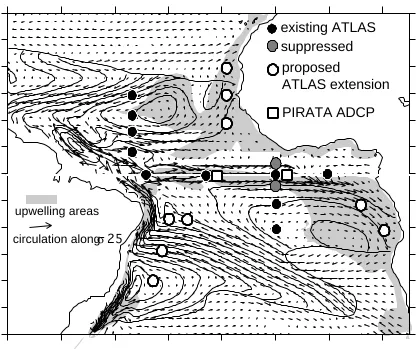
PIRATA has entered its "consolidation" period (2001-2006) where it will maintain the initial 12-moorings array (see Fig. 1) while facing the challenge to become the Tropical Atlantic observing system serving the observational needs for TAV study and prediction. In addition there are pilot extension initiatives that are planned in the North-East, South-East and West of the initial array (see Fig. 1). These pilot initiatives are supposed to be implemented during the PIRATA "consolidation" period, supported mainly by the regional countries with the expected help and partial support of the international community and agreement of PIRATA Scientific Committee. It was noted that no decision has yet been made on the future operational configuration of the initial PIRATA array.
Tony Busalacchi specifically addressed the issues related to the PIRATA extensions plans:
• PIRATA West extension is supported by Brazil with the objective to improve the climate
forecast of the Americas (climate change of the south-east coast of Brazil, impact on the rainy season of the north-east, etc…)
• PIRATA North-East extension is supported by Morocco, Guinea, Cape-Vert, Mauritania and
Senegal. The main objective is to study the ocean-atmosphere interaction in the north-east Atlantic and its impact both on the climate and regional oceanographic variability. Help in terms of funding are sought from international institutions like GEF, EU, WorldBank.
• PIRATA South-East extension is supported mainly by South Africa. The objectives are
proposed
ATLAS extension
circulation along
σ 25
existing ATLAS
suppressed
upwelling areas
[image:9.595.71.490.88.437.2]PIRATA ADCP
Figure 1. Status of the PIRATA array in 2001 and the plans for its extension.
It was noted that during the PIRATA-8 meeting there hasn't been a formal endorsement to these extensions but that these projects are seeking, and would greatly benefit from, a formal endorsement from CLIVAR.
ACTION ITEM 5. I. Wainer and A. Busalacchi to write a letter to the P.I.s/groups/countries
involved in the PIRATA extensions encouraging the enhancement of moored buoy observations in the Tropical Atlantic. The groups are encouraged to submit a white paper to the CLIVAR Atlantic Panel highlighting the scientific justifications for the proposed PIRATA extension in order to obtain CLIVAR endorsement.
Review of the CLIVAR Science and Implementation in the Tropical Atlantic
Rowan Sutton first reviewed the conclusions reached at the WG1 of the TAV workshop on coupled ocean-atmosphere systems. The several critical issues highlighted by recent analysis and modelling studies are:
• Existence of a local ocean-atmosphere coupling in the equatorial region and the importance of external forcing (by atmospheric or oceanic teleconnections) in affecting regional variability
• TAV displays a large range of variability from interannual to decadal scales and these time scales seem to be interdependent
• The specific meridional configuration of the tropical Atlantic basin (bordered by two large landmasses with complex boundaries) confers a strong predominance to the seasonal cycle, which consequently interacts with lower frequency variability.
the slower oceanic teleconnections between the tropical region and the mid-latitudes. In addition, regional coupled modelling studies are recommended to explore the local effects of atmospheric teleconnections and their interaction with local processes.
ACTION ITEM 6. R. Sutton, T. Delworth and F. Schott to provide input to the next meeting of
WGCM on the role of MOC on the Atlantic climate variability. Propose to perform perturbation experiments of MOC in climate modelling.
The panel acknowledge the new elements introduced in the science review of the TA coupled ocean-atmosphere system, namely: the role of annual cycle and land effects on the system variability. These conclusions were endorsed and further analysis encouraged along the proposed lines.
Yochanan Kushnir, as the chairman of the TAV WG2 on climate impacts and predictions, gave an overview of the issues and recommendations emerged at the WG. It was recognised that a link between existing national and international operational prediction/outlook activities and CLIVAR science agenda would stimulate improvements in the areas of:
• Sustained ocean/atmosphere/land observations for research and operations
• Models and methods for simulation, data assimilation and prediction of TA climate
• Process studies intended to improve understanding of local and remote mechanisms governing TAV
The identified issues and the proposed recommendations are relative to four areas:
• Data and Data Assimilation. There are well-known gaps in TA observations that have yet to be bridged (along the coast of Africa north and south) and the need to facilitate reliable regional, model-based, ocean data assimilation products. It appears that the performance of the existing assimilation procedures in the tropical Atlantic is far less satisfactory than in other regions. To address the needs for data to improve simulation, assimilation and prediction and identify ongoing and upcoming regional special observation efforts are recommended actions.
ACTION ITEM 7. R. Boscolo to monitor the promised progress on the surface drifters
deployment in the Tropical Atlantic region.
• Impacts. While a great deal is known on the links between fluctuations of climate variable important to society and TA SST, there is much more that needs to be done in terms of identifying the actual societal effects of this variability, the extend of the end user community and the implied priorities. It is therefore recommended to continue emphasising the needs for impact related research (end-to-end) and the attention to year-round variability and the south tropical Atlantic region.
• Predictability. There is the need to better define the predictability limits of TAV and related phenomena through data analysis and model experiments. This can be addressed by liasing with WGSIP and WGCM and encouraging the scientific CLIVAR Atlantic community to study/develop models of the tropical Atlantic region.
• Links to Operational Centres. It is recommended to identify the centres of climate prediction and forecasting and seek contacts in these organisations. An international workshop is also proposed, directed towards a meeting between the operational and research communities working on all aspects of TAV.
ACTION ITEM 8. Invite the chairman of the TAV workshop WG on climate impact and
predictability to provide the Atlantic panel with more details on the possible workshop on predictability to be held in 2003 for CLIVAR endorsement.
Finally Fritz Schott addressed the issues on links between the upper tropical Atlantic, the Deeper Ocean and the other basins. The overarching question is on the role of the 4D advection in the Tropical Atlantic SST, and specifically the role of subsurface to deep circulation in determining TAV, ITCZ position and SST. He expressed his concerns on available wind products noting that in the Tropical Atlantic, the interannual and decadal wind stress anomalies exhibit substantial differences from one product to another.
ACTION ITEM 9. I. Wainer, Y. Kushnir, J. Hurrell and G. Reverdin to report on the status of
The three process studies were proposed for the science objectives:
• STC variability study (endorsement of the Venice STC workshop's recommendations, www.clivar.org/organization/atlantic/STC/STC_rep0801.pdf)
• MOC transformation study. With focus on lower to middle NADW transfer in the tropical zone and dynamics of recirculation gyre
• NADW pulse effects on the TAV
Among those proposed initiatives the STC process study was judged to be the most ready for implementation. It was therefore recommended to organise an implementation workshop for the STC process study.
Regarding sustained observations, the current and planned efforts in monitoring MOC transport were welcomed (MOVE/GAGE and 24°N) and repeat water mass inventories encouraged. For the STC transport moored array off Brazil and geostrophy moorings (end point) or mooring across the interior of the basin were proposed. It was also suggested to add ADCP and thermosalinograph to the VOS ships that cross the Tropical Atlantic.
Overview of VAMOS and its Interaction with the Atlantic Panel
The Atlantic panel welcomed the presence of Roberto Mechoso who gave an overview of VAMOS objectives that are related to the Atlantic Ocean. Both VAMOS and the Atlantic panel are seeking a synergy in observational and process study efforts that would benefit both research areas. VAMOS investigates the variability and predictability of the American monsoon system in the context of global climate variability and predictability. One of the goal of VAMOS is therefore to improve the capacity for seasonal to interannual predictions by understanding land processes and properly incorporating them in the CGCM.
Roberto Mechoso brought to the attention of the panel a couple of cross-panels issues:
• Understanding the intraseasonal aspects of the monsoon system in the southwestern North America and the warm pool region to the south-west of Mexico. The role of Tropical Easterly Waves (TEW) in the Gulf of California surge events. The relationship between Madden-Julian Oscillation, tropical cyclone activity and monsoon precipitation.
• The role of the South Atlantic on South America monsoon system. Understanding the mechanism of the South Atlantic Convergence Zone in supplying moisture and maintains a precipitation maximum over central Brazil.
VAMOS current plans are centred on two internationally co-ordinated efforts to improve prediction of warm season precipitation over South and North America: the Monsoon Experiment South America (MESA) and the North America Monsoon Experiment (NAME) (www.clivar.org/organization/vamos/). Particularly the PLATIN project, part of MESA and addressing the connections of the western south Atlantic and north Tropical Atlantic SST anomalies with the climate variability of the Plata Basin, would benefit from a strategic plan for sustained observations and process studies in the tropical and South Atlantic. The Atlantic Implementation Panel is interested in pursuing linkages between TAV and changes over the Americas and will seek an effective co-ordination of Atlantic activities and VAMOS research projects.
International CLIVAR Project Office (ICPO) support to Atlantic Implementation activities
implementation in the Atlantic sector, namely: modelling efforts, climate data products and paleo data. Emphasis was placed on the difficulty to gather the relevant information, above all for proposed (non-funded), planned (funded but to be started) and forward look (intention to write a proposal) activities. Her strategy was to compile a mailing list of all known Atlantic CLIVAR PIs, asking them to look at the web page and send her feedback on omissions, inaccuracies and potential contacts. While this approach didn't give the expected responses, she found particularly useful her participation to the TAV workshop with a poster showing the maps with the information she gathered for the web page. During the workshop she had the opportunity to meet personally with several PIs working in the Atlantic, draw the poster (hence the web page) to their attention and get substantial feedback. On the other hand the poster was found very useful by the workshop participants when discussing future plans for the enhancement of the Atlantic observations and implementation of process studies
The panel welcomed the progress made on the observations tracking project and suggested some improvements on the layout of the web page (introduce a time dimension on the maps, add labels to the figures). However, it was generally felt that the web page is an useful tool for identifying gaps in the programmes and observing systems and help scientists to write better proposal for CLIVAR relevant research.
ACTION ITEM 10. Roberta Boscolo to maintain updated and improve the web page on the
CLIVAR related activities in the Atlantic (www.clivar.org/organization/atlantic/IMPL). Enhance the system to also show the timeline of the Atlantic observations and process studies in the layout of the maps in order to highlight the CLIVAR implementation.
Roberta Boscolo also reported on the current ICPO effort to develop a CLIVAR Searchable Program Information Network (SPRINT), currently available at http://sprint.clivar.org/projects/index.htm. SPRINT is a web tool intended to act as a quick reference guide to what is happening in CLIVAR. It gives and overview of CLIVAR's major programs with information such as objectives, timelines, contacts, URLs and data information. It was noted that SPRINT, in order to be useful to CLIVAR PIs, needs to be constantly updated and this relies on the actions of the PIs themselves who should check the information and add appropriately new projects.
ACTION ITEM 11. Roberta Boscolo to co-ordinate the flow of information related to CLIVAR
Atlantic onto CLIVAR SPRINT. Charge to R. Boscolo to be the point person for CLIVAR Atlantic projects.
Update on Arctic Sub-arctic Ocean Flux Array (ASOF)
Bob Dickson started his overview of ASOF (http://asof.npolar.no/) by giving evidence that the recent freshening of the upper Nordic Seas is passing across the Greenland-Scotland Ridge via both intermediate and depth overflow to affect the deep and abyssal layers of the North Atlantic. Freshening is approximately of 0.01 per decade at sill depth in the Faroe-Shetland Channel and in the Norwegian Sea Arctic Intermediate Water (NSAIW) layer, together with a corresponding decrease downstream in the Northeast Atlantic Deep Water (NEADW) layer of the Labrador Sea. The thermohaline controls and linkages at high latitude in the Atlantic is the research focus of ASOF (the parent body of the US programme SEARCH, Study of Environmental Arctic Change). The present status of ASOF planning comprises the establishment of an ISSG that aims to get most of his planned measurements array into the ocean by the end of 2003. The ISSG will have its first meeting at NSF in Washington D.C. from 29 November to 1 December 2001 with the aim to produce the 1st
draft of the ASOF Implementation plan. The funding opportunities are likely to come from an arrangement of NSF-EC co-operation on a range of scientific research topics. The list of topics, including something similar in aims to ASOF, has been already agreed.
The Atlantic panel was asked to give an endorsement to ASOF as the programme would benefit from being part of CLIVAR. The panel welcomed the ASOF efforts and progress toward implementation however found some missing elements in the programme that are of relevance to CLIVAR science like atmospheric interaction and feedback. It was also noted that ASOF should include in its mooring array all ongoing observational activities in the northern North Atlantic.
ACTION ITEM 12. P. Koltermann and M. Visbeck to write an encouraging letter to ASOF
Process Studies and Experiments in the Atlantic Sector
Martin Visbeck reminded to the panel that one of the statements emerging from the last CLIVAR SSG meeting stressed the importance of process studies as one way of implementing CLIVAR. He therefore asked whether the panel should encourage and promote process studies in the Atlantic as part of the implementation process of CLIVAR in the Atlantic sector.
Rowan Sutton followed the initial discussion by reporting on an observational effort promoted by CLIVAR VACS (Variability of Africa Climate Study) called WAMEX (West African Monsoon Experiment). This experiment was introduced in the white book recently produced by the French scientific community. However, VACS plans to have an international experiment in West Africa, potentially in 2004, with various components and more countries involved. The scientific issues that motivate the proposed experiment are related to monsoon dynamics and associated weather systems, continental water cycle, surface conditions, atmospheric chemistry and hurricanes. An area of interest is the tropical eastern Atlantic and its influence on the western Africa.
ACTION ITEM 13. J. Hurrell, R. Sutton and M. Visbeck to provide inputs to VACS initiated West
African Monsoon Experiment and enhance collaboration and linkages between VACS and CLIVAR Atlantic activities.
Fritz Schott pointed out that the STC process study proposed at the Tropical Atlantic Variability workshop could contribute to WAMEX objectives as well as provide ocean measurements that would complement the experiment. Rowan Sutton also highlight the great opportunity to perform critical observations that would be used in model runs.
ACTION ITEM 14a. M Visbeck, A. Busalacchi and R. Boscolo to encourage further planning
and preparation of implementation plans for two process studies in the tropical Atlantic (NTA and STA) region combining STC variability with upper ocean dynamics, air-sea flux measurement and atmospheric boundary layer studies.
ACTION ITEM 14b. M Visbeck, A. Busalacchi and R. Boscolo to prepare a statement on how to
encourage and endorse process research studies in the Atlantic.
The South Atlantic was unanimously identified as an area with scarce observations and no process studies at basin scale. The ongoing process studies are mainly close to the coast of Africa and Argentina. Among those:
• BENEFIT (Benguela Environment Fisheries Interaction and Training) focusing on fisheries and marine resources of the Benguela current (contact Charles Hocutt, [email protected])
• Oceanographic Investigations of the Argentinean Continental Shelf and Rio de la Plata (contact Mario Nuñez, [email protected])
• ARGAU, Study of the role of ocean dynamics and biological processes on CO2 balance in the Southwest Atlantic and Southern Ocean (contact Alberto Piola, [email protected])
ACTION ITEM 15. P. Koltemann and F. Schott to recommend to COOP to help with the
implementation of a high resolution XBT line at 30°S, possibly including end-point geostrophic transport moorings and hydrographic sections in the S. Atlantic.
Updates on selected sustained observations
• GUAN. At the last Atlantic panel meeting, Jim Hurrell was asked to follow up one action item
(A.I. 5) on the reliability of GCOS radiosonde network. GUAN (GCOS Upper Air Network) is a subset of GCOS stations with reliable prior records and which will continue to provide data in the future. However the reporting stations are only 70% of the whole network and this is the same statistics for the whole GCOS network (including the unreliable stations). Jim Hurrell reported also on problems related to GUAN monitoring by the data analysis centres that are more concerned with reporting ability rather than data quality control.
• ARGO. Subsurface floats deployment as part of ARGO in the Atlantic, is well underway
Fritz Schott highlight the advantage of having the ARGO Information Centre responsible for tracking all the floats deployed in the ocean even those not part of ARGO and therefore with different specification and data policy.
ACTION ITEM 16. F. Schott, D. Legler and P. Koltermann to continue to lobby the ARGO SSG
and COOP for S. Atlantic coverage of ARGO floats. And to consider implementing a process by which real time data for science research have a specific data policy.
• Repeat Hydrography. A number of national and international initiatives are planning to
reoccupy a subset of WOCE Hydrographic lines in the Atlantic. An update of the various planned and funded activities are available at:
http://clivar-search.cms.udel.edu/hydro/hydro_table.asp
Both CLIVAR and the carbon community are interested in jointly co-ordinating those reoccupations in order to ensure that the measurements serve both CLIVAR and ocean carbon requirements, agree standards for the determination of each parameter and develop an effective system for quality-control, safeguard, distribute and archive the resulting data sets. A US working group on repeat hydrography has been recently set up in order to implement an integrated approach to a global observational program for carbon, hydrographic and tracer measurements in support of the objectives of the US Carbon Cycle Program and US CLIVAR. More information can be found at:
www.aoml.noaa.gov/ocd/repeathydro/index.html
ACTION ITEM 17. P. Koltermann to recommend to the US hydrography Panel to co-ordinate
the resurvey of the Atlantic such that line occupations are all done around 2004 and consider high priority to a 5 year repeat of the hydrographic line at 30°S.
CLIVAR Atlantic interaction with the Carbon Cycle Science Planning
Maria Hood from IOC (Intergovernmental Oceanographic Commission of UNESCO) was invited to give an overview of the future plans for developing an integrated approach to global CO2
measurements in the ocean. The WOCE/JGOFS survey during the 1990s has provided full-depth high-quality observations used to assess the ocean component of the global carbon cycle and a baseline ocean data set against which to measure future changes. However with JGOFS programme finishing and IGBP in the middle of reorganisation, the ocean CO2 scientific
community did not find a forum for promoting further initiatives that would address the changing patterns of carbon dioxide in the ocean and provide the necessary data to support continuing model development. In order to provide an international forum for discussing future CO2
observations, data management and modelling, SCOR and IOC established an Advisory Panel on ocean CO2.
Doug Wallace, chairman of the SCOR-IOC Advisory Panel on ocean CO2 reported on the main
activities of the Panel. The main concerns are to identify the sinks and sources of CO2 in the ocean
and monitor their long-term variability. The panel is in charge of:
• identifying gaps and weak links in the present carbon cycle observation system that compromise the ability to understand and predict global change
• identifying opportunities that can be used to continue development of such an observing system
• aiding the synthesis of results from JGOFS and other projects of the International IGBP with respect to marine CO2 observations, data management and modelling.
CO2 observations currently underway in the Atlantic Ocean include the German project SFB460
(www.ifm.uni-kiel.de/fb/fb1/po1/research/sfb460/a5/sfb-a5.html), EU project ANIMATE (http://envsol.env.uea.ac.uk/temp/tracer/e072/animate.htm), BATS (Bermuda time-series station) and EU project CAVASSOO (http://envsol.env.uea.ac.uk/temp/tracer/e072/). However the Atlantic panel was asked to help enhancing the present observations by encouraging CO2 measurements on
PIRATA (or a subset of the moorings) and pCO2 underway measurements on additional HD XBT
lines (not included in CAVASSOO).
ACTION ITEM 18. G. Reverdin and D. Wallace and M. Visbeck to check whether the high
It was noted that US CLIVAR and US GCRP Carbon Cycle Science Programme are initiating an analysis of requirements for occupying a series of full-depth hydrographic cruises at decadal intervals (www.aoml.noaa.gov/ocd/repeathydro/) taking in consideration the objectives of the programmes and international plans.
Finally Ludger Mintrop presented an international north Atlantic carbon project called CARINA (Carbon dioxide in the North Atlantic Ocean http://www.ifm.uni-kiel.de/fb/fb2/ch/research/carina/). CARINA main objectives are: to bring together research groups that measure CO2 in the North
Atlantic ocean, to create an inventory of CO2-measurements, to make available the
yet-unpublished data to the CARINA partners, to form working groups that co-operate on various aspects of the CO2 system and exchange information concerning CO2 research in the North
Atlantic. It was recognised the benefit of having a closer link between CARINA and the CLIVAR Atlantic for measurements co-ordination in the Atlantic sector and implementation of CLIVAR climate change detection.
ACTION ITEM 19. R. Boscolo and M. Hood to liase with CARINA, Atlantic Carbon group, for
co-ordination between CLIVAR and the carbon community.
Brief discussions on relevant items
• Virtual Centre for Decadal Climate Variability Studies. Conceived by V. Mehta and funded
by NASA Oceanography Program, the virtual centre (www.decvar.org) should provide facilities to assess long-term data sets of various types, integrated with analysis and visualisation software; and allow community-wide planning and execution of collaborative projects on various aspects of decadal variability. The "writing lab" provides a forum for editing documents (papers, reports, proposals etc…). Some areas are still under construction (data analysis and visualisation) and some others are incomplete (data, bibliography and links). The bibliography of published papers on various aspects of decadal climate variability is definitely very useful and efforts should be made by all the interested scientists to keep it updated. There is also an area with documents on climate and societal impacts. It was generally recognised that the virtual center can be a useful source of information for CLIVAR Atlantic and eventually it could have a CLIVAR area dedicated to the Atlantic implementation.
• Applications of CLIVAR Atlantic research.
ACTION ITEM 20. R. Boscolo to identify end-users and applications of CLIVAR Atlantic
research activities and make it available on the web.
• Interaction of Atlantic Panel with PAGES
ACTION ITEM 21. Y. Kushnir to liase with PAGES to get a more complete picture on paleo
activities related to Atlantic climate variability science.
• Next Meeting
ACTION ITEM 22. M. Visbeck and R. Boscolo to explore the possibility to hold the next Panel
APPENDIX 1.List of Attendees
T. Busalacchi ESSIC, University of Maryland, USA [email protected] B. Dickson CFAS, Lowestoft, UK [email protected] J. Hurrell NCAR, Boulder, USA [email protected]
P. Koltermann BSH, Hamburg, Germany [email protected] Y. Kushnir LDEO, Columbia University, USA [email protected] G. Reverdin LEGOS, Toulouse, France [email protected] F. Schott IfM, University of Kiel, Germany [email protected] R. Sutton CGAM, University of Reading, UK [email protected] M. Visbeck LDEO, Columbia University, USA [email protected] I. Wainer University of Sao Paolo, Brazil [email protected]
APPENDIX 2.Agenda Friday, September 7, 2001
14.00-14.20 Introduction to the Meeting. (Visbeck)
• Review of the Agenda
• Review of the Membership
• Review of the TOR
• Review of the Action Items from the last meeting
14.20-14.40 Review of the action items from the CLIVAR SSG-10 relevant to the Atlantic Panel. (Busalacchi)
14.40-15.00 Report and issues from the CLIVAR Tropical Atlantic Workshop. (Garzoli)
15.00-15.30 Overview of VAMOS and its interaction with the Atlantic Panel. (Mechoso)
15.30-15.50 Coffee Break
15.50-16.20 Update on the status and plans for PIRATA including recommendations from the panel to the tropical buoy network review meeting. (Busalacchi)
16.20-18.10 Review of CLIVAR science and implementation in the Tropical Atlantic.
• Issues on Coupled Ocean Atmospheric Systems (Sutton)
• Issues on Climate Impact and Predictability (Kushnir)
• Issues on Links between the Upper Tropical Atlantic, the Deeper Ocean and the Other Basins (Schott)
18.10-18.40 Discussions on several items relevant to the Panel. (Visbeck)
• Interaction of the Atlantic Panel with PAGES
• Data and information management issues
• CLIVAR Atlantic societal relevance, applications, customers
• Panel new members
• Next meeting
18.40-19.00 Virtual Center for Decadal Climate Variability Studies, a model for CLIVAR
interaction? (Busalacchi)
Saturday, September 8, 2001
9.00-9.45 Support of the CLIVAR office for CLIVAR Atlantic Implementation (Boscolo)
• Summary of ongoing observations web page and future development
• SPRINT
• Overview of the implementation status
9.45-10.15 Update on ASOF (Dickson)
10.15-10.30 Coffee Break
10.30-11.00 Process Studies and experiments in the Atlantic Sector, a way to implement CLIVAR? (Visbeck)
• Presentation of VACS observational effort WAME (Sutton)
11.00-11.15 Update on GUAN (Hurrell)
11.15-11.30 Update on ARGO (Reverdin, Visbeck)
11.30-12.00 Update on hydrography (Koltermann)
12.00-13.00 Lunch Break
13.00-15.00 Interaction with the Carbon Science Planning pertinent to CLIVAR Atlantic
(Hood/Wallace)
• Introduction to CARINA (CARbon Dioxide In the North Atlantic Ocean) group (Mintrop)
Southampton Oceanography Centre University of Southampton Empress Dock, Southampton SO14 3ZH United Kingdom