Abstract—This paper presents the development of a monitoring system for electrical energy consumption and power quality analysis, also known as power quality analyser (PQA). The internal architecture of the developed monitoring system is described in detail along the paper, highlighting the signal conditioning circuit and analogue to digital conversion (ADC) stage, the advanced RISC machine (ARM) processor, and the digital signal processor (DSP), which are used, respectively, for data acquisition, data communication and power quality calculations. This paper also describes the software developed for a Raspberry Pi, which receives the processed information from the ARM processor and presents it in real-time using a touch screen user-friendly interface. Among all the available features of the developed system, the paper presents the most relevant experimental results obtained with linear and nonlinear loads, showing the main functionalities of the different menus available in the developed user interface, mainly the menus “Scope”, “Harmonics” and “Data”.
Index Terms—Electrical Energy Consumption, Monitoring System, Power Quality Analyser, Total Harmonic Distortion.
I. INTRODUCTION
In a globally competitive business environment, where productivity is a condition for success, the focus on the use of electronic equipment to automate production processes is essential. This modernization has introduced new loads into the electrical system that are more sensitive to electrical disturbances that can cause a malfunction of the equipment and, consequently, cause manufacturing defects or production stops, which translate into additional costs, often neglected [1][2][3]. Therefore, the issue of power quality (PQ) has become a subject of relevance for both distributors and consumers of electricity [4][5][6]. By definition, a PQ problem is a deviation from ideal values of voltage or current signals, resulting in a failure or malfunction of the equipment [7][8].
Although PQ is a matter of utmost importance, most companies are not prepared to deal with PQ problems. In a
Manuscript received March 14, 2017. This work is supported by FCT with the reference project UID/EEA/04436/2013, by FEDER funds through the COMPETE 2020 – Programa Operacional Competitividade e Internacionalização (POCI) with the reference project POCI-01-0145-FEDER-006941.
Pedro L. M. Silva is with Centro Algoritmi, University of Minho, Campus of Azurem, Guimaraes, 4800-058, Portugal (e-mail: a65316@alunos. uminho.pt)
Jose A. Afonso is with CMEMS-UMinho, University of Minho, Campus of Azurem, Guimaraes, 4800-058, Portugal (phone: 351-253510190; fax: 351-253510189; e-mail: [email protected]).
Vítor Monteiro, J. G. Pinto and João L. Afonso are with Centro Algoritmi, University of Minho, Campus of Azurem, Guimaraes, 4800-058, Portugal (e-mail: {vmonteiro, gpinto, jla}@dei.uminho.pt).
study carried out under the Leonardo Energy Initiative, it was concluded that engineers responsible for electrical installations rarely take measures to solve PQ problems, and when they do, they mostly use conventional solutions [2][9]. Often, the lack of information results in incorrect options, including the installation of equipment that is not the most appropriate to solve the problems, such as the installation of capacitor banks to compensate the power factor in installations where there are harmonics in the power system [10]. Since capacitors have a low impedance at the higher frequencies, this solution will cause an increase in the harmonic distortion of the current, also contributing to the supply voltage distortion and to the occurrence of resonances in the electrical installation [11][12].
Power quality analysers (PQAs) allow the investigation of disturbances associated with the electric energy supplied and consumed, evaluating these problems according to specific norms. In this way, they are an added value to help engineers responsible for electrical installations in the identification and assertiveness in taking corrective measures to mitigate PQ problems, preventing the acquisition of unsuitable or even unnecessary equipment. In addition, PQAs enable a better characterization of the PQ at the point of access to the power grid (PCC - Point of Common Coupling), an important feature for both consumers and power distributers. Regarding the quality of the electrical energy supplied in many European countries, the EN 50160 standard is applied. This standard defines the characteristics of the voltage supplied by public electricity distribution networks, both in low and medium voltage.
Relatively to the measurement and interpretation of results for PQ parameters in distribution systems with frequencies of 50 Hz and 60 Hz, the IEC 61000-4-30 standard, published by the International Electrotechnical Commission (IEC), is usually used as a reference. Regarding to PQA equipment, this standard defines three distinct classes (A, B and S), where class A is the most demanding in terms of requirements and accuracy. The main objective of this classification is to ensure that different monitors belonging to the same class present similar results when subjected to the same measurement conditions in the electrical installation.
Depending on the sophistication, PQAs can provide more or less functionalities. Typically, all of them can measure the power grid voltages and currents in order to record the most relevant parameters for the characterization of the PQ problems of the electrical installation. Basic PQA models record: true root mean square (RMS) values of voltages and currents, harmonic distortion, voltage sags, voltage swells
Development of a Monitoring System for
Electrical Energy Consumption and
Power Quality Analysis
and voltage transients. Sophisticated PQA models also allow register: voltage and current unbalances; active, reactive and apparent powers; total power factor per phase; notches and voltage fluctuations that cause flicker. Moreover, some PQAs have a graphical display that shows the waveforms of voltages and currents in real-time, the harmonic spectrum and the phasor diagram. Besides the aforementioned distinction, there are PQAs more suitable to be installed at a fixed location and others designed to be used as portable equipment. Fixed equipment can usually be accessed remotely via Ethernet, GPRS, or other digital communication, and permanently monitors a single installation. On the other hand, portable equipment is usually installed at the desired location for a certain period of time and then collected and installed in another location.
In this context, this paper presents the development of a fixed PQA with an integrated consumption monitoring system, which combines the main features of the aforementioned PQAs. Thus, the main features of the developed PQA are: measurement of the RMS voltage and current values; measurement of the total harmonic distortion; identification and characterization of voltage sags, swells, transients and fluctuations; identification of voltage and current unbalances; measurement of active, reactive and apparent power; measurement of total power factor per phase; and real-time graphical user interface.
II. RELATED WORK
This section describes the main PQ problems present in the electrical installations and presents some representative power quality analyser (PQA) systems available in the market.
A. Power Quality Problems
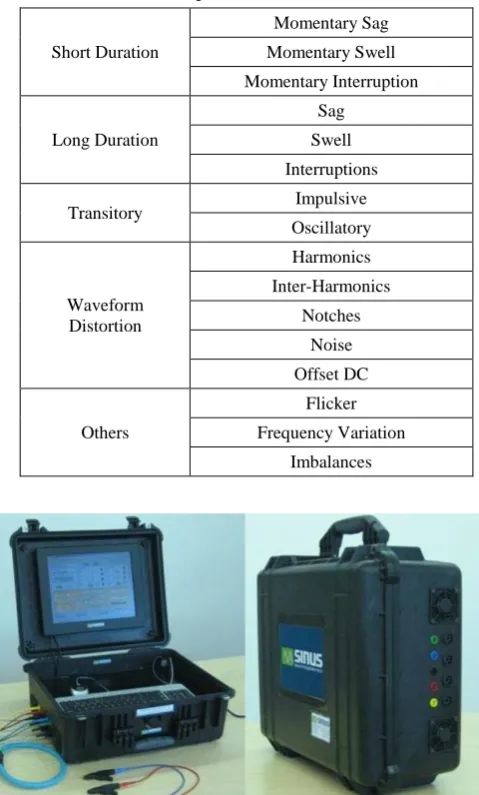
PQ is a term that can have different definitions according to the regulatory entity, e.g., the International Electrotechnical Commission (ICE) or Institute of Electrical and Electronics Engineers (IEEE) [11][14]. The European standard EN 50160, established by the CENELEC (European Committee for Electrotechnical Standardization), is responsible to quantify the limits of all the power quality problems, as well as to define the nominal values for the voltage and frequency in the many European countries [15]. However, it is important to note that this standard is adapted to each country. In the particular case of Portugal, it is referred as NP EN 50160. Table I presents a list of PQ problems and its classification according to the IEEE 1159-2009 standard [16].
B. Power Quality Analyser Systems
Among the several manufacturers of PQA equipment on the market, Fluke, Schneider, Dranetz, Hioki and Chauvin Arnoux are some brands that stand out. All of them present several models in their product portfolio, trying to respond to the diverse needs of the market. The potential of these PQAs is very high, namely in the medium/high range, but they have a high cost, making their use still very restricted. Examples are the Dranetz PQA model PowerXplorer PX5 [17] and the Fluke PQA model 1738 [18]. Aware to this reality, our research group, Group of Energy and Power Electronics (GEPE), from University of Minho, Portugal,
[image:2.595.307.547.219.617.2]has focused, in recent years, on the research and development of PQA solutions. In 2008, under the SINUS project of the GEPE - University of Minho, a PQA prototype was developed [19]. This prototype was based on a micro personal computer with a digital data acquisition board, using software developed in LabVIEW to perform data processing, and providing a graphical user interface. With this solution, the costs have been reduced compared to the equipment available in the market. All the components of this PQA were installed in sturdy carrying case, facilitating the portability and safety of use. Fig. 1 shows the developed PQA prototype under the SINUS project.
Table I. Power quality problems classified according to IEEE 1159–2009.
Short Duration
Momentary Sag
Momentary Swell
Momentary Interruption
Long Duration
Sag
Swell
Interruptions
Transitory Impulsive
Oscillatory
Waveform Distortion
Harmonics
Inter-Harmonics
Notches
Noise
Offset DC
Others
Flicker
Frequency Variation
Imbalances
Fig. 1. Power quality analyser developed by GEPE - University of Minho.
A. Signal Conditioning Board
The signal conditioning board is constituted by several circuits, including the circuit used to adjust the acquired signals from the sensors to the inputs of the ADC, the individual protection circuit for each input channel to prevent damages to the ADC, the individual low-pass filter for each input channel, mainly to prevent undesired noise, and the external ADC, model MAX1320, from the manufacturer Maxim Integrated. This is an 8-channel bipolar ADC with an input voltage range from -5 V to +5 V and with 14 bits of resolution. Fig. 3 shows the developed signal conditioning board.
Developed Power Quality Analyser with Integrated Consumption Monitoring System
Linear and Nonlinear
Loads
Signal Conditioning Board and ADC
Acquisition Board
RTC µSD Card
LCD Raspberry Pi
3B
CYHVS025A CYHVS025A CYHVS025A CYHVS025A
Three-Phase Power Grid
HDMI
[image:3.595.50.290.203.355.2]Ethernet SSI I2C LA 100-P
Fig. 2. Block diagram of the developed electrical energy consumption and power quality analysis monitoring system.
Output to the DSP
ADC MAX1320
Signal Conditioning
Input From Sensores
Fig. 3. Developed signal conditioning board with internal ADC.
B. Signal Processing Board
The data treatment of the output signals of the ADC of the signal conditioning board is performed in the F28M35H52C1 board from Texas Instruments. This board has a system-on-chip (SoC) with a C28 digital signal processor (DSP) and an Advanced RISC Machine (ARM) M3 processor. The DSP has a clock frequency of 150 MHz and two types of memories: a flash memory of 512 kB and three volatile memories, a random access memory (RAM) memory of 36 kB, a shared RAM memory of 64 kB, and an interprocess communications (IPC) message RAM. This DSP also has several interfaces for communication with other systems, including a serial communication interface (SCI), a serial peripheral interface (SPI), and the
inter-integrated circuit (I2C) interfaces. The DSP also has two timers of 32 bits, a floating point unit (FPU), and 18 output enhanced pulse width modulation (ePWM) channels, where 16 of them have high resolution.
The ARM M3 processor of this developing board has a maximum clock frequency of 100 MHz and two types of memories, like the DSP, with the same configuration, except the RAM memory, which has a capacity of 32 kB. This processor has several interfaces for data exchanging with external devices, including, five universal asynchronous receiver transmitter (UART) interfaces, four synchronous serial interfaces (SSI), two I2C and two controller area network (CAN) interfaces. It also has four general-purpose timers and two watchdog timer modules. Besides the aforementioned peripherals, it has an additional interface, the IEEE 802.3 Ethernet 10BASE-T and 100BASE-TX/RX, which is responsible for bidirectional data communication with the Raspberry Pi 3B. The Raspberry Pi is responsible to send control frames and the signal processing board is responsible to answer to these control frames with data frames. In this board, a µSD socket was used to provide extra flash memory through external memory card that supports the file allocation table (FAT) format. This board also has a bus that is responsible to connect some peripheries to the ARM processor or DSP. Such bus is also responsible to connect the Ethernet interface to the ARM M3 processor. In order to integrate the developing board in this project, it was necessary to use a special docking station provided by Texas Instruments, which includes a XDS100 JTAG debugger/programmer.
C. Raspberry Pi 3B and LCD
The graphical user interface (GUI) is an important issue in a PQA system, since it allows exchange of information with the user. In the scope of this project a Raspberry Pi 3 model B connected to a LCD was used in order to execute the code of the graphical user interface. The Raspberry Pi 3B is a credit-card-sized computer platform created by the Raspberry Pi Foundation, which also provides an operating system based in the Debian called Raspbian. This platform integrates a SoC from Broadcom, the BCM2837, which contains a quad-core processor ARM Cortex-A53 with 64 bits with a frequency of 1.2 GHz, a Bluetooth Low Energy 4.1 module, and an IEEE 802.11n wireless LAN module. This platform also has a dual-core VideoCore IV multimedia graphics processing unit (GPU) co-processor, which is constituted by a 1 GB RAM, four USBs, 40 GPIO, an HDMI interface, an Ethernet 10/100 BaseT interface, as well as SPI and I2C interfaces. Although this platform includes several peripherals, it is very compact, with a small size of 85 mm length and 56 mm large.
The graphical user interface of the developed monitoring system was implemented using the Qt-Linux application framework installed in an Ubuntu operating system. The cross-compile method was used in order to compile the code in the Ubuntu and to create an executable file to be used directly in the Raspberry Pi platform. This compiling method was used since the selected platform does not support all the Qt-Linux versions and the processing speed is inferior, comparing with a desktop computer.
[image:3.595.55.284.395.591.2]monitoring system is performed through the use of a Lilliput LCD. This LCD has a 7-inch screen with a 16:9 aspect ratio and capacity to reproduce images with a maximum resolution of 1080p. This LCD has several interfaces for video connections, where two of them are digital inputs, HDMI (High-Definition Multimedia Interface) and DVI (Digital Visual Interface), and two are analogic inputs, VGA (Video Graphics Array) and composite video.
D. Final Hardware Prototype
Fig. 4 shows the final hardware prototype of the developed PQA, including all of the aforementioned circuits. As it can be seen, all the developed hardware is included inside a box, except the current sensors and the LCD.
Voltage Sensors
Signal Conditioning
Board DSP LCD
Raspberry Pi 3B
Power Supply
Fig. 4. Developed power quality analyser with integrated electrical energy consumption monitoring system.
E. Software
The software created for the power quality analyser is composed of several distinct components, which are dependent on the platforms for which they were created. Inside the signal acquisition board, the signal acquisition is performed by the ARM M3 processor, whereas the calculation of all the power quality parameters is performed by the C28 DSP. On the other hand, the GUI is executed in the Raspberry Pi. The Code Composer Studio (CCS) integrated development environment (IDE) was used for the software development of both acquisition board processors, while the software development for the GUI was made using Qt-Linux.
F. Data Communication
The data exchange between the ARM M3 processor and the Raspberry Pi 3 model B is performed using an Ethernet interface. In this project a point-to-point connection was used. For such communication it was defined that the processor presented in the signal processing board is the server and the Raspberry Pi is the client. Therefore, it was necessary to implement a socket complemented with an IP address (Internet Protocol) and a gate.
In this project it was defined that the client implements the user interface. The client sends data requests to the server and waits the answer. In case of error, a new request
is made. In order to regulate the communication between the client and the server, a command frame with only two bytes was created, where the first byte represents the requested information and the second byte is used to provide information to the server about the end of the command frame. This command frame is sent from the client to the server.
[image:4.595.49.285.237.433.2]Since the ARM M3 processor was defined as the server, it needs to be always available in order to answer to all the data requests from the Raspberry Pi 3B. The server provides answers to the client requests with a frame structure which depends of the requested content, composed by an initial control byte followed by a set of data bytes. The initial byte is equal to the first byte sent by the client during the request, in order to inform the client about the type of frame that it is receiving. The data field can have different formats and sizes, depending on the type of information that the server is sending. The frame sent by the server that answers to the request of the three voltage data points follows the format identified in Fig. 5, where for each signal it is necessary to accommodate 256 bytes, corresponding to 128 samples, as well as additional 10 bytes with information about the RMS value, mean value, maximum value, and the total harmonic distortion (THD). The frame sent by the server in answer to the request of the three current data points is similar, only changing the voltages by currents.
Fig. 5. Data frame format for the voltages of the three phases.
IV. RESULTS AND DISCUSSION
This section presents the functionalities of the developed PQA and the corresponding experimental results, which were obtained with the PQA connected to the power grid through transformer with a nominal RMS output voltage of 100 V and considering two operation scenarios: (1) with a three-phase balanced linear load; (2) with a nonlinear load.
A. Case 1: Tests with Linear Load
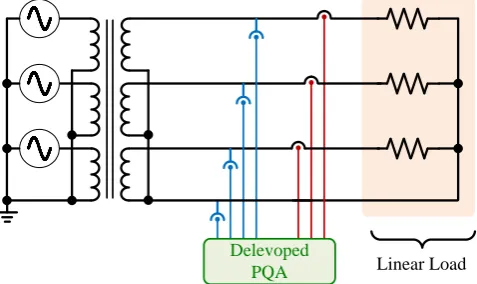
In this case a pure resistive load was used in order to obtain unitary power factor and to consume only active power from the power grid. Fig. 6 shows the electrical diagram of evaluation setup used.
Linear Load
[image:4.595.308.547.602.744.2]Delevoped PQA
Fig. 6. Electrical diagram of the setup used with a linear load.
the RMS value of the three voltages is very similar and the THD of the three voltages do not exceed the limit of 8% established by the NP EN 50160 standard. In the Scope menu it is also possible to see the three currents of the three phases, as well as to select a combination of voltages and currents, for instance, to select only the voltage and current in phase A. Several other tests with linear loads were performed and produced the expected outcomes.
Fig. 7. Scope menu: Waveforms of the three-phase voltages using a linear load.
B. Case 2: Tests with Nonlinear Load
In this case a nonlinear load was used. For such purpose a nonlinear single-phase load was connected to the phase A, as shown in Fig. 8, replacing the original linear load.
Delevoped
[image:5.595.45.292.152.291.2]PQA Nonlinear Load
Fig. 8. Electrical diagram of the setup used with a nonlinear load.
Due to the nonlinear load and the used transformer, the voltage in phase A presents a high value of THD. Fig. 9 shows the three phase voltages in the Scope menu of the developed equipment.
Fig. 10 shows the four currents of the system, i.e., the current in each one of the three phases and the neutral current. As it can be seen the waveforms of the currents in phases B and C are very similar to the waveforms of the voltages in the same phases. On the other hand, the current in phase A presents a higher value of THD resulting. The unbalance caused by the nonlinear load results in a neutral current with high RMS and THD values.
The Harmonics menu of the developed equipment was also tested. Fig. 11 shows the amplitudes of the harmonics and the THD values of the three phase currents. As expected, the THD in phase A (THDA% = 25.5%) is greater than the THD in the phases B (THDB% = 2.7%) and C (THDC% = 2.4%).
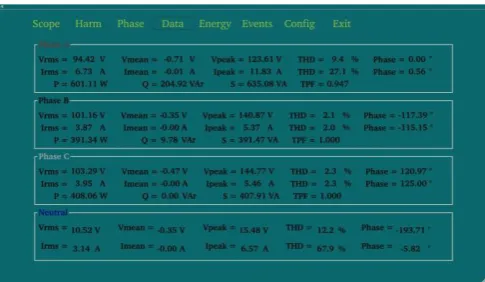
The Data menu was also tested. Fig. 12 shows the value of all the measured voltages and currents. It is important to
[image:5.595.304.550.277.413.2]note that there are other functionalities that were implemented and validated, such as the Energy, PQ Events and Phasor menus, but due to space restrictions in this paper, it is not possible to present these results.
[image:5.595.51.287.386.525.2]Fig. 9. Scope menu: Waveforms of the three-phase voltages using a nonlinear load.
Fig. 10. Scope menu: Waveforms of the three phases currents and neutral current using a nonlinear load.
Fig. 11. Harmonics menu: Amplitudes of the harmonics and THD values of the three phases currents.
[image:5.595.304.551.450.587.2] [image:5.595.305.548.618.759.2]V. CONCLUSION
The economic losses resulting from power quality (PQ) problems in industries are very high, and, for this reason, this issue is more than ever a matter of great concern. Power quality analysers (PQAs) are important equipment for the engineers responsible for electrical installations, allowing the optimization of consumption profiles and the identification of PQ problems, which allow greater assertiveness, preventive maintenance and corrective measures to mitigate PQ problems. In this context, this paper presents the development of a monitoring system for electrical energy consumption and power quality analysis. It also shows several experimental results obtained with this monitoring system, highlighting the different menus available in the implemented graphical user interface. The experimental validation was performed considering a three-phase power grid with both linear and nonlinear loads, in order to verify the correct operation of the developed power quality monitoring system.
REFERENCES
[1] S. Bhattacharyya, S. Cobben, “Consequences of Poor Power Quality – An Overview”, Andreas Eberhard (Ed.), InTech, pp.3-24, Apr. 2011. [2] H. D. Keulenaer, “The Hidden Cost of Poor Power Quality”,
Leonardo Energy – Power Quality, pp.1-7, Oct. 2003.
[3] Fluke, “The Costs of Poor Power Quality”, Application Note, 2012. [4] M. H. J. Bollen, R. D. S. Djokic, “Power Quality Concerns in
Implementing Smart Distribution-Grid Applications”, IEEE Transactions on Smart Grid, vol.8, no.1, pp.391-399, Jan. 2017. [5] S. Yan, S.-C. Tan , C.-K. Lee, “Use of Smart Loads for Power Quality
Improvement”, IEEE Journal of Emerging and Selected Topics in Power Electronics, vol.5. no.1, pp.504-512, Dec. 2016.
[6] IEE Standard 1159–1995, “Recommended Practice for Monitoring Electric Power Quality”, 1995.
[7] R. C. Dugan, M. F. MacGranaghan, H. W. Beaty, “Electrical Power Systems Quality”, New York: MacGraw - Hill, 1996.
[8] C. Sankaran, “Power Quality”, CRC Press LLC, 2002.
[9] R. Targosz “Leonardo ENERGY E-Learning Program on Power Quality”, Modern Electric Power Systems, Wroclaw, Poland 2010.
[10] J. Batista, J. S. Martins, J. L. Afonso, “Low-Cost Digital System for Power Quality Monitoring”, ICREPQ’03 – International Conference on Renewable Energies and Power Quality, Vigo, Spain, Apr. 2003.
[11] R. Alves, P. Neves, D. Gonçalves, J. G. Pinto, J. Batista, J. L. Afonso, “Electric Power Quality Monitoring Results in Different Facilities”, IEEE IECON Industrial Electronics Conference, pp.3666-3671, Nov. 2009.
[12] J. Batista, J. S. Martins, J. L. Afonso, “Low-Cost Power Quality Monitor Based on a PC”, IEEE ISIE International Symposium on Industrial Electronics, Jun. 2003.
[13] M. H. J. Bollen, I. Y. H. Gu, “Signal Processing of Power Quality Disturbances”, Wiley, vol. XXXIII, no. 2. 2006.
[14] S. Khalid, B. Dwivedi, “Power quality issues, problems, standards and their effects in industry with corrective means,” Int. J. Adv. Eng. Technol., vol. 1, no. 2, pp. 1–11, 2011.
[15] CENELEC, “Características da tensão fornecida pelas redes de distribuição pública de energia eléctrica”, EN 50160, 2nd edition, Dec. 2001.
[16] IEEE, “1159-2009 - IEEE Recommended Practice for Monitoring Electric Power Quality” PQ-1159_WG - Working Group for Monitoring Electric Power Quality, 2009.
[17] Dranetz Technologies, “PowerXplorer PX5 - USER’S GUIDE,” 2003. [Online]. Available: http://www.dranetz.com/. [Accessed: 15-Sep-2016].
[18] Fluke Corporation, “Fluke 1736 and 1738 Three-Phase Power Loggers KEY - TECHNICAL DATA,” 2015. [Online]. Available: http://www.fluke.com/. [Accessed: 01-Oct-2016].