For decades, consumers have considered
tender-ness as the most important meat quality attribute (Ouali et al., 2006; Erkens et al., 2009). To increase meat tenderness by traditional selective breeding is a difficult task, since meat quality is controlled by polygenes (Bendixen, 2005). However, the marker-assisted selection based on investigating the as-sociations of candidate gene polymorphism and traits has advantages for selection of meat quality traits (Wimmers et al., 2005). The intramuscular fat content (IMF) or marbling improves meat tender-ness by reducing bulk density and decreasing the strength of the connective tissue (Savell and Cross, 1988), and has beneficial effects on the taste quality and juiciness (Stupka et al., 2008). Therefore the genes involved in fatty acid metabolism are usually considered as potential candidate genes for meat tenderness.
Fatty acid binding proteins play an important role in the regulation of lipid and glucose homeostasis by interaction with peroxisome proliferator
acti-vated receptors (PPARs) (Adida and Spener, 2006). Specifically, the fatty acid binding protein 4 (FABP4) fatty acid complex activates the peroxisome prolif-erator-activated receptor-γ (PPAR-γ) isoform, which in turn regulates transcription of FABP4 (Damcott et al., 2004). FABP4 was proposed as a potential candi-date gene for obesity as it was located within a quan-titative trait locus (QTL) region for serum leptin levels in mice (Ogino et al., 2003). In addition, FABP4 protein content could be a marker of longissimus thoracis muscle (LT) IMF content accretion in pigs (Gerbens et al., 2001; Damon et al., 2006; Mercadé et al., 2006). Obviously, FABP4 has become a strong candidate gene for fat metabolism. However, the ef-fect of FABP4 on fat deposition and meat quality traits in sheep has not been reported yet.
Here, we cloned the cDNA of FABP4 gene and ap-plied the polymerase chain reaction-single strand conformation polymorphism (PCR-SSCP) assay to assess the association of the single nucleotide poly-morphisms (SNP) of the FABP4 gene with the LT
Supported by the Chinese Agriculture Ministry for Adjusting the Agricultural Frame (Project No. 05-07-03B).
The FABP4 gene polymorphism is associated with meat
tenderness in three Chinese native sheep breeds
Q.L. Xu, G.W. Tang, Q.L. Zhang, Y.K. Huang, Y.X. Liu, K. Quan, K.Y. Zhu,
C.X. Zhang
Department of Animal Science and Technology, Zhengzhou College of Animal Husbandry Engineering, Zhengzhou, Henan, P.R. China
ABSTRACT: The aim of this study was to assess the association of single nucleotide polymorphisms (SNP) of sheep fatty acid binding protein 4 (FABP4) gene with longissimus thoracis muscle (LT) meat quality traits in sheep. The FABP4 cDNA was cloned by RT-PCR method, and the sequence analysis showed that the open reading frame of sheep FABP4 is 399 bp and codes 132 amino acids. A mutation (A/G) detected in intron 1 of FABP4 gene was studied in 286 lambs of three Chinese native sheep breeds by PCR-SSCP procedure. Significant statistical association results revealed that AA genotype conferred higher tenderness (P < 0.05), muscle marbling score (P < 0.05) and intramuscular fat content (IMF; P < 0.05). Thus we suggested that the genotype AA could be regarded as a molecular marker for LT meat tenderness and IMF content in sheep.
IMF, meat tenderness and other important carcass quality traits in three Chinese native sheep breeds.
MATeRiAl And MeThodS
Sheep populations
Three Chinese native sheep breeds, Small-tailed Han sheep (STH, 96 lambs), Tan sheep (TS, 94 lambs) and Inner Mongolia sheep (IMS, 96 lambs), were obtained from several farms. There was no pedigree relationship among lambs within the breed, and no genetic communication history in three sheep breeds. Sixty-days-old lambs were col-lected, vaccinated, branded and maintained on the laboratory farm of the College of Animal Science and Technology, Northwest A and F University with the uniform feeding and management conditions.
Meat quality traits and sampling
At 90 days of age, all lambs were slaughtered after overnight fasting. Body weight, hot carcass weight, loin-eye area, net meat percentage and fat thick-ness were recorded at slaughter by the methods described by Dickerson et al. (1972). Subcutaneous white adipose tissue samples were frozen in liquid nitrogen and stored at –80°C for the FABP4 gene isolation. Blood samples (10 ml) were collected in heparin at exsanguination and stored at –80°C. Fresh
samples of LT muscle between the 4th and 6th rib were removed from left carcasses. LT meat colour and shear force value were determined according to Fiems et al. (2000). The pH values of LT meat were measured with a pH meter after slaughter within 45 min. Drip loss rate was determined using the method described by Honikel (1998). Meat marbling score was measured according to Xing and Deng (1999). IMF was extracted from about 10 to 20 g of LT ac-cording to the method described by Bligh and Dyer (1959) using chloroform and methanol.
FABP4 gene isolation and sequencing
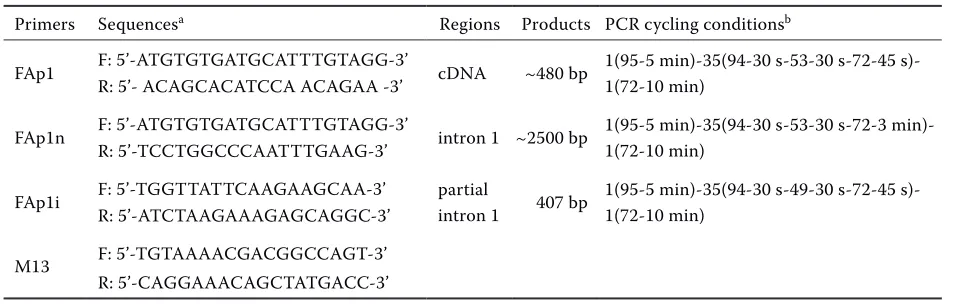
A putative sheep FABP4 cDNA sequence was identified using the Bos taurus FABP4 complete coding sequence (accession No. NM_174314) to search Ovis aries expressed sequence tags (EST) da-tabase. Based on the putative sequences, the primer pair FAp1 (Table 1) was designed to amplify the FABP4 cDNA coding sequence.
[image:2.604.71.551.538.690.2]Total RNA was extracted from subcutaneous white adipose tissue with Trizol reagent according to the manufacturer’s instructions (Invitrogen Inc., Carlsbad, CA). Then, 2 μg of total RNA, 10 pmol of oligo(dT) 18 primer (TaKaRa, Dalian, China) and 200 U of MMLV reverse transcriptase (Invitrogen Inc., Carlsbad, CA) were used to synthesize the cDNA first strand. The amplification of FABP4 gene was carried out according to the conditions listed in Table 1 with FAp1 primers. The obtained
Table 1. The primer sequences and amplification conditions
Primers Sequencesa Regions Products PCR cycling conditionsb
FAp1 F: 5’-ATGTGTGATGCATTTGTAGG-3’ cDNA ~480 bp 1(95-5 min)-35(94-30 s-53-30 s-72-45 s)-1(72-10 min) R: 5’- ACAGCACATCCA ACAGAA -3’
FAp1n F: 5’-ATGTGTGATGCATTTGTAGG-3’ intron 1 ~2500 bp 1(95-5 35(94-30 s-53-30 s-72-3 min)-1(72-10 min)
R: 5’-TCCTGGCCCAATTTGAAG-3’
FAp1i F: 5’-TGGTTATTCAAGAAGCAA-3’ partial
intron 1 407 bp
1(95-5 min)-35(94-30 s-49-30 s-72-45 s)-1(72-10 min)
R: 5’-ATCTAAGAAAGAGCAGGC-3’
M13 F: 5’-TGTAAAACGACGGCCAGT-3’ R: 5’-CAGGAAACAGCTATGACC-3’ aF = forward; R = reverse
bcycles (time)-cycles (denaturation time-annealing time-elongation
temperature-time)-cycles (elongation temperature-time)
PCR products were cloned into pMD18-T
plas-mid vectors (TaKaRa, Dalian, China) and positive clones were sequenced with M13 forward and re-verse primers (Table 1). Plasmid transformation, isolation and other standard molecular biology techniques were performed as described earlier (Sambrook et al., 1989).
Genotyping
The intron 1 fragment of FABP4 was amplified with FAp1n primer pair (Table 1), which was designed according to the sequence of sheep cDNA and Bos taurus genomic DNA (accession No. NC_007312). The protocols for cloning and sequencing of FAp1n amplicon were the same as for the cDNA isolation.
DNA was extracted by the phenol/chloroform pu-rification method from blood samples (Sambrook et al., 1989). To amplify partial intron 1 of FABP4 gene, the FAp1i primers (Table 1) were designed based on the sequence of intron 1. The PCR products were then analyzed by electrophoresis for SSCP ac-cording to the standard protocol (Sambrook et al., 1989). Silver staining was carried out as described by Bassam et al. (1991). Several PCR products showing different band patterns on SSCP gel were subcloned to T-vector and sequenced from both directions.
Statistical analyses
Genotype distribution for Hardy-Weinberg equi-librium was tested by the method described by Falconer and Mackay (1996). The statistical soft-ware SAS 8.0 (GLM procedure, SAS 8.0 softsoft-ware, SAS Institute, Cary, NC) was used to analyze the relationship between genotypes and meat quality traits by means of the least-squares method. Allele frequencies were tabulated and compared by χ2 analysis using PROC FREQ.
The model used to analyze the data was:
Yijk = µ + Si + Bj + Gk + bx + Eijk where:
Yijk = observation value of the trait µ = population mean
Si = fixed effect of sex Bj = effect of j-th breed Gk = effect of k-thgenotype
b = regression coefficient of slaughter day Eijk = random error
[image:3.604.83.486.463.684.2]The effects of sire, farm, feeding and age were not built into the linear model, because all lambs were raised on the same farm from 60 to 90 days of age.
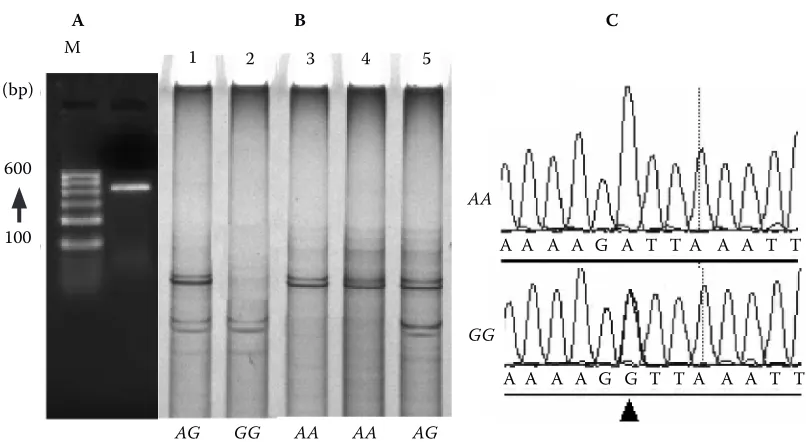
Figure 1. The Polymorphisms analysis of FAp1i fragment
Penal A is the electrophoresis examination of amplification product 407 bp of FAp1i primers;
Penal B is the PCR-SSCP band pattern of FAp1i amplicons. Four bands were separated on the gel,
and three haplotypes were detected based on the bands mobility and the sequenced results; from
lane 1 to 5, the genotypes are AG, GG, AA, AA and AG, respectively; penal C is the
demonstrations of sequenced results; The arrow indicated the mutation sites
AG GG AA AA AG
A A A A G G T T A A A T T A A A A G A T T A A A T T
A B C
M 1 2 3 4 5
(bp)
600
100
AA
GG
ReSulTS
Sequence analysis of cdnA of sheep FABP4
Sequencing demonstrated that the RT-PCR am-plicon of FAp1 primer is 467 bp, containing an open reading frame of 399 bp and coding 132 amino ac-ids. The sequence was submitted to Genbank (ac-cession No. EU301804). The putative amino acid sequence of Ovis aries FABP4 protein showed 86%, 86%, 93%, 84%, 72% and 74% identity, with the FABP4 amino acid sequences of the Mus musculus, Homo sapiens, Bos taurus, Sus scrofa, Gallus gal-lus, Anas platyrhynchos, respectively, confirming
that the RT-PCR product in this study is authentic sheep FABP4 cDNA.
Polymorphism of sheep FABP4
In the FAp1i amplicons, a SNP in intron 1 was found which was located at nt 209 (accession No. HM061165: 282 A > G) counted from the first nu-cleotide of intron 1, but no restriction site for endo-nuclease was created or abolished. Three genotypes were detected in all individuals of the three Chinese native sheep breeds (Figure 1). AA genotype quencies were 0.52, 0.40 and 0.50 and A allele fre-Table 2. FABP4 gene Genetic diversity of FAp1i loci in the three sheep populations
Index STH TS IMS
Individuals 96 94 96
Individuals of AA genotype (frequency) 50 (0.52) 38 (0.40) 48 (0.50) Individuals of AG genotype (frequency) 30 (0.31) 32 (0.34) 20 (0.21) Individuals of GG genotype (frequency) 16 (0.17) 24 (0.26) 28 (0.29)
Frequency of allele A1 0.68 0.57 0.60
Frequency of allele G1 0.32 0.43 0.40
P value (locus equilibrium χ2 test) < 0.01 (disequilibrium) < 0.01 (disequilibrium) < 0.01 (disequilibrium)
[image:4.604.76.540.100.232.2]1allele frequency was not significantly different between breeds (P = 0.988, by χ2 tested)
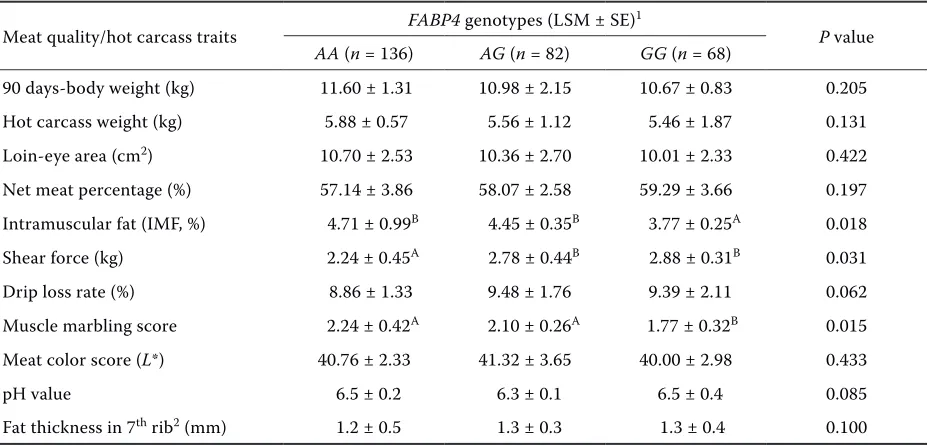
Table 3. The associations of FABP4 genotypes with LM meat quality and hot carcass traits in the sheep populations
Meat quality/hot carcass traits FABP4 genotypes (LSM ± SE) 1
P value AA (n = 136) AG (n = 82) GG (n = 68)
90 days-body weight (kg) 11.60 ± 1.31 10.98 ± 2.15 10.67 ± 0.83 0.205 Hot carcass weight (kg) 5.88 ± 0.57 5.56 ± 1.12 5.46 ± 1.87 0.131 Loin-eye area (cm2) 10.70 ± 2.53 10.36 ± 2.70 10.01 ± 2.33 0.422 Net meat percentage (%) 57.14 ± 3.86 58.07 ± 2.58 59.29 ± 3.66 0.197 Intramuscular fat (IMF, %) 4.71 ± 0.99B 4.45 ± 0.35B 3.77 ± 0.25A 0.018 Shear force (kg) 2.24 ± 0.45A 2.78 ± 0.44B 2.88 ± 0.31B 0.031 Drip loss rate (%) 8.86 ± 1.33 9.48 ± 1.76 9.39 ± 2.11 0.062 Muscle marbling score 2.24 ± 0.42A 2.10 ± 0.26A 1.77 ± 0.32B 0.015 Meat color score (L*) 40.76 ± 2.33 41.32 ± 3.65 40.00 ± 2.98 0.433
pH value 6.5 ± 0.2 6.3 ± 0.1 6.5 ± 0.4 0.085
Fat thickness in 7th rib2 (mm) 1.2 ± 0.5 1.3 ± 0.3 1.3 ± 0.4 0.100
1least square means (LSM) estimated for each polymorphism was indicated with its standard error (SE)
2subcutaneous fat thickness was measured at the 7th rib interface perpendicular to the outside surface of the fat organism at the point three-fourths the length of the longissimus muscle from its chine bone end
[image:4.604.77.542.480.703.2]quencies were 0.68, 0.57 and 0.60 in STH, TS and
IMS, respectively (Table 2).
effects of genotypes on meat quality traits
As seen in Table 3, the FABP4 A allele had a significant effect on IMF (P < 0.05), shear force (P < 0.05) and marbling score (P < 0.05). Compared with the GG genotype, the AA genotype conferred significantly higher IMF and marbling score but lower shear force. Significant differences were also observed between AG and GG genotypes in IMF and marbling score. However, the FABP4 A allele had no significant effect on 90-day body weight, hot carcass weight, loin-eye area, net meat percentage, drip loss rate, meat colour score, pH value and fat thickness on the 7th rib (P > 0.05).
diSCuSSion
This study reported the isolation of 467-bp cDNA of the sheep FABP4 gene, and a SNP in intron 1 (A > G) was detected in three Chinese sheep breeds. This SNP was significantly associated with LT IMF, marbling score and tenderness in sheep.
There are many papers concerned with FABP4 as a candidate gene for fat traits of meat quality in pigs, and FABP4 shows high nucleotide variability (Nechtelberger et al., 2001; Mercadé et al., 2006; Ojeda et al., 2006). A mutation of the sheep FABP4 gene, which is located in intron 1 at nt 209 was associated with meat quality traits in our study. The A allele had a positive effect on IMF, mar-bling score and tenderness of LT, which is con-sistent with the results documenting that higher IMF content was related with higher tenderness (Fiems et al., 2000) and higher marbling score was related with lower shear force (Huff-Lonergan et al., 2002). However, no correlation was found between tenderness and subcutaneous fat content (Riley et al., 1983). Statistical results also indicated that the genotypes had no significant association with hot carcass traits including hot carcass weight, loin-eye area, and net meat percentage (Table 3). It indicates that the genetic marker FABP4 cannot be recom-mended for selection for growth and carcass traits in sheep breeding. The same result was obtained in the study of the FABP4 polymorphism effect on porcine meat production traits (Nechtelberger et al., 2001).
Most SNPs in introns or silent mutations do not have a direct impact on production traits. To the best of our knowledge, the SNP of FABP4 intron 1 was first detected in the sheep population in the present study, and this SNP was associated with meat quality traits. These results could be due to the following reasons: (1) other mutations occurred within 3’ or 5’ flanking regulatory regions and these mutations have not been detected yet; (2) the SNP indirectly affected meat quality traits by being in linkage disequilibrium with another polymorphism that directly influenced the quantitative traits. This hypothesis is supported by the following facts: the porcine FABP4 is closely associated to the FAT1 locus on chromosome 4, and the FAT1 has an important effect on meat marbling and growth (Mercadé et al., 2006). Furthermore, in-tegrated analyses of both genetic map and radiation hybrid (RH) map indicated that the bovine FABP4 gene falls into the QTL interval for marbling on chromosome 14 (Michal et al., 2006). Interestingly, the same functional QTL has been detected on sheep chromosome 9, which is homologous to bo-vine chromosome 14 (Barillet et al., 2005). Hence, future studies should focus on mapping the sheep FABP4 gene and define the genetic basis of FABP4 effects on sheep meat quality traits.
In conclusion, we cloned the full coding region of the sheep FABP4 gene and studied the relationships between FABP4 polymorphism and 11 meat pro-duction traits in 286 lambs. The A allele of FABP4 had a positive effect on sheep meat tenderness. Hence we suggest that the AA genotype could be regarded as a molecular marker for meat tender-ness and IMF in sheep.
RefeRenCeS
Adida A., Spener F. (2006): Adipocyte-type fatty acid-binding protein as inter-compartmental shuttle for peroxisome proliferators activated receptor γ agonists in cultured cell. Biochimica et Biophysica Acta. Mo-lecular and Cell Biology of Lipids, 1761, 172–181. Barillet F., Arranz J.J., Carta A. (2005): Mapping
quanti-tative trait loci for milk production and genetic poly-morphisms of milk protein in dairy sheep. Genetics, Selection, Evolution, 37, S109–S123.
Bassam B.J., Caetano-Anollés G., Gresshoff P.M. (1991): Fast and sensitive silver staining of DNA in polyacry-lamide gels. Analytical Biochemistry, 196, 80–83. Bendixen E. (2005): The use of proteomics in meat
Bligh E.G., Dyer W.J. (1959): A rapid method of total lipid extraction and purification. Canadian Journal of Bio-chemistry and Physiology, 37, 911–917.
Damcott C.M., Moffett S.P., Feingold E., Barmada M.M., Marshall J.A., Hamman R.F., Ferrell R.E. (2004): Genetic variation in fatty acid-binding protein-4 and peroxisome proliferator-activated receptor gamma interactively in-fluence insulin sensitivity and body composition in males. Metabolism - Clinical and Experimental, 53, 303–309. Damon M., Louveau I., Lefaucheur L., Lebret B., Vincent
A., Leroy P., Sanchez M.P., Herpin P., Gondret F.(2006): Number of intramuscular adipocytes and fatty acid bind-ing protein-4 content are significant indicators of intra-muscular fat level in crossbred Large White × Duroc pigs. Journal of Animal Science, 84, 1083–1092. Dickerson G.E., Glimp H.A., Tuma H.J., Gregory K.E. (1972):
Breeds growth and carcass characteristics of ram lambs of seven genetic resources for efficient meat production in sheep. Journal of Animal Science, 34, 940–951. Erkens T., Rohrer G.A., Van Zeveren A., Peelman L.J.
(2009): SNP detection in the porcine PPARGC1A pro-moter region and 3’UTR, and an association analysis in a Landrace – Duroc – Yorkshire population. Czech Jour-nal of Animal Science, 54, 408–416.
Falconer D.S., Mackay T.F.C. (1996): Introduction to Quan-titative Genetics. 4th ed. Longman Group Essex, Essex, UK, 119.
Fiems L.Q., De Campeneere S., De Smet S.,Van de Voorde G., Vanacker G.M., Boucqué C.V. (2000): Relationship between fat depots in carcasses of beef bulls and effect on meat colour and tenderness. Meat Science, 56, 41–47. Gerbens F., Verburg F.J., Van Moerkerk H.T., Engel B., Buist
W., Veerkamp J.H., te Pas M.F. (2001): Associations of heart and adipocyte fatty acid-binding protein gene ex-pression with intramuscular fat content in pigs. Journal of Animal Science, 79, 347–354.
Honikel K.O. (1998): Reference methods for the assessment of physical characteristics of meat. Meat Science, 49, 457–477.
Huff-Lonergan E., Baas T.J., Malek M., Dekkers J.C., Prusa K., Rothschild M.F. (2002): Correlations among selected pork quality traits. Journal of Animal Science, 80, 617–627. Mercadé A., Pérez-Enciso M., Varona L., Alves E., Noguera
J.L., Sánchez A., Folch J.M. (2006): Adipocyte fatty-acid binding protein is closely associated to the porcine FAT1 locus on chromosome 4. Journal of Animal Science, 84, 2907–2913.
Michal J.J., Zhang Z.W., Gaskins C.T., Jiang Z. (2006): The bovine fatty acid binding protein 4 gene is significantly associated with marbling and subcutaneous fat depth in Wagyu × Limousin F2 crosses. Animal Genetics, 37, 400–402.
Nechtelberger D., Pires V., Soolknet J., Brem G., Mueller M., Mueller S. (2001): Intramuscular fat content and ge-netic variants at fatty acid-binding protein loci in Aus-trian pigs. Journal of Animal Science, 79, 2798–2804. Ogino T., Moralejo D.H., Kose H., Yamada T., Matsumoto
K. (2003): Serum leptin concentration is linked to chro-mosomes 2 and 6 in the OLETF rat, an animal model of type 2 diabetes with mild obesity. Mammalian Genome, 14, 239–244.
Ojeda A., Rozas J., Folch J.M., Pérez-Enciso M. (2006): Un-expected high polymorphism at the FABP4 gene unveils a complex history for pig populations. Genetics, 174, 2119–2127.
Ouali A., Herrera-Mendze C.H., Coulis G., Becila S., Boud-jellal A., Aubry L., Sentandreu M.A. (2006): Revisiting the conversion of muscle into meat and the underlying mechanisms. Meat Science, 74, 44–58.
Riley R.R., Savell J.W., Murphey C.E., Smith G.C., Stiffler D.M., Cross H.R. (1983): Palatability of beef from steers and young bull carcass as influenced by electrical stimu-lation, subcutaneous fat thickness and marbling. Journal of Animal Science, 56, 592–597.
Sambrook J., Fritsch E.F., Maniatis T. (1989): Molecular Cloning: A Laboratory Manual. 2nd ed. Cold Spring Har-bor LaHar-boratory Press, New York, USA.
Savell J.W., Cross H.R. (1988): The role of the fat in the palatability of beef, pork, and lamb. In: Designing Foods. Animal Product Options in the Marketplace. National Academy Press, Washington, USA, 345–355.
Stupka R., Čítek J., Šprysl M., Okrouhlá M., Kureš D., Líkař K. (2008): Effect of weight and sex on intramus-cular fat amounts in relation to the formation of selected carcass cuts in pigs. Czech Journal of Animal Science, 53, 506–514.
Wimmers K., Murani E., Schellander K., Ponsuksili S. (2005): Combining QTL and expression-analysis: identification of functional positional candidate genes for meat quality and carcass traits. Archiv Tierzucht, 48, 23–31.
Xing Y.Z., Deng Y.C. (1999): Principle and Method of Swine Testing. Chinese Agriculture Press, Beijing, China.
Received: 2009–08–18 Accepted after corrections: 2010–08–26
Corresponding Author
Dr. C.X. Zhang, Zhengzhou College of Animal Husbandry Engineering, Department of Animal Science and Technology, No. 16 Beilin Road, Zhengzhou, 450 011 Henan, P.R. China