Abstract— Building an ontology resource network using grid computing is one method to exploit the sparsely distributed ontology resources. Grid computing technology provides merit on security issues and ease of controlling the resources. However, problems on resource discovery and the effectiveness in managing and provisioning the various scattered grid resources exist. We addressed these problems with the construction of a semantic grid service which automatically provides the optimal required grid resources, and the adaption of the notion of Virtual Organization (VO). The semantic grid service consists of various VOs, and the sub-ontology extraction and tailoring application was used as a proof-of-concept. The processing of the application was analyzed in order to verify the workability of the system.
Index Terms—Semantic Grid, Sub-ontology Tailoring, Grid Application
I. I NTRODUCTION
ne method to exploit the sparsely distributed ontology resources includes the construction of a grid computing environment using these ontology resources. Grid computing enables to exploit systematically these distributed resources and to increase the processing throughput. Grid computing provides improvement in security and control of resources.
However, the problem of using a grid network and the problem of exploiting ontology resources exists. The first problem pertains to the resource discovery problem [1,2,3].
With the vast resources on the grid network, it becomes fairly difficult to grasp the required resources. The notion of Virtual Organization (VO) which bundles two or more resources (real or virtual) defines a group and is considered a viable approach.
However, to manage the ontology resources using only the indexing service of the Globus Toolkit in the VO is insufficient. In grid computing, the scheduler describes the job for each node. If the information or composition about the nodes to be used is insufficient, it will become difficult to perform the required job and produce the expected results.
Therefore, a means to provide detailed information about the nodes is sought.
The second problem pertains to the scattered and remote nodes on a grid network. If an application requires a collection of these nodes, which are also performing other processing at the same time, will result in slow or decrease
performance and/or throughput. For one sub-ontology search, what can be done is to search for the required node, conduct the processing locally and then transmit the result to the user.
However, when two or more required nodes are involved and connecting them altogether will incur large delay contributing to performance degradation.
In this paper, we describe the construction of the semantic grid service in which a server automatically selects the optimal nodes even if the user did not fully describe the required nodes to the scheduler. The grid application using sub-ontology tailoring technology in extracting the required and relevant ontology information was developed.
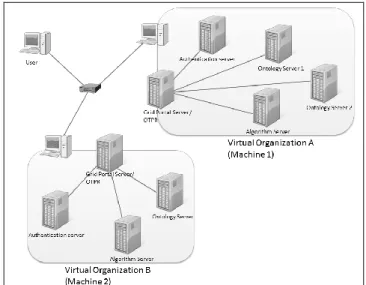
We realized the above by building a semantic grid service which consists of two VOs and executed onto a grid application as a proof-of-concept.
In the following, section II describe some related work, while section III shows compositions and example of semantic grid service. Section IV describe the constructed environment with VOs, and analyze the constructed environment using sub-ontology extraction/tailoring application service in section V. Section VI describe our concluding remarks and future work.
II. R ELATED W ORKS
Previous work on semantic based resource discovery and matching, i.e., A New Grid Resource Discovery Framework [4] proposed a novel semantic-based scalable decentralized grid resource discovery framework. It describes three related technologies, namely: JXTA, P2P, Ontology and Intelligent Agent. We adopted the same technologies in our service discovery. These technologies were further applied for resource discovery for large-scale semantic grid environment.
III. S EMANTIC G RID S ERVICE A. Grid Service
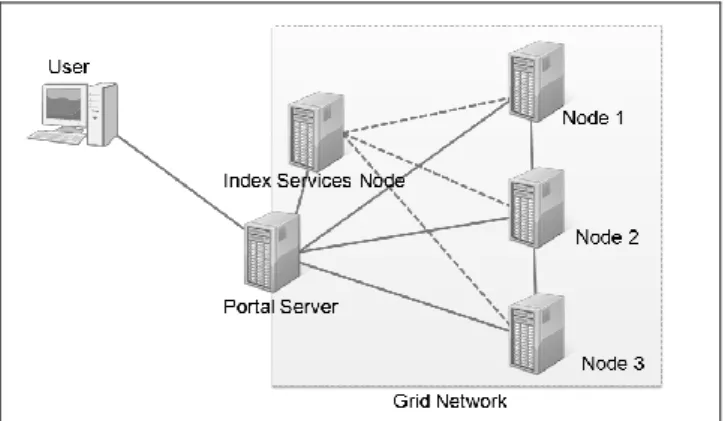
In this paper, a service which access the node on a grid network from a web site application, and enable it to perform jobs, such as file transmission and calculation processing, is defined as a grid service.
A user accesses a web application through a web browser, and can use the grid easily because beforehand, an administrator or a user defines the processing using the grid network.
Construction and Analysis of a Semantic Grid Service for Large-scale Environment
Toshihiro Uchibayashi
†, Bernady O. Apduhan
‡, Norio Shiratori
*O
†‡
Faculty of Information Science, Kyushu Sangyo University, Fukuoka, Japan
*