Application of Sensing & Actuation for Online Hybrid
Testing of Structural Control Devices
J. Geoffrey Chase
(1), Kerry J. Mulligan
(1), Rodney B. Elliot
(1), Xiaoqi Chen
(1)John B. Mander
(2)(1)
Department of Mechanical Engineering, University of Canterbury,
Private Bag 4800, Christchurch 8140, New Zealand.
[email protected]
(2)
Department of Civil Engineering, University of Canterbury,
Private Bag 4800, Christchurch 8140, New Zealand.
Abstract
On-line hybrid tests couple virtual structures under dynamic loading with physical sub-structures or devices in a dynamic test rig. The use of sensors and actuators in a closed-loop feedback system maintains the dynamic equilibrium of the overall system comprising the physical test article and virtual modelled structure. This research presents simple, cost-effective and robust hybrid test system by cleverly melding the sensors and actuators with virtual model. It outlines solutions to the major issues faced in developing any hybrid system. The overall approach is centred on the dSpaceTM real-time control system development tool.
Keywords
: sensing and actuation, online hybrid test, virtual model, structural control devices1 Introduction
Recent decades have witnessed widespread applications of mechatronics for systems monitoring and control, ranging from machine components such as bearings, precision machines, automotive systems, aerial vehicles to civil structures. [1-2] discusses various techniques like acoustic emission sensing, embedded systems, and clustering algorithms for real-time monitoring of machine structures and rotating tools. With the rapid advancement of experimental test methods, numerical simulation, and high-speed communication networks, it is possible to distribute geographically the testing of structural systems using hybrid experimental-computational simulation. Many researchers have developed various hybrid test methods for substructures [3-6]. The team from the University of Canterbury has worked on resetable device [7] and hybrid methods to test and analyse semi-active control structure [8].
The purpose of online hybrid test is to test elements or sub-structures as if they were physically in place in a real structure without having to create the full scale system. To achieve this goal what is required is twofold: 1) a detailed (non-linear) model that captures the essential dynamics of the main structure at the proper level of detail so that a real-time numerical integration can be performed; and 2) a real-time system capable of melding this model with the test system actuators and sensors in a seamless fashion. The test system comprises three essential components: 1) virtual structures under dynamic loading; 2) physical sub-structures or devices in a dynamic test rig; and 3) a real-time system capable of
melding this model with the test system actuators and sensors in a seamless fashion.
In the case presented here its is necessary to use a real time testing procedure, as the control of the physical device being tested is determined by the response of the main structure. Hence, it is essential that the test be carried out in real time as when in place the device will have to perform in real time. Pan et al [9] and Takahashi & Fenves [10] offer a similar type of testing with the additional feature of being connected over the web where different aspects of the setup can be located in a wide special area. This feature, however, adds complexity and the project focuses on the geographic distribution of the test sub-structures, whereas the process described here was developed with the focus on the implementation of a number of applications that would benefit structural research. This paper presents a novel process based on commercially readily available real-time system products that use Matlab® and Simulink®. In developing the cost-effective HILT system, the overall approach is centred on the dSpaceTM real-time
2 Testing Methodolgy
Testing of mechatronics systems, machineries or civil structures in a completely virtual environment relies on the model of the systems. The fidelity of the results depends on the accuracy of the model entirely, and on its ability to capture the fundamental dynamics observed in operating conditions. On many occasions, some parts and modules (sub-systems) of the system cannot be modelled accurately, or additional testing and validation is required for certification or to ensure the elements, as built, will respond as expected. The idea of online test is a hybrid approach where testing is carried out by operating real, physical components or modules in connection with real-time simulated components. Effectively, this approach allows hardware testing as if it were within a full-scale physical system, which is of immense value for large-scale systems found in structural engineering. A good modelled portion also allows several physical instantiations or devices to be tested, as if in the full system, so that an optimal choice can be made before committing to a full-scale structure or system.
In this research work, real-time control system hardware and software based on dSpaceTM was
employed. The controlled process (consisting of actuators, physical processes, and sensors) comprises simulated components or real components.
The process is similar to that for pseudo-dynamic testing with the structure model (the well understood part of the system) computationally modelled, while the sub-system or device is physically built. The two systems are linked by a dynamic test rig or actuators that provide the commands dictated by the main structure response, while measuring devices return the response of the sub-system to the main structure. This virtual-real interface is managed by a real-time control system development tool (the dSpaceTM
system), which is also utilised as the data gathering and storage system.
Sensors on the test structure or system measure both forces and motions that are fed back to the model to determine the equilibrium response at each time step, as part of a whole structure. The motions are measured to ensure that what was commanded was received by the system and to ensure precision and stability around equilibrium in an inner feedback loop if required. The entire process, along with data collection for offline analysis, must be done in real-time at a speed high enough to minimise the calculations required to ensure equilibrium is satisfied for the overall test/model structure.
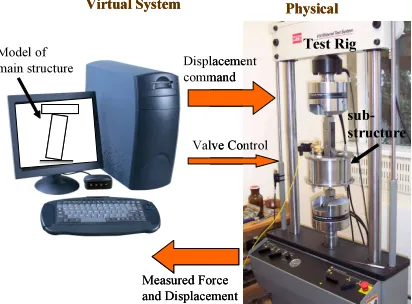
The hybrid testing procedure follows a step wise calculation process. The testing procedure is done in real time, hence there is no opportunity to reiterate steps in the computation. Figure 1 is a flow chart of the process, and Figure 2 shows the device in the dynamic test rig with an illustration of the process.
External inputs
Structural model calculations
Conversion factors Command
Virtual System Physical System
Returned Signals
Response of sub-structure measured
Test rig implements
commands
Real-time interface and data exchange
External inputs
Structural model calculations
Conversion factors Command
Virtual System Physical System
Returned Signals
Response of sub-structure measured
Test rig implements
commands External inputs
External inputs
Structural model calculations Structural model
calculations
Conversion factors
Conversion factors Command
Virtual System Physical System
Returned Signals
Response of sub-structure measured Response of sub-structure measured
Test rig implements
commands Test rig implements
commands
[image:2.595.306.521.66.236.2]Real-time interface and data exchange
Figure 1: Procedure flow at each time step.
Physical system
Measured Force and Displacement
Displacement command
Valve Control
Virtual System
Test Rig
sub-structure
Model of main structure
Physical system
Measured Force and Displacement
Displacement command
Valve Control
Virtual System
Test Rig
sub-structure
Model of main structure
Figure 2: Dynamic test rig and schematic of the physical-virtual interface and calculation system. The overall process consists of a series of specific step outlined as follows:
Step 1:
A. (First time step) External inputs to the main structure, such as forces due to a ground motion, are determined for the current time step. These external inputs are required to be known for the duration of the test.
B. (All other time steps) All inputs to the system are determined, including external inputs and returned responses from the sub-structure being examined.
Following Steps:
2. Response of the (model) structure to these external inputs is calculated and the conditions at the point of attachment/interface of the sub-structure and device being examined are determined. Conversion factors due to scaling or changes in the type of motion, such as rotational to linear motion, are applied at this point.
[image:2.595.318.524.281.433.2]4. The test rig implements these commands (in all cases to date these have been linear displacement commands but the type of command can be of any form and is dependent on the experiment and therefore the type of test rig being used).
5. The physical sub-structure or device being tested/examined is subjected to the command and the response is measured (once again the response is dependent on the form of the experiment).
6. The response from the sub-structure is returned to the computation system where the conversion factors, if any, are again applied.
All of the steps 1-6 are repeated in order for the duration of the test creating a closed loop feedback controlled system coupling the virtual structure or model and physical test specimen.
Running this system at a rate at least ten times higher than the system frequencies of interest minimises the need to determine changes in equilibrium status between time steps. For the case presented, the dSpaceTM system used is capable of running at least
10 input and 10 output channels at 1-10 kHz, which is far faster than any structural system requirement. Hence, no inner iterations should be required to determine the necessary forces and displacements during each step, particularly given the inherent stability of these structural systems and models. An inherently unstable system might still require further inner loops to ensure equilibrium under control.
3 Benefits of Hybrid Testing
The benefits of using the online hybrid testing procedure include: real time analysis, ease of experimental setup, and the ability to quickly change system parameters during experimentation. In addition, a wide variety of possible applications can be analysed and tested perhaps far more readily as a sub-system, or as a series of disconnected subsystems. Finally, using dSpaceTM and Matlab®, the
computational system is contained within an easily transportable unit utilising well accepted programs and systems.
3.1 Real Time
Central to the whole process is the dSpaceTM real-time
control system. Due to the computational power of the dSpaceTM system, fairly complex structural models
can be used with no delays for data processing. Hence the experiments can be run in real time. This real time analysis can be preferable to pseudo-dynamic testing as inertial effects do not have to be additionally incorporated into the virtual analysis. In addition, the dSpaceTM system does not allow continuation in the
calculation process if the preceding time step analysis has not been completed. This condition ensures the simulation follows in the correct order with inputs to
the system corresponding to the correct point in time of the analysis.
3.2 Easy Setup
Once again the easy set up is due to the real-time control system used. The virtual model is set up in simulink’s block diagram framework, which allows easy access to sections of the model, thus allowing rapid implementation of any changes required during testing. The dSpaceTM system is used for data
gathering and storage, hence there is no need for a separate system for this purpose. In addition, connection to a variety of different sensors and measuring devices presents no problems as any conversions and calibration can be incorporated into the experiment layout and controlled from the command desk.
3.3 Easily Transportable
The computation, virtual-real interface and the data recording and storage systems are all contained within the dSpaceTM unit. The software is well accepted as
Matlab® and Simulink® are well accepted in the field and thus readily modified by a moderately experienced user. Thus, the whole system and approach is easily transportable to different test locations or environments, in this case in a wheeled unit.
3.4 Adaptability to Different
Applications
Due to the flexibility of the procedure a variety of structural systems can be implemented. The implementation of any structural system is dependent only on the ability to model the main/virtual structure sufficiently to capture the necessary structural dynamics and on an external testing machine or actuators that can supply the necessary commands, dictated by the response analysis of the virtual structure, to the sub-structure. The developed test method can readily adapt to difference applications. The applications tested to date include a single-degree-of-freedom system with a device attached between the structure mass and the ground and a rocking wall panel where the device acts as a ‘smart’ tendon to control the rocking dynamics of the wall.
3.5 Control Prototyping
4 Limitations and Solutions
The problems associated with development of the HILT method include:
1. Signal processing lag;
2. Optimising sensing resolution; and
3. Bandwidth, and efficient model computation. The last of these issues, bandwidth and efficient computation, is largely a trade-off between model complexity, model accuracy and fast computation. A more non-linear, more detailed, more accurate model will require greater computation per degree of freedom, than a simpler model. If that simpler model captures the fundamental dynamic responses of interest and omits none of importance, or perceived importance, then the simpler model should be chosen over the more complex one, where bandwidth is an issue. Finally, note that simplifying the model, where effective, also minimises complexity ensuring an easier test setup and shorter debugging of any hardware or software errors.
4.1 Signal Processing Lag
Signal processing lag is the time difference between completion of the computation for a particular time step and the time when the signals from the external ‘physical’ system are received. These two signals are both required before the subsequent time step calculation can commence. If data from these two sources is not synchronized the overall system may become unstable due to the system changing dynamic state during the computational period.
An example of this instability occurs with a simple single-degree-of-freedom structure with a single displacement based structure control device attached between the ground and the structure mass. If the virtual structure has been calculated to have changed direction and the external signal from the physical device lags behind, it will appear to the calculation system that the device, instead of resisting the structure motion, is pushing the structure, hence adding energy to the overall structural system. This spurious condition can be removed by using the returned commands instead of a combination of computed and measured signals, thus ensuring the main structure and sub-structure conditions are consistent at each time step calculation.
4.2 Optimising Sensor Resolution and
Sensor Bandwidth
The clarity of the returned (measured) signals can have a significant effect on the quality of the analysis. If these signals have excess noise it is very difficult to determine the true signal, and thus to run the system properly and accurately. However, if the signals are filtered to provide a clearer signal, the lag between the calculated response and the corresponding returned
values increases and the possibility of instability, as discussed previously, increases.
0 5 10 15 20
-8 -6 -4 -2 0 2 4 6x 10
-5
time
LV
D
T
(m
m
[image:4.595.309.524.100.285.2])
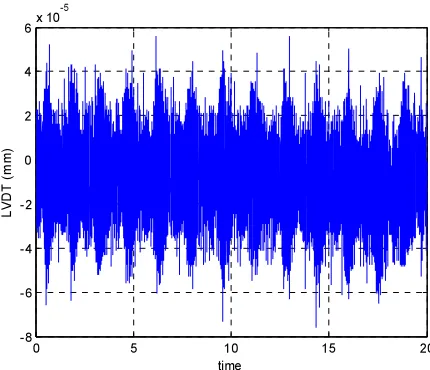
Figure 3: Typical value of noise associated with a displacement signal for a LVDT sensor.
0 100 200 300 400 500
0 0.5 1 1.5 2 2.5x 10
-8
[image:4.595.308.527.326.512.2]frequency (Hz)
Figure 4: FFT of the displacement signal showing frequency peaks associated with noise caused by
mains power.
Figure 3 shows a portion of a typical displacement signal with a large amount of noise in the signal.
Figure 4 is the FFT of the displacement signal showing the typical harmonic noise peaks due to mains power. This less than desirable effect was removed by using linear potentiometers for displacement measurement instead of the internal displacement sensor in the dynamic test rig. These potentiometers have the additional advantage of allowing manual calibration and zeroing, something that was not possible with the internal displacement measurement.
4.3
Efficient Model Computation
used have not been complex. If large complex models were required, the structural calculations and data management could be separated onto two dSpaceTM
chips to optimise the method. Overall, this issue best managed by using the most efficient model with the necessary dynamic accuracy.
5 Application Examples
This section presents two hybrid test example applications using dSpaceTM. The primary focus is
based on recent research into seismic mitigation devices and systems conducted at the University of Canterbury. In particular, the development of semi-active systems and structures enhances seismic energy management.
10 15 20 25 30 35 40 45 50
-2 0 2 gr ou nd m ot io n (m /s 2)
10 15 20 25 30 35 40 45 50
-0.02 0 0.02 th et a (r ad )
10 15 20 25 30 35 40 45 50
-0.01 0 0.01 co m m an d di sp la ce m en t (m )
10 15 20 25 30 35 40 45 50
[image:5.595.310.520.167.325.2]-1000 0 1000 2000 re tu rn ed fo rc e (N ) tiem (sec)
Figure 5: Typical results from a hybrid test.
16.6 16.8 17 17.2 17.4 17.6
0 0.5 1 1.5 2 2.5
3x 10
[image:5.595.75.284.267.448.2]-3 time (sec) di sp la ce m en t ( m )
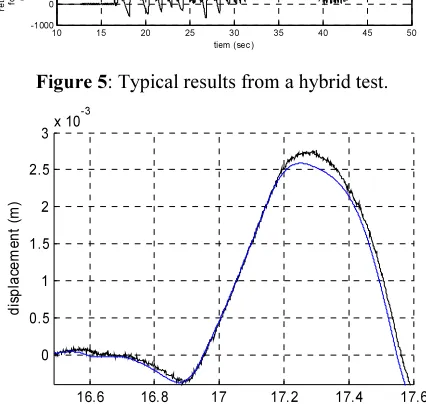
Figure 6: Comparison between command signal (calculated) and returned (measured) signal. A section of a rocking structure (one rocking wall panel) is used as the first example to demonstrate the results obtained using the hybrid testing procedure (Mulligan et al. 2006). In this application the external input is the ground motion. The computation model calculates the response of the wall in terms of the angle theta (rotation about the bottom corners of the wall), which is converted into a linear displacement command sent to the dynamic test rig (in this case the
corresponding displacement of the actuator if it were in place in the wall). The result from the physical device being tested is then returned and used as an input to the subsequent calculation step. Figure 5
shows these signals, and Figure 6 illustrates the slight difference between the command sent to the dynamic test rig and the actual dynamic test rig actuation.
25 30 35 40 45
-2 0 2 4 gr ou nd m ot io n (m /s 2)
25 30 35 40 45
[image:5.595.74.287.415.617.2]-0.04 -0.02 0 0.02 th et a (r ad ) time (sec)
Figure 7: Virtual structure response with and without the addition of the physical device being examined.
Figure 7 demonstrates the types of discovery that results from using the hybrid testing procedure. In this case, for the particular ground motion, it is observed that the addition of the device to the structure system results in a better response for the small rotations but not for the initial large rotations. If only one particular ground motion was examined with full scale testing, the resulting conclusions made could be biased either for or against the particular sub-structure or device being examined. Thus, hybrid testing offers the possibility to examine the structure response to a variety of situations and choose the most appropriate tests to take through to full scale testing.
-20 -15 -10 -5 0 5 10
-10 -5 0 5 Fo rc e (k N) Structure Only
-20 -15 -10 -5 0 5 10
-2 -1 0 1 2 Fo rc e (k N) Actuator
-20 -15 -10 -5 0 5 10
-10 -5 0 5 Fo rc e (k N) Combined
Displacement (mm)
Figure 8: Force-displacement response of a single-degree-of-freedom structure and the attached actuator
[image:5.595.306.518.526.721.2]The second example involves a single-degree-of-freedom structure used to generate experimental response spectra using a physical, non-linear test device (Mulligan et al. 2005). The results are shown for the force-displacement hysteresis loop and seismic response in Figure 8. This second example has similar results and exactness to the first rocking wall example. In this case, the non-linearity of the device is more evident in contrast to the linear one degree of freedom structural response.
Overall, both examples demonstrate the accuracy and potential of this “real-time pseudo-dynamic” or hybrid test approach. The main outcome of the work presented is the ability to simply and readily implement this type of test system using the dSpaceTM
real-time prototyping system. A second outcome is the delineation of the fundamental experimental design tradeoffs that arise in this type of experimental procedure. Finally, the examples presented in this section also illustrate the particularly effective use of this test approach for analysing novel structural devices.
6 Conclusions
The online hybrid test method developed here illustrates the efficacy of a cost-effective and easy-to-implement system that is applicable to a wide variety of structural systems. A dSpaceTM system that utilises
well-accepted Matlab® and Simulink® programs is used to rapidly develop a real-time system with minimal time or overhead. The process runs in real time and has been demonstrated at rates up to 10 kHz. Thus, the computation does not need to incorporate additional complexity to account for inertial effects or inner equilibrium iterations as the system dynamic change in a time step – a significant advantage over existing approaches.
This approach enables a large number of tests to be accomplished in a short period using smaller, more easily made substructures, or in this case, repeatable structural devices. Hence, a stronger test series can be run prior to full-scale testing. As a result, the final outcome of the full-scale test can be far less variable or unknown in the event.
Overall, the system is simple and enables any lab with this type of system to develop this capability quite rapidly. The use of hybrid testing is growing in structural engineering design and is thus becoming more of an important capability for many labs. Hence, the method presented, utilizing off-the-shelf products and proven real-time systems, creates a well-accepted and transferable test method and environment.
7 References
[1] Zeng H & Chen X Q, “Chapter 4 - Acoustic Emission Sensing and Signal Processing for Machining Monitoring and Control” in
Advanced Automation Techniques in Adaptive Material Processing, ISBN 981-02-4902-0, World Scientific, 2002. pp. 91-124.
[2] Li H Z, Li X P, Chen X Q, “A Novel Chatter Stability Criterion for Modelling and Simulation of the Dynamic Milling Process in Time Domain”. The International Journal of Advanced Manufacturing Technology (2003) 22: 619-625. [3] Pinto AV, Pegon P, Magonette G, Tsionis G.
Pseudo-dynamic testing of bridges using non-linear substructuring. Earthquake Engineering and Structural Dynamics 2004; 33:1125–1146. [4] Neild SA, Stoten DP, Drury D, Wagg DJ.
Control issues relating to real-time
substructuring experiments using a shaking table. Earthquake Engineering and Structural Dynamics 2005; 34:1171–1192.
[5] Wallace MI, Sieber J, Neild SA, Wagg DJ, Krauskopf B. Stability analysis of real-time dynamic substructuring using delay differential equation models. Earthquake Engineering and Structural Dynamics 2005; 34: 1817–1832.
[6] Wu B, Xu G, Wang Q, Williams SM.
Operator-splitting method for real-time substructure testing. Earthquake Engineering and Structural Dynamics 2005, 35: 293 – 314.
[7] Mulligan KJ, Chase JG, Gue A, Alnot T, Rodgers GW, Mander JB, Elliott RE, Deam BL, Cleeve L and Heaton D, “Large Scale Resetable Devices for Multi-Level Seismic Hazard Mitigation of Structures,” Proceedings of the 9th International Conference on Structural Safety and Reliability (ICOSSAR 2005), Rome, Italy, June 19-22 2005.
[8] Mulligan KJ, Chase JG, Mander JB, Fougere M, Deam BL, Danton G and Elliott RB, “Hybrid experimental analysis of semi-active rocking wall systems”, Proceedings of the New Zealand Society of Earthquake Engineering 2006 Conference (NZSEE 2006), Napier, NZ, March 10-12 2006.
[9] Pan P, Tomofuji H, Wang T, Nakashima M, Ohsaki M, Mosalam K M, “Development of peer-to-peer (P2P) internet online hybrid test system”. Earthquake Engineering and Structural Dynamics”, Earthquake Engineering and Structural Dynamics 2006; 35:867–890