BAYESIAN APPLICATIONS
IN ECONOMETRICS
A thesis presented for the degree of
Doctor of Philosophy
in Economics
at
the University of Canterbury
Christchurch, New Zealand
by
D.E.A. Giles
"
\3CJ
'GI;-l'l.
\915
CHAPTER
1.
II.
ABSTRACT
INTRODUCTION
CONTENTS
PAGE
1 3
I. Introductory comments. 3
II.
BASIC
1.
II.
III.
IV.
V.
(1) General background . . . . . 3
(2) Bayesian methods in econometrics 6
Outline of the thesis • • . 9
RESULTS 0
· ·
.
12Definitions
·
. . . . . 12Bayes' theorem . . . 13
Estimation
·
· ·
• • • 1 5Prediction
· · ·
.
· . . . 17Model comparisons • • 0 18
III. A M.S.E. COMPARISON OF TWO M.E.L. ESTIMATORS
FOR THE MULTIPLE REGRESSION MODEL 21
21
23
10 Introduction
II. Preliminary results.
A
III. Comparing
a
anda ..
IV. Further analytic results
(1) Speci cation of
13
• • • • • • • 26
32
33 (2) Speci fica tion of A . . . 37
(3) Multicollinearity and precision. . 48
V. A special prior p.d.f.
VI. A test statistic
(1) A formal test
(2) An ad hoc test
VII. Conclusions.
· . . . Sl · . . . 53 53 59
CHAPTER PAGE
IV. B'AYESIAN SEASONAL ADJUSTMENT OF ECONOMI C
TIME SERIES . . . .
I. Introduction.
81 81 82
II. Explaining seasonality
III. Statistical properties · . . ". . . 83
IV. The systematic component. 85
V. Estimating the seasonal influence 87
VI. Model comparisons
VII. Regression relationships with seasonal
data . . . .
VIII. Conclusions
V. BAYESIAN ANALYSIS OF DISTRIBUTED LAG MODELS:
A SURVEY
I. Introduction
II. Infinite lag models
(1) Rational lags
(2) Other contributions
III. Finite lag models
IV. Conclusions
VI. DISCRIMINATING BETWEEN AUTOREGRESSIVE FORMS:
A MONTE CARLO COMPARISON OF BAYESIAN AND
AD HOC METHODS
.
. .
I. Introduction
II. B.P.O. Analysis
· ·
I I I . The Monte Carlo study
·
.
·
(1) M1 is true
.
. . · .
(2) MZ is true
· . .
(3) Limitations of the tests
.
90
92
94
95 95 97 97
100
101
104
106
106
111
114
115
117
IV. The choice of data and parameters
· ·
119( 1) Exogenous variable
·
· ·
119(2) Parameter values 119
( 3) Random disturbances
·
120(4) Initial value of y
·
·
· · ·
· ·
121V. Results
. .
.
. . · · ·
· ·
·
·
·
121(1) Ml is true
· · ·
· ·
· ·
·
·
122 (2) M2 is true.
· ·
·
·
· · · ·
128( 3) Summary
· · ·
· '.
·
·
133VI. Conclusions
.
·
·
·
·
·
·
135VII. BAYESIAN INFERENCE AND THE RESTRICTED
ALMON ESTIMATOR. PART I: THEORETICAL RESULTS 137
I. Introduction 137
II. The classical P.A.E. · . 138
(1) Estimation · 138
(2) Linear restrictions . · . 139
(3) A Critique · . . 140
II I. Bayesian considerations . .
IV. Re-parameterizing the model
· . 143
· 147
V.
VI.
VII.
Bayesian estimation . · . 151
(1) Serially independent errors . . . 151
(2) Serially correlated errors 156
Random L
.
.
.
.
... .
.
. .
. .
· . 159(1) Serially independent errors . . . 160
(2) Serially correlated errors 163
Model comparisons . . . · . . . 165
(1) Computation of th.e B.P.O.. . 165
(2) A Qualification . . . . . 169
CHAPTER PAGE
VIII. BAYESIAN INFERENCE AND THE RESTRICTED
ALMON ESTIMATOR. PART II: AN APPLICATION TO
CURRENT PAYMENTS FOR NEW ZEALAND IMPORTS 172
I. Introduction . .
II. Data . .
I II. Seasonal adjustment
IV. Estimation . . . .
V. Prior knowledge
(1) The model space
(2) The parameter space
VI. Posterior distributions
(1) L fixed and known; independent
.
.
.
(2) L fixed and known; correlated
. . . .
errors
. .
.
errors. . .
(3) L random; errors serially independent
(4) L random; errors serially
correlated .
· . '.
serially·
·
·
.
.
serially· · · . .
172 173 175 177 l7~ 180 180 183 184 185· . . . 187
VII. B.P.O. and point predictions .
189
191
191 (1) B.P.O. analysis
(2) Point predictions
· . .'
192VI I I. Resul ts 193
IX.
(1) Discussion of tabulated results 193
(2) Diagrammatic resul ts . . . 221
(3) Appraisal of the Bayes-Almon
estimator
(4) Economic implications
Concluding remark
232
236
IX. SUMMARY AND CONCLUSIONS . ACKNOWLEDGEMENTS
. .
REFERENCES APPENDIX
. . .
. .
. . . .
.
.. I: SOME USEFU L RESULTS .
APPENDIX II: SOME RESULTS WITH THE ONE~
REGRESSOR MODEL . . . . . APPENDIX III: LAG DISTRIBUTION SHAPES. APPENDIX
APPENDIX
IV: RAW DATA FOR CHAPTER VIII
V: SEASONALLY ADJUSTED DATA
238
242 244 253
TABLE II I. VI.1 III. VI. 2
III.VI.3 III. VI. 4
I II. VI. 5
I II. VI. 6
III. VI. 7
I II. VI. 8
I I I. VI. 9
III.V1.10 III. VI. 11 III.VI.12
III.VI.13 I II. VI. 14 . VI. IV.1
VI. V. 1
VI. V. 2 VI. V. 3
VI.V.4
VI. V. 5 VI. V. 6 VI. V • 7
VI. V. 8
LIST OF TABLES
2 .
Hybrid R values
. . .
.
PAGE
· . • 68 71
· . . 71
72
a
=
1.0; 0 2=
1.0; n=
10a
=
1.0; 0 2=
1.0; n=
30a
= 2.0; 0 2=
1.0; n=
10a
=
2.0; 02=
1.0; n=
30a
=
3.0; 0 2=
1.0; n=
10a
=
3.0; 0 2=
1.0; n=
30a
=
1.0; 02=
2.0; n=
10a
=
1.0; 0 2=
2.0; n=
30a
=
2.0; 0 2=
2.0; n=
10a
=
2.0; 0 2=
2.0; n=
30B
=
3.0; 02=
2.0; n=
10a
=
3.0; 02=
2.0; n=
30Estimated power functions Hybrid R2 values . . . .
72
• • • 73
• • • 73
• • • • 74
• • • 74
• • • • • 75 75
• • • 76
. • • • 7 Q
77
121 M1 true; y = 0.90; p = 0.30 . . . 124 M1 true; Y
=
0.90; p=
0.60Ml true; Y
=
0.90; p - 0.90G < 5%
.
. .
.
.
..
. . .
.
.
. . .
. .
MZ true; B = 0.09; A=
0.90M2 true; B
=
0.45; A = 0.50M2 true;
a
=
0.81; A=
0.10 . . . .~[PTfT + p (I 1) ]
125
126
127
130
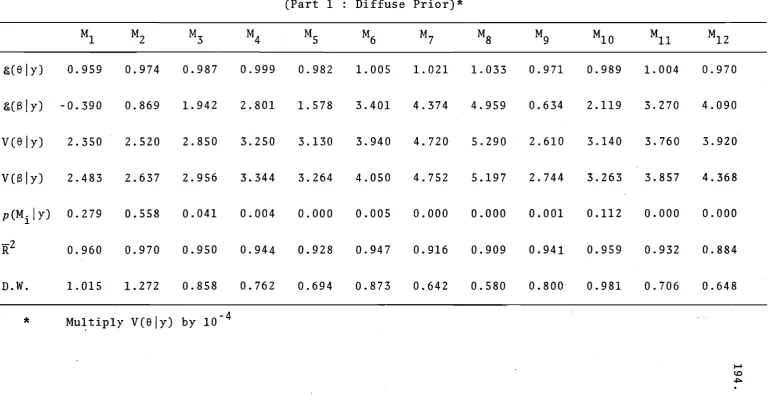
VIII.VIII.1 Part 1: diffuse prior.
VIII.VIII.2 Part 1: diffuse prior . .
VIII.VIII.3 Part 1: diffuse prior
. . .
.' 131 132 134 194 195 196 197
VIII.VIII.S Part 1 : loose prior
· ·
· · · ·
198 VIII.VIII.6 Part 1 : loose prior· · ·
·
· ·
199VIII.VIII.7 Part 1: tight prior
·
· ·
·
200VIII.VIII.8 Part 1 :: tight prior
·
· · ·
201VIII.VIII.9 Part 1 : tight prior
·
· ·
·
202VIII.VIII.10 Part 2 : diffuse prior
·
·
· ·
203VIII.VIII.11 Part 2 : diffuse prior
·
204VIII. VIII.12 Part 2 : diffuse prior
·
·
·
20SVIII.VIII.13 Part 2 : loose prior
· · ..
·
· · · · ·
206VlIl.VIII.14 Part 2 : loose prior
· ·
·
· · · ·
207\
VIII.VIII.IS Part 2 : loose prior
·
208VIIl.VlII.16 Part 2 : tight prior
· · ·
·
209VIII.VIII.17 Part 2 : tight prior 210
VIII.VIII.18 Part 2 : tight prior 211
VIIl.VIIl.19 Part 3
· ·
·
·
· ·
·
212VIII.VIIl.20 Part 3:
· ·
· .
· ·
·
· · ·
·
213VIII.VIII.21 Part 3
·
·
·
· · · ·
214VIII.VIII.22 Part 4
· · ·
·
· ·
·
21SVIII.VIII.23 Part 4
· · · . · · ·
·
·
·
216LIST OF FIGURES
FIGURE PAGE
I I 1. IV.l Effects of varying
a
·
· ·
·
·
·
·
34I II. IV. 2 A as a function of
a
·
· · · ·
·
·
36 I I I. IV. 3 An extreme curve decolletage·
·
· ·
• 42 I II. IV. 4 Effects of varying cp whens*' (X'X)S*
> 0 2· · · ·
·
· · ·
· 44III.IV.S Effects of varying cp when
S*' (X'X)S*
=
0 2·
,.
·
·
·
· ·
·
• 44I II. IV. 6 Effects of varying cp when
S*' (X' X) S*
< 0 2.
. ·
·
·
·
· ·
• 44II I. IV. 7 A as a function of cp
·
·
· ·
· ·
· 47 III.V.l The curve decolletage when A a:(X'X)
· S 3I I 1. Vr.l Estimated power curves
· ·
78VIII.VIII.l Part 1, M2 (diffuse prior)
·
· ·
222 VIII.VIII.2 Part 1, M2 (loose prior)·
·
· ·
· 222 VIII.VIII.3 Part 1, M2 (tight prior)·
· ·
· · ·
· 222 VIII. VIII. 4 Part 1, M2 (posteriors)· ·
· 223 VIII.VIII.S Part 1, M2 (joint po~teriors)·
·
·
· 223VIII.VIII.6 Part 2, M3 (diffuse prior)
·
· 224VIII.VIII.7 Part 2, M3 (loose prior)
·
· ·
· ·
· ·
224 VIII.VIII.8 Part 2, M3 (tight prior)·
· ·
· ·
·
·
225 VIII.VIII.9 Part 2, M3 (comparative posteriors). · 225·VIII.VIII.I0 Part 3, SI (diffuse prior)
· · ·
· ·
· 226 VIII.VIII.l1 Part 3, SI (loose prior)·
· · ·
· 226 VIII.VIII.12 Part 3, SI (tight prior)· · · ·
·
227VIII.VIII.13 Part 3, SI (comparative posteriors). · 227
VIII.VIII.17
A.1
A.2 A.3 A.4 A.S A.6
Part 4, Sl (posteriors) . . . .
P
=
1P > 2
P -> 2
P -, > 2
P > 3 P > 3
·
-231
260 260
261
261
261 261
P > 3
·
A.7 261
P > 4
·
A.8 - . 261
A.9 Seasonally adjusted current payments. 267
[image:10.539.44.477.72.789.2]1.
ABSTRACT
The thesis considers several related aspects of
Bayesian inference in econometrics. Particular attention
is given to model-comparisons, distributed lags, and the
sampling properties of estimators.
In Chapter III the natural-conjugate Bayes (8) and "
Ordinary Least Squares (8) estimators for the linear model
are compared, and a condition is derived and investigated
under which 8 is preferred to 8 in terms of matrix mean
squared error. In a limiting case a test statistic is
obtained and shown to be related to another well-known test.
Two observable substitute statistics are shown to be
consistent but upward-biased. The bias is studied in a
limited Monte Carlo experiment.
Bayesian inferential methods are advocated in
Chapter IV for the seasonal adjustment of economic
time-series. This is motivated by Chapter III and the application
in Chapter VIII. A well-known classical procedure is shown
to be a special case of the Bayesian method.
Bayesian analyses of distributed lag models are
surveyed in Chapter V, and Chapter VI considers the problem
of discriminating between a Koyck distributed lag model
and a regression model with autocorrelated disturbances.
A Monte Carlo study compares several interpretations of an
ad hoc rule-of-thumb proposed by Griliches with Bayesian
Posterior Odds analysis, and the latter is found to be
Chapters VII and VIII present a Bayesian
inter-pretation of the Almon estimator, treating theoretical
results and an application to some New Zealand data.
The theory generalizes that of Zellner and Williams,
special attention being paid to: prior information;
unknown lags; model comparisons; and autocorrelation.
Although the methodological problems associated with the
classical Almon estimator are overcome, the computational
cost is increased substantially.
The evidence presented suggests that several
econometric problems may be handled more satisfactorily
3 .
CHAPTER I
INTRODUCTION
I. INTRODUCTORY COMMENTS
(1) General Background
In recent years the theory of mathematical statistics
has been liberated to some extent from the firm grip of the
"frequentist" (or "classical") school associated with
Sir Ronald Fisher in the United Kingdom, and with J. Neyman
and E.S. Pearson in the United States. 1 There has been
renewed interest in an old principle first suggested by
Thomas Bayes in 1763.
Although Bayes is well known for the theorem which
bears his name, in fact it seems that he has even closer
links with the modern "Bayesian" school, in that he shared their concept of probability.2 Modern Bayesians differ
from the frequentists by adopting a subjectivistic
(personalistic) view of probability, rather than defining
a probability as a long-run frequency. Although the use of
Bayes' Theorem is important in modern Bayesian analysis, it
is also used (correctly) in various contexts by frequentists.
The Bayesian approach draws on the contributions of
de Finetti (1937), (1972); Ramsey (1950); Savage (1954),
(1961); and Jeffreys (1961). This subjectivistic
inter-pretation makes it meaningful to attach probabilities to once-and-for all events, parameters, hypotheses or models.
1. See Bartlett (1965); Plackett (1966); Lindley (1965).
The value of a subjective probability represents a personal
degree of belief, based on the individual's present state of
knowledge. As data are observed, this state of knowledge
changes, and the a priori degrees of belief must be updated
to the a ppsteriori state. This updating is effected
through Bayes' Theorem, thus introducing the basic principle
of "learning from experience". The process may continue
sequentially if additional data become available. The
previous a posterior state then becomes the new a priori
state, and Bayes' Theorem is applied again, etc ..
Expressing this somewhat differently, a priori
information is combined with sample information, the total
amount being summarized in the resulting a posteriori
distribution. This distribution contains all of the
available information. However, Bayesians often wish to
make decisions on the basis of the posterior distribution3 ,
and at this stage the loss structure of actions is taken
into account explicitly. Being based on the earlier work
of von Neumann and Morgenstern (1947) and Wa1d (1950),
Bayesian decision theory pursues the principle of acting
to maximize expected utility.
The Bayesian philosophy should be (and has been)
scrutinized on at least two fundamental levels. First,
the concept of subjective probability itself4 has' prompted
a heated debate. An individual's (subjective) probability
of the outcome of an event is determined by the least
odds at which he is prepared to bet on that outcome, such
3. For example, one may wish to draw statistical inferences, such as choosing a point estimate.
5.
bets being measured in terms of utility. In all but the
simplest of situations the introspection required to
determine the prior distribution precisely would be
enourmous. 5
Secondly, there is the explicit introduction of a
model of "learning from experience", arising with the use
of Bayes' Theorem. This view of the learning process is
in direct conflict with that advocated by Popper (1965),
Kuhn (1962) and Feyerabend (1965), for example. In their
view, we learn from our mistakes, and progress as a result
of criticism and by trying to refute earlier propositions. 6
The philosophical debate surrounding Bayes' Theorem
is as old as the theorem itself, and the controversy over
the subjective view of probability is by no means resolved
either. These issues are of fundamental importance and
will undoubtedly continue to pose problems for philosophers
of mathematics for some time.
However, such matters are not the subject of this
thesis, and are raised here only to provide a setting for
what is to follow. Despite the controversy which still
surrounds the Bayesian school of statistical thought, its
adherents have made many important contributions in recent
years, and its acceptance appears to be spreading. 7 Thus,
5. See P1ackett, op.cit., pp.252-253; Raiffa and Schlaifer
(1961), pp. 59- 62 .
6. For example, see Rothenberg (1969), pp.200-204.
7. To some extent this is reflected in the appearance of texts on mathematical statistics which are written
primarily from a Bayesian viewpoint. For example,
for the purposes of this thesis we accept the
meaningful-ness and usefulmeaningful-ness of the Bayesian philosophy, at least
in certain situations, and consider some aspects of its
use in econometric theory.
(2) Bayesian Methods in Econometrics
The recent developments in mathematical statistics
have been reflected in several of the disciplines based on
this theory, one of these being econometrics. By virtue.
of its historical development, econometrics is firmly
based on the principles of frequentist theory, though
lately there has been increasing interest in the use of
Bayesian methods for analysing econometric problems.
The supporters of a Bayesian approach in econometrics,
notably Arnold Zellner, have argued convincingly for its
wider adoption. a If there is one principal self-supporting argument advanced by these Bayesians it is that their
approach is based on a simple and unified set of principles
which provides the means for inference and decision-making
in a wide variety of situations. According to its adherents,
it is in this respect that the Bayesian approach in
econometrics stands above its non-Bayesian rivals, the
latter being seen as a collection of "ad hockeries".
The specific advantages of the Bayesian approach to
econometric analysis are essentially those that apply at
a more general level in mathematical statistics. These
advantages have been summarized well by Zellner (1969), and
8. For example, see Zellner (1969). Much of Zellner's
7 .
relate to the main areas of econometric theory: estimation;
hypothesis testing; prediction; control; the incorporation
of prior information; the handling of "nuisance" parameters;
and specification analysis.
Of prime concern in econometrics9 are the two. major
areas of inference: estimation, and hypothesis testing.
In the former, the main contribution of the Bayesian
approach is that unknown parameters are treated as random
variables and are assigned prior probability density
functions (p.d.f. IS) or probability mass functions (p.m.f. IS).
Sample information is introduced via the likelihood function,
and then posterior p.d.f. 's (or p.m.f.'s) are produced by
means of Bayes' Theorem. Once the loss structure is made
specific, the posterior distributions form the basis for
point or interval estimation1o , if such estimates are desired. For example, see Tiao and Zellner (1964).
With regard to the latter, the subjectivistic
interpretation of probability makes it meaningful to
compare non-nested models or hypotheses. In general, such
comparisons cannot be formalized within the frequentist
framework, though unfortunately ad hoc attempts are often
made. Major contributions to the Bayesian theory of
model comparisons have been made by Thornber (1966),
Geisel (1970), Lempers (1971), and Gaver (1974). Bayesian
and non-Bayesian methods in this area have been surveyed
9. Again, the comments here in general apply to math-ematical statistics, not just to econometrics.
10. In contrast, classical theory treats the parameters
by Gaver and Geisel (1974). Again, the analysis relates
to any parametric statistical models, but the presentation
by these authors centres on economic problems, and
economlc applications are given.
There are many troublesome areas of traditional
econometric theory which may be handled formally and
efficiently by Bayesian methods. Examples are the problems
of model comparisons; the handling of "nuisance" paramet·ersl l;
specification analysis12; and distributed lag models 13 , to
name a few. As might be expected, however, these gains are
not without cost.
For example, although it is helpful to have a
formal means of using prior knowledge, it may be very
difficult to formulate a satisfactory prior p.d.f.
(or p.m.f.) in practice. In such cases a Bayesian might
suggest trying a variety of prior distributions (including
one devoid of informational content 14
) in order to test
the sensitivity of inferences to the choice of prior p.d.f ..
Further, in practice Bayesian methods in econometrics
(and elsewhere) may have to be limited to rather simple15
models, unless the prior p.d.f. can be chosen in such a way
that it can be combined with the likelihood function
11.
12. 13. 14.
15.
See Zellner (1971), pp.21-22. See Lempers, op.cit., pp.47-65. See Chapter V of this thesis.
For a discussion of prior ignorance, see Zellner
(1971), pp.41-53, or Box and Tiao, op.cit., pp.25~60.
9.
analytically. 16 In general, numerical approximations must
be used when integrating to normalize the posterior p.d.f.
and to obtain its moments. In such cases the computa.:.
tional cost of even simple techniques as Simpson's rule
is prohibitive in parameter spaces of even moderate dimens ion. 17
However, as already noted, a wide range of
important econometric problems which cause difficulties·
in a frequentist setting, are well suited to Bayesian
analysis. Despite conceptual and practical difficulties,
the Bayesian framework has much to offer when analysing
problems of this type, and considerable progress has been
made in a variety of areas.
A belief in this (limited) usefulness of Bayesian
inference in econometrics underlies this thesis.
II. OUTLINE OF THE THESIS
The thesis considers a number of related problems
concerned with the use of Bayesian methods of inference
in econometrics. The layout is as follows. Chapter II
contains some basic notation and results related to
Bayesian estimation, hypothesis testing ,and prediction.
16.
17.
Two such types of prior p.d.f. are Jeffreys'
"diffuse" prior, and the Natural-Conjugate priors suggested by Raiffa and Sch1aifer, op.cit., pp.43-76. Very roughly, the processing time w~en applying
This material is drawn primarily from Zellner (1971;
Ch. 2, 3), and from Geisel (1970; Ch. 1, 2), and is. used
repeatedly throughout the thesis.
The rest of the thesis falls broadly into two
sections. Chapter III is quasi-Bayesian in philosophy,
lying between the frequentist and Bayesian school~, in
that it considers the sampling properties of certain Bayes
estimators. Using general I8 Mean Squared Error (M.S.E.) ·as
a basis, two estimators for the linear regression
model are compared in various situations. This M.S.E.
basis forms part of the motivation in Chapter IV for a
Bayesian interpretation of the problem of seasonally
adjusting an economic time-series. The approach used here
amounts to a particular application of the usual Bayesian
methods of inference in parametric models.
The second, and major section of the thesis centres
on the Bayesian analysis of distributed lag models. Such
models have been analysed already by different Bayesian
methods under various conditions, the relevant literature
being surveyed in Chapter V. One of the main reasons for
concentrating on this type of model here is that it raises
a wide variety of econometric problems which are very
difficult to solve by classical methods, but which may
be handled more successfully by adopting a Bayesian approach.
Chapter VI analyses a particular problem of model
discrimination which arises with certain infinite distr~buted
lag models, and compares Bayesian Posterior Odds (B.P.O.)
11.
analysis with an ad hoc approach.
The Polynomial Approximation (Almon) estimator
for finite distributed lag models has received a lot of
attention in the literature since its conception, partly
as a result of the methodological problems which it poses
for frequentists. A general Bayesian interpretation of
this estimator is developed in Chapter VII, this being
an extension of the earlier contribution by Zellner and
Williams (1973). This estimator is applied to some New
Zealand data in Chapter VIII. Some concluding remarks
CHAPTER II
BASIC RESULTS
Here, and throughout the thesis the symbol p
denotes any general prior or posterior p.d.f. or p.m.f.,
regardless of mathematical form. It may relate to
parameters, observations, or models, but the meaning will
be clear from the context in which it is used. l
I. DEFINITIONS
We define four spaces required for a discussion of
Bayesian decision theory:
The sample space, Y
=
{y}, is the set of all possiblevalues of the sample observations for the experiment of
interest.
The ~---~~-, A
=
{a}, is the set of possible actionsrelated to a particular decision problem.
The model space,
Wl.
=
{M}, is the set of poss ib Ie mode Is orhypotheses for the experiment being considered. 2
The parameter space,
n
i
=
rei}' for the ith. model in11t
is the set of unknown parameters associated with that model.Both ~ and the ni's are stat~ spaces in the .usual
terminology. Further, a parametric statisti~al model of a
1.
2.
Detailed descriptions of the basic Bayesian framework are given by Raiffa and Schlaifer, op.cit., de Groot, op.cit" and Box and Tiao, 0E.cit ..
This space is restr1cted to be finite or countable, for
asons described below. However, this restriction can
13.
stochastic process is a family of data densities,
depend-ent on a (usually finite) number of parameters and a
specified set of predetermined variables, and a prior
density for the parameters of the data densities.
For each model in
nt,
the data density is given byp(yla.
,M.), which when viewed as a function of the unknown1 1
parameters is the likelihood function, Q (a. ly,M.). The
1 1
prior p.d.f. (or p.m.f.) for the parameters of Mi is giv~n
by p(a·IM.). Finally, a prior p.m.£' is defined over the
1 1
elements of
m,
so that the prior mass of the ith. model isp (M.) . 1
II. BAYES' THEOREM
The conditional (on the model) data density is
obtained as
P(yIM.)-= f p(yla.,M.)p(e·IM.)da.,
1 ~. 1 1 1 1 1
1
and the marginal data density is
p(y)
= Ep (y 1M. ) p (M. ) . 1 11
ILI!.l
ILII.2
The~ applying Bayes'Theorem, the (joint) posterior
p.d.f. for the parameters of the ith. model is
p(a·ly,M.) = {p(e·IM·)p(yla.,M·)}/p(yIM.)
1 1 1 1 I I I IT.IL.3
p(6.ly,M.) iXp(a·IM.)2(9·ly,M.)
1 1 1 1 1 1
where the proportionality constant is 3
I
-1{f PCa.IM.)2(6. y,M.)d8.}
Q. 1 1 1 1 1
1
Further, the posterior probability of the ith.
model is given by
or,
p(M.ly) iX p(M.)p(yIM.)
1 1 1
I1.I1.4
where the proportionality constant is
{~p(M.)p(YIM.)}-l.
. 1 1
1
In many instances, attention centres on one (or a
subset) of ~he parameters in the vector ai' In such cases,
- - - " " - - - posterior p.d.f. 's for these parameters may be
derived.
a. '
1Q.
1
Then,
Partition a. and Q. such that
1 1
3, Here and throughout the thesis the notation is simplified by using the single symbol f even for
multi-dimensional integrals.
15.
where eli E Q1i; and a symmetric result holds if p(ezily) is required. Such integration is also useful for
eliminating "nuisance" parameters, once their influence
on the posterior p.d.f. for the remaining parameters has
been accounted for.
III. ESTIMATION
We define a decision rule, d, as a function mapping
Y to A. Further, a loss function Lis a real function
describing the loss of utility (in the von
Neumann-Morgenstern sense) resulting when action a is taken for a
particular true state of nature. This state of nature
will be a point in Q. here, but in Section V below it 1
will be a model in
nt.
Thus, here L maps (Q. x A) to1
[0,00). The notation L(8.,e.) denotes the loss incurred
1 1
when ei is the true state of nature, and e
i is the point estimate lf of e ..
1
The minimum expected loss
(ME1J
rules is to choosee. such that 1
A
f L(8. ,8.)p(e·ly,M.)de.
Q. 1 1 1 1 1
1
is minimized. If this integral is finite, then the Fubini
Theorem may be applied, and it can be shown that 8i is a
MA~ estimate iff it is a Bayes estimate of e .. As such, 1
4. The selection of 8 i amounts to taking some action, a.
9. minimizes average risk. However, in some cases the
1
M.E.L. estimate exists when the Bayes estimate does not,
and so in this thesis we concentrate on M.E.L. decision
rUles. 6 As it is well known7
, if L is positive definite quadratic then the M.E.L. estimate, 6., is the mean of the
1
conditional posterior p.d.f. for ai :
A
6i
=
&(aily, Mi )·Now, let ~' r denote the rth moment about zero for
6· . 1 So,
~'
=
r
e~p(a·ly)da.r Q. 1 1 1
1
=
~.
eI
U:p (e iI
y, M i) p eM iI
y) ] d a i1
= I:p(M·ly)
r
a:pca·ly, M.)da.. 1 ~ 1 1 1 1
1 ~6'
1
say. II. 111.1
Thus, under the above loss function the marginal M.E.L.
estimate of
e.
is1
=
I:p (M.I
y) &(e .
I
y, M.). 1 1 1 11.111.2
1
Let ~r denote the rth moment about the mean for a i . Then
it is well known that
11.11I.3
6. Here we are following Thornber, op.cit.; Geisel,
~it.; and Gaver, op.cit.. .
17.
Combining 11.111.1 and 11.111.3,
11.111.4
Thus,
v(eily)
=
~P(MiIY)[V(eily,Mi)+(&(aily,Mi))2]
1
-
[~P(Mily)&(aily,Mi)]2
111.111.5
IV. PREDICTION
Let YFEYF be a vector of as yet unobserved (future)
observations for the endogenous variable of the stochastic
process. Then the predictive p.d.f~ for YF is
p(yFly)
=
~p(YFly, Mi)P(Mily),1
II.IV.1
where P(Mily) is obtained in 11.11.4,
p(yFly,M.)
=
J p(yFIS. ,M. ,y)p(e·ly,M.)de.1 Q. 1 1 1 1 1
1
I I. IV. 2
In this case, the loss function maps (YF x A) to
~ A
[0,00), and L(YF' YF) denotes the loss incurred when YF is chosen as the point estimate of the unknown YF' Again,
"
"-J L(YP,yp)p(Yply,Mi)dyp
Yp
is minimized8 , and results analogous to 11.111.2 and II.III.S apply here.
V. MODEL COMPARISONS
Let M. denote the action of selecting the jth.
J
model from 1Y/,. In this case L maps (m x A) to [0,(0).
Since M is assumed to be countable, the MEL. and Bayes
rules are equivalent9 , and M. is chosen from~ iff
1
EL(M ,M.)p(M Iy) < EL(M ,M.)P(M Iy)
r r 1 r r r J r
for all j~i.
II.V.I
If attention focuses on just two of the models in
~, then the B.P.O. relating Mk and Mj are
{P(MiIY)/P(Mj Iy)}
=
{P(Mk)/PCMj)}{p(yIMk)/P(yIMj )},II.V.2
which depends on the prior odds and the ratio of weighted
likelihood functions, the latter being obtained from
11.11.1. The B.P.O. are independent of
pey),
so there isno need to specify the full extent of
m
if only Mk and Mjare of interest. Although the B.P.O. are unaffected by
the presence or absence of other models as long as the
prior odds are unaffected, clearly any individual posterior
8. See Zellner (1971), p.30.
19.
probability depends on the other models, through p(y).
An interesting large-sample approximation can be
obtained by re-writing 11.11.1 as
p(yIM.)
=
f Q(e·ly,M.)P(8·IM.)d8.,1
n.
1 1 1 1 11
and then following Lindley (1961) and applying a Taylor
expansion to the likelihood function:
-~ f Q (e·ly,M.)p(e·IM.)d8.,
n.
1 1 1 1 11
ILV.3
where
e.
is the Maximum Likelihood estimate of e., and1 1
only the first term of the expansion is retained. Then,
if pCeilMi) is a properlO prior p.d.f., the large-sample
approximation in II.V.3 becomes:
-~ Q(e·ly,M.),
1 1 ILV.4
so that:
A A
.{£(8k
l
y ,Mk)/£(Oj ly,Mj )} ILV.5
Thus, the prior odds transform the usual likelihood
ratio into an approximate posterior odds ratio, regardless
of the form of the (proper) prior p.d.f. 's for the
10. That is, if fp(8.IM.)de. = 1.
n.
1 1 1parameters in each model.
In the two-model case, Mk is preferred to Mj by
the
MEL.
rule iffILV.6
where the L.H.S. of II.V.6 is computed from II.II.4, or may be approximated (in large samples) by II.V.S.
Thus, if the loss function is symmetric, so that
for all j,k;
then the MEL rule leads to choosing the model with the
highest posterior probability.
Finally, results established by Lempers and by
Geisel 12
indicate that plim {p(M. Iy)}
=
1, andn+co 1
plim {p(M. Iy)}
=
0, for all jfi, when M. is the truen+oo J 1
model and n is the number of sample observations.
These results of Bayesian inference summarized
here form the basis for the analysis in the remainder
of the thesis. The presentation here is brief in view
of the detailed discussions given in the various
references cited above.
11. See Zellner and Palm (1973), pp.23-24.
12. See Lempers, op.cit., pp.37-4l; and Geisel,
21.
CHAPTER III
A M.S.E. COMPARISON OF TWO M.E.L.
ESTIMATORS FOR THE MULTIPLE REGRESSION MODEL
I. INTRODUCTION
In this Chapter we investigate some aspects of the sampling properties of two M.E.L. estimators for the
coefficient vector, S, in the usual multiple regression model.
These estimators are
g,
the Ordinary Least Squares (O.L.S.)estimator; and ~, the Bayes estimator based on a
Natural-Conjugatl~ prior p.d.L and a quadratic loss function (N.C.B.).
Thus, some may view the contents of this Chapter as
being only semi-Bayesian, since the strict Bayesian view
places relatively little emphasis on the sampling properties
of point estimators. l However, some analysts are concerned
with suc~ properties, as is clear from the recent
contributions by Zellner and Vandaele (1972), and Smith
(1973). Although M.E.L. and Bayes estimators are usually
obtained for reasons unrelated to their sampling properties,
we believe that these properties are interesting, none the
less.
The basis of comparison used here is2 generalized
(matrix) M.S.E .. Thus, ~ is said to be "preferred" to Shere if [M.S.E. (S) - M.S.E. (e)] is a positive semi-definite (p.s.d.)
,
-matrix. This is equivalent to requiring that M.S.E. (n S)
t "..
< M.S.E.(n B), for all non-zero k-vectors, n. Of course,
other comparative bases are possible - Wal1ace(1972) uses a
weaker ~1.S.E. criterion which is a special case of that just
noted, and Thornber(1967) discusses the merits of absolute
and average risk criteria. B.P.O. could also be used here.
A
The choice between Sand 8 may be viewed as a choice
between amounts of prior information to be used when estimating
S,
sinceB
may be interpreted as a M.E.L. estimator based on a diffuse3prior p.d.f. and a quadratic loss function.A
Although S is inadmissible under quadratic loss in models of
three or more regressors(see Stein(1960) and Sc10ve(1968) , for example), it is frequently adopted in practice. Thus it
is interesting to compare its sampling properties with those
-of S.
The two estimators are equivalent in large samples,
since under very general regularity conditions S converges to
A
the Maximum Likelihood (M.L.) estimator~ here S. Thus, under
A ~
these conditions both 8 and
e
are consistent. However, infinite samples their properties generally differ, as is made
apparent in this Chapter_ The situation is complicated by
A
the fact that ~ is both non-linear and biased, while
B
is theminimum variance linear unbiased estimator of 8.
A
-If one of
B
or S is to be chosen50n the basis of matrix M.S.E. then a practical test procedure may be required. This possibility is considered in Section VI, and there we abstractfrom the well-known problem of pre-testing bias. s
3. For a discussion of diffuse prior p.d.f. 's see Zellner
(1971), pp.41-53. For a discussion of the relationship
between M.E.L. and Bayes estimators see Section III of
Chapter II. .
4. See Zellner, o~. cit., pp. 31-34.
5. We do not conslder the possibilitx of "mixed strategies": i.e. the possibility of using
B=wS+(l-w)S; O<w<l.
23.
Finally, we focus attention only on point estimators,
but it must be emphasised that an important feature of M.E.L.
(and Bayes) procedures is that they lead to a complete
posterior p.d.f., containing all relevant information, on
which interval estimates, predictions, etc. may be based.
II. PRELIMINARY RESULTS
Consider the usual linear regression model:
y
=
xe
+ u III.II.lwhere:
(i) Y is an n-vector of observations on the dependent
variable.
(ii) X is en x k); a matrix of n observations on k fixed
explanatory variables.
(iii)
a
is a k-vector of unknown parameters.(iv) u is an n-vector of unknown disturbances, with ut
2
NID(O,cr ); t
=
1,2, ... ,noThe O.L.S. estimator of S is
III. II. 2
with7
v
(~)=
III.II.3The likelihood function for 111.11.1 is
7. Throughout this Chapter, V(·) denotes a covariance matrix;
var. (.) denotes a scalar variance; and
a (.)
denotes expectation, all with respect to the space Y,given the-n -2 '
ex: a exp{ -~a (y-Xe) (y-Xe)} 111.11.4
We consider a Bayesian analysis of 111.11.1, first
under prior ignorance, and secondly when some prior
information is available. In the former case, Jeffreys'
diffuse prior p.d.f. is adopted:
where
p (e,a)
=
p (e).p (a)p(e).de ex: de
p(a).da ex: da/a
-00 <
e.
< 00; i = 1,2, ... ,k1
o
< a < 00.111.11.5
III. 11.6
Although the p.d.f. in 111.11.6 is improper, an appeal
to the probability axioms of R6nyi (1970) permits its use in
Bayes' Theorem:
p(e,a/y) ex: and,
p (e / y) ex:
where
=
(n-k) ,-(n+1) -2 '
a exp{ -~a (y- xe) (y-Xe)}
and \)s 2
=
(y-Xe) (y-Xe).,,'
"Under a positive definite (p.d.) quadratic loss
function,
S
is the M.E.L. estimator of S in this case.III. II. 7
111.11.8
One way of introducIng prior information about the
parameters of 111.11.1 is through the Natural-Conjugate prior
p.d.f., here a Normal-inverted Gamma density8:
p (8 ,0 )
=
p (8 10) . p (0)where
p(810) a:
!.: -k -2 - ,
-1 A -1 20 e xp { -~o (8 - 8) A (8 - a )}
p (0) a: o -(w+1) exp{-~o -2 wc} 2
w
> 0By Bayes' Theorem,
p(a,oly)
and
where:
m
=
n+w=
a: o -(m+k+1)
-2 2 - ' ,
-.exp{-~o [mq +(8-a) (A+X X)(a-a)]}
a: {mq 2 + (a-a)' (A+X'x) (a-a)} - (m+k)/2
a
=
(A+X'X)-l(AS+X'Y);25.
III. 11.9
III. 11.10
111.11.11
111.11.12
111.11.13
and A must be positive definite symmetric (p.d.s) for 111.11.9
to be a proper p.d.f .•
-In this case under a p.d. quadratic loss function a in
111.11.13 is thp, M.E.L. estimator of 8.
The estimator
e
is biased (and non-linear) in general,A •
while 8 IS unbiased (and linear). However, we shall show
that any linear combination of the elements of the latt~r
has larger sampling variance than has the corresponding linear
be some regions of the parameter space in which any linear
combination of the elements of a has smaller M.S.E. than has
the corresponding linear combination of the elements of
a.
For the purposes of this Chapter (and for part of the
analysis in Chapter IV) we shall describe
a as being
"
"preferred" to a in terms of its sampling properties9
, if the
above M.S.E. relationship is satisfied. This strong M.S.E.
criterion is used in a similar way in other comparative
studies, such as those of Toro-Vizcarrondo and Wallace (1968),
and Griffiths (1973).
A
III. COMPARING a AND a
Clearly,
a
differs froma
by the prior information.
reflected
io
in A and~.
This information decreases as A ~a
and w ~ 0, for then p(a,crly) in 111.11.11 differs in the limit from p(S,crly) in 111.11.8 onlyll in the power of cr. Further,
S
converges toe
in large samples, for then the sample information dominates that in the prior p.d.f., unless thelatter is totally "dogmatic", i.e. A-I
=
O. (In this caseB
=
Sand p(alcr) in 111.11.9 is an improper density.) It is also interesting to note thatB
may be expressed aswhich is of Stein-like form. Clearly, if
S
=
S,
then8
=
S.
-9. Of course, a strict Bayesian would always use a in
preference to
B,
since the former incorporates all,of theavailable relevant a priori information.
---10. Zellner (1972) shows that the construction of A should depend on c and w.
27.
If B*
=
(a-B),and W
=
(A+X'X)-l,then
Bias (B)
=
WAB* 111.111.1so that Bias (B i ) depends not only on Bi*' but also on Bj* for all j
F
i. Further,V(S)
=
crZWX'XW' III.IIl.Z- A
Thus, B is unbiased iff
8
=
S. However, as is well known, 8is unbiased with covariance matrix as in 111.11.3.
Using the matrix M.S.E. concept noted earlier, a
strong criterion 12 for an arbitrary estimator, bI' to be
preferred to another arbitrary estimator, b 2, is:
,
,
M.S.E.(n bi) < M.S.E.(n b
z),
111.111.3for all n
F
0. This is equivalent to& (b Z - 8) (b 2 - 8)
=
&(bl-B) (bl-B) + D for a (k x k) p.s.d. D; or:V(b 2) + Bias (bZ)·Bias(b 2)
=
V(bl) + Bias(bl)·Bias(b l ) + D III. 111.4
12. Wallace, op.cit., suggests a weaker criterion,
replacing 111.111.3 by:
r
M.S.E. (b li ) ~r
M.S.E.(b 2i )·The weak criterion is a special case of the strong one, as is seen by letting n' = (0, ... ,1, ... ,0) in
We now show that any linear combination of the
-elements of
S
always has smaller variance than has the corresponding linear combination of the elements ofa.
Proposition 111~111.1:
6
=
Veal -
V(S) is a p.d.s. matrix.Proof: Let n be any non-zero k-vector. Then, from 111.11.3
and 111.111.2,
, ' 2 ' -1 2 "
n 6n
=
n
{a (X X) - a WX XWIn.
,
Let ~
=
Wn,
then:
=
since W is p.d.s. (bylS Theorems A.2 and A.3).
However,
=
111.111.5since A is symmetric by construction.
Thus,
=
Now, A is p.d.s., so it is non-singular, by Theorem
, , , -1
A.4, and A = A. Thus, by Theorem A.1, A(X X) A is p.d.s.,
29.
, , -1
since rank (X X)
=
k. Further, {A(X X) A + 2A} is p.d.s., by Theorem A.3. Since 0 2 > 0,(W-l~W-l)
is p.d.s., so~
is p.d.s.by Theorem A.l. Q.E.D.
Thus, S has a covariance matrix which "dominates" that
..
..
of
a,
and under c~rtain conditions this may mean that B is..
"preferred" to ~ in terms of M.S.E., even though B is biased while ~ is not. Necessary and sufficient conditions emerge in
Proposition 111.111.2.
,
Finally, since ~ is p.d., n ~n > 0 for all n
r
O.,
"'
..
Equivalently, var.(n B) > var.(n B) for all n
r
O. In particular, letting n=
(0, ... ,0,1,0, ... ,0),var. (Si) > var. (Si)' for all i. This result is useful in Part (3) of this Section.
Proposition 111.111.2:
A necessary and sufficient condition for
S
to be"preferred" to ~ in terms of the strong M.S.E. criterion is that
< 1.
Proof: Applying criterion 111.111.4 to 111.11.3, 111.111.1
and 111.111.2,
'8
is "preferred" to S in terms of the strongM.S.E. condition iff
=
o WX XW 2 " + WAB B A W* *' , ,
+ DlI 2 I -1 2 "
'* '*,
t ,n {o
ex
X) - 0 WX XW - WAS SAW}n > 0,for all non-zero k-vectors,
n.
t
Let ~
=
Wn,
then lIl.lll.6 holds iffsince W is p.d.s.
111.111.6
> 0,
But, from 111.111.5,
a
is "preferred" to 13 on thestrong M.S.E. criterion iff
< 1. III. 111.7
Finally, lII.III.7 holds for all non-zero ~ as defined above
iff
= sup. (A )
'*
(0
that is, iff14 \
< 1.
< I'
,
III. 111.8
Q.E.D.
As expected, condition 111.111.8 involves the unknown
Band 02 as well as the known X, A and
a.
Further, bothI
(X X) and A are symmetric, so A is a quadratic form in the
31.
vector
B*
=
(i-B).
The terms 02(X'X)-1 and oZA- 1 in 111.111.8are
Vee)
and the conditional prior covariance matrix forB,
from 111.11.9. Also, note a very important feature of the criterion developed in Proposition 111.111.2. The result is asymmetric in that it does not follow that ~. is preferred 1 5 to
e
if A ~ 1. If A > 1 then there are some n for whichB
is preferred toa,
and some for which the reverse is true. Thus, there is not a 1 - 1 correspondence between the two conditions:(i) (ii)
A
=
1,
-
,
"M.S.E.(n B)
=
M.S.E.(n e); for all n ; 0 ..This last fact should be borne in mind when interpreting some of the results in the next Section.
Finally, we consider a property of that value of ~ for which the supremum in Proposition 111.111.2 is attained.
Proposition 111.111.3:
Let ~o be the value of ~ for which A is attained.
-1 '
-Then, if nO
=
W ~o' Bias(nOB)=
A> O.Proof: As a corollary to the theorem cited in footnote 14,
~o =
so,
=
Thus,
15. The argument used in Proposition 111.111.2 cannot be used to consider the conditions under which ~ is preferred to
,
-
"
Bias(n o13)
=
noWA13 Ie ,[02(X'X)-1 202A-l] -1 13
*
=
a
+=
A"
> 0
.
,
for alla
~ O. Q.E.D.2 '- 2
The fact that Bias (n
013)
=
A is exploited in Part (2) of the next Section. Further, A is attained for a particular ~O (ornO)'
and for this particular vector the squared bias of the corresponding linear combination of the elements ofS
isnon-zero. The importance of this is clarified at the start of the next Section.
IV. FURTHER ANALYTIC RESULTS
The fact that A in 111.111.8 depends on unknown
a
and02 poses some difficulties for the use of this criterion in
applications, if some practical test procedure is desired.
Toro-Vizcarrondo and Wallace show that in their problem ~A is
the non-centrality parameter of a non-central F-distribution,
so that a formal test is feasible. In the absence of such a
test in his problem, Griffiths16 chooses to explore part of
the parameter space numerically for some simple special cases.
We consider the possibility of a test statistic in
Section VI, but before turning to this we present some
analytic results relating to the general multiple regression
model, 111.11.1 - in particular we investigate the influences
of the parameters of the prior distribution and of the data
33.
sample. Of primary interest are the influences on A itself, but attention is also paid to the effects on the sampling properties of Band
e,
where applicable.Throughout this Section we often consider linear ~ ~
'N
fAcombinations of a or a: n a, n a; for non-zero k-vectors, n. This scalarizes the analysis so that the results may be shown diagrammatically. Clearly, there is nothing to be gained by
,
..,considering those n for which Bias(n a)
=
0, for in that case the result of Proposition 111.111.1 implies thate
is always preferred toe
on the basis of M.S.E .• Thus, the analysis,
*
proceeds for those n such that n WAa
r
O. This restriction is not at all severe, since for particular A, X, a and'a,
the,
*
class of n for which n WAa
=
0 is a set of measure zero. Finally, the result of Proposition 111.111.3 indicates thatthis degenerate class of n may be totally disr~garded when investigating the properties of
A,
for the latter is defined for a value of n outside of this class.(1) Specification of a
The conditional prior mean vector,
i,
affects M.S.E.(~) and A only by affecting BiaseS). Clearly, from III.III.2,V(S) is independent of~. Let
a
be an arbitrary positive*
scalar parameter that scales all of the elements of a
=
(a-a)
equally:
*
*
a :::
ab ,*
for (k x 1) non- zero b .
Let
-
-
,
B ::: Bias(S).Bias(a)
2
* *
I , I" *
I* *
INow, (13 13 ) is p.s.d. by Theorem A.9, so (b b ) is also p.s.d., since
e
> O. Applying Theorem A.I twice, B is a p.s.d. matrix. NOW, from III.IV.1,and
Limit(B)
e
+ 0= 0, Limit{M.S.E.Ca)}
e
+ 0Limit(B)
=
Limit{M.S.E.(a)}=
00,6+ 00 a + o o
...
=
V(a),
For the purposes of
depi~ting
these results diagrammatically it is helpful to consider the scalar quantity13
=
Bias (n B) 2 I ...=
I I I. IV. 2Limits similar to those above also apply to
B.
Further,B
isI
*
a simple quadratic in
e
provided that (n WAb )r
OJ i.e.I
*
(n WAS)
r
O. For one such n and for particular X, A, 13,B
and 02, the above results are depicted in Figure III.IV.I.M.S.E.(n'B)
Bias2Cn'a) A
02n' (XIX) -In
t---T~----4----
var. (n'B)A
=M.S.E.(n'B)
02n I WX I
XW·I;nll--....:~---+---
var. C n ' B)o
e
35.
Thus, ceteris paribus, by choosing
B
sufficiently closeto
S
it is possible fore
to be "preferred" toS
in the strong sense defined earlier in the Chapter. Of course,S
itself isalways unknown. A similar conclusion is reached by Smith,
using a weak M.S.E. criterion in the context of a Bayesian
analysis of an hierarchical linear model.
This particular feature of the way in which the choice
of S affects the sampling properties of S in relation to those
of
8
is highlighted by considering the relationship between Aand
e.
*
First, since A in 111.111.8 is a quadratic form in
S ,
if S = S then A = 0 and S is "preferred" to
8,
as expected. Clearly, from 111.111.1, Bias(s)=
0 ifa
=
s,
so ase
~ 0, the comparison between SandS
amounts to a comparison of their covariance matrices, and Proposition 111.111.1 takes effect . .Secondly,
*
(aA!aB )
=
I I 1. IV. 3*
so A is continuous in
S.
Thus, there exists a continuum of*
B' values (or values of 8) such that A < 1 is satisfied. Thus, ceteris paribus, choosing
e
so thatS
is "preferred" to i3 maybe accomplished in an infinity of ways. Again, this is
re-fleeted in Figure III.IV.1.
Further, since 111.111.8 may be written
I
A is a simple quadratic in 8, for all p.d.s. A and (X X), and
*
*
Thus, there exists a unique eO such that A
=
1:=
III.IV.4*
which is positive for b
r
0, as shown in Figure III.IV.2.A(e)
1
o
~~~__________
~____________ e
Figure III.IV.2: A as a function o£
e.
The above results concerning A apply, of course, for the particular vector, ~O' for which A is attained. Although
*
A is our main concern, the relationship between A and
e
isalso of some interest. From 111.111.7,
Now, the denominator in III.IV.S is strictly positive for all
~,
since A and (X'X)-1 are p.d.s .• Thus,A~
is a simple, *
2quadratic in
e
as long as (~ Ab)r
O. For particular A, ~, *
and
S
there is an infinity of ~ for which (~ Ab )r
o.
Further,,
,
*
since ~
=
W n, the required restriction is that (n WAb)or
0,37.
Taking account of the proof of Proposition I11.lll.2, it is
not surprising that the restriction required for a strong
'*
relationship between A and
e
is that required for a strongrelationship between Band
e.
The results of this sub-section are summarized in
Figure lII.IV.1, and again it may be emphasized that ~ will be
"preferred" to
B
ifa
is chosen sufficiently close to 13, ceteris paribus, for p.d.s. A.(2) Specification of A
The matrix A affects M.S.E.(~) and
A
through both V(S)and Bias(~). Let ~ be a positive scalar parameter which
scales all of the elements of A-I uniformly. Thus, all of the
conditional prior covariances and variances of the elements of
-1 -1
13 are affected equally, and A
=
~AO ,where AO is also p.d.s .• This approach is, also used by Geisel C1970; Ch.3).Clearly, LimitCS)
=
13, and Limit(B)=
A 13 • Now, consider the~ -+ 0 ~ -+ 00
behaviour of M.S.E.(S) as ~ varies.
ProEosition III.IV.l:
Limit{M.S.E.(B)} '* '* I
(i)
=
13a
4> -+ 0
Limit{M.S.E.(S)} A cr2CX'x)-1.
(ii)
=
M.S.E. (13) =4> -+ 00
Proof:
(i) Bias(S) = (AO + 4>X'X)-lA OI3'*