Building Energy Performance Testing: Future Labs that
Support the Development of Innovative Building
Envelopes and Systems
Larry Bellamy
RMIT University 360 Swanston Street
Melbourne +61 3 99253907
[email protected]
Ian Ridley
RMIT University 360 Swanston Street
Melbourne +61 3 99258246
[email protected]
Andrew Carre
RMIT University 360 Swanston Street
Melbourne +61 3 99253903
[email protected]
ABSTRACT
This paper considers the functional requirements of building energy performance laboratories with advanced capability to test and develop innovative building envelopes and systems. The aim is to contribute to an ongoing discussion on the future of building energy performance testing, which leads to the complementary development of new test facilities and methods around the world. The development of whole building simulator laboratories with the capability to test the energy and environmental performance of full-scale buildings is considered in light of practices used in fire performance and seismic structural performance testing. The design and use of building energy performance laboratories able to mimic dynamic outdoor and indoor conditions is discussed.
Keywords
Laboratory testing, building energy, performance
1.
INTRODUCTION
The building industry has entered a period of intense, if not radical, innovation due to changing sustainability performance requirements for new and existing buildings. Consider, for example, recent changes in building energy efficiency regulations in Australia. Insulation regulations were first introduced in the State of Victoria in 1991, increasing the typical energy efficiency rating of new houses from 1 star (uninsulated house) to 2.2 stars. Twenty years later the minimum requirement increased to 6 stars. More stringent future requirements are being planned [1] and a requirement for net zero-energy buildings can be expected within the next 10-20 years, if policy developments in Europe and the USA are any indication. This level of performance can not be achieved through traditional strategies, such as simply increasing insulation levels. Technologies such as thermal mass, low-grade thermal energy heat exchangers and solar power also need to be deployed [2].
Achieving large, widespread and reliable improvements in the sustainability performance of buildings in an affordable and cost effective manner is a difficult innovation challenge. The need for new and advanced building materials, envelopes, systems and designs, and the rate at which energy efficiency regulations are tightening, contribute to the difficulty. The innovation capacity of the building industry has to be developed in order to meet this challenge. This paper focuses on the development of energy performance laboratories with the capability to test the energy and
environmental performance of full-scale building envelopes and systems under dynamic outdoor and indoor conditions, including solar. We call this type of facility a whole building simulator. The rationale for developing these facilities and their functional requirements are considered in light of practices used in fire performance and structural performance testing. The intention is to contribute to a discussion on the future of building energy performance testing, leading ultimately to the complementary development of new laboratory facilities and performance tests around the world.
2.
RATIONALE
There is renewed interest in full-scale dynamic testing of building energy and environmental performance [3, 4], although discussion on this topic tends to focus on testing the in-service performance of buildings in the field [5, 6] rather than laboratory testing under controlled conditions. Whole building simulators can yield data on the climate-design-performance relationship of building materials, elements (e.g. walls), sub-assemblies (e.g. shaded photovoltaic windows) and systems (e.g. lighting control), that cannot be obtained by other methods, or at least not easily. Data from simulator tests may be used to:
1. Develop a better understanding of the nature of mass and energy flows in buildings and the climate-design-performance relationship.
2. Validate and improve building energy models.
3. Develop and assess novel new building materials, envelopes and systems.
These objectives are linked in an innovation-knowledge cycle [7], as shown in Figure 1, so each is important for developing the building industry’s innovation capacity, as discussed below.
Develop and assess new building technologies
Validate and improve building energy models
Share knowledge Apply
knowledge
Gain evidence
[image:1.612.321.551.595.688.2]and experience
Figure 1. Innovation-knowledge cycle
Develop better understanding of building
2.1
Develop and assess new technologies
Detailed empirical evidence of the in-service energy performance of building envelopes and systems and how they affect the energy and environmental performance of buildings is a fundamental requirement of an effective innovation-knowledge cycle. Gaining evidence is difficult because building performance is a complex function of many parameters. Improved methods for testing and analysing the in-service performance of occupied buildings will undoubtedly benefit the building industry. But for innovators a more urgent need is the ability to test the performance of novel technologies over a range of conditions before they are pressed into service.
Measured data from unoccupied test rooms, or test cells, exposed to outdoor conditions are useful for testing and assessing the performance of building elements and systems [8]. However, test rooms have limitations that reduce their usefulness to innovators, including:
1. Performance assessments are limited to the outdoor conditions at the test room site over the course of the test.
2. Costly long-term tests (i.e. one year or more) are required to assess seasonal effects on performance.
3. Costly side-by side test rooms, with attendant uncertainties about differences in constructions and microclimates, are required for comparative performance assessments of different envelopes or systems.
4. Normalisation of data, with its attendant uncertainties, is required when comparing test results from different locations and/or time periods, to account for different outdoor climates. 5. Simulation, with its attendant uncertainties, is required to
up-scale test room results to predict performance in full-up-scale occupied buildings [9].
6. Test rooms can be difficult to modify for new uses, once the original project for which they are constructed is complete. 7. Information on occupant behavior cannot be gained from test
rooms.
Compared with test rooms, testing over a wide range of conditions can be performed relatively quickly in a whole building simulator. The ability to test under controlled conditions is also an important advantage, as it enables researchers and innovators to undertake parametric studies. And of course it enables performance to be assessed under prescribed conditions, against standards. Finally, the convenience and efficiency of producing test specimens and conducting tests in an indoor facility should not be overlooked.
A drawback with whole building simulators is that it is difficult and costly to mimic the outdoor climate, especially extreme temperatures, wind, solar radiation, sky long wave radiation and precipitation. Also, they do not provide information on occupant behavior and depending on the size of the facility simulation may still be required to up-scale results.
Parallel developments in full-scale dynamic testing are occurring in other branches of engineering. For example, a facility for testing the fire performance of full-scale structural systems or components (up to 2 storeys) subjected to realistic fires and structural loading under controlled conditions has recently been constructed in the US [10]. The rationale for this facility mirrors that given in this paper: data and information gained from full-scale dynamic testing under controlled conditions is essential for the development of new knowledge, improved models, better standards and innovative building technologies and methods.
Facilities for full-scale dynamic testing of seismic structural performance have been operating for decades in many laboratories around the world. Seismic testing is well advanced compared to building energy performance testing. This is highlighted by the E-Defense shake table in Japan, the largest earthquake simulator in the world that can test buildings up to 22 m high, weighing up to 1200 tonnes [11]. Data and experience gained from seismic tests have been used to develop earthquake resistant buildings, design methods and codes. The benefits of these innovations were highlighted recently by the performance of buildings during the series of earthquakes near Christchurch, New Zealand [12].
Selected existing facilities with the capability to test the dynamic energy and environmental performance of full-scale building envelopes and/or systems are shown in Table 1. While this list is not meant to be exhaustive, it shows there is a base level of capability within the building research community, although very few facilities can perform tests under controlled conditions, including solar.
2.2
Improve models and knowledge transfer
Improving sustainable building design practice, through using test data to develop better building energy models and simulation tools, is a key benefit of whole building simulators. To maximise benefits a collaborative network of researchers should be created to facilitate data sharing and a coordinated approach to simulator testing. Well-developed methods for using test room data to validate building energy models [13] can be adapted to simulators. However testing protocols for simulators will need to be developed.
Sustainable building design is best practiced by professionals with practical expertise in building physics, energy systems and climate systems. The rationale for the proposed simulator at RMIT University includes using the facility in postgraduate teaching and training programs in the design, engineering and management of sustainable and energy efficient buildings.
3.
FUNCTIONAL REQUIREMENTS
3.1
Envelope performance
The philosophy behind the design of the whole building simulator is to develop a facility that tests the performance of building elements or sub-assemblies rather than individual materials. Therefore rather than measuring the thermal conductivity of a single material in a guarded hot box, the overall U-factor of a system containing a number of materials, with a possible complex geometry would be measured. The simulator must be capable of examining the issue of moisture movement and the effects of interstitial condensation on the thermal performance of the envelope, hence it should expose the surface of the elements to varying humidity and also incident solar radiation to explore the drying and heating effects.
Table 1. Selected whole building simulator laboratories
Facility Organisation Description
Capability
E
n
v
el
o
p
e
&
s
u
b
-a
ss
em
b
ly
t
es
ts
IE
Q
&
c
li
m
a
te
sy
st
em
t
es
ts
D
y
n
a
m
ic
t
es
ts
u
n
d
er
co
n
tr
o
ll
ed
c
o
n
d
it
io
n
s
in
cl
u
d
in
g
s
o
la
r
VERU [14] Fraunhofer IBP, Germany
Three-storey reconfigurable outdoor test building containing six test cells on each floor, which can be examined individually or in combination to study concepts of open-plan offices or meeting rooms.
Y Y
IEQ Lab [15] University of Sydney, Australia
Indoor facility with two test rooms and an outdoor simulation corridor that runs past windows in both rooms. Rooms and outdoor corridor can be set to independent conditions.
Y
FLEXLAB (under construction) [16]
Berkeley Lab, USA Large multi-building facility incorporating indoor test areas with four test beds, including a rotating test bed and a two-storey test bed.
Y Y Y
Building Envelope Performance Lab CFI [17]
Concordia University, Canada
Indoor test facility with two chambers representing indoor and
outdoor conditions. Y Y Y
Building Technologies Research and Integration Centre [18]
Oak Ridge National Laboratory, U.S.A.
Indoor and outdoor test facilities including a large-scale climate simulator, rotatable guarded hot box, roof thermal research
apparatus and envelope systems research apparatus. Y
Carrier TIEQ and BEST Labs [19, 20]
Syracuse Centre of Excellence,USA
TIEQ is a large indoor facility with the capability to simulate multi-zone office and classroom settings, and various ventilation, air distribution and environmental control technologies
incorporating micro-environments.
BEST has the capability to test 34 wall-assembly test panels under outdoor conditions.
Y Y
Minbat [4] Centre for Thermal Sciences of Lyon, France
Indoor facility with two test cells. One face of cell 1 is adjacent to a climatic chamber and the remaining five sides are thermally guarded. Walls and indoor volumes are equipped with numerous sensors, and both cells can be ventilated, heated, cooled, etc.
Y Y
Kubik [4] Tecnalia, Spain Three-storey reconfigurable outdoor test building with
conventional and renewable (geothermic, solar and wind) energy sources.
Y Y
Salford Energy House [4]
University of Salford, UK
Indoor test facility comprising a full-scale, fully functioning house
3.2
System performance
An example of a complex building system element whose performance could be evaluated using the whole building simulator is a façade-integrated PV system. The performance of a PV system integrated into a double facade design is a non-trivial problem. The efficiency of the PV system is a function of the panel temperature, the temperature behind the panel dependent on solar gain, and convection loss at the panel and in the façade cavity. Ventilating the façade improves PV performance, the removed heat could then be used in the building. The heat loss of the facade is affected by the temperature in the cavity. The complex feed-back loops between cavity ventilation and PV temperature would be best studied in a controlled laboratory environment such as the proposed whole building simulator.
3.3
Facility design
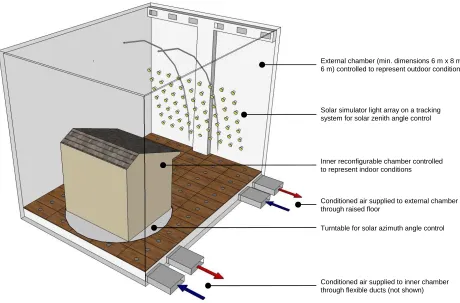
Design of the whole building simulator proposed at RMIT University, shown in part in Figure 2, allows for dynamic control and measurement of all the major variables that affect heat and mass flow in a building element.
The facility comprises two temperature and relative humidity controlled environments, or chambers. The external chamber represents the outdoor conditions the external surface of the façade would be exposed to (air temperature -5 oC to 40 oC; RH 10% to 90%), and the internal chamber represents the indoor conditions the internal surface of the façade would be exposed to (air temperature 5 oC to 30 oC; RH 10% to 90%).
The external surface of the façade needs to be capable of being exposed to a controlled source of simulated solar radiation (100 W/m2 to 1000 W/m2) with a spectrum complying to ASTM E927-05 standard, Class C. The solar simulator light array will be mounted on a tracking system that allows the solar zenith at different times of the year in different geographical locations to be simulated.
The simulator will be designed to a specification that allows facade U-factors to be measured according to ISO 9869:1994 Thermal insulation - Building elements - In-situ measurement of thermal resistance and thermal transmittance.
The inner chamber will be designed to be easily reconfigurable and can have dimensions up to approximately 3 m x 3 m x 3 m. The external chamber must be relatively large to encompass the inner chamber and a solar array. A minimum size of 6 m x 8 m x 6 m is suggested. Conditioned air is supplied separately to the inner and external chambers by two HVAC systems.
[image:4.612.75.535.62.365.2]The chambers need to be instrumented so that surface temperature (+/- 0.2 oC), relative humidity (+/- 5%) and hygrothermal conditions at points within multi-layered façade elements to be measured, allowing comparison with heat and mass transfer simulation tools such as Wufi to be made. The inner chamber requires the option to fit a window solar calorimeter, complete with mask wall, active thermal guard, flow loop, and absorber panel to measure the optical and thermal performance of facades.
Figure 2. Environmental chambers concept for a whole building simulator
External chamber (min. dimensions 6 m x 8 m x 6 m) controlled to represent outdoor conditions
Inner reconfigurable chamber controlled to represent indoor conditions (represents indoor conditions) Solar simulator light array on a tracking system for solar zenith angle control
Turntable for solar azimuth angle control Conditioned air supplied to external chamber through raised floor
In addition to controlling air temperature, humidity and solar irradiance in the external chamber, it would be desirable to have the ability to control wind speed as this would enable air tightness and weather tightness testing. This is not being considered at this time because of the high cost of incorporating a wind tunnel into the design.
The walls of the external chamber are likely to be fixed-in-place insulation panels. The option of being able to reconfigure part of the chamber’s envelope that is exposed to ambient conditions is being explored. This would potentially increase the usefulness of the facility by enabling it to serve the dual functions of test room and whole building simulator.
4.
DISCUSSION
This paper argues the key role of whole building simulator laboratories in developing the innovation capacity of the building industry, as it responds to the challenge of developing cost-effective technologies for the next generation of sustainable buildings. It is also argued that these facilities are needed to improve building energy models and the capability of sustainable building designers, both of which are important in developing innovation capacity.
Whole building simulator laboratories need to be able to test the energy performance of full-scale building envelopes and systems under dynamic conditions. They need to account for all the major variables that effect heat and mass flow in a building element, which includes solar. The design of these laboratories will vary with the needs and budget of each developer. Their effectiveness will be maximised if they are designed and operated within international agreements covering design, testing protocols and data exchange. The purpose of this paper is to contribute to a discussion that leads to this outcome.
5.
REFERENCES
[1] Department of Climate Change and Energy Efficiency 2012. Draft National Building Energy Standard-Setting,
Assessment and Framework (May 2012). Department of Climate Change and Energy Efficiency, Canberra.
[2] Pellegrino, J. L., Fanney, A. H., Bushby, S. T., Domanski, P. A., Healy, W. M. and Persily, A. K. 2010. Measurement Science Roadmap for Net-Zero Energy Buildings Workshop Summary Report (March 2010). NIST Technical Note 1660. National Institute of Standards and Technology,
Gaithersburg, MA.
[3] Reliable Building Energy Performance Characterisation Based on Full Scale Dynamic Measurements (Annex 58). In ECBCS Annual Report 2011 (International Energy Agency Energy Conservation in Buildings and Community Systems Programme). ECBCS Bookshop, ℅ AECOM Ltd,
Birmingham, United Kingdom, 7.
[4] International workshop: Full scale test facilities for
evaluation of energy and hygrothermal performances (March 2011). Janssens, A., Roels, S. and Vandaele, L., Ed. Ghent University, Belgium.
[5] Summerfield, A. J and Lowe R. 2012. Challenges and future directions for energy and buildings research. Building Research and Information 40(4), 391-400.
[6] Augenbroe, G. and Park, C. S. 2005. Quantification methods of technical building research. Building Research and Information 33(2), 159-172.
[7] Paukert, M., Niederée, C., Muscogiuri, C., Bouquet, P. and Hemmje, M. 2003. Knowledge in the innovation process: an empirical study for validating the innovation knowledge life cycle. In Proceedings of the 4th European Conference on Knowledge Management (Oxford University, United Kingdom, Sept 18-19, 2003). Academic Conferences Ltd, 2003, 725-737.
[8] Jimenez, M. J. and Madsen, H. 2008. Models for describing the thermal characteristics of building components. Building and Environment 43, 152-162.
[9] Strachan, P. A. 2008. Simulation support for performance assessment of building components. Building and Environment 43, 228-236.
[10]The National Fire Research Laboratory. National Institute of
Standards and Technology,
http://www.nist.gov/el/fire_research/upload/nsflweb-2.pdf.
[11]Ohtani, K., Ogawa, N., Katayama, T. and Shibata, H. 2004. Construction of E-Defense (3-D full-scale earthquake testing facility). In Proceedings of the 13th World Conference on Earthquake Engineering (Vancouver, Canada, August 1-6, 2004). International Association for Earthquake Engineering, 2004, Paper No. 189.
[12]Canterbury Earthquakes Royal Commission 2012. Final Report Volume 2: The Performance of Christchurch CBD Buildings. Department of Internal Affairs, Wellington.
[13]Judkoff, R., Wortman, D., O’Doherty, B. and Burch, J. 2008. A Methodology for Validating Building Energy Analysis Simulations (April 2008). Technical Report NREL/TP-550-42059. National Renewable Energy Laboratory, Golden, CO.
[14]VERU Modular Test Facility for Energy and Indoor
Environments. Fraunhofer IBP,
http://www.ibp.fraunhofer.de/content/dam/ibp/en/documents/ VERU_Flyer_e_tcm1021-85279.pdf.
[15]Indoor Environmental Quality Laboratory Launch. Faculty
of Architecture, Design and Planning, University of Sydney, http://sydney.edu.au/architecture/documents/FS/IEQLAB_Br ochure.pdf
[16]Facility for Low Energy eXperiments in Buildings - A New
National Resource for Energy-Efficient Building Technologies. Berkeley Lab,
http://i4energy.org/downloads/projects/sutardja-dai/2-FlexLab.pdf.
[17]Building Envelope Performance Lab CFI. Concordia
University, http://www.bcee.concordia.ca/research-and facilities/research-labs/building-envelope-performance-lab/.
[18]Building Technologies Research and Integration Centre.
Oak Ridge National Laboratory, http://web.ornl.gov/sci/ees/etsd/btric/.
[19]The Willis H. Carrier Total Indoor Environmental Quality
Lab. Syracuse Centre of Excellence,
http://www.syracusecoe.org/coe/sub1.html?skuvar=18.
[20]Building Performance. Syracuse University,