http://www.scirp.org/journal/jss ISSN Online: 2327-5960
ISSN Print: 2327-5952
Risk Analysis of Laundry Equipment
Development Project with Interpretative
Structural Modeling
Chengpeng Zhong
1,2, Haoheng Ye
1, Leqi Xie
11School of Business Administration, South China University of Technology, Guangzhou, China 2Engineering, Alliance Laundry Equipment (Guangzhou) Ltd., Guangzhou, China
Abstract
This paper uses the method of expert voting to determine the top ten key risk factors, and then uses the interpretative structure model to find out the deep logic between the top ten risks. Ten key risk factors are attributable to five as-pects of the project of washing equipment development: organization, initia-tive, planning, executing and controlling that more intuitively show the level of the relationship between the factors, which provides a theoretical founda-tion for risk management and risk response of washing equipment develop-ment project, to reduce the risk and failure.
Keywords
Laundry Equipment Development Project, Risk Management, Key Risk Factors, Interpretative Structural Modeling, Causal Relationship, Deep Logic
1. Introduction
With the improvement of living standards, the washing amount of hotel and restaurant linens is growing, and washing industry has ushered in a new devel-opment opportunities. According to the ministry of commerce business infor-mation service enterprise statistics and the wash typical commission statistics data, by the end of 2016, washing and dyeing industry revenue has risen from 99.82 billion yuan in 2015 to 104.71 billion yuan in 2016, increased by 4.9%. One of the enterprises above designated size operating income rose from 57.13 billion yuan in 2015 to 60.67 billion yuan in 2016, increased by 6.2%. The size of the following corporate revenues from 42.7 billion yuan in 2015, rose to 44.04 billion yuan in 2016, up 3.2%. However, at present, the project management system of
How to cite this paper: Zhong, C.P., Ye, H.H. and Xie, L.Q. (2018) Risk Analysis of Laundry Equipment Development Project with Interpretative Structural Modeling. Open Journal of Social Sciences, 6, 117-126.
https://doi.org/10.4236/jss.2018.62011
Received: January 21, 2018 Accepted: February 23, 2018 Published: February 26, 2018
Copyright © 2018 by authors and Scientific Research Publishing Inc. This work is licensed under the Creative Commons Attribution International License (CC BY 4.0).
http://creativecommons.org/licenses/by/4.0/
Open Access
washing equipment development is still imperfect in China. Especially the risk management is rather weak. The control ability of risk determines the success or failure of the project of washing equipment development to a certain extent.
This paper establishes the interpretative structure model of risk factors of washing machine development project by using the interpretative structural model method (Interpretative Structure Model, referred to as ISM), to analyze the causal relationship between the key risk factors and find out the key factors that lead to the failure of the project of washing equipment development, for providing theoretical guidance for risk management of the washing equipment development project.
2. Literature Review
The first edition of “A Guide to the Project Management Body of Knowledge” is published by American PMI Association in 1996. The risk management is as one of the nine knowledge field, and it is retained in the later updated version; Qi Anbang professor, president of Management Committee of the International Project Management Association published the “Project Risk Management” in November 2010, that a comprehensive introduction to the basic process, the
principle and method of project risk management [1]; China’s first certified
in-ternational senior project manager Mr. Shen Jianming put forward and estab-lished a relatively perfect and scientific risk management system model and me-thod in his book “Project Risk Management” which published in September
2010 [2]. The risk analysis of the equipment development project includes the
following steps: first, risk identification. One of the features of a project is uni-queness, so the risk of each project is not the same, but we can still learn from previous project risk levels to identify risks in the process of identifying risks, or consult industry experts to identify project risks. Second, risk analysis. Risk analysis is a qualitative and quantitative analysis of the identified risks, a com-prehensive analysis and evaluation of the probability and impact of risk, risk ranking priority and impact on the project evaluation process. Third, risk con-trol. Risk control includes the formulation of corresponding risk response schemes and the process of controlling and reducing the probability of risk dur-ing the entire implementation of the project. The ability of risk control plays a
great role in the success or failure of the project [1][2][3].
The interpretive structure model (ISM) refers to the application matrix and simple logic operation to describe the structural relationships among the com-ponents of a complex system. ISM technology uses directional graph, matrix and other tools to deal with the relationship between the problem elements, and ex-plains it with text, to better clarify the level and overall structure of the problem,
and improve the understanding and understanding of the problem [4]. The
work steps of interpretative structural modeling method: 1) The formation of ISM implementation team construction; 2) A set of key issues; 3) Through re-peated discussions, get the cause list of the key factors; 4) List the correlation fac-tors; 5) Establish the adjacency matrix and reachable matrix; 6) Regional division;
7) Division of the level; 8) Extract the skeleton matrix and draw the interpreta-tion structure model. The ISM is widely used, in medical field, applicainterpreta-tion of in-terpretative structural model the whole process management of medical waste of extracted factors, determine the relationship and the division level, thus found to
affect key factors of medical waste management in the whole process [5]; in the
high-tech field, ISM can carry out scientific analysis and evaluation of technolo-gical innovation capability of high-tech enterprises, to find out the ideas and
methods to solve problems [6]; in the manufacturing field, application of
inter-pretive structural model to analyze the factors existing in the maintenance man-agement of the comprehensive production obstacles, and puts forward
counter-measures [7]; project management, through the interpretative structural
model-ing method to establish a risk factor to explain the structure, it can directly re-flect the level of the relationship between various factors, to provide guidance
and reference for metro construction safety management [4]; in the field of
In-ternet software, identifying risk factors through the IT service management project implementation failure, and according to the degree of risk they are sorted and analyzed, and identify the risk factors resulting in failure, through the development of countermeasures in advance, In order to guarantee the success
of project [8][9]; in agriculture, through the method of interpret structure
mod-el, analysis of agricultural logistics distribution center, and puts forward the
lo-gistics distribution center location is proposed in the medical field [10]; from the
Internet to the manufacturing industry, the interpretation structure model is widely used, the risk management and interpretation structure model method
has also been a very good combination [11].
3. Identify Risk Factors
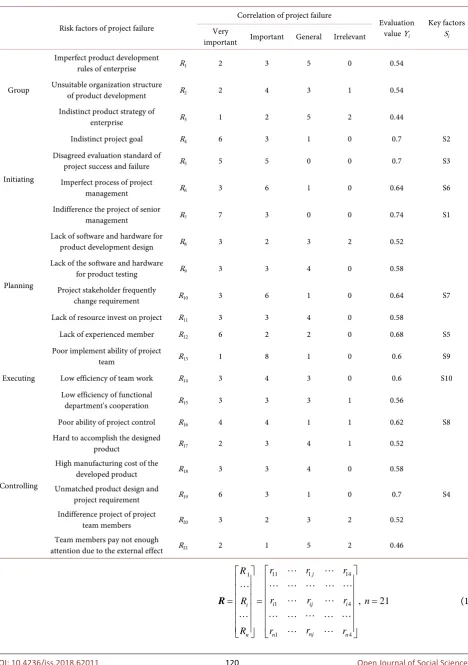
Based on the previous washing equipment development project risk register analysis and through expert interview, this paper extracted the 21 risk factors which may cause the failure of washing equipment development project and formed a list of risk factors, and then, the risk factors are divided into five cate-gories—group, initiating process, planning process, executing process and
con-trolling process (Table 1).
In order to further determine the key risk factors, this paper uses the Delphi method to assess the importance of the risk factors that lead to the failure of the project. First, according to the principle of systems engineering, we set a set of
commentary on the correlation between risk factors and project failure: X = {X1,
X2, X3, X4} = {Very important, Important, General, Irrelevant} = {0.8, 0.6, 0.4,
0.2}. Then, on the basis of circular evaluation of ten washing industry experts, the number of each risk factor selected as the relevant comment set is
aggre-gated, and the evaluation results are obtained, see Table 1.
Then, creating the importance evaluation matrix R of risk factors which lead
to project failure based on Table 1, These risk factors belong to the degree of Xj
of each item in the project failure, as in (1).
Table 1. Ranked list of TOP 10 key risk factors.
Risk factors of project failure
Correlation of project failure
Evaluation value Yi
Key factors Si Very
important Important General Irrelevant
Group
Imperfect product development
rules of enterprise R1 2 3 5 0 0.54
Unsuitable organization structure
of product development R2 2 4 3 1 0.54
Indistinct product strategy of
enterprise R3 1 2 5 2 0.44
Initiating
Indistinct project goal R4 6 3 1 0 0.7 S2
Disagreed evaluation standard of
project success and failure R5 5 5 0 0 0.7 S3
Imperfect process of project
management R6 3 6 1 0 0.64 S6
Indifference the project of senior
management R7 7 3 0 0 0.74 S1
Planning
Lack of software and hardware for
product development design R8 3 2 3 2 0.52
Lack of the software and hardware
for product testing R9 3 3 4 0 0.58
Project stakeholder frequently
change requirement R10 3 6 1 0 0.64 S7
Lack of resource invest on project R11 3 3 4 0 0.58
Lack of experienced member R12 6 2 2 0 0.68 S5
Executing
Poor implement ability of project
team R13 1 8 1 0 0.6 S9
Low efficiency of team work R14 3 4 3 0 0.6 S10
Low efficiency of functional
department's cooperation R15 3 3 3 1 0.56
Controlling
Poor ability of project control R16 4 4 1 1 0.62 S8
Hard to accomplish the designed
product R17 2 3 4 1 0.52
High manufacturing cost of the
developed product R18 3 3 4 0 0.58
Unmatched product design and
project requirement R19 6 3 1 0 0.7 S4
Indifference project of project
team members R20 3 2 3 2 0.52
Team members pay not enough
attention due to the external effect R21 2 1 5 2 0.46
11 1 14
1
1 4
1 4
, 21 j
i ij i
i
nj
n n
n
r r r
R
r r r n
R r r r R = = =
R (1)
Among them, rij = dij/da, dij means the number of people of factor i select
evaluation value j; da is the total number of participants to participate in the
evaluation. At the end, through the calculation of Y = RXT = (y1, ∙∙∙, yi, ∙∙∙, yn)T,
obtain the evaluation value Y of candidate risk factors’ importance of project,
with the other calculation, to obtain the evaluation value yi of each candidate risk
factor’s importance of project, the last column in Table 1. According to the 2 - 8
law, we selected and removed the evaluation value yi < 0.6 of related candidate
success factors, and the remaining 10 factors were the top ten key risk factors leading to the failure of the washing equipment development project. The top ten factors were named S1, S2, S3, ∙∙∙, S10 sort by score from high to low.
From Table 1, S1 Indifference the project of Senior management, S2 Indistinct
project goal, S3 Disagreed evaluation standard of project success and failure, it is
also not hard to find these three elements are in initiating process stage of the project, project input has a significant impact on the project; Followed by S4
Unmatched product design and project requirement, S5 Lack of experienced
member, S6 Imperfect process of project management, we can see that the
prob-lems appeared in initiating process, planning process and controlling process,
that mainly reflect the project manager’s ability to control project. The S7 Project
stakeholder frequently change requirement, the frequent change of project re-quirements is mainly due to the fact that the project has not identified the root causes of the stakeholders in the planning stage, and the quality of the project
will have a great impact on the project. S8 Poor ability of project control, S9 Poor
implement ability of project team, S10 Low efficiency of team work, these three
factors have the same votes and they belong to the category of communication management, which is extreme important to the project implementation process.
4. Create the ISM of Risk of Laundry Equipment
Development Project
4.1. Create Adjacency Matrix Based on Key Risk Factors
According to Table 1 ranked list of TOP 10 key risk factors and using the ISM to
analyze the structure relationship of the risk factors, in order to make a complete structure of the relationship between risk factors and the risk factors lead to
project results more clear, here introduces a risk factors S0 represents “washing
equipment development project failure”, in this way, carries on the analysis on
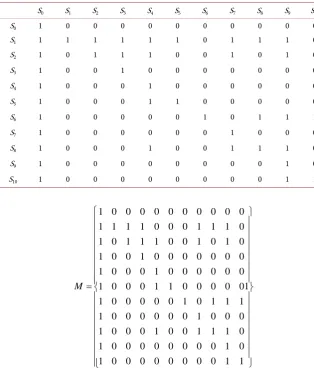
the relationship of 11 risk factors, The specification is as follows: Si has an
influ-ence on Sj, mark 1; Si has no influence on Sj, mark 0; (i, j = 0, 1, ∙∙∙, 10). For the factors influencing each other, the influence of the influential party is influenced. The result is as in Table 2.
From Table 2, we can get the 11 × 11 adjacency matrix A, after calculation of
matrix A: A1 = A, A2 = A2, A3 = A3, ∙∙∙, according to the ISM calculation rule, for general, A1 ≠ A2 ≠ ∙∙∙ ≠ Ar−1 = Ar = Ar+1, and r≤ 11-1, getting reachable matrix M = Ar = Ar.
Table 2. Relationship of key risk factors.
S0 S1 S2 S3 S4 S5 S6 S7 S8 S9 S10
S0 1 0 0 0 0 0 0 0 0 0 0
S1 1 1 1 1 1 1 0 1 1 1 0
S2 1 0 1 1 1 0 0 1 0 1 0
S3 1 0 0 1 0 0 0 0 0 0 0
S4 1 0 0 0 1 0 0 0 0 0 0
S5 1 0 0 0 1 1 0 0 0 0 0
S6 1 0 0 0 0 0 1 0 1 1 1
S7 1 0 0 0 0 0 0 1 0 0 0
S8 1 0 0 0 1 0 0 1 1 1 0
S9 1 0 0 0 0 0 0 0 0 1 0
S10 1 0 0 0 0 0 0 0 0 1 1
1 0 0 0 0 0 0 0 0 0 0
1 1 1 1 0 0 0 1 1 1 0
1 0 1 1 1 0 0 1 0 1 0
1 0 0 1 0 0 0 0 0 0 0
1 0 0 0 1 0 0 0 0 0 0
1
1 0 0 0 1 1 0 0 0 0 0
1 0 0 0 0 0 1 0 1 1 1
1 0 0 0 0 0 0 1 0 0 0
1 0 0 0 1 0 0 1 1 1 0
1 0 0 0 0 0 0 0 0 1 0
1 0 0 0 0 0 0 0 0 1 1
M
=
4.2. Grade Partition for Reachable Matrix
Reachable set: Element set which element Si is able to reach can be defined as
reachable set of element Si, represented by R(Si), composing by the column
which all matrix elements are “1” in the Si raw of reachable matrix.
Cause set: Element set which elements are able to reach element Si can be
de-fined as cause set of element Si, represented by A(Si), composing by the raw
which all matrix elements is “1” in the Si column of reachable matrix.
The highest element set: A multilevel hierarchical structure is a collection of elements that cannot reach other elements but can reach themselves. The set
R(Si) contains only its own set of elements, while the previous focus, excluding
the elements Si itself, includes the next level of elements that can reach it. If R(Si) = R(Si) ∩A(Si), i = j, then R(Si) is the highest set of elements. After finding the top-level set of elements, you can remove the corresponding rows and columns from the reachable matrix, and then continue to search for the new superlative elements from the remaining matrix. By analogy, you can find the highest set of
elements contained in all levels [5]. The first level can reach the set and the
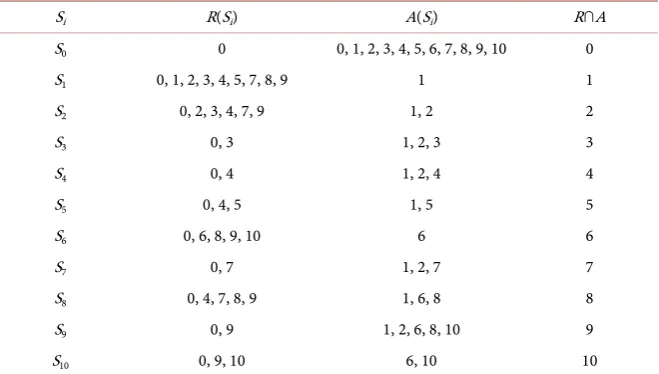
pre-vious set, as in Table 3.
Table 3. First grade of reachable set and cause set.
Si R(Si) A(Si) R∩A
S0 0 0, 1, 2, 3, 4, 5, 6, 7, 8, 9, 10 0
S1 0, 1, 2, 3, 4, 5, 7, 8, 9 1 1
S2 0, 2, 3, 4, 7, 9 1, 2 2
S3 0, 3 1, 2, 3 3
S4 0, 4 1, 2, 4 4
S5 0, 4, 5 1, 5 5
S6 0, 6, 8, 9, 10 6 6
S7 0, 7 1, 2, 7 7
S8 0, 4, 7, 8, 9 1, 6, 8 8
S9 0, 9 1, 2, 6, 8, 10 9
S10 0, 9, 10 6, 10 10
According to the theory of Grade Partition for Reachable Matrix and Table 3,
R(S0) = R(S0) ∩A(S0), the same of S0 in first grade, cancel raw 0 and column 0,
obtain the second grade of reachable set and cause set; the same of S3, S4, S7, S9,
cancel raw 3, 4, 7, 9, and column 3, 4, 7, 9, obtain the third grade of reachable set and cause set; the same of S2, S5, S8, S10, cancel raw 2, 5, 8, 10, and column 2, 5, 8, 10, obtain the fourth grade of reachable set and cause set. The accessible matrix can be further obtained by the combination of the above and the previous set.
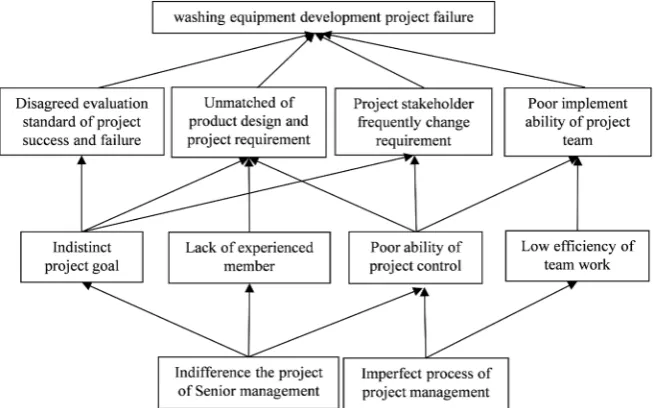
We know that S0 washing equipment development project failure is the
high-est factor; S3 Disagreed evaluation standard of project success and failure, S4
Unmatched product design and project requirement, S7 Project stakeholder
fre-quently change requirement and S9 Poor implement ability of project team are
the second-level factor set. S2 Indistinct project goal, S5 Lack of experienced
member, S8 Poor ability of project control and S10 Low efficiency of team work
are the third level factor set; S1 Indifference the project of Senior management
and S6 Imperfect process of project management are the base lever set as same as
root factor set, is the root factor set which lead to S0 washing equipment
devel-opment project failure. A clear demonstration of the linkages between levels, the hierarchy of risk factors and the interconnections between various risk factors is of great significance to the creation of an interpretation structure model.
4.3. Create Interpretative Structural Model
This paper establishes the risk interpretative structural model of laundry
equip-ment developequip-ment project as Figure 1, factors Indifference the project of Senior
[image:8.595.210.539.499.703.2]management and Imperfect process of project management are the root of washing equipment development project failure. Senior management did not at-tach enough importance to the project’s commercial argumentation and the al-location of resources that bring the significant influence, in the process of project implementation will be a serious blow the morale of the project members, thus affecting the implementation of the project. The project management process is not perfect. The project management process is very important to the project. It is the cornerstone of the project operation and is an important pre-mise to ensure the orderly progress of the project. Both root causes and trigger indistinct project goal; Lack of experienced member; Poor ability of project con-trol; Low efficiency of team work; Disagreed evaluation standard of project suc-cess and failure; Unmatched product design and project requirement; Project stakeholder frequently change requirement; Poor implement ability of project team, these factors eventually lead to project failure. By using the interpretative structural modeling method, the structure relation between the risk factors of the washing equipment is analyzed, so that we can better prepare the risk re-sponse measures.
Figure 1. Risk interpretative structural model of laundry equipment development project.
5. Management Enlightenment
We can find that the washing equipment development project risk type and the structure of the relationship between risk factors, which cause the failure of washing equipment development project of the five factors, respectively, in the second, three and four layers in the model, the product design does not accord with the project requirements involve the project goal is not clear, the lack of experienced developers and project development capacity is low; Poor execution of the project is also the result of elements of the third tier. In addition, high-level management is the most fundamental factor in the lack of attention to the project and low project control ability.
1) Washing equipment due to the particularity of the industry, so the top management are integrated in product development strategy formulation with the characteristics of the industry, so early in the project, must maintain close communication with senior management, to ensure the project to get the atten-tion of senior management personnel, during the project implementaatten-tion, keep reporting to senior management, to ensure the project from beginning to end top managers are involved in the project.
2) Washing industry project management is still in its infancy, so the project manager should reflect the defects existing in the project process in a timely manner to senior management, so that top management to improve and arrange resources to improve the project management process, reduce the project failure caused by imperfect process.
3) Washing equipment of the customer experience is very important, so the project manager to communication with senior management or customers, to ensure that the input of the project is clear, training for project team members and ensure that team members possess the skills required to perform project. At the same time, the project manager must constantly improve the project man-agement level to avoid the lack of project manman-agement and control ability due to lack of self-level.
6. Conclusions
This paper selects the top 10 key risk factors by using the Delphi method and explains the deep logic of the top ten key risk factors. Top ten key risk factors are attributable to five aspects of washing equipment development project: or-ganization, initiation, planning, executing and controlling, so that it is more intuitive to reflect the level of the relationship between the factors, for provid-ing scientific theoretical basis of risk management and risk responses of wash-ing equipment development project, and that would be beneficial for reducwash-ing the project risk and project failure possibility.
Acknowledgements
Thanks a lot for the valuable discussions with you, professor Jiangping Wan.
References
[1] Qi, A.B. (2010) Project Risk Management. Nankai University Press, Tianjing, 1-35. [2] Project Management Institute. (2013) Project Management Body of Knowledge
(PMBOK Guide). 5th Edition, Publishing House of Electronics Industry, Beijing, 309-312.
[3] Shen, J.M. (2010) Project Risk Management. 2nd Edition, China Machine Press, Beijing, 487-489.
[4] Gou, M. and Zhao, J.X. (2014) Risk Analysis of Tunnel Boring Machine Based on ISM Method. Shenyang Jianzhu University Journal (Social Science Edition), 10, 390-393.
[5] Chang, Y., Liu, X.D. and Yang, L. (2003) Analyze the Technological Innovation Ability of High-tech Enterprises by ISM Method. Science Research Management, 3, 41-47.
[6] Liu, G.F. and Tian, T.T. (2016) Study on the Influence Factors of the Whole Process of Medical Waste Management Based on ISM. Manager Journal, No. 35, 7-8. [7] Poduval, P.S., Pramod, V.R. and Jagathy Raj, V.P. (2005) Interpretive Structural
Modeling (ISM) and Its Application in Analyzing Factors Inhibiting Implementa-tion of Total Productive Maintenance (TPM). International Journal of Quality &
Reliability Management, 32, 308-331.
[8] Wan, J.P., Cao, Y.H. and Hou, J.J. (2013) Case Study on H Corp. Software Project Risk Management with ISM. Technology and Investment, 4, 145-152.
[9] Wan, J.P., Wang, Y.F. and Liu, Q.J. (2009) An Empirical Analysis of Risk Factors for IT Service Management Project Based on ISM. Science Research Management, No. 5, 487-489.
[10] Huang, L.J., Yu, J. and Huang, X.W. (2012) Modeling Agricultural Logistics Distri-bution Center Location Based on ISM. Journal of Software, 7, 638-643.
[11] Zhang, Y.L. and Yang, N.D. (2006) Project Risk Management Process and Integra-tion under the Perspective of Knowledge Management. Industrial Engineering and
Management, No. 6, 110-113.