
www.editada.org
_______________________________________________________________________________________
Editorial Académica Dragón Azteca (EDITADA.ORG)
A Hybrid VNS/TABU Search Algorithm for Solution the P-Median Problem
Mauricio Romero Montoya a, Erika Granillo Martínez b,, Rogelio González Velázquez b
María Beatriz Bernabé Loranca b, Martín Estrada Analco b a Instituto Tecnológico de Orizaba (ITO).
b Benemérita Universidad Autónoma de Puebla (BUAP).
[email protected] [email protected]
[email protected] [email protected] [email protected]
Abstract. The p-median problem is an excellent tool to solve location facilities problems. There are many applications in which the problem of the p-median can be used, some of these can be; location of fire stations, location of police stations and location of distribution centers, among others. This work introduces the use of A Hybrid VNS / TABU Search Algorithm to determine the correct location of p centers. Experimental results on benchmark and the application to a real case indicate the potential of the proposed approach, which is able to produce good solutions with the use of VNS / TABU Search.
Keywords: VNS, Tabu Search, Metaheuristic, p-median, Np-Hard
Article Info
Received Jun 20, 2019 Accepted Dec 11, 2019
1
Introduction
Location problems arise from the need to define the most convenient location to place facilities such as distribution centers (DC), production plants, commercial warehouses, service centers, trash dumps, fire or police stations, hospitals or supermarkets [20]. Yet, how can one ensure that the DC is placed at the best location? By the best location, we mean that both customers and suppliers have the best logistic advantages, that is closest to the optimum and that costs in general are minimized.
The p-median problem (PMP) and the capacitated p-median problem (CPMP) are excellent options to define the best location for these centers. The p-median problem basically considers a situation in which it is required to partition a set of clients into exactly p groups. Each group is defined only by the set of clients in it, but also by the location of their median. A clear representation of this problem is presented in figure 1.
[image:1.612.133.444.550.685.2]
68
The present work is organized as follows: Section 1 presents the introduction. Section 2 includes a brief description of the P-Median Problem and its mathematical formulation and the hybrid´s construction, section 3 shows the result of the computational experiments, and Section 4 shows the discussion. Finally, in section 5 the conclusions are presented.
2 Materials and methods
The combinatorial nature of the p-median problem caused advances in solution techniques to be often made using combinations of mathematical programming and heuristic search techniques such as branch and bound and Lagrangean relaxation [18]. Several efforts have been made in order to solve the p-median and capacitated p-median problems. Moreover, there are two articles of greatest interest when Tabu search is involved, because the methods developed to solve the p-median problem are solved by means of Tabu search (TS). A TS procedure for PMP was developed by Sörensen (2008) [21] that achieved optimal solutions for all the small and medium sized instances in the OR- Library, except for two. Although the document fails to identify such instances, it is set that the relative errors were under 0.1%, which represents an improvement over all previous work for the PMP. This work backs the conclusions by Arostegui et al (2006) [3] and establishes that TS may well be a dominant methodology to use when solutions for the CPMP are sought.
There are solution algorithms that ranges from the optimal search by simplifying the model as it can be seen in COBRA [5], to the application of metaheuristics, some examples of these are genetic algorithms, simulated annealing, clustering tools, among others. It is important to bring out that all these algorithms search the optimum. Taking into account the clustering method, the methods of the p-median have been created within the data mining area to detect patterns in large scale of data as it can be seen in regions which are densely populated in an Euclidean space. One of the challenges is to use those large amounts of data properly to obtain quality in the solutions in a reasonable computing time [9].
In this context, it is possible to see that most of those models are formulated with Mixed Integer Linear Programming (MILP); this is done because the exact ways to solve this type of problems in medium sizes need powerful computers; so the heuristic approaches are used to solve the real problems [1]. The main techniques used are patterns of decomposition, hierarchical, Lagrangian relaxation, branching and dimensioning models and some metaheuristics such as simulated annealing and genetic algorithms [19]. Hindi and Basta in 1994 used the branching and dimensioning techniques to work the same Geoffrion & Graves model; they also added the limited capacity constraint and calculated the lower limits through structured transformations (Hindi and Basta, 1994).In the same area, there were great results when p-median and simulated annealing were mixed. The effectiveness of this type of methods can be seen clearly through the tests done with the instances of OR-Library [2]. Lately, it can be found an excellent review of this literature on p-median [14]. About partitioning, considered as a p-median problem, the correct grouping is given when the elements of the partition meet the geometric criterion of compactness, which it is achieved when the distance is minimized between the distribution centers and the clients (centroids and geographic objects) [4]. The Tabu Search (TS) meta-heuristic has proved highly successful for solving combinatorial and nonlinear problems. A key aspect of TS consists of using adaptive forms of memory to forbid the search process to revisit solutions already examined unless the trajectory to reach it is different Herda, M., & Haviar, M. [12] suggests two ways of combining a genetic algorithm (GA) with integer programming to improve the quality solution of the CPMP [12]. On the other hand Comber & Sasaki describes the development and application of a modified grouping genetic algorithm (GGA) used to identify sets of optimal ambulance locations [6]. Osman and Christofides [17] propose a simulated annealing and tabu search method. At the end, good results are obtained when using 3 different search types for the PMP, the first solutions is obtained with Scatter Search while the second algorithm uses Path Relinking, a third approach that combines Path Relinking with Scatter Search is also analyzed. The GRASP methodology is used to generate the initial reference set both for Scatter Search and Path Relinking [7].
2.1 Problem description
The P-median problem, credited to Hakimi (1964) [11] is an adaption of the classical Weber problem. It is particularly difficult to solve when considering problems of a more practical size where the number of variables may run in the hundreds or even thousands.
69
Formally, it is assumed that each vertex in a graphic potential median. The p-median problem may be formally defined as follows:
Let G=(V,A) be a simple directed graph where V represents the vertexes and A represents the arcs. The objective is to find the vertex set VpCV (set of medians) with cardinality P, such that: a) the sum of the distances between the remaining vertexes and the selected vertex Vp in {V-Vp} (the demand set) is minimized, and b) all demand points are met without violating the capacity restrictions for the located median facilities.
Subject to:
Target function (1) minimizes the sum of distances between all nodes. Constraint (2) ensures each node is assigned to exactly one facility. (3) Demand nodes constrains to be assigned. (4) Ensures that one client is assigned to only one selected median. (5) Binary restrictions
2.1 Algorithms
In this section, we present the algorithms used and hybrid developed
2.2.1 Variable Neighborhood Search VNS
Formally, a neighborhood structure over a space or search universe U is a function E: U 2S that associates a neighborhood E(x) U to every solution x of U. A big amount of heuristic methods proposed in the literature belongs to the neighborhood search procedures class [10].
2.2.2 Tabu Search TB
In its best known form, Tabu search can be viewed as beginning in the same way as ordinary local or neighborhood search, proceeding iteratively from one point (solution) to another until a chosen termination criterion is satisfied. Each solution x has an associated neighborhood N(x) ⊂ X, and each solution x′∈ N(x) x is reached from x by an operation called a move [23].
2.2.3 VNS/TB Search for P-Median Problem
70
dissimilarity matrix with the distances between the objects. Additionally the parameters that the hybrid requires, like: number of iterations VNS, VNS indicates the number of times the neighborhood structures defined will be traversed, the iterations for neighborhood change (nc), that is a value that will determine when the local taboo search ends, in specific define the freedom that the taboo search will have to accept worse solutions, if nc is equal to one, the search ends when a worse solution is found, that is, the neighborhood structure changes when the first local optimum is found. Tabu tenure stops medoides, ta_tenure indicates the number of iterations during which a medoi-of-addition to the solution will remain immovable given its taboo state, while the taboo holds for non-medoids, td_tenure indicates the same but for the replaced medoids, that is, it will not be returned to a solution by td_tenure iterations.
The algorithm begins to generate a random initial solution, whose cost was obtained by means of the defined cost function. This time, you can also waste your time. The cycle that controls the total search, vns_count with the iterations until reaching the value vns_it. The load cycle of the distance of the neighborhood structures defined, in this case, is equivalent to the number of grouped objects. The local search cycle around the current neighborhood structure and ends when a certain number of worse solutions is obtained (nc_it). Within the cycle, movements are performed on the actual solution accepted and the two conditions, examine the quality of the solution; the first replaces the best solution found if it is overcome. The second one increases the nc_cont counter each time it is a solution to the previous one. Finally, it returns to the best solution found.
2.2.4 Hybrid VNS and Tabu Search Code
Algoritmo 1. Híbrido VNS y TSsol Estructura Inicial Aleatoria
costo Función Objetivo (sol)
s_sol sol
s_costo costo
vns_cont 0
Mientras vns_cont < vns_it repetir
vns_cont vns_cont + 1
kvecindad 1
Mientras kvecindad < n repetir
sol Cambiar Vecindad (kvecindad)
Si costo < s_costo entonces
s_sol = sol s_costo = costo
Fin si
ts_cont 0
nc_cont 0
Repetir
ts_cont ts_cont + 1
p_costo = costo
sol Movimiento (sol)
Si costo < s_costo entonces
s_sol sol
s_costo costo
Fin si
Si costo > p_costo entonces
nc_cont nc_cont + 1
Fin si
Actualizar Listas Tabu
Hasta nc_cont < nc_it
71
PMP is a problem in combinatorial optimization, classified as NP-Hard [13,15], and the VNS and TABU search metaheuristic has proven efficient in searching for solutions for a wide variety of problems of this kind, such as the quadratic assignment problem, the traveling salesman problem, among others.
3. Computational Experience
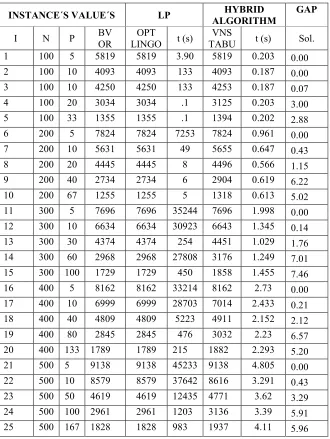
[image:5.612.143.473.283.722.2]The hybrid algorithm here presented was validated using the instances drawn from the OR-Library [16] for PMP problems, where the range of instances runs from n=100 to n=900, and p=5 to p=200. The files of the instances, which were downloaded directly from the OR-Library files, are encoded medium-sized decode the information. It was also necessary to apply the Floyd algorithm. As a result of this activity, the necessary dissimilarity matrices were obtained to solve the PMP instances. Code was developed in Java and tested with a PC with 6GB RAM and a fifth-generation i5 processor. Each instance from the OR-Library has executed a total of 50 times in order to obtain registers for the best solution and computing times. The OR-Library instances were also solved with the Lingo 17.0 optimization software and results were later compared, which showed that the solution times for each of the instances was short. However, the solutions obtained by the algorithm were not always near the optimum.
Table 1. The OR-Library 40 Instances
INSTANCE´S VALUE´S LP ALGORITHM HYBRID GAP
I N P BV OR LINGO OPT t (s) TABU VNS t (s) Sol.
1 100 5 5819 5819 3.90 5819 0.203 0.00
2 100 10 4093 4093 133 4093 0.187 0.00
3 100 10 4250 4250 133 4253 0.187 0.07
4 100 20 3034 3034 .1 3125 0.203 3.00
5 100 33 1355 1355 .1 1394 0.202 2.88
6 200 5 7824 7824 7253 7824 0.961 0.00
7 200 10 5631 5631 49 5655 0.647 0.43
8 200 20 4445 4445 8 4496 0.566 1.15
9 200 40 2734 2734 6 2904 0.619 6.22
10 200 67 1255 1255 5 1318 0.613 5.02
11 300 5 7696 7696 35244 7696 1.998 0.00 12 300 10 6634 6634 30923 6643 1.345 0.14
13 300 30 4374 4374 254 4451 1.029 1.76
14 300 60 2968 2968 27808 3176 1.249 7.01 15 300 100 1729 1729 450 1858 1.455 7.46
16 400 5 8162 8162 33214 8162 2.73 0.00
17 400 10 6999 6999 28703 7014 2.433 0.21 18 400 40 4809 4809 5223 4911 2.152 2.12
19 400 80 2845 2845 476 3032 2.23 6.57
20 400 133 1789 1789 215 1882 2.293 5.20 21 500 5 9138 9138 45233 9138 4.805 0.00 22 500 10 8579 8579 37642 8616 3.291 0.43 23 500 50 4619 4619 12435 4771 3.62 3.29 24 500 100 2961 2961 1203 3136 3.39 5.91
72
26 600 5 9917 9917 53425 9917 10.18 0.00 27 600 10 8307 8307 49413 8321 7.04 0.17
28 600 60 4498 4498 3539 4665 5.03 3.71
29 600 120 3033 3033 2725 3239 4.244 6.79 30 600 200 1989 1989 1215 2119 5.006 6.54 31 700 5 10086 10086 68479 10086 13.104 0.00 32 700 10 9297 9297 54280 9297 8.767 0.00 33 700 70 4700 4700 52345 4884 4.821 3.91 34 700 140 3013 3013 43120 3168 5.445 5.14 35 800 5 10400 10400 87659 10400 12.215 0.00 36 800 10 9934 9934 76987 9957 15.709 0.23 37 800 80 5057 5057 54980 5260 11.232 4.01 38 900 5 11060 11060 87215 11060 17.019 0.00 39 900 10 9423 9423 76542 9465 18.439 0.45 40 900 90 5128 5128 32415 5309 16.005 3.53
In table 1, the notation is the next: I=Instance, BV is the best-known value published in the OR-Library, N are the number of Customers, P are the medians, OPT LINGO are the values in the experiment whit Lingo 17, VNS TABU are the values in the experiment whit the Hybrid metaheuristic, t (sec), is the execution time for each test (OPT LINGO, VNS TABU), The GAP is the difference between the best value and the obtained value by the approximation method.
4 Results of real instances
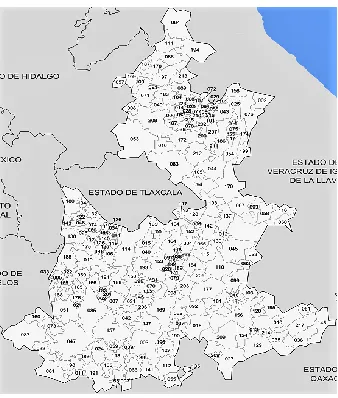
Fig. 2 Data from the problem refer to the state of Puebla Table 2. Metaheuristic Results
I N P VNS TABU t (s)
1 217 5 61498 .416
2 217 7 51318 .201
[image:6.612.221.390.426.625.2]73
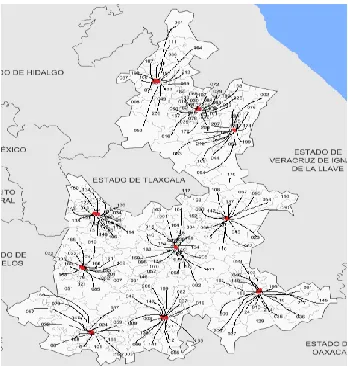
[image:7.612.219.393.126.309.2]The following map (figure 3) indicates in red spots the locations where medical care units are placed which correspond to the p- median problem, with the solution given by VNS TABU, for the case of p = 10. Each population is linked by lines to the assigned facility.
Fig. 3 Location where medical care units were placed
5. Discussions
By comparing the results obtained, the efficiency of the designed hybrid can be corrected. In some cases, it was not possible to reach the optimal values, but it is important to mention that the GAP ranges for the 40 instances go from 0% to 7.5%, having the major strength in the designed hybrid, the computational parameters are a great advantage when it was compared to the branch and bound method with the use of Lingo 17, and this is because all instances have a superior performance as far as the execution time is concerned. As you can see in Figure 4, when plotting the execution times of LINGO 17 (blue graph) against those of VNS TABU (orange graph) in each of the 40 instances, there is a very large GAP between these two methods from solution. In a general way, it can see that; for the solution of the 40 instances in lingo LINGO 17 there is a behavior to the high regarding the increase of the data and use of small P in comparison with the total data of each instance, while for the VNS TABU the observed behavior shows a high level of stability regardless of the size of the instance or of the P. The total time required in seconds to solve the 40 instances of OR-Library with LINGO 17 is 1011936.1s, while for VNS TABU it is 196,774s. (VNS TABU only needed 2% of the total solution time in LINGO 17) Therefore we can say we have a good performance hybrid.
[image:7.612.120.499.519.689.2]74
6. Conclusion
The research described in the present work has been motivated by the need to more efficiently find solutions to the PMP, as shown by the robustness of the designed algorithm, validated by means of the 40 OR-Library instances, which have been compared with the results obtained with Lingo, with an acceptable GAP, as shown in Table 1. It is well known that PMP is part of the location-allocation problems, which define the strategy for an organization, that is, they are long term decisions, and a good decision in the distribution and placement of facilities has positive implications in the efficiency of the supply chains, as well as in the competitive cost of the products or services reaching customers, thus generally benefiting the population sector that demands the product or service.
References
1. Alegre, J., Aragón, A., Casado, S., Delgado, Cristina, & Joaquín, P. (2010). Resolución de 2 modelos de localización mediante Búsqueda Dispersa. Universidad de Burgos.
2. Al-khedhairi 2008. Simulated Annealing Metaheuristic for Solving P-Median. Int. J. Contemp. Math. Sciences, 3, 1357- 1365
3. Arostegui, M. J., S. Kadipasaogul, and B. Khumawala. An empirical comparison of tabu search, simulated annealing and genetic algorithms for facilities location problems. Interna-tional Journal of Production Economics 103, 742–754 (2006) 4. Bernábe B,. Gonzalez V. 2014 P-Median: a performance analysis, 2do International Symposiumon Languaje a Knowledge
Engeeniring LKE 2014
5. Church, L. Richard, Cobra: A new Formulation of the Clasic P-Median Location Problem, Annals of Operation Research, p-103.
6. Comber, A. J., Sasaki, S., Suzuki, H., & Brunsdon, C. (2011). A modified grouping genetic algorithm to select ambulance site locations. International Journal of Geographical Information Science, 25(5), 807-823.
7. Díaz, J. A., & Fernandez, E. (2006). Hybrid scatter search and path relinking for the capacitated p-median problem. European Journal of Operational Research, 169(2), 570-585.
8. Glover, F., Laguna, M.: Tabu Search. Kluwer Academic Publishers, Norwell, MA, USA (1997)
9. Hansen P, GERARD, and CRT. Data Clustering using Large p-Median Modelsand Primal Dual Variable Neighborhood Search. Montreal Canada.
10. Hanafi, S. (2001). On the convergence of tabu search. Journal of Heuristics, 7(1), 47-58.
11. Hakimi, S.: An algorithmic approach to network location problems. part i: The p-centres, SIAM Journal of Applied Mathematics, 37, pp. 513–538 (1979)
12. Herda, M., & Haviar, M. Hybrid genetic algorithms with selective crossover for the capacitated p-median problem. Central European Journal of Operations Research, 1-14 (2017).
13. J. Resse. 2006. Methods for Solving the p-Median Problem: An Annotated Bibliography. Wiley Periodicals, Inc. Networks 48(3), 125-142.. 8
14. Kariv O., & Hakimi, S.L. 1979. An algorithmic approach to network location problems: The p-medians. SIAM Journal on Applied Mathematics, 37(3), 539-560.
15. M, Daskin, M., 1995. Network and Discrete Location: Models, Algorithms and Applications. New York: John Wiley and Sons, Inc. 2
16. OR-library: http://people.brunel.ac.uk/~mastjjb/jeb/orlib/pmedinfo.html, Retrieved (2017)
17. Osman, I. H., Christofides, N.: Capacitated clustering problems by hybrid simulated annealing and tabu search. Intern. Trans. in Operational Research, Vol.1 (3), pp. 317–336
18. Prikul, H., & Jayaraman, V. (1996). Production, Transportation, and Dstribition Planning in a Multi- Commodity Tri-Echelon System. T
19. Reese, J.: Methods for solving the p-median problem: An annotated bibliography. Networks, 48(3), pp. 125–142 (2006)
20. Revelle, C.: A perspective of location Science. Location Science, 5, pp. 3‒13 (1997)
21. Sörensen, K. Investigation of practical, robust and flexible decisiions for facility location problems using tabu search and simulation. J Operations Research Society 59(5), 624–636 (2008, May)
22. Venables, H.: Ant Colony Optimization: A Proposed Solution Framework for the Capacitated Facility Location Problem. http://sure.sunderland.ac.uk/policies.html (2011)
![Fig. 1 P-Median Problem (Alegre, et al 2010) [1]](https://thumb-us.123doks.com/thumbv2/123dok_us/9926652.494480/1.612.133.444.550.685/fig-p-median-problem-alegre-al.webp)
![Maximising, optimising, empowering : the work of the public health nurse in a college setting : a thesis presented in partial fulfilment of the requirements for the degree of Masters [sic] of Arts in Nursing at Massey University](data:image/gif;base64,R0lGODlhAQABAIAAAP///wAAACH5BAEAAAAALAAAAAABAAEAAAICRAEAOw==)