THE INFLUENCE OF HR-PRACTICES ON
INNOVATIVE BEHAVIOUR AND THE
MODERATING EFFECT OF LINE MANAGER
BEHAVIOUR
Author: Sören Labrenz
University of Twente P.O. Box 217, 7500AE Enschede
The Netherlands
[email protected]
ABSTRACT
Purpose – This study aims at explaining the effect of HR-practices on innovative behaviour and examining how line manager behaviour moderates this relationship.
Methodology – To explain the above mentioned relationships a literature review is conducted incorporating articles from the fields of innovation, HRM, line manager behaviour and leader-member exchange.
Findings – The review reveals that HR-practices (teamwork, performance management, rewards, training & development, delegation of responsibilities) can improve employees’ innovative behaviour when designed properly. Moreover, line managers can increase the effect of HR-practices on innovative behaviour by maintaining a high quality relationship with their subordinates. However, line manager behaviour that is expressed in a low quality relationship will impede the effect of HR-practices on innovative behaviour. This means, the effect of HR-practices on innovative behaviour is dependent on line manager behaviour.
Limitations – External pressures on an organisation as pressure for innovation or pressure for efficiency are not considered in this paper. However, they can alter the effect of HR-practices on innovative behaviour and the moderating effect of line manager behaviour. In addition, potential synergies among HR-practices are neglected although adopting a system perspective may lead to different results.
Practical implications – The importance of line manager behaviour is highlighted as the effect of HR-practices is dependent on line manager behaviour. Line manager behaviour is not only important in this context, as implementer of HRM they always have to be taken into account when investigating the outcome of HRM. Furthermore, organisations have the responsibility to provide a framework which allows high-quality relationships to grow. Thereby, companies can optimise the effectiveness of their HR-practices, ultimately leading to innovative employee behaviour.
Supervisors: Anna C. Bos-Nehles
Jan de Leede
Keywords
Innovative Behaviour, HRM, HR-practices, Leader-Member Exchange, Line Manager Behaviour, Innovation
Permission to make digital or hard copies of all or part of this work for personal or classroom use is granted without fee provided that copies are not made or distributed for profit or commercial advantage and that copies bear this notice and the full citation on the first page. To copy otherwise, or republish, to post on servers or to redistribute to lists, requires prior specific permission and/or a fee.
3rd IBA Bachelor Thesis Conference, July 3rd, 2014, Enschede, The Netherlands.
1.
INTRODUCTION
In the last decades innovation has become the crucial success factor for organisations and the ability to innovate is valued highly by customers and companies alike. Customers demand new features, new products and multiple design choices or even customised designs. Moreover, innovations are increasingly subject to open debates as for example the development of ‘Google Glass’. This debate shaped how Google is perceived by customers. According to the Boston Consulting Group (Taylor, Wagner & Zablith, 2013) Google was placed third in a list of the most innovative companies in the world in 2012. Clearly, innovation is a must-have for companies.
Accordingly, researchers have turned their interest towards innovation and its roots within organisations. Innovation is initiated by employees as they are in frequent contact with processes and products and detect potential improvements and opportunities for new developments. However, innovation only occurs if employees show a certain behaviour (innovative behaviour) meaning activities aimed at generating and implementing ideas. Consequently, management needs to know how innovative behaviour can be shaped and stimulated. Inter alia, the design of HR practices has been identified as a factor predetermining innovative behaviour (Farr & Tran, 2008; Gupta & Singhal, 1993; Laursen & Foss, 2003; Shipton, Fay, West, Patterson & Birdi, 2005; Shipton, West, Dawson, Birdi & Patterson, 2006). For example, the HR-practice ‘rewards’ can stimulate innovative behaviour by rewarding employees who contributed to new product developments. Accordingly, companies design HR practices to stimulate their employees’ innovative behaviour, albeit, how practices are perceived by employees determines the effectiveness of HR-practices and hence their effect on innovative behaviour. When employees do not perceive HR-practices as supportive to innovative behaviour, they are unlikely to show such behaviour. Employees’ perception of HR-practices – and hence their effect on innovative behaviour – depends on how those policies are put into practice by line managers (de Jong & Den Hartog, 2007; Scott & Bruce, 1994; Stoker, Looise, Fisscher & De Jong, 2001). Therefore, it is of relevance for practitioners to be aware of the line manager’s importance in this context. As Purcell and Hutchinson (2007, p.4) wrote: “Poorly designed or inadequate policies can be ‘rescued’ by good management behaviour in much the same way as ‘good’ HR practices can be negated by poor FLM [first line manager] behaviour or weak leadership”. However, limited research is currently present on how line manager behaviour influences the relationship between HR-practices and innovative behaviour of employees. The goal of this paper is to fill this knowledge gap and raise awareness of line managers’ importance to the relationship between HR-practices and innovative behaviour. To achieve the research goal the following research question will be answered:
How does line manager behaviour influence the effect of HR practices on innovative behaviour? Through answering the research question, practitioners will become aware of how important line manager behaviour is and how line managers ultimately can impact employees’ innovative behaviour. This knowledge will practically contribute by demonstrating how line managers can alter the perception of HR-practice design and hence the effect on innovative behaviour.
1.1
Methodology
To answer the research question a literature review is conducted. The databases of two search engines were used to gather information for the literature review, namely Scopus and Google Scholar. The following search terms were used to analyse the current conception of key terms and ultimately explain the relationship among the key concepts: “Innovative
Behaviour”, “Innovation AND HRM”, “HR-practices”, “Line Manager Behaviour” and “Leader-member exchange”. The search terms were not further specified ensuring that not too much literature was ignored at an early stage. Selection of literature was narrowed down through certain criteria. First and foremost articles which incorporated innovative behaviour and HR-practices or HR-practices and line manager behaviour as key concepts were taken into account. To further filter the found articles, the abstract, introduction and discussion were scanned to check for relevance for this literature review. Articles that investigated the key concepts (innovative behaviour, HR-practices, line manager behaviour, leader-member exchange) were included and synthesised in a literature matrix to provide a thorough and precise definition. The same procedure was used for articles which examined the relationships between single HR-practices and innovative behaviour. By combining the results of different studies this literature review provides a comprehensive insight into the field of stimulating innovative behaviour.
The paper is based on the following structure: firstly, to lead to the literature review the relevant concepts of innovative behaviour, HR-practices and line manager behaviour will be explained. Secondly, it is elaborated on the relationship between HR-practices and innovative behaviour. Subsequently, the moderating effect of line manager behaviour on the previous mentioned relationship is demonstrated, followed by a concluding discussion in the last section.
2.
THEORETICAL BACKGROUND
2.1
Innovative Behaviour
Before establishing a link between HR activities and the innovative behaviour of employees it must be clarified what innovative behaviour incorporates and what is excluded. Clearly, creativity, innovation and innovative behaviour are related concepts, however the exact relationships and distinctions are perceived as blurred. The current literature often refers to Amabile (1996) to describe creativity and innovation. She refers to creativity as the generation of novel and useful ideas and sees expertise, creativity skills and task motivation as the components of creativity. Innovation on the other side is “the successful implementation of creative ideas within an organisation” (Amabile, 1996, p.1). Consequently, creativity precedes innovation – ideas are generated and then implemented in a meaningful way. Moreover, while innovation focuses on the process and the outcome, innovative behaviour focuses on the contribution of employees to the innovation process (De Jong & Den Hartog, 2007; Janssen, 2005).
Like innovation, the innovative behaviour is divided into two phases, the idea generation phase and the implementation phase (Janssen, 2000; Ramamoorthy, Flood, Slattery & Sardessai, 2005). The two stages are the basis for De Jong and Den Hartog’s (2007, p.43) description of innovative behaviour: "behaviour directed towards the initiation and application (within a work role, group or organisation) of new, useful ideas, processes products or procedures". They highlight the importance of employees in the idea generation as well as the implementation stage. A similar approach was taken by Hammond, Neff, Farr, Schwall and Zhao (2011) in their meta-analysis, referring to the ideation phase and implementation phase in the innovation process.
phases individually and allows drawing more accurate conclusions about the relationship between HR practices and innovative behaviour. Therefore, the example of other researchers will be followed by distinguishing between effects on the idea generation phase and effects on the implementation phase of innovative behaviour (De Jong & Den Hartog, 2007; Hammond et al., 2011; Janssen, 2005).
Amabile (1996) describes creativity as the generation of novel and useful ideas. The idea generation phase is described as opportunity identification and reorganisation of information to derive novel ideas (De Jong & Den Hartog, 2010; Hammond et al., 2011). Clearly, the concept of creativity and idea generation overlap in their descriptions. Therefore, congruence between both terms is present. Accordingly, creativity in its similarity to the idea generation phase can be seen as a subset of innovative behaviour. Since HRM can influence employees’ creativity by increasing expertise, creativity skills and task motivation through e.g. trainings, HRM also has an effect on idea generation and hence innovative behaviour of employees (Chandler, Keller & Lyon, 2000; Jiang, Wang & Zhao, 2012).
Hammond et al. (2011) identify four areas which determine the innovative behaviour of employees; (1) individual factors, such as personality and education, (2) motivational factors, (3) job factors, such as job complexity and autonomy as well as (4) contextual factors, such as supervisor support or climate. As human resource management can shape an employee’s extrinsic motivation through incentives and improve education through training and development, managing innovative behaviour means managing human resources. Other authors support the idea that innovative behaviour is an outcome of organisational effort (Amabile, 1996; Scott & Bruce, 1994; Xerri & Brunetto, 2011). Hence, HR practices in their organisation-shaping nature are likely to influence the innovative behaviour of employees.
It must be critically mentioned though, that the previously mentioned researchers only took internal factors into account when investigating the innovative power of organisations and their employees. However, the external pressure for innovation through competition or the willingness/resistance to innovate within an industry may represent a leverage that must not be underestimated. Nevertheless, because of the limited scope of this paper the focus will be on the effect of HR practices and line manager behaviour and therefore excludes potential external influences.
2.2
HR-Practices
Many studies have strived to explore the impact of HRM on desired employee performance (in this paper innovative behaviour) and whether HRM can be a source of sustained competitive advantage (Becker & Gerhart, 1996; Guest, 1997; Gupta & Singhal, 1993; Laursen & Foss, 2003; Pfeffer, 1994; Pil & MacDuffie, 1996; Tiwari & Saxena, 2012; Wright, Gardner, Moynihan & Allen, 2005). However, HR is often perceived as a cost centre, rather than a value adding function that is able to stimulate innovative behaviour (Farndale, Paauwe & Hoeksema, 2009; Stiles & Trevor, 2006). Accordingly, HR managers are asked to minimise costs instead of designing practices that contribute to the company’s innovative capability.
Generally, two streams can be identified to explain the effect of HR practices on desired outcomes such as innovative behaviour. A comprehensive discussion of the perspectives is provided by Becker and Gerhart (1996) as well as by Guest (1997). The universal perspective or best practice approach assumes that specific HR practices are always more effective than others and are generalizable, i.e. can be applied in any organisational context (Pfeffer, 1994). This implies that the effect of HRM is the sum of HR practices. Any synergetic
ramifications between single practices are neglected. In contrast, the resource-based view emphasises that complementary resources are the basis for sustained competitive advantage and superior desired behaviour such as innovative behaviour. I.e. by combining different practices into HRM-systems, synergy is established providing an edge over other organisations as HRM systems are difficult to imitate (Becker & Gerhart, 1996; Laursen & Foss, 2003; Pil & MacDuffie, 1996). Guest (1997) highlights that the best-practice approach provides detailed insights into how best-practices transform into outcomes as e.g. employees’ innovative behaviour. Therefore, single practices are investigated in this paper rather than synergy effects. Synergy effects and their interrelationship with line manager behaviour are not explored in this paper and are potential subject for future studies.
Clearly, the decision which practices to adopt and how to design them is dependent on the desired organisational goals. This paper strives to investigate the relationship between HR-practices and innovative behaviour of employees. Accordingly, behaviour-shaping and innovation-related practices are most relevant in this context. When reviewing the current literature, five HR practices which are related to innovation, widely executed by professionals and researched by scholars can be identified (Allani, Arcand & Bayand, 2003; Guest, 1997; Laursen & Foss, 2003; Rynes, Colbert & Brown, 2002; Wright et al., 2005). Different researchers use different terms for the same concept - in this paper the names are adapted from Boselie’s (2010) approach to strategic HRM and Laursen and Foss’ (2003) definition of new HRM-practices: (1) teamwork, (2) performance management, (3) rewards, (4) training and developement and (5) delegation of responsibilities. In the recent comprehensive literature review of Tiwari and Saxena (2012) it is shown that those practices are recognised by many researchers. In addition to their practical and scientific relevance the practices can be related to innovation. For example, the criteria for performance appraisals can be linked to KPIs of innovation and training and development can focus on encouraging and stimulating creativity skills. Moreover, by emphasising knowledge diffusion in training and development, the innovative performance can be increased (Laursen & Foss, 2003).
2.3
Line Manager Behaviour
On examination of the previously mentioned literature it becomes apparent that the relationship between HR-practices and innovative behaviour is not fully explored and a moderating variable seems to be present (Liden, Bauer & Erdogan, 2004; Uhl-Bien, Graen & Scandura 2000; Wright et al., 2005). One explanation is that employees often experience HR-practices differently than HR-practices were planned by top management (Boselie, 2010). I.e. how employees perceive HR-practices will determine the effectiveness of those practices. The perception of HR-practices is largely dependent on how first line managers apply the intended HR-practices (Purcell & Hutchinson, 2007). The perception then shapes employees’ attitudes and behaviour and ultimately the unit level outcomes as e.g. innovative behaviour (Figure 1). Accordingly, this paper will investigate the effect of line manager behaviour on the aforementioned causality between HR-practices and innovative behaviour.
Social exchange theory can be used to explain the connection between perceived HR-practices and employees’ attitudes towards the organisation (Blau, 1964; Rousseau, 1989). “HRM practices are viewed by employees as a ‘personalized’ commitment to them by the organisation which is then reciprocated back to the organisation by employees through positive attitudes and behaviour” (Hannah & Iverson, 2004, p.339). This means, when the organisation invests in the employee, the employee is willing to invest in the organisation. The employee’s investment manifests in innovative behaviour. Providing training or increasing autonomy of employees are examples of commitment by the organisation (Rousseau, 1989). Another form of commitment stems from the line manager as representative of the organisation. In particular, the social exchange between the line manager and the subordinate. “Rather than treating all subordinates alike, leaders differentiate between subordinates, forming relationships that range from being based strictly on the employment contract to relationships that involve the exchange of resources and support that extend beyond the formal job description.” (Liden et al., 2004, p.227). The higher the line manager’s support, the higher is the likelihood of subordinates showing beneficial behaviour towards the organisation (in this paper innovative behaviour). Leader-membership exchange (LMX) theory is a major approach to study the leader-subordinate relationship (Dienesch & Liden, 1986; Graen & Scandura, 1987; Graen & Uhl-Bien, 1995; Liden et al., 2004). It is distinguished between high quality relationships, characterised by highly open communication, high support experienced by subordinates, high autonomy of subordinates, and low quality relationships, characterised by limited, formalised transactional exchange, limited support and limited autonomy (Graen & Scandura, 1987; Graen & Uhl-Bien, 1995; Uhl-Bien et al., 2000). Every relationship starts at a transactional level where line manager and subordinate perceive each other as ‘strangers’ (Uhl-Bien et al., 2000). This stage is denoted by self-interest and a perceived necessity to keep track of the give-and-take in the exchange. With increasing interactions the relationship may progress to a transformational, ‘partnership’ stage. Pursuing team-interests and contribution regardless of the give-and-take balance is present here (Uhl-Bien et al., 2000). However, not every relationship reaches this level. The quality of a relationship is
dependent on respect, trust and obligation (Graen & Uhl-Bien, 1995).
Competent employees who are able to increase the work-unit’s productivity are valued highly by the line manager. Vice versa, knowledgeable line managers who are familiar with the company and possess interpersonal as well as professional skills are favoured by employees as those line managers teach and support their protégés. Accordingly, the respect for technical and personal abilities determines the respect for the other in a line manager-subordinate relationship. If a level of mutual respect is reached the relationship will move to a higher, more transformation-oriented level. This transition will fail if a line manager perceives a subordinate as unable to fulfil an important task. Likewise, from the employee perspective, a perceived lack of line manager support and commitment reflects a lack of respect and hinders the transition to a partnership stage (Uhl-Bien et al., 2000).
The conditions for developing mutual trust are similar. Trust reflects that “individuals are willing to confide in the other, acknowledge weaknesses, and delegate because they believe the other will not act opportunistically” (Uhl-Bien et al., 2000, p.158). I.e. in the transactional stage of LMX both parties will take minimum risks to avoid being exploited by the other. By incrementally increasing risk, the trustworthiness can be tested; however a single event of negative behaviour can break the trust and will hinder the relationship to progress to a partnership level. Once the testing proved that the other is reliable and dependable the relationship moves to a stage where a high level of information exchange and autonomy is present, equivalent to a high quality LMX relationship (Basu & Green, 1997).
In an early stage of a relationship, obligation is characterised by immediate exchanges with avoidance of long-term (social-) debts. Line managers as well as employees seek to preserve their social independence. As the relationship improves the focus shifts from self-interest to team-interest, neglecting the importance of immediate payback. Thereby, high leader-support and commitment is experienced by employees and the possibility to delegate emerges for line manager. This corresponds to a high quality LMX (Uhl-Bien et al., 2000).
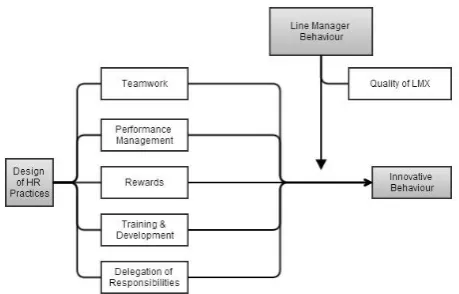
It must be noted that not every relationship will achieve a high quality of LMX. Additionally, line managers as well as subordinates need to pursue an improvement in LMX to ultimately increase organisational performance - or innovative behaviour - through utilising the social capital. Respect, trust and obligation determine the quality of LMX. As line managers’ behaviour influences respect, trust and obligation (Uhl-Bien et al., 2000) the quality of LMX can be used to measure and illustrate variation in line managers’ behaviour. That means through a change in behaviour the line manager may change the perception of HR-practices, which influences the effect of these on innovative behaviour. Figure 2 illustrates the relationships among the variables which are basis for this paper.
Figure 2. The moderating effect of Line Manager Behaviour
3.
THE INFLUENCE OF HR-PRACTICES
ON INNOVATIVE BEHAVIOUR
As mentioned before, HR-practices are perceived as having an impact on organisational outcomes such as innovative behaviour. The effects of the practices (1) teamwork, (2) performance management, (3) rewards, (4) training and development as well as (5) delegation of responsibilities on innovative behaviour are explained in the following section.
3.1
How does teamwork influence
innovative behaviour?
While innovations are often attributed to individuals, new developments mainly stem from team effort. Likewise, Folkestad and Gonzalez (2010) highlight: “reality is that most innovation is a process of collaboration and joint discovery and is not based on a sole individual’s epiphany” (p.118). Furthermore, creativity and hence idea generation is hampered when a company is characterised by a lack of cooperation and teamwork (Amabile, Hennessey & Grossman, 1986). It becomes clear that in order to stimulate innovative behaviour, companies have to encourage employees to work as a team (Tushman & O’Reilly, 1997). However, what teamwork is and how it can be measured is often only vaguely defined in the current literature. Hoegl and Gemuenden (2001) developed the construct “teamwork quality” (TWQ) as a measurement of how well individuals collaborate in a team. TWQ incorporates six facets of teamwork, four of those will be used in this paper: (1)
communication refers to the openness and frequency of information sharing among team members, (2) coordination
addresses the question whether individual efforts are well structured and synchronised, (3) balance of member contribution reflects the degree to which members can contribute with their knowledge and skills, (4) effort illustrates that each team member contributes uniformly highly to team tasks. The other two facets (mutual support & cohesion) are only slightly related to innovative behaviour and are therefore not included in this paper. In the following it will be elaborated on the contribution of the facets of teamwork to innovative behaviour.
“It is widely agreed upon in the literature that the flow of communication within teams influences the success of innovative projects” (Hoegl & Gemuenden, 2001, p.439). Information sharing facilitates innovative behaviour as ideas are generated through the re-combination of information (De Jong & Den Hartog, 2007). In detail, by horizontally communicating challenges and opportunities, problems can be identified and solved (Allani et al., 2003). Accordingly, through communication resulting in high TWQ the organisation is provided with knowledge that would otherwise not be
accessible as it is fragmentally hold by single individuals in separate departments. Thus, communication is necessary to utilise said local knowledge. Consequently, HRM needs to provide a platform for employees to engage in cross-functional communication, which results into innovative behaviour.
To successfully implement ideas, individual efforts need to be coordinated. Often the expertise of different areas is needed for idea generation and implementation, however as cross-functional team members come from different departments with different working methods it is crucial to structure and synchronise efforts to keep the idea generation and implementation goal-oriented and efficient (Frimpong & Agyemang, 2010).
The contributions of individuals need to be balanced in a team. Otherwise, the ideas and contributions of some team members are overruled by dominant team members in discussions or decision-making processes which leads to avoidable mistakes in e.g. the implementation phase (Hoegl & Gemuenden, 2001).
Obviously the effort each team member dedicates to the team’s task influences total team outcomes such as successful idea generation and implementation. HRM can encourage and ensure that each member contributes to the total team effort and that contributions are equally high. One may argue that individualism results in greater efficiency than teamwork, however teamwork results in greater innovative behaviour than individualism (Smith, Collins & Clark, 2005).
All in all, teamwork contributes to innovative behaviour when TWQ is high. To ensure that teamwork is effective, HRM has to measure and maintain the different facets of TWQ.
3.2
How does performance management
influence innovative behaviour?
Performance management is the company’s means to frequently evaluate, guide and develop employees with the ultimate goal of increasing organisational performance (in this context innovative behaviour) (DeNisi, 2000). The most common form of performance management is executed by conducting appraisal interviews between line manager and subordinate (Den Hartog, Boselie & Paauwe, 2004). With the goal of stimulating innovative behaviour in mind, specific requirements for performance management emerge. By articulating a need for idea generation employees are more likely to show innovative behaviour (De Jong & Den Hartog, 2007; Gupta & Singhal, 1993; Hammond et al., 2011 Shipton et al., 2006). Shalley (1991) investigated the effect of goal formulation on individual creativity. She discovered that providing a productivity goal but no creativity goal decreases individual creativity. It becomes evident that expressing innovation as a goal facilitates innovative behaviour by increasing task motivation and encouraging employees to generate ideas. In addition, acknowledging that the innovation process is uncertain is important – innovation requires risk-taking. Therefore, risk taking and proactivity should be encouraged and rewarded in a reasonable way (Gupta & Singhal, 1993; Hellström & Hellström, 2002).
It must be mentioned though that performance management does not directly influence expertise and creativity skills of employees. Judging an employee’s expertise does not increase or decrease it. Rather performance management is an advisory practice that stimulates the intrinsic motivation of employees by setting challenging goals and innovative objectives (Jiang et al. 2012). Thus performance management can increase innovative behaviour through stimulating intrinsic motivation (idea generation) and keeping the innovation process efficient (implementation).
Despite the benefits, there is also a drawback to performance management in the context of stimulating innovative behaviour. Developing and implementing new ideas is a lengthy and uncertain process which makes it difficult to determine hard criteria for employee evaluation (Gupta & Singhal, 1993). Accordingly, measurements and criteria for innovative behaviour can be perceived as arbitrary and hence unfair by line managers and subordinates (Kanfer, Sawyer, Earley & Lind, 1987). To illustrate the worst case: Kanfer et al. (1987) discovered that a lack of knowledge of evaluation criteria reduced the subsequent task performance. I.e. when employees do not know on which basis they are evaluated their performance will decline. Therefore, practitioners run the risk of leading in the wrong direction when performance appraisals are poorly designed and when criteria are not well communicated. In addition, by the mere existence of performance management innovative behaviour can be hampered as employees are anxious about the evaluation itself and restrain themselves from risk taking and autonomy (Byron, Khazanchi & Nazarian, 2010). On the other hand, others mention that the developmental feedback involved in performance evaluation increases the likelihood of innovative behaviour to emerge (Egan, 2005; Zhou, 2003).
It follows from the above that the exact effect of performance management on innovative behaviour is potentially moderated by a third variable as no consensus about the appraisal-innovative behaviour relationship is present. A potential explanation is that the overall climate within a company or the quality of leader-member relationship can influence how evaluation is perceived and how it affects innovative behaviour (Zhou, 2003).
3.3
How do rewards influence innovative
behaviour?
As idea generation is predominantly dependent on intrinsic motivation rather than extrinsic motivation (Amabile, 1993) it is by default difficult for HR professionals to design reward structures that stimulate innovation. Even more so it is argued that rewards inhibit innovative behaviour as they reduce risk-taking and intrinsic motivation (Kohn, 1993). In a series of studies Amabile and colleagues (1986) discovered that fulfilling a creative task for a reward will negatively influence creativity regardless of reward type or task type. Eisenberger and Armeli (1997) found completely different correlations. According to the authors “the explicit requirement of novel performance for salient reward enhances generalized creative performance without any loss of intrinsic creative interest” (Eisenberger & Armeli, 1997, p.659). However, both papers tested elementary school boys and girls as well as undergraduate women, whether those results are generalizable to the business context is unclear. Nevertheless, it becomes clear that the effect of rewards on creativity is not fully explored yet.
Rewards cannot increase expertise directly, only by rewarding employees for e.g. attending trainings. Therefore, rewards should focus on rewarding behaviour that precedes innovation. I.e. incentives have to be provided for e.g. information sharing
and attending trainings that aim at increasing expertise and skills which may eventually lead to idea generation. Another example is provided by Gupta & Singhal (1993); In order to overcome the ‘not invented here’ syndrome, some companies established a ‘not invented here’ award. I.e. adopting and implementing an idea from outside the company is rewarded and encouraged. Those rewarding mechanisms aim for task motivation as well as attitude towards idea generation and implementation rather than for direct effect on skills and expertise. This is supported by findings of Shipton et al. (2006) who discovered that linking rewards directly with innovative behaviour yielded no correlation. However, rewards tied to training achievements had a positive impact on innovative behaviour. Additionally, it is highlighted that rewards are often related to short term outcomes, however due to the uncertain and time-consuming nature of the innovation process employees do not strive for achieving rewards related to innovative behaviour.
Another suggestion is that rewards have an inverse-U shaped effect on innovative behaviour. This means “the extrinsic reward approach has positive effects on innovative behaviour, but excessive extrinsic incentives will deviate or erode the intrinsic motivation of employees towards creativity and will reduce their innovative behaviours” (Zhou, Zang & Montoro-Sánchez, 2011, p.88).
Non-monetary rewards as recognition and appreciation are perceived to increase employees’ intrinsic motivation not only to generate ideas but also to implement and maintain innovation (Peterson & Luthans, 2006). Markova and Ford (2011) revealed that non-monetary rewards are a stronger predictor of intrinsic motivation than monetary rewards. Further, they highlight that “intrinsic motivation was found to fully mediate the relationships between received non-monetary rewards and performance and innovation” (p.813). It follows that non-monetary rewards through an increase in intrinsic motivation can stimulate innovative behaviour. Additionally, non-monetary rewards can be used more flexibly and faster than monetary rewards by line managers. They can reward innovative behaviour with non-monetary incentives immediately as the innovative behaviour occurs. This allows to provide employees with appreciation during the implementation phase, which can increase the successful adoption of innovative ideas.
Concluding it can be said that monetary rewards can mainly increase innovative behaviour in conjunction with practices stimulating intrinsic motivation. However, non-monetary rewards seem to have a direct effect on intrinsic motivation and consequently on innovative behaviour.
3.4
How does training & development
influence innovative behaviour?
To discuss the relationship with innovative behaviour some distinctions have to be made in regard to training and development, namely between training and general employee development. Employee training focuses on work-related skills and routine knowledge which in itself does not yield innovation (Gupta & Singhal, 1993; Jiang et al., 2012; Laursen & Foss, 2003). However, employees must possess knowledge and skills about their current tasks to analyse day-to-day processes. Only when current tasks are routine rather than disruptive it is possible for employees to reflect upon these tasks and then to generate process innovation (Lopez‐Cabrales, Pérez‐Luño & Cabrera, 2009). Thus training is the foundation for innovative behaviour, but training alone does not guarantee innovation.
them to critically question current practices as it allows employees “to transcend logical and sequential thinking, making the leap to innovation.” (Jiang et al., 2012, p.4042) This facilitates idea generation. It follows that innovative behaviour can be enhanced through training and development by a combination of fundamental trainings to conceive the current work space and general employee development to empower employees to think beyond their day-to-day routine. This combination must be provided by HRM to facilitate employees’ innovative behaviour.
Another distinction can be made in regards to the level of training and development. Sung & Choi (2013) separate three levels of learning practices: individual practices, interpersonal practices and organisational practices. Individual practices are aimed at increasing the knowledge base through self-learning opportunities as providing literature. Interpersonal practices offer opportunity for communication between different departments and enable knowledge sharing to facilitate mutual learning and idea generation (López, Peón & Ordás, 2006). Examples are cross-functional trainings, "such knowledge-sharing processes instigate employees to create novel combinations of existing knowledge by bringing together knowledge that was not readily connected in the past" (Sung & Choi, 2013, p.398). Organisational practices create an overarching environment of learning through task forces, knowledge sharing systems and organisation wide learning practices. Moreover, when e.g. engineers collaborate with shop floor workers the implementation of innovation is facilitated.
Individual learning represents only the basis for innovation as it does not facilitate idea generation in itself (Shipton et al., 2006). Interpersonal training however improves employees’ creativity skills as mutual learning opens up novel combinations of knowledge within a company (Allani et al., 2003). This is especially vital for the idea generation phase of innovative behaviour. Moreover, horizontal communication stimulates a feedback culture which increases the likelihood of successful application of innovation during the implementation phase. Organisational learning follows the same logic as knowledge dissemination through e.g. IT systems or established information-sharing mechanisms which stimulate flexibility, experimenting and feedback – crucial elements for the idea generation and implementation phases of innovative behaviour (Laursen & Foss, 2003).
Concluding it can be said that training and development enhances innovative behaviour when task-specific training (enable innovative behaviour) is combined with general employee development (stimulate innovative behaviour). It is important though to encourage employees to participate in trainings because often they are concerned with their day-to-day work, neglecting the relevance of personal development (Jiang et al., 2012; Shipton et al., 2006).
3.5
How does delegation of responsibilities
influence innovative behaviour?
Since McGregor’s (1960) distinction between Theory X and Theory Y, the proactivity of employees and their willingness to take responsibility gained increasing attention by practitioners and researchers alike (Kopelman, Prottas & Davis, 2008). To enable employees to take responsibilities it is expected from HRM to provide employees with a workplace that incorporates elements of autonomy and decentralized decision-making (Boselie, 2010). These elements are outcomes of the HR-practice delegation of responsibilities (Laursen & Foss, 2003). Delegation of responsibilities means that employees have the freedom to make decisions on their own and that they can (at
least to some degree) work on chosen projects in a self-chosen approach.
Krause (2004, p.98) discovered that “the generation and testing of ideas are promoted most by influence exerted through the granting of degrees of freedom and autonomy, followed by support for innovation and by openness in the decision-making process”. I.e. delegation of responsibilities facilitates the idea generation phase of innovative behaviour. When employees have the freedom to choose their own projects they are motivated to develop new solutions and generate ideas. Google and 3M are examples where this is already implemented. Their employees are allowed to devote a part of their working hours to a project they can choose completely unrelated to their actual tasks. “This approach can be understood in light of the fact that innovation is often a result of unpredictable and non-contractible initiatives, which go beyond employees’ normally prescribed tasks” (Krasteva, Sharma & Wagman, 2012, p.2). Thereby, companies can stimulate the non-contractible idea generation. Moreover, granting employees the autonomy to decide on their own about the approach to address a problem has another benefit; Employees will choose the approach which yields most ideas for them and hence will benefit idea generation the most. This utilises the skills and knowledge of every individual in an effective way which also facilitates the successful implementation of innovations.
Additionally, decentralised decision-making allows “for the discovery and utilisation of local knowledge in the organisation” (Laursen & Foss, 2003, p.248). An employee may possess the ability and the knowledge to improve a process, however as he/she does not feel responsible or not empowered, the employee will not be willing to invest in examining potential improvements.
Delegating responsibilities improves the implementation phase of innovative behaviour, as an employee is made responsible for implementing and sustaining an innovation. When responsibilities are centralised one supervisor may be responsible for multiple innovations which equals to less attention paid to each innovation. When responsibilities are decentralised one employee may be responsible for one innovation. This ensures that the innovation is overseen closely. In addition, when responsibilities are centralised the employee who is responsible for e.g. a process innovation may not be in daily contact with the respective process. Delegating the responsibility to an employee, who deals frequently with the process, enables better monitoring of the implementation phase.
All in all, this means that delegating responsibilities facilitates the idea generation and improves the implementation phase ultimately increasing innovative behaviour of employees (Hammond et al., 2011).
4.
THE MODERATING EFFECT OF
LINE MANAGER BEHAVIOUR
4.1
The line manager’s influence on
teamwork
It was previously mentioned that TWQ determines the effect of teamwork on innovative behaviour. As the line manager supervises a team the TWQ can be influenced by the line manager’s behaviour. Hence line manager behaviour can moderate the effect of teamwork on innovative behaviour. To elaborate on this, the effect of LMX on the facets of TWQ will be illustrated.
The openness of communication can be influenced through the level of trust in a relationship between line manager and employee. Employees will be reluctant to share information and be open in a team meeting when the employee is not sure whether the line manager as team leader will act opportunistically once information is shared (Jones & George, 1998). Moreover, when the line manager does not invest time and effort into a team, the obligation level in the relationship between line manager and team members is low. Therefore, each team member will not feel obligated to reciprocate by sharing ideas on a frequent basis. This ultimately would hamper the innovative behaviour of employees as total TWQ is decreased trough the low level of LMX. On the other hand with a high level of mutual respect the line manager will encourage employees to share their opinion on generated ideas as he/she respects the technical knowledge and skills of the employees (Uhl-Bien et al., 2000).
Aronson, Reilly and Lynn (2006, p.225) discovered that “this person [line manager] is able to coordinate and solve problems among and between team members and other functional groups” moreover, they describe the “leader as one of the forces that pulls a project team together to ensure unified effort among team members”. It becomes clear that line manager behaviour influences the coordination within a team. In addition, employees will only adhere to the proposed task allocation when they respect and trust the line manager. When employees do not perceive their line manager as capable of synchronising and structuring tasks across multiple team members due to a low level of LMX, then coordination will be low and accordingly TWQ will be low. This ultimately hampers the intended effect of teamwork on innovative behaviour.
Balance of team member contributions and effort are related facets and are equally altered by line manager behaviour. To keep the balance of member contributions to team tasks is not easy. On the one hand team members must not act too dominant in order to avoid that others are overruled. On the other hand team members’ effort must not be lower than of other members; in this case employees may perceive teamwork as an unfair process which could decrease innovative behaviour. The line manager is in a position to monitor the contributions of each team member and if necessary can intervene. However, the success of an intervention is dependent on the relationship’s quality between employee and line manager. When a low level of obligation is present the employee will not feel obligated to increase his/her contribution even if asked to by the line manager. Likewise a line manager will increase monitoring activities when the trust level is low. However, increased monitoring may decrease innovative behaviour (Byron et al., 2010).
To sum it up, HRM has to take into account the line manager’s behaviour when trying to stimulate innovative behaviour through teamwork. A low LMX is likely to decrease overall teamwork by worsening the facets of TWQ, which eventually will inhibit innovative behaviour.
4.2
The line manager’s influence on
performance management
Townley (1989) found that in 98% of the investigated organisations the immediate supervisor was executing the appraisal. Therefore, it is only logical to examine whether the relationship between supervisor and subordinate has an effect on the effectiveness of performance management. A high quality LMX is comprised of a high level of mutual respect, trust and obligation (Uhl-Bien et al., 2000). When respect and trust are present in a leader-subordinate relationship the employee perceives the supervisor as knowledgeable and competent. Accordingly, the employee appreciates the supervisor’s feedback in an appraisal more when trust and respect are experienced. Moreover, employees are more likely to share problems with the supervisor when the leader is perceived as capable of solving problems and developing the employee further (respect for technical and personal abilities). Therefore, trust and respect are vital for the performance management mechanism to facilitate innovative behaviour. Only when employees are willing to share their thoughts with the supervisor, information sharing and hence idea generation is facilitated. Furthermore, goal-oriented feedback by a capable supervisor increases the employee’s intrinsic motivation leading to innovative behaviour (Deci, 1972).
Concerning the obligation element of LMX it can be stated that the support for an employee and the effort put into an appraisal by the supervisor is perceived as a commitment from the leader to the employee. Therefore, the employee feels obligated to reciprocate the commitment by achieving the set objectives and fulfilling the supervisor’s expectations. In this context when the supervisor encourages a subordinate to follow a novel idea, the subordinate will reciprocate the support by showing innovative behaviour. Though, “managers must walk a fine line when using evaluation, as too much emphasis on evaluation may decrease creativity” (Byron et al., 2010, p.208). A balance must be found by line managers between challenging employees and not putting too much pressure on them.
A low level of respect reflects that the employee perceives the supervisor as not capable of solving problems. A low level of trust shows that the employee is insecure whether an investment made will pay back in the long run as the leader has shown before to be unreliable. A low level of obligation may stem from the employee’s experience that a supervisor does not invest in the subordinates. Hence employees do not feel obligated to invest in the organisation either. Accordingly, a performance management system that is well designed and intents to encourage employees may fail due to the low quality relationship between leader and subordinate.
It becomes evident, that line manager behaviour has a major moderating impact on the influence of performance management on innovative behaviour. Only through maintaining a high quality relationship, performance management yields the desired effect of innovative behaviour.
behaviour (Zhou et al., 2011). A low quality relationship between line manager and subordinate will not provide a stimulus to employees’ intrinsic motivation due to the low levels of obligation and trust. Accordingly, a low quality LMX does not facilitate the influence of compensation on innovative behaviour.
Some rewarding mechanisms are largely in control of the line manager. Especially non-monetary incentives as recognition, appreciation and encouragement are executed and initiated by the line manager. These mechanisms are likely to stimulate innovative behaviour by addressing the employees’ intrinsic motivation (Markova & Ford, 2011). Especially when a high level of trust and respect is present in a relationship, the effect of non-monetary rewards will be high. When an employee perceives a line manager as knowledgeable the employee will strongly value the expressed appreciation by the line manager, which results in an increased intrinsic motivation. Moreover, employees will feel more encouraged to take risks when receiving non-monetary rewards. However, a low level of trust will inhibit this effect as the employee is anxious that mistakes will result into punishment although appreciation was experienced earlier. The encouragement to take risks and the increased intrinsic motivation will yield innovative behaviour (Markova & Ford, 2011) as long as the relationship between employee and line manager is characterised by high levels of respect, trust and obligation.
All in all, to take full effect monetary rewards needs to be accompanied with high LMX to provide the required intrinsic motivation and ultimately achieve high innovative behaviour. Non-monetary rewards do increase intrinsic motivation on their own; however a low quality LMX can hamper the effect of non-monetary rewards on innovative behaviour.
4.4
The line manager’s influence on training
and development
The line manager is in a position to ensure that employees perceive trainings as necessary for innovation and their personal development (Liden et al., 2000). Through a high level of obligation the employee is intrinsically motivated to reciprocate the line manager’s effort by attending trainings and general employee development. Hence, a high quality LMX increases the positive influence of training and development on innovative behaviour. This is shown by Scaduto, Lindsay and Chiaburu (2008) who found that high quality LMX is positively related to training motivation and training effectiveness; “The individual who has a good relationship with his or her supervisor […] stands a much better chance of benefiting from the training, which will lead to positive outcomes, both for the individual and the organization” (Scaduto et al., 2008, p.166). Additionally, supervisors’ feedback after attending trainings is crucial for the transfer of skills learned in trainings to the actual workspace (Velada, Caetano, Michel, Lyons & Kavanagh, 2007). The line manager’s feedback is a form of investment (time and effort) from the line manager towards the employee. This investment increases the obligation level in the line manager-subordinate relationship and the employee feels then obligated to pay back by implementing the feedback and transferring the learned skill to the workspace. When employees reflect together with their supervisor on how the acquired skills and knowledge are applicable to their current task, training and development will result in innovative behaviour. Consequently, the supervisor is not only vital for initiating employee development but also for sustaining the training effect.
However, when employees perceive their supervisor as not capable (respect) to reflect upon trainings, the effectiveness of
training and development is reduced (Scaduto et al, 2008). Moreover, trainings are done during working time, i.e. the employee can only participate in trainings when the line manager dispenses the employee from work-related duties. When the trust level is low in the line manager-employee relationship, the manager does not trust the employee to pay back the time spent on training with increased innovative behaviour. I.e. without trust the likelihood increases that employees are not allowed to participate in trainings as the line manager is not confident that time spent on training will yield any benefit for the organisation. Thereby, the effect of training and development on innovative behaviour could be completely abolished through a low level of mutual trust. Furthermore, when the LMX quality is low due to a low level of obligation, employees may be reluctant to attend trainings. Hence a low quality relationship between supervisor and subordinate will impede the effect of training and development on innovative behaviour. A high quality relationship on the other hand will increase the effect of training and development on innovative behaviour as training motivation, effectiveness and maintenance are increased.
4.5
The line manager’s influence on
delegation of responsibilities
As stated before, the delegation of responsibilities facilitates idea generation and improves the implementation phase of innovative behaviour. However to which degree employees perceive themselves as responsible for certain decisions and tasks may be dependent on their relationship with the line manager. The effect of LMX on delegation of responsibilities was investigated by Scandura, Graen and Novak (1986). They discovered that high LMX quality results in employees perceiving their influence on decisions as high. I.e. without high quality LMX, delegation of responsibilities will not yield increased innovative behaviour. This can be explained by looking at the single elements which constitute LMX. When mutual respect is low in a line manager-employee relationship, the line manager will not be willing to delegate responsibilities to the employee (although intended by HRM) because the line manager perceives the employee as incapable of making decisions and carrying responsibility. When the employee does not experience the freedom as intended by HRM then the employee’s intrinsic motivation is likely to decrease which results in decreased innovative behaviour.
A high level of trust reflects that both parties (line manager and employee) believe that the other party will not act opportunistically (Uhl-Bien et al., 2000). In the context of delegating responsibilities this means in a relationship characterised by a high level of trust, the line manager assumes that the employee will not abuse and exploit the given power once responsibilities are delegated. When this trust is missing the line manager will be reluctant to allow the employee to make decisions on his/her own. This decreases intrinsic motivation and the organisation forfeits the opportunity to get access and to utilise local knowledge held by employees.
When obligation is high the employee feels obligated to reciprocate the given autonomy with desired behaviour, in this case innovative behaviour. Whereas when the obligation level is low, both parties strive to keep their social independence. This leads to the fact that the line manager will restrain from delegating responsibilities to the employee.
5.
DISCUSSION
The aim of this paper was to answer the question: ‘how does line manager behaviour influence the effect of HR practices on innovative behaviour?’ To answer this question it was necessary to first examine the impact of HR-practices on innovative behaviour before it is possible to explain how line manager behaviour moderates this relationship. The next paragraphs follow this reasoning by first elaborating on the HR-practice – innovative behaviour relationship and afterwards illustrating the moderating effect of line manager behaviour.
Innovation has an enormous priority for many companies and to examine the preconditions for innovation is only logical. Research has shown that the innovativeness of an organisation depends on the innovative behaviour of its employees and the design of HR-practices contributes to employees’ innovative behaviour. Accordingly, organisations need to design their HR-practices appropriately. The first sections of this paper indicated how HR-practices influence innovative behaviour.
The current literature highlights that teamwork is needed for employees to be innovative. However clear measurements and guidelines how to stimulate teamwork are rare. TWQ is an approach to measure teamwork and can be used to explain how teamwork influences innovative behaviour. It was found that teamwork facilitates innovative behaviour by ensuring cross-functional communication and intra-team communication. Moreover, coordination among team members is crucial for the idea generation as well as the implementation phase. However, too much teamwork can inhibit innovative behaviour as teamwork was found to result in less efficiency than individualism. Performance management can increase innovative behaviour by encouraging and challenging employees (intrinsic motivation) and keeping the innovation process efficient. Nevertheless, an overemphasis on monitoring may hamper innovative behaviour. Financial rewards as such were not found to have a direct impact on innovative behaviour. Rather they need to be tied to e.g. training achievements to unfold its potential and increase employees’ motivation. Non-monetary rewards directly influence an employee’s intrinsic motivation and hence innovative behaviour. Training and development, through a combination of training and general employee development facilitates innovative behaviour by increasing employees’ expertise and creative skills. However, this is only true when employees are motivated by rewards to attend trainings. Delegation of responsibilities, i.e. decentralisation of decision-making and autonomy contributes to innovative behaviour since employees experience the freedom to choose their own projects which increases their intrinsic motivation. However it must be mentioned that this holds only true if the freedom provided to employees is not exploited. Further, the decentralised decision-making enables the utilisation of local knowledge. In addition, the delegation of responsibilities ensures that the implementation of ideas is overseen by one employee who is in close contact with the innovation. Critical is that multiple innovations may interfere each other as the responsibility is not centrally hold. Moreover, employees must be willing, skilled and knowledgeable enough to carry the responsibility. This may not necessarily be the case in every organisation. All in all it was found that HR-practices can influence innovative behaviour when designed accordingly.
However, in some studies a third variable seemed to moderate the relationship between single HR-practices and innovative behaviour and researchers highlighted that this needs clarification (Nishii et al., 2008; Wright et al., 2005). It is also possible that HR-practices could have a negative effect on innovative behaviour in specific situations. For example,
incentives related to innovative behaviour could restrain the creativity of employees as employees may focus on the incentive instead of focusing on the idea generation process. Furthermore, the perception of HR-practices (rather than intended HR-practices) shapes to which degree employees show innovative behaviour. As a potential third variable and factor that shapes perception of HR-practices, line manager behaviour was identified which is in line with findings from Alfes et al. (2013), Purcell and Hutchinson (2007).
To investigate the effect of line manager behaviour, LMX was used as a measurement for variance in line manager behaviour. The vital role of line managers in the HR-practice/innovative behaviour relationship was not highlighted before as far as the author knows. This is surprising since innovation is a key to organisational survival and line managers clearly have their share in determining whether the practices intended by top management are executed as desired.
Findings suggest that a high quality LMX enables and increases the positive impact of HR-practices on innovative behaviour. It follows that the line manager as implementer of HRM moderates the effect of HR-practices on innovative behaviour through his/her behaviour. The conclusion, that line managers have a tremendous stake in determining the effect of HR-practices is also found by other researchers (Alfes et al., 2013; Purcell & Hutchinson, 2007). Mainly, through a high level of obligation employees become intrinsically motivated to accept and utilise HR-practices to ultimately increase innovation. I.e. when line managers invest in a relationship with their subordinates the employees are open and willing to make use of opportunities as training and development or performance management. The high level of trust and respect in a high quality relationship are the foundation for a productive supervisor-subordinate collaboration. Only when subordinates perceive their line manager as capable and trustworthy the preconditions of successful innovation can be established. For example, employees will not be willing to accept the supervisor’s advice in an appraisal when their relationship lacks trust and mutual respect. It becomes evident that organisations need to spend as much effort on improving relationships between employees and line manager as on HR-practice design. Only when both systems are in a positive state, innovative behaviour will be the outcome. Nevertheless, the quality of a relationship is a construct which is difficult to measure for HRM and hence difficult to proactively manage. Additionally, some relationships will remain at a low level of respect, trust and obligation regardless of the efforts of HRM. Therefore, findings have to be carefully assessed. What HRM can do is to design the framing conditions in which relationships evolve. By establishing regular team events or designing appraisal meetings properly, HRM can provide ground for relationships to grow. Moreover, HRM has to monitor the quality of relationships between line managers and employees. When a low level of LMX seems to be present HRM can intervene by taking a conciliatory role, aiming at improving the relationship. This can ultimately enable line manager behaviour to facilitate the effect of HR-practices on innovative behaviour.