ABSTRACT
Electronic word-of-mouth has proven to have a great impact on the online decision making process of consumers. There is a lot of information available on the internet and consumers use the information to inform themselves before purchasing a product or service. In this research, the effects of persuasion in online product reviews on the attitude of a consumer toward the review, reviewer and brand have been studied. To test the effects, stimulus material has been developed in which different persuasive cues were added around a review text. Two studies were conducted among 167 Dutch participants in study 1 and 166 in study 2. Data has been gathered by the use of an online questionnaire. The results demonstrate a positive effect of liking of the reviewer on the perceived quality of a review and trustworthiness of a reviewer. The volume of available reviews has an effect on the perceived brand attitude and purchase intention. Especially a high volume of available reviews, combined with a positive review score, contributes to a positively perceived review quality and a positive attitude toward the brand. Finally, the results demonstrate an interaction effect between involvement and liking on the perceived brand quality and an interaction effect between involvement and social proof on the perceived review quality and trustworthiness of the reviewer. This paper contains implications for online marketers to improve their product review pages.
ACKNOWLEDGEMENTS
With this report a great period as a student comes to an end. During this period, I’ve met a lot of great people and made a lot of friends. I’m very grateful that I’ve had the opportunity to experience this. I would like to thank my family, friends and fellow students for their friendship and support during all those great years. In particular I would like to thank my first supervisor, Sabrina Hegner, for helping me out during the whole process of the research and her, in many cases unbelievable, quick and thorough feedback. I also would like to thank my second supervisor, Anna Fenko, for her feedback during the final part of the thesis. Without the help of everyone I wouldn’t be able to hand in the report like it is now.
TABLE OF CONTENTS
ABSTRACT ... 2
ACKNOWLEDGEMENTS ... 3
Introduction ... 6
Focus of the research ... 7
THEORETICAL FRAMEWORK ... 9
An introduction to the theoretical framework ... 9
E-commerce ... 9
WOM and e-WOM ... 10
Persuasion in offline and online marketing ... 11
Introduction to the persuasive heuristics ... 13
Authority ... 13
Liking... 14
Scarcity ... 16
Social proof... 18
e-WOM responses ... 20
Perception of the review ... 21
Review quality ... 21
Perception of the reviewer... 21
Trustworthiness of the reviewer ... 21
Perception of the brand ... 21
Brand attitude ... 21
Brand quality ... 22
Purchase intention... 22
The moderating role of involvement ... 22
METHODOLOGY ... 25
An introduction to the methodology ... 25
The research design ... 26
Selecting the stimulus material ... 27
Product category ... 28
Participants ... 28
Measures ... 29
Reliability of the construct ... 31
Procedure ... 32
Manipulation check pre-test ... 33
RESULTS ... 35
Introduction to result section ... 35
Results study 1 ... 35
Results study 2 ... 42
DISCUSSION ... 50
MANAGERIAL IMPLICATIONS ... 54
LIMITATIONS AND FUTURE RESEARCH ... 56
REFERENCES ... 58
Appendix A – English version online questionnaire ... 68
Appendix B – Dutch version online questionnaire ... 71
Introduction
People use the internet for travel and dinner reservations, checking the news and weather forecast and all kinds of other activities; the internet has become a ‘new normal way of life’ for many people (Ho & Dempsey, 2010; Rainie, 2005). A lot of companies use online channels to sell their products or services and consumer make use of the possibility to use these channels. 91% of the consumers go on the internet to search for information before deciding to purchase a product or service (Cheung & Thadani, 2012). Not only do a lot of consumers use online product reviews to inform themselves about a new product, it also has a great influence on the purchase intention (Dou, Walden, Lee & Lee, 2012). Consumers use the information available on the internet and they spend a lot of money online as well. According to Thuisbezorgd (2014), an amount of €10.6 billion has been spent in online stores in the Netherlands in 2013.
The way consumers search for information and buy their products is changing (Jalilvand, Esfahani, & Samiei, 2010; Pitta & Fowler, 2005). While the online commerce is growing, searching for other consumers’ online opinions is becoming a more important part of purchasing behaviour (Pitta & Fowler, 2005). Consumers used to buy all their products in offline stores, nowadays, a lot of purchases are made online. The internet provides a lot of information via different channels. People are using blogs, social media, comparison-platforms and product pages in their quest for information. Companies that are active online, try to distinguish their online activities from their competitors. In a market with fast growing competition, it becomes harder and harder for online marketers to persuade a consumer to engage to a product or service from their company.
Focus of the research
This research focuses on the reader of a review, just like inter alia Horstman (2013), Lee and Shin (2013), Park, Lee and Han (2007), Pillen (2013), Racherla and Friske (2012) and Vermeulen and Seegers (2009) did. There are two types of people involved when it comes to online reviews; the reviewer, a creator of a review and the receiver of the information, the reader of the review. The creator is someone who has knowledge, experience or a certain opinion about a product, service or brand and shares this via the internet in the form of an online review. The receiver is searching for information about a certain product or service and reads the information which a creator did write. The research focuses on the influence of persuasion on the receiver of the information, the reader of the review. Next to the effect of persuasion, the effect of a consumers’ involvement with the product category has been part of the research. Prior research of Zaichkowsky (1985) demonstrated the importance of involvement with the product category on the attitude of a consumer in an offline situation and Park et al. (2007) demonstrated the importance in an online situation. This research searched for effects of involvement as a moderator in an online environment. The main marketing-communication question during this research is:
In what way can marketers design their review page to create a more positive attitude
toward a review, reviewer and the brand?
An answer to this question will be given in the managerial implication section at the end of this report. The persuasive heuristics authority, scarcity, liking and social proof have been related to the attitude of an individual toward the review, reviewer and brand.
The main questions during this study are:
1) To what extent do persuasive heuristics in online reviews influence the attitude of a consumer
2) To what extent does involvement play a role in the relationship between persuasive heuristics
THEORETICAL FRAMEWORK
An introduction to the theoretical framework
During this study, the effect of persuasion in online product reviews on the attitude of a consumer toward the review, reviewer and brand has been researched. Next to the direct effect of persuasion, the moderating effect of involvement with the product category has been measured. To be able to understand the purpose of this study, a variety of concepts will be defined in the theoretical framework.
E-commerce
E-commerce refers to a variety of online commercial activities with the focus on commodity exchanges via the internet, by the consumer, industrial undertakings, factories, companies and enterprises (Zheng, 2009).
WOM and e-WOM
Multiple studies demonstrated that WOM communication, as in its traditional form, influences the pre-purchase decision making process and also the post-purchase perception of the product (Matos & Rossi, 2008; Sweeney, Soutar & Mazzarol, 2008). Consumers who are using the internet to compare products and services, trust online reviews from people who are unknown to them more than information in traditional media, almost 12 times more (Bazaarvoice, 2014; eMarketer, 2010). The access to the internet enables consumers to compare products and services at any time of the day. It can be assumed that the widespread of e-WOM interaction and the fact that consumers perceive e-WOM (marketing) communication as more relevant and credible than traditional marketing communication, contribute for an important part to a consumers’ intention to make a purchase (Bickart & Schindler, 2001; Chevalier & Mayzlin, 2006; Christodoulides, Michaelidou & Argyriou, 2012; Park & Lee, 2009; Park et al., 2009). Prior e-WOM research of Racherla and Friske (2012) demonstrates that a combination of the reviewer and the review characteristics influences the perceived usefulness of a review. Research of Park and Lee (2009) demonstrates that the e-WOM effect of negatively formulated e-e-WOM on the attitude of a consumer is greater than the effect of positive e-WOM. Park and Lee (2009) also found evidence for the impact of e-WOM on websites with reputation. Established websites experience more e-WOM than unestablished websites (Park & Lee, 2009). Because of the reputation effect of websites, an established Dutch comparison website (Beslist.nl) has been used in the stimulus material.
more powerful than e-WOM (Lovett, Peres & Shachar, 2013; Meuter, McGabe & Curran, 2013). WOM communication is more trustworthy and credible than existing, traditional marketing communication (Christodoulides et al., 2012; de Matos & Rossi, 2008; Newman & Staelin, 1972). More positive implications with regard to a person are formed when communicating face-to-face (traditional WOM) than computer-mediated communication (Okdie, Guadagno, Bernieri, Geers & Mclarney-Vesotski, 2011).
Although offline WOM is more powerful than e-WOM, online communication is becoming more important (Kaptein, 2012). According to Kaptein (2012), the reach of a message via an online channel is enormous. An individual can in theory reach the whole world with a message spread via the internet, something that is hardly possible with traditional WOM. The reach of e-WOM did increase over de last decades, but the impact of the message did decrease (Kaptein, 2012). Communication experts are trying to find ways to increase the impact of online messages. This research is conducted to determine whether or not certain persuasive cues influence the impact of a message, spread via the internet; in this case the impact of persuasive cues in online product reviews.
Persuasion in offline and online marketing
persuade consumers using two different approaches. Focus on the strong and weak points of a specific product or service is the first possible persuasive approach. The second approach, which a marketer can use to persuade consumers, is to focus on a variety of peripheral cues, like attractiveness, source credibility and expertise (Pornpitakpan & Francis, 2001; Pornpitakpan, 2004). In the past, a lot of persuasive principles have been formulated. Today, there are six main principles, formulated by Cialdini (2001), which are mainly used in textbooks, by students and marketers. According to Cialdini (2001), the six main principles of persuasion are reciprocity, consistency, social proof, authority, scarcity and liking. Although reciprocity and consistency are part of the theory of Cialdini, they will not be part of this research. Authority, scarcity, social proof and liking are used because they are more applicable on the receiver of the information than the heuristics reciprocity and consistency. Although reciprocity and consistency are not part of this research, they will be defined briefly, to be sure that the theory of persuasion is explained clearly. Consistency, also known as commitment, is used by different organisations, aimed on consumers who have already bought or used a product or service and are committed to their brand, product or service (Cialdini, 2001). People who commit orally or written to a brand, product or service are more likely to continue liking or buying it. Online marketers use consistency by, for example, offering a free trial in return for the e-mail of the visitor. Consistency is not part of the study, because the effect of consistency on the reader of a review is difficult to manipulate. Consistency is presumably more applicable on the creator of the review, who might write a review or buy a product because he or she uses the product or has used the product in the past.
a product or service. This research focuses on the reader of a review, who will presumably not feel committed to give something in return for reading a review. For this reason, reciprocity is not part of this research.
The next part of this chapter focuses on the different persuasive heuristics, which have been used during this study.
Introduction to the persuasive heuristics
Authority, liking, scarcity and social proof are the four persuasive heuristics and independent variables during this study. The persuasive cues have been added around a review text. Prior e-WOM research demonstrated that different personal attributes have an influence on the perceived credibility of the information (Münz & Sergiūnaitė, 2012). Inter alia a pseudonym, domicile, occupation, a photo of a reviewer, name and age appear to have an effect on the review credibility (Münz & Sergiūnaitė, 2012).
Authority
been asked to give someone an electrical shock, did show that people fictitiously ‘tortured’ and in some cases even fictitiously ‘killed’ the person who was receiving the electrical shocks.
Figure 1. Authority in e-WOM by Amazon
Prior research demonstrates that authority has a positive influence on the readers’ acceptance toward (e-)WOM (Huang, Cai, Tsang & Zhou, 2011; Lo, 2014). If information is shared or presented by an expert, the influence of WOM communication is greater (Bone, 1995). Vermeulen and Seegers (2009) conducted research to the effect of reviewer-expertise in online hotel reviews. Results indicate a minor positive influence of reviewer-expertise on the review impact (Vermeulen & Seegers, 2009). According to Lo (2014), people do especially rely on e-WOM information if it contains accuracy, comprehensibility and authority. Lo (2014) also found that if an online product review relates to a third party, it generates greater authority. Posts from experts contain more authority than posts that are not from experts (Lo, 2014). Therefore the first hypothesis is:
H1: High authority of a reviewer leads to a more positive attitude toward a) the review, b) the reviewer and c) the brand compared to low authority of a reviewer.
Liking
a reader of a review has to be divided between the photo and the text. Because of the fact that a reader has to divide his attention, a picture can disturb a thorough and extensive estimation of the information in the review (Lang, 2000; Lee & Shin, 2013; Wais, Rubens, Boccanfuso & Gazzaley, 2010).
According to Erdogan (1999) physical attractiveness of a source can induce attitude change of a consumer. Roberts (2013) found that physical attractiveness in video blogging contributes largely to the perceived credibility of the source. It is conceivable that the physical attractiveness of the reviewer contributes to more likeability toward the reviewer, which therefore results in an attitude change of the receiver of information. Raghunathan and Corfman (2006) found a positive effect on liking of an individual if the specific person shares his opinion. Kiecker and Cowles (2001) describe likeability as an affection for the source which is an effect of the behaviour of an individual, physical appearance or other personal characteristics, like talent or personality. Likeability is just like familiarity (the extent to which the receiver has knowledge of the source or feels a certain level of comfort with him or her) and similarity (resemblance between, for example, the reader and creator of e-WOM) part of attractiveness, and reflects the way a reader of the information identifies himself with the source, for example the creator of e-WOM (Cheung & Thadani, 2010; Kiecker & Cowles, 2001). Likeability has, just like familiarity, a positive influence on the way a consumer perceives the source to have the best intentions in mind. Therefore, the second hypothesis is:
H2: High liking of a reviewer leads to a more positive attitude toward a) the review, b) the reviewer and c) the brand compared to low liking of a reviewer.
that the use of pictures in online product reviews contribute to a more positive attitude of a consumer.
Figure 2. An example of liking in an online environment by PetRelocation.
Scarcity
review, from which a consumer has to derive the information. The example in figure 3.1 has been used during this study.
Figure 3. The use of scarcity in the amount of available products by Booking.com.
Figure 3.1. The use of scarcity in the amount of reviews, as used during this research.
[image:16.595.75.524.135.254.2]thought that a lot of product reviews are available, makes more people aware of the existence of that product or service, which results in an awareness effect and suggests that numerous others accept the product, wherefore it should presumably should be good enough for ‘me’ too (Duan, Gu, & Whinston, 2008; Fu & Sim, 2011; Park et al., 2007). If there is not a lot available, people would be more likely to have or use it (Cialdini, 2001). It is plausible that people perceive the value of a review and reviewer higher when there are not a lot of reviews available. Because people do not have a lot of reviews available to use during their decision making process, the information has to come from that specific review. Because prior research demonstrates an awareness effect when the number of available reviews increases, which suggests that other consumer already did accept the product or brand, it is not expected that high scarcity (a small amount of available reviews) has a positive effect on the attitude of a consumer; the opposite is expected. Therefore hypothesis 3 is:
H3: High scarcity of reviews leads to a more positive attitude toward a) the review, b) the reviewer and a less positive attitude toward c) the brand compared to low scarcity of reviews.
Social proof
on the attitude of a consumer toward a product or brand (Cialdini, 2001). A well-known example of people following similar others is the experiment of Asch and Solomon (1956). In an experiment with a group of actors, a volunteer had to designate a specific line out of three lines. Although it was obvious which line the participant had to point out, the volunteer did, in several cases, go along with the answer of the group, which was not the correct answer. Cialdini (2001) did mention an example of researchers who found that showing a list of neighbours who donated to charity, contributed to a larger amount of money, donated by people to whom the list was shown, which is an example of social proof in an offline situation. Booking.com is a well-known example of a company that uses persuasion in online marketing. Figure 4 gives an example of social proof applied by Booking.com. Reviewers rate this hotel with an 8.4. Figure 4.1 shows an example of (high) social proof, as used during this research. In this case, 95% of the readers of the review have indicated that the review is useful.
Figure 4. An example of social proof in e-WOM by Booking.com.
Prior e-WOM research demonstrates the importance of a clear opinion of significant others on the perceived quality of a product or service (Awad & Ragowsky, 2008). The reader and creator of a review do usually not know one another. For that reason, if a review does not contain significant information, people distrust the information given in an online review, therefore the review has to contain valuable information for the reader (Ratchford, Talukdar & Lee, 2001). According to Petty and Cacioppo (1986) an objective and/or rational statement is more adequate than a subjective and/or emotional statement, which indicates that people appreciate useful information. Consumers perceive the quality of a product higher than the actual quality experience, if a positive product review-score has been given by other consumers (Hu, Pavlou & Zhang, 2006). Therefore, the fourth hypothesis is:
H4: High social proof of a review leads to a more positive attitude toward a) the review, b) the reviewer and c) the brand compared to low social proof of a review.
e-WOM responses
Perception of the review
Review quality
During this research, the perceived quality of the review has been one of the dependent variables. Within this research, review quality can be described as the way in which a reader of a review perceives the quality of the review text. The quality of a review is an important factor, which, inter alia, influences the purchase intention of a consumer (Park, Lee & Han, 2007). According to Purnawirawan, De Pelsmacker and Dens (2012), only when a review is perceived as relatively useful, recall of information in reviews has an effect on the attitude of a consumer; it has a crucial role on the attitude and intention formation process.
Perception of the reviewer
Trustworthiness of the reviewer
In this research, trustworthiness of the reviewer refers to the amount of trust a reader of a review has in the reviewer. Important purchase decisions are based on the degree of trust in a (sales-)person, a product or a business (Hosmer, 1995). The most important credibility dimension in e-WOM is trustworthiness (Reichelt, Sievert & Jacob, 2013). A consumer, or in the context of this research a reviewer, is perceived as credible if he or she consists of a widespread knowledge with regard to a certain topic and has the willingness to honestly share the information with others (Feick & Higie, 1992; Gilly, Graham, Wolfinbarger & Yale, 1998; Shrauger & Schoeneman, 1979; Tseng & Fogg, 1999).
Perception of the brand
Brand attitude
or negative. Brand attitude can be influenced in a positive way by positive WOM of consumers, (Keller & Berry, 2003). Bakshy, Hofman, Mason and Watts (2011) found, in their study among 1.6 million Twitter users, the same positive effect on brand attitude for e-WOM as Keller and Berry (2003) found in their WOM study. Next to the effect of positive WOM and e-WOM, positive advertisements have a positive influence on brand attitude (Keller & Berry, 2003; Bakshy et al., 2011).
Brand quality
According to Aaker and Keller (1990), the perceived quality of a brand is a global assessment of the judgment of people, regarding the superiority of the brand. If a consumer perceives a brand as credible and relies on the quality of that brand, the probability that the specific brand becomes part of the consideration set of a consumer increases (Erdem & Swait, 2004).
Purchase intention
During this research, purchase intention is the likelihood that a person is going to purchase a product in the future, just like in the studies of Huang, Chou and Lin (2010) and Ng (2013). Online product reviews do have a great influence on the consumers’ intention to make a purchase (Dou, Walden, Lee & Lee, 2012). According to Chang, Cheung and Lai (2005) the attitude of a consumer consistently exhibits impact on the intention to make a purchase. The moderating role of involvement
study among undergraduates, they have found a greater impact on the attitude among low involved individuals compared to high involved individuals, when a product endorser was shown in the manipulation. Findings of Petty et al. (1983) are in line with the Elaboration Likelihood Model from Petty and Cacioppo (1986) in which low involved consumers are less motivated and follow the peripheral route, in which they are influenced by judgmental heuristics like the number of arguments of an expert. Therefore, the hypotheses for study 1, with authority and liking as independent variables, are:
H5: If a consumer is low involved, the effect of high authority of the reviewer, compared to low authority of the reviewer on a) the review, b) the reviewer and c) the brand, should be stronger, compared to someone who is high involved.
H6: If a consumer is low involved, the effect of high liking of the reviewer, compared to low liking of the reviewer on a) the review, b) the reviewer and c) the brand, should be stronger, compared to someone who is high involved.
& Whinston, 2008; Fu & Sim, 2011; Park et al., 2007). Therefore, the hypotheses for study 2 are:
H7: If a consumer is low involved, the effect of high scarcity of reviews, compared to low scarcity of reviews on a) the review and b) the reviewer, should be stronger, compared to someone who is high involved and the effect of high scarcity of reviews, compared to low scarcity of reviews on c) the brand, should be less strong, compared to someone who is high involved.
METHODOLOGY
An introduction to the methodology
This part of the paper focuses on the studies that have been conducted. Within this research, two studies have been conducted, in which the effect of persuasive cues in online reviews has been investigated. Before the start of the main study, a pre-study has been conducted to test the visibility of the persuasive manipulations.
The research design
The model is an in between subjects design with four independent variables.
[image:25.842.76.810.128.453.2]Design 1: Authority * Liking Design 2: Scarcity * Social Proof
Figure 5. Research design for measuring the effect of persuasion on attitude toward the review, reviewer and brand. Scarcity
Social Proof
High Low
High X X
Low X X
Authority
Liking
High Low
High X X
Low X X
Study 2
Scarcity Social Proof
Involvement with product
category
Perception of the Brand
Brand attitude
Brand Quality
Purchase intention
Perception of the Reviewer
Thrustworthiness
Perception of the Review
Quality of the review
Study 1
Selecting the stimulus material
As demonstrated in prior research, expertise has a positive influence on the impact of a message (Bone, 1995; Lo, 2014; Vermeulen & Seegers, 2009). Therefore it has been decided to add a description of the reviewer to the review in order to manipulate authority. In the high authority condition, the reviewer is an expert (professional photographer), in the low authority condition, the reviewer is just registered to write a review and has no cues of expertise in his description.
As mentioned by Cheung and Thadani (2010) and Kiecker and Cowles (2001) a message is more persuasive when perceived attractiveness is greater. A likeable picture with cues of attractiveness might contribute to a greater perceived attractiveness. Therefore a photo of the reviewer is added in the high liking situation. In the low liking situation, a standard image has been used, containing less likeability.
Perceived scarcity contributes, according to the theory of Cialdini (2001), to a bigger demand. By supplying only one review, the specific review might be perceived as more relevant than in a situation in which over a 1000 reviews are available. The participant has, after all, to rely on the information in that specific review, because it is the only one available. Therefore, it has been decided to add the text ‘review 1 out of 1’ to the review in the high scarcity situation and ‘review 1 out of 1390’ in the low scarcity situation.
Product category
There are a few differences with regard to product categories, therefore it is important to determine whether to use search goods or experience goods. Search goods can be described as products or product attributes wherefore a lot of information can be acquired before the purchase is done. Experience goods are dominated by attributes that are unknown to an individual until the purchase is done and/or for which the collection of information is more costly than experiencing the product directly (Klein, 1998; Nelson, 1970; Park & Lee, 2009). A book or a movie is an example of an experience good. Next to search and experience goods, there are credence goods. Darby and Karni (1973) define credence products as product attributes an individual can not (or can hardly) verify, even after using it. Medical treatment or supplements are examples of credence goods. The effect of e-WOM is greater for experience goods in contrast to search goods (Klein, 1998). During this research, search goods have been used in the stimulus material. Search goods are goods for which a lot of information can be acquired before the purchase is done. A consumer can collect information on the website of a company, on social media and on comparison platforms. It is likely that participants in this research have searched for information concerning search goods in the past. In the first study, a camera has been used in the stimulus material and in the second study a laptop; products which participants presumably have searched for in their personal life.
Participants
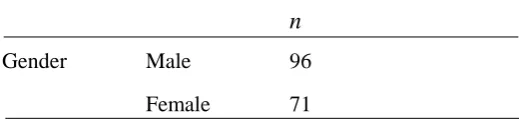
in study one and 166 participants in study two. In study one, 71 of the participants are female and 96 of the participants are male, as demonstrated in Table 1. In study two, 70 females have participated and 96 of the participants are male, as demonstrated in Table 2. All the data has been collected within a two week period, between the 14th of February and the 28th of February. All the participants are Dutch citizens, aged 18 years or older, who did participate voluntarily and anonymously. The mean age is 26,7.
Table 1. Distribution of gender in study one n
Gender Male 96
Female 71
Table 2. Distribution of gender in study two n
Gender Male 96
Female 70
Measures
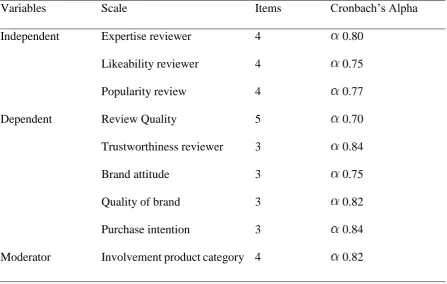
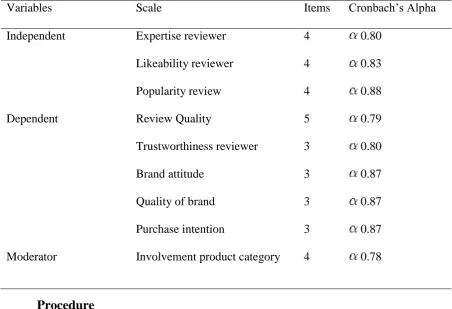
disagree to 5 = strongly agree. The fourth and last independent variable is social proof, wherefore the popularity (of the review) scale from Bell, Holbrook and Solomon (1991) has been used. The scale consists of 4 items with anchors ranging from 1 = strongly disagree to 5 = strongly agree. The scale has proven to be reliable in study 1 ( = 0.77) and in study 2 ( = 0.88).
Reliability of the construct
Table 3.
An overview of the internal consistency for study 1.
Variables Scale Items Cronbach’s Alpha
Independent Dependent Moderator Expertise reviewer Likeability reviewer Popularity review Review Quality Trustworthiness reviewer Brand attitude
Quality of brand Purchase intention
Table 4.
An overview of the internal consistency for study 2.
Variables Scale Items Cronbach’s Alpha
Independent Dependent Moderator Expertise reviewer Likeability reviewer Popularity review Review Quality Trustworthiness reviewer Brand attitude
Quality of brand Purchase intention
Involvement product category 4 4 4 5 3 3 3 3 4 0.80 0.83 0.88 0.79 0.80 0.87 0.87 0.87 0.78 Procedure
Experimental setting
As mentioned above, the review-text has been the same in every condition. The persuasive cues did differ in the eight different conditions. The following combinations have been made in the different combinations:
Study one did, in the positive version of the stimulus material, contain a picture of a friendly looking person with a camera (manipulation for liking) and a description of a ‘professional photographer’ (manipulation for authority). The contrary stimulus material did not contain a picture, but a standard stock photo from Beslist.nl (liking low) and the description ‘registered’ instead of professional photographer (authority low). According to Ohanian (1990; 1991) a perceived image of a spokesperson can have an impact on the purchase intention. By adding a photo of a friendly looking person to the review, the review becomes more personal and therefore readers presumably like it more.
Study two did contain the volume / amount of available reviews with regard to the product (laptop). In the positive version, with a high level of scarcity, 1 out of 1 review was available, in the version with a low level of scarcity, 1 out of 1309 reviews were available. Social proof has been the other cue in the second study. In the situation with a high level of social proof, 95% of the readers of the review found the review useful, in the contrary situation, 23% of the readers found it useful.
Manipulation check pre-test
between the sample means of the independent variables authority, scarcity, liking and social proof. The results show significant results for all the manipulations. The independent samples T-test indicates the presence of the main effect for (study 1) scarcity (t(46) = -8.69, p < .01), with in the high scarcity situation (M = 1.33, SD = .64) and (M = 4.17, SD = 1.46) in the low scarcity condition. Authority (t(46) = 5.71, p < .01), with in the high authority condition (M = 4.10, SD = .44) and (M = 3.18, SD = .67) in the low liking condition. For study 2: liking (t(46) = 2.51, p = .016), with in the high liking condition (M = 3.81, SD = .53) and (M = 3.46, SD = .89) in the low liking condition. Social proof (t(46) = 14.01, p < 0.01), with in the high social proof condition (M = 4.48, SD = .47) and in the low social proof condition (M = 2.41, SD = .56). All the manipulations in the stimulus material show significant results, strong enough to start gathering the data.
RESULTS
Introduction to result section
In total, there are four independent variables in this study. In study 1, authority and liking are the independent variables, in study 2 scarcity and social proof. The dependent variables are perception of the review (quality of the review), perception of the reviewer (trustworthiness of the reviewer) and perception of the brand (brand attitude, quality of the brand and purchase intention) have been used to measure the dependent variables in both studies. Involvement with the product category has been the moderator in both studies.
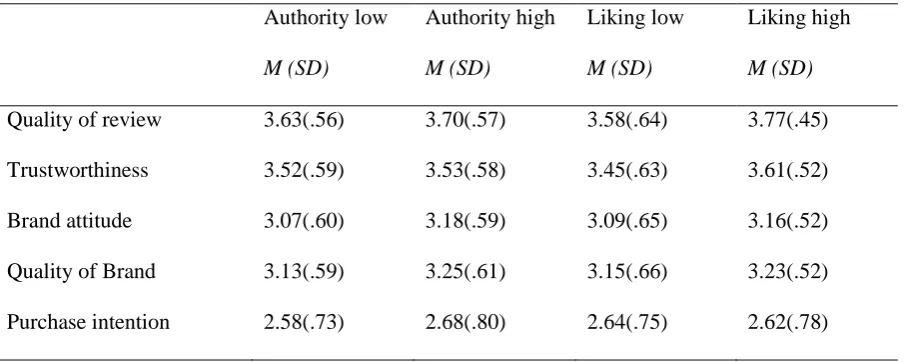
Table 5 gives an overview of the direct effects (mean and standard deviation) of study 1. Table 6 gives an overview of the main effects of study 1 (sum of squares, F-value and p-value) and tables 7 and 8 show the interaction effects (mean and standard deviation) of study 1. Tables 9 gives an overview of the direct effects (mean and standard deviation) of study 2. Table 10 contains an overview of the main effect of study 2 and tables 11 and 12 demonstrate the interaction effect of study 2. In order to test the hypotheses, an univariate analysis of variance (ANOVA) has been conducted for both studies.
Results study 1
Table 5.
The direct effects of authority and liking.
Authority low M (SD) Authority high M (SD) Liking low M (SD) Liking high M (SD)
Quality of review
Trustworthiness
Brand attitude
Quality of Brand
Purchase intention 3.63(.56) 3.52(.59) 3.07(.60) 3.13(.59) 2.58(.73) 3.70(.57) 3.53(.58) 3.18(.59) 3.25(.61) 2.68(.80) 3.58(.64) 3.45(.63) 3.09(.65) 3.15(.66) 2.64(.75) 3.77(.45) 3.61(.52) 3.16(.52) 3.23(.52) 2.62(.78)
The mean is higher for all the dependent variables in the high authority condition, in which the description professional photographer had been assigned to the reviewer, instead of registered, in the low authority situation. The mean score of perceived quality of the review, trustworthiness of the reviewer and brand attitude is higher in the high liking situation, in which a picture of an likeable photographer has been used, instead of a standard photo. Only the purchase intention has a slightly lower mean-score in the high liking condition.
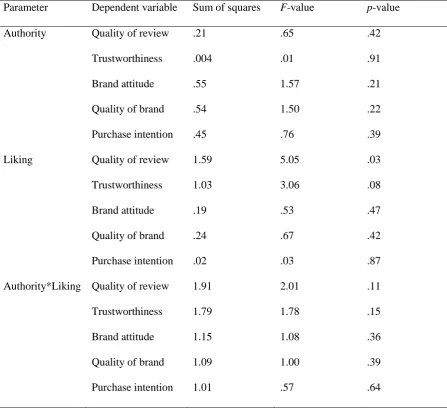
As the results in table 6 demonstrate, there is no significant difference between high authority and low authority on quality of the review(F (1, 165) = .65, p = .42), trustworthiness of the reviewer (F (1, 165) = .01, p = .91), attitude toward the brand (F (1,165) = 1.57, p= .21), quality of the brand (F (1, 165) = 1.50, p = .22) and purchase intention (F (1,165 = .76, p = .39), therefore hypothesis 1 - high authority of the reviewer leads to a more positive attitude toward (a) the review, (b) the reviewer and (c) the brand than low authority of the reviewer - can not be confirmed.
significant main effect of liking on the quality of the review (F (1, 165) = 5.05, p = .03). This means that participants in the high liking condition (M = 3.77, SD = .45) did perceive the quality of the review higher than in the low liking condition (M = 3.58, SD = .64). The results indicate a marginally significant effect for liking on trustworthiness of the reviewer (F (1, 165) = .01, p = .08). This means that participants in the high liking condition (M = 3.61, SD = .52) did perceive the trustworthiness of the reviewer slightly higher than in the low liking condition (M = 3.45, SD = .63). No significant effect has been found for liking on brand attitude (F (1, 165) = .53, p = .47), quality of the brand (F (1, 165) = .67, p = .42) and purchase intention (F (1, 165) = .03, p = .87). Therefore, hypothesis 2a can be confirmed, 2b can be marginally confirmed. Hypothesis 2c can not be confirmed.
Table 6.
The direct main effects of study 1
Parameter Dependent variable Sum of squares F-value p-value
Authority
Liking
Authority*Liking
Quality of review
Trustworthiness
Brand attitude
Quality of brand
Purchase intention
Quality of review
Trustworthiness
Brand attitude
Quality of brand
Purchase intention
Quality of review
Trustworthiness
Brand attitude
Quality of brand
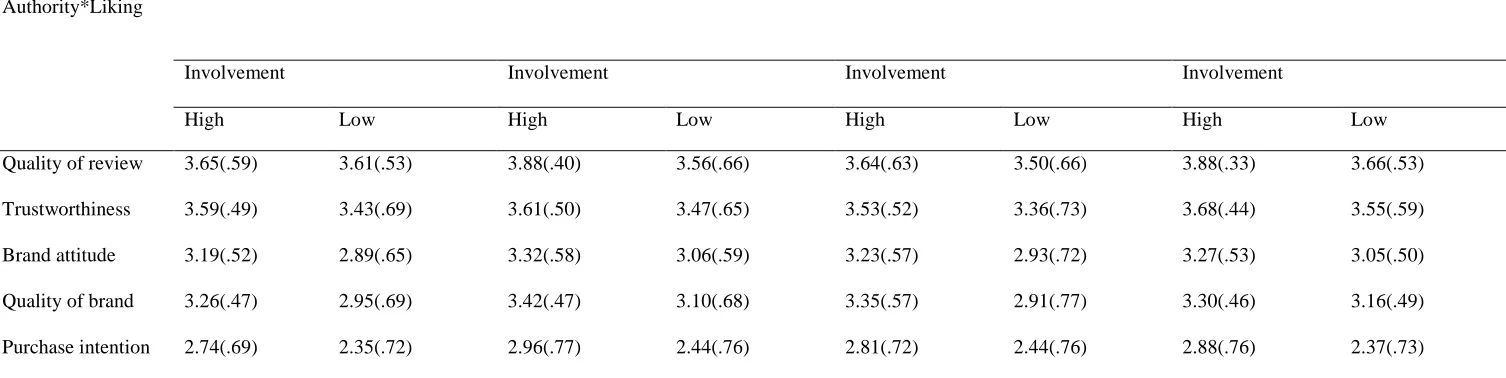
Table 7.
The interaction effect of study 1.
Study 1
Authority*Liking
Authority low Authority high Liking low Liking high
Involvement Involvement Involvement Involvement
High Low High Low High Low High Low
Quality of review
Trustworthiness
Brand attitude
Quality of brand
Purchase intention 3.65(.59) 3.59(.49) 3.19(.52) 3.26(.47) 2.74(.69) 3.61(.53) 3.43(.69) 2.89(.65) 2.95(.69) 2.35(.72) 3.88(.40) 3.61(.50) 3.32(.58) 3.42(.47) 2.96(.77) 3.56(.66) 3.47(.65) 3.06(.59) 3.10(.68) 2.44(.76) 3.64(.63) 3.53(.52) 3.23(.57) 3.35(.57) 2.81(.72) 3.50(.66) 3.36(.73) 2.93(.72) 2.91(.77) 2.44(.76) 3.88(.33) 3.68(.44) 3.27(.53) 3.30(.46) 2.88(.76) 3.66(.53) 3.55(.59) 3.05(.50) 3.16(.49) 2.37(.73)
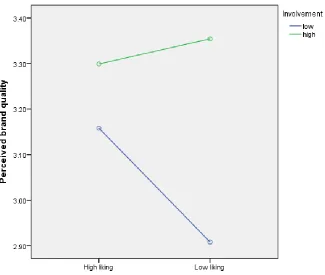
involvement condition (M = 3.16, SD = .49) and participants in the low liking condition who are highly involved (M = 3.35, SD = .57) perceive the quality of the brand higher than in the low involvement condition (M = 2.91, SD = .77). Figure 6 contains a graph in which the interaction effect between involvement and liking on the perceived brand quality is demonstrated. Especially in the low liking condition, involvement affects the perceived brand quality. High liking has an effect on participants who are low involved. Therefore, hypothesis 6 - If a consumer is low involved, the effect of high liking of the reviewer, compared to low liking of the reviewer on a) the review, b) the reviewer and c) the brand, should be stronger, compared to someone who is high involved – can partially be confirmed. Hypothesis 6a and 6b can not be confirmed, hypothesis 6c can partially be confirmed.
Table 8.
The interaction effect between authority and involvement on the dependent variables.
Parameter study1 Dependent variable Sum of squares F-value p-value
Authority*involvement
Liking*involvement
Quality of review
Trustworthiness
Brand attitude
Quality of brand
Purchase intention
Quality of review
Trustworthiness
Brand attitude
Quality of brand
Results study 2
[image:41.595.71.546.213.396.2]The results in this section apply to the independent variables scarcity (of reviews) and social proof (of a review).
Table 9.
The direct main effects of study 2.
Scarcity low
M (SD)
Scarcity high
M (SD)
Social proof low
M (SD)
Social proof high
M (SD)
Quality of review
Trustworthiness
Brand attitude
Quality of brand
Purchase intention 3.66(.66) 3.49(.67) 3.08(.69) 3.02(.63) 2.67(.82) 3.57(.45) 3.41(.69) 2.84(.69) 3.00(.60) 2.42(.87) 3.51(.62) 3.42(.67) 2.90(.73) 2.96(.65) 2.51(.88) 3.73(.48) 3.49(.69) 3.02(.66) 3.07(.56) 2.59(.82)
The mean score is higher for every dependent variable in the high social proof condition. The mean score is lower when the scarcity condition is high, which is in line with the expectations.
more positive attitude toward the a) review, b) reviewer and a less positive attitude toward c) the brand compared to low scarcity of reviews - can partially be confirmed. Hypotheses 3a and 3b can not be confirmed, hypothesis 3c can partially be confirmed.
Hypothesis 4 - high social proof of a review leads to a more positive attitude toward (a) the review, (b) the reviewer and (c) the brand than low social proof of a review - can partly be confirmed. Social proof has a significant effect on the quality of the review (F (1, 164) = 6.75, p = .01). This means that the participants in the high social proof situation (M = 3.73, SD = .48) did perceive the quality of the review higher than in the low social proof situation (M = 3.51, SD = .62). Therefore hypothesis 4a can be confirmed. Social proof has no significant effect on trustworthiness of the reviewer (F (1, 164) = .41, p = .53), brand attitude (F (1, 164) = 1.31, p = .26), quality of the brand (F (1, 164) = 1.32, p = .25) and purchase intention (F (1, 164) = .34, p = .56). Therefore, hypothesis 4b and 4c can not be confirmed.
Figure 8 contains a graph with the interaction effect between scarcity and social proof on the attitude toward the brand. No interaction effect between scarcity and social proof has been found on the trustworthiness of the reviewer (F (3, 162) = 1.08, p = .36), quality of the brand (F (3, 162) = .77, p = .51) and purchase intention (F (3, 162) = 1.29, p = .28).
Table 10.
The direct main effects and interaction effect between scarcity and social proof.
Parameter Dependant variable Sum of squares F-value p-value Scarcity
Social Proof
Scarcity*Social
Proof
Quality of review
Trustworthiness
Brand attitude
Quality of brand
Purchase intention
Quality of review
Trustworthiness
Brand attitude
Quality of brand
Purchase intention
Quality of review
Trustworthiness
Brand attitude
Quality of brand
Figure 7. Graph for interaction effect between social proof and scarcity on perceived quality of the review.
[image:44.595.76.357.386.629.2]Table 11
interaction effect between the independent variables and involvement on the dependent variables.
Study 2 Scarcity*Social Proof
Scarcity Low Scarcity High Social Proof Low Social Proof High
Involvement Involvement Involvement Involvement
High Low High Low High Low High Low
Quality of review
Trustworthiness
Brand attitude
Quality of brand
Purchase intention 3.67(.75) 3.49(.70) 2.99(.72) 2.95(.67) 2.59(.80) 3.66(.52) 3.50(.62) 3.22(.56) 3.12(.54) 2.78(.86) 3.51(.51) 3.42(.63) 2.85(.67) 3.01(.53) 2.37(.93) 3.64(.36) 3.39(.76) 2.83(.72) 2.99(.67) 2.48(.81) 3.38(.72) 3.32(.68) 2.81(.76) 2.88(.66) 2.37(.88) 3.68(.38) 3.55(.63) 3.03(.68) 3.07(.64) 2.70(.87) 3.83(.45) 3.61(.62) 3.04(.65) 3.09(.53) 2.61(.84) 3.61(.49) 3.33(.74) 3.00(.67) 3.04(.58) 2.56(.82)
As demonstrated in table 12, the interaction between social proof and involvement shows an effect on quality of the review (F (1, 162) = 9.57, p < .01). Although this result is significant, it is contrary to the expectations. Participants in the high social proof condition who are highly involved with the product category (M = 3.82, SD = .45) perceive the quality of the brand higher than in the low involvement condition (M = 3.61, SD = .48) and participants in the low social proof condition who are highly involved (M = 3.38, SD = .72) perceive the quality of the brand lower than in the low involvement condition (M = 3.68, SD = .38). Figure 9 contains an overview of the interaction effect between involvement and social proof on the perceived review quality. The results do not indicate a positive effect of social proof on participants who are low involved. Particularly participants who are highly involved with the product category do perceive the quality of the brand as more positive in the high social proof condition.
quality of the brand (F (1, 162) = 1.61, p = .21) and purchase intention (F (1, 162) = 1.92, p = .17). Hypothesis 8 - If a consumer is low involved, the effect of high social proof of a review, compared to low social proof of a review on a) the review, b) the reviewer and c) the brand, should be stronger, compared to someone who is high involved – can, although significant results have been found, not be confirmed. The effect of high social proof on participants who are low involved is not stronger compared to someone who is high involved.
Table 12.
Interaction effect between the independent variables and moderator on the dependent
variables.
Parameter study 2 Dependent variable Sum of squares F-value p-value
Scarcity*involvement
Social
Proof*involvement
Quality of review
Trustworthiness
Brand attitude
Quality of brand
Purchase intention
Quality of review
Trustworthiness
Brand attitude
Quality of brand
Figure 9. Graph for interaction effect between social proof and involvement on perceived quality of the review.
[image:48.595.113.401.423.664.2]DISCUSSION
During this research, the effect of the persuasive heuristics authority, liking, scarcity and social proof on the attitude toward the review, reviewer and brand has been studied. Involvement with the product category has been used as a moderator.
Although not all of the hypotheses are confirmed, a number of significant results have been found. In study 1, significant results were found for the effect of liking on the quality of the review, liking on trustworthiness of the reviewer (marginally) and a marginally significant interaction effect between involvement and liking on the quality of the brand.
In study 2, a significant result has been found for the effect of scarcity on brand attitude and a marginally significant effect of scarcity on purchase intention. Social proof has a significant effect on the perceived quality of the review. Also an interaction effect has been found between the independent variables scarcity and social proof on the quality of the review and a marginally significant interaction effect between scarcity and social proof on the dependent variable brand attitude. Finally, an interaction effect has been found between involvement with the product category and social proof on the quality of the review and on the trustworthiness of the reviewer.
attitude of a consumer. The stimulus material contained, next to the review, product information and a part of a website. This might have distracted the participant too much. Another reason for not finding significant results with regard to authority, is the probability that authority does not work for Dutch participants. During this research, only Dutch individuals participated. Authority of a reviewer might be of less influence on a Dutch review reader. Presumably Dutch consumers do not believe the reviewer is an expert, because they are not known to the person in a real-life situation. For future research, it would be recommendable to add more authoritarian cues to test the effect on the attitude of a consumer.
For liking, significant results have been found for the effect of this persuasive heuristic on the attitude toward the review and reviewer. No significant direct effect has been found for liking on the attitude toward the brand. According to Cheung and Thadani (2010) and Kiecker and Cowles (2001), attractiveness, a part of likeability, influences the way a reader of a review identifies himself with the source. Lee and Shin (2013) found that the presence of a photo of a reviewer distracts the attention from the review text, because the reader has to divide the attention between the photo and the text. This might be a reason for not finding a significant result for liking on the attitude toward the brand. Significant positive results have been found for liking on the attitude toward the review and reviewer; a photo of the reviewer has probably a bigger effect on personal characteristics than brand related characteristics.
research did not result in significant effects with regard to the attitude toward the review and reviewer, but it did result in a significant result on the attitude toward the brand. A lot of available reviews (1.390), as manipulated in the low scarcity condition, leads to a more positive attitude toward the brand and a higher purchase intention. These results are in line with prior research from Duan et al. (2008), Fu and Sim (2011) and Park et al. (2007). They demonstrated a positive effect of the quantity of reviews on the attitude of a consumer towards the brand. It reflects some kind of popularity. In their studies, more than one review has been shown, in this study, participants saw one review. Above the text, the amount of reviews has been shown. Consumers think that the product or service should be good enough for them, because many others did buy or use the product as well (Duan et al., 2008; Fu & Sim, 2011; Park et al., 2007).
Social proof has a significant positive effect on the quality on the review, but not a significant effect on the trustworthiness of the reviewer and the attitude toward the brand. As mentioned by Ratchford, Talukdar and Lee (2001) and Awad and Ragowsky (2008), a reviewer and reader of a review usually do not know one another. Therefore, a review should contain valuable information to gain trust in the information. Presumably, the information in the stimulus material did not contain enough valuable information to find significant results for the attitude toward the reviewer (trustworthiness) and attitude toward the brand.
Presumably, high involved Dutch consumers are looking for conformation and are therefore sensitive for social proof. It is also plausible that low involved Dutch consumers do not really care about social proof or do not take the manipulation seriously. The mean score of low involved participants is almost the same in the high and low social proof condition.
A reason for not finding a lot of significant results might be that the manipulation in the stimulus material did not work. Although the pre-test did show significant results, not all the results are as expected. Probably the persuasive cues did not get enough attention; the review text might have taken too much attention. Consumers have to divide their attention between the text and cues surrounding the text (Lee & Shin, 2013). The persuasive cues could have been placed in a more prominent way in the stimulus material.
Another possible reason why the manipulation did not work, might be the fact that in both studies only two cues have been used. A combination of all the four heuristics might have worked better.
MANAGERIAL IMPLICATIONS
The online environment enables consumers to consult a large amount of sources. From company websites to social media and comparison platforms, a consumer can and does consult different sources in the decision making process. Prior research already did demonstrate the impact of e-WOM and, in the context of this research, online product reviews, on the attitude of a consumer. Marketers should be aware of the importance of e-WOM. The question for the marketing department should not be if reviews are interesting to use, but how reviews should be used within a marketing strategy of the company.
Liking (likeability of the reviewer) has a positive effect on a consumer his or hers attitude toward the quality of a review and trustworthiness of the reviewer. As a marketer, it would be interesting to give reviewers the opportunity to personalize their (review-)account. Next to offering the possibility to personalize an account, provide the reviewer with easy to understand tips with regard to their profile picture and motivate reviewers to use a profile picture. Consumers who are low involved with the product category, are affected by likeability. This study demonstrates a positive effect on the perceived brand attitude of low involved participants, if a profile picture of the reviewer has been shown. By displaying a profile picture of the reviewer, marketers can persuade low involved consumers to perceive the quality of the brand as more positive.
LIMITATIONS AND FUTURE RESEARCH
This research has a few limitations. One of the limitations of this study is the fact that not all the persuasive cues have been combined in the stimulus material. Although a variety of different combinations has been made, there was not enough capacity to test the effect of all combinations. Future researchers can, for example, use multivariate testing to determine which combination gives the best results.
A second limitation is the fact that during this study only two search goods have been used in the stimulus material; one product per study. It would be interesting to use different products to check whether the results differ. It would also be interesting for future research to use experience goods like movies or books or even credence goods, like medication.
According to Guadagno and Cialdini (2002; 2006), there are differences in the effect of persuasion in e-WOM between men and women. In one of their articles, titled ‘persuade him by e-mail and her face-to-face’, the differences are demonstrated. Because a lot of companies focus particularly on women or men, it is important and interesting for future research to know what the differences are between men and women after being exposed to persuasive cues surrounding a review text.
REFERENCES
Aaker, D. A., & Keller, K. L. (1990). Consumer Evaluations of Brand Extensions. Journal of Marketing, 54, 27-41.
Asch, S. E. & Solomon, E. (1956). Studies of independence and conformity: I. A minority of one against a unanimous majority. Psychological Monographs: General and Applied, 70(9), 1-70.
Awad, N.F., & Ragowsky, A. (2008). Establishing Trust in Electronic Commerce Through Online Word of Mouth: An Examination Across Genders. Journal of Management Information Systems, 24(4), 101-121.
Baker, M. J., & Churchill, G. A. (1977). The Impact of Physically Attractive Models on Advertising Evaluations. Journal of Marketing Research, 14(4), 538-555.
Bakshy, E., Hofman, J. M., Mason, W. A., & Watts, D. J. (2011). Everyone’s an Influencer: Quantifying Influence on Twitter. Proceeding, 65-74.
Bell, S. S., Holbrook, M. B., & Solomon, M. R. (1991). Combining Esthetic and Social Value to Explain preferences for Product Styles with the Incorporation of Personality and Ensemble Effect. Journal of Social Behavior and Personality, 6(6), 243-273.
Bone, P. F. (1995). Word-of-Mouth Effects on Short-term and Long-term Product Judgments. Journal of Business Research, 32(3), 213-223.
Bruner II, G. C. (2009). Marketing Scales Handbook – A Compilation of Multi-Item Measures for Consumer Behavior & Advertising Research – Volume 5. Carbondale, Illinois IS: GCBII Productions.
Cameron, K. A. (2009). A practitioner’s guide to persuasion: An overview of 15 selected persuasion theories, models and frameworks. Patient Education and Counseling, 74, 309-317.
Chang, M. K., Cheung, W., & Lai, S. L. (2005). Literature derived reference models for the adoption of online shopping. Information & Management, 42, 543-559.
Cheung, C. M. K., & Thadani, D. R. (2010). The Effectiveness of Electronical Word-of-Mouth Communication: A Literature Analysis. 23rd Bled eConference eTrust: Implications for the Individual, Enterprises and Society, 329-345.
Cheung, C. M. K., & Thadani, D. R. (2012). The impact of electronic word-of-mouth communication: A literature analysis and integrative model. Decision Support Systems, 54, 461-470.
Christodoulides, G., Jevons, C., & Blackshaw, P. (2011). The Voice of the Consumer Speaks Forcefully in Brand Identity: User-Generated Content Forces Smart Marketers to Listen. Journal of Advertising Research, 51(1), 101-111
Cialdini, R. B. (2001).The Science of Persuasion. Scientific American, 284, 77-81.
Cialdini, R. B. (2001). Harnessing the Science of Persuasion. Harvard Business Review, 72-79.
Cialdini, R. B., & Goldstein, N. J. (2002). The Science and Practice of Persuasion. Cornell Hotel and Restaurant Administration Quarterly, 40-50.
Christodoulides, G., Michaelidou N., & Argyriou, E. (2012). Cross-national differences in e-WOM influence. European Journal of Marketing, 46(11/12), 1689-1707.
Dainton, M.,& Zelley, E.D. (2011). Applying communication theory for professional life. Sage publications, California, 121-138.
Darby, M. R., & Karni, E. (1973). Free Competition and the Optimal Amount of Fraud. Journal of Law and Economics, 16(1), 67-88.
Dou, X., Walden, J. A., Lee, S., & Lee, J. Y. (2012). Does source matter? Examining source effects in online product reviews. Computers in Human Behavior, 28(5), 1555-1563. Duan, W., Gu, B., & Whinston, A.B. (2008). Do online reviews matter? – An empirical
investigation of panel data. Decision Support Systems, 45, 1007-1016.
eMarketer (2010) as in Bazaarvoice (2014), Social Commerce Statistics. Retrieved on 29 April, 2014, from http://media2.bazaarvoice.com/
documents/Bazaarvoice_Social_Commerce_Statistics_112612.pdf
Erdem, T., & Swait, J. (2004). Brand Credibility, Brand Consideration, and Choice. Journal of Consumer Research, 31, 191-198.
Erdogan, B. Z. (1999). Celebrity Endorsement: A Literature Review. Journal of Marketing Management, 15(4), 291-314.
Feick, L., & Higie, R. A. (1992). The Effects of Preference Heterogeneity and Source Characteristics on Ad Processing and Judgments about Endorsers. Journal of Advertising, 21(2), 9-24.
Fishbein, M., & Ajzen, I. (1975). Belief, Attitude, Intention, and Behavior: An Introduction to Theory and Research. Reading, MA: Addison-Wesley.
Fournier, S. (1998). Consumers and Their Brands: Developing Relationship Theory in Consumer Research. Journal of Consumer Research, 24, 343-373.
Gilly, M. C., Graham, J. L., Wolfinbarger, M. F., & Yale, L. J. (1998). Journal of the Academy of Marketing Science, 26(2), 83-100.
Godes, D., & Mayzlin, D. (2004). Using Online Conversations to Study Word-of-Mouth Communication. Marketing Science, 23(4), 545-560.
Guadagno, R. E., & Cialdini, R. B. (2002). Online Persuasion: An Examination of Gender Differences in Computer-Mediated Interpersonal Influence. Group Dynamics: Theory, Research, and Practice, 6(1), 38-51.
Guadagno, R. E., & Cialdini, R. B. (2006). Persuade him by email, but see her in person: Online persuasion revisited. Computers in Human Behavior, 23, 999-1015.
Hennig-Thurau, T., Gwinner, K. P., Walsh, G., & Gremler, D. D. (2004). Electronic word-of-mouth via consumer-opinion platforms: What motivates consumers to articulate themselves on the internet? Journal of Interactive Marketing, 18(1), 38- 52. doi:10.1002/dir.10073
Ho, J. Y. C., & Dempsey, M. (2010). Viral marketing: Motivations to forward online content. Journal of Business Research, 63, 1000-1006.
Hong, S., & Park, H. S. (2012). Computer-mediated persuasion in online reviews: Statistical versus narrative evidence. Computers in Human Behavior, 28, 906-919. Horstman, B. (2013). The impact of electronic word-of-mouth communication: A
cross-cultural perspective. Unpublished manuscript, Faculty of Behavioural Sciences, University of Twente, Enschede, Netherlands.
Hosmer, L. T. (1995). Trust: The Connection Link between Organizational Theory and Philosophical Ethics. Academy of Management Review, 20(2), 379-403.
Communication. Proceedings of the 7th ACM conference on Electronical Commerce, 324-330.
Huang, C. Y., Chou, C. J., & Lin, P. C. (2010). Involvement theory in constructing bloggers’ intention to purchase travel products. Tourism Management, 31(4), 513-526.
Huang, M., Cai, F., Tsang, A.S.L., & Zhou, N. (2011). Making your online voice loud: the critical role of WOM information. European Journal of Marketing, 45(7/8), 1277-1297. Jalilvand, M. R., Esfahani, S. S., & Samiei, N. (2010). Electronic word-of-mouth: challenges
and opportunities. Procedia Computer Science, 3, 42-46. doi:10.10106/j.procs.2010.12.008
Kaptein, M. (2012). Digitale Verleiding. Amsterdam/Antwerpen: Business Contact.
Keller, E., & Berry, L. (2003). The Influentials: One American in ten tells the other nine how to vote, where to eat, and what to boy. They are The Influentials. New York: The Free Press.
Keller, E., & Fay, B. (2012). The Face-to-Face Book: Why Real Relationships Rule in a Digital Marketplace. Retrieved on 17 September, 2013, from
http://www.marketingfacts.nl/berichten/de-6-nieuwste-wetten-van-word-of-mouth- marketing/
Kiecker, P., & Cowles, D. (2001). Interpersonal Communication and Personal Influence on the Internet: A Framework for Examining Online Word-of-Mouth. Internet Applications in Euromarketing, 11(2), 71-88.
Klein, L. R. (1998). Evaluating the Potential of Interactive Media through a New Lens: Search versus Experience Goods. Journal of Business Research, 41, 195-203.
Lee, E. J., & Shin, S. Y. (2013) When do consumers buy online product reviews? Effects of review quality, product type, and reviewer’s photo. Computers in Human Behavior, 31, 356-366.
Lo, L.W.T. (2014). An Exploratory Research on eWOM Information Seeking Behavior and Attitudes in Service Consumption. Review of Integrative Business & Economics Research, 3(1), 172-189.
Lovett, M. J., Peres, R., & Shachar, R. (2013). On Brands and Word of Mouth. Journal of Marketing Research, L, 427-444.
Lui, Y. (2006). Word of Mouth for Movies: Its Dynamics and Impact on Box Office Revenue. Journal of Marketing, 70, 74-89.
Matos, C. A., de, & Rossi, C. A. V. (2008). Word-of-mouth communications in marketing: a meta-analytic review of the antecedents and moderators. Journal of the Academic Marketing Science, 36, 578-596.
Meuter, M. L., McGabe, D. B., & Curran, J. M. (2013) Electronic Word-of Mouth Versus Interpersonal Word-of-Mouth: Are All Forms of Word-of-Mouth Equally Influential? Services Marketing Quarterly, 34(3), 240-256.
Milgram, S. (1963). Behavioral Studies of Obedience. Journal of Abnormal and Social Psychology, 67(4), 371-378.
Mitchell, A. A., & Olsen, J. C. (1981). Are Product Attribute Beliefs the Only Mediator of Advertising Effects on Brand Attitude? Journal of Marketing Research, 18, 318-332. Münz, K., & Sergiūnaitė, V. (2012). Electronic word-of-mouth (eWOM): The relationship
between anonymous and semi-anonymous eWOM and consumer attitudes. Retrieved on 12 May, 2014, from http://www.diva-portal.org/smash/get/diva2:529125/
Nelson, P. (1970). Information and Consumer Behavior. Journal of Political Economy, 78(2), 311-329.
Newman, J. W., & Staelin, R. (1972). Prepurchase information seeking for new cars and major household appliances. Journal of Marketing Research, 9(3), 249-257.
Ng, C. S. P. (2013). Intention to purchase on social commerce websites across cultures: A cross-regional study. Information & Management, 50, 609-620.
Ohanian, R (1990). Construction and Validation of a Scale to Measure Celebrity Endorsers’ Perceived Expertise, Trustworthiness, and Attractiveness. Journal of Advertising, 19(3), 39-52.
Ohanian, R. (1991). The Impact of Celebrity Spokes Persons’ Perceived Image on Consumer’s Intention to Purchase. Journal of Advertising Research, 31(1), 46-54.
Okdie, B. M., Guadagno, R. E., Bernieri, F. J., Geers, A. L., &Mclarney-Vesotski, A. R. (2011). Getting to know you: Face-to-face versus online interactions. Computers in Human Behavior, 27(1), 153-159.
Park, C., & Lee, T. M. (2009). Information direction, website reputation and eWOM effect: A moderating role of product type. Journal of Business Research, 62, 61-67.
Park, D. H., Lee, J., & Han, I. (2007). The Effect of On-Line Consumer Reviews on Consumer Purchasing Intention: The Moderating Role of Involvement. International Journal of Electronic Commerce, 11(4), 125-148. doi:10.2753/JEC1086-4415110405
Petty, R. E., Cacioppo, J. T., & Schumann, D. (1983). Central and Peripheral Routes to Advertising Effectiveness: The Moderating Role of Involvement. Journal of Consumer Research, 10(2), 135-146.