The Parameter-optimized ATEC Metric for MT Evaluation
Billy T-M Wong Chunyu Kit
Department of Chinese, Translation and Linguistics
City University of Hong Kong
Tat Chee Avenue, Kowloon, Hong Kong
{ctbwong, ctckit}@cityu.edu.hk
Abstract
This paper describes the latest version of the ATEC metric for automatic MT evaluation, with parameters optimized for word choice and word order, the two fundamental features of language that the metric relies on. The former is assessed by matching at various linguistic levels and weighting the informa-tiveness of both matched and unmatched words. The latter is quantified in term of word position and information flow. We also discuss those aspects of language not yet covered by other existing evaluation metrics but carefully considered in the formulation of our metric.
1
Introduction
It is recognized that the proposal of the BLEU metric (Papineni et al., 2002) has piloted a para-digm evolution to MT evaluation. It provides a computable solution to the task and turns it into an engineering problem of measuring text simi-larity and simulating human judgments of trans-lation quality. Related studies in recent years have extensively revealed more essential charac-teristics of BLEU, including its strengths and weaknesses. This has aroused the proposal of different new evaluation metrics aimed at ad-dressing such weaknesses so as to find some oth-er hopefully bettoth-er altoth-ernatives for the task. Ef-fort in this direction brings up some advanced metrics such as METEOR (Banerjee and Lavie, 2005) and TERp (Snover et al., 2009) that seem to have already achieved considerably strong correlations with human judgments. Nevertheless, few metrics have really nurtured our understand-ing of possible parameters involved in our lan-guage comprehension and text quality judgment. This inadequacy limits, inevitably, the applica-tion of the existing metrics.
The ATEC metric (Wong and Kit, 2008) was developed as a response to this inadequacy, with a focus to account for the process of human comprehension of sentences via two fundamental features of text, namely word choice and word order. It integrates various explicit measures for these two features in order to provide an intuitive and informative evaluation result. Its previous version (Wong and Kit, 2009b) has already illu-strated a highly comparable performance to the few state-of-the-art evaluation metrics, showing a great improvement over its initial version for participation in MetricsMATR081. It is also ap-plied to evaluate online MT systems for legal translation, to examine its applicability for lay users’ use to select appropriate MT systems (Wong and Kit, 2009a).
In this paper we describe the formulation of ATEC, including its new features and optimiza-tion of parameters. In particular we will discuss how the design of this metric can complement the inadequacies of other metrics in terms of its treatment of word choice and word order and its utilization of multiple references in the evalua-tion process.
2
The ATEC Metric
2.1 Word Choice
In general, word is the basic meaning bearing unit of language. In a semantic theory such as Latent Semantic Analysis (LSA) (Landauer et al., 1998), lexical selection is even the sole consider-ation of the meaning of a text. A recent study of the major errors in MT outputs by Vilar et al. (2006) also reveals that different kinds of error related to word choices constitute a majority of error types. It is therefore of prime importance
1http://www.itl.nist.gov/iad/mig/tests/metricsmatr/2008/
for MT evaluation metrics to diagnose the ade-quacy of word selection by an MT system.
It is a general consensus that the performance of an evaluation metric can be improved by matching more words between MT outputs and human references. Linguistic resources like stemmer and WordNet are widely applied by many metrics for matching word stems and syn-onyms. ATEC is equipped with these two mod-ules as well, and furthermore, with two measures for word similarity, including a WordNet-based (Wu and Palmer, 1994) and a corpus-based measure (Landauer et al., 1998) for matching word pairs of similar meanings. Our previous work (Wong, 2010) shows that the inclusion of semantically similar words results in a positive correlation gain comparable to the use of Word-Net for synonym identification.
In addition to increasing the number of legiti-mate matches, we also consider the importance of each match. Although most metrics score every matched word with equal weight, different words indeed contribute different amount of in-formation to the meaning of a sentence. In Ex-ample 1 below, both C1 and C2 contain the same number of words matched with Ref, but the matches in C1 are more informative and there-fore should be assigned higher weights.
Example 1
C1: it was not first time that prime minister con-fronts northern league …
C2: this is not the prime the operation with the north …
Ref: this is not the first time the prime minister has faced the northern league …
The informativeness of a match is weighted by the tf-idf measure, which has been widely used in information retrieval to assess the relative impor-tance of a word as an indexing term for a docu-ment. A word is more important to a document when it occurs more frequently in this document and less in others. In ATEC, we have “document” to refer to “sentence”, the basic text unit in MT evaluation. This allows a more sensitive measure for words in different sentences, and gets around the problem of an evaluation dataset containing only one or a few long documents. Accordingly, the tf-idf measure is formulated as:
) log( )
,
( ,
i j
i
sf N tf
j i
tfidf = ⋅
where tfi,j is the occurrences of word wi in
sen-tence sj, sfi the number of sentences containing
word wi, and N the total number of sentences in
the evaluation set. In case of a high-frequency word whose tf-idf weight is less than 1, it is then rounded up to 1.
In addition to matched words, unmatched words are also considered to have a role to play in determining the quality of word choices of an MT output. As illustrated in Example 1, the un-matched words in Ref for C1 and C2 are [this | is | the | the | has | faced | the] and [first | time | mi-nister | has | faced | northern | league] respective-ly. One can see that the words missing in C2 are more significant. It is therefore necessary to ap-ply the tf-idf weighting to unmatched reference words so as to quantify the information missed in the MT outputs in question.
2.2 Word Order
In MT evaluation, word order refers to the extent to which an MT output is interpretable following the information flow of its reference translation. It is not rare that an MT output has many matched words but does not make sense because of a problematic word order. Currently it is ob-served that consecutive matches represent a legi-timate local ordering, causing some metrics to extend the unit of matching from word to phrase. Birch et al. (2010) show, however, that the cur-rent metrics including BLEU, METEOR and TER are highly lexical oriented and still cannot distinguish between sentences of different word orders. This is a serious problem in MT evalua-tion, for many MT systems have become capable of generating more and more suitable words in translations, resulting in that the quality differ-ence of their outputs lies more and more crucial-ly in the variances of word order.
ATEC uses three explicit features for word or-der, namely position distance, order distance and phrase size. Position distance refers to the diver-gence of the locations of matches in an MT out-put and its reference. Example 2 illustrates two candidates with the same match, whose position in C1 is closer to its corresponding position in
Ref than that in C2. We conceive this as a signif-icant indicator of the accuracy of word order: the closer the positions of a matched word in the candidate and reference, the better match it is.
Example 2
C1: non-signatories these acts victims but it caused to incursion transcendant
C2: non-signatories but it caused to incursion transcendant these acts victims
The calculation of position distance is based on the position indices of words in a sentence. In particular, we align every word in a candidate to its closest counterpart in a reference. In Example 3, all the candidate words have a match in the reference. As illustrated by the two “a” in the candidate, the shortest alignments (strict lines) are preferred over any farther alternatives (dash lines). In a case like this, only two matches, i.e.,
thief and police, vary in position by a distance of 3.
Example 3
Candidate: a thiefchases apolice
Pos distance: 0 3 0 0 3 Pos index: 1
2 3 4 5
Reference: a policechases athief
Pos index: 1 2 3 4 5
This position distance is sensitive to sentence length as it simply makes use of word position indices without any normalization. Example 4 illustrates two cases of different lengths. The po-sition distance of the bold matched words is 3 in
C1 but 14 in C2. Indeed, the divergence of word order in C1 does not hinder our understanding, but in C2 it poses a serious problem. This exces-sive length inevitably magnifies the interference effect of word order divergence.
Example 4
C1: Short1 and2 various3 international4 news5 R1: International1 news2 brief3
C2: Is1 on2 a3 popular4 the5 very6 in7 Iraq8 to9
those10 just11 like12 other13 world14 in15
which16 young17 people18 with19 the20 and21
flowers22 while23 awareness24 by25 other26
times27 of28 the29 countries30 of31 the32 R2: Valentine’s1 day2 is3 a4 very5 popular6 day7
in8 Iraq9 as10 it11 is12 in13 the14 other15
coun-tries16 of17 the18 world19. Young20 men21
ex-change22 with23 their24 girlfriends25 sweets26,
flowers27, perfumes28 and29 other30 gifts31.
Another feature, the order distance, concerns the information flow of a sentence in the form of the sequence of matches. Each match in a candi-date and a reference is first assigned an order index in a sequential manner. Then, the differ-ence of two counterpart indices is measured, so as to see if a variance exists. Examples 5a and 5b exemplify two kinds of order distance and their corresponding position distance. Both cases have
two matches with the same sum of position dis-tance. However, the matches are in an identical sequence in 5a but cause a cross in 5b, resulting in a larger order distance for the latter.
Example 5a
Position index Order index
Candidate:
Reference:
Order index Position index
Position distance Order distance
1 2 3 4 1 2
A B C D
B E D F
1 2 1 2 3 4
(2-1) + (4-3) = 2 (1-1) + (2-2) = 0
Example 5b
Position index Order index
Candidate:
Reference:
Order index Position index
Position distance Order distance
1 2 3 4 1 2
A B C D
C B E F
1 2
1 2 3 4
(2-2) + (3-1) = 2 (2-1) + (2-1) = 2
In practice, ATEC operates on phrases like many other metrics. But unlike these metrics that count only the number of matched phrases, ATEC gives extra credit to a longer phrase to reward its valid word sequence. In Example 6,
C1 and C2 represent two MT outputs of the same length, with matched words underlined. Both have 10 matches in 3 phrases, and will receive the same evaluation score from a metric like METEOR or TERp, ignoring the subtle differ-ence in the sizes of the matched phrases, which are [8,1,1] and [4,3,3] words for C1 and C2 re-spectively. In contrast, ATEC uses the size of a phrase as a reduction factor to its position dis-tance, so as to raise the contribution of a larger phrase to the metric score.
Example 6
C1: w1 w2 w3 w4 w5 w6 w7 w8 w9 w10 w11 w12 w13 C2: w1 w2 w3 w4 w5 w6 w7 w8 w9 w10 w11 w12 w13
2.3 Multiple References
This deficit can be illustrated by a well-known example from Papineni et al. (2002), as repli-cated in Example 7 with slight modification. It shows that nearly all candidate words can find their matches in either reference. However, if we resort to single reference, only around half of them can have a match, which would seriously underrate the quality of the candidate.
Example 7
C: It is a guide to action which ensures that the military always obeys the commands of the party.
R1: It is a guide to action that ensures that the military will forever heed Party commands.
R2: It is the guiding principle which guarantees the military forces always being under the commands of the party.
ATEC exploits multiple references in this fa-shion to maximize the number of matches in a candidate. It begins with aligning the longest matches with either reference. The one with the shortest position distance is preferred if more than one alternative available in the same phrase size. This process repeats until no more candi-date word can find a match.
2.4 Formulation of ATEC
The computation of an ATEC score begins with alignment of phrases, as described above. For each matched phase, we first sum up the score of each word i in the phrase as
∑
∈ − = } { ) ( phrase i i match type match tfidf Info w Wwhere wtype refers to a basic score of a matched
word depending on its match type. It is then minus its information load, i.e., the tf-idf score of the matched word with a weight factor, Infomatch.
There is also a distance penalty for a phrase,
order order e
pos
pos c w dis
p dis
w
Dis= − )+
| | | | 1 ( ,
where dispos and disorder refer to the position
distance and order distance, and wpos and worder
are their corresponding weight factors, respectively. The position distance is further weighted according to the size of phrase |p| with
an exponential factor e, in proportion to the length of candidate |c|.
The score of a matched phrase is then computed by ⎩ ⎨ ⎧ − ⋅ = , , Dis W Limit W Phrase match dis
match if Dis > Wmatch·Limitdis;
otherwise,
Limitdis is an upper limit for the distance penalty.
Accordingly, the score C of all phrases in a can-didate is
∑
∈ = } {candidate j j Phrase C .Then, we move on to calculating the informa-tion load of unmatched reference words Wunmatch,
approximated as ) ( } {
∑
∈ − = unmatch k k unmatch type unmatch tfidf Info w W .The overall score M accounting for both the matched and unmatched is defined as
⎩ ⎨ ⎧ − ⋅ = , , unmatch Info W C Limit C
M if Wunmatch > C·LimitInfo; otherwise,
LimitInfo is an upper limit for the information
penalty of the unmatched words.
Finally, the ATEC score is computed using the conventional F-measure in terms of precision P and recall R as
R P PR ATEC ) 1 ( α α + − =
where |c|
M P=
, |r|
M R=
.
The parameter α adjusts the weights of P and R, and |c| and |r| refer to the length of candidate and reference, respectively. In the case of multiple references, |r| refers to the average length of ref-erences.
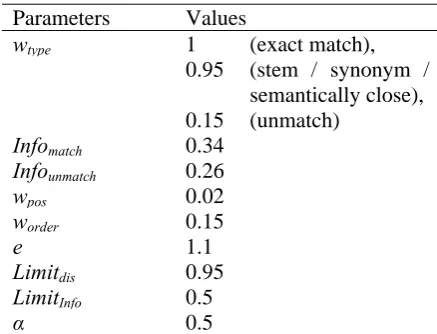
We have derived the optimized values for the parameters involved in ATEC calculation using the development data of NIST MetricsMATR10 with adequacy assessments by a simple hill climbing approach. The optimal parameter set-ting is presented in Table 1 below.
3
Conclusion
have a comprehensive coverage of different tex-tual factors involved in our interpretation of a sentence. The optimal offsetting for the parame-ters is expected to report an empirical observa-tion of the relative merits of each factor in ade-quacy assessment. We are currently exploring their relation with the errors of MT outputs, to examine the potential of automatic error analysis. The ATEC package is obtainable at:
http://mega.ctl.cityu.edu.hk/ctbwong/ATEC/
Acknowledgments
The research work described in this paper was supported by City University of Hong Kong through the Strategic Research Grant (SRG) 7002267.
References
Satanjeev Banerjee and Alon Lavie. 2005. METEOR: An Automatic Metric for MT Evaluation with Im-proved Correlation with Human Judgments. Pro-ceedings of Workshop on Intrinsic and Extrinsic Evaluation Measures for MT and/or Summariza-tion at the 43th Annual Meeting of the AssociaSummariza-tion of Computational Linguistics (ACL), pages 65-72, Ann Arbor, Michigan, June 2005.
Alexandra Birch, Miles Osborne and Phil Blunsom. 2010. Metrics for MT Evaluation: Evaluating Reordering. Machine Translation (forthcoming).
Thomas Landauer, Peter W. Foltz and Darrell Laham. 1998. Introduction to Latent Semantic Analysis. Discourse Processes 25: 259–284.
Kishore Papineni, Salim Roukos, Todd Ward, and Wei-Jing Zhu. 2002. BLEU: A Method for Auto-matic Evaluation of Machine Translation. Proceed-ings of 40th Annual Meeting of the Association for Computational Linguistics (ACL), pages 311–318, Philadelphia, PA, July 2002.
Matthew Snover, Nitin Madnani, Bonnie Dorr, and Richard Schwartz. 2009. Fluency, Adequacy, or HTER? Exploring Different Human Judgments with a Tunable MT Metric. Proceedings of the Fourth Workshop on Statistical Machine Transla-tion at the 12th Meeting of the European Chapter of the Association for Computational Linguistics (EACL), pages 259-268, Athens, Greece, March, 2009.
David Vilar, Jia Xu, Luis Fernando D'Haro and Her-mann Ney. 2006. Error Analysis of Statistical Ma-chine Translation Output. Proceedings of the 5th International Conference on Language Resources and Evaluation (LREC), pages 697-702, Genova, Italy, May 2006.
Billy T-M Wong. 2010. Semantic Evaluation of Ma-chine Translation. Proceedings of the 7th Interna-tional Conference on Language Resources and Evaluation (LREC), Valletta, Malta, May, 2010.
Billy T-M Wong and Chunyu Kit. 2008. Word choice and Word Position for Automatic MT Evaluation. AMTA 2008 Workshop: MetricsMATR, 3 pages, Waikiki, Hawai'i, October, 2008.
Billy T-M Wong and Chunyu Kit. 2009a. Meta-Evaluation of Machine Translation on Legal Texts. Proceedings of the 22nd International Conference on the Computer Processing of Oriental Languag-es (ICCPOL), pages 343-350, Hong Kong, March, 2009.
Billy Wong and Chunyu Kit. 2009b. ATEC: Automat-ic Evaluation of Machine Translation via Word Choice and Word Order. Machine Translation, 23(2):141-155.
Zhibiao Wu and Martha Palmer. 1994. Verb Seman-tics and Lexical Selection. Proceedings of the 32nd Annual Meeting of the Association for Computa-tional Linguistics, pages 133-138, Las Cruces, New Mexico.
Parameters Values
wtype 1 (exact match),
0.95 (stem / synonym / semantically close), 0.15 (unmatch)
Infomatch 0.34
Infounmatch 0.26
wpos 0.02
worder 0.15
e 1.1
Limitdis 0.95
LimitInfo 0.5
[image:5.595.70.289.69.236.2]α 0.5