Development of the Korean Resource Grammar:
Towards Grammar Customization
Sanghoun Song Dept. of Linguistics Univ. of Washington
Jong-Bok Kim School of English Kyung Hee Univ.
Francis Bond Linguistics and Multilingual Studies
Nanyang Technological Univ.
Jaehyung Yang Computer Engineering
Kangnam Univ.
Abstract
The Korean Resource Grammar (KRG) is a computational open-source grammar of Korean (Kim and Yang, 2003) that has been constructed within the DELPH-IN consortium since 2003. This paper re-ports the second phase of the KRG devel-opment that moves from a phenomena-based approach to grammar customiza-tion using the LinGO Grammar Matrix. This new phase of development not only improves the parsing efficiency but also adds generation capacity, which is nec-essary for many NLP applications.
1 Introduction
The Korean Resource Grammar (KRG) has been under development since 2003 (Kim and Yang, 2003) with the aim of building an open source grammar of Korean. The grammatical frame-work for the KRG is Head-driven Phrase Struc-ture Grammar (HPSG: (Pollard and Sag, 1994; Sag et al., 2003)), a non-derivational, constraint-based, and surface-oriented grammatical archi-tecture. The grammar models human languages as systems of constraints on typed feature struc-tures. This enables the extension of grammar in a systematic and efficient way, resulting in linguistically precise and theoretically motivated descriptions of languages.
The initial stage of the KRG (hereafter, KRG1) has covered a large part of the Korean grammar with fine-grained analyses of HPSG. However, this version, focusing on linguistic
data with theory-oriented approaches, is unable to yield efficient parsing or generation. The addi-tional limit of the KRG1 is its unattested parsing efficiency with a large scale of naturally occur-ring data, which is a prerequisite to the practical uses of the developed grammar in the area of MT. Such weak points have motivated us to move the development of KRG to a data-driven ap-proach from a theory-based one upon which the KRG1 is couched. In particular, this second phase of the KRG (henceforth, KRG2) also starts with two methods: shared grammar libraries (the Grammar Matrix (Bender et al., 2002; Bender et al., 2010)) and data-driven expansion (using the Korean portions of multilingual texts).
Next, we introduce the resources we used
(§ 2). this is followed by more detailed
motiva-tion for our extensions (§3). We then detail how
we use the grammar libraries from the Grammar
Matrix to enable generation (§ 2) and then
ex-pand the coverage based on a corpus study (§5).
2 Background
2.1 Open Source NLP with HPSG
The Deep Linguistic Processing with HPSG
Initiative (DELPH-IN:www.delph-in.net)
provides an open-source collection of tools and grammars for deep linguistic processing of hu-man language within the HPSG and MRS (Min-imal Recursion Semantics (Copestake et al., 2005)) framework. The resources include
soft-ware packages, such as theLKB for parsing and
generation, PET (Callmeier, 2000) for parsing,
and a profiling tool [incr tsdb()] (Oepen, 2001).
English Resource Grammar (Flickinger, 2000), Jacy; a Japanese Grammar (Siegel and Bender, 2002), the Spanish grammar, and so forth. These along with some compiled versions of pre-processing or experimental tools are packaged in theLOGONdistribution.1 Most resources are
un-der the MIT license, with some parts unun-der other
open licenses such as the LGPL.2 The KRG has
been constructed within this open-source
infras-tructure, and is released under the MIT license3.
2.2 The Grammar Matrix
The Grammar Matrix (Bender et al., 2002; Ben-der et al., 2010) offers a well-structured envi-ronment for the development of precision-based grammars. This framework plays a role in build-ing a HPSG/MRS-based grammar in a short time, and improving it continuously. The Gram-mar Matrix covers quite a few linguistic phe-nomena constructed from a typological view. There is also a starter-kit, the Grammar Matrix customization system which can build the back-bone of a computational grammar from a linguis-tic description.
2.3 A Data-driven Approach
Normally speaking, building up a computational grammar is painstaking work, because it costs too much time and effort to develop a grammar by hand only. An alternative way is a data-driven approach which ensures ‘cheap, fast, and easy’ development. However, this does not mean that one is better than the other. Each of these two approaches has its own merits. To achieve the best or highest performance of parsing and gen-eration, each needs to complement the other.
3 Directions for Improvement 3.1 Generation for MT
HPSG/MRS-based MT architecture consists of parsing, transfer, and generation, as assumed in Figure 1 (Bond et al., 2005). As noted earlier,
1wiki.delph-in.net/moin/LogonTop
2www.opensource.org/licenses/
3It allows people “. . . without limitation the rights to
[image:2.595.309.518.77.105.2]use, copy, modify, merge, publish, distribute, sublicense, and/or sell copies” so long as “The above copyright notice and this permission notice shall be included . . . ”
Figure 1: HPSG/MRS-based MT Architecture the KRG1 with no generation function is limited only to the Source Analysis in Figure 1. In addi-tion, since its first aim was to develop a Korean grammar that reflects its individual properties in detail, the KRG1 lacks compatible semantic rep-resentations with other grammars such as ERG and Jacy. The mismatches between the compo-nents of the KRG1 and those of other grammars make it difficult to adopt the Korean grammar for an MT system. To take a representative example, the KRG1 treats tense information as a feature type of HEAD, while other grammars incorpo-rate it into the semantics; thus, during the trans-fer process in Figure 1, some information will be missing. In addition, KRG1 used default inheri-tance, which makes the grammar more compact,
but means it could not used with the faster PET
parser. We will discuss this issue in more detail in Section 4.1.
Another main issue in the KRG1 is that some of the defined types and rules in the grammar are inefficient in generation. Because the declared types and rules are defined with theoretical mo-tivations, the run-time for generating any parsing units within the system takes more than expected and further causes memory overflow errors to crop up almost invariably, even though the in-put is quite simple. This problem is partially due to the complex morphological inflection system in the KRG1. Section 4.2 discusses how KRG2, solves this problem.
Third it is better “to be robust for parsing and strict for generation” (Bond et al., 2008). That means robust rules will apply in parsing, though the input sentence does not sound perfect, but not in generation. For example, the sentence (1b), the colloquial form of the formal, standard sen-tence (1a), is used more frequently in colloquial context:
(1) a. ney-ka you-NOM
cham
reallyyeppu-ney.pretty-DECL
‘You are really pretty.’ b. ni-ka cham ippu-ney
(1b) and needs to yield the same MRS be-cause both sentences convey the same truth-conditional meaning. However, the KRG1 han-dles only the legitimate sentence (1a), exclud-ing (1b). The KRG1 is thus not sophisticated enough to distinguish these two stylistic differ-ent sdiffer-entences. Therefore we need to develop the generation procedures that can choose a proper
sentence style. Section 4.3 proposes the ‘STYLE’
feature structure as the choice device.
3.2 Exploiting Corpora
One of the main motivations for our grammar improvement is to achieve more balance between linguistic motivation and practical purpose. We have first evaluated the coverage and perfor-mance of the KRG1 using a large size of data to track down the KRG1’s problems that may cause parsing inefficiencies and generating clog. In other words, referring to the experimental re-sults, we patterned the problematic parts in the current version. According to the error pattern, on the one hand, we expanded lexicon from oc-curring texts in our generalization. On the other hand, we fixed the previous rules and sometimes introduced new rules with reference to the occur-rence in texts.
3.3 How to Improve
In developing the KRG, we have employed two strategies for improvement; (i) shared grammar libraries and (ii) exploiting large text corpora.
We share grammar libraries with the Gram-mar Matrix in the gramGram-mar (Bender et al., 2002) as the foundation of KRG2. The Grammar Ma-trix provides types and constraints that assist the grammar in producing well-formed MRS repre-sentations. The Grammar Matrix customization system provides with a linguistically-motivated broad coverage grammar for Korean as well as the basis for multilingual grammar engineering. In addition, we exploit naturally occurring texts as the generalization corpus. We chose as our corpora Korean texts that have translations avail-able in English or Japanese, because they can be the baseline of multilingual MT. Since the data-driven approach is influenced by data type, mul-tilingual texts help us make the grammar more
suitable for MT in the long term. In developing the grammar in the next phrase, we assumed the following principles:
(2) a. The Grammar Matrix will apply when a judg-ment about structure (e.g. semantic represen-tation) is needed.
b. The KRG will apply when a judgment about Korean is needed.
c. The resulting grammar has to run on both PET and LKB without any problems. d. Parsing needs to be accomplished as robustly
as possible, and generation needs to be done as strictly as possible.
4 Generation
It is hard to alter the structure of the KRG1 from top to bottom in a relatively short time, mainly because the difficulties arise from con-verting each grammar module (optimized only for parsing) into something applicable to gener-ation, and further from making the grammar run separately for parsing and generation.
Therefore, we first rebuilt the basic schema of the KRG1 on the Grammar Matrix customiza-tion system, and then imported each grammar module from KRG1 to the matrix-based frame
(§4.1). In addition, we reformed the inflectional
hierarchy assumed in the KRG1, so that the grammar does not impede generation any longer
(§4.2). Finally, we introduced theSTYLEfeature
structure for sentence choice in accordance with our principles (2c-d) (§4.3).
4.1 Modifying the Modular Structure
The root folder krg contains the basic type
definition language files (*.tdl. In the
KRG2, we subdivided the types.tdl into:
matrix.tdl file which corresponds to
gen-eral principles; korean.tdl with language
particular rules; types-lex.tdl for
lex-ical types and types-ph.tdl for phrasal
types. In addition, we reorganized the KRG1’s
lexicons.tdl file into thelex folder con-sisting of several sub-files in accordance with the
POS values (e.g.;lex-v.tdlfor verbs).
We further transplanted each previous module into the KRG2, while checking the attested test items used in the KRG1. The test items, con-sisting of 6,180 grammatical sentences, 118 un-grammatical sentences, were divided into sub-groups according to the related phenomena (e.g. light verb constructions).
4.2 Simplifying the Inflectional Hierarchy
Korean has rigid ordering restrictions in the mor-phological paradigm for verbs, as shown in (3).
(3) a. V-base + HON + TNS + MOOD + COMP b. ka-si-ess-ta-ko ‘go-HON-PST-DC-COMP’
[image:4.595.113.267.319.399.2]KRG1 dealt with this ordering of suffixes by us-ing a type hierarchy that represents a chain of in-flectional slots (Figure 2: Kim and Yang (2004)).
Figure 2: Korean Verbal Hierarchy
[image:4.595.99.283.523.590.2]This hierarchy has its own merits, but it is not so effective for generating sentences. This is be-cause the hierarchy requires a large number of calculations in the generation process. Figure 3 and Table 1 explains the difference in computa-tional complexity according to each structure.In
Figure 3: Calculating Complexity
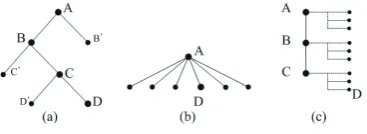
Figure 3, (a) is similar to Figure 2, while (b) is on the traditional template approach. Let us com-pare each complexity to get the target node D. For convenience’ sake, let us assume that each node has ten constraints to be satisfied. In (a), since there are three parents nodes (i.e. A, B, and C) on top of D, D cannot be generated until A, B, and C are checked previously. Hence, it costs
at least 10,000 (10[A]×10[B]×10[C]×10[D])
calculations. In contrast, in (b), only 100 (10[A]
×10[D]) calculations is enough to generate node
D. That means, the deeper the hierarchy is, the more the complexity increases. Table 1 shows (a) requires more than 52 times as much com-plexity as (b), though they have the same number of nodes.
Table 1: Complexity of (a) and (b)
(a) (b)
B’ 10[A]×10[B’] 100 10[A]×10[B’]
C’ 10[A]×10[B]×10[C’] 1,000 10[A]×10[C’] D’ 10[A]×10[B]×10[C]×10[D’] 10,000 10[A]×10[D’] D 10[A]×10[B]×10[C]×10[D] 10,000 10[A]×10[D]
Σ 21,100 400
When generation is processed byLKB, all
po-tential inflectional nodes are made before syntac-tic configurations according to the given MRS. Thus, if the hierarchy becomes deeper and con-tains more nodes, complexity of (a)-styled hi-erarchy grows almost by geometric progres-sion. This makes generation virtually impossi-ble, causing memory overflow errors to the gen-eration within the KRG1.
A fully flat structure (b) is not always supe-rior to (a). First of all, the flat approach ig-nores the fact that Korean is an agglutinative language. Korean morphological paradigm can yield a wide variety of forms; therefore, to enu-merate all potential forms is not only undesirable but also even impossible.
The KRG2 thus follows a hybrid approach (c) that takes each advantage of (a) and (b). (c) is more flattened than (a), which lessens computa-tional complexity. On the other hand, in (c), the depth of the inflectional hierarchy is fixed as two, and the skeleton looks like a unary form, though each major node (marked as a bigger circle) has its own subtypes (marked as dotted lines). Even though the depth has been diminished, the hier-archy is not a perfectly flat structure; therefore, it can partially represent the austere suffix ordering in Korean. The hierarchy (c), hereby, curtails the cost of generation.
Table 2: Complexity of (a-c)
Depth Complexity (a) n≥3 ≥10,000
(b) n = 1 100
(c) n = 2 10,000
that denote semantic information attaches to the second slot, and a series of suffixes, likewise, attaches to the third slot. Since semantic suf-fixes are, almost invariably, followed by syntac-tic ones in Korean, this ordering is convincing, granting that it does not fully represent that there is also an ordering among semantic forms or syn-tactic ones. (4) is an example from hierarchy (c).
There are three slots; rootka‘go’, semantic
suf-fixessi-ess, and syntactic onesta-ko.
(4) a. V-base + (HON+TNS) + (MOOD+COMP) b. ka-si+ess-ta+ko ‘go-HON+PST-DC+COMP’
Assuming there are ten constraints on each node, the complexity to generate D in (c) is just 10,000. The measure, of course, is bigger than that of (b), but the number never increases any more. That means, all forms at the same depth have equal complexity, and it is fully predictable. Table 2 compares the complexity from (a) to (c). By con-verting (a) to (c), we made it possible to generate with KRG2.
4.3 Choosing a Sentence Style
The choice between formal or informal (collo-quial) sentence styles depends on context. A ro-bust parser should cover both styles, but we gen-erally want a consistent style when generating.
Figure 4: Type Hierarchy ofSTYLE
In such a case, the grammar resorts to STYLE
to filter out the infelicitous results. The type
hi-erarchy is sketched out in Figure 4. strictis near
to school grammar (e.g. written is a style of
newspapers). On the other hand, some variant
forms that stem from the corresponding
canoni-cal forms falls underrobustin Figure 4. For
in-stance, if the text domain for generation is
news-paper, we can select onlywrittenas our sentence
choice, which excludes other styled sentences from our result.
Let us see (1a-b) again. ni‘you’ in (1b) is a
di-alect form ofney, but it has been used more
pro-ductively than its canonical form in daily speech.
In that case, we can specify STYLEofnias
di-alect as given below. In contrast, the neutral
formneyhas an unspecifiedSTYLEfeature:
ni := n-pn-2nd-non-pl &
[ STEM < ‘‘ni’’ >, STYLE dialect ]. ney := n-pn-2nd-non-pl &
[ STEM < ‘‘ney’’ > ].
Likewise, since the predicate in (1b) ippu
‘pretty’ stems from yeppu in (1a), they share
the predicate name ‘yeppu a 1 rel’ (i.e. the
RMRS standard for predicate names such as ‘ lemma pos sense rel’), but differ in each
STYLE feature. That means (1a-b) share the
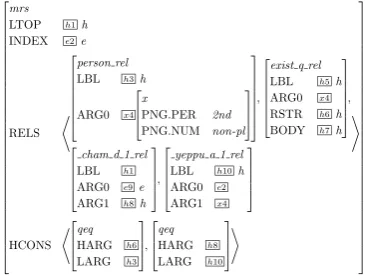
same MRS structure (given below). KRG hereby can parse (1b) into the same MRS as (1a) and generate (1a) from it.
mrs
LTOP h1h
INDEX e2e
RELS * person rel
LBL h3h
ARG0 x4
x PNG.PER 2nd PNG.NUM non-pl ,
exist q rel
LBL h5h
ARG0 x4
RSTR h6h
BODY h7h
,
cham d 1 rel
LBL h1
ARG0 e9e
ARG1 h8h
,
yeppu a 1 rel
LBL h10h
ARG0 e2
ARG1 x4
+ HCONS * qeq
HARG h6
LARG h3
, qeq
HARG h8
LARG h10
+
Figure 5: MRS of (1a-b)
[image:5.595.111.266.561.628.2]5 Exploiting Corpora
5.1 Resources
This study uses two multilingual corpora; one is the Sejong Bilingual Corpora: SBC (Kim and
Cho, 2001), and the other is theBasic Travel
[image:6.595.95.284.248.354.2]Ex-pression Corpus: BTEC (Kikui et al., 2003). We exploited the Korean parts in each corpus, taking them as our generalization corpus. Table 3 repre-sents the configuration of two resources (KoEn: Korean-English, KoJa: Korean-Japanese):
Table 3: Generalization Corpora SBC BTEC Type Bilingual Multilingual
Domain Balanced Corpus Tourism
Words KoEn : 243,788KoJa : 276.152 914,199
T/T ratio KoEn : 27.63KoJa : 20.28 92.7
Avr length KoEn : 16.30KoJa : 23.30 8.46
We also make use of nine test suites sorted by three types (Each test suite includes 500 sen-tences). As the first type, we used three test sets covering overall sentence structures in
Ko-rean; Korean Phrase Structure Grammar (kpsg;
Kim (2004)), Information-based Korean
Gram-mar (ibkg; Chang (1995)), and the SERI test set
(seri; Sung and Jang (1997)).
Second, we randomly extracted sentences from each corpus, separately from our gener-alization corpus; two suites were taken from the Korean-English and Korean-Japanese pair in
SBC (sj-ke andsj-kj, respectively). The other
two suites are from the BTEC-KTEXT (b-k),
and the BTEC-CSTAR (b-c); the former consists
of relatively plain sentences, while the latter is composed of spoken ones.
Third, we obtained two test suites from sample sentences in two dictionaries; Korean-English (dic-ke), and Korean-Japanese (dic-kj). These suites assume to have at least two advantages with respect to our evaluation; (i) the sentence length is longer than that of BTEC as well as shorter than that of SBC, (ii) the sample sen-tences on dictionaries are normally made up of useful expressions for translation.
5.2 Methods
We tried to do experiments and improve the KRG, following the three steps repeatedly: (i) evaluating, (ii) identifying, and (iii) exploiting. In each of the first step, we tried to parse the nine test suites and generate sentences with the MRS structures obtained from the parsing results, and measured their coverage and performance. Here, ‘coverage’ means how many sentences can be parsed or generated, and ‘performance’ repre-sents how many seconds it takes on average. In the second step, we identified the most serious problems. In the third step, we sought to exploit our generalization corpora in order to remedy the drawbacks. After that, we repeated the proce-dures until we obtain the desired results.
5.3 Experiments
So far, we have got two versions; KRG1 and
base. Our further experiments consist of four
phases;lex,MRS,irules, andKRG2.
Expanding the lexicon: To begin with, in or-der to broaden our coverage, we expanded our lexical entries with reference to our generaliza-tion corpus and previous literature. Verbal items are taken from Song (2007) and Song and Choe (2008), which classify argument structures of Korean verbal lexicon into subtypes within the HPSG framework in a semi-automatic way. The reason why we do not use our corpus here is that verbal lexicon commonly requires subcat-egorization frames, but we cannot induce them so easily only using corpora. For other word classes, we extracted lexical items from the POS tagged SBC and BTEC corpora. Table 4 explains how many items we extracted from our general-ization corpus. Let us call this version ‘lex’.
Table 4: Expansion of Lexical Items
verbal nouns 4,474 verbs and adjectives 1,216 common nouns 11,752 proper nouns 7,799
adverbs 1,757
numeral words 1,172
MRS: Generation in LKB, as shown in
[image:6.595.348.475.606.673.2]well-formedness of MRS. In other words, if our MRS is broken somewhere or constructed inefficiently, generation results is directly affected. For in-stance, if the semantic representation does not scope, we will not generate correctly. We were able to identify such sentences by parsing the corpora, storing the semantic representations and then using the semantic well formedness
check-ers in the LKB. We identified all rules and
lexi-cal items that produced ill-formed MRSs using a small script and fixed them by hand. This had an immediate and positive effect on coverage as well as performance in generation. We refer to
these changes as ‘MRS’.
Different inflectional forms for sentence styles: Texts in our daily life are actually com-posed of various styles. For example, spoken forms are normally more or less different from written ones. The difference between them in Korean is so big that the current version of KRG can hardly parse spoken forms. Besides, Ko-rean has lots of compound nouns and derived words. Therefore, we included these forms into our inflectional rules and expanded lexical en-tries again (3,860 compound nouns, 2,791 de-rived words). This greatly increased parsing cov-erage. We call this version ‘irules’.
Grammaticalized and Lexicalized Forms: There are still remaining problems, because our test suites contain some considerable forms. First, Korean has quite a few grammaticalized
forms; for instance, kupwun is composed of a
definite determinerkuand a classifier for human
pwun “the person”, but it functions like a
sin-gle word (i.e. a third singular personal pronoun). In a similar vein, there are not a few lexical-ized forms as well; for example, a verbal lexeme
kkamek- is composed of kka- “peel” and
mek-“eat”, but it conveys a sense of “forget”, rather than “peel and eat”. In addition, we also need to cover idiomatic expressions (e.g. “thanks”) for robust parsing. Exploiting our corpus, we added 1,720 grammaticalized or lexicalized forms and
352 idioms. Now, we call this ‘KRG2’.
[image:7.595.306.511.73.239.2]Table 5 compares KRG2 with KRG1, and Fig-ure 6 shows how many lexical items we have covered so far.
Table 5: Comparison between KRG1 and KRG2
KRG1 KRG2 # of default types 121 159 # of lexical types 289 593 # of phrasal types 58 106 # of inflectional rules 86 244 # of syntactic rules 36 96 # of lexicon 2,297 39,190
Figure 6: Size of Lexicon
5.4 Evaluation
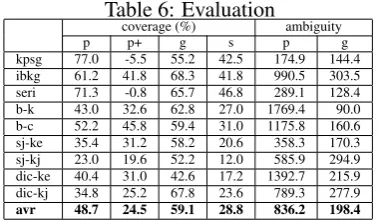
[image:7.595.315.505.339.449.2]Table 6 shows the evaluation measure of this study. ‘p’ and ‘g’ stand for ‘parsing’ and ‘gener-ation’, respectively. ‘+’ represents the difference compared to KRG1. Since KRG1 does not gen-erate, there is no ‘g+’.
Table 6: Evaluation
coverage (%) ambiguity
p p+ g s p g
kpsg 77.0 -5.5 55.2 42.5 174.9 144.4
ibkg 61.2 41.8 68.3 41.8 990.5 303.5
seri 71.3 -0.8 65.7 46.8 289.1 128.4
b-k 43.0 32.6 62.8 27.0 1769.4 90.0
b-c 52.2 45.8 59.4 31.0 1175.8 160.6
sj-ke 35.4 31.2 58.2 20.6 358.3 170.3
sj-kj 23.0 19.6 52.2 12.0 585.9 294.9
dic-ke 40.4 31.0 42.6 17.2 1392.7 215.9
dic-kj 34.8 25.2 67.8 23.6 789.3 277.9
avr 48.7 24.5 59.1 28.8 836.2 198.4
On average, the parsing coverage increases
24.5%. The reason why there are negative
val-ues in ‘p+’ ofkpsgandseriis that we discarded
some modules that run counter efficient process-ing (e.g., the grammar module for handlprocess-ing float-ing quantifiers sometimes produces too many ambiguities.). Since KRG1 has been constructed largely around the test sets, we expected it to perform well here. If we measure the parsing coverage again, after excluding the results of
kpsgandseri, it accounts for32.5%.4 The
gen-eration coverage of KRG2 accounts for almost
60%per parsed sentence on average. Note that
KRG1 could not parse at all. ‘s’ (short for ‘suc-cess’) means the portion of both parsed and
gen-erated sentences (i.e. ‘p’בg’), which accounts
4The running times, meanwhile, becomes slower as we
0 10 20 30 40 50 60 70 80 90
KRG1 base lex MRS irules KRG2
%
[image:8.595.333.486.78.288.2]kpsg ibkg seri b-k b-c sj-ke sj-kj dic-ke dic-kj
Figure 7: Parsing Coverage (%)
0 10 20 30 40 50 60 70 80 90
base lex MRS irules KRG2
%
kpsg ibkg seri b-k b-c sj-ke sj-kj dic-ke dic-kj
Figure 8: Generation Coverage (%)
for about29%. Ambiguity means ‘# of parses/#
of sentences’ for parsing and ‘# of realizations/# of MRSes’ for generation. The numbers look rather big, which should be narrowed down in our future study.
In addition, we can find out in Table 6 that there is a coverage ordering with respect to the type of test suites; ‘test sets > BTEC>dic > SBC’. It is influenced by three factors; (i) lexi-cal variety, (ii) sentence length, and (iii) text do-main. This difference implies that it is highly necessary to use variegated texts in order to im-prove grammar in a comprehensive way.
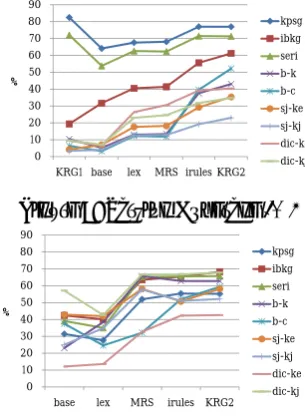
Figure 7 to 10 represent how much each
exper-iment in§5.3 contributes to improvement. First,
let us see Figure 7 and 8. As we anticipated,
lexandirulescontribute greatly to the growth of
parsing coverage. In particular, the line ofb-cin
Figure 8, which mostly consists of spoken forms,
rises rapidly inirulesandKRG2. That implies
Korean parsing largely depends on richness of lexical rules. On the other hand, as we also
ex-pected,MRSmakes a great contribution to
gen-eration coverage (Figure 8). InMRS, the growth
accounts for22%on average. That implies
test-ing with large corpora must take precedence in order for coverage to grow.
Figure 9 and 10 shows performance in pars-ing and generation, respectively. Comparpars-ing to
KRG1, our Matrix-based grammars (frombase
0.0 5.0 10.0 15.0 20.0 25.0
KRG1 base lex MRS irules KRG2
sec.
kpsg ibkg seri b-k b-c sj-ke sj-kj dic-ke dic-kj
Figure 9: Parsing Performance (s)
0.0 5.0 10.0 15.0 20.0 25.0
base lex MRS irules KRG2
sec.
kpsg ibkg seri b-k b-c sj-ke sj-kj dic-ke dic-kj
Figure 10: Generation Performance (s)
toKRG2) yields fairly good performance. It is
mainly because we deployed thePETparser that
runs fast, whereas KRG1 runs only onLKB.
Fig-ure 10, on the other hand, shows that the revi-sion of MRS also does much to enhance gen-eration performance, in common with coverage mentioned before. It decreases the running times
by about3.1seconds on average.
6 Conclusion
The newly developed KRG2 has been
success-fully included in the LOGON repository since
July, 2009; thus, it is readily available. In fu-ture research, we plan to apply the grammar in an MT system (for which we already have a prototype). In order to achieve this goal, we need to construct multilingual treebanks; Korean (KRG), English (ERG), and Japanese (Jacy).
Acknowledgments
[image:8.595.109.262.81.290.2]References
Bender, Emily M., Dan Flickinger, and Stephan Oepen. 2002. The Grammar Matrix: An Open-Source Starter-Kit for the Rapid Development of Cross-Linguistically Consistent Broad-Coverage
Precision Grammars. InProcedings of the
Work-shop on Grammar Engineering and Evaluation at the 19th International Conference on Computa-tional Linguistics.
Bender, Emily M., Scott Drellishak, Antske Fokkens, Michael Wayne Goodman, Daniel P. Mills, Laurie Poulson, and Safiyyah Saleem. 2010. Grammar Prototyping and Testing with the LinGO Grammar
Matrix Customization System. InProceedings of
ACL 2010 Software Demonstrations.
Bond, Francis, Stephan Oepen, Melanie Siegel, Ann Copestake, and Dan Flickinger. 2005. Open Source Machine Translation with DELPH-IN. In Proceedings of Open-Source Machine Transla-tion: Workshop at MT Summit X.
Bond, Francis, Eric Nichols, Darren Scott Appling, and Michael Paul. 2008. Improving Statistical Machine Translation by Paraphrasing the
Train-ing Data. InProceedings of the 5th International
Workshop on Spoken Languaeg Translation.
Callmeier, Ulrich. 2000. PET–a Platform for Exper-imentation with Efficient HPSG Processing
Tech-niques. Natural Language Engineering, 6(1):99–
107.
Chang, Suk-Jin. 1995. Information-based Korean
Grammar. Hanshin Publishing, Seoul.
Copestake, Ann, Dan Flickinger, Carl Pollard, and Ivan A. Sag. 2005. Minimal Recursion
Seman-tics: An Introduction. Research on Language and
Computation, 3(4):281–332.
Flickinger, Dan. 2000. On Building a More Efficient
Grammar by Exploiting Types.Natural Language
Engineering, 6 (1) (Special Issue on Efficient Pro-cessing with HPSG):15 – 28.
Kikui, Genichiro, Eiichiro Sumita, Toshiyuki Takezawa, and Seiichi Yamamoto. 2003. Creating
corpora for speech-to-speech translation. InProc.
of the EUROSPEECH03, pages 381–384, Geneve, Switzerland.
Kim, Se-jung and Nam-ho Cho. 2001. The progress and prospect of the 21st century Sejong project. In ICCPOL-2001, pages 9–12, Seoul.
Kim, Jong-Bok and Jaehyung Yang. 2003. Ko-rean Phrase Structure Grammar and Its
Implemen-tations into the LKB System. InProceedings of
the 17th Pacific Asia Conference on Language, In-formation and Computation.
Kim, Jong-Bok and Jaehyung Yang. 2004. Projec-tions from Morphology to Syntax in the Korean Resource Grammar: Implementing Typed Feature
Structures. InLecture Notes in Computer Science,
volume 2945, pages 13–24. Springer-Verlag.
Kim, Jong-Bok. 2004. Korean Phrase Structure
Grammar. Hankwuk Publishing, Seoul.
Oepen, Stephan. 2001. [incr tsdb()]— competence
and performance laboratory. User manual. Tech-nical report, Computational Linguistics, Saarland University.
Pollard, Carl and Ivan A. Sag. 1994. Head-Driven
Phrase Structure Grammar. The University of Chicago Press, Chicago, IL.
Sag, Ivan A., Thomas Wasow, , and Emily M. Bender.
2003. Syntactic Theory: A Formal Introduction.
CSLI Publications, Stanford, CA.
Siegel, Melanie and Emily M. Bender. 2002.
Effi-cient Deep Processing of Japanese. In
Proceed-ings of the 3rd Workshop on Asian Language Re-sources and International Standardization.
Song, Sanghoun and Jae-Woong Choe. 2008.
Automatic Construction of Korean Verbal Type
Hierarchy using Treebank. In Proceedings of
HPSG2008.
Song, Sanghoun. 2007. A Constraint-based Analysis of Passive Constructions in Korean. Master’s the-sis, Korea University, Department of Linguistics.
Sung, Won-Kyung and Myung-Gil Jang. 1997. SERI
Test Suites ‘95. In Proceedings of the