VCA: An Experiment With A Multiparty Virtual Chat Agent
Samira Shaikh
1, Tomek Strzalkowski
1, 2, Sarah Taylor
3, Nick Webb
1 1ILS Institute, University at Albany, State University of New York2Institute of Computer Science, Polish Academy of Sciences 3Advancded Technology Office, Lockheed Martin IS&GS
E-mail: [email protected], [email protected]
Abstract
The purpose of this research was to advance the understanding of the behavior of small groups in online chat rooms. The research was conducted using Internet chat data collected through planned exercises with recruited par-ticipants. Analysis of the collected data led to construction of preliminary models of social behavior in online discourse. Some of these models, e.g., how to effectively change the topic of conversation, were subsequently im-plemented into an automated Virtual Chat Agent (VCA) prototype. VCA has been dem-onstrated to perform effectively and convinc-ingly in Internet conversation in multiparty chat environments.
1
Introduction
Internet chat rooms provide a ready means of communication for people of most age groups these days. More often than not, these virtual chat rooms have multiple participants conversing on a wide variety of topics, using a highly infor-mal and free-form text dialect. An increasing use of virtual chat rooms by a variety of demograph-ics such as small children and impressionable youth leads to the risk of exploitation by deceit-ful individuals or organizations. Such risks might be reduced by presence of virtual chat agents that could keep conversations from progressing into certain topics by changing the topic of conversa-tion.
Our aim was to study the behavior of small groups of online chat participants and derive models of social phenomena that occur fre-quently in a virtual chat environment. We used the MPC chat corpus (Shaikh et al., 2010), which is 20 hours of multi-party chat data collected through a series of carefully designed online chat sessions. Chat data collected from public chat rooms, while easily available, presents signifi-cant concerns regarding its adaptability for our research use. Publicly available chat data is
com-pletely anonymous, has a high level of noise and lack of focus, in addition to engendering user privacy issues for its use in modeling tasks. The MPC corpus was used in (1) understanding how certain social behaviors are reflected in language and (2) building an automated chat agent that could effectively achieve certain (initially lim-ited) social objectives in the chat-room. A brief description of the MPC corpus and its relevant characteristics is given in Section 3 of this paper.
One specific phenomenon of social behavior we wanted to model was an effective change of conversation topic, when a participant or a group of participants deliberately (if perhaps only tem-porarily) shift the discussion to a different, pos-sibly related topic. Both success and failure of these actions was of interest because the outcome depended upon the choice of utterance, the per-sons to whom it was addressed, their reaction, and the time when it was produced. Our analysis of the corpus for such phenomena led to the use of an annotation scheme that allows us to anno-tate for topic and focus change in conversation. We describe the annotation scheme used in Sec-tion 4.
We constructed an autonomous virtual chat agent (VCA) that could achieve initially limited social goals in a chat room with human partici-pants. We used a novel approach of exploiting the topic of conversation underway to search the web and find related topics that could be inserted in the conversation to change its flow. We tested the first prototype with the capability to opportu-nistically change to topic of conversation using a combination of linguistic, dialogic, and topic reference devices, which we observed effectively deployed by the most influential chat participants in the MPC corpus. The VCA design, architec-ture and mode of operation are described in de-tail in Section 5 of this paper.
2
Related Work
Automated dialogue agents such as the early ELIZA (Weizenbaum, 1966) and PARRY
(Colby, 1974) could conduct a one-on-one “con-versation” with a human using rules and pattern-matching algorithms. More recently, the addition of heuristic pattern matching in A.L.I.C.E (Wallace, 2008) led to development of chat bots using AIML1 and its variations, such as Project
CyN2. Most of the work on conversational agents
was limited to one-on-one situations, where a single agent converses with a human user, whether to perform a transaction (such as book-ing a flight or bankbook-ing transactions) (Hardy et al., 2006) or for companionship (e.g., browsing of family photographs) (Wilks, 2010). Many of these systems were inspired by the challenge of the Turing Test or its more limited variants such as Loebner Prize.
Research in the field of developing a multi-user chat-room agent has been limited. This is some-what surprising because a multi-user setting makes the agent’s task of maintaining conversa-tion far less onerous than in one-on-one situa-tions. In a chat-room, with many users engaged in conversations, it is much easier for an agent to pass as just another user. Indeed, a skillfully de-signed agent may be able to influence an ongoing conversation.
3
MPC Chat Corpus
The MPC chat corpus is a collection of 20 hours of chat sessions with multiple participants (on average 4), conversing for about 90 minutes in a secure online chat room. The topics of conversa-tion vary from free-flowing chat in the initial collection phase to allow participants to build comfortable a rapport with each other, to specific task-oriented dialogues in the latter phase; such as choosing the right candidate for a job inter-view from a list of given resumes. This corpus is suitable for our research purposes since the chat sessions were designed around enabling the so-cial phenomena we were interested in modeling.
4
Annotation Scheme
We wished to annotate the data we collected to derive models from language use for social phe-nomena. These represent complex pragmatic concepts that are difficult to annotate directly, let alone detect automatically. Our approach was to build a multi-level annotation scheme.
In this paper we briefly outline our annotation scheme that consists of three layers:
1 http://www.alicebot.org/aiml.html 2 http://www.daxtron.com/123start.htm?Cyn
tive links, dialogue acts, and topic/focus changes. A more detailed description of the annotation scheme will be presented in a future publication.
4.1 Communicative Links
Annotators are asked to mark each utterance in one of three categories – utterance is addressed to a participant or a set of participants, it is in response to a specific prior utterance by another participant or it is a continuation of the partici-pant’s own prior utterance. By an utterance, we mean the set of words in a single turn by a par-ticipant. In multi-party chat, participants do not generally add addressing information in their utterances and it is often ambiguous to whom they are speaking. Communicative link annota-tion allows us to accurately map who is speaking to whom in the conversation, which is required for tracking social phenomena across partici-pants.
4.2 Dialogue Acts
At this annotation level, we developed a hierar-chy of 20 dialogue acts, based loosely on DAMSL (Allen & Core, 1997) and SWBD-DAMSL (Jurafsky et al., 1997), but greatly re-duced and more tuned to dialogue pragmatics. For example, the utterance “It is cold here today” may function as a Response-Answer when given in response to a question about the weather, and would act as an Assertion-Opinion if it is evalu-ated alone. The dialogue acts, thus augmented, become an important feature in modeling partici-pant behavior for our research purpose. A de-tailed description of the tags is beyond the scope of this paper.
4.3 Topic and Focus boundaries
The flow of discussion in chat shifts quite rapidly from one topic to another. Furthermore, within each topic (e.g., music bands) the focus of conver-sation (e.g., dc for cutie) moves just as rapidly. We
distinguish between topic and focus to accom-modate both broader thematic shifts and more narrow aspect changes of the topic being dis-cussed. For example, participants might discuss the topic of healthcare reform, by focusing on
The effect of topic change is apparent when a subsequent utterance by another participant is about the same topic. This is a successful attempt at changing the topic. Shown in Figure 1 is an example of topic shift annotated in our data col-lection.
Figure 1. A topic change in dialogue, with three participants (AA, KA and KN)
We found this model of topic change fairly con-sistently exhibited, where the participants would ask an open question, in order to get other par-ticipants to respond to them, thereby changing the course of conversation. We collected all ut-terances marked topic shifts and focus shifts and created a set of templates from them. These templates served as a model for the VCA to util-ize when creating a response
.
Another model of behavior that we found as a consequence of topic change is topic sustain. This is an instance where the utterance is marked to be on the same topic as the one currently being discussed, for example, utterance 5 in Figure 1. These may be in the form of offering support or agreement with a previous utterance or asking a question about a new in-topic aspect.
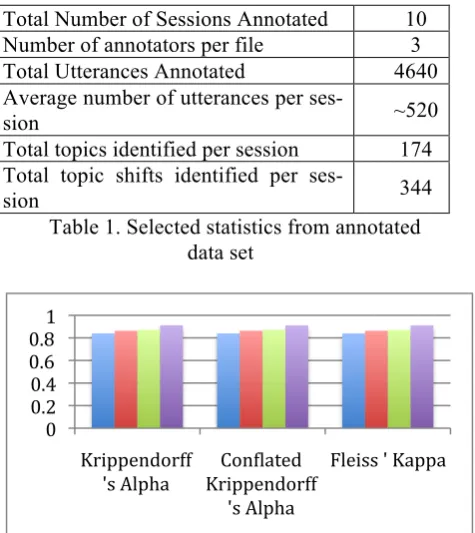
We gave our annotators a fair amount of lev-erage on how to label the topics and how to rec-ognize the focus. Our primary interest was in an accurate detection of topic/focus boundaries and shifts. Of the 14 sessions we selected from the MPC corpus, we selected 10 for annotation, with at least 3 annotators for each session. In Table 1 some of the overall statistics computed from this set are shown. We computed inter-annotator agreement on all three levels of our annotation, i.e. Communication Links, Dialogue Acts and
Topic/Focus Shifts. Topic and Focus shifts had the highest inter-annotator agreement scores on different measures such as Krippendorf’s Alpha (Krippendorff, 1980) and Fliess’ Kappa (Fliess, 1971). In Figure 2, we show inter-annotator agreement measures on Topic/Focus shift anno-tation for four of the annotated sessions. Krip-pendorff’s Alpha and Fleiss’ Kappa measures show inter-annotator agreement on topic shift alone, and Conflated Krippendorff’s Alpha measures show the agreement when topic and focus are conflated as one category. With such high degree of agreement, we can reliably derive models of topic shift behavior from our anno-tated data.
Total Number of Sessions Annotated 10 Number of annotators per file 3 Total Utterances Annotated 4640 Average number of utterances per
ses-sion ~520
Total topics identified per session 174 Total topic shifts identified per
ses-sion 344
Table 1. Selected statistics from annotated data set
Figure 2. Inter-annotator agreement measures for Topic/Focus shifts
5
VCA Design
A virtual chat agent is an automated program with the ability to respond to utterances in chat. Our VCA is distinctive in its ability to participate in multi-party chat and manage to steer the flow of conversation to a new topic. We exploit the dialogue mechanism underlying HITIQA (Small et al. 2009) to drive the dialogue in VCA. The topic as defined by the information con-tained in the participant’s utterance is used to mine outside data sources (e.g., a corpus, the web) in order to locate and learn additional in-formation about that topic. The objective is to identify some of the salient concepts that appear
0 0.2 0.4 0.6 0.8 1
Krippendorff
's Alpha Krippendorff Con9lated 's Alpha
Fleiss ' Kappa
AA 1: did anyone watch the morning talk
shows today (MTP, for example)? KA 2: nope!
AA 3: I missed them – I was hoping someone else had.
AA 4: My kids tell me the band you’re going to hear (dc for cutie) is great.
(TOPIC: music bands, FOCUS: dc for cutie)
KA 5: oh cool! Their lyrics are nice, I think.
(TOPIC: music bands, FOCUS: dc for cutie)
KA 6. what kind of music do you guys listen to?
(TOPIC: music, FOCUS: none)
KN 7: I don’t really have a favorite genre….you on youtube right now?
associated with the topic, but are not directly mentioned in the utterance. Such associations may be postulated because additional concepts are repeatedly found near the concepts men-tioned in the utterance.
An illustrative example found in our annotated corpus is the utterance, “Lars Ulrich might have a thing or two to say about technology.” Here, the topic of conversation prior to this utterance was “ tech-nology” and it was changed to “music” after this utterance. Here, “Lars Ulrich” is the bridge that connects the two concepts “technology” and “ mu-sic” together.
5.1 VCA Architecture
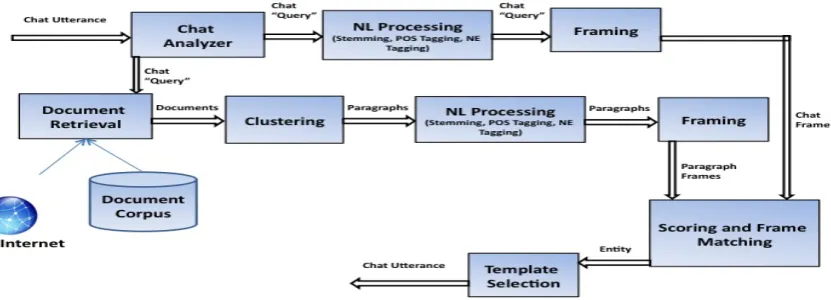
The VCA is composed of the following modules that interact as shown in Figure 3.
5.1.1 Chat Analyzer
Every utterance in chat is first analyzed by the Chat Analyzer component. This process removes stop words, emoticons and punctuation, as well as any participant nicknames from the utterance. We postulate that the remaining content bearing words in the utterance represent the topic of that utterance. We call this analyzed utterance our chat “query” which is sent in parallel to the Document Retrieval and NL Processing compo-nent.
5.1.2 Document Retrieval
The document retrieval process retrieves docu-ments from either the web or a test document
corpus. We use Google AJAX api for our web retrieval process and InQuery (Callan et al., 1992) retrieval engine for our offline mode of operation to retrieve documents from the test corpus. The test document corpus was collected by mining the web for all utterances in our data
collection, creating a stable document set for ex-perimental purposes. Currently, the document corpus contains about 1Gb of text data.
5.1.3 Clustering
We cluster the paragraphs in documents retrieved using clustering method in Hardy et al. (Hardy et al., 2009) This process groups the paragraphs containing salient entities into sets of closely as-sociated concepts. From each cluster, we choose the most representative paragraph, usually called the “seed” paragraph for further NL processing. Each seed paragraph and the chat query undergo the same further NL processing sequence.
5.1.4 Natural Language Processing
We process each chat query by performing stemming, part-of-speech tagging and named-entity recognition on it. Each seed paragraph is also run through same three natural language processing tasks. We are using Stanford POS tagger for our part-of-speech tagging. For named entity recognition, we have the ability to choose between BBN’s IdentiFinder and AeroText™ (Taylor, 2004).
5.1.5 Framing
We build frames from the entities and attributes found in both the chat query and the paragraphs.. This work extends the concept of framing devel-oped for HITIQA (Small et al, 2009) and COL-LANE (Strzalkowski, 2009). Framing provides an informative handle on text, which can be
ex-ploited to compare the underlying textual repre-sentations, as we explain in the next section.
5.1.6 Scoring and Frame Matching
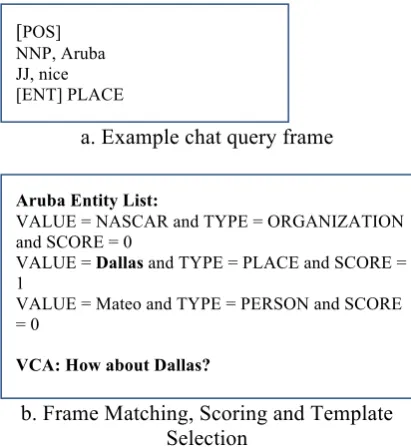
[image:4.595.97.513.507.657.2]built from the chat query, to the frames created from the paragraphs, called paragraph frames. We assign a score for each paragraph frame based on how many attributes and their corre-sponding values match; in the current version of VCA a very basic approach to counting how many attribute-value pairs match is taken. Of all the paragraph frames we select the highest scor-ing frames and select the attribute-value pairs that are not part of the chat query frame. For ex-ample, as shown in Figure 4a below, the chat utterance “Aruba might be nice!” created the fol-lowing chat query frame.
a. Example chat query frame
b. Frame Matching, Scoring and Template Selection
Figure 4. From frames to VCA responses
Correspondingly, we select all PLACE type
en-tities from the highest-ranking paragraph frames. These are shown in Figure 4b as Aruba Entity list. The entities “NASCAR”, “Women Seeking Men” and “Mateo” are not of entity type – PLACE, we
assign them a score of 0. The score is the fre-quency of occurrence of that entity in the para-graph; in this example it is found to be 1. Assign-ing scores by frequency of occurrence ensures that the most commonly occurring concept around the one that is being discussed in the chat query utterance will be used to respond with.
5.1.7 Template Selection
Once we have chosen the entity to respond with, we select a template from the set of templates for that entity. These are templates that are created based on the models created from topic change utterances annotated in our data set. For a select group of entities, which are quite frequently
en-countered in our data collection such as PLACE, PERSON, ORGANIZATION etc., we have a set of
templates specific to that entity type. We also have several generic templates that may be used if the entity type does not match the ones that we have selected. For example, a PLACE specific
template is “Have you ever been to __?” and a PER-SON specific template is “You heard about __?”. Not all templates are formulated as questions. An-other example of a generic template is “__rules!”.
6
Example of VCA Interaction
Figure 5 represents an example of the VCA in action in a simulated environment; the VCA is the participant “renee”. We can see how the con-versation changes from “gun laws” to “hunting”
after renee’s utterance at 11:48 AM.
Figure 5. Topic change example
7
Evaluation
We ran two tests of this initial VCA prototype in a public chat-room. VCA was inserted into a public chat-room with multiple participants on two separate occasions. The general topic of dis-cussion during both instances was “anime”. We have developed an evaluation protocol in order to test the effectiveness of the VCA prototype in a realistic setting. The initial metric of VCA ef-fectiveness is the rate of involvement measured in the number of utterances generated by the VCA during the test period. These utterances are subsequently judged for appropriateness using the metric developed for the Companions Project (Webb, 2010). The actual appropriateness anno-tation scheme can be quite involved, but for this simple test we reduced the coding to only binary assessment, so that the VCA utterances were an-notated as either appropriate or inappropriate, given the content of the utterance and the flow of dialogue thus far. Using this coarse grain evalua-tion on a live chat segment we noted that the VCA made 9 appropriate utterances and 7
inap-[POS] NNP, Aruba JJ, nice [ENT] PLACE
Aruba Entity List:
VALUE = NASCAR and TYPE = ORGANIZATION and SCORE = 0
VALUE = Dallas and TYPE = PLACE and SCORE = 1
VALUE = Mateo and TYPE = PERSON and SCORE = 0
[image:5.595.82.288.246.470.2]propriate utterances, which gives the appropri-ateness score of 56%. While some of VCA utter-ances seem inappropriate (i.e., not related to the conversation topic), we noted also that other posters generally tolerated these inappropriate utterances that occurred early in the dialogue. Moreover, these early inappropriate utterances did generate appropriate responses from the hu-man users. This “positive” dynamic changed gradually as the dialogue progressed, when the participants began to ignore VCA’s utterances.
While this coarse grained evaluation is useful, our plan is to conduct evaluation experiments by recruiting subjects for chat sessions and inserting the VCA in the discussion. We will measure the impact of the VCA in the chat session by having participants fill out post-session questionnaires, which can elicit their responses regarding (a) if they detect presence of a VCA at any time during the dialogue; (b) who was the VCA; (c) who changed the topic of conversation most often; and so on. Another metric of interest is the level of engagement of the VCA, which can be meas-ured by the number of direct responses to an ut-terance by the VCA. We are developing the evaluation process, and report on the results in a separate publication.
References
Allen, J. M. Core. (1997). Draft of DAMSL: Dialog
Act Markup in Several Layers.
http://www.cs.rochester.edu/research/cisd/resource s/damsl/
Callan, J. P., W. B. Croft, and S. M. Harding. 1992. The INQUERY Retrieval System, in Proceedings of the 3rd Inter- national Conference on Database and Expert Systems.
Colby, K.M, Hilf, F.D, and S. Weber. 1972. Turing-like indistinguishability tests for the validation of a computer simulation of paranoid processes. In: Ar-tificial Intelligence , Vol. 3, p. 199-221.
Fleiss, Joseph L. 1971. Measuring nominal scale agreement among many raters. Psychological Bul-letin, 74(5):378{382.
Hardy, Hilda, Nobuyuki Shimizu, Tomek Strzalk-owski, Ting Liu, Bowden Wise and Xinyang Zhang. 2002. Cross-document summarization by concept classification. In Proceedings of ACM SIGIR '02 Conference, pages 121-128, Tampere, Finland.
Hardy, H., A Biermann, R. Bryce Inouye, A. McKenzie, T. Strzalkowski, C. Ursu, N. Webb and M. Wu. 2006. The AMITIES System: Data-Driven
Techniques for Automated Dialogue. In
Speech Communication 48 (3-4), pages 354-373. Elsevier.
Jurafsky, Dan, Elizabeth Shriberg, and Debra Biasca. (1997). Switchboard SWBD-DAMSL Shallow-Discourse-Function Annotation Coders Manual. http://stripe.colorado.edu/~jurafsky/manual.august 1.html
Krippendorff, Klaus. 1980. Content Analysis, an In-troduction to its Methodology. Sage Publications, Thousand Oaks, CA.
Samira S., Tomek Strzalkowski, Sarah Taylor and Jonathan Smith (2009) Comparing an Integrated QA system performance - A Preliminary Model. Proceedings of PACLING Conference, Sapporo, Japan.
Shaikh, S., Strzalkowski, T., Broadwell, A., Stromer-Galley, J., Taylor, Sarah and Webb, N. 2010. Pro-ceedings of LREC Conference, Malta.
Sharon Small and Tomek Strzalkowski. 2009. HITIQA: High-Quality Intelligence through Inter-active Question Answering. Journal of Natural Language Engineering, Vol. 15 (1), pp. 31—54. Cambridge.
Tomek Strzalkowski, Sarah Taylor, Samira Shaikh, Ben-Ami Lipetz, Hilda Hardy, Nick Webb, Tony Cresswell, Min Wu, Yu Zhan, Ting Liu, and Song Chen. 2009. COLLANE: An experiment in com-puter-mediated tacit collaboration. In Aspects of Natural Language Processing (M. Marciniak and A. Mykowiecka, editors). Springer.
Taylor, Sarah M. 2004. "Information Extraction Tools: Deciphering Human Language." IT Profes-sional. Vol. 06, no. 6, pages: 28-34.
Novem-ber/December, 2004. Online.
http://ieeexplore.ieee.org/iel5/6294/30282/0139087 0.pdf?tp=&arnumber=1390870&isnumber=30282
Wallace, R. 2008. The Anatomy of A.L.I.C.E. In Parsing the Turing Test. (Robert Epstein, Gary Roberts and Grace Beber, editors). Springer.
Webb, N., D. Benyon, P. Hansen and O. Mival. 2010. Evaluating Human-Machine Conversation for Ap-propriateness. In Proceedings of the 7th Interna-tional Conference on Language Resources and Evaluation (LREC2010), Valletta, Malta.
Weizenbaum, Joseph. January 1966. "ELIZA — A Computer Program For the Study of Natural Lan-guage Communication Between Man And Ma-chine", Communications of the ACM 9 (1): 36–45.