Encoding syntactic dependencies by vector permutation
Pierpaolo Basile
Dept. of Computer Science University of Bari
Via Orabona, 4 I-70125, Bari (ITALY) [email protected]
Annalina Caputo
Dept. of Computer Science University of Bari
Via Orabona, 4 I-70125, Bari (ITALY) [email protected]
Giovanni Semeraro
Dept. of Computer Science University of Bari
Via Orabona, 4 I-70125, Bari (ITALY) [email protected]
Abstract
Distributional approaches are based on a sim-ple hypothesis: the meaning of a word can be inferred from its usage. The application of that idea to the vector space model makes possi-ble the construction of a WordSpace in which words are represented by mathematical points in a geometric space. Similar words are rep-resented close in this space and the definition of “word usage” depends on the definition of the context used to build the space, which can be the whole document, the sentence in which the word occurs, a fixed window of words, or a specific syntactic context. However, in its original formulation WordSpace can take into account only one definition of context at a time. We propose an approach based on vector permutation and Random Indexing to encode several syntactic contexts in a single WordSpace. Moreover, we propose some op-erations in this space and report the results of an evaluation performed using the GEMS 2011 Shared Evaluation data.
1 Background and motivation
Distributional approaches usually rely on the WordSpace model (Sch¨utze, 1993). An overview can be found in (Sahlgren, 2006). This model is based on a vector space in which points are used to represent semantic concepts, such as words.
The core idea behind WordSpace is that words and concepts are represented by points in a math-ematical space, and this representation is learned from text in such a way that concepts with sim-ilar or related meanings are near to one
an-other in that space (geometric metaphor of mean-ing). The semantic similarity between concepts can be represented as proximity in an n-dimensional space. Therefore, the main feature of the geomet-ric metaphor of meaning is not that meanings can be represented as locations in a semantic space, but rather that similarity between word meanings can be expressed in spatial terms, as proximity in a high-dimensional space.
One of the great virtues of WordSpaces is that they make very few language-specific assumptions, since just tokenized text is needed to build semantic spaces. Even more important is their independency of the quality (and the quantity) of available train-ing material, since they can be built by exploittrain-ing an entirely unsupervised distributional analysis of free text. Indeed, the basis of the WordSpace model is thedistributional hypothesis(Harris, 1968), accord-ing to which the meanaccord-ing of a word is determined by the set of textualcontextsin which it appears. As a consequence, in distributional models words can be represented as vectors built over the observable con-texts. This means that words are semantically related as much as they are represented by similar vectors. For example, if “basketball” and “tennis” occur fre-quently in the same context, say after “play”, they are semantically related or similar according to the distributional hypothesis.
Since co-occurrence is defined with respect to a context, co-occurring words can be stored into ma-trices whose rows represent the terms and columns represent contexts. More specifically, each row cor-responds to a vector representation of a word. The strength of the semantic association between words
can be computed by using cosine similarity.
A weak point of distributional approaches is that they are able to encode only one definition of con-text at a time. The type of semantics represented in WordSpace depends on the context. If we choose documents as context we obtain a semantics differ-ent from the one we would obtain by selecting sen-tences as context. Several approaches have inves-tigated the above mentioned problem: (Baroni and Lenci, 2010) use a representation based on third-order tensors and provide a general framework for distributional semantics in which it is possible to represent several aspects of meaning using a sin-gle data structure. (Sahlgren et al., 2008) adopt vector permutations as a means to encode order in WordSpace, as described in Section 2. BEAGLE (Jones and Mewhort, 2007) is a very well-known method to encode word order and context informa-tion in WordSpace. The drawback of the BEAGLE model is that it relies on a complex model to build vectors which is computational expensive. This problem is solved by (De Vine and Bruza, 2010) in which the authors propose an approach similar to BEAGLE, but using a method based on Circu-lar Holographic Reduced Representations to com-pute vectors.
All these methods tackle the problem of repre-senting word order in WordSpace, but they do not take into account syntactic context. A valuable at-tempt in this direction is described in (Pad´o and La-pata, 2007). In this work, the authors propose a method to build WordSpace using information about syntactic dependencies. In particular, they consider syntactic dependencies as context and assign dif-ferent weights to each kind of dependency. More-over, they take into account the distance between two words into the graph of dependencies. The re-sults obtained by the authors support our hypothesis that syntactic information can be useful to produce effective WordSpace. Nonetheless, their methods are not able to directly encode syntactic dependen-cies into the space.
This work aims to provide a simple approach to encode syntactic relations dependencies directly into the WordSpace, dealing with both the scalability problem and the possibility to encode several con-text information. To achieve that goal, we devel-oped a strategy based on Random Indexing and
vec-tor permutations. Moreover, this strategy opens new possibilities in the area of semantic composition as a result of the inherent capability of encoding rela-tions between words.
The paper is structured as follows. Section 2 describes Random Indexing, the strategy for build-ing our WordSpace, while details about the method used to encode syntactic dependencies are reported in Section 3. Section 4 describes the formal defi-nition of some operations over the WordSpace and shows a first attempt to define a model for semantic composition. Finally, the results of the evaluation performed using the GEMS 2011 Shared Evaluation data1 is presented in Section 5, while conclusions are reported in Section 6.
2 Random Indexing
We exploit Random Indexing (RI), introduced by Kanerva (Kanerva, 1988), for creating a WordSpace. This technique allows us to build a WordSpace with no need for (either term-document or term-term) matrix factorization, because vectors are inferred by using an incremental strategy. Moreover, it allows to solve efficiently the problem of reducing dimen-sions, which is one of the key features used to un-cover the “latent semantic dimensions” of a word distribution.
RI is based on the concept of Random Projection according to which high dimensional vectors chosen randomly are “nearly orthogonal”.
Formally, given ann×mmatrixAand anm× k matrix R made up of k m-dimensional random vectors, we define a newn×kmatrixBas follows:
Bn,k =An,m·Rm,k k << m (1)
The new matrix B has the property to preserve the distance between points. This property is known as Johnson-Lindenstrauss lemma: if the distance be-tween two any points ofAisd, then the distancedr between the corresponding points inB will satisfy the property thatdr=c·d. A proof of that property is reported in (Dasgupta and Gupta, 1999).
Specifically, RI creates a WordSpace in two steps (in this case we consider the document as context):
1Available on line:
1. a context vector is assigned to each document. This vector is sparse, high-dimensional and ternary, which means that its elements can take values in{-1, 0, 1}. A context vector contains a small number of randomly distributed non-zero elements, and the structure of this vector fol-lows the hypothesis behind the concept of Ran-dom Projection;
2. context vectors are accumulated by analyzing terms and documents in which terms occur. In particular, the semantic vector for a term is computed as the sum of the context vectors for the documents which contain that term. Con-text vectors are multiplied by term occurrences.
Formally, given a collection of documents D whose vocabulary of terms is V (we denote with dim(D) anddim(V) the dimension of D and V, respectively) the above steps can be formalized as follows:
1. ∀di ∈ D, i = 0, .., dim(D) we built the cor-respondent randomly generated context vector as:
− →r
j = (ri1, ..., rin) (2)
wheren dim(D), ri∗ ∈ {−1,0,1}and−→rj contains only a small number of elements dif-ferent from zero;
2. the WordSpace is made up of all term vectors −
→ tj where:
− →
tj =tfj
X
di∈D
tj∈di − →r
i (3)
andtfj is the number of occurrences of tj in di;
By considering a fixed window W of terms as context, the WordSpace is built as follows:
1. a context vector is assigned to each term;
2. context vectors are accumulated by analyzing terms in which terms co-occur in a windowW. In particular, the semantic vector for each term is computed as the sum of the context vectors for terms which co-occur inW.
It is important to point out that the classical RI approach can handle only one context at a time, such as the whole document or the windowW.
A method to add information about context in RI is proposed in (Sahlgren et al., 2008). The authors describe a strategy to encode word order in RI by the permutation of coordinates in random vector. When the coordinates are shuffled using a random permu-tation, the resulting vector is nearly orthogonal to the original one. That operation corresponds to the gen-eration of a new random vector. Moreover, by apply-ing a predetermined mechanism to obtain random permutations, such as elements rotation, it is always possible to reconstruct the original vector using the reverse permutations. By exploiting this strategy it is possible to obtain different random vectors for each context2 in which the term occurs. Let us consider the following example “The cat eats the mouse”. To encode the word order for the word “cat” using a context windowW = 3, we obtain:
< cat >= (Π−1the) + (Π+1eat)+
+(Π+2the) + (Π+3mouse) (4)
where Πnx indicates a rotation by n places of the elements in the vectorx. Indeed, the rotation is per-formed bynright-shifting steps.
3 Encoding syntactic dependencies
Our idea is to encode syntactic dependencies, in-stead of words order, in the WordSpace using vector permutations.
A syntactic dependency between two words is de-fined as:
dep(head, dependent) (5)
where dep is the syntactic link which connects the dependent word to the head word. Gener-ally speaking,dependentis the modifier, object or complement, while head plays a key role in de-termining the behavior of the link. For example, subj(eat, cat) means that “cat” is the subject of “eat”. In that case the head word is “eat”, which plays the role of verb.
The key idea is to assign a permutation function to each kind of syntactic dependencies. Formally,
2
letDbe the set of all dependencies that we take into account. The functionf :D→Πreturns a schema of vector permutation for eachdep ∈ D. Then, the method adopted to construct a semantic space that takes into account both syntactic dependencies and Random Indexing can be defined as follows:
1. a context vector is assigned to each term, as de-scribed in Section 2 (Random Indexing);
2. context vectors are accumulated by analyzing terms which are linked by a dependency. In particular the semantic vector for each termti is computed as the sum of the permuted con-text vectors for the termstj which are depen-dents of ti and the inverse-permuted vectors for the terms tj which are heads of ti. The permutation is computed according to f. If f(d) = Πn the inverse-permutation is defined asf−1(d) = Π−n: the elements rotation is per-formed bynleft-shifting steps.
Adding permuted vectors to the head word and inverse-permuted vectors to the corresponding de-pendent word allows to encode the information about both heads and dependents into the space. This approach is similar to the one investigated by (Cohen et al., 2010) to encode relations between medical terms.
To clarify, we provide an example. Given the fol-lowing definition off:
f(subj) = Π+3 f(obj) = Π+7 (6) and the sentence “The cat eats the mouse”, we obtain the following dependencies:
det(the, cat) subj(eat, cat)
obj(eat, mouse) det(the, mouse) (7)
The semantic vector for each word is computed as:
• eat:
< eat >= (Π+3cat) + (Π+7mouse) (8)
• cat:
< cat >= (Π−3eat) (9)
• mouse:
< mouse >= (Π−7eat) (10)
In the above examples, the function f does not consider the dependencydet.
4 Query and vector operations
In this section, we propose two types of queries that allow us to compute semantic similarity be-tween two words exploiting syntactic dependencies encoded in our space. Before defining query and vector operations, we introduce a small set of nota-tions:
• Rdenotes the original space of random vectors generated during the WordSpace construction;
• Sis the space of terms built using our strategy;
• rti ∈ Rdenotes the random vector of the term ti;
• sti ∈Sdenotes the semantic vector of the term ti;
• sim(v1, v2)denotes the similarity between two
vectors; in our approach we adopt cosine simi-larity;
• Πdepis the permutation returned fromf(dep).
Π−depis the inverse-permutation.
The first family of queries isdep(ti,?). The idea is to find all the dependents which are in relation with the head ti, given the dependency dep. The query can be computed as follows:
1. retrieve the vectorsti fromS;
2. for each rtj ∈ R compute the similarity be-tweensti and<Π
depr tj >:
sim(sti, <Π
depr tj >);
3. rank in descending order alltj according to the similarity computed in step 2.
compute how the headticontributes to the vectortj, which differs from the goal of our query.
Using the same approach it is possible to compute the querydep(?, tj), in which we want to search all theheads related to thedependent tj fixed the de-pendencydep. In detail:
1. retrieve the vectorstj fromS;
2. for each rti ∈ R compute the similarity be-tweenstj and the inverse-permutation of rti , <Π−deprti >:sim(stj, <Π
−depr ti >);
3. rank in descending order alltiaccording to the similarity computed in step 2.
In this second query, we compute how the inverse-permutation of eachti(head) affects the vectorstj ∈ S. In the following sub-section we provide some initial idea about semantic composition.
4.1 Compositional semantics
Distributional approaches represent words in isola-tion and they are typically used to compute similar-ities between words. They are not able to represent complex structures such as phrases or sentences. In some applications, such as Question Answering and Text Entailment, representing text by single words is not enough. These applications would benefit from the composition of words in more complex struc-tures. The strength of our approach lies on the ca-pability of codify syntactic relations between words overcoming the “word isolation” issue.
A lot of recent work argue that tensor product (⊗) could be useful to combine word vectors. In (Wid-dows, 2008) some preliminary investigations about product and tensor product are provided, while an interesting work by Clark and Pulman (Clark and Pulman, 2007) proposes an approach to combine symbolic and distributional models. The main idea is to use tensor product to combine these two as-pects, but the authors do not describe a method to represent symbolic features, such as syntactic de-pendencies. Conversely, our approach is able to en-code syntactic information directly into the distri-butional model. The authors in (Clark and Pulman, 2007) propose a strategy to represent a sentence like “man reads magazine” by tensor product:
man⊗subj⊗read⊗obj⊗magazine (11)
They also propose a solid model for composition-ality, but they do not provide a strategy to repre-sent symbolic relations, such assubjandobj. They wrote: “How to obtain vectors for the dependency relations - subj, obj, etc. - is an open question”. We believe that our approach can tackle this problem by encoding the dependency directly in the space, be-cause each semantic vector in our space contains in-formation about syntactic roles.
The representation based on tensor product is useful to compute sentence similarity. Given the previous sentence and the following one “woman browses newspaper”, we want to compute the sim-ilarity between the two sentences. The sentence “woman browses newspaper”, using the composi-tional model, is represented by:
woman⊗subj⊗browse⊗obj⊗newspaper (12)
Computing the similarity of two representations by inner product is a complex task, but exploiting the following property of the tensor product:
(w1⊗w2)·(w3⊗w4) = (w1·w3)×(w2·w4) (13)
the similarity between two sentences can be com-puted by taking into account the pairs in each depen-dency and multiplying the inner products as follows:
man·woman×read·browse×
×magazine·newspaper (14)
et al. (Clark et al., 2008) propose a model based on (Clark and Pulman, 2007) combined with a com-positional theory for grammatical types, known as Lambek’s pregroup semantics, which is able to take into account grammar structures. It is important to note that this strategy is not able to encode gram-matical roles into the WordSpace. This peculiarity makes our approach completely different. In the fol-lowing section we provide some examples of com-positionality.
5 Evaluation
The goal of the evaluation is twofold: proving the capability of our approach by means of some exam-ples and providing results of the evaluation exploit-ing the “GEMS 2011 Shared Evaluation”, in particu-lar the compositional semantics dataset. We propose two semantic spaces built from two separate corpora using our strategy. To achieve the first goal we pro-vide several examples for each family of queries de-scribed in Section 4. Concerning the second goal, we evaluate our approach to compositional seman-tics using the dataset proposed by Mitchell and Lap-ata (Mitchell and LapLap-ata, 2010), which is part of the “GEMS 2011 Shared Evaluation”. The dataset is a list of two pairs of adjective-noun combinations or verb-object combinations or compound nouns. Hu-mans rated pairs of combinations according to simi-larity. The dataset contains 5,833 rates which range from 1 to 7. Examples of pairs follow:
support offer help provide 7
old person right hand 1
where the similarity between offer-support and provide-help (verb-object) is higher than the one be-tween old-person and right-hand (adjective-noun). As suggested by the authors, the goal of the eval-uation is to compare the system performace against humans scores by means of Spearman correlation.
5.1 System setup
The system is implemented in Java and relies on some portions of code publicly available in the Semantic Vectors package (Widdows and Ferraro, 2008). For the evaluation of the system, we build two separate WordSpaces using the following cor-pora: ukWaC (Baroni et al., 2009) and TASA.
ukWaC contains 2 billion words and it is constructed from the Web by limiting the crawling to the .uk domain and using medium-frequency words from the BNC corpus as seeds. We use only a por-tion of ukWaC corpus consisting of 7,025,587 sen-tences (about 220,000 documents). The TASA cor-pus (compiled by Touchstone Applied Science As-sociates) was kindly made available to us by Prof. Thomas Landauer from the University of Colorado. The TASA corpus contains a collection of English texts that is approximately equivalent to what the av-erage college-level student has read in his/her life-time. The TASA corpus consists of about 800,000 sentences.
To extract syntactic dependencies, we adopt MINIPAR3 (Lin, 2003). MINIPAR is an efficient English parser, which is suitable for parsing a large amount of data. The total amount of extracted de-pendencies is about 112,500,000 for ukWaC and 8,850,000 for TASA.
Our approach involves some parameters. We set the random vector dimension to 4,000 and the num-ber of non-zero elements in the random vector equal to 10. We restrict the WordSpace to the 40,000 most frequent words4. Another parameter is the set of de-pendencies that we take into account. In this prelim-inary investigation we consider the four dependen-cies described in Table 1, that reports also the kind of permutation5applied to vectors.
5.2 Results
In this section we report some results of queries per-formed in ukWaC and TASA corpus.
Table 2 and Table 3 report the results respectively for the queriesdep(ti,?)anddep(?, tj). The effects of encoding syntactic information is clearly visible, as can be inferred by results in the tables. Moreover, the results with the two corpora are different, as ex-pected, but in many cases the first result of the query is the same.
Our space can be also exploited to perform classi-cal queries in which we want to find “similar” words. Tables 4 and 5 report results for TASA and ukWaC
3
MINIPAR is available at
http://webdocs.cs.ualberta.ca/∼lindek/minipar.htm
4
Word frequency is computed taking into account the se-lected dependencies.
Dependency Description Permutation
obj object of verbs Π+7
subj subject of verbs Π+3
mod the relationship between a word and its adjunct modifier Π+11
[image:7.612.107.506.55.127.2]comp complement Π+23
Table 1: The set of dependencies used in the evaluation.
corpus, respectively. The results obtained by similar test are not the typical results expected by classical WordSpace. In fact, in Table 5 the word most simi-lar to “good” is “bad”, because they are used in the same syntactic context, but have opposite meaning. The similarity between words in our space strongly depends on their syntactic role. For example, the words similar to “food” are all the nouns which are object/subject of the same verbs in syntactic relation with “food”.
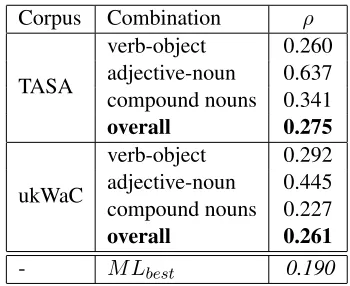
Finally, we provide the results of semantic com-position. Table 6 reports the Spearman correlation between the output of our system and the mean similarity scores given by the humans. The table shows results for each types of combination: verb-object, adjective-noun and compound nouns. To per-form the experiment on compound nouns, we re-build the spaces encoding the “nn” relation provided by MINIPAR which refers to compound nouns de-pendency. Table 6 shows the best result obtained by Mitchell and Lapata (Mitchell and Lapata, 2008) using the same dataset. Our method is able to out-performM Lbestand obtains very high results when adjective-noun combination is involved.
Corpus Combination ρ
TASA
verb-object 0.260 adjective-noun 0.637 compound nouns 0.341
overall 0.275
ukWaC
verb-object 0.292 adjective-noun 0.445 compound nouns 0.227
overall 0.261
- M Lbest 0.190
Table 6: GEMS 2011 Shared Evaluation results.
The experiments reported in this preliminary eval-uation are only a small fraction of the experiments
that are required to make a proper evaluation of the effectiveness of our semantic space and to compare it with other approaches. This will be the main fo-cus of our future research. The obtained results seem to be encouraging and the strength of our approach, capturing syntactic relations, allows to implement several kind of queries using only one WordSpace. We believe that the real advantage of our approach, that is the possibility to represent several syntactic relations, has much room for exploration.
6 Conclusions
In this work, we propose an approach to encode syn-tactic dependencies in WordSpace using vector per-mutations and Random Indexing. In that space, a set of operations is defined, which relies on the possibil-ity of exploiting syntactic dependencies to perform some particular queries, such as the one for retriev-ing all similar objects of a verb. We propose an early attempt to use that space for semantic composition of short sentences. The evaluation using the GEMS 2011 shared dataset provides encouraging results, but we believe that there are open points which de-serve more investigation. We planned a deeper eval-uation of our WordSpace and a more formal study about semantic composition.
Acknowledgements
[image:7.612.97.272.501.644.2]obj(provide,?) mod(people,?)
TASA ukWaC TASA ukWaC
information 0.344 information 0.351 young 0.288 young 0.736
food 0.208 service 0.260 black 0.118 with 0.360
support 0.143 you 0.176 old 0.089 other 0.223
energy 0.143 opportunity 0.141 conquered 0.086 handling 0.164 job 0.142 support 0.127 deaf 0.086 impressive 0.162
Table 2: Examples of querydep(ti,?).
obj(?, f ood) mod(?, good)
TASA ukWaC TASA ukWaC
eat 0.604 eat 0.429 idea 0.350 practice 0.510 make 0.389 serve 0.256 place 0.320 idea 0.363 grow 0.311 provide 0.230 way 0.269 news 0.274 need 0.272 have 0.177 friend 0.246 for 0.269 store 0.161 buy 0.169 time 0.234 very 0.228
Table 3: Examples of querydep(?, tj).
food provide good
food 1.000 provide 1.000 good 0.999
foods 0.698 make 0.702 best 0.498
meat 0.654 restructure 0.693 excellent 0.471
meal 0.651 ready 0.680 wrong 0.453
bread 0.606 leave 0.673 main 0.430
wheato 0.604 mean 0.672 nice 0.428
thirty percent 0.604 work 0.672 safe 0.428
mezas 0.604 offer 0.671 new 0.428
orgy 0.604 relate 0.667 proper 0.400
chocolatebar 0.604 gather 0.667 surrounded 0.400
Table 4: Find similar words, TASA corpus.
food provide good
food 1.000 provide 0.999 good 1.000
meal 0.724 offer 0.855 bad 0.603
meat 0.656 supply 0.819 best 0.545
pie 0.578 deliver 0.801 anti-discriminatory 0.507
tea 0.576 give 0.787 nice 0.478
fresh food 0.576 contain 0.786 reflective 0.470 supper 0.556 require 0.784 brilliant 0.464
porridge 0.553 present 0.782 great 0.462
entertainment 0.533 gather 0.778 evidence-based 0.453
[image:8.612.112.505.58.158.2]soup 0.532 work 0.777 unsafe 0.444
References
M. Baroni and A. Lenci. 2010. Distributional mem-ory: A general framework for corpus-based semantics.
Computational Linguistics, 36(4):673–721.
M. Baroni, S. Bernardini, A. Ferraresi, and E. Zanchetta. 2009. The WaCky Wide Web: A collection of very large linguistically processed Web-crawled corpora.
Language Resources and Evaluation, 43(3):209–226. S. Clark and S. Pulman. 2007. Combining symbolic and
distributional models of meaning. InProceedings of the AAAI Spring Symposium on Quantum Interaction, pages 52–55.
S. Clark, B. Coecke, and M. Sadrzadeh. 2008. A com-positional distributional model of meaning. In Pro-ceedings of the Second Quantum Interaction Sympo-sium (QI-2008), pages 133–140.
T. Cohen, D. Widdows, R.W. Schvaneveldt, and T.C. Rindflesch. 2010. Logical leaps and quantum con-nectives: Forging paths through predication space. In
AAAI-Fall 2010 Symposium on Quantum Informatics for Cognitive, Social, and Semantic Processes, pages 11–13.
S. Dasgupta and A. Gupta. 1999. An elementary proof of the Johnson-Lindenstrauss lemma. Technical report, Technical Report TR-99-006, International Computer Science Institute, Berkeley, California, USA.
L. De Vine and P. Bruza. 2010. Semantic Oscillations: Encoding Context and Structure in Complex Valued Holographic Vectors. Quantum Informatics for Cog-nitive, Social, and Semantic Processes (QI 2010). Z. Harris. 1968. Mathematical Structures of Language.
New York: Interscience.
D. Haussler. 1999. Convolution kernels on discrete structures. Technical Report UCSC-CRL-99-10. M.N. Jones and D.J.K. Mewhort. 2007. Representing
word meaning and order information in a composite holographic lexicon. Psychological review, 114(1):1– 37.
P. Kanerva. 1988. Sparse Distributed Memory. MIT Press.
D. Lin. 2003. Dependency-based evaluation of MINI-PAR. Treebanks: building and using parsed corpora. J. Mitchell and M. Lapata. 2008. Vector-based models
of semantic composition. InProceedings of ACL-08: HLT, pages 236–244, Columbus, Ohio, June. Associa-tion for ComputaAssocia-tional Linguistics.
J. Mitchell and M. Lapata. 2010. Composition in distri-butional models of semantics. Cognitive Science. To appear.
S. Pad´o and M. Lapata. 2007. Dependency-based con-struction of semantic space models. Computational Linguistics, 33(2):161–199.
M. Sahlgren, A. Holst, and P. Kanerva. 2008. Permu-tations as a means to encode order in word space. In
Proceedings of the 30th Annual Meeting of the Cogni-tive Science Society (CogSci’08).
M. Sahlgren. 2006. The Word-Space Model: Us-ing distributional analysis to represent syntagmatic and paradigmatic relations between words in high-dimensional vector spaces. Ph.D. thesis, Stockholm: Stockholm University, Faculty of Humanities, Depart-ment of Linguistics.
H. Sch¨utze. 1993. Word space. In Stephen Jos´e Hanson, Jack D. Cowan, and C. Lee Giles, editors,Advances in Neural Information Processing Systems, pages 895– 902. Morgan Kaufmann Publishers.
D. Widdows and K. Ferraro. 2008. Semantic Vectors: A Scalable Open Source Package and Online Technology Management Application. InProceedings of the 6th International Conference on Language Resources and Evaluation (LREC 2008).