Elsevier Editorial System(tm) for Nurse Education Today Manuscript Draft
Manuscript Number: NET-D-14-00268R2
Title: Scaling up nurse education: An evaluation of a national PhD capacity development programme in South Africa, in the context of the global shortage of nursing graduates.
Article Type: Research Paper
Keywords: Capacity; development; education; Ireland; nursing; PhD; South Africa; strategy. Corresponding Author: Prof. Catherine Maria Comiskey, PhD
Corresponding Author's Institution: Trinity College Dublin First Author: Catherine Maria Comiskey, PhD
Order of Authors: Catherine Maria Comiskey, PhD; Anne Matthews, PhD; Charmaine Williamson, PhD; Judith Bruce, PhD; Mavis Mulaudzi, PhD; Hester Klopper, PhD
Manuscript Region of Origin: SOUTH AFRICA
Abstract: BackgroundThe global shortage of nursing professionals educated at baccalaureate level and beyond has been highlighted. Within America, services are preparing to treat an additional 32 million individuals under the Health Reform Bill. Within South Africa nursing education outputs do not meet demands. Countries are addressing these shortages by developing advanced nurse roles which require research degrees. Objective: To evaluate a national PhD programme within the context of a nurse education strategy and a national health insurance plan.Design: A comparative effectiveness research design was employed. Setting:The setting was South Africa between 2011 and 2013, a county with 51.7 million inhabitants.Participants:Participants included PhD candidates, programme facilitators,
Trinity College Dublin Faculty of Health Sciences
School of Nursing & Midwifery 24 D’Olier Street, Dublin 2
Tel: + 353 1 8962692 Fax: + 353 1 8963001 http://www.tcd.ie/Nursing_Midwifery/
Date: 15th November 2014
Dear Editor
Please find the revised resubmission which has addressed the second reviewers’ comments. The requests for additional background and discussion has increased the word count slightly.
Thank you.
We look forward to your review
Please note the following:
All authors substantially contributed to the writing and editing of the manuscript; All authors approve the submission of the manuscript;
The manuscript and data have not been previously published or currently under review for a separate publication; and
All ethical standards for protecting human subjects have been followed in accordance with standards of the institution's internal review board or committee for the protection of human subjects where the study was conducted and the Helsinki Declaration of 1975.
Best wishes
Yours sincerely,
______________________ Prof. Catherine Comiskey
Head of School and Professor of Healthcare Modelling, School of Nursing and Midwifery, Trinity College Dublin, Ireland.
Response to reviewers:
Reviewer 1
1. Reviewer comment 2 and 3. Response and changes made
4. Page number
The ethical content has been expanded to a limited extent. Nonetheless,
according to the law of land, these are justified. Audio-recordings could have been considered.
Thank you, yes the legal ethical requirements were met
Page 8
Reviewer 2
1. Reviewer comment 2 and 3. Response and changes made
4. Page number
This continues to be an interesting and vital piece of the educational system of South Africa however currently it is not at a depth appropriate for this journal
Thank you for recognising the importance of this topic and work. In line with your later comments below additional depth has been added to the paper by adding to the review of the wider current literature.
Pages 3,4,5
3. Possess a suitable title and an abstract that accurately and concisely summarises the
content? Yes___ No_X__
Comments: Fairly long title that could be more focused to what the research actually is... it is evaluating a PhD program although this is not
necessarily clear yet
Title has been shortened for clarity and focus and the abstract has had minor edits.
Revised Title Scaling up nurse education; An evaluation of a national PhD capacity development programme in South Africa, in the context of the global shortage of nursing graduates.
To improve clarity and flow minor deletions have been made to the abstract between the original line numbers on page 2 lines 6
Page 1 and 2
to 13 now lines 5 to 11
4. Cite, discuss and
critically evaluate relevant international literature? Yes___ No_X__
Additional recent references have been added and key points included. With the addition of the new citations the reader can access the wider literature and discussions on the need for PhD and the DNP. The key focus of the present article is not this discussion but the evaluation of a PhD capacity building program within the context of the international need for such programs. This has been a challenge to do within the word count.
Pages 3 and 4
7. Are conclusions drawn rigorously? Yes___ No_X__
Comments: Even with added information, still seems disjointed.
Considerable rewriting has been done within the discussion and conclusion to ensure great clarity of argument and conclusion
Pages 17,18,`19
9. Outline and justify the overall research design? Yes___ No_X__
Comments: Still feel the design is not clear even though a really long sentence was added to that section.
Yes we appreciate your comment here. The study could be viewed as a multiple methods design. Multiple qualitative and multiple quantitative methods were used
concurrently. I suppose we decided on the
Comparative Effectiveness Research (CER) design as the focus within that design is the comparison of the results across the multiple methods. We have kept this choice but are happy to change it if required.
11. Clearly indicate and discuss data
analysis/findings? Yes___ No_X__
Comments: The sentence that was added did address some of the previous concern; results for Mann-Whitney just stated to be stat sign.
Findings have been edited for clarity. The discussion has also been edited considerably and key points clarified.
Pages 16,17,18 and 19
Although changes have been made, I still feel the flow is in need of
improvement - the aim, objectives, title and conclusions.
Scaling up nurse education: An evaluation of a national PhD capacity development
programme in South Africa, in the context of the global shortage of nursing graduates.
Word count including abstract and references 5501
Professor Catherine M. Comiskey, School of Nursing and Midwifery, Trinity College Dublin, 24, D’Olier St,, Dublin 2, Ireland
Tel +353 1 8962776
Fax +353 1 8963001
Email [email protected]
Dr Anne Matthews, Dublin City University, Ireland
Dr Charmaine Williamson, Santrust, Educational Trust, South Africa.
Professor Judith Bruce, University of Witwatersrand, Johannesburg, South Africa.
Professor Mavis Mulaudzi, University of Pretoria, South Africa.
Professor Hester Klopper, President International Sigma, Theta, Tau.
Acknowledgement: The Santrust PhD Proposal Development Programmes is funded by Irish
Aid, South Africa and the National Research Foundation (NRF) of South Africa
Scaling up nurse education; An evaluation of a national PhD capacity development 1
programme in South Africa, in the context of the global shortage of nursing graduates. 2
3
Abstract
4
Background 5
The global shortage of nursing professionals educated at baccalaureate level and beyond has 6
been highlighted. Within America, services are preparing to treat an additional 32 million 7
individuals under the Health Reform Bill. Within South Africa nursing education outputs do 8
not meet demands. Countries are addressing these shortages by developing advanced nurse 9
roles which require research degrees. 10
Objective: 11
To evaluate a national PhD programme within the context of a nurse education strategy and a 12
national health insurance plan. 13
Design: 14
A comparative effectiveness research design was employed. 15
Setting: 16
The setting was South Africa between 2011 and 2013, a county with 51.7 million inhabitants. 17
Participants: 18
Participants included PhD candidates, programme facilitators, supervisors and key 19
stakeholders. 20
Methods: 21
Data from a one day workshop was analysed using an inductive thematic analysis. Three 1
years of evaluation reports were analysed. A mapping of the alignment of the PhD topics with 2
healthcare priorities, and a comparison of the development of nurse education, of the national 3
and international funder was conducted. 4
Results 5
The evaluation reports rated the programme highly. Three themes were identified from the 6
workshop. These were, ―support‖ with the sub-themes of burden, leveraging and a physical 7
supportive place; ―planning‖ with the sub-themes of the national context and practice, and 8
―quality‖ with the sub-themes of processes and monitoring and evaluation. The mapping of 9
PhD topics revealed that research was in line with development priorities. However, further 10
investment and infrastructural changes were necessary to sustain the programme and its 11
impact. 12
Conclusions 13
To address sustainability and capacity in nations scaling up nurse education and healthcare 14
insurance, it was recommended that top-up degrees for diploma educated nurses be 15
developed along with, the implementation of a national nursing strategy for PhD and post-16
doctoral training encompassing clinical practice implementation and collaboration. 17
18
Key words 19
Introduction
1
A global shortage of nursing professionals educated at baccalaureate level and beyond exists 2
and the impact of this shortage is apparent on each continent. Nickitas and Feeg (2011) 3
found that less than 1% of nurses have a doctoral degree and that forecasters predict 4
substantial shortfalls in future nurse academics, and as a consequence, future nurse 5
practitioners. 6
Many countries are addressing these shortages in healthcare provision by ensuring that the 7
basic nursing education qualification is at degree level, and by developing advanced nursing 8
roles which have a wider remit and which require research degrees. Within Europe and the 9
United States some evaluation of the impact of these roles on the profession, clinical care, 10
education and the service user has been carried out by Bryant et al (2004), Kennedy et al 11
(2012) and Comiskey et al (2013) and all found positive impacts of the expanded role. 12
Background
13
To address the nursing shortfalls within the United States (US), national targets have been set 14
to increase the number of registered nurses holding baccalaureate degrees from 50% to 80% 15
over the next ten years and to ensure that at least 10% of all baccalaureate graduates enter 16
into a master‘s or doctoral program within 5 years of graduation. Furthermore within the US,. 17
Devi (2011) highlights that services are preparing to treat an additional 32 million individuals 18
under the new Health Reform Bill. Bednash et al (2014) have stated that authorities from 19
inside and outside of nursing are calling for a rapid increase in the number of nurses holding 20
doctoral degrees. More nurses with a PhD degree are needed to serve as Advanced Practice 21
Registered Nurses, assume faculty roles, embark on research careers, and pursue top 22
leadership positions. Florczac et al (2014) have also stated that there is a need for more PhD 23
They believe the focus on the PhD would help to facilitate a better understanding between 1
traditional research and translational research. 2
3
Fitzgerald et al (2012) have, however, highlighted that nurse education programs are facing 4
significant difficulties as they try to prepare sufficient numbers of advanced practice 5
registered nurses to fulfil the vision of helping to implement an improved US healthcare 6
system as described in the Institute of Medicine‘s ―Future of nursing‖ report. The Institute of 7
Medicine (2011) have described within their report the potential for advanced practice 8
registered nurses (APRNs) to contribute to the provision of high-quality healthcare as part of 9
the comprehensive healthcare reform 10
11
12
Across Africa, healthcare policy and practice is undergoing a period of radical change with 13
increasing demands. Within Rwanda, as with many other African countries, there has 14
historically been a shortage of health workers and individuals skilled at clinical research. 15
Government and healthcare academics within Rwanda have stated that going forward, 16
building research infrastructure and capacity will be essential pillars for development of the 17
Rwandan healthcare policy (Rwandan Research Implementation and Writing Group, 2014). 18
19
South Africa is also undergoing major reforms to revitalise and restructure the health system 20
and to ensure access to healthcare for all. As part of improving the healthcare system and 21
ensuring that all South Africans have equitable access to essential healthcare services, the 22
government is introducing a National Health Insurance (NHI) system (Green Paper on 23
launched the National Strategic Plan for Nurse Education, Training and Practice: 2012/13 – 1
2016/17 (DoH, 2013). 2
3
Thompson and Hyrkas (2014) also commented on the demands on nursing, and, in particular 4
nursing leadership at a global level. In their editorial within a special issue on global nursing 5
leadership they provide a summary of work from over 13 contributions from more than 10 6
countries from Canada to Australia and New Zealand, from North and South America to 7
Europe, from Finland to Israel and beyond. Thompson and Hyrkas (2014), state that the 8
biggest demand facing nursing in the 21st century is the transformation within nursing. They 9
believe that nurse leadership needs to be active not only in practice, but also in education, 10
research and the policy and political arenas. A high standard of nursing education will assist 11
in the active involvement of nurses in leadership, health policy, system improvement, 12
research and evidence-informed practice. Indeed, Begley et al (2012) demonstrated the 13
improvements in clinical leadership among those with advanced nursing practice roles and 14
degrees. In terms of service user experiences Comiskey et al (2013) also found, in line with 15
the international literature, that nurses with advanced degrees were rated more highly by 16
service users across a range of domains and outcomes than these without such roles and 17
degrees. 18
In order to address these issues and the current and anticipated deficits in nursing research 19
and scholarship capacity across South Africa, a PhD proposal development programme for 20
nursing sciences was initiated. The programme aimed to contribute to South Africa‘s national 21
research and development agenda. It was aimed at nurse academics and senior nurse 22
practitioners who had already obtained a Master‘s degree. It consisted of six modules 23
delivered over the course of a year in seven, one-week- residential blocks. The six modules 24
overview of a doctoral proposal; conceptualising/defining research problems and questions; 1
research designs; overview of qualitative and quantitative methods; dealing with data, a 2
theoretical introduction (part one); presenting and defending the research proposal and finally 3
dealing with data, at an applied level (part two). Module five part two was carried out after 4
the PhD candidates had passed the assessment and defence of their research proposal and had 5
collected their pilot or preliminary exploration data. Each module was co-facilitated by an 6
experienced South African and an Irish academic. 7
The aim of this research study was to evaluate the PhD proposal development programme 8
and to determine if it was, ‗fit for purpose‘, in relation to meeting current and future needs 9
for nursing sciences within the new Strategic Plan for Nursing Education, Training and 10
Practice and the National Health Insurance policy context. The objectives were: 11
1. To ascertain, how the programme (curriculum, content and process) was experienced 12
by the candidates, facilitators and assessors. 13
2. To explore to what extent the programme contributed to both the funders and the 14
national nurse education and training and the proposed healthcare insurance policies. 15
3. To compare nursing sciences development in Ireland and South Africa as the 16
programme was jointly funded from South Africa and Ireland, a country once noted 17
for its supply of highly qualified nurses (Nelson, 2004). 18
Method
19
Design 20
To realise these objectives a Comparative Effectiveness Research (CER) study design was 21
adopted. The CER approach is the new ‗Gold Standard‘ in effectiveness research and has 22
March 2010 (Tunis, Benner, McClellen, 2010). A concurrent mixed methods approach to the 1
design was considered but as the methods employed involved a workshop of expert 2
stakeholders, an analysis of evaluation forms, a comparison of the Irish and South African 3
histories of the development of nursing academia and a review of the alignment of the PhD 4
topics with funders and national priorities, CER was deemed to capture the design approach 5
more accurately as at the centre of CER is meaningful engagement and feedback from local 6
policy and service providers and the incorporation of a wide variety of relevant research into 7
policy and service provision decisions. 8
Data 9
To realise the first objective, evaluation reports from three cohorts of nursing science PhD 10
candidates, facilitators and assessors from 2012, 2013 and 2014 were collated and descriptive 11
summaries were prepared. 12
To realise objective two, a one day consultation workshop with both health and education, 13
key stakeholders was held. This workshop was to provide, to the stakeholders, the necessary 14
background information to the study and to obtain their input and feedback on both the 15
research process plan (task 1), and their input to the recommendations for the development of 16
the existing and possible expanded curriculum, and their input to addressing the supply of 17
nursing education, training and practice, following a discussion comparing their experiences 18
as facilitators, supervisors and assessors (task 2). 19
Workshop participants included facilitators, assessors, supervisors, programme managers and 20
a wide range of the key stakeholders. There were three Professors of Nursing who had 21
additional roles as leaders within national nursing organisations (including FUNDISA - the 22
Forum of University Nursing Deans of South Africa) as well as facilitators on the curriculum 23
representatives from the South African national funding organisation; a senior representative 1
from the international development funding organisation, and national and international 2
external academics/consultants with a track record in the delivery of international healthcare 3
education. 4
Ethical approval to conduct a consultation workshop with experts was not required, however 5
while signed informed consent was not obtained for the workshop, the acceptance of the 6
invitation demonstrated willingness to participate. The Trinity College Dublin, Ireland 7
universal principles and policy of good research practice were adhered to, these stipulated 8
that the law of the land be followed and the ethical principles of respect; beneficence and the 9
absence of maleficence; and justice be the overarching ethical guidelines (Trinity College 10
Dublin, 2009). Invited participants to the workshop were provided with written information 11
on the nature of the workshop approximately two months in advance. On the day of the 12
workshop verbal assent to participate in the workshop was obtained and participants had the 13
option to attend a concurrent leadership planning meeting if they did not wish to participate 14
in the workshop. No audio recordings of the workshop were taken and participants had the 15
opportunity to read, review and comment on the workshop notes as well as the details of the 16
thematic analysis of the workshop content. 17
Data Analysis 18
Evaluation reports, for each module, for each of the yearly cohorts, were reviewed and an 19
early, mid- way and a later module were purposively sampled and selected for analysis. 20
Reports were checked for accuracy and any discrepancies were noted and corrected against 21
the original individual forms. Frequencies of responses were prepared for individual cohorts 22
and were also collated across cohorts. Mean values were also calculated where appropriate. 23
maximum of 5 denoting excellent. The Mann-Whitney U test for two independent samples 1
was used to compare the responses to the seven evaluation questions from each of the two 2
completed cohorts. The null hypothesis for each evaluation question assumed there was no 3
difference in the distribution of scores between the two groups. Findings arising from the 4
collated responses were reviewed in relation to the component.ts of the Kirkpatrick (1998) 5
evaluation framework and evidence of the presence or absence of a factor at a level within the 6
framework was noted. 7
A thematic analysis was implemented for the analysis of the data arising from the 8
consultation workshop task two. According to Braun and Clarke (2006) a thematic analysis 9
tends not to be guided by prevalence but by a clear definition of the theme, where a theme is 10
described as, ‗…capturing something important about the data in relation to the research 11
question, and represents some level of patterned response or meaning within the data set.‘ 12
Guided by the work of Braun and Clarke (2006) an inductive data driven, realist approach 13
was adopted for the analysis of the workshop data rather than a deductive, or theory driven 14
approach. This approach was deemed appropriate as the participants‘ comments and data 15
arising from task two of the workshop were not generated by participant responses to a set of 16
predefined theoretically informed questions. The data were also not analysed for hidden or 17
underlying meanings, instead, themes emerging from the data were identified at a semantic 18
and explicit level rather than at a latent or interpretive level. 19
20
Results
21
Analysis of the demographics of the candidates within the programme revealed that the 1
majority of the programme participants were Black, older women. This may have been a 2
result of the situational reality of the country which has many Black older women entering 3
PhD studies at a later stage in their life-cycle. Many of these women may have been 4
adversely affected by the apartheid policies, which lasted until 1994,and for socio-economic 5
and political reasons, would not have advanced their careers in a health and education system 6
that catered and provided quality for the minority of the population. Additionally, on a gender 7
dimension, many women interrupt their education for reproductive responsibilities. 8
The Evaluation Report Forms 9
Since the start of the Nursing Science PhD Proposal Development Programme, two cohorts 10
of candidates had been part the programme, one based in two national sites of Johannesburg 11
and Cape Town, one in Durban. At the time of the research study the Johannesburg and Cape 12
Town cohort had completed the first six modules which included a module 5, part two, which 13
was completed after candidates have collected pilot or preliminary exploration data. The 14
Durban cohort, at the time of the study had not completed all modules and data for this cohort 15
were not complete. 16
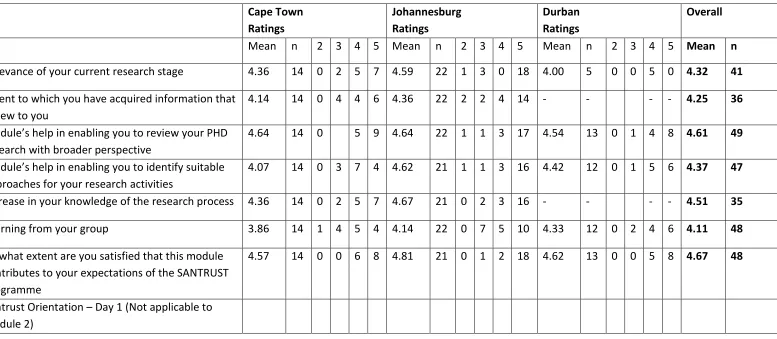
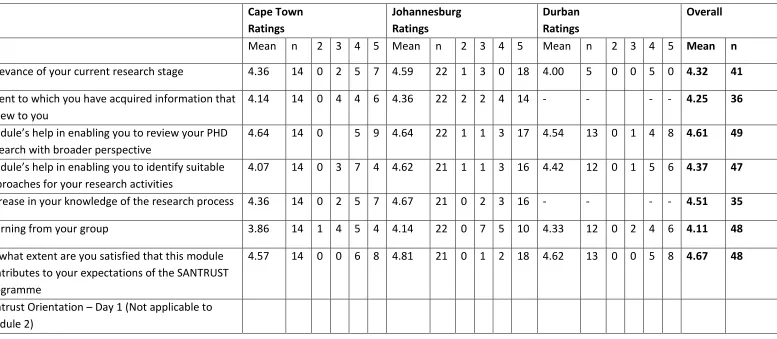
Analysis of the candidate evaluation forms revealed that the vast majority of candidates 17
valued the academic content of the modules highly, with the majority of candidates rating 18
each question with a score of five, denoting excellence. No candidates provided a score of 1, 19
denoting poor, on any of the evaluation question.. A further interesting finding from this 20
analysis was the range in scores across the sites in response to the question on, ‗learning from 21
your group‘. Again, the overall score across the three sites was above four but one site 22
scored below four indicating that these candidates did not experience the same level of 23
location from which the group was drawn or it may have arisen from other extraneous 1
factors. Finally the Mann-Whitney U test revealed a statistically significant difference 2
(p=0.009) in the distribution of scores in response to the question ‗Module‘s help in enabling 3
you to identify suitable approaches for your research activities‘, with a greater proportion of 4
candidates within the Johannesburg cohort rating this higher than the Capetown candidates 5
cohort. Details of the responses are provided in Table 1. 6
Table 1 about here 7
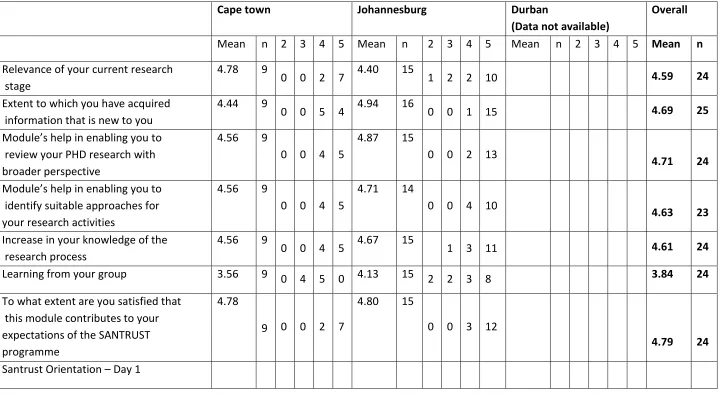
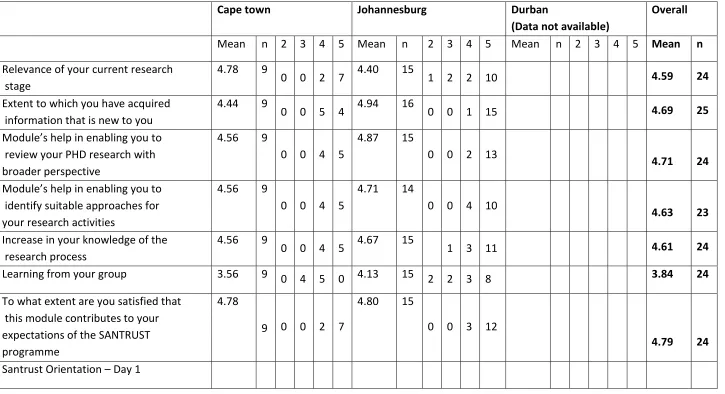
Overall the majority of candidates ranked facilitation as excellent, however, several aspects 8
of facilitation appeared to be valued more highly than others, the aspects of facilitation that 9
obtained the majority of excellent scores were, in order, the facilitator as ―a role model for 10
scholarship‖, ―attention to making useful links between theory and application‖ and the 11
―content of the module‖. Details are provided in Table 2. 12
Table 2 about here 13
Results from the analysis of the facilitators‘ reports overwhelmingly provided positive 14
feedback on facilitation and a real interest in improving the programme and continuing to be 15
involved in it. Facilitators gave constructive comments, in all cases, and showed real concern 16
for the quality of the programme and of nursing sciences, doctoral research in South Africa. It 17
was however worth noting that the facilitator reports were provided as internal reports to the 18
educational trust and there may have been a degree of bias in reporting. However the design 19
of the facilitator feedback reports did strive to reduce this bias by asking questions such as, 20
‗Which part of the Module appears to you as particularly needed and successful?‘ and, 21
‗Which part of the Module could be adapted/re-worked for a better outcome?‘. 22
Workshop participants were also asked to share and discuss their experiences as facilitators, 1
assessors and supervisors. The thematic analysis of the data was conducted within the 2
broader context of the full data set arising from the research project. 3
Theme One: Supports 4
The need to support all stakeholders across the research process emerged. This included 5
candidates, facilitators, supervisors, funders, practitioners and practice. Within this theme 6
three sub themes could be identified: leveraging the resources that the stakeholders and the 7
universities bring, stakeholder burden and providing a physical supportive place. 8
The need for support was evident in varying forms: from the need for financial resources to 9
the need for alleviating supervisor frustration at overload and lack of support. Evidence for 10
this could be found in the following input from one supervisor/workshop participant, 11
‗Disparate allocation of candidates to supervisors eg 29 candidates for one supervisor’. 12
Reflective note 5 from the workshop facilitator also demonstrated this, ‘The facilitator 13
remembers thinking 29 candidates for supervision, that can’t be right’. Financial burden was 14
also noted with one participant noting, ‗No bursary support for students’. The burden felt by 15
supervisors and facilitators was also evident in the following contributions from participants, 16
‗Major problem with writing and English – compounds the work’, and, ‗Releasing of staff [to 17
attend the PhD Proposal Development Programme] within Universities is difficult’. 18
However, in spite of the burden experienced by participants, the notion of the stakeholders as 19
a potential asset to the research process was also evident. The notion of identifying 20
champions among stakeholders was evident from several of the participant comments and 21
questions, these included, ‗Fundisa [Federation of University Deans in South Africa] – 22
driving give weight behind the SANTRUST prog’; ‘Chief nurse – to be the champion?’; ‘Who 23
individual stakeholders but to organisations. Participants identified the assets that could be 1
leveraged from other organisations, this was evident from the comments, ‗liaise with uni 2
[university] for writing workshops’ and ‗Institutionalise pre doc. Prog [pre doc Programme 3
as the PhD Proposal Development Programme is colloquially called} within the universities‘ 4
and the comment, ‗Case study the MRC of S.A’ and ‘CAPRISA1
– partnership. $20m U.S.- 5
see that model-restructured the organisation’. 6
Reviewing the order of the transcribed workshop notes the sub theme of learning from others 7
followed from the emerging theme of a physical supportive place. The need for a supportive 8
place, within which, the range of all doctoral candidates, from the varying universities and 9
places of practice could be supported throughout the PhD and research process was found in 10
the comments, ‗ Recommendations SA + IRL[Ireland] …Others …E.g. educational 11
development unit’; ‗Before, during and after the Santrust prog. Are the candidates 12
supported? ; Step up / Step down?; Hybrid Model’; CAPRISA.. see that model’ and ‗Centre 13
of Excellence’. 14
Theme Two: Planning 15
Planning emerged as a theme with the two subthemes of the South African context and 16
healthcare practice. A clear need to devise and implement a visionary, longer term plan for 17
nursing research that addressed the South African context and translated into practice 18
emerged from the workshop. Currently, one of the funders provides a research and academic 19
pipeline for the development of the research and knowledge economy in South Africa. 20
Comments, underlining and arrows in the texst that reflected the need for a longer term vision 21
and planning included, ‗National history of PhD and for Santrust to look at short, medium, 22
long term –caveats – remember these’. An arrow on the flip chart pointed from the word 1
―short‖ to the note; ‗exclusive output here [the proposal achieved at the end of the PhD 2
Proposal Development Programme]’. A facilitator reflection, also noted the need for planning 3
in the reflection, ‗The facilitator remembers thinking that the age issue could be a major 4
factor that no one is addressing; the investment of resources may be inappropriately 5
targeting those who will not remain in the system’. 6
Planning and addressing the South African context was also evident in the comments on PhD 7
topics, these included, ‗to what extent are the PhD topics relevant to national priorities – this 8
will also address Irish Aid/Funders needs‘ and ‗PhD Topics Proposals Curr[Curriculum] / 9
Alignment with police and needs’. The specific South African context was also found in the 10
comments, ‗Remember importance of Irish Aid – Funders needs‘; Remember the S.A. 11
context‘, and, ‗uniqueness of the health burden’. 12
The importance of research relating to practice and healthcare needs clearly emerged from 13
the underlining of text and arrows in the comments; ‗Translational Research’; 14
‗Dissemination and implementation‘; ‗Bedside to bench Bench to bedside’ and ‘IHI 15
institute for health improvement‘ and ‗Outputs, outcomes (NRF Irish Aid)‘ and ‗Needs ‗ 16
and ‗Balanced with profession / caring’. 17
Theme Three: Quality 18
The third and final theme emerging from the analysis was one of quality. Two sub themes 19
within this arose. These were, processes and monitoring and evaluation. 20
The need for improvements in processes was evident from the comments. The need to 21
examine processes for candidate selection, supervisor allocation, PhD topic choice and 22
included; ‗Random distribution of projects to supervisor – co supervisor?; ‗not implementing 1
regulation / policy eg 10 PhDs but what about quality‘; ‗Selection of the place on the Pre doc 2
– Criteria for selection may be informed further‘; Are the criteria stringent?‘ and ‗Enablers / 3
barriers to implementing the programme’. 4
5
The quality processes at individual candidate level were also questioned and gaps in learning 6
were identified. Comments included, ‗Educational disparity eg rural writing skills vary 7
accordingly’; ‗Older age group numbers higher – challenges with technology and familiarity 8
with the field‘; ‗Major problem with writing and English – compounds the work‘; ‗part-time 9
and long distance learning‘ and ‗No shortage of PhD candidates shortage of quality’. 10
The importance of monitoring quality emerged as a sub theme. Theis focus of the sub theme 11
was not so much the monitoring of process as above, but rather monitoring and evaluating the 12
outputs from the research and PhD process. Comments illustrating this included; ‗define 13
specifics and outputs eg completion rates, publishing‘; ‗Be aware of the limitations of the 14
metrics eg accepted proposals’ and the underlined comment, ‗Note publication rates’ . 15
Alignment to Funder priorities: 16
An analysis of the alignment of the nursing PhD research with national and funding priorities 17
was undertaken. An analysis of topics revealed that topics were in general in line with 18
priorities, with some areas being addressed more frequently than others, and that this would 19
need ongoing monitoring to ensure the relevance of topics to practice and policy needs. In 20
addition, while priorities were being addressed the analysis revealed that in order for the 21
underpinning values of Irish Aid of (partnership, sustainability and effectiveness) to be fully 22
Finally, a review of the Irish case study revealed the importance of strategic planning for 1
research, providing supports and collaborating closely with practice to ensure 2
implementation. A review of the South African case study revealed that although the 3
National Strategic Plan for Nurse Education, Training and Practice 2012-2017 had just been 4
launched in March 2013, this Plan related to education, training and practice, and did not 5
encompass research. Post study dissemination indicated that a national draft research policy 6
had been developed, but there was lack of integration between these two key areas. 7
Discussion
8
The PhD Proposal Programme received positive endorsements for its, ‗fit for purpose‘, to 9
address doctoral education (especially for redress of Black, older women); to relieve 10
supervisors‘ overload as well as to support supervisors in their own development; to advance 11
Nursing Science scholarship, both through better capacitated academics and their potential 12
throughput to PhD graduation and to contribute to the two seminal national strategies of 13
South Africa named above. Attendant to this, the research also demonstrated that the 14
programme was well aligned to the priorities of the funders: Ireland‘s ―One world, one 15
future: Ireland‘s policy for international development‘ (Government of Ireland 2013) and 16
those of the National Research Foundation of South Africa that has declared Nursing Science 17
as a vulnerable Science (Pillay: Interview). 18
With reference to the Kirkpatrick (1998) model for evaluation, the candidate evaluation 19
assessment forms provided strong strong positive evidence of the presence of factors 20
identified within Level 1 of the model labelled ‗Reaction‘, these factors being engagement, 21
relevance and customer satisfaction. Level 2 within Kirkpatrick (1998) identified as 22
‗Learning‘ containsed the factors, knowledge, skills, attitude, confidence and commitment 23
However, evidence of the sustainability of the commitment factor beyond the later module of 1
the programme was not captured in the evaluation forms analysed but may possibly be found 2
within later completion rates of the cohorts. 3
From the workshop consultation, three themes emerged. These were firstly, support with the 4
subthemes of burden (experienced in overload of the education and health sectors) and 5
leveraging and the importance of providing a physical supportive place. The second theme 6
was the centrality of planning with the sub themes of the South African context and 7
healthcare practice. Finally the third theme was, quality, with the sub themes of processes 8
and monitoring and evaluation. Within the workshop consultation the main barriers to the 9
sustainability, and implementation of the programme were identified. Although the thematic 10
analysis was conducted with an inductive data driven approach, findings must be interpreted 11
within the limitation of the study design and the researcher bias. 12
13
The study also showed that the programme could conceivably be scaled up to include more 14
cohorts, as well as to include interventions that would assist with the so-called pipeline 15
towards attaining Nursing Science excellence, within the country, such as Doctoral and Post- 16
Doctoral interventions; support for Masters students; a Nursing Science ―Top Up‖ Degree (to 17
up-skill from a Diploma to Degree). This would need to be supported systemically, 18
administratively and academically though the remit of the educational trust and/or other like-19
minded organisations. 20
While the role of the funders was encouraging and the results equally encouraging for the 21
funders‘ national and international goals, the absence of the national stakeholders was noted. 22
This was highlighted when the draft findings of the evaluation reported on the absence of a 23
made it known to the research team that a draft research strategy was in existence. This 1
oversight speaks to a bigger issue, namely the lack of ―relational or systemic‖ responses to 2
support of an innovative doctoral education programme. This was identified previously by 3
Smit et al, 2013. Should critical areas, such as these, be improved upon, the impact of 4
programmes and strategies might be more pronounced (Head, 2008). The results of the study 5
reinforced this and also indicated that the sustainability and the more long-term impact of the 6
PhD Proposal Development Programme were influenced by factors beyond the control of the 7
programme itself. 8
The study also showed that the programme could conceivably be scaled up to include more 9
cohorts, as well as to include interventions that would assist with the so-called pipeline 10
towards attaining Nursing Science excellence, within the country, such as Doctoral and Post- 11
Doctoral interventions; support for Masters students; a Nursing Science ―Top Up‖ Degree (to 12
up-skill from a Diploma to Degree) and a Nursing Leadership programme. This would need 13
to be supported systemically, administratively and academically though the remit of the 14
educational trust and/or other like-minded organisations. 15
While the role of the funders was encouraging and the results equally encouraging for the 16
funders‘ national and international goals, the absence of the national Department of Health as 17
a contributor is noted. In relation to this, the National Research Foundation‘s pipeline 18
strategy seems systemically under emphasised in the mind-sets of the stakeholders of the 19
programme and the broader custodians of nurse strategy. This was highlighted when the 20
findings of the evaluation reflected on the absence of a research strategy, and only at 21
dissemination stage, was the existence of a draft research strategy tabled. These three areas of 22
oversight speak to a bigger issue, namely the lack of ―relational or systemic‖ responses to 23
support, at a more overarching level (Head, 2008:4), an innovative doctoral education 24
impact of the respective and collective programmes and strategies might be more pronounced 1
(Head, 2008). The results of the study reinforced this and also indicated that the 2
sustainability and the more long-term impact of the PhD Proposal Development Programme 3
were influenced by factors beyond the control of the programme. 4
While the throughput of the candidates to graduation level could not be ascertained from the 5
data, owing to the lead time still to go for the cohorts to complete, the comparative case study 6
of the Irish nursing programme demonstrated that, internationally, when PhD candidates 7
were provided with ongoing structured supports accelerated outputs of PhD candidates could 8
be achieved. which included specific targeted supports for data analysis. Within this South 9
African The evaluation study noted that the PhD Proposal Development Programme did 10
provide for a week of structured data analysis at the applied stage during module 5 part 2 11
which took place post the PhD proposal assessment. In the dissemination of the study, it was 12
also encouraging to learn that candidates could apply for an additional nine years of funding 13
(three years during the doctorate, three years as post- doctoral and three years as an emerging 14
researcher) through a National Research Foundation, in a competitive process. (Pillay, 2013: 15
Dissemination Discussion) Additional research on longitudinal data would allow for the 16
efficacy of this sustained and programmatic support to be measured for impact. 17
18
Conclusion
19
The evaluation data provided the evidence for a ‗snap-shot‘ of the success of one, multi-year 20
cohort programme, within a health and education system that faces multiple challenges and 21
vast swathes of redress to overcome inter-generational, multiplier effects that persist from the 22
historical legacy of a systematically oppressive and highly disparate development trajectory 23
it delivered short term observable benefits to the cohort group for whom it was conceived and 1
intended. However the consultation workshop did reveal the need for increased supports, 2
improved planning and increased monitoring to ensure sustained quality, Overall the results 3
demonstrated the need for a deepened response, on a systems and multi/ inter-relational level 4
by a broader continuum of stakeholders for this programme and others of its nature to deliver 5
longer-term and embedded benefits for health, education and research, within not only a 6
democratic developing country, such as South Africa but within a profession that needs to 7
expand rapidly to meet the urgent shortage of nursing care. 8
1
References
2
Begley C., Elliott N., Lalor J., Coyne I., Higgins A. & Comiskey C.M. (2013). Differences 3
between clinical specialist and advanced practitioner clinical practice, leadership, and 4
research roles, responsibilities, and perceived outcomes (the SCAPE study). Journal of 5
Advanced Nursing 69(6),1323-1337. 6
Braun, V. and Clarke, V. (2006) Using thematic analysis in psychology. Qualitative Research 7
in Psychology, 3 (2). 77-101. ISSN 1478-0887 8
Bednash, G., Breslin E., Kirschling, J, Rosseter, R. (2014) PhD or DNP: Planning for 9
Doctoral Nursing Education Nursing Science Quarterly, 27:296-301 10
Bryant-Lukosius D., DiCenso A., Browne G. & Pinelli J. (2004) Advanced practice nursing 11
roles: Development, implementation and evaluation. Journal of Advanced Nursing 48(5), 12
519-529. 13
Comiskey C., Coyne I., Lalor J. & Begley C. (2013) A national cross-sectional study 14
measuring predictors for improved service user outcomes across clinical nurse or midwife 15
specialist, advanced nurse practitioner and control sites. Journal of Advanced Nursing 00(0), 16
000–000. doi: 10.1111/jan.12273 (early online view) 17
Department of Health (2012) Strategic Plan for Nursing Education, Training and Practice 18
2012/13 – 2016/17, Summary Document. Department of Health, Republic of South Africa 19
Devi, S. (2011). World Report. US nurse practitioners push for more responsibilities. The 20
Feeg, V., & Nickitas, D.M. (2011). Doubling the Number of Nurses with a Doctorate by 2020 1
— Predicting the Right Number or Getting it Right? Nursing Economic$, 29(3), 109-110, 2
125. 3
Fitzgerald, C., Kantrowitz-Gordon, I., Katz, J & Hirsch, A. (2012) Advanced Practice 4
Nursing Education: Challenges and Strategies Nursing Research and Practice Article ID 5
854918, 8 pages doi:10.1155/2012/854918 6
Florczak, K. Poradzisdz, M.,Kostovich, C. (2014)Traditional or Translational Research for 7
Nursing Nursing Science Quarterly, 27(3) 195-200. 8
Government of Ireland (2013). ‗One world, one future: Ireland‘s policy for international 9
development‘. Government of Ireland, Stationary Office, Dublin, Ireland. 10
Head, B.W. (2008) Research and Evaluation. Three Lenses of Evidence Based Policy. ‘The 11
Australian Journal of Public Administration’, (67) : 1–11.[on-line]. Available from:, 12
http://www.vic.ipaa.org.au/sb_cache/professionaldevelopment/id/36/f/3%20lenses%20of%20 13
evidence%20based%20policy%20-%20brian%20head.pdf>. Accessed: 3 March 2014 14
Institute of Medicine (2011) The Future of Nursing: Leading Change, Advancing Health, The 15
National Academies Press, Washington, DC, USA. 16
Kennedy F., McDonnell A., Gerrish, K., Howarth A., Pollard C. & Redman J. (2012) 17
Evaluation of the impact of nurse consultant roles in the United Kingdom: a mixed method 18
systematic literature review. Journal of Advanced Nursing, 68(4), 721-742 doi: 19
10.1111/j.1365-2648.2011.05811.x 20
Kirkpatrick, D. L. (1998). Evaluating training programs: The four levels. Second Edition 21
Maclure M, Carleton B, Schneeweiss S. (2007). Designed delays versus rigorous pragmatic 1
trials: lower carat gold standards can produce relevant, drug evaluations. Medical Care 2007; 2
45(10):S44--S49. 3
Matsoso, M.P. and Fryatt, R, 2013. Editorial. The South African Medical Journal, 103 (3): 4
156-158 [online] Available from: 5
<http://www.samj.org.za/index.php/samj/article/view/6601/4920>. Accessed: 3 March 2014 6
Matsoso, M. P. & Fryatt, R. (2013). National Health Insurance: The first 18 months. South 7
African Medical Journal, 103(3), 156-158. 8
National Research Council (2011). The Future of Nursing: Leading Change, Advancing 9
Health. Washington, DC: The National Academies Press. 10
Nelson R. (2004) World Report, The nurse poachers. The Lancet, 364(13), 1743-1744. 11
Riegel, B.,Sullivan-Marx, E., Fairman, J. (2012). Meeting global needs in primary care with 12
nurse practitioners. The Lancet 380, 4, 449-450. 13
Rwandan Research and Implementation Writing Group (2014). Building health research 14
infrastructure in Rwanda, The Lancet, 2, e9-e10 15
Smit, B., Williamson, C. & Padayachee, A. 2013. PhD capacity-building, from aid to 16
innovation: The SANPAD-SANTRUST experience. Studies in Higher Education 38(3): 441-17
455. 18
Thompson, P. & Hyrkas, K.(2014). Global Nursing Leadership. Editorial. Journal of 19
Nursing Management. 22, 1–3 20
Trinity College Dublin (2009). Policy on Good Research Practice, Trinity College Dublin, 21
Ireland. Available from: 22
16th July 2014) 1
Table 1 Candidate assessment of academic content of an early module
Comments are rated 1-5. One = poor and Five= excellent. Frequencies and mean values are provided.
Cape Town Ratings
Johannesburg Ratings
Durban Ratings
Overall
Mean n 2 3 4 5 Mean n 2 3 4 5 Mean n 2 3 4 5 Mean n
Relevance of your current research stage 4.36 14 0 2 5 7 4.59 22 1 3 0 18 4.00 5 0 0 5 0 4.32 41
Extent to which you have acquired information that is new to you
4.14 14 0 4 4 6 4.36 22 2 2 4 14 - - - - 4.25 36
Module’s help in enabling you to review your PHD research with broader perspective
4.64 14 0 5 9 4.64 22 1 1 3 17 4.54 13 0 1 4 8 4.61 49
Module’s help in enabling you to identify suitable approaches for your research activities
4.07 14 0 3 7 4 4.62 21 1 1 3 16 4.42 12 0 1 5 6 4.37 47
Increase in your knowledge of the research process 4.36 14 0 2 5 7 4.67 21 0 2 3 16 - - - - 4.51 35
Learning from your group 3.86 14 1 4 5 4 4.14 22 0 7 5 10 4.33 12 0 2 4 6 4.11 48
To what extent are you satisfied that this module contributes to your expectations of the SANTRUST programme
4.57 14 0 0 6 8 4.81 21 0 1 2 18 4.62 13 0 0 5 8 4.67 48
Table 2 Candidate assessment of academic content of a later module
Comments are rated 1-5. One = poor and Five= excellent. Frequencies and mean values are provided
Cape town Johannesburg Durban
(Data not available)
Overall
Mean n 2 3 4 5 Mean n 2 3 4 5 Mean n 2 3 4 5 Mean n
Relevance of your current research stage
4.78 9
0 0 2 7 4.40 15 1 2 2 10 4.59 24
Extent to which you have acquired information that is new to you
4.44 9
0 0 5 4 4.94 16 0 0 1 15 4.69 25
Module’s help in enabling you to review your PHD research with broader perspective
4.56 9
0 0 4 5
4.87 15
0 0 2 13
4.71 24
Module’s help in enabling you to identify suitable approaches for your research activities
4.56 9
0 0 4 5
4.71 14
0 0 4 10
4.63 23
Increase in your knowledge of the research process
4.56 9
0 0 4 5 4.67 15 1 3 11 4.61 24
Learning from your group 3.56 9 0 4 5 0 4.13 15 2 2 3 8 3.84 24
To what extent are you satisfied that this module contributes to your expectations of the SANTRUST programme
4.78
9 0 0 2 7
4.80 15
0 0 3 12
4.79 24
Scaling up nurse education: An evaluation of a national PhD capacity development 1
programme in South Africa, in the context of the global shortage of nursing graduates. 2
3
Abstract
4
Background 5
The global shortage of nursing professionals educated at baccalaureate level and beyond has 6
been highlighted. Within America, services are preparing to treat an additional 32 million 7
individuals under the Health Reform Bill. Within South Africa nursing education outputs do 8
not meet demands. Countries are addressing these shortages by developing advanced nurse 9
roles which require research degrees. 10
Objective: 11
To evaluate a national PhD programme within the context of a nurse education strategy and a 12
national health insurance plan. 13
Design: 14
A comparative effectiveness research design was employed. 15
Setting: 16
The setting was South Africa between 2011 and 2013, a county with 51.7 million inhabitants. 17
Participants: 18
Participants included PhD candidates, programme facilitators, supervisors and key 19
stakeholders. 20
Methods: 21
Data from a one day workshop was analysed using an inductive thematic analysis. Three 1
years of evaluation reports were analysed. A mapping of the alignment of the PhD topics with 2
healthcare priorities, and a comparison of the development of nurse education, of the national 3
and international funder was conducted. 4
Results 5
The evaluation reports rated the programme highly. Three themes were identified from the 6
workshop. These were, ―support‖ with the sub-themes of burden, leveraging and a physical 7
supportive place; ―planning‖ with the sub-themes of the national context and practice, and 8
―quality‖ with the sub-themes of processes and monitoring and evaluation. The mapping of 9
PhD topics revealed that research was in line with development priorities. However, further 10
investment and infrastructural changes were necessary to sustain the programme and its 11
impact. 12
Conclusions 13
To address sustainability and capacity in nations scaling up nurse education and healthcare 14
insurance, it was recommended that top-up degrees for diploma educated nurses be 15
developed along with, the implementation of a national nursing strategy for PhD and post-16
doctoral training encompassing clinical practice implementation and collaboration. 17
18
Key words 19
Introduction
1
A global shortage of nursing professionals educated at baccalaureate level and beyond exists 2
and the impact of this shortage is apparent on each continent. Nickitas and Feeg (2011) 3
found that less than 1% of nurses have a doctoral degree and that forecasters predict 4
substantial shortfalls in future nurse academics, and as a consequence, future nurse 5
practitioners. 6
Many countries are addressing these shortages in healthcare provision by ensuring that the 7
basic nursing education qualification is at degree level, and by developing advanced nursing 8
roles which have a wider remit and which require research degrees. Within Europe and the 9
United States some evaluation of the impact of these roles on the profession, clinical care, 10
education and the service user has been carried out by Bryant et al (2004), Kennedy et al 11
(2012) and Comiskey et al (2013) and all found positive impacts of the expanded role. 12
Background
13
To address the nursing shortfalls within the United States (US), national targets have been set 14
to increase the number of registered nurses holding baccalaureate degrees from 50% to 80% 15
over the next ten years and to ensure that at least 10% of all baccalaureate graduates enter 16
into a master‘s or doctoral program within 5 years of graduation. Furthermore within the US,. 17
Devi (2011) highlights that services are preparing to treat an additional 32 million individuals 18
under the new Health Reform Bill. Bednash et al (2014) have stated that authorities from 19
inside and outside of nursing are calling for a rapid increase in the number of nurses holding 20
doctoral degrees. More nurses with a PhD degree are needed to serve as Advanced Practice 21
Registered Nurses, assume faculty roles, embark on research careers, and pursue top 22
leadership positions. Florczac et al (2014) have also stated that there is a need for more PhD 23
They believe the focus on the PhD would help to facilitate a better understanding between 1
traditional research and translational research. 2
3
Fitzgerald et al (2012) have, however, highlighted that nurse education programs are facing 4
significant difficulties as they try to prepare sufficient numbers of advanced practice 5
registered nurses to fulfil the vision of helping to implement an improved US healthcare 6
system as described in the Institute of Medicine‘s ―Future of nursing‖ report. The Institute of 7
Medicine (2011) have described within their report the potential for advanced practice 8
registered nurses (APRNs) to contribute to the provision of high-quality healthcare as part of 9
the comprehensive healthcare reform 10
11
12
Across Africa, healthcare policy and practice is undergoing a period of radical change with 13
increasing demands. Within Rwanda, as with many other African countries, there has 14
historically been a shortage of health workers and individuals skilled at clinical research. 15
Government and healthcare academics within Rwanda have stated that going forward, 16
building research infrastructure and capacity will be essential pillars for development of the 17
Rwandan healthcare policy (Rwandan Research Implementation and Writing Group, 2014). 18
19
South Africa is also undergoing major reforms to revitalise and restructure the health system 20
and to ensure access to healthcare for all. As part of improving the healthcare system and 21
ensuring that all South Africans have equitable access to essential healthcare services, the 22
government is introducing a National Health Insurance (NHI) system (Green Paper on 23
launched the National Strategic Plan for Nurse Education, Training and Practice: 2012/13 – 1
2016/17 (DoH, 2013). 2
3
Thompson and Hyrkas (2014) also commented on the demands on nursing, and, in particular 4
nursing leadership at a global level. In their editorial within a special issue on global nursing 5
leadership they provide a summary of work from over 13 contributions from more than 10 6
countries from Canada to Australia and New Zealand, from North and South America to 7
Europe, from Finland to Israel and beyond. Thompson and Hyrkas (2014), state that the 8
biggest demand facing nursing in the 21st century is the transformation within nursing. They 9
believe that nurse leadership needs to be active not only in practice, but also in education, 10
research and the policy and political arenas. A high standard of nursing education will assist 11
in the active involvement of nurses in leadership, health policy, system improvement, 12
research and evidence-informed practice. Indeed, Begley et al (2012) demonstrated the 13
improvements in clinical leadership among those with advanced nursing practice roles and 14
degrees. In terms of service user experiences Comiskey et al (2013) also found, in line with 15
the international literature, that nurses with advanced degrees were rated more highly by 16
service users across a range of domains and outcomes than these without such roles and 17
degrees. 18
In order to address these issues and the current and anticipated deficits in nursing research 19
and scholarship capacity across South Africa, a PhD proposal development programme for 20
nursing sciences was initiated. The programme aimed to contribute to South Africa‘s national 21
research and development agenda. It was aimed at nurse academics and senior nurse 22
practitioners who had already obtained a Master‘s degree. It consisted of six modules 23
delivered over the course of a year in seven, one-week- residential blocks. The six modules 24
overview of a doctoral proposal; conceptualising/defining research problems and questions; 1
research designs; overview of qualitative and quantitative methods; dealing with data, a 2
theoretical introduction (part one); presenting and defending the research proposal and finally 3
dealing with data, at an applied level (part two). Module five part two was carried out after 4
the PhD candidates had passed the assessment and defence of their research proposal and had 5
collected their pilot or preliminary exploration data. Each module was co-facilitated by an 6
experienced South African and an Irish academic. 7
The aim of this research study was to evaluate the PhD proposal development programme 8
and to determine if it was, ‗fit for purpose‘, in relation to meeting current and future needs 9
for nursing sciences within the new Strategic Plan for Nursing Education, Training and 10
Practice and the National Health Insurance policy context. The objectives were: 11
1. To ascertain, how the programme (curriculum, content and process) was experienced 12
by the candidates, facilitators and assessors. 13
2. To explore to what extent the programme contributed to both the funders and the 14
national nurse education and training and the proposed healthcare insurance policies. 15
3. To compare nursing sciences development in Ireland and South Africa as the 16
programme was jointly funded from South Africa and Ireland, a country once noted 17
for its supply of highly qualified nurses (Nelson, 2004). 18
Method
19
Design 20
To realise these objectives a Comparative Effectiveness Research (CER) study design was 21
adopted. The CER approach is the new ‗Gold Standard‘ in effectiveness research and has 22
March 2010 (Tunis, Benner, McClellen, 2010). A concurrent mixed methods approach to the 1
design was considered but as the methods employed involved a workshop of expert 2
stakeholders, an analysis of evaluation forms, a comparison of the Irish and South African 3
histories of the development of nursing academia and a review of the alignment of the PhD 4
topics with funders and national priorities, CER was deemed to capture the design approach 5
more accurately as at the centre of CER is meaningful engagement and feedback from local 6
policy and service providers and the incorporation of a wide variety of relevant research into 7
policy and service provision decisions. 8
Data 9
To realise the first objective, evaluation reports from three cohorts of nursing science PhD 10
candidates, facilitators and assessors from 2012, 2013 and 2014 were collated and descriptive 11
summaries were prepared. 12
To realise objective two, a one day consultation workshop with both health and education, 13
key stakeholders was held. This workshop was to provide, to the stakeholders, the necessary 14
background information to the study and to obtain their input and feedback on both the 15
research process plan (task 1), and their input to the recommendations for the development of 16
the existing and possible expanded curriculum, and their input to addressing the supply of 17
nursing education, training and practice, following a discussion comparing their experiences 18
as facilitators, supervisors and assessors (task 2). 19
Workshop participants included facilitators, assessors, supervisors, programme managers and 20
a wide range of the key stakeholders. There were three Professors of Nursing who had 21
additional roles as leaders within national nursing organisations (including FUNDISA - the 22
Forum of University Nursing Deans of South Africa) as well as facilitators on the curriculum 23
representatives from the South African national funding organisation; a senior representative 1
from the international development funding organisation, and national and international 2
external academics/consultants with a track record in the delivery of international healthcare 3
education. 4
Ethical approval to conduct a consultation workshop with experts was not required, however 5
while signed informed consent was not obtained for the workshop, the acceptance of the 6
invitation demonstrated willingness to participate. The Trinity College Dublin, Ireland 7
universal principles and policy of good research practice were adhered to, these stipulated 8
that the law of the land be followed and the ethical principles of respect; beneficence and the 9
absence of maleficence; and justice be the overarching ethical guidelines (Trinity College 10
Dublin, 2009). Invited participants to the workshop were provided with written information 11
on the nature of the workshop approximately two months in advance. On the day of the 12
workshop verbal assent to participate in the workshop was obtained and participants had the 13
option to attend a concurrent leadership planning meeting if they did not wish to participate 14
in the workshop. No audio recordings of the workshop were taken and participants had the 15
opportunity to read, review and comment on the workshop notes as well as the details of the 16
thematic analysis of the workshop content. 17
Data Analysis 18
Evaluation reports, for each module, for each of the yearly cohorts, were reviewed and an 19
early, mid- way and a later module were purposively sampled and selected for analysis. 20
Reports were checked for accuracy and any discrepancies were noted and corrected against 21
the original individual forms. Frequencies of responses were prepared for individual cohorts 22
and were also collated across cohorts. Mean values were also calculated where appropriate. 23