(will be inserted by the editor)
safeDpi: a language for controlling mobile
code
?Matthew Hennessy1, Julian Rathke1, Nobuko Yoshida2
1 Department of Informatics, University of Sussex. 2 Department of Computing, Imperial College London.
The date of receipt and acceptance will be inserted by the editor
Abstract. safeDpi is a distributed version of the Picalculus, in which processes are located at dynamically createdsites. Parametrised code may be sent between sites using so-calledports, which are essen-tially higher-order versions ofPicalculuscommunication channels. A host location may protect itself by only accepting code which con-forms to a given type associated to the incoming port.
We define a sophisticated static type system for these ports, which restrict the capabilities and access rights of any processes launched by incoming code. Dependent and existential types are used to add flexi-bility, allowing the behaviour of these launched processes, encoded as
process types, to depend on the host’s instantiation of the incoming code.
We also show that a natural contextually defined behavioural equivalence can be characterised coinductively, using bisimulations based on typed actions. The characterisation is based on the idea of knowledge acquisition by a testing environment and makes explicit some of the subtleties of determining equivalence in this language of highly constrained distributed code.
Key words. distributed calculus, security, static types, behavioural equivalence, bisimulations
? The first two authors would like to acknowledge the financial support of
1 Introduction
In this paper we elaborate a theory of distributed systems which incorporates resource policies. Our main results are:
– a language for distributed systems in which access to hosts by mobile code is controlled using capability-based types
– a fine-grained type system using novel forms of dependent and existential types which gives hosts considerable flexibility in de-termining the allowed behaviour of incoming code
– a coinductive characterisation of a natural contextual equivalence, based on the notion of typed actions.
This is developed in terms of an extension of the language Dpi, [10,8,20,14], a version of the Picalculus, [21], in which processes may migrate between locations, which in turn can be dynamically created. InDpia typical system takes the form
lJPK|(newe:E)(kJQK|lJRK)
where there are two threadsP andRrunning atland one,Q, running at k. The threads Q and R share the private name e at type E. The threads P , Q, Rare similar to processes in thePicalculus in that they can receive and send values on local channels; the types of these channels indicate the kind of values which may be transmitted. Locations may be dynamically created. For example in
lJ(newlock:K)withQ in xpt1!hki |xpt2!hkiK
a new location k is created at type K, the code Q is installed at k and the name of the new location is exported via the channels xpti. Location types are similar to record types, their form being
loc[c1 :C1, . . . cn:Cn]
This indicates that the channels, or resources,ciat typesCiare avail-able at the location. So for exampleK above could be
loc[ping:rwhPi,fing:rwhFi]
indicating that the services ping and fing(er) are supported at k; r
indicates the permission to read from a channel, while w indicates the permission to write to the channel. However the types at which k becomes known depends on the types of the exporting channels. Suppose for example these had the types
xpt1 :whloc[ping:whPi]i
Then processes receiving the namekfrom the sourcexpt1would only be able to write to the ping service at k, i.e. send messages to that service, while the sourcexpt2 only allows similar restricted access to thefinger service. It is in this way, by selectively distributing names at particular subtypes, that resource access policies are implemented inDpi.
In this paper we make two extensions to Dpi. The first allows more control to locations over code which wishes to access their com-putation space. InDpithe migration rule is given by
kJgotol.PK−→lJPK;
any thread is allowed to migrate to the site l. InsafeDpi, the lan-guage of this paper, migration is represented by
kJgotopl.PK−→lJp!hPiK
A thread must designate a port p at l in order to migrate. It then reduces to the system lJp!hPiK, which apriori represents a thread running at locationl. However this thread will have no effect until the sitelmakes available a corresponding thread of the form lJp?(x)QK; using standard communication this will now allow the effective entry of F. In this manner, by programming the presence or absence of ports, the sitel can control the immigration of code.
Effectively we have replaced unconstrained spawning of processes at arbitrary sites by higher-order communication. Moreover these ports, higher-order channels, have types associated with them. The types on ports are the second major extension to the language. In general we allow scripts, parameterised code, to be sent via ports. These take the form
λ(˜x: ˜T)P
where eachxi can be matched by arbitrarytransmittable values; it is the typesTiwhich determine the nature of the abstraction. But when such a script is transmitted it may be instantiated at the receiving site by values of the appropriate type. This gives added security to sites by controlling the type at which scripts will be accepted. This of course depends on the granularity of the type structure for scripts.
The most straightforward form of type for scripts is (˜x: ˜T)→proc
use. To limit the access of incoming code to resources we introduce fine-grainedprocess types, [26]. These dictate the capabilities, on both local and third-party channels, which the code is allowed to access, and take the form of a record:
pr[c1:C1@k1, . . . , cn:Cn@kn]
A process of this type can useat most the set of channelsci, located respectively at the locations ki, with the capabilities Ci; in these process types the use of a local channelc is indicated by an entry of the form c:C@here.
When these process types are incorporated into script types a host location can have much more effective control over the behaviour of incoming code, particularly when we use a form ofdependent function type. For example suppose a port only accepts scripts at the type
Fdep(x:rhTi →pr[x:rhTi@here, reply:whTi@k])
Then an incoming script can only be instantiated by a local channel, with read capability at typeT. Moreover the resulting running code is now only allowed to read from this local channel and write to the third-party channel called reply located at the specific location k. With a port at the type
Fdep(y:whTi@k→pr[info:rhTi@here, y:whTi@k])
the host can instantiate the incoming script with some channel lo-cated at the sitek, on which it has write permission, and the running code is restricted to writing there, and reading from a local channel calledinfo.
Note that in both these examples the location k is built into the script types. Thus a server with an access port at this type would only allow entry to scripts which guarantee to write only at k. However
dependent types can be used to allow this target site to be parame-terised. Consider the simple example
Tdep(z:L)Fdep(y:whTi@z→pr[info:rhTi@here, y:whTi@z]) where the script type is now parameterised by locations of some type
L. This allows the server to accept scripts which can write the infor-mation at sites determined by the client.
up the possibility of (rogue) servers abusing this extra information. Howeverexistential typesprovide extra protection to clients, because, as we will see, this extra information is not required as part of the communication.
The language safeDpi is formally defined in Section 2, together with a reduction semantics. In Section 3 we define the set of types and the type inference system; the formal development relies heavily on the type systems already given in [8,19]. In Section 4 we develop a series of example systems. These are designed on the one hand, to explain the intricacies of the the type inference rules, and on the other to demonstrate the power and flexibility of the types. This is followed by a section devoted to establishing the expected properties of the type system, in particular Subject Reduction.
We now turn to the second topic of the paper, typed behavioural equivalences. In untyped languages, these are normally defined coin-ductively, as the largest equivalences over processes which preserve, in some sense, actions of the form
M−→µ M0 (1)
Typically these actions describe the possible forms of interactions between a process and its environment. In a typed setting many of these actions will not be possible, because the environment will not have the power to participate in them. As a simple example consider the system
lJ(newcc:C) (xpt!hci |c?(x)Q)K
in an environment in which the export channel xpt can only send channels with the read capability. The environment will receive c along xpt but will not be able to transmit on c. Consequently the potential input actions oncby the process above will not be possible. Following [9,8] we replace the untyped actions in (1) with typed actions of the form
IM−→ Iµ 0M0
where M is the system being observed while I is a constraint on the observing environment representing its knowledge of the system M. Actions change both the processes and the environment in which they are being observed. This will lead, in the standard manner, to a coinductively defined, bisimulation-based, relation between systems, which we denote by
I |= M≈bisN
M, N ::= Systems
lJPK Located Process
M|N Composition (newe:E)M Name Creation
0 Termination
P, Q ::= Processes
u!hVi Output
u?(X:T)P Input
gotouv.P Migration
ifu1=u2thenPelseQ Matching
(newcc:C) P Channel creation (newregn:N) P Global name creation (newlock:K)withQ in P Location creation
P|Q Composition
F (˜v) Application
∗P Iteration
stop Termination
U, V, W ::= Values
(˜v) Tuples
v ::= Value components
λ(˜x: ˜T). P Scripts
u Identifiers
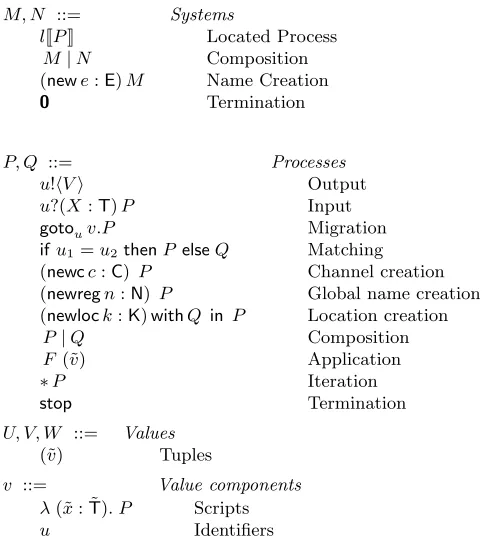
Fig. 1 Syntax ofsafeDpi
One of the features of our approach is the explicit representation of the information which the environment can obtain from systems through testing with contexts. In such a highly constrained setting as this, this becomes a genuine aid in understanding the equivalence. This is the topic of Section 6.
The paper ends, in Section 7, with some conclusions and a brief survey of related work.
2 The language safeDpi
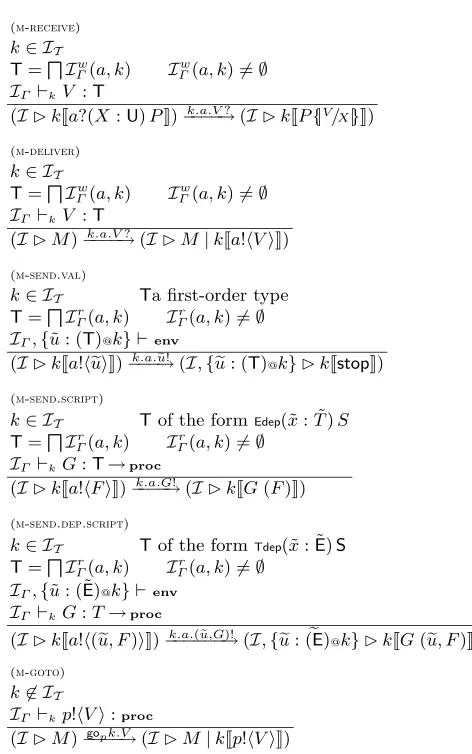
[image:6.612.114.355.49.319.2]and Chans ranged over by a, b, c, . . . for channels. There is also a distinguished subset of channels called ports, and ranged over by p, q, . . ., which are used to handle higher-order values. Similarly we will sometimes use ξ, ξ0
for variables which will be instantiated by higher-order values.
The syntax for systems, ranged over by M, N, O, is the same as in Dpi, allowing the parallel composition of located processes lJPK, which may share defined names, using the construct (newe:E)−.
The syntax for processes, ranged over by P, Qis an extension of the Picalculus, [21], with primitives for migration between loca-tions. Parallelism is allowed, we have the terminated process stop, and we also allow matching and mismatching, with the construct
if u1 =u2 thenP elseQ, and a form of iteration∗P.
In the input construct u?(X :T)P we take X to be a pattern which is used to deconstruct incoming values; this is a value which only contains distinct occurrences of variables. In our somewhat re-stricted format for values this means that X has the form (˜x), with each xi being distinct. The output construct is asynchronous, u!hVi. Here V is a tuple consisting of either identifiers or higher-order val-ues. The latter can take the form of scripts, λ(˜x: ˜T). P, whereP is an arbitrary process term; we will often useF to indicate an arbitrary script, whereas v will be reserved for the individual components in a tuple V; thus it will represent either an identifier or a script. Of particular interest to us will be tuples of the form (˜v, F) which will be interpreted asdependent values; intuitively the script F depends on the values ˜v.
At the risk of being verbose, the syntax has explicit notations for the various forms of names which can be declared. In (newcc:C) P a new local channel named cis declared, while (newregn:N) P rep-resents the generation of a new globally registered name nfor chan-nels. This allows channel names to be shared among a set of differ-ent locations in a coherdiffer-ent manner; see [8] for motivation. When a new location is declared, in (newlock:K)withQ in P, its declaration type K can only involve channel names which have been registered. This construct generates the new locationk, sets the codeQrunning there, and in parallel continues with the execution ofP. This specific construct for new locations is required since code may only be exe-cuted at a location once entry has been gained via a port; so hereQ represents the code with which the location is initialised.
The main novelty in safeDpi, overDpi, is the construct
Intuitively this means: migrate to location kvia the portp with the codeF. Our type system will ensure thatF is in fact a script with a type appropriate to the portp; moreover entry will only be gained if at the locationk the portp is currently active.
The various binding structures, for names and variables, give rise to the standard notions of free and bound occurrences of identifiers, α-conversion, and (capture-avoiding) substitution of values for iden-tifiers in terms, P{|v/u|}; this is extended to patterns, P{|V/X|} in the standard manner. We omit the details but three points are worth emphasising. The first is that many such substitutions may give rise to badly formed process terms but our typing system will ensure that this will never occur in well-typed terms. The second is that identi-fiers may occur in certain types and therefore we require a notion of substitution into types; this will be explained in Section 3. Finally terms will be identified up toα-equivalence, and bound identifiers will always be chosen to be distinct, and different from any free identifiers. In the sequel we use system to refer to a closed system term, that is a system term which contain no free occurrences of variables; similarly a process means a closed process term.
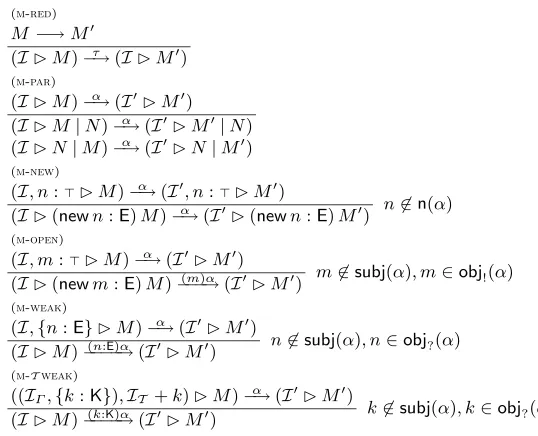
Reduction Semantics: This is given in terms of a binary relation between systems
M −→N
and is a mild generalisation of that given in [8,10] for Dpi.
Definition 1 (Contextual relations). A relation R over systems is said to be contextual if it preserves all the system constructors of the language; that isM RN implies
–M |ORN |O and O|MRO|N
–(newe:E)MR(newe:E)N.
The reduction relation is defined to be the least contextual relation which satisfies the axioms and rules in Figure 2. The rule (r-str) merely says that we are working up to a structural equivalence, ≡, which abstracts from inessential details in the terms representing sys-tems. Formally structural equivalence is defined to be the least con-textual relation between (closed) systems which satisfies the axioms which are given in Figure 3; these are the natural adaptations of the usual axioms for structural equivalence in the Picalculus.
(r-comm)
kJc!hViK|kJc?(X:T)PK−→kJP{|V/X|}K
(r-split)
kJP|QK−→kJPK|kJQK
(r-n.create)
kJ(newregn:N) PK−→(newn:N)kJPK
(r-move)
kJgotopl.FK−→lJp!hFiK
(r-l.create)
kJ(newlocl:L)withC in PK−→(newl:L)(kJPK|lJCK)
(r-c.create)
kJ(newcc:C) PK−→(newc:C@k)kJPK
(r-unwind)
kJPK|M−→M0
kJ∗PK|M −→kJ∗PK|M0
(r-eq)
kJifu=uthenP elseQK−→kJPK
(r-beta)
kJ(λ(xe:Te). P)(ve)K−→kJP{|ev/xe|}K (r-neq)
kJifu=vthenP elseQK−→kJQK u6=v
(r-str)
M ≡N, M −→M0, M0≡N0
N −→N0
Fig. 2 Reduction semantics forsafeDpi
(s-extr) (newn:E)(M|N) =M | (newn:E)N
ifn6∈fn(M) (s-com) M|N =N|M
(s-assoc) (M|N)|O=M|(N|O)
(s-zero) M|0=M
(s-stop) kJstopK=0
(s-flip) (newn:E) (newn0:E0)M = (newn0:E0) (newn:E)M
ifn06∈E, n6∈E0
Fig. 3 Structural equivalence forsafeDpi
Migration to a sitelmust designate aport pat which the migrating code is to be received. The rule
kJgotopl.FK−→lJp!hFiK
then translates the migration command into the system lJp!hFiK, which apriori represents a thread running at the target location l. However this will have no effect until the sitelmakes available a cor-responding thread of the form lJp?(ξ)QK; using the rule (r-comm) this will now allow the effective entry ofF. In this manner the sitel can control the immigration of code.
[image:9.612.75.393.58.294.2]There is a corresponding rule for registered names, (r-n.create); but such names are global and therefore there is no need to record where they were declared. The generation of new locations is governed by (r-l.create):
kJ(newlocl:L)withC in PK−→(newl:L)(kJPK|lJCK) The code C is set to run at the new location l, and note that this name is known to the continuation threadP running at the initiating locationk.
The remaining axioms are self-explanatory; there is testing of sim-ple identifiers in (r-eq), (r-neq), β-reduction in the rule (r-beta) for instantiating scripts and a standard rule for iterated processes.
For examples of reductions see Section 4.
3 Typing
In this section we discuss the types and type inference for safeDpi. There are three subsections. The first discusses informally the types used, which builds on those in [24,10,8,26], while the second describes the type environments required to infer that systems are well-typed. Because the details are heavily syntactic, on first reading it may be better to skip directly to the final subsection which deals with the type inference rules, referring to the first two sections only on a call-by-need basis.
3.1 The Types
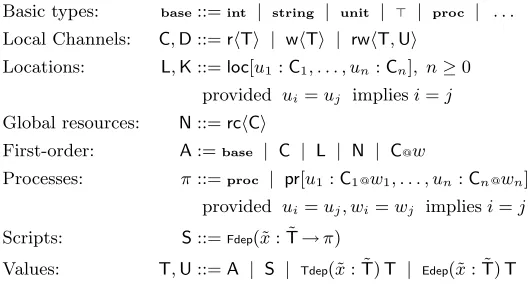
The collection of types is an extension of those used in [8,10], to which the reader is referred for more background and motivation. They are described informally in Figure 4. Note however that the syntax rules given there will be constrained by well-formedness conditions to be elaborated later, which will eliminate many evidently ill-formed types. For the same reason, when giving the syntax of systems in Figure 1, we have preferred to use the neutral metavariable E for types; the precise format allowed for such E in well-typed systems will also be determined by well-formedness constraints. Intuitively the types may be classified as follows:
Basic types: base::=int | string | unit | > | proc | . . .
Local Channels: C,D::=rhTi | whTi | rwhT,Ui
Locations: L,K::=loc[u1:C1, . . . , un:Cn], n≥0
provided ui=uj impliesi=j
Global resources: N::=rchCi
First-order: A:=base | C | L | N | C@w
Processes: π::=proc | pr[u1:C1@w1, . . . , un:Cn@wn]
provided ui=uj, wi=wj impliesi=j
Scripts: S::=Fdep(˜x: ˜T→π)
Values: T,U::=A | S | Tdep(˜x: ˜T)T | Edep(˜x: ˜T)T
Fig. 4 Type expressions - informal
constant will beglobal, that is not dependent on a particular loca-tion. We also includeproc, to indicate that a process is well-typed, and a top type >.
Local channel types, ranged over by C,D: These take the form
rwhTr,Twi
where Tr, Tw are transmission or value types; that is types of values which may be transmitted along channels. If an agent has a name at this type then it can transmit values of at most type
Tw along it and receive from it values which have at least type
Tr. In the formal description of types there will be a subtyping constraint, thatTw must be a subtype ofTr, explained in detail in [19]. When the transmit and receive types coincide we abbreviate this type byrwhTi. We also allow the typeswhTwiandrhTri, which only allow the transmission, reception respectively, of values. Global resource name types, ranged over byN: These take the form
rchCi, where C is a channel type. Intuitively these are the types of names which are available to be used in the declaration of new locations. They allow an individual resource name, such as print, to be used in multiple locations, resulting in a form of dynamic typing.
Location types, ranged over by K,L: The standard form for these is
loc[u1:C1, . . . , un:Cn]
[image:11.612.102.366.53.200.2]of view of the agent,k is a site which offers the servicesu1, . . . un at the corresponding types. In the formal definition we will require each ui to be already declared as a global resource name. If n is zero then the agent knows of the existence of k but has no right to use resources there. We abbreviate this trivial type from loc[] toloc. We also identify location types up to re-orderings.
Process types, ranged over by π. The simplest process type is proc, which can be assigned to any well-typed process. More fine-grained process types take the form
pr[u1:C1@w1, . . . , un:Cn@wn]
where the pairs (ui, wi) are assumed to be distinct. A process of this type can useat most the resource namesui at the locationwi with their specified types Ci; these types determine the locations at which the channels ui may be used.
Script types, ranged over byS: The general form here is
Fdep(˜x: ˜T→π)
Scripts of this type require parameters (˜v) of type ( ˜T); when these are supplied the resulting process will be of type π{|v˜/˜x|}. In other
words the type of the resulting process may in general depend on the parameters. In these types we allow π to contain occurrences of a special location constant hereto denote the current location. These types will be abbreviated to ( ˜T→π) whenever the variables (˜x) do not appear in the process typeπ, that is when the type of result is in fact independent of the parameters.
Script types, a generalisation of those used in [26], are one major innovation of the current paper; they allow parameterised processes, or scripts to be transmitted. Examples of such types include
whTi →proc: the type of a script which is parameterised on a local channel name, on which write permission at type Tis needed. (rhRi,whWi@k)→proc: a value of this type will be applied to a pair,
the first element will be a local channel with read capability at typeRand the second a channel located atkwith write capability at type W.
More importantly by using fine-grained process types, access to resources by incoming code can be restricted. Here are two examples:
Fdep(x:rhTi →pr[x:rhTi@here, reply:whTi@k])
process is then only allowed access to two channels, namely the local channel c, from which it can read, and a channel namedreply at the location k, to which it can write. This process will have the type
pr[c:rhTi@here, reply:whTi@k]. Code at the type
Fdep((x, y, z) : (loc,rhTi@x,whTi)→pr[y:rhTi@x, z:whTi@here]) needs to be instantiated by a location, a channel at that location, and a local channel. For example the location could be calledsource, the channel located there info, from which values can be read at the type T, and the local channelrecord, at which values can be written at type T. The resulting process will then have type
pr[info:rhTi@source,record:whTi@here]
It can download information from the third-party source site source
via the channelinfothere.
Finally Transmission or V value types dictate the kind of values which can be transmitted over channels. These may be first order values, or scripts. We also allow dependent and existential types to be used. For example inputting a value of the dependent typeTdep(x: K)Swill result in the reception of a pair (k, F), whereF is guaranteed to be of typeS{|k/x|};kis the witness that the scriptFhas the required type, and is received with the script. On the other hand inputting at the corresponding existential typeEdep(x:K)Swill only result in the
reception of the value F, although, as we will see, when the overall system is typechecked the witnessv must be produced, to verify that F is indeed well-typed.
Notation 31 [Globalising types] It is worth noting that there is a crucial distinction between local channel types C and, for example, location types. The former only make sense relative to a specific loca-tion, whereas the latter are location independent, orglobal types. We can convert the local channel type C to a global type by appending a location,C@w; this is the type of a channel of typeC located at w. In various contexts it will be convenient to apply this globalisation operation to an arbitrary type, (T)@w; this will only have an effect on any components ofTwhich are local channel or script types. The operation is defined by induction onT:
(C)@w=C@w, (S)@w=S, (base)@w=base (K)@w=K, (C@w0)@w=C@w0
(Tdep(˜x: ˜T)T)@w=Tdep(˜x: (˜T)@w) (T)@w
Note that in the last two clauses we have used the obvious notation (˜T)@w, for the list T1@w, . . . ,Tn@w. There are numerous constraints on the formation rules for types, well-documented in [10,8]. The description given in Figure 4 should be viewed as defining pre-types; those which satisfy the formation constraints will then be considered to be types. It is best to describe these constraints relative to a type environment.
3.2 Type environments
A type judgement will take the form Γ ` M
whereΓ is a type environment, a list of assumptions about the types to be associated with the identifiers in the systemM. These can take the form
– u:base, meaning that u is of type base
– u:loc, meaning uis a location
– u : C@w, meaning the channel u located at w has type C; for technical reasons C must be aclosed type, that is containing no free occurrences of variables.
– u : rchCi, meaning u is a global resource name, which may be installed at any new location.
– x :S, meaning x can be instantiated by any script which can be inferred to have type S
– x : hT with y˜ : ˜Ei. This represents a package, which will be used
to handle existential types. Intuitively this defines the association x : T but the type T may depend on the auxiliary associations
˜ y : ˜E.
Lists of assumptions are created dynamically during typechecking, typically by augmenting a current environment with new assumptions on bound variables. It is convenient to introduce a particular notation for this operation:
Definition 2 (Forming environments). Let {V : T} be a list of type assumptions defined by
–{x:base}=x:base
–{v:C@w}=v:C@w
–{x:S}=x:S
–{(˜y, x) :Tdep(˜y: ˜E)T}={y1 :E1}. . . ,{yn:En}, {x:T}
–{x:Edep(˜y: ˜E)T}=x:hTwith{y1 :E1}. . . ,{yn:En}i
Of course there a lots of other possibilities for V and T but only those mentioned give rise to lists of assumptions. Moreover even those given may give rise to lists which are not consistent. For example we should not be able to introduce an assumption u : loc if u is already designated a channel, or introduceu:C@wunlesswis known to be a location. Since type expressions also use identifiers, before introducing this assumption we would need to ensure that C is a properly formed type; for example it should only use identifiers which are already known. In order to describe the set of valid environments we introduce judgements of the form
Γ `env
The inference rules are straightforward and consequently are rele-gated to the appendix, in Figure 10. We also relegate to there the definition of subtyping judgements, of the form
Γ `T<:U,
given in Figure 11. Again the rules are straightforward, and mostly inherited from [8]. Informally the rules for subtyping channels are essentially determined by
Γ `Tr <:Ur, Uw <:Tw, Γ `whTwi<:whUwi, Γ `rhTri<:rhUri
Γ `rwhTr,Twi<:rwhUr,Uwi
Γ `rwhTr,Twi<:whTwi Γ `rwhTr,Twi<:rhTri
while those for locations depend on Γ ` Ci <:C0i,
Γ ` loc[u1 :C1, . . . , um:Cm]<:loc[u1 :C01, . . . , un:C0n]
0≤n≤m
However it is worth noting that process types are ordered differently than location types. For example we have
Γ ` pr[u1 :C1@k]<:pr[u1:C1@k, u2:C2@l] but
Γ `loc[u1 :C1, u2 :C2]<:loc[u1:C1]
assuming, of course, that the various types used, Ci,Cj are well-defined relative toΓ.
Definition 3 (Valid types).We say the type expressionTis a valid type relative to Γ, written Γ ` T : ty, whenever we can derive the
judgement Γ ` T<:T.
Types can be viewed intuitively as sets of capabilities and unioning
these sets corresponds to performing a meet operation with respect to subtyping. This we now explain. Let (D,≤) be a preorder. We say a subsetE ⊆Dis lower-bounded byd∈Difd≤efor everyeinE. Upper bounds are defined in a similar manner.
Definition 4 (partial meets and joins). We say that the preorder
(D,≤) has partial meets if every pair of elements in D which has a lower bound also has a greatest lower bound. This means that for every pair of elementsd1, d2 in D which has some lower bound, that is there is some element ind∈Dsuch thatd≤d1, d≤d2, there is a particular lower bound, denotedd1ud2 which is greater than or equal to every lower bound. The upper bound of pairs of elements, d1td2 is defined in an analogous manner.
Let TypesΓ denote the set of all type expressionsT such that Γ `
T:ty.
Theorem 1.For everyΓ, the setTypesΓ, ordered by<:, has partial meets and partial joins.
Proof. See Proposition 11 in Appendix A
Intuitively the existence ofTuUmeans thatTandUarecompatible, in that they allow compatible capabilities on values at these types. Moreover the type TuU may be viewed as a unioning of the capa-bilities allowed by the individual types.
3.3 Type Inference
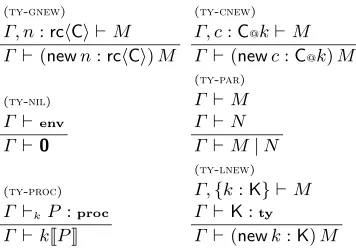
We are now ready to describe the type inference system for ensuring that systems are well-typed. There are three forms of judgements, for systems, processes and values. The type inference rules for the first,
Γ ` M,
meaning that M is a well-typed system relative to Γ, are given in Figure 5. The intention is that whenever such a judgement can be inferred it will follow thatΓ is a well-formed environment.
(ty-gnew)
Γ, n:rchCi `M Γ `(newn:rchCi)M
(ty-cnew)
Γ, c:C@k`M Γ `(newc:C@k)M
(ty-nil)
Γ `env
Γ `0
(ty-par)
Γ `M Γ `N Γ `M|N
(ty-proc)
Γ `kP:proc
Γ `kJPK
(ty-lnew)
Γ,{k:K} `M Γ `K:ty
Γ `(newk:K)M
Fig. 5 Typing Systems
to run at k; at the system level it is sufficient to be able to associate
any process type with P. The typing of processes must be relative to a location because it may use local channels which are required to exist at k; it also turns out that typing of scripts will depend on their location. There is also a subtlety in the typing of name creation. First note that in these, and all subsequent rules, we assume that all bound names in a judgement must be different than any free names used as part of the judgement. Thus in (ty-cnew) we know that c is actually fresh to Γ. However we are still not guaranteed that Γ, c : C@k is a well-defined environment even when Γ is. From the type environment rules it will only be so when C is a well-defined type expression relative to Γ, and k is known as a location. There is a further complication in (ty-lnew), the rule for new location creation. Deriving Γ,{k : K} ` M will ensure that Γ,{k : K} is a well-defined environment, but we must also ensure that all of the channels used in the location typeKhave already been declared, inΓ, as global resource names. This is enforced by the second requirement, Γ `K:ty.
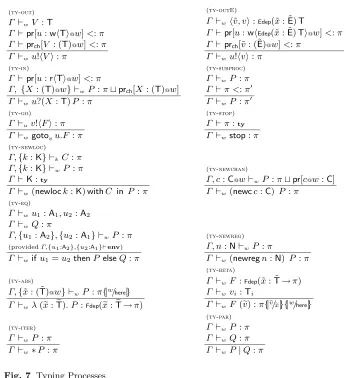
The typing rules for the judgements on processes Γ `wP :π
are given in Figure 7, and are defined simultaneously with the judge-ments for values, in Figure 6,
Γ `V :T
[image:17.612.145.323.43.167.2](ty-lookup)
Γ, v: (E)@w, Γ0`env
Γ, v: (E)@w, Γ0`wv:E
(ty-base)
Γ `env
Γ `wb:base b∈ base
(ty-subval)
Γ `wV :T
Γ `T<:T0
Γ `wV :T0
(ty-meet)
Γ `wu:T1
Γ `wu:T2
Γ `wu:T1uT2
(ty-loc)
Γ `wui:Ci
Γ `loc[u1:C1, . . . , un:Cn] :ty
Γ `wv:loc[u1 :C1, . . . , un:Cn] (ty-TuDep)
Γ `wvi:Ei{|˜v/x˜|}
Γ `wv:T{|˜v/x˜|}
Γ `w(ev, v) :Tdep(ex:Ee)T
(ty-EDep)
Γ `wvi:Ei{|v˜/˜x|}
Γ `wv:T{|v˜/˜x|}
Γ `whev, vi:Edep(ex:Ee)T
(ty-Elookup)
Γ, y:h(T)@wwithx˜: ˜Ei, Γ0`env
Γ, y:hT@wwithex:eEi, Γ0`wy:T
(ty-Unpack)
Γ `whv, v˜ i:Edep(˜x: ˜E)T
Γ `wv:T{|ve/ex|} Fig. 6 Typing Values
whenKis a valid location type; this means that each channel used in
Kis already known toΓ, at a suitable type, as a global resource name. The rule (ty-meet) is required because in certain circumstances we allow multiple associations with identifiers in valid environments; of course it can only be applied for types T1,T2 for which T1uT2
(ty-out)
Γ `wV :T
Γ `pr[u:whTi@w]<:π Γ `prch[V : (T)@w]<:π Γ `wu!hVi:π
(ty-outE)
Γ `whv, v˜ i:Edep(˜x: ˜E)T
Γ `pr[u:whEdep(˜x: ˜E)Ti@w]<:π Γ `prch[˜v: (˜E)@w]<:π
Γ `wu!hvi:π
(ty-in)
Γ `pr[u:rhTi@w]<:π
Γ, {X: (T)@w} `wP:πtprch[X: (T)@w] Γ `wu?(X:T)P :π
(ty-subproc)
Γ `wP :π
Γ `π <:π0
Γ `wP :π0
(ty-go)
Γ `uv!hFi:π
Γ `wgotovu.F:π
(ty-stop)
Γ `π:ty
Γ `wstop:π
(ty-newloc)
Γ,{k:K} `kC:π
Γ,{k:K} `wP :π
Γ `K:ty
Γ `w(newlock:K)withC in P :π
(ty-newchan)
Γ, c:C@w`wP :πtpr[c@w:C] Γ `w(newcc:C) P :π
(ty-eq)
Γ `wu1:A1, u2:A2
Γ `wQ:π
Γ,{u1:A2},{u2:A1} `wP :π
(providedΓ,{u1:A2},{u2:A1}`env)
Γ `wifu1=u2thenP elseQ:π
(ty-newreg)
Γ, n:N`wP :π
Γ `w(newregn:N) P :π
(ty-abs)
Γ,{x˜: (˜T)@w} `wP :π{|w/here|} Γ `wλ(ex:Te). P:Fdep(xe:Te→π)
(ty-beta)
Γ `wF :Fdep(˜x: ˜T→π)
Γ `wvi:Ti
Γ `wF (ev) :π{|ev/xe|}{|w/here|}
(ty-iter)
Γ `wP :π
Γ `w∗P :π
(ty-par)
Γ `wP :π
Γ `wQ:π
Γ `wP|Q:π
Fig. 7 Typing Processes
knowledge of the value, and not the witnesses, to be deduced from an existential assumption.
[image:19.612.68.414.47.425.2]identi-fiers. (ty-abs) and (ty-beta) are standard rules for abstraction and application, adapted to dependent function types. But note the use of {x˜ : (˜T)@w} in the premise of the former; the arguments in an abstraction are relativised to the current locationw. The rule for mi-gration, (ty-go), is justified by the reduction semantics, although we could easily have phrased it in terms of the premises of the output rule.
However the real interest is in the typing of the input and out-put processes. To ensure u!hVi has a process type π relative to Γ, (ty-out), we have to ensure thatuhas the output capability at some type appropriate to V. Thus we need to find some typeT such that Γ `w V :T and u has the output capability on T. But we must also
check that this capability is allowed byπ. Both of these requirements are encapsulated in the second premise of the rule
Γ `pr[u:whTi@w]<:π
But there is a further complication. If the value being sent, V, con-tains channels, or more precisely capabilities on channels, then these must also be allowed byπ. This is the intent of the third premise
Γ `prch[V :T@w]<:π
which uses a (partial) function which constructs a process type from a valueV and its type; it essentially extracts out any channels which may be inV. To define this we usetwhich is ajoinoperator on types, relative to <: the subtyping order; when applied to process types it effectively takes the union of the capabilities of the individual types. It is worth noting thatprch[v:T] is the trivial process typepr[] when T is a script type.
prch[v:C@w] =pr[v :C@w]
prch[v:K] =pr[c1:C1@v, . . . , cn:Cn@v]
whereK=loc[c1 :C1, . . . , cn:Cn]
prch[˜v: ˜T] =prch[v1 :T1]t. . .tprch[v1 :T1]
prch[(˜v, v) :Tdep(˜x: ˜E)T] =prch[˜v: ˜E]tprch[v:T] prch[h˜v, vi:Edep(˜x: ˜E)T] =prch[˜v: ˜E]tprch[v:T]
prch[v:T] =pr[] otherwise
type, but only the (unpacked) valuevis actually transmitted. Finally to ensure u?(X :T)P has the type π, we need to check that u has the appropriate read capability, which also is allowed byπ,
Γ `pr[u:rhTi@w]<:π
and that the capabilities exercised by the residualP are either allowed by π or inherited by values which are input and bound toX:
Γ, {X: (T)@w} `w P :πtprch[X:T@w]
It is worth noting that the typing rules for input and output de-generate to the more standard form, for example as in [10], when we wish to establish that the processes are simply well-typed, that is have the type proc. For example we have the derived instances:
(ty-out)
Γ `w V :T
Γ `w u:whTi Γ `w u!hVi:proc
(ty-in)
Γ `wu:rhTi
Γ, {X : (T)@w} `wP :proc Γ `wu?(X:T)P :proc
4 Examples
In this section we demonstrate the usefulness of the type system by a series of examples of increasing sophistication.
To make the examples more readable let us introduce some conve-nient notation. First we will abbreviate the transmission typeunit→proc, for thunked processes, simply tothunk. Then we userun as an
abbre-viation for the termλξ ξ(), where ()is the only value of type unit. So
the type of run is thunk→proc; it takes a thunked process and runs it. Thunked processes, which we often refer to as thunks, take the formλ(). P but in the context ofgotop. . . .and port outputs p!h. . .i we will omit theλabstraction; thusgotoinl.λ(). P is abbreviated to
gotoinl.P. Finally we mimic the notation of process types for thunks, by lettingth[....] denote the typeunit→pr[....].
4.1 Installing and broadcasting services
Suppose there are two globally defined channel names ping and fing
and a port name in; that is we are working in a type environment Γ with the property that
for some typesDp,Df and Di. LetLbe a location type such that
L<:loc[in:Ci,ping:Cp,fing :Cf]. (3) Then in the system
rJ(newlocl:L)withQ in PK
the sitergenerates a new locationlwith declaration typeL; it evolves to the new system
(newl:L)(rJPK|lJQK) To be well-typed with respect to Γ we need that
– Lis a proper declaration type for locations, that isΓ,{l:L} `l:L. This means that all the resource names in L should be globally defined inΓ with a type which supports their use inL. For example this would require Dp <:Cp, Df <:Cf and Di <:Ci with respect toΓ.
– the residual P is well-typed to run atr, that is Γ,{l:L} `r P :proc
– the installed code is well-typed to run at the new location l, that is
Γ,{l:L} `lQ:proc.
The residualP running atrnow knows the locationland its type, and may make it known to other agents. Suppose P has the form
∗dist1!hli | ∗dist2!hli |R
where disti are distribution channels at r for broadcasting informa-tion. Agents with access to these channels can find out aboutl. More importantly the type at which they receivel depends on the types of
disti at the siter. For example suppose Γ contains
dist1 :rwhloc[in:whIi,ping:whVpi]i@r,
dist2:rwhloc[in:whIi,fing:whVfi]i@r
(4)
for some types I,Vp,Vf. Then agents finding out about l from the source dist1 only know about the resource ping there (in addition
to the port in), while if the source of information is dist2 only fing
may be used. Of course an agent may have access to both sources. If that is the case then they can eventually come to knowlat the type
4.2 Servicing resources
The installed codeQdetermines, at least initially, who has access to the newly created site l. A typical example of the installed code C may take the form
∗in?(ξ :thunk) (runξ) | S
Entry will be allowed to any well-typed thread at the port in, and the thread can subsequently interact with the servicing code S. This will only be well-typed if the original declaration type for the global name in allows values of type thunk to be received at that port. For
example it will be well-typed if Γ ` in:rchrwhthunkii, that is setting
the declaration typeDi in (2) above to bethunk, and the typeIin the
typing for the sources at r, in (4), to be thunkalso.
Note that there is some choice in the type at which in is declared at l, in (3) above. If Ci is set to rwhthunki then the servicing code S
at l can both read and write at in, but the type rhthunki is sufficient
for well-typing, if S never writes to that port. Consider a thread running at r such as
rJdist1?(x:Lp)gotoinx.ping!hviK (5)
which gains knowledge of the newly created location lvia the source
dist1. Here we use Lp to be an abbreviation for an instance of the type used in (4) above,loc[in:whthunki,ping:whVpi]. This thread is
well-typed,
Γ ` rJdist1?(x:Lp)gotoinx.ping!hviK
provided the valuevcan be assigned the proper type forping, namely
Vp. This follows from the fact that for such aΓ we can establish Γ `rdist1?(x:Lp)gotoinx.ping!hvi :proc
which in turn follows from
Γ,{x:Lp} `r gotoinx.ping!hvi :proc
This is a consequence of applying the typing rule (ty-go) to the judgement
Γ,{x:Lp} `xin!hping!hvii :proc (6) The type environmentΓ,{x:Lp}takes the form
Therefore (6) follows from an application of the simple form of the output rule (ty-out), provided we can establish
Γ, x:loc,in:whthunki@x,ping:whVpi@x`x λ().ping!hvi:thunk,
that is
Γ, x:loc,in:whthunki@x,ping:whVpi@x`x ping!hvi:proc Finally this requires the judgement
Γ, x:loc,in:whthunki@x,ping:whVpi@x`xv:Vp (7) Note that this checking of v is carried out relative to the variable locationx; so the typeVpneeds to be someglobal type, whose meaning is independent of the current location. This could be a base type such asint, although we will see more interesting examples, such asreturn
channels, later.
4.3 Site protection
A simple infrastructure for a typical site could take the form hJ∗in?(ξ :I) runξ | SK
The on-site codeScould provide various services for incoming agents, repeatedly accepted at the input port in. In a relaxed computing environment the typeIcould simply bethunkindicating that any
well-typed code will be allowed to immigrate. In the sequel we will always assume that when the type of the portin is not discussed it has this liberal type.
However constraints can be imposed on incoming code by only publicising ports which have associated with them more restrictive
guardian types. In such cases it is important that read capabilities on the these ports be retained by the host. This point will be ignored in the ensuring discussion, which instead concentrates on the forms the guardian types can take.
Consider a system consisting of a server and client, defined below, running in parallel.
Server: sJ∗req?(ξ:S)runξ | news!hscandaliK
Client: cJgotoreqs.news?(x)gotoinc.report!hxi |in?(ξ:R)runξ |report?(y). . .K
The server is straightforward; it accepts incoming code at the port
req and runs it. The only service it provides is some information on a channel called news. The client, who knows of the req port at the server sends code there to collect the news and report it back to it’s own channel report; the type at which it inputs from news, which obviously must bestring, is elided. This code migrates twice, once via the port req from the client to the server, and once via the port in, from the server to the client.
The server protects its site using the guardian type S while the client protects its site usingR. What should these be? Let us assume that both sites have the required channels at appropriate types; sup-pose inΓ we have the entries
news:rwhstringi@s, req:rwhSi@s,
report:rwhstringi@c, in:rwhRi@c
The first possibility is for the client to be relaxed but the server vigilant:
R: thunk
S: th[news:rhstringi@s, in:whRi@c]
Here the client allows in any well-typed process, whereas the server will only accept at the portreqprocesses which use at most the local channelnewsand the portinat the sitec; moreover the local channel
newscan only be used in read mode. Note in passing that this limits severely the usefulness of the server, as results can only be returned to the clientc; this limitation is addressed in Section 4.5.
With these types one can show that the overall system is well-typed. Typing the server is straightforward but to type the client we need to establish, among other requirements,
Γ `c gotoreqs.news?(x)gotoinc.report!hxi :proc As usual this follows by an application of (ty-go) from
Γ `sreq!hnews?(x)gotoinc.report!hxi i :proc which in turn requires establishing
Γ `s λ().news?(x)gotoinc.report!hxi :S
In other words the incoming code should match the guardian type of the server,S. By dethunking we get the requirement
This is established via an application of the rule (ty-in). The first premise is immediate since we assume Γ `s news :rwhstringi. More-over the second amounts to
Γ, x:string`sgotoinc.report!hxi :pr[news:rhstringi@s, in:whRi@c] because the value being received is a string; that is prch[x :string@s] is the trivial process typepr[].
The significant step in establishing this second premise is to check that the code returning to the client satisfies its guardian typeR:
Γ, x:string`cin!hreport!hxii :pr[news:rhstringi@s,in:whRi@c] (9) However this is straightforward sinceRis the liberal guardianthunk.
It follows by an application of the output rule (ty-out) in Figure 7. But it is important to note that in the application the third premise is vacuous, asprch[λ(). report!hxi:proc] is the trivial typepr[].
The current type R = thunk leaves the client site open to abuse
but it is easy to check that the above reasoning is still valid if the guardians are changed to
R: th[report:whstringi@c]
S: th[news:rhstringi@s, in:whRi@c]
Here the guardian for the client only allows in agents which write to the local portreport; note that this change requires that the guardian at the server site also uses this more restrictive type in its annotation for the portin atc.
One can check that with these new restrictive guardians the sys-tem is still well-typed. The only extra work required is in providing a proof for the judgement (9) above, ensuring that the code returning to the client satisfies the more demanding guardian. By an application of (ty-go) and (ty-out) this reduces to the judgement
Γ, x:string`cλ(). report!hxi :th[report:whstringi@c] which is a straightforward consequence of (ty-out).
It might be tempting to define the guardians by
R: th[report:whstringi@c]
S: th[news:rhstringi@s, in:whthunki@c]
intuitive inconsistency here. The client has read capability at its port, at the restrictive type R, while somehow the server has obtained a more liberal write capability there, namely thunk.
In fact the system can not be typed with these revised guardians. In particular
Γ 6`sJreq?(ξ :S)runξK
Any derivation of this judgement would require the judgement Γ, ξ:S`s runξ
which in turn would require
Γ `S:ty or more formally
Γ `S<:S
But as we will see this can not be inferred; that is S is not a valid type, relative toΓ.
To see why let us suppose, for simplicity, that the port in has been declared at the sitecwith a type of the formrwhR,Wifor some type W. One constraint in the type formation rules, (see (ty-chan) in Figure 11) is that the write capabilities on a channel are always a subtype of the read capabilities; in our setting this means that Γ ` W <: R. Our rules also ensure that Γ `c in : whTwi implies Γ `Tw <:W and consequently Γ ` Tw <:R.
However the structure of Rensures thatΓ0
`thunk<:Rfor noΓ0,
from which we can conclude that Γ 6`cin:whthunki@c. But this is one of the requirements, in the formation rules in Figure 11, to establish Γ `S:ty.
4.4 Anonymous channels
Consider the following variation on the server/client system: Server: sJreq?(ξ :S)runξ | where?((y, z) :T)gotoiny.z!hscandaliK
Client: cJgotoreqs.where!hc,reporti |in?(ξ:R)runξ |report?(y). . .K
migrates to the relevant location, which is assumed to have aninport, to deliver the news.
Defining guardians is straightforward. For example these could be
R: thunk
S: th[where:whTi@s, in:whthunki@c]
However the difficulty is in ascertaining the required type T for the pair of values. One possibility is to set
T= (I, whstringi)
whereIis the location typeloc[in:whRi], allowing the first component to be a location with aninport at the appropriate type and the second to be a channel for sending strings.
Unfortunately the server can not be typed with such a T. The problem arises when we try to establish
Γ,{(y, z) : (T)@s} `s gotoiny.z!hscandali:proc (11)
Unravelling the extended environment this means establishing Γ, y:loc,in:whRi@y, z :whstringi@s`yz!hscandali:proc
which is not possible; the output rule (ty-out) demands thatzbe a channel at the location y.
So to be able to statically type this example we need to be able to use the first component in the pair (y, z) as part of the type of the second component; we need a dependent type.
Let
T=Tdep(x:I)whstringi@x
Note that (sub-TuDep) from Figure 11 ensures that this is a well-defined type:
Γ `T:ty because
Γ,{x:I} `whstringi@x:ty
So this type can be safely used as part of a process. Moreover it is now easy to establish (11) above as the extended environment Γ,{(y, z) :T}unravels toΓ, y:loc, in:whRi@y, z:whstringi@y.
report channel at the client site. In the sequel we will borrow the no-tation used in [10] for these dependent types; we use (u@w) to denote any pair of identifiers (u, w) which is expected to have a dependent type of the form Tdep(x : I)C. In a similar vein we abbreviate this
type to C@I. Thus we can reformulate the example (10) above as: Server sJreq?(ξ:S)runξ | where?((z@y) :whstringi@I)
gotoiny.z!hscandaliK
Client cJ(newc report)
gotoreqs.where!hreport@ci |
in?(ξ:R)runξ |report?(y). . .K
Here, as a form of self-protection, the client generates a new return channel, also called report and whose obvious type is elided, which it sends to the server. The client’s self-protection consists of reading this channel exactly once, which it knows will be a response to its request to the server.
Note that these location dependent types are exactly what is re-quired to type the example (5) above. In the type judgement (7) we need to find an appropriate type Vp for values transmitted on the channelping. We can now letVp be the dependent typewhstringi@loc, consisting of a return address; that is a location, and a write capa-bility at some channel at that location.
4.5 Dependent process types
There remains a major difficulty with the server in (10) and (8) above. The guardian type of the server Suses the name of the client c, and therefore it can only be used by that client. To overcome this difficulty we need to allow process types to depend on locations and channels. Here the general form will be
Tdep(˜x: ˜E)S
whereSis a script type which may depend on the variables ˜x. A value of this type takes the form
(˜v, v)
where v is some script. But again to emphasise the occurrence of these types we will use the more descriptive syntax
An example of the use of such types is in the following variation of the client server from (8) above:
Server: sJreq?(ξwithy:Sd)runξ | ∗news!hscandaliK
Client: cJ(newc report)
gotoreqs.(news?(x)gotoinc.report!hxi)withc| in?(ξ:R)runξ |report?(y). . .K
(12)
with the types
R: thunk
Sd: Tdep(y :I)th[news:rhstringi@s, in:whRi@y]
I: loc[in:whRi]
Here the important point to notice is the server’s guardian type at the port req,Sd, no longer mentions any clients name; it can be used by any client which satisfies the types requirements. The server accepts a thunk, of type th[news : rhstringi@s,in : whRi@y] which must be accompanied by a location of typeIto be used in place of the variable y in Sd. A typical client c can generate a new reply channel report and send to the server
– the thunk news?(x)gotoinc.report!hxi
– accompanied by a required location, in this casec.
Let us now see how the overall system typechecks, assuming as usual an environment in which the channel news and ports req,in, have the appropriate types, and that the declaration type ofreportis
rwhstringi. At the server let us concentrate on establishing
Γ `s req?(ξwithy:Sd)runξ :proc
This follows by an application of the simple form of (ty-in) to Γ,{(y, ξ) : (Sd)@s} `s runξ :proc
Noting that (Sd)@sis the same as Sd, unravelling the extended envi-ronment gives the requirement
Γ, y:loc,in:whthunki@y, ξ:thy `s runξ
where thy is an abbreviation for the type th[news : rhstringi@s,in :
whRi@y]. Apriori typing the process runξ should be straightforward with respect to this environment. But there is a subtlety; at some point in establishing this judgement we need to apply (ty-base) from Figure 6 to conclude
and this requires the premise
Γ, y:loc,in:whthunki@y, ξ:thy `env which in turn requires the premise
Γ, y:loc,in:whthunki@y` thy :ty (13) In other words we have to check thatthy is a well-defined type, rel-ative to the extended environment. However this is now straightfor-ward using the rule (sub-proc) from Figure 11, in the presence of the new associations involvingy in the extended environment.
Let us now turn our attention to typechecking the client in (12) above, where we concentrate on ensuring that the process sent to the port req satisfies the typeSd. We have to ensure
Γ,report:rwhstringi@c`s (λ().news?(x)gotoinc.report!hxi)withc :Sd
The rule (ty-TuDep) in Figure 6 reduces this to two premises: Γ,report:rwhstringi@c`sc:I
Γ,report:rwhstringi@c`snews?(x)gotoinc.report!hxi :
th[news:rhstringi@s,in:whRi@c] The first is immediate from our assumptions aboutΓ and the second is essentially the same as a derivation we have already seen on page 26.
Thus using dependent process types we can define general purpose servers which can be used by multiple clients. The example we have just considered, (12), apriori leaves the clients insecure because of the use of the liberal typethunkfor the clients guardian typeR. But it can
be generalised so that this guardian is strengthened, allowing in only threads which are going to write to the locally declared reporting channel. Here is one possible formulation:
Server: sJreq?(ξwith(y, z, x) :Sd)runξ | ∗news!hscandaliK
Client: cJ(newc report) (newc in:rwhRi)
gotoreqs.(news?(x)gotoinc.report!hxi)with(c,report,in)| in?(ξ:R)runξ |report?(y). . .K
(14) Here a client generates a local channelreport, whose typerwhstringiwe have elided, and a local portinwhose declaration type isrwhRi, where
which will only write on the newly created channelreport. The client then sends the usual process to the server but now accompanies it with the triple (c,report,in)
The code for the server is the same except that accompanying the incoming thread it expects three values. Its guardian typeSdhowever is changed to
Sd: Tdep(y:loc, z:whstringi@y, x:whth[z:whstringi@y]i@y)
th[news:rhstringi@s, x:whth[z:whstringi@y]i@y] Here, once more, this guardian type does not mention any client names, but it allows clients to employ much more restrictive guardian types at their own sites. We leave the reader to check that this revised system can still be typechecked.
4.6 Existential process types
The use of dependent script types, as in the previous subsection, has certain disadvantages from the point of view of the clients. For example in (14) above the client sends to the server, in addition to the script to be executed, the triple (c,report,in). These values are used by the server we have defined only as part of the received script. But servers are in principle able to use them in any way they deem fit. An alternative server could be given by
badServer: sJreq?(ξwith(y, z, x) :Sd)gotoxy.z!hboringiK (15)
This rogue server does not run the incoming script to obtain the latest news; instead it uses the incoming accompanying values and sends directly to the client some boring data.
Existential types allow the client to hide from the server the data which accompanies the incoming scripts. These type take the form
Edep(˜x: ˜E)S
where, as with dependent types, the type of the scriptSmay depend on the parameters ˜x. Intuitively a value of this type is once more a form of tuple (˜v, v), although access to the accompanying parameters is restricted. That is reading a value of this type from a port only results in the script being obtained, although that script itself may use these parameters. This new form of tuple, often called apackage, is denoted by
The important point about such a package is that it only gives access to the scriptvand not the internal parameters ˜v. In our formulation to send such a value on a channel the sender must have the package h˜v, vi, although only the script v is emitted. For this reason we need a special output rule for existential types; see (ty-outE) in Figure 7, which has already been explained in Section 3.3.
Let us now reformulate (14) above using existential types: Server: sJreq?(ξ :Se)runξ | ∗news!hscandaliK
Client: cJ(newc report) (newc in:rwhRi)
gotoreqs.news?(x)gotoinc.report!hxi |
in?(ξ:R)runξ |report?(y). . .K
(16)
Here the guardian type Se is
Edep(y:loc, z:whstringi@y, x:whth[z:whstringi@y]i@y)
th[news:rhstringi@s, x:whth[z:whstringi@y]i@y] The server is much the same as before except that it does not receive any parameters with the incoming script. Similarly the client only sends the script.
Let us now see that this example typechecks. Establishing that the server is well-typed is a little more complicated than with dependent type Sd. The interest centres on establishing
Γ,{ξ: (Se)@s} `srunξ:proc
and there are two essential steps. Note that, as withSd, (Se)@sis the same as Se, and so in the sequel we will omit the (−)@s. The first step is deriving
Γ,{ξ:Se} `s() :unit
and proceeds as with the use of Sd on page 30; unravelling the envi-ronment this amounts to establishing
Γ, ξ:hthy withy :loc, z:whstringi@y, x:whth[z:whstringi]i@yi `env (17) where nowthyrepresentsth[info:rhstringi@s,in:whth[z:whstringi]i@y]. Here the relevant type formation rule is (e-EDep) from Figure 10, which requires the premise
The second essential step in typechecking the server is
Γ,{ξ:Se} `s ξ:proc (18) This is necessary in order to ensure thatruncan be applied toξ. Here we use an application of (ty-Elookup) from Figure 6 to obtain
Γ,{ξ :Se} `s ξ:thy One can also establish, using the subtyping rules,
Γ,{ξ :Se} `thy <:proc
and therefore by (ty-subval) from Figure 6 we obtain the required judgement (18) above.
Now let us examine the client. The central point is to ensure that thegotoreqs. . . .command is well-typed, which amounts to establish-ing the judgement:
Γ,report:rwhstringi@c`s req!hnews?(x)gotoinc.report!hxii :proc Here the relevant rule is (ty-outE) from Figure 7. The second premise follows from our assumption about the type ofreqatswhile the third is vacuous as π is instantiated to proc. However the first premise re-quires us to find some ˜v such that
Γ,report:rwhstringi@c`s h˜v,news?(x)gotoinc.report!hxii :Se (19) In fact the required ˜v is obviously going to be (c,report,in).
With these values the judgement (19) can be established using the rule (ty-EDep) from Figure 6. This requires the following four premises, where for convenience we useΓe as an abbreviation for the extended environment Γ,report: rwhstringi@c,in :rwhRi.Recall that
Ris the typeth[report:whstringi]. Γe`s c:loc
Γe`s report:whstringi@c Γe`s in:whRi@c
Γe`s news?(x)gotoinc.report!hxi
:th[news:rhstringi@s, in:whRi@c] The first three are simple value judgements and we have already seen a derivation of the last.
This ends our consideration of the client/server in (16) above. But let us reconsider the badServer from (15) above. Using existential types this example might be written
But one can show that this no longer typechecks. The problem arises when trying to establish
Γ,{ξ:Se} `yx!hz!hboringii (20) We have already seen the expanded environment in (17) above, which is
Γ, ξ:hthy withy:loc, z:whstringi@y, x:whth[z:whstringi]i@yi However the only way to get information from the package
ξ :hthy withy:. . . , z:. . . , x:. . .i
in this environment is to use the rule (ty-Unpack) from Figure 6. This will only give information on the variableξ whereas the judge-ment (20) requires information on the other components of the pack-agey, z, xwhich are inaccessible.
4.7 Script types
In all of the examples so far servers react to data furnished directly from clients. The general form of script types,
Fdep(˜x: ˜T→π),
allow servers to accept parameterised scripts, which can be instan-tiated by data owned, or trusted, by the server itself. Consider the following variation on the client used in (8):
Client: cJgotoreqs.F |in?(ξ :R)runξ |report?(y). . .K F = λ y:whstringi. y?(x)gotoinc.report!hxi
It does not know the source of the news at the server; so it sends the scriptF there, a script which uses the pre-existing port and channel
in,report, but is parameterised on an information channel local to the server. The server inputs the script and is now free to apply it to whatever information source it deems fit. A simple server, with the same functionality as that in (8), is given by
Server: sJreq?(ξ :Ss)ξ(news) | ∗news!hscandaliK
It simply applies the incoming script to the local channelnews. How-ever it could also dynamically generate the local news channel, along the lines of
Note that when F is received by the server and instantiated, the type of the resulting process is dependent on that of the channel to which F is applied. Under the assumptions in place during the discussion of (8), and assuming thatfoois a local channel, one would expect the process (F foo), running at s, to behave in accordance with the type
pr[foo:rhstringi@s,in:whthunki@c]
This is indeed the case asF can be assigned the parameterised type
Fdep(y:rhstringi →pr[y:rhstringi@here,in:whthunki@c]) (21) To see this let Γ be as described on page 25. Then, using a simple variation on the inference described there, we can infer
Γ, y:rhstringi@s`sy?(x)gotoinc.report!hxi:
pr[y:rhstringi@here,in:whthunki@c] An application of (ty-abs) from Figure 7 gives the required
Γ `sF : Fdep(y:rhstringi →pr[y:rhstringi@here,in:whthunki@c]) Under the further assumption thatΓ `s foo:rhstringian application of (ty-beta) gives
Γ `s (F foo) : pr[foo:rhstringi@s,in:whthunki@c]
Following this discussion it should be apparent that to ensure that the overall system is well-typed it is sufficient to use the dependent type (21) above for the guardian type Ss. Then it is easy to check
Γ ` Client|Server
For example typing the server involves establishing
Γ, ξ:Ss `s(ξnews) :proc (22) Assuming that Γ `s news : rhstringi, we have already seen that an application of (ty-beta) gives
Γ, ξ:Ss`s (ξ news) :pr[news:rhstringi@s,in:whthunki@c] and the required (22) follows by subtyping.
and on the other enables sites to protect their local resources by im-plementing powerful dynamic access policies. As a final example, to indicate the potential of these types, consider the the following vari-ation on the client in (16), which is in turn an elaborvari-ation of the example we have just considered:
Server: sJreq?(ξ:Sse) (ξnews) | ∗news!hscandaliK
Client: cJ(newc report) (newc in:rwhRi)
gotoreqs.F |
in?(ξ:R)runξ |report?(y). . . F = λ y :whstringi. y?(x)gotoinc.report!hxiK
Here the client does not know the source of the news at the server, and at the same time the server is not aware of the reply mechanisms in place at the client; indeed these are generated dynamically by the client and used to construct the scriptF to be sent to the server. One can show that this system is well-typed if we let the guardian type for the client and server to be
R: th[report:whstringi@c]
Sse Fdep(w:rhstringi →Swe) respectively, where Sw
e is the existential type
Edep(y:loc, z:whstringi@y, x:whth[z:whstringi@y]i@y)
th[w:rhstringi@s, x:whth[z:whstringi@y]i@y]
5 Subject Reduction
Many of the expected properties can be derived for our type inference system. To state these succinctly it will useful to use
Γ `w J :T
to denote either a value judgementΓ `w v:Tor a process judgement Γ `w P : T. We will confine our attention to judgements in which Γ contains no occurrences of the special symbol here; thus they will only occur as part of dependent typesFdep(˜x: ˜T→π) and note that in
applications of the rule (ty-abs) from Figure 7 they are eliminated.
–Γ `w P :π implies Γ `π :ty
Proof. The first is proved by induction on the inference ofΓ `wJ :T
while the second is on that of the inference ofΓ `w P :π. It is required by the base case (ty-stop) while in the cases (ty-out), (ty-outE), (ty-in) and (ty-sub) it follows from the corresponding result for subtyping, Proposition 10. All other cases follow by induction except (ty-beta). There we haveΓ ` F (˜v) :π{|v˜/x˜|}{|w/here|}because
(i) Γ `wvi :Ti
(ii) Γ `wF :Fdep(˜x: ˜T→π)
The latter can only be inferred by (ty-abs) from which we know that Γ,{˜x: (˜T)@w} `w P :π{|w/here|}.By the induction hypothesis we have
that Γ,{˜x : (˜T)@w} ` π{|w/here|} :ty. It follows by the substitution result, Proposition 14, applied to (i), that Γ ` π{|w/here|}{|˜v/x˜|} : ty. However since we know that w is different than each xi this type is π{|˜v/x˜|}{|w/here|}.
In a similar vein we can show that well-typed processes can only use well-defined types. For example if Γ `w u?(X:T)P :proc then Γ `T:ty.
Environments can be ordered by their ability to assign types to identifiers: Γ1 <: Γ2 if for every identifier u, Γ2 `w u : T implies
Γ1 `wu:T. We will write Γ1 ≡Γ2 whenever Γ1 <:Γ2 and Γ2 <:Γ1. Proposition 2.
–(Weakening) Suppose Γ2 `w J :T and Γ1<:Γ2 for some Γ1 such that Γ1 `env. Then Γ1`w J :T.
–(Strengthening) Suppose Γ, u : T `w J : proc, where u does not
occur free in J. Then Γ `w J :proc.
–(Subtyping) Suppose Γ `w J : T. Then Γ ` T <: T0 implies
Γ `w J : T0
Proof. The first two statements are proved by induction on the infer-ences. The third follows immediately from (ty-subproc) in Figure 7 and (ty-subval) in Figure 6.
Multiple occurrences of an identifier is governed by the following result:
Proof. This property is essentially enforced by the formation rules for well-defined environments. These ensure that ifΓ1, u:C1@w1, . . . , u:
C2@w2, . . . is a well-defined environment then Γ1 must contain an entry u:rchDi, whereΓ1 `D<:C1 and Γ1, u:C1@w1, . . .`D<:C2. The formal proof is by induction on the inferences of Γ `w u :
C1@w1 and Γ `w u : C2@w2. The base case, when both are inferred from (ty-lookup), depends on this property of well-defined environ-ments.
An interesting consequence of this result is that whenever the condi-tions of the proposition hold C1uC2 is guaranteed to exist. This is
spelled out in detail in Proposition 11 in the Appendix.
As usual the proof of Subject Reduction relies on the fact that, in a suitable sense, type inference is preserved under substitutions. We require two such results, one for standard values, and one for the existential values used in type inference.
Lemma 1 (Substitution). Suppose Γ `w1 v : T with x not in Γ. Then Γ, x : (T)@w1, ∆ `w2 J : T implies Γ, ∆{|
v/x|} `w
2{|v/x|} J{| v/x|} :
T{|v/x|}
Proof. First note that the entry x: (T)@w1 can only take one of the four forms, a channel registration, x : rchDi, a location declaration x :loc, a channel declaration, x:C@w0 or a script declarationx :S. The proof is by induction on the inference ofΓ, x: (T)@w1, ∆`w2 J :
T, which can use the rules from Figure 6 or Figure 7. For convenience we useα0
to denoteα{|v/x|}for the various syntactic categoriesα. Also we use Γe as an abbreviation for the environment Γ, x : (T)@w1, ∆.
First let us look at some cases from Figure 6.
– Suppose (ty-lookup) is used. So Γe`w2 u:Ebecause (i) Γe`env
(ii) Γe has the form Γ1, u: (E)@w2, . . ..
The substitution result for well-defined environments, Proposi-tion 14 in the appendix, ensures that
(i’) Γ, ∆0 `env
To obtain the corresponding
(ii’) Γ, ∆0 has the form ∆1, u0 : (E0)@w02, . . .
we perform a case analysis on whereu: (E)@w2 occurs inΓe; with
(i’) and (ii’) an application of the rule (ty-lookup) gives the required Γ `w20 u
0
:E0
.