Reducing Complexity in Parsing Scientific Medical Data,
a Diabetes Case Study
Dimitrios Kokkinakis
Center for Language Technology and Språkbanken
Department of Swedish
University of Gothenburg, Sweden
[email protected]
Abstract
The aim of this study is to assemble and dep-loy various NLP components and resources in order to parse scientific medical text data and evaluate the degree in which these resources contribute to the overall parsing performance. Withparsingwe limit our efforts to the identi-fication of unrestricted noun phrases with full phrase structure and investigate the effects of using layers of semantic annotations prior to parsing. Scientific medical texts exhibit com-plex linguistic structure but also regularities that can be captured by pre-processing the texts with specialized semantically-aware tools. Our results show evidence of improved performance while the complexity of parsing is reduced. Parsed scientific texts and inferred syntactic information can be leveraged to im-prove the accuracy of higher-level tasks such as information extraction and enhance the ac-quisition of semantic relations and events.
1
Introduction
Linguistic annotation of textual corpora in any field, and in specialized fields in particular, is a demanding and complex task, absolute necessary for data-driven language processing, human lan-guage technologies and knowledge mining. One such type of processing is at the syntactic level, i.e.syntactic parsing. The aim of this study is to develop and evaluate a method of identifying unrestricted noun phrases with full phrase struc-ture from a scientific medical corpus. To ease the evaluation, in lack of an appropriate gold stan-dard, we selected random sentences from the available corpus with mentions of the word di-abetes.This subset then was automatically anno-tated and manually inspected and corrected. Fur-thermore, we tried to be minimalistic by assem-bling and deploying various existing NLP com-ponents and resources in order to evaluate the degree in which these resources contribute to the
overall parser's performance. Analysis of scien-tific texts is a challenging task caused by deviant and idiosyncratic uses of vocabulary and syntax and complex linguistic structure. However, we believe that there are also regularities that can be captured by pre-processing the texts with specia-lized semantic tools. This way the complexity of parsing in scientific discourse, e.g., ambiguities, can be reduced, while the technical vocabulary increases the lexical coverage. For parsing we use state cascades and sequential finite-state transducers. The focus of the current work is on the extraction of complete noun phrases, an important step that upon succession paves the way for the extraction of more complex struc-tures and functional syntactic relations. Parsing is important for in-depth semantic interpretation; inferred syntactic and semantic information can be used to improve the accuracy of higher-level tasks such as information extraction and enhance the acquisition of relations and events.
2
Background
Parsing technology has seen a dramatic im-provement over the last decade and a number of fairly robust parsers are available for a growing number of languages and application domains. This is a trend that has been accelerated by the appearance of wide coverage grammars and sta-tistical parsing modules, both based on the avail-ability of various treebanks such as the Penn or the GENIA treebanks (cf.Rimell & Clark, 2009). The commonest strategies to parsing are consti-tuency/phrase structure or dependency parsing; for a review of parsing strategies, cf.Ljunglöf & Wirén (2010). In the first, words combine into phrases which repeatedly combine to form the sentence; while in the second syntactic analysis take the form of binary relations, that hold be-tween words; Pyysalo (2008); Nivre (2005). Phrase structure grammars yield fast and reliable results without the need of large (annotated) cor-pora while dependency parsing is essentially
very similar to the concept of valency extended to all word classes. In the medical field, there have been a number of approaches to syntactic parsing (Leroy et al., 2003; Ohta et al., 2005; Lease & Charniak, 2005). The goal for most of these approaches was with the extraction of vari-ous types of relations between phrases with named entities, e.g. proteins, since good preci-sion and recall figures for extracting such rela-tions requires a reliable syntactic analysis of the text. A large body of work to dependency pars-ing in the (bio)medical domain is based on the GENIA corpus Kim et al. (2003); see for in-stance Rinaldiet al. (2008) and Pyysalo (2008). Nevertheless, the issue of domain adaptation of existing grammars is still an open issue. It has been discussed that adaptation efforts should be on lower, local levels of representation (domain specific part-of-speech, dictionary collocations, named entities, terminology) not on full parse trees (Leash & Charniak, 2005; Huang et al., 2005; Aubin et al., 2005; Grover et al., 2005; Hogan et al., 2011). For example, Leash & Charniak (2005) showed clear improvements of the parsing accuracy considering a combination part-of-speech/named entities. Accuracy in-creased from 81.5% to 82.9% of a Penn Tree-bank-trained parser applied on biomedical litera-ture. For a survey of comparing and combining six state-of-the-art chunkers for the biomedical domain see Kanget al., (2010).
3
Materials and Method
The ever-increasing amount of biomedical (mo-lecular biology, genetics, proteomics) and clini-cal data repositories increase in a dramatic man-ner. Such data appropriately annotated with event-level information are a valuable source of evidence-based research and text mining activi-ties, such as information extraction, semantic search, question&answering and knowledge dis-covery. Syntactic parsing is considered an impor-tant ingredient for event-based information ex-tractionfrom medical free text. Extracting pieces of information pertaining to specific events re-quires the extraction of argument mentions, often syntactic, that play a specific role within the event. In order to support the automated extrac-tion of events, annotated corpora with event-level information is a necessary requirement; cf. Wattarujeekritet al. (2004) and Thompsonet al. (2009).
For our study we have selected a random sample of 120 sentences1with the mention of the word diabetes from a large corpus of scientific medical Swedish (Kokkinakis & Gerdin, 2010). The average length of a tokenized sentence in the sample is 23,8 tokens. Despite the small size of the sample, we can still find characteristics, typi-cal of the meditypi-cal scientific language such as terminology overload and coordinative construc-tions. For instance, it is rather common with coordinative phrases such as: Man har visat att serumnivåerna av CRP, IL-6, fibrinogen, PAI-1, amyloid A och sialinsyra är förhöjda vid typ 2-diabetes 'It has been shown that serum levels of CRP, IL-6, fibrinogen, PAI-1, amyloid A and sialic acid are elevated in type 2 diabetes'. These characteristics are expressed by a syntactic and vocabulary variability which compared to "ordi-nary" language requires adapted parsing strate-gies in order to be able to effectively capture the peculiarities of the genre. Terminology and named entity recognition can contribute to relia-bly resolve some of these problems.
3.1 Parsing Method
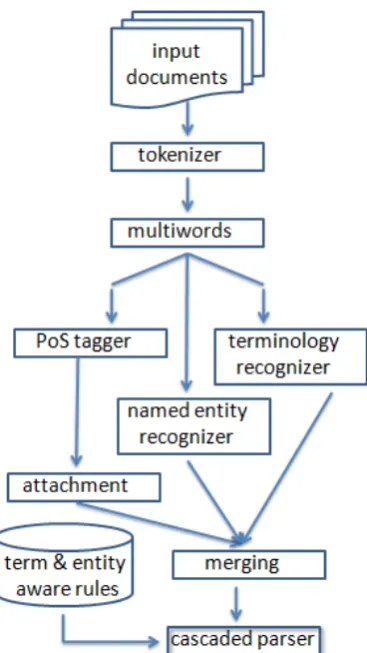
For the identification and labeling of noun phras-es we apply an easy-first parsing deterministic approach using state cascades. A finite-state cascade consists of a sequence of levels; phrases at one level are built on phrases at the previous level. Levels consist of rules, alias groups of patterns, ordered according to their internal complexity and length. A pattern con-sists of a category and a regular expression and parsing consists of a series of finite transduc-tions. Spans of input elements are reduced to a single element in each transduction; i.e. regular expressions are translated into finite-state auto-mata, the union of which yields a single, deter-ministic, finite-state, level recognizer; for further details of the approachcf.Abney (1997). We use an existing generic grammar for modern Swedish which has been evaluated for both basic noun phrases and functional labels in general language corpora, for the noun phrases the precision re-ported was 97.82% and recall 94.5% (butwithout resolved attachments); details are reported in Kokkinakis & Johansson Kokkinakis (1999). The workflow of all the various steps are shown in Figure 1; here "attachment" refers to nouns and adjectives while the "term & entity aware rules" are integrated in the parser.
Figure 1. The workflow of the parsing process.
3.2 Parsing Adaptation,Preliminaries Manual annotation of large amount of data with complex linguistic information, such as syntactic trees, is a costly enterprise, and means to remedy for this should be exploited. Moreover, since many parsers rely on several layers of represen-tation there are various possible ways to enhance their performance even in different domains than the one they have been designed for. Our metho-dology is motivated by the fact that parsing per-formance can be gained by applying and improv-ing on a number of pre-parsimprov-ing stages. The idea is that various morphosyntactic and semantic representation layers can pave the way of sub-stantial text complexity reduction as long as the parser can be madeawareof these layers. There-fore, by putting effort on various levels of repre-sentation (pre-processing) we can hypothesize, and actually show, that performance can be im-proved. Thus, we help the parser in such a way that it can avoid some hard decisions, e.g. brack-eting and structural ambiguities. We follow, and to a certain degree, extend the idea of Lease & Charniak (2005) discussed earlier. Our strategy is primarily based on four (domain) adaptations:
recognition of multiword expressions
recognition of medical terminology
recognition of named entities
attachment for nouns & adjectives.
In an indirect way, the recognition of terminolo-gy and named entities implies that multiword expressions are also recognized and the number of unknown words is reduced, while the lexical coverage increases. Consider for instance the examples: Drottning Silvias Barn- och Un-gdomssjukhus 'Queen Silvia Children's Hospital' in which 5 tokens constitute a coherent entity and the more complex: DIGAMI 1-studien (Di-abetes mellitus insulin glucose infusion in acute myocardial infarction 1) [3] visade att [...].'The DIGAMI-1 study [...] showed that [...]' in which 9 tokens constitute a single entity. Apart from the terminology recognition (and the manual addi-tion of domain vocabulary at the lexical re-sources we use) the rest are domain-independent adaptations.
3.3 Parsing Adaptation,Steps
Adaptations deal with the resolvement of at least some of the possible types of problems that can arise during parsing. For instance, we manage to dramatically increase the lexical coverage by efficiently dealing with unknown words, e.g., genre specific vocabulary. The majority of un-known words can be captured by the use of do-main terminologies. A number of individual terms from such terminologies have been incor-porated into the part-of-speech tagger's lexicon, for that purpose we use the TnT tagger (Brants, 2000). Similarly, for various types of multiword tokens, we have manually added a large number of common multiword function words (e.g., ad-verbs, preposition, determiners) in the part-of-speech tagger's lexicon2. While for the majority of other types of multiword expressions (i.e., terms and named entities) which are identified during terminology and named entity recogni-tion, possibly erroneous part-of-speech annota-tion does not have impact during parsing. For instance the part-of-speech annotation of the segment: en latent diabetes mellitus 'a latent di-abetes mellitus' becomes: en/DI@US@S la-tent/AQPUSNIS diabetes/NCUSN@IS melli-tus/XF (XF stands here as a tag for foreign
2Nivre & Nilsson (2004) have showed that significant
words) while the parsing of this segment (in a simplified form) becomes np: <en latent di-abetes> np: <mellitus>, that is two separate noun phrases. However, if we apply terminology recognition and then combine (in some suitable way) that information with the part-of-speech (e.g., by adding a feature to the part-of-speech) then we end with the following annotation: en/DI@US@S latent/AQPUSNIS diabetes/ NCUSN@IS-TRM-B mellitus/XF-TRM-I. The parser, being aware of these new features, will treat diabetesand mellitusas a unit (e.g., with a rule such as ART? ADJ* TERM+) and favorize the term annotation, since term and entity label features are given higher precedence compared to part-of-speech tags by the parser. In this case, the parser produces a correct phrasal constituent, one noun phrase, namely np-mdcn: <en latent diabetes mellitus>.
The following example will be used to illu-strate some of these steps in sections 3.3.1-3.3.3:
Malmö 22 januari 2008 - Nya data som publiceras idag styrker effektiviteten hos basinsulinet Levemir® (insulin dete-mir) som behandling en gång om dagen för personer med typ 2-diabetes.
Lit: "Malmö 22 January 2008 - New data pub-lished today, confirm the effectiveness of basal insulin Levemir® (insulin detemir) as a treat-ment once a day for people with type 2 di-abetes.".
3.3.1 Medical Terminology Recognition We use the SwedishSystematizedNomenclature ofMedicine,ClinicalTerms (SNOMED CT) for terminology recognition. Terminology is actually used for two reasons: (i) to improve the perfor-mance of the generic part-of-speech tagger and (ii) to actually aid the recognition of the termi-nology and consequently also the annotation of terms in text in which the parser has been mod-ified to be aware of. First, we extracted one-word terms (ca 30k) and semi-automatically added those with their full morphosyntactic description, to the part-of-speech tagger's backup lexicon. Using regular expressions over the suffixes of the terms we automatically added appropriate morphosyntactic descriptions and manually re-viewed a number of unmatched cases, usually Latin terms, which we added with the label for foreign words. Secondly, we performed termi-nology recognition and then merged the output to the representation format required by the parser, thus the parser becomes aware of the terminolo-gy in a single, simple step. The previously
men-tioned example follows below after terminology annotation (annotations are given between the XML tagsnomed with attributescconcept,h id-number and o original form). Note that for sim-plicity reasonsqualifier valueshave been filtered away:
Malmö 22 januari 2008 - Nya data som publiceras idag styrker effektiviteten hos <snomed c="substance" h="25305005" o="långtidsverkande insulin"> basinsuli-net</snomed> Levemir® (<snomed c= "sub-stance" h="414515005" o="detemir insu-lin">insulin detemir</snomed>) som be-handling en gång om dagen för personer med <snomed c="disorder" h="44054006"
o="diabetes mellitus typ 2">typ
2-diabetes</snomed>.
3.3.2 Named Entity Recognition
In exactly the same manner, as previously, we apply the generic named entity recognizer which also serves two important purposes. Firstly, to aid the recognition and annotation of single and multiword named entities and secondly, in an indirect way, to aid the appropriate recognition of (unknown) multiword expressions/tokens. The annotation of the previous example shown this time below illustrates how this type of annotation looks like. After named entity recognition the example sentence takes the following form:
<ENAMEX TYPE="LOC" SBT="PPL">Malmö </ENAMEX> <TIMEX TYPE="TME" SBT="DAT"> 22 januari 2008</TIMEX> - Nya data som publiceras <TIMEX TYPE="TME" SBT="DAT">
idag</TIMEX> styrker effektiviteten hos
basinsulinet <ENAMEX TYPE= "OBJ" SBT= "MDC">Levemir®</ENAMEX> (insulin dete-mir) som behandling <NUMEX TYPE="MSR" SBT="FRQ">en gång om dagen</NUMEX> för <ENAMEX TYPE="PRS" SBT="CLC">personer
</ENAMEX> med typ 2-diabetes.
In the above annotations, ENAMEX stands for a named entity, TIMEXfor a time entity and NU-MEX for a measure entity. All annotations pro-duce also two attributes (not used in the current study) namely main TYPE andSuBType; details are provided in Kokkinakis (2004).
of the tumor') and adjectives (such as resistent) which also take a contextually optional preposi-tional phrase as complement, e.g. resistent mot autokrint insulin 'resistant to autocrine insulin'. There is also a small number of nouns that show a semantic preference for two arguments, such as övergång 'transition, as in övergång från blod-glukos till plasma-glukos 'transition from blood-glucose to plasma blood-glucose'. This type of lexical information is applied after part-of-speech tag-ging using a contextually-driven filter that de-termines whether a suitable feature can be added to nouns' or adjective's part-of-speech annota-tion. This is a naïve but reliable way to capture lexical semantic preferences without a lot of ef-fort. Thus, in the example from section 3.3 there are two such tokens identified and annotated with the feature -VAL, for valency (attached to the appropriate nominal or adjectival heads); the morphosyntactic descriptions NCUSN@DS, NCUSN@IS stand for common nouns and SPS stands for a preposition, the tags for the rest of the words have been omitted for simplicity. The tagset we use is an extended version of the Swe-dish MULTEXT tagset3.
Malmö 22 januari 2008 - Nya data som publiceras idag styrker effektivite-ten/NCUSN@DS-VAL hos/SPS basinsulinet Levemir® (insulin detemir) som behand-ling/NCUSN@IS-VAL en gång om dagen
för/SPS personer med typ 2-diabetes.
3.3.2 Merging and Parsing Awareness
All results are merged into a uniform representa-tion. In order to make the parser aware of all the annotations we have added two new levels of manually written rules into the parser's original sequence of levels. Recall that each level con-tains a handful of rules, and phrases recognized by the rules of one level are built on phrases at the previous level. The two new levels, at the very beginning of the parser's level set, are used to only recognize and process the sequences of terminology and named entity annotations, labe-ling them as either noun phrases, e.g., np-location, np-disorder, or adverbial phrases, as in the case of time expressions. Examples of rules for these new levels and an example of parsing output are given in Appendix A&B. The parser provides several possible ways to produce output results. For instance, all features can be explicitly generated and in the example we can seelemma,
3<http://spraakbanken.gu.se/parole/tags.phtml> (last visited
in August 2011).
the base form of each token and semthe seman-tics (term or entity labels) or N/A (non-applicable) otherwise.
Note that each level is proceeded by abbre-viated bundles of enhanced part-of-speech tags, e.g., one mnemonic name for all adjectives (ADJ) or one for all possible location annotations (LOC-BandLOC-I). By this technique the actual rules become simpler, flexible and human reada-ble; examples are also given in Appendix B. This convention does not exclude the possibility to actually use a particular part-of-speech tag or even word in a rule, which implies that rules can be lexicalized i.e. use words in the production rules.
4
Results and Evaluation
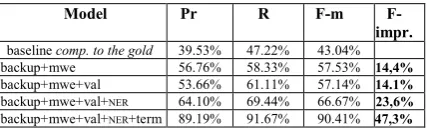
We performed a four-stage evaluation in order to measure the contribution of the adaptations to the overall performance of the results.
Model Pr R F-m
F-impr.
baselinecomp. to the gold 39.53% 47.22% 43.04% +backup+mwe 56.76% 58.33% 57.53% 14,4%
+backup+mwe+val 53.66% 61.11% 57.14% 14.1%
+backup+mwe+val+NER 64.10% 69.44% 66.67% 23,6%
[image:5.595.310.524.346.411.2]+backup+mwe+val+NER+term 89.19% 91.67% 90.41% 47,3%
Table 1: Evaluation results
We manually corrected the output of the auto-matic parsing withall adaptations and used it as a gold standard for the evaluation, using the 2008-version of the evalb software by Sekine & Collins with default values. The only change we made was to convert the parsing output in order to run evalb. Brackets, that the parser returns as delimiters, were converted to parentheses, that evalbrequires. The results in table 1 stand for:Pr bracketing precision, R bracketing recall, F bracketing f-measure and F-impr. for f-measure improvement.
5
Conclusions
To our knowledge there hasn't been any other report to use of parsing Swedish medical corpus of any type. Therefore any direct comparisons are difficult to make. With simple modifications, as shown in Table 1, the parser becomes aware of the different (shallow) semantic annotations produced during pre-processing. We believe of course that any type of parsing strategy can bene-fit from the integration of this type of annota-tions. The results show a substantial improve-ment of accuracy which can be attributed to a number of factors such as structural ambiguity reduction, increasing lexical coverage, enhanced processing of coordinative structures. For the future we intend to extend the subcategorizations to verbs, particularly since relevant Swedish lex-ical resources are available for that purpose. We also plan to adapt the rest of the original, generic parser in order to be able to support event-based information extraction from Swedish medical corpora.
Acknowledgments
This work is partially supported by the Centre for Language Technology (CLT) <http://clt.gu.se/>.
References
Abney S. 1997. Part-of-Speech Tagging and Partial Parsing. In Corpus-Based Methods in Language and Speech Processing. Young & Bloothooft (eds). 4:118-136. Kluwer.
Aubin S., Nazarenko A. and Nédellec C. 2005. Adapt-ing a general parser to a sublanguage. Recent Ad-vances in Natural Language Processing (RANLP) Pp. 89-93. Bulgaria.
Brants T. 2000. TnT: a statistical part-of-speech tag-ger. Sixth Conference on Applied NLP. Seattle, USA.
Grover C., Lapata M. and Lascarides A. 2005.A Comparison of Parsing Technologies for the Bio-medical Domain. Natural Language Engineering
11(1), 27-65, CUP.
Hogan D., Foster J. and van Genabith J. 2011. De-creasing Lexical Data Sparsity in Statistical Syn-tactic Parsing - Experiments with Named Entities. Proceedings of the ACL Workshop: Multiword Expressions: from Parsing and Generation to the Real World (MWE). Portland, USA
Huang Y., Lowe HJ., Klein D. and Cucina RJ. 2005. Improved Identification of Noun Phrases in Clini-cal Radiology Reports.. J Am Med Inform Assoc.
12(3): 275–285.
Kang N., van Mulligen EM. and Kors JA. 2010. Comparing and combining chunkers of biomedical text.J Biomed Inform.44(2):354-60. Epub Nov 4. Kim J-D., Ohta T. Tateisi Y. and Tsujii, J. 2003.
GE-NIA corpus - a semantically annotated corpus for bio-textmining.Bioinformatics. 19 Suppl 1:i180-2. Kokkinakis D. and Johansson Kokkinakis S. 1999. A
Cascaded Finite-State Parser for Syntactic Analysis of Swedish. 9th European Chapter of the Associa-tion of ComputaAssocia-tional Linguistics (EACL). 245-248. Norway.
Kokkinakis D. 2004. Reducing the Effect of Name Explosion.Workshop: Beyond Named Entity Rec-ognition, Semantic Labelling for NLP tasks. In conjunction with the 4th Language Resources and Evaluation Conference (LREC). Lisbon, Portugal. Kokkinakis D. and Gerdin U. 2010. A Swedish
Scien-tific Medical Corpus for Terminology Management and Linguistic Exploration. Seventh Language Re-sources and Evaluation Conference (LREC). Malta. Lease M. and Charniak E. 2005. Parsing Biomedical Literature. Second International Joint Conference on Natural Language Processing. 58-69. Korea. Leroy G., Chen H. and Martinez J.D. 2003. A shallow
parser based on closed-class words to capture rela-tions in biomedical text. J Biomed Inform.
36(3):145-58.
Ljunglöf P. and Wirén M. 2010. Syntactic Parsing. In
Handbook of Natural Language Processing, 2nd edition. Indurkhya N. and Damerau FJ. (eds). Pp. 59-91. CRC Press.
Nivre J. 2005. Dependency Grammar and Dependen-cy Parsing. Technical Report. Växjö University. Nivre J. and Nilsson, J. 2004, Multiword Units in
Syntactic Parsing. MEMURA 2004 workshop. pp. 39-46. Lisbon
Ohta T., Tateisi Y. and Tsujii J. 2005. Syntax Annota-tion for the GENIA corpus. IJCNLP, pp. 222-227. Korea.
Pyysalo S. 2008.A Dependency Parsing Approach to Biomedical Text Mining. Turku Centre for Com-puter Science. TUCS Dissertations: 105, U of Tur-ku, Finland.
Rimell L. and Clark S. 2009. Porting a lexicalized-grammar parser to the biomedical domain. J of Biomed Inf. 42:5.
Rinaldi F., Schneider G., Kaljurand K. and Hess, M. 2008. Dependency-Based Relation Mining for Biomedical Literature. Sixth Language Resources and Evaluation Conference (LREC). Morocco.
Sekine S. and Collins MJ. 2008. EVALB.
Thompson P., Iqbal SA. McNaught J. and Ananiadou S. 2009. Construction of an annotated corpus to support biomedical information extraction. BMC Bioinformatics, 10:349.
APPENDIX A
Wattarujeekrit T, Shah PK. and Collier N. 2004. PASBio: predicate-argument structures for event extraction in molecular biology.BMC Bioinformat-ics.19;5:155.