Semantic distance and terminology structuring methods for the
detection of semantically close terms
Marie Dupuch
CNRS UMR 8163 STL Universit´e Lille 1&3 59653 Villeneuve d’Ascq, France
La¨etitia Dupuch
Universit´e Toulouse III Paul Sabatier France
Thierry Hamon
LIM&BIO (EA3969) UFR SMBH Universit´e Paris 13, France [email protected]
Natalia Grabar
CNRS UMR 8163 STL Universit´e Lille 1&3 59653 Villeneuve d’Ascq, France [email protected]
Abstract
The identification of semantically similar lin-guistic expressions despite their formal differ-ence is an important task within NLP appli-cations (information retrieval and extraction, terminology structuring...) We propose to de-tect the semantic relatedness between biomed-ical terms from the pharmacovigilance area. Two approaches are exploited: semantic dis-tance within structured resources and termi-nology structuring methods applied to a raw list of terms. We compare these methods and study their complementarity. The results are evaluated against the reference pharmacovigi-lance data and manually by an expert.
1 Introduction
When an automatic system is able to identify that different linguistic expressions convey the same or similar meanings, this is a positive point for several applications. For instance, when documents refer-ring to muscle pain or cephalgiaare searched, in-formation retrieval system can also take advantage of the synonyms, like muscle acheorheadache, to return more relevant documents and in this way to increase the recall. This is also a great advantage for systems designed for instance for text mining, terminology structuring and alignment, or for more specific tasks such as pharmacovigilance.
The pharmacovigilance area covers the identifi-cation of adverse drug reactions (ADRs) in order to improve the vigilance on the health products. Pharmacovigilance reports are traditionally encoded with normalised terms from the dedicated termi-nologies, such as MedDRA (Medical Dictionary for
Drug Regulatory Activities) (Brown et al., 1999). MedDRA is a relatively fine-grained terminology with nearly 90,000 terms. This means that a given pharmacovigilance report can be coded with dif-ferent terms which have close meaning (Fescharek et al., 2004), like muscle pain and muscle acheor
headache andcephalgia: although formally differ-ent the terms from these pairs have the same mean-ing. The difficulty is then to detect their semantic closeness. Indeed, if this semantic information is available, reports from the phramacovigilance data-banks and mentionning similar adverse events can be aggregated: the safety signal is intensified and the safety regulation process is improved.
In order to aggregate the pharmacovigilance re-ports, several types of semantic information from MedDRA are used: (1)different hierarchical levels of MedDRA between the five levels available; (2) the SMQs (Standardized MedDRA Queries) which group together terms associated to a given medical condition such asAcute renal failure, Angioedema
orEmbolic and thrombotic events; and(3)specific resources (Bousquet et al., 2005; Iavindrasana et al., 2006; Alecu et al., 2008; Jaulent and Alecu, 2009). The SMQs are defined by groups of experts through a long and meticulous work consisting of the man-ual study of the MedDRA structure and of the anal-ysis of the scientific literature (CIOMS, 2004). 84 SMQs have been created so far. They become the gold standard data of the pharmacovigilance area. However, the SMQs currently suffer from the lack of exhausitivity (Pearson et al., 2009): the set of SMQs is not exhaustive because this is an ongoing work. We assume that automatic approaches can be
ploited to systematize and accelerate the process of recruiting the semantically related MedDRA terms and to build the SMQs. We propose to exploit two approaches: methods dedicated to the terminology structuring and semantic distance approaches. We compare and combine the generated results. For the evaluation, we compare the results with the existing SMQs and also analyse them manually with an ex-pert. Our work is different from previous work be-cause we exploit the whole set of the available Med-DRA terms, we apply several methods to cluster the terms and we perform several types of evaluation.
2 Material
We exploit two kinds of material: material issued from MedDRA and specific to the pharmacovigi-lance area (sections 2.1 and 2.3), and linguistic re-sources issued from general and biomedical lan-guages (section 2.2). The MedDRA terms are struc-tured into five hierarchical levels: SOC(System Or-gan Class) terms belong to the first and the high-est level, whileLLT(Lowest Level Terms) terms be-long to the fifth and the lowest level. Terms from the fourth levelPT(Preferred Terms) are usually ex-ploited for the coding of the pharmacovigilance re-ports. They are also used for the creation of SMQs. A given PT term may belong to several SMQs.
2.1 Ontology ontoEIM
ontoEIM is an ontology of ADRs (Alecu et al., 2008) created through the projection of MedDRA to SNOMED CT (Stearns et al., 2001). This projec-tion is performed thanks to the UMLS (NLM, 2011), where an important number of terminologies are al-ready merged and aligned, among which MedDRA and SNOMED CT. The current rate of alignment of thePTMedDRA terms with SNOMED CT is weak (version 2011): 51.3% (7,629 terms). Projection of MedDRA to SNOMED CT allows to improve the representation of the MedDRA terms:
• the structure of the MedDRA terms is parallel to that of SNOMED CT, which makes it more fine-grained (Alecu et al., 2008). The num-ber of hierarchical levels within the ontoEIM reaches 14, instead of five levels in MedDRA;
• the MedDRA terms receive formal defini-tions: semantic primitives which decompose
the meaning. MedDRA terms can be described along up to four axes from SNOMED CT, ex-emplified here through the termArsenical ker-atosis: (1) Morphology (type of abnormal-ity): Squamous cell neoplasm; (2) Topogra-phy (anatomical localization): Skin structure; (3)Causality(agent or cause of the abnormal-ity): Arsenic AND OR arsenic compound; and (4)Expression(manifestation of the abnormal-ity):Abnormal keratinization. The formal def-initions are not complete. For instance, only 12 terms receive formal definitions along these four axes and 435 along three axes. This is due to the incomplete alignment of the MedDRA terms and to the fact these four elements are not relevant for every term (their absence is not always problematic).
2.2 Linguistic resources
Linguistic resources provide three kinds of pairs of synonym words: (1) Medical synonyms ex-tracted from the UMLS 2011AA (n=228,542) and then cleaned up (n=73,093); (2) Medical syn-onyms acquired from three biomedical terminolo-gies thanks to the exploitation of their composition-ality (Grabar and Hamon, 2010) (n=28,691); (3) Synonyms from the general language provided by WordNet (Fellbaum, 1998) (n=45,782). Among the pairs of words recorded in these resources, we can find {accord, concordance}, {aceperone, ac-etabutone}, {adenazole,tocladesine},{adrenaline,
epinephrine} or{bleeding, hemorrhage}. The last two pairs are provided by medical and general re-sources. However, the pair{accord, concordance} is provided only by medical resources.
2.3 Standardized MedDRA Queries
We exploit 84 SMQs as reference data. Among these SMQs, we distinguish 20 SMQs which are struc-tured hierarchically. We also exploit 92 sub-SMQs, which compose these 20 hierarchical SMQs.
3 Methods
re-Abdominal abscess
Abdominal cavity T Abscess morphology
M
Pharyngal abscess
M Neck structure
T
... ...
... ...
... ... ... ... ... ... ... ... ...
1
o
o o
6
5
o2
o3
o
7
4
o
POS−tagging Syntactic analysis
Detection of hierarchical relations
Detection of synonymy relations ontoEIM resource (Zhong et al, 2002)
(Leacock & Chodorow, 1998)
Computing of the semantic distance Clustering of MedDRA terms and similarity
Term structuring
Lexical inclusion
Synoterm + resources Genia tagger
Ogmios platform
YaTeA Pre−processing
Merging of the clusters
Clustering within directed graphs
Evaluation Radius
HAC (with the R project)
SMQs
Hierarchical SMQs sub−SMQs
Semantic distance and similarity approaches
Terminology structuring approach
(Rada et al, 1989)
Strongly connected components Faster
Faster Raw list of
[image:3.612.76.536.50.282.2]MedDRA terms
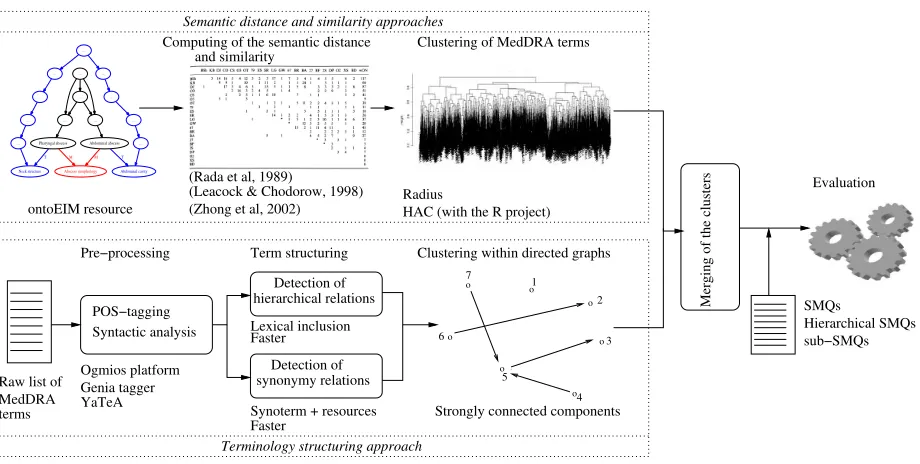
Figure 1: General schema of the experiment composed of four steps: (1) semantic distance approaches, (2) terminology structuring approaches, (3) their combination and (4) their evaluation
lations between MedDRA terms and their cluster-ing (section 3.2),(3)the merging of these two sets of clusters (section 3.3), (4) the evaluation of the merged clusters (section 3.4). We exploit Perl lan-guage,R1project and several NLP tools.
3.1 Semantic distance approach
The semantic distance and similarity approach is ap-plied to the 7,629PTMedDRA terms and their for-mal definitions from ontoEIM. The two main steps are: computing the distance or similarity (section 3.1.1) and clustering of terms (section 3.1.2).
3.1.1 Computing the semantic distance
Because we work with a tree-structured resource, we exploit edge-based algorithms to compute the distance or similarity between two termst1andt2: two semantic distances (Rada (Rada et al., 1989) and Zhong (Zhong et al., 2002)) and one seman-tic similarity (Leacock and Chodorow, 1998). In the following, we call them semantic distance al-gorithms. For each algorithm, three paths may be exploited: between the MedDRA terms but also be-tween the elements of their formal definitions on two axes (morphology M and topography T often involved in diagnostics (Spackman and Campbell,
1http://www.r-project.org
1998)). For the illustration, let’s consider two Med-DRA terms,Abdominal abscessandPharyngeal ab-scessdefined as follows:
• Abdominal abscess:M =Abscess morphology,
T=Abdominal cavity structure
• Pharyngeal abscess: M = Abscess morphol-ogy,T =Neck structure
The shortest pathssp are computed between these two MedDRA terms and between their formal defi-nitions, whose hierarchical structure is also inherited from SNOMED CT. The weight of edges is set to1 because all the relations are of the same kind (hier-archical), and the value of each shortest path corre-sponds to the sum of the weights of all its edges. The semantic distancesdare then exploited to compute the unique distance between the ADR terms from
MedDRA:
X
i∈{ADR,M,T}
Wi∗sdi(t1, t2)
X
i∈{ADR,M,T}
Wi
, where the
three axes {ADR, M, T} respectively correspond to terms meaning the ADR, axis Morphology M
and axis Topography T; t1 and t2 are two ADR terms; Wi is the coefficient associated with each
of the three axes; and sdi is the semantic distance
ex-head
component component
expansion head
component component expansion
pain muscle ache muscle
Figure 2: Syntactically analyzed terms (muscle painandmuscle ache) into their head and expansion components
periments. Semi-matrices 7629*7629 with semantic distance between the terms are built.
3.1.2 Clustering of terms
An unsupervised creation of clusters is applied to the semi-matrices. We exploit two approaches:
• R radius approach: every MedDRA term is considered a possible center of a cluster and its closest terms are clustered with it. The thresh-olds tested correspond to the following inter-vals: 2 and 3 forRada, [0; 5.059] forLCHand [0; 0.49] forZhong. The intersection of these clusters is not empty.
• HAC hierarchical ascendant classification is performed through theR Project tools (hclust
function). Iteratively, this function chooses the best centers for terms and builds the hierar-chy of terms by progressively clustering those which are closest to these centers. Then the unique cluster with all the terms is split up. Several splitting values between 100 and 7,000 are tested. These clusters are exclusive.
Clusters created with the radius approach are merged in order to eliminate smaller clusters in-cluded in bigger clusters and in order to aggregate clusters which have an important intersection be-tween them. For the intersection, we test several in-tersection values within the interval [10; 90], which means that two compared clusters may have between 10% and 90% of common terms.
3.2 Terminology structuring approach
The terminology structuring methods are applied to a raw list of 18,209 MedDRA PTs. They allow the detection of semantic relations between these terms. The POS-tagging is done with Genia tag-ger (Tsuruoka et al., 2005) and the syntactic analy-sis with the YATEA parser (Aubin and Hamon, 2006). Three kinds of methods are applied for the acquisi-tion of synonymy and hierarchical relaacquisi-tions: lexical inclusions (section 3.2.1), morpho-syntactic variants
(section 3.2.2) and compositionality (section 3.2.3). The terms are then clustered (section 3.2.4).
3.2.1 Lexical inclusion and hierarchy
The lexical inclusion hypothesis (Kleiber and Tamba, 1990), which states that when a given term is lexically included at the head syntactic position in another term there is a semantic subsumption be-tween them, allows to identify hierarchical relations between terms. For instance, on figure 2, the short termpainis the hierarchical parent and the long term
muscle painis its hierarchical child becausepainis the syntactic head ofmuscle pain. The lexical inclu-sions are computed on POS-tagged and syntactically analyzed terms. We compute two kinds of lexical in-clusions:
• syntactic dependencies on minimal syntactic heads: the parent term corresponds to the short-est lexical form of the syntactic head. For in-stance, within the termkaolin cephalin clotting time, the minimal head istime;
• syntactic dependencies on maximal syntactic heads: the parent term is the most complete lex-ical form of the syntactic head. Within the same termkaolin cephalin clotting time, the maximal head iscephalin clotting time.
Parent and child terms have to be MedDRA terms.
3.2.2 Morpho-syntactic variants
be ambiguous: gland abscess and abscess of sali-vary gland combines permutation (synonymy) and insertion (hierarchy) rules. In such cases the hierar-chical relation prevails.
3.2.3 Compositionality and synonymy
The synonymy relations are acquired in two ways. First, the synonymy relation is established between two simple MedDRA terms if this relation is pro-vided by the linguitistic resources. Second, the identification of synonym relations between com-plex terms relies on the semantic compositionality (Partee, 1984). Hence, two complex terms are con-sidered synonyms if at least one of their compo-nents at the same syntactic position (head or ex-pansion) are synonyms. For instance, on figure 2, given the synonymy relation between the two words
pain and ache, the terms muscle pain and muscle ache are also identified as synonyms (Hamon and Nazarenko, 2001). Three transformation rules are applied: on the head component (figure 2), on the expansion component and on both of them. We per-form several experiments: each medical synonymy resource is first used individually and then in com-bination with WordNet.
3.2.4 Clustering of terms
The sets of terms related through the lexical in-clusions are considered as directed graphs: the terms are the nodes of the graph while the hierarchical re-lations are the directed edges. We partition these di-rected graphs and identify clusters of terms which could correspond to or be part of the SMQs. Among connected components and strongly connected com-ponents, we choose to generate the strongly con-nected components: they allow an intersection be-tween clusters which means that a given term may belong to several clusters (this is also the case with the SMQs). Thus, within the directed graphsGwe have to identify the maximal sub-graphs H of G
where for each pair {x, y} of the nodes from H, there exists a directed edge fromxtoy(or fromyto
x). To improve the coverage of the obtained clusters, we also add the synonyms: if a term has a synonymy relation with the term from a cluster then this term is also included in this cluster. From a graph theory point of view, the initial graph is augmented with two edges going from and to the synonyms.
Methods and relationships #relations Hierarchical relations
Maximal syntactic head 3,366
Minimal syntactic head 3,816
Morpho-syntactic variants 743
Medical synonyms
3 biomedical terminologies 1,879
UMLS/Filtered UMLS 190
Morpho-syntactic variants 100
Medical synonyms and WordNet
3 biomedical terminologies 1,939
[image:5.612.320.533.53.219.2]UMLS/Filtered UMLS 227
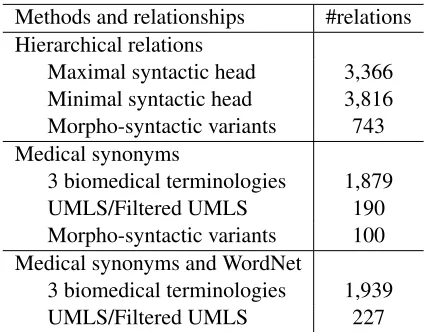
Table 1: Hierarchical and synonymy relations generated by terminology structuring methods
3.3 Merging of clusters from two approaches
We merge the clusters generated by the two ap-proaches. The merging is performed on the inter-section between the clusters. As previously, we test intersection values within the interval [10; 90].
3.4 Evaluation
We give judgments on: (1) the correctness of the generated relations,(2)their relevance according to the reference data,(3) their relevance according to the manual evaluation by an expert. The evaluation is performed with three measures: precisionP (per-centage of the relevant terms clustered divided by the total number of the clustered terms), recall R
(percentage of the relevant terms clustered divided by the number of terms in the corresponding SMQ) and F-measure F1. The association between the SMQs and the clusters relies on the bestF1.
4 Results
Approach Hierarchical SMQs SMQs and sub-SMQs #clusters interval mean #clusters interval mean
Semantic distance 2,667 [2; 1,206] 73 2,931 [2; 546] 17
Structuring (hierarchical) 690 [1; 134] 3.69 748 [1; 117] 3.43
Structuring (hierarchical+synonymy) 690 [1; 136] 4.11 748 [1; 119] 3.82
Merging (hierarchical) 2,732 [1; 1,220] 72.40 2,998 [1; 563] 24.44
[image:6.612.80.535.54.152.2]Merging (hierarchical+synonymy) 2,732 [1; 1,269] 75.94 2,998 [1; 594] 26.03
Table 2: Number of clusters and their size (the interval and the mean number of terms per cluster) for individual approaches and for their merging computed for hierarchical SMQs and also for SMQs and sub-SMQs
0 20 40 60 80 100
0 10 20 30 40 50 60 70 80
precision recall f−measure
(a) Semantic distance
0 20 40 60 80 100
0 10 20 30 40 50 60 70 80
precision recall f−measure
(b) Terminology structuring
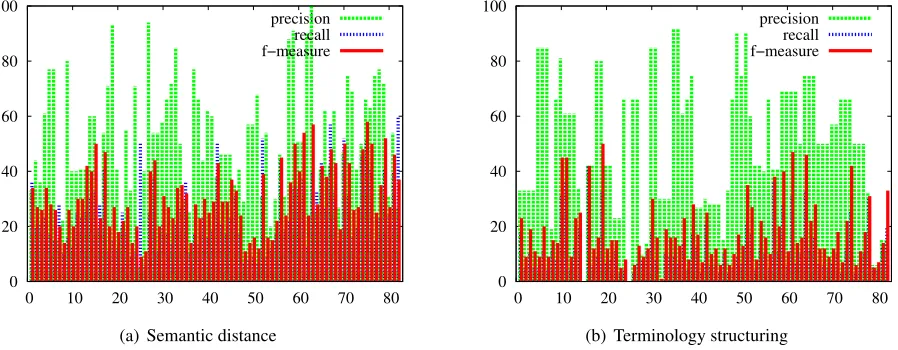
Figure 3: Results (precision, recall and F-measure) for semantic distance and terminology structuring approaches
4.10 forLCHand 0 forZhong. With the HAC, the best results are obtained with 300 classes (number of terms per class is within the interval [1; 98], mean number of terms per class is 25.34). Our results show that the best parameters for the semantic dis-tance are the Rada disdis-tance, radius approach and no formal definitions, while the best parameters for the terminology structuring are maximal syntactic head with hierarchical relations by Faster augmented with synonyms. For the merging of the clusters we apply 50% intersection for hierarchical SMQs and 80% in-tersection for SMQs and sub-SMQs. We exploit and discuss these results. The percentage of the Med-DRA terms involved by the terminology structur-ing is the 32% with hierarchical relations, it reaches 40% when the synonymy is also considered. With semantic distance, all the terms from ontoEIM (51% of the MedDRA) are used.
Table 2 provides information on clusters:
num-ber of clusters, numnum-ber of terms per cluster (their interval and the mean number of terms per cluster). In table 2, we first indicate the results for the indi-vidual approaches, and then when the merging of the approaches is performed. We observe that the merging has a positive effect on the number and the size of clusters: data generated by the individual ap-proaches (and by synonymy) are complementary.
4.1 Correctness of the semantic relations
[image:6.612.90.539.212.387.2]0 20 40 60 80 100
0 10 20 30 40 50 60 70 80
[image:7.612.89.294.60.213.2]precision recall f−measure
Figure 4: Results (precision, recall and F-measure) ob-tained when the two approaches are merged
pair, there is an ambiguity on drug as two de-pendencies seem possible: {anticonvulsant drug level, drug level} as proposed by the system and {anticonvulsant drug level,level}. But whatever the syntactic analysis performed, the semantic relations are correct.
4.2 Relevance of the generated clusters
Figures 3 and 4 provide quantitative evaluation of the clusters: semantic distance (figure 3(a)), termi-nology structuring (figure 3(b)), merging of these two sets (figure 4). On figure 3, we can observe that there is a great variability among the SMQs and the two approaches. The positive result is that these approaches are indeed complementary: their merg-ing slightly increases performance. An analysis of the clusters generated with terminology structuring shows that:(1)hierarchical relations form the basis of the clusters: they correspond to 96% of the in-volved terms and show 69% precision. Only three clusters do not contain hierarchical relations; (2) Faster relations are involved in 50% of clusters and show precision between 75 and 85%;(3) one third of the clusters contains synonymy relations, which precision varies between 55 and 69%;(4)relations acquired with the UMLS resources are involved in 14% of clusters while their precision is only 38%.
We also performed a detailed qualitative analysis of several SMQs and clusters with an expert. Table 3 presents the analysis for three SMQs: Angioedema,
Embolic and thrombotic events, arterialand
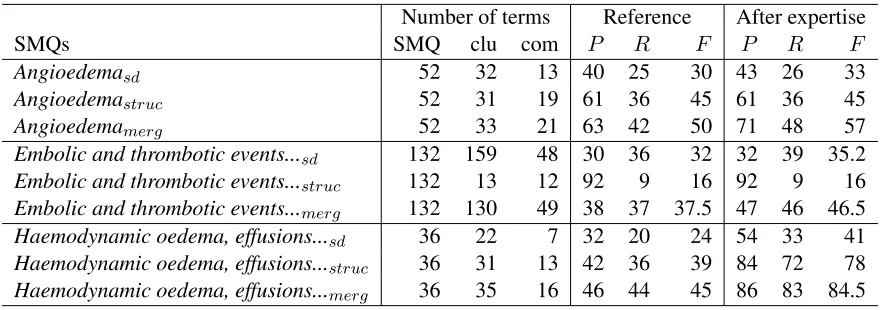
Haemo-dynamic oedema, effusions and fluid overload. It indicates the number of terms in the SMQ and in the corresponding clustersclu, as well as the num-ber of common terms between them com and the performance (precisionP, recall R and F-measure
F) when computed against the reference data Ref-erenceand also after the analysis performed by the expert After expertise. The results obtained with the two approaches are indicated: semantic dis-tancesdand terminology structuringstruc, as well as their merging merg. In the colums Reference, we can observe that the best F-measure values are obtained with the terminology structuring method for the SMQHaemodynamic oedema, effusions and fluid overload(F=45) and with the semantic distance for the SMQEmbolic and thrombotic events, arte-rial(F=32). The merging of the two methods sys-tematically improves the results: in the given exam-ples, for all three SMQs.
A detailed analysis of the generated noise indi-cates that across the SMQs we have similar situa-tions: we generate false positives (terms non rele-vant for the medical conditions, such asPulmonary oedema, Gestational oedema, Spinal cord oedema
for the SMQAngioedema), but also the SMQs may contain non relevant terms or may miss relevant terms (thus, Testicular oedema, Injection site ur-ticaria, Bronchial eodemaare missing in the SMQ
Angioedema). The expert evaluation (columns Af-ter expertisein table 3) attempts to analyse also the quality of the SMQs. The corrected performance of the clusters is improved in several points, which indicates that automatic approaches may provide a useful basis for the creation of SMQs.
5 Discussion
Number of terms Reference After expertise
SMQs SMQ clu com P R F P R F
Angioedemasd 52 32 13 40 25 30 43 26 33
Angioedemastruc 52 31 19 61 36 45 61 36 45
Angioedemamerg 52 33 21 63 42 50 71 48 57
Embolic and thrombotic events...sd 132 159 48 30 36 32 32 39 35.2
Embolic and thrombotic events...struc 132 13 12 92 9 16 92 9 16
Embolic and thrombotic events...merg 132 130 49 38 37 37.5 47 46 46.5
Haemodynamic oedema, effusions...sd 36 22 7 32 20 24 54 33 41
Haemodynamic oedema, effusions...struc 36 31 13 42 36 39 84 72 78
[image:8.612.86.526.53.208.2]Haemodynamic oedema, effusions...merg 36 35 16 46 44 45 86 83 84.5
Table 3: Comparison between the two approaches (semantic distancesdand terminology structuringstruc) and the merging of the two approaches merg for three SMQs: Angioedema, Embolic and thrombotic events, arterialand
Haemodynamic oedema, effusions and fluid overload
Traditionnal classification methods, which produce disjoint clusters, are less efficient for this task.
It has been surprising to observe that the contri-bution of the generated hierarchical relations is so important (table 1) and that these relations appear to be so often correct for the creation of SMQs. In-deed, because PT terms belong to the same hierar-chical level of MedDRA, they should be hierarchi-cally equivalent between them. In reality, within a cluster, we can find several hierarchical levels of the PT terms. This means that the hierarchical structure of MedDRA could be more fine-grained and that in-termediate hierarchical levels could be created. As for the generated synonymy relations, their number is low and they contribute in a lesser way to the building of the clusters: this means that the PTs are semantically differentiated between them.
Finally, the merging of these two approaches is beneficial for the generation of clusters: the per-formance is improved, although slightly. The two approaches provide indeed complementary results. The low recall and F-measure are due to the material and methods exploited: ontoEIM contains only 51% of the MedDRA terms to be processed while the ex-ploited terminology structuring methods are not able to detect more common features between the terms.
The difference between the results obtained against the reference data and after the expert eval-uation (table 3) show that the reference data are not very precise. In previous work, it has already been observed that some important PT terms can be
miss-ing in the SMQs (Pearson et al., 2009). With the proposed automatic methods we could find some of these terms. It has been also demonstrated that the SMQs are over-inclusive (Mozzicato, 2007; Pear-son et al., 2009). In the proposed analysis of the SMQs, we have also found terms which have too large meaning and which should not be included in the SMQs.
6 Conclusion and Perspectives
acquisi-tion and evaluaacquisi-tion of the hierarchical structure of SMQs. We plan also to design corpora-based meth-ods which may also to increase the recall of the re-sults. We will perform an exhaustive analysis of the nature of semantic relations which can be observed within the SMQs and propose other methods to fur-ther improve the coverage of the clusters. Different filters will be tested to remove the true false posi-tive relations between terms. The results will also be evaluation by several experts, which will allow to assess the inter-expert variation and its influence on the results. Besides, the obtained clusters will also be evaluated through their impact on the pharma-covigilance tasks and through the exploring of the pharmacovigilance databases.
References
I Alecu, C Bousquet, and MC Jaulent. 2008. A case report: using snomed ct for grouping adverse drug re-actions terms. BMC Med Inform Decis Mak, 8(1):4–4. S Aubin and T Hamon. 2006. Improving term extrac-tion with terminological resources. InFinTAL 2006, number 4139 in LNAI, pages 380–387. Springer. C Bousquet, C Henegar, A Lillo-Le Lou¨et, P Degoulet,
and MC Jaulent. 2005. Implementation of auto-mated signal generation in pharmacovigilance using a knowledge-based approach. Int J Med Inform, 74(7-8):563–71.
EG Brown, L Wood, and S Wood. 1999. The medical dictionary for regulatory activities (MedDRA). Drug Saf., 20(2):109–17.
CIOMS. 2004. Development and rational use of stan-dardised MedDRA queries (SMQs): Retrieving ad-verse drug reactions with MedDRA. Technical report, CIOMS.
C Fellbaum. 1998. A semantic network of english: the mother of all WordNets. Computers and Humanities. EuroWordNet: a multilingual database with lexical
se-mantic network, 32(2-3):209–220.
R Fescharek, J K¨ubler, U Elsasser, M Frank, and P G¨uthlein. 2004. Medical dictionary for regulatory activities (MedDRA): Data retrieval and presentation.
Int J Pharm Med, 18(5):259–269.
N Grabar and T Hamon. 2010. Exploitation of linguis-tic indicators for automalinguis-tic weighting of synonyms induced within three biomedical terminologies. In
MEDINFO 2010, pages 1015–9.
T Hamon and A Nazarenko. 2001. Detection of syn-onymy links between terms: experiment and results.
In Recent Advances in Computational Terminology,
pages 185–208. John Benjamins.
J Iavindrasana, C Bousquet, P Degoulet, and MC Jaulent. 2006. Clustering WHO-ART terms using semantic distance and machine algorithms. InAMIA Annu Symp Proc, pages 369–73.
Christian Jacquemin. 1996. A symbolic and surgical ac-quisition of terms through variation. In S. Wermter, E. Riloff, and G. Scheler, editors,Connectionist, Sta-tistical and Symbolic Approaches to Learning for
Nat-ural Language Processing, pages 425–438, Springer.
MC Jaulent and I Alecu. 2009. Evaluation of an ontolog-ical resource for pharmacovigilance. InStud Health Technol Inform, pages 522–6.
G Kleiber and I Tamba. 1990. L’hyperonymie revisit´ee : inclusion et hi´erarchie.Langages, 98:7–32, juin. C Leacock and M Chodorow, 1998. Combining local
context and WordNet similarity for word sense iden-tification, chapter 4, pages 305–332.
P Mozzicato. 2007. Standardised MedDRA queries: their role in signal detection. Drug Saf, 30(7):617–9. NLM, 2011. UMLS Knowledge Sources Manual.
Na-tional Library of Medicine, Bethesda, Maryland. www.nlm.nih.gov/research/umls/.
Barbara H. Partee. 1984. Compositionality. In F. Land-man and F. VeltLand-man, editors, Varieties of formal se-mantics. Foris, Dordrecht.
RK Pearson, M Hauben, DI Goldsmith, AL Gould,
D Madigan, DJ O’Hara, SJ Reisinger, and
AM Hochberg. 2009. Influence of the
Med-DRA hierarchy on pharmacovigilance data mining results.Int J Med Inform, 78(12):97–103.
R Rada, H Mili, E Bicknell, and M Blettner. 1989. De-velopment and application of a metric on semantic nets. IEEE Transactions on systems, man and cyber-netics, 19(1):17–30.
K Spackman and K Campbell. 1998.
Composi-tional concept representation using SNOMED: To-wards further convergence of clinical terminologies.
In Journal of American Medical Informatics
Associ-ation (JAMIA), pages 740–744.
MQ Stearns, C Price, KA Spackman, and AY Wang. 2001. SNOMED clinical terms: overview of the de-velopment process and project status. InAMIA, pages 662–666.
Y Tsuruoka, Y Tateishi, JD Kim, T Ohta, J McNaught, S Ananiadou, and J Tsujii. 2005. Developing a ro-bust part-of-speech tagger for biomedical text. LNCS, 3746:382–392.
J Zhong, H Zhu, J Li, and Y Yu. 2002. Concep-tual graph matching for semantic search. In 10th International Conference on Conceptual Structures,
ICCS2002, LNCS 2393, Springer Verlag, pages 92–