Ecological Validity and the Evaluation of Speech Summarization Quality
Anthony McCallum
Cosmin Munteanu
University of Toronto National Research Council Canada
40 St. George Street 46 Dineen Drive
Toronto, ON, Canada Fredericton, NB, Canada
[email protected] [email protected]
Gerald Penn
Xiaodan Zhu
University of Toronto National Research Council Canada
40 St. George Street 1200 Montreal Road
Toronto, ON, Canada Ottawa, ON, Canada
[email protected] [email protected]
Abstract
There is little evidence of widespread adoption of speech summarization systems. This may be due in part to the fact that the natural language heuristics used to generate summaries are often optimized with respect to a class of evaluation measures that, while computationally and experimentally inex-pensive, rely on subjectively selected gold stand-ards against which automatically generated sum-maries are scored. This evaluation protocol does not take into account the usefulness of a summary in assisting the listener in achieving his or her goal. In this paper we study how current measures and methods for evaluating summarization systems compare to human-centric evaluation criteria. For this, we have designed and conducted an ecologic-ally valid evaluation that determines the value of a summary when embedded in a task, rather than how closely a summary resembles a gold standard. The results of our evaluation demonstrate that in the domain of lecture summarization, the well-known baseline of maximal marginal relevance (Carbonell and Goldstein, 1998) is statistically sig-nificantly worse than human-generated extractive summaries, and even worse than having no sum-mary at all in a simple quiz-taking task. Priming seems to have no statistically significant effect on the usefulness of the human summaries. In addi-tion, ROUGE scores and, in particular, the context-free annotations that are often supplied to ROUGE
as references, may not always be reliable as inex-pensive proxies for ecologically valid evaluations. In fact, under some conditions, relying exclusively on ROUGE may even lead to scoring human-gen-erated summaries that are inconsistent in their use-fulness relative to using no summaries very favour-ably.
1 Background and Motivation
Summarization maintains a representation of an entire spoken document, focusing on those utter-ances (sentence-like units) that are most important and therefore does not require the user to process everything that has been said. Our work focuses on extractive summarization where a selection of ut-terances is chosen from the original spoken docu-ment in order to make up a summary.
Current speech summarization research has made extensive use of intrinsic evaluation meas-ures such as F-measure, Relative Utility, and ROUGE (Lin, 2004), which score summaries against subjectively selected gold standard sum-maries obtained using human annotators. These an-notators are asked to arbitrarily select (in or out) or rank utterances, and in doing so commit to relative salience judgements with no attention to goal ori-entation and no requirement to synthesize the meanings of larger units of structure into a coher-ent message.
Given this subjectivity, current intrinsic evalu-ation measures are unable to properly judge which summaries are useful for real-world applications. For example, intrinsic evaluations have failed to show that summaries created by algorithms based on complex linguistic and acoustic features are bet-ter than baseline summaries created by simply choosing the positionally first utterances or longest utterances in a spoken document (Penn and Zhu, 2008). What is needed is an ecologically valid evaluation that determines how valuable a sum-mary is when embedded in a task, rather than how closely a summary matches the subjective utter-ance level scores assigned by annotators.
Ecological validity is "the ability of experiments to tell us how real people operate in the real world" (Cohen, 1995). This is often obtained by using hu-man judges, but it is important to realize that the mere use of human subjects provides no guarantee as to the ecological validity of their judgements. When utterances are merely ranked with numerical scores out of context, for example, the human judges who perform this task are not performing a task that they generally perform in their daily lives, nor does the task correspond to how they would create or use a good summary if they did have a need for one. In fact, there may not even be a guar-antee that they understand the task --- the notions of “importance,” “salience” and the like, when de-fining the criterion by which utterances are selec-ted, are not easy to circumscribe. Judgements ob-tained in this fashion are no better than those of the generative linguists who leaned back in their arm-chairs in the 1980s to introspect on the grammatic-ality of natural language sentences. The field of computational linguistics could only advance when corpora became electronically available to invest-igate language that was written in an ecologically valid context.
Ours is not the first ecologically valid experiment to be run in the context of speech summarization, however. He et al. (1999; 2000) conducted a very thorough and illuminating study of speech sum-marization in the lecture domain that showed (1) speech summaries are indeed very useful to have around, if they are done properly, and (2) abstract-ive summaries do not seem to add any statistically significant advantage to the quality of a summary over what topline extractive summaries can provide. This is very good news; extractive sum-maries are worth creating. Our study extends this
work by attempting to evaluate the relative quality of extractive summaries. We conjecture that it would be very difficult for this field to progress un-less we have a means of accurately measuring ex-tractive summarization quality. Even if the meas-ure comes at great expense, it is important to do. Another noteworthy paper is that of Liu and Liu (2010), who, in addition to collecting human sum-maries of six meetings, conducted a subjective as-sessment of the quality of those summaries with numerically scored questionnaires. These are known as Likert scales, and they form an important component of any human-subject study in the field of human-computer interaction. Liu and Liu (2010) cast considerable doubt on the value of ROUGE relative to these questionnaires. We will focus here on an objective, task-based measure that typically complements those subjective assessments.
2 Spontaneous Speech
Spontaneous speech is often not linguistically well-formed, and contains disfluencies, such as false starts, filled pauses, and repetitions. Additionally, spontaneous speech is more vulnerable to automat-ic speech recognition (ASR) errors, resulting in a higher word error rate (WER). As such, speech summarization has the most potential for domains consisting of spontaneous speech (e.g. lectures, meeting recordings). Unfortunately, these domains are not easy to evaluate compared to highly struc-tured domains such as broadcast news. Further-more, in broadcast news, nearly perfect studio acoustic conditions and professionally trained readers results in low ASR WER, making it an easy domain to summarize. The result is that most research has been conducted in this domain. How-ever, a positional baseline performs very well in summarizing broadcast news (Christensen, 2004), meaning that simply taking the first N utterances provides a very challenging baseline, questioning the value of summarizing this domain. In addition, the widespread availability of written sources on the same topics means that there is not a strong use case for speech summarization over simply sum-marizing the equivalent textual articles on which the news broadcasts were based. This makes it even more difficult to preserve ecological validity.
from written sources (e.g., textbooks) is common-place. Here, a positional baseline performs very poorly. The lecture domain also lends itself well to a task-based evaluation measure; namely univer-sity level quizzes or exams. This constitutes a real-world problem in a domain that is also representat-ive of other spontaneous speech domains that can benefit from speech summarization.
3 Ecologically Valid Evaluation
As pointed out by Penn and Zhu (2008), current speech summarizers have been optimized to per-form an utterance selection task that may not ne-cessarily reflect how a summarizer is able to cap-ture the goal orientation or purpose of the speech data. In our study, we follow methodologies estab-lished in the field of Human-Computer Interaction (HCI) for evaluating an algorithm or system – that is, determining the benefits a system brings to its users, namely usefulness, usability, or utility, in al-lowing a user to reach a specific goal. Increasingly, such user-centric evaluations are carried out within various natural language processing applications (Munteanu et al., 2006). The prevailing trend in HCI is for conducting extrinsic summary evalu-ations (He et al., 2000; Murray et al., 2008; Tucker et al., 2010), where the value of a summary is de-termined by how well the summary can be used to perform a specific task rather than comparing the content of a summary to an artificially created gold standard. We have conducted an ecologically valid evaluation of speech summarization that has evalu-ated summaries under real-world conditions, in a task-based manner.
The university lecture domain is an example of a domain where summaries are an especially suitable tool for navigation. Simply performing a search will not result in the type of understanding required of students in their lectures. Lectures have topics, and there is a clear communicative goal. For these reasons, we have chosen this domain for our evalu-ation. By using actual university lectures as well as university students representative of the users who would make use of a speech summarization system in this domain, all results obtained are ecologically valid.
3.1Experimental Overview
We conducted a within-subject experiment where participants were provided with first year soci-ology university lectures on a lecture browser sys-tem installed on a desktop computer. For each lec-ture, the browser made accessible the audio, manu-al transcripts, and an optionmanu-al summary. Evmanu-aluation of a summary was based on how well the user of the summary was able to complete a quiz based on the content of the original lecture material.
It is important to note that not all extrinsic eval-uation is ecologically valid. To ensure ecological validity in this study, great care was taken to en-sure that human subjects were placed under condi-tions that result in behavior that would be expected in actual real-world tasks.
3.2Evaluation
Each quiz consisted of 12 questions, and were de-signed to be representative of what students were expected to learn in the class, incorporating factual questions only, to ensure that variation in parti-cipant intelligence had a minimal impact on res-ults. In addition, questions involved information that was distributed equally throughout the lecture, but at the same time not linearly in the transcript or audio slider, which would have allowed parti-cipants to predict where the next answer might be located. Finally, questions were designed to avoid content that was thought to be common knowledge in order to minimize the chance of participants having previous knowledge of the answers.
All questions were short answer or fill-in-the-blank. Each quiz consisted of an equal number of four distinct types of questions, designed so that performing a simple search would not be effective, though no search functionality was provided. Question types do not appear in any particular or-der on the quiz and were not grouped together.
Type 1: These questions can be answered simply by looking at the slides. As such, these questions could be answered correctly with or without a summary as slides were available in all conditions.
Type 3: Answers to these questions can only be found in the transcript and audio. The slides provide no hint as to where the relevant content is located.
Type 4: These questions are more complicated and require a certain level of topic comprehension. These questions often require connecting concepts from various portions of the lecture. These ques-tions are more difficult and were included to min-imize the chance that participants would already know the answer to questions without watching the lecture.
A teaching assistant for the sociology class from which our lectures were obtained generated the quizzes used in the evaluation. This teaching as-sistant had significant experience in the course, but was not involved in the design of this study and did not have any knowledge relating to our hypotheses or the topic of extractive summarization. These quizzes provided an ecologically valid quantitative measure of whether a given summary was useful. Having this evaluation metric in place, automated summaries were compared to manual summaries created by each participant in a previous session.
3.3Participants
Subjects were recruited from a large university campus, and were limited to undergraduate stu-dents who had at least two terms of university studies, to ensure familiarity with the format of university-level lectures and quizzes. Students who had taken the first year sociology course we drew lectures from were not permitted to participate. The study was conducted with 48 participants over the course of approximately one academic semester.
3.4Method
Each evaluation session began by having a parti-cipant perform a short warm-up with a portion of lecture content, allowing the participant to become familiar with the lecture browser interface. Follow-ing this, the participant completed four quizzes, one for each of four lecture-condition combina-tions. There were a total of four lectures and four conditions. Twelve minutes were given for each quiz. During this time, the participant was able to browse the audio, slides, and summary. Each lec-ture was about forty minutes in length, establishing
a time constraint. Lectures and conditions were ro-tated using a Latin square for counter balancing. All participants completed each of the four condi-tions.
One week prior to his or her evaluation session, each participant was brought in and asked to listen to and summarize the lectures beforehand. This resulted in the evaluation simulating a scenario where someone has heard a lecture at least one week in the past and may or may not remember the content during an exam or quiz. This is similar to conditions most university students experience.
3.5Conditions
The lecture audio recordings were manually tran-scribed and segmented into utterances, determined by 200 millisecond pauses, resulting in segments that correspond to natural sentences or phrases. The task of summarization consisted of choosing a set of utterances for inclusion in a summary (ex-tractive summarization), where the total summary length was bounded by 17-23% of the words in the lecture; a percentage typical to most summariza-tion scoring tasks. All participants were asked to make use of the browser interface for four lectures, one for each of the following conditions: no sum-mary, generic manual sumsum-mary, primed manual summary, and automatic summary.
No summary: This condition served as a baseline where no summary was provided, but par-ticipants had access to the audio and transcript. While all lecture material was provided, the twelve-minute time constraint made it impossible to listen to the lecture in its entirety.
Generic manual summary: I this condition, each participant was provided with a manually generated summary. Each summary was created by the participant him or herself in a previous session. Only audio and text from the in-summary utter-ances were available for use. This condition demonstrates how a manually created summary is able to aid in the task of taking a quiz on the sub-ject matter.
cre-ation. This determines the value of creating sum-maries with a particular task in mind, as opposed to simply choosing utterances that are felt to be most important or salient.
Automatic summary: The procedure for this condition was identical to the generic manual sum-mary condition from the point of view of the parti-cipant. However, during the evaluation phase, an automatically generated summary was provided in-stead of the summary that the participant created him or herself. The algorithm used to generate this summary was an implementation of MMR (Car-bonell and Goldstein, 1998). Cosine similarity with tf-idf term weighting was used to calculate similar-ity. Although the redundancy component of MMR makes it especially suitable for multi-document summarization, there is no negative effect if re-dundancy is not an issue. It is worth noting that our lectures are longer than material typically summar-ized, and lectures in general are more likely to con-tain redundant material than a domain such as broadcast news. There was only one MMR sum-mary generated for each lecture, meaning that mul-tiple participants made use of identical summaries. The automatic summary was created by adding the highest scoring utterances one at a time until the sum of the length of all of the selected utterances reached 20% of the number of words in the origin-al lecture. MMR was chosen as it is commonly used in summarization. MMR is a competitive baseline, even among state-of-art summarization algorithms, which tend to correlate well with it.
What this protocol does not do is pit several strategies for automatic summary generation against each other. That study, where more ad-vanced summarization algorithms will also be ex-amined, is forthcoming. The present experiments have the collateral benefit of serving as a means for collecting ecologically valid human references for that study.
3.6Results
Quizzes were scored by a teaching assistant for the sociology course from which the lectures were taken. Quizzes were marked as they would be in the actual course and each question was graded with equal weight out of two marks. The scores were then converted to a percentage. The resulting scores (Table 1) are 49.3+-17.3% for the no sum-mary condition, 48.0+-16.2% for the generic
manual summary condition, 49.1+-15.2% for the primed summary condition, and 41.0+-16.9% for MMR. These scores are lower than averages expec-ted in a typical university course. This can be par-tially attributed to the existence of a time con-straint.
Condition Average Quiz Score
no summary 49.3+-17.3%
generic manual summary 48.0+-16.2%
primed manual summary 49.1+-15.2%
automatic summary (MMR) 41.0+-16.9%
Table 1. Average Quiz Scores
Execution of the Shapiro-Wilk Test confirmed the scores are normally distributed and Mauchly's Test of Sphericity indicates that the sphericity as-sumption holds. Skewness and Kurtosis tests were also employed to confirm normality. A repeated measures ANOVA determined that scores varied significantly between conditions (F(3,141)=5.947, P=0.001). Post-hoc tests using the Bonferroni cor-rection indicate that the no summary, generic manual summary, and primed manual summary conditions all resulted in higher scores than the automatic (MMR) summary condition. The differ-ence is significant at P=0.007, P=0.014 and P=0.012 respectively. Although normality was as-sured, the Friedman Test further confirms a signi-ficant difference between conditions (χ2(3)=11.684, P=0.009).
4 F-measure
F-measure is an evaluation metric that balances precision and recall which has been used to evalu-ate summarization. Utterance level F-measure scores were calculated using the same summaries used in our human evaluation. In addition, three annotators were asked to create conventional gold standard summaries using binary selection. Annot-ators were not primed in any sense, did not watch the lecture videos, and had no sense of the higher level purpose of their annotations. We refer to the resulting summaries as context-free as they were not created under ecologically valid conditions. F-measure was also calculated with reference to these.
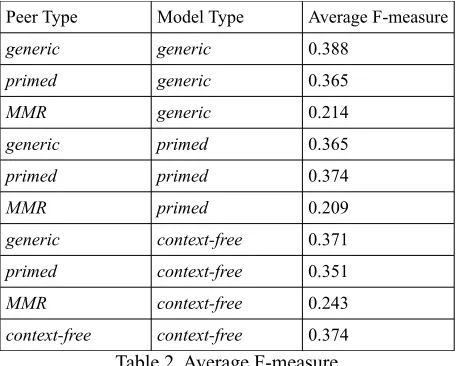
given peer summary type with the same model type, the generic-generic scores are higher than both the primed-primed and context-free-con-text-free summaries. This means that generic sum-maries tend to share more utterances with each oth-er, than primed summaries do, which are more var-ied. This seems unintuitive at first, but could po-tentially be explained by the possibility that differ-ent participants focused on differdiffer-ent aspects of the priming quiz, due to either perceived importance, or lack of time (or summary space) to address all of the priming questions.
Peer Type Model Type Average F-measure
generic generic 0.388
primed generic 0.365
MMR generic 0.214
generic primed 0.365
primed primed 0.374
MMR primed 0.209
generic context-free 0.371
primed context-free 0.351
MMR context-free 0.243
[image:6.612.72.300.236.419.2]context-free context-free 0.374
Table 2. Average F-measure
We also observe that generic summaries are more similar to conventionally annotated (context-free) summaries than either primed or MMR are. This makes sense and also confirms that even though primed summaries do not significantly out-perform generic summaries in the quiz taking task, they are inherently distinguishable from each other.
Furthermore, when evaluating MMR using F-measure, we see that MMR summaries are most similar to the context-free summaries, whose utter-ance selections can be considered somewhat arbit-rary. Our quiz results confirm MMR is signific-antly worse than generic and primed summaries. This casts doubt on the practice of using similarly annotated summaries as gold standards for sum-marization evaluation using ROUGE.
5 ROUGE Evaluation
More common than F-measure, ROUGE (Lin, 2004) is often used to evaluate summarization. Al-though Lin (2004) claimed to have demonstrated
that ROUGE correlates well with human summar-ies, both Murray et al. (2005), and Liu and Liu (2010) have cast doubt upon this. It is important to acknowledge, however, that ROUGE is actually a family of measures, distinguished not only by the manner in which overlap is measured (1-grams, longest common subsequences, etc.), but by the provenience of the summaries that are provided to it as references. If these are not ecologically valid, there is no sense in holding ROUGE accountable for an erratic result.
To examine how ROUGE fairs under ecologic-ally valid conditions, we calculated ROUGE-1, ROUGE-2, ROUGE-L, and ROUGE-SU4 on our data using the standard options outlined in previ-ous DUC evaluations. ROUGE scores were calcu-lated for each of the generic manual summary, primed manual summary, and automatic summary conditions. Each summary in a given condition was evaluated once against the generic manual summaries and once using the primed manual summaries. Similar to Liu and Liu (2010), ROUGE evaluation was conducted using leave-one-out on the model summary type and averaging the results.
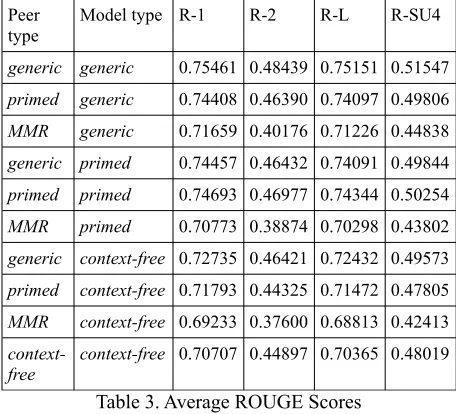
In addition to calculating ROUGE on the sum-maries from our ecologically valid evaluation, we also followed more conventional ROUGE evalu-ation and used the same context-free annotator summaries as were used in our F-measure calcula-tions above. Using these context-free summaries, the original generic manual, primed manual, and automatic summaries were evaluated using ROUGE. The result of these evaluations are presented in Table 3.
rarely consist of a situation where a summary was created for no apparent reason. More interesting is the observation that, when measured by ROUGE, primed summaries have less in common with each other than generic summaries do. The difference, however, is less pronounced when measured by ROUGE than by F-measure. This is likely due to the fact that ROUGE can account for semantically similar utterances.
Peer type
Model type R-1 R-2 R-L R-SU4
generic generic 0.75461 0.48439 0.75151 0.51547
primed generic 0.74408 0.46390 0.74097 0.49806
MMR generic 0.71659 0.40176 0.71226 0.44838
generic primed 0.74457 0.46432 0.74091 0.49844
primed primed 0.74693 0.46977 0.74344 0.50254
MMR primed 0.70773 0.38874 0.70298 0.43802
generic context-free 0.72735 0.46421 0.72432 0.49573
primed context-free 0.71793 0.44325 0.71472 0.47805
MMR context-free 0.69233 0.37600 0.68813 0.42413
[image:7.612.71.299.199.406.2]
context-free context-free 0.70707 0.44897 0.70365 0.48019 Table 3. Average ROUGE Scores
5.1Correlation with Quiz Scores
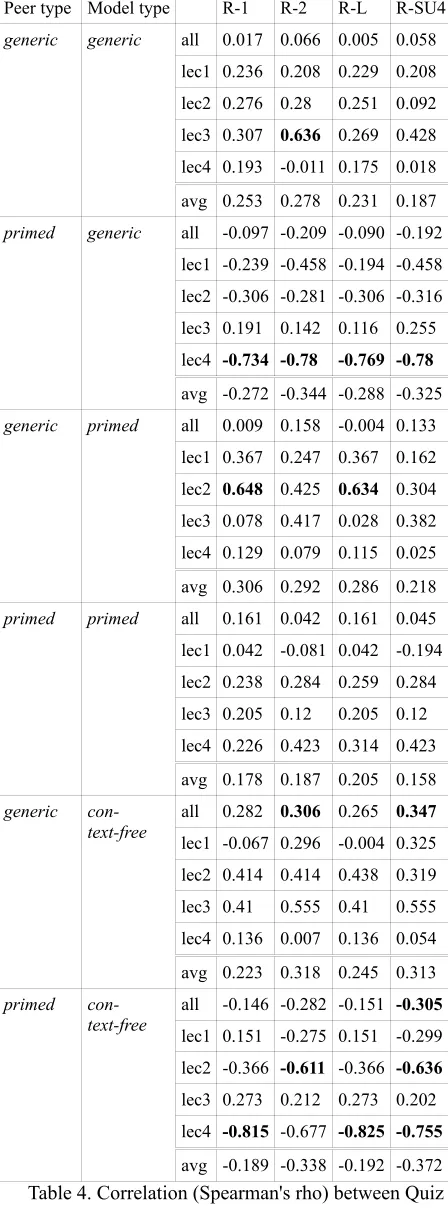
In order to assess the ability of ROUGE to predict quiz scores, we measured the correlation between ROUGE scores and quiz scores on a per participant basis. Similar to Murray et al. (2005), and Liu and Liu (2010), we used Spearman’s rank coefficient (rho) to measure the correlation between ROUGE and our human evaluation. Correlation was meas-ured both by calculating Spearman's rho on all data points (“all” in Table 4) and by performing the cal-culation separately for each lecture and averaging the results (“avg”). Significant rho values (p-value less than 0.05) are shown in bold.
Note that there are not many bolded values, in-dicating that there are few (anti-)correlations between quiz scores and ROUGE. The rho values reported by Liu and Liu (2010) correspond to the “all” row of our generic-context-free scores (Liu and Liu (2010) did not report ROUGE-L), and we obtained roughly the same scores as they did. In contrast to this, our "all" generic-generic correlations are very low. It is possible that the
lec-tures condition the parameters of the correlation to such an extent that fitting all of the quiz-ROUGE pairs to the same correlation across lectures is un-reasonable. It may therefore be more useful to look at rho values computed by lecture. For these val-ues, our SU4 scores are not as high relative to R-1 and R-2 as those reported by Liu and Liu (20R-10). It is also worth noting that the use of context-free binary selections as a reference results in increased correlation for generic summaries, but substantially decreases correlation for primed summaries.
With the exception that generic references prefer generic summaries and primed references prefer primed summaries, all other values indicate that both generic and primed summaries are better than MMR. However, instead of ranking summary types, what is important here is the ecologically valid quiz scores. Our data provides no evidence that ROUGE scores accurately predict quiz scores.
6 Conclusions
Peer type Model type R-1 R-2 R-L R-SU4
generic generic all 0.017 0.066 0.005 0.058 lec1 0.236 0.208 0.229 0.208 lec2 0.276 0.28 0.251 0.092 lec3 0.307 0.636 0.269 0.428 lec4 0.193 -0.011 0.175 0.018 avg 0.253 0.278 0.231 0.187
primed generic all -0.097 -0.209 -0.090 -0.192 lec1 -0.239 -0.458 -0.194 -0.458 lec2 -0.306 -0.281 -0.306 -0.316 lec3 0.191 0.142 0.116 0.255 lec4 -0.734 -0.78 -0.769 -0.78
avg -0.272 -0.344 -0.288 -0.325
generic primed all 0.009 0.158 -0.004 0.133 lec1 0.367 0.247 0.367 0.162 lec2 0.648 0.425 0.634 0.304 lec3 0.078 0.417 0.028 0.382 lec4 0.129 0.079 0.115 0.025 avg 0.306 0.292 0.286 0.218
primed primed all 0.161 0.042 0.161 0.045 lec1 0.042 -0.081 0.042 -0.194 lec2 0.238 0.284 0.259 0.284 lec3 0.205 0.12 0.205 0.12 lec4 0.226 0.423 0.314 0.423 avg 0.178 0.187 0.205 0.158
generic
con-text-free all 0.282 0.306 0.265 0.347
lec1 -0.067 0.296 -0.004 0.325 lec2 0.414 0.414 0.438 0.319 lec3 0.41 0.555 0.41 0.555 lec4 0.136 0.007 0.136 0.054 avg 0.223 0.318 0.245 0.313
primed con-text-free
all -0.146 -0.282 -0.151 -0.305
lec1 0.151 -0.275 0.151 -0.299 lec2 -0.366 -0.611 -0.366 -0.636
lec3 0.273 0.212 0.273 0.202 lec4 -0.815 -0.677 -0.825 -0.755
[image:8.612.73.297.76.680.2]avg -0.189 -0.338 -0.192 -0.372
Table 4. Correlation (Spearman's rho) between Quiz Scores and ROUGE
7 References
J. Carbonell and J. Goldstein. 1998. The use of mmr, di-versity-based reranking for reordering documents and producing summaries. In Proceedings of the 21st an-nual international ACM SIGIR conference on Re-search and development in information retrieval, 335-336, ACM.
P. R. Cohen. 1995. Empirical methods for artificial in-telligence. Volume 55. MIT press Cambridge, Mas-sachusetts.
H. Christensen, B. Kolluru, Y. Gotoh, and S. Renals. 2004. From text summarisation to style-specific sum-marisation for broadcast news. Advances in Informa-tion Retrieval, 223-237.
L. He, E. Sanocki, A. Gupta, and J. Grudin. 1999. Auto-summarization of audio-video presentations. In Pro-ceedings of the seventh ACM international confer-ence on Multimedia (Part 1), 489-498. ACM. L. He, E. Sanocki, A. Gupta, and J. Grudin. 2000.
Com-paring presentation summaries: slides vs. reading vs. listening. In Proc. of the SIGCHI, 177-184, ACM. C. Lin. 2004. Rouge: a package for automatic
evalu-ation of summaries. In Proc. of ACL, Text Summariz-ation Branches Out Workshop, 74–81.
F. Liu and Y. Liu. 2010. Exploring correlation between rouge and human evaluation on meeting summaries.
Audio, Speech, and Language Processing, IEEE Transactions on, 18(1):187-196.
C. Munteanu, R. Baecker, G. Penn, E. Toms, and D. James. 2006. The effect of speech recognition accur-acy rates on the usefulness and usability of webcast archives. In Proceedings of the SIGCHI conference on Human Factors in computing systems, 493-502, ACM.
G. Murray, S. Renals, J. Carletta, and J. Moore. 2005. Evaluating automatic summaries of meeting record-ings. In Proc. of the ACL 2005 MTSE Workshop, Ann Arbor, MI, USA, 33-40.
G. Murray, T. Kleinbauer, P. Poller, S. Renals, J. Kilgour, and T. Becker. 2008. Extrinsic summariza-tion evaluasummariza-tion: A decision audit task. Machine Learning for Multimodal Interaction, 349-361. G. Penn and X. Zhu. 2008. A critical reassessment of
evaluation baselines for speech summarization. Proc. of ACL-HLT.
S. Tucker, O. Bergman, A. Ramamoorthy, and S. Whit-taker. 2010. Catchup: a useful application of time-travel in meetings. In Proc. of CSCW, 99-102, ACM. S. Tucker and S. Whittaker. 2006. Time is of the