Mining Lexical Variants from Microblogs: An Unsupervised Multilingual
Approach
Alejandro Mosquera
University of Alicante San Vicente del Raspeig s/n - 03690
Alicante, Spain
Paloma Moreda
University of Alicante San Vicente del Raspeig s/n - 03690
Alicante, Spain
Abstract
User-generated content has become a re-current resource for NLP tools and ap-plications, hence many efforts have been made lately in order to handle the noise present in short social media texts. The use of normalisation techniques has been proven useful for identifying and replac-ing lexical variants on some of the most informal genres such as microblogs. But annotated data is needed in order to train and evaluate these systems, which usu-ally involves a costly process. Until now, most of these approaches have been fo-cused on English and they were not taking into account demographic variables such as the user location and gender. In this pa-per we describe the methodology used for automatically mining a corpus of variant and normalisation pairs from English and Spanish tweets.
1 Introduction
User-generated content (UGC), and specially the microblog genre, has become an interesting re-source for Natural Language Processing (NLP) tools and applications. Many are the advantages of exploiting this real-time stream of multilingual textual data. Popular applications such as Twit-ter has an heTwit-terogeneous user base of almost 600 million users that generate more than 60 million new tweets every day. For this reason, Twitter has become one of the most used sources of tex-tual data for NLP with several applications such as sentiment analysis (Tumasjan et al., 2010) or realtime event detection (Sakaki et al., 2010). Re-cent advances on machine translation or informa-tion retrieval systems have been also making an extensive use of UGC for both training and evalu-ation purposes. However, tweets can be very noisy
and sometimes hard to understand for both hu-mans (Mosquera et al., 2012) and NLP applica-tions (Wang and Ng, 2013), so an additional pre-processing step is usually required.
There have been different perceptions regard-ing the lexical quality of social media (Rello and Baeza-Yates, 2012) (Baldwin et al., 2013) and even others suggested that 40% of the messages of Twitter were “pointless babble” (PearAnalyt-ics, 2009). Most of the out of vocabulary (OOV) words present in social media texts can be cata-logued as lexical variants (e.g. “See u 2moro”→
”See you tomorrow”), that are words lexically re-lated with their canonic form.
The use of text normalisation techniques has been proven useful in order to clean short and in-formal texts such as tweets. However, the eval-uation of these systems requires annotated data, which usually involves costly human annotations. There are previous works about automatically con-structing normalisation dictionaries, but until now, most of these approaches have been focused on English and they were not taking into account de-mographic variants. In this paper we describe the methodology used for automatically mining lexi-cal variants from English and Spanish tweets as-sociated to a set of headwords. These formal and informal pairs can be later used to train and eval-uate existing social media text normalisation sys-tems. Additional metadata from Twitter such as geographic location and user gender is also col-lected, opening the possibility to model and anal-yse gender or location-specific variants.
This paper is organised as follows. We describe the related work in Section 2. We then describe our variant mining methodology in Section 3. The obtained results are presented in Section 4. Sec-tion 5, draws the conclusions and future work.
2 Related Work
One way to handle the performance drop of NLP tools on user-generated content (Foster et al., 2011) is to re-train existing models on these in-formal genres (Gimpel et al., 2011), (Liu et al., 2011b). Another approaches make use of pre-processing techniques such as text normalisation in order to minimise the social media textual noise (Han et al., 2013), (Mosquera and Moreda, 2012) where OOV words were first identified and then substituted using lexical and phonetic edit dis-tances. In order to enhance both precision and recall both OOV detection and translation dic-tionaries were used. Moreover, the creative na-ture of informal writing and the low availability of manually-annotated corpora can make the im-provement and evaluation of these systems chal-lenging.
Motivated by the lack of annotated data and the large amount of OOV words contained in Twitter, several approaches for automatically construct-ing a lexical normalisation dictionary were pro-posed; In (Gouws et al., 2011) a normalisation lexicon is generated based on distributional and string similarity (Lodhi et al., 2002) from Twit-ter. Using a similar technique, a wider-coverage dictionary is constructed in (Han et al., 2012) based on contextually-similar (OOV, IV) pairs. More recently, (Hassan and Menezes, 2013) intro-duced another context-based approach using ran-dom walks on a contextual similarity graph.
Distributional-based methods can have some drawbacks: they rely heavily on pairwise com-parisons that make them computationally expen-sive, and as the normalisation candidates are se-lected based on context similarity they can be sen-sitive to domain-specific variants that share similar contexts. Moreover, these approaches were focus-ing on extractfocus-ing English lexical variants from so-cial media texts, but due the heterogeneity of its users, lexical distributions can be influenced by geographical factors (Eisenstein et al., 2010) or even gender (Thomson and Murachver, 2001).
To the best of our knowledge, there are not multilingual approaches for mining lexical vari-ants from short, noisy texts that also take into ac-count demographic variables. For this reason, we present an unsupervised method for mining En-glish and Spanish lexical variants from Twitter that collects demographic and contextual information. These obtained pairs can be later used for training
and evaluating text normalisation and inverse text normalisation systems.
3 Lexical Variant Mining
Lexical variants are typically formed from their standard forms through regular processes (Thur-low and Brown, 2003) and these can be mod-elled by using a set of basic character transfor-mation rules such as letter insertion, deletion or substitution (Liu et al., 2011a) e.g. (“tmrrw” →
“2morrow”) and combination of these (“2moro”). The relation between formal and informal pairs is not always 1-to-1, two different formal words can share the same lexical variant (“t” in Spanish can represent “te” or “t´u”) and one formal word can have many different variants (e.g. “see you” us commonly shortened as “c ya” or “see u”). As a difference with previous approaches based on contextual and distributional similarity, we have chosen to model the generation of variant candi-dates from a set of headwords using transforma-tion rules. These candidates are later validated based on their presence on a popular microblog service, used in this case as a high-coverage cor-pus.
3.1 Candidate Generation
We have defined a set of 6 basic transforma-tion rules (see Table 1) in order to automati-cally generate candidate lexical variants from the 300k most frequent words of Web 1T 5-gram (En-glish) (Brants and Franz, 2006) and SUBTLEX-SP (Spanish) (Cuetos et al., 2011) corpora.
Rule Example a) Character duplication “goal”→“gooal” b) Number transliteration “cansados”→“cansa2” c) Character deletion “tomorrow”→“tomrrw” d) Character replacement “friend”→“freend” e) Character transposition “maybe”→“mabye” f) Phonetic substitution “coche”→“coxe” g) Combination of above “coche”→“coxeee”
Table 1: Transformation rules.
As modelling some variants may need more than one basic operation, and lexically-related variants are usually in an edit distance t where t <= 3 (Han et al., 2013), the aforementioned rules were implemented using an engine based on stacked transducers with the possibility to apply a maximum of three concurrent transformations:
duplicated n times (∀n>0, n<4), generating n3candidate variants.
(b) Number transliteration: Words and num-bers are transliterated following the language rules defined in Table 2.
Rule Lang. “uno”→“1” SP “dos”→“2” SP “one”→“1” EN “two”→“2” EN “to”→“2” EN “three”→“3” EN “for”→“4” EN “four”→“4” EN “eight”→“8” EN “be”→“b” EN “a”→“4” EN “e”→“3” EN “o”→“0” EN “s”→“5” EN “g”→“6” EN “t”→“7” EN “l”→“1” EN
Table 2: Transliteration table for English and Spanish.
(c) Character deletion: The candidate variants from all possible one character deletion com-binations plus the consonant skeleton of the word will be generated.
(d) Character replacement: Candidate variants are generated by replacing n characters (∀
n>0, n<7) by their neighbours taking into account a QWERTY keyboard and an edit distance of 1.
(e) Character transposition: In order to generate candidate lexical variants the position of ad-jacent characters are exchanged.
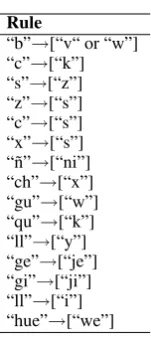
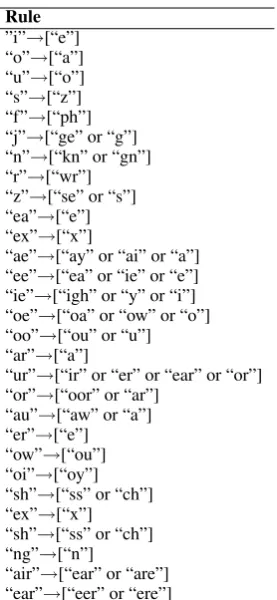
(f) Phonetic substitution: A maximum of three character n-grams are substituted for char-acters that sound similar following different rules for Spanish (Table 3) and English (Ta-ble 4).
3.2 Candidate Selection
We have explored several approaches for filtering common typographical errors and misspellings, as these are unintentional and can not be technically considered lexical variants, in order to do this we have used supervised machine learning tech-niques. Also, with aim to filter uncommon or
Rule
[image:3.595.380.456.56.229.2]“b”→[“v“ or “w”] “c”→[“k”] “s”→[“z”] “z”→[“s”] “c”→[“s”] “x”→[“s”] “˜n”→[“ni”] “ch”→[“x”] “gu”→[“w”] “qu”→[“k”] “ll”→[“y”] “ge”→[“je”] “gi”→[“ji”] “ll”→[“i”] “hue”→[“we”]
Table 3: Phonetic substitution table for Spanish.
low quality variants, the Rovereto Twitter corpus (Herdagdelen, 2013) was initially used in order to rank the English candidates present in the cor-pus by their frequencies. The 38% of the variants generated by one transformation were successfully found, however, performing direct Twitter search API queries resulted to have better coverage than using a static corpus (90% for English variants).
3.2.1 Intentionality Filtering
Given an OOV wordaand its IV versionbwe have extracted character transformation rules fromato
busing the longest common substring (LCS) algo-rithm (See Table 5). These lists of transformations were encoded as a numeric array where the num-ber each transformation counts were stored. We have used NLTK (Bird, 2006) and the Sequence-Matcher Python class in order to extract those sets of transformations taking into account also the po-sition of the character (beginning, middle or at the end of the word).
A two-class SVM (Vapnik, 1995) model has ben trained using a linear kernel with a corpus composed by 4200 formal-variant pairs extracted from Twitter 1, SMS2 and a corpus of the 4200
most common misspellings3. In table 6 we show
the k-fold cross-validation results (k=10) of the model, obtaining a 87% F1. This model has been used in order to filter the English candidate vari-ants classified as not-intentional.
To the best of our knowledge there are not simi-lar annotated resources for Spanish, so this clas-sifier was developed only for English variants. However, would be possible to adapt it to work for
[image:3.595.133.230.147.332.2]Rule ”i”→[“e”] “o”→[“a”] “u”→[“o”] “s”→[“z”] “f”→[“ph”] “j”→[“ge” or “g”] “n”→[“kn” or “gn”] “r”→[“wr”] “z”→[“se” or “s”] “ea”→[“e”] “ex”→[“x”]
“ae”→[“ay” or “ai” or “a”] “ee”→[“ea” or “ie” or “e”] “ie”→[“igh” or “y” or “i”] “oe”→[“oa” or “ow” or “o”] “oo”→[“ou” or “u”] “ar”→[“a”]
“ur”→[“ir” or “er” or “ear” or “or”] “or”→[“oor” or “ar”]
“au”→[“aw” or “a”] “er”→[“e”] “ow”→[“ou”] “oi”→[“oy”] “sh”→[“ss” or “ch”] “ex”→[“x”] “sh”→[“ss” or “ch”] “ng”→[“n”]
[image:4.595.114.253.59.360.2]“air”→[“ear” or “are”] “ear”→[“eer” or “ere”]
Table 4: Phonetic substitution table for English.
another languages if the adequate corpora is pro-vided. Because of the lack of this intentionality detection step, the number of generated candidate variants for Spanish was filtered by taking into ac-count the number of transformations, removing all the variants generated by more than two opera-tions.
3.2.2 Twitter Search
The variants filtered during the previous step were searched on the real time Twitter stream for a pe-riod of two months by processing more than 7.5 million tweets. Their absolute frequenciesnwere used as a weighting factor in order to discard not used words (n >0). Additionally, variants present in another languages rather than English or Span-ish were ignored by using the language identifica-tion tags present in Twitter metadata.
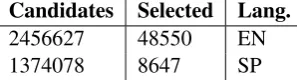
There were important differences between the final number of selected candidates for Spanish, with 6 times less variant pairs and English (see Ta-ble 7). Spanish language uses diacritics that are commonly ignored on informal writing, for this reason there is a higher number of possible com-binations for candidate words that would not gen-erate valid or used lexical variants.
Formal/Informal pair Transf. Pos.
house→h0use o→0 middle
campaign→campaing n→ ∅ end
∅ →n middle happy→:) happy→:) middle embarrass→embarass r→ ∅ middle acquaintance→ ∅ →q middle
aqcuaintance q→ ∅ middle
virtually→virtualy l→ ∅ middle
[image:4.595.307.528.62.207.2]cats→catz s→z end
Table 5: Example of formal/informal pairs and the extract transformations.
Method Precision Recall F1
SVM 0.831 0.824 0.827
SVM+Pos. 0.878 0.874 0.876
Formal/Informal pair Verdict
you→yu intentional
accommodate→acommodate unintentional business→bussiness unintentional
doing→doin intentional
acquaintance→aqcuaintance unintentional basically→basicly unintentional rules→rulez intentional
Table 6: Cross-validation results of intentionality classification with examples.
4 Results
Besides the original message and the context of the searched variant, additional metadata has been collected from each tweet such as the gender and the location of the user. In Twitter the gender is not explicitly available, for this reason we applied an heuristic approach based on the first name as it is reported in the user profile. In order to do this, two list of male and female names were used: the 1990 US census data 4 and popular baby names from
the US Social Security Administration’s statistics between 1960 and 20105.
[image:4.595.308.523.257.436.2]Candidates Selected Lang.
2456627 48550 EN
[image:5.595.106.255.64.104.2]1374078 8647 SP
Table 7: Number of generated and selected vari-ants after Twitter search.
Figure 1: Transformation trends by gender.
users with a 5% more than their male counter-parts. On the other hand, variants generated by character replacement and deletion were found a 2% more on tweets from male users. The differ-ences between English and Spanish were notable, mostly regarding the use of transliterations, that were not found on Spanish tweets, and phonetic substitutions, ten times less frequent than in En-glish tweets.
For the distribution of transformations across geographic areas, we have just taken into account the countries where the analysed languages have an official status. Lexical variants found in Tweets from another areas are grouped into the “Non-official” label (see Figure 2). The biggest dif-ferences were found on the use of translitera-tions (higher in UK and Ireland with more than a 5%) and phonetic substitutions (higher in Pak-istani users with more than a 22%). Transforma-tion frequencies from non-official English speak-ing countries were very similar as the ones regis-tered for users based on United States and Canada. Spanish results were less uniform and showed more variance respect the use of character dupli-cation (57% in Argentina), character replacement (more than 24% in Mexico and Guatemala) and character transposition (with more than a 19% for users from Cuba, Colombia and Mexico) (see Fig-ure 3).
5 Conclusions and Future Work
In this paper we have described a multilingual and unsupervised method for mining English and Spanish lexical variants from Twitter with aim to close the gap regarding the lack of annotated cor-pora. These obtained pairs can be later used for the training and evaluation of text normalisation systems without the need of costly human anno-tations. Furthermore, the gathered demographic and contextual information can be used in order to model and generate variants similar to those that can be found on specific geographic areas. This has interesting applications in the field of inverse text normalisation, that are left to a future work. We also intend to explore the benefits of feature engineering for the detection and categorisation of lexical variants using machine learning tech-niques.
Acknowledgments
This research is partially funded by the European Commission under the Seventh (FP7 -2007- 2013) Framework Programme for Re-search and Technological Development through the FIRST project (FP7-287607). This pub-lication reflects the views only of the author, and the Commission cannot be held responsi-ble for any use which may be made of the in-formation contained therein. Moreover, it has been partially funded by the Spanish Govern-ment through the project “An´alisis de Tenden-cias Mediante T´ecnicas de Opini´on Sem´antica” (TIN2012-38536-C03-03) and “T´ecnicas de De-construcci´on en la Tecnolog´ıas del Lenguaje Hu-mano” (TIN2012-31224).
References
Timothy Baldwin, Paul Cook, Marco Lui, Andrew MacKinlay, and Li Wang. 2013. How noisy social media text, how diffrnt social media sources. In Pro-ceedings of the Sixth International Joint Conference on Natural Language Processing, pages 356–364.
Steven Bird. 2006. Nltk: the natural language toolkit. InProceedings of the COLING/ACL on In-teractive presentation sessions, COLING-ACL ’06, pages 69–72, Stroudsburg, PA, USA. Association for Computational Linguistics.
[image:5.595.73.291.166.305.2]Figure 2: Transformation trends by English-speaking countries.
Figure 3: Transformation trends by Spanish-speaking countries.
Fernando Cuetos, Maria Glez-Nosti, Anala Barbn, and Marc Brysbaert. 2011. Subtlex-esp: Spanish word frequencies based on film subtitles. Psicolgica, 32(2).
Jacob Eisenstein, Brendan O’Connor, Noah A. Smith, and Eric P. Xing. 2010. A latent variable model for geographic lexical variation. InProceedings of the 2010 Conference on Empirical Methods in Natu-ral Language Processing, EMNLP ’10, pages 1277– 1287, Stroudsburg, PA, USA. Association for Com-putational Linguistics.
Jennifer Foster, ¨Ozlem C¸etinoglu, Joachim Wagner, Joseph Le Roux, Stephen Hogan, Joakim Nivre, Deirdre Hogan, and Josef van Genabith. 2011. #hardtoparse: Pos tagging and parsing the twitter-verse. InAnalyzing Microtext, volume WS-11-05 of
AAAI Workshops. AAAI.
Kevin Gimpel, Nathan Schneider, Brendan O’Connor, Dipanjan Das, Daniel Mills, Jacob Eisenstein, Michael Heilman, Dani Yogatama, Jeffrey Flanigan, and Noah A. Smith. 2011. Part-of-speech tagging for twitter: annotation, features, and experiments. In Proceedings of the 49th Annual Meeting of the Association for Computational Linguistics: Human Language Technologies: short papers - Volume 2, HLT ’11, pages 42–47, Stroudsburg, PA, USA. As-sociation for Computational Linguistics.
S. Gouws, D. Hovy, and D. Metzler. 2011. Unsuper-vised mining of lexical variants from noisy text. In
Proceedings of the First workshop on Unsupervised Learning in NLP, page 82–90.
Bo Han, Paul Cook, and Timothy Baldwin. 2012. Au-tomatically constructing a normalisation dictionary for microblogs. In Proceedings of the 2012 Joint Conference on Empirical Methods in Natural guage Processing and Computational Natural Lan-guage Learning (EMNLP-CoNLL 2012), pages 421– 432, Jeju Island, Korea.
Bo Han, Paul Cook, and Timothy Baldwin. 2013. Lex-ical normalization for social media text. ACM Trans. Intell. Syst. Technol., 4(1):5:1–5:27, February. Hany Hassan and Arul Menezes. 2013. Social text
normalization using contextual graph random walks. In Proceedings of the 51st Annual Meeting of the Association for Computational Linguistics (Volume 1: Long Papers), pages 1577–1586, Sofia, Bulgaria, August. Association for Computational Linguistics. Ama Herdagdelen. 2013. Twitter n-gram corpus with demographic metadata. Language Resources and Evaluation, 47(4):1127–1147.
[image:6.595.96.510.246.380.2]nor supervision. InProceedings of the 49th Annual Meeting of the Association for Computational Lin-guistics: Human Language Technologies: Short Pa-pers - Volume 2, HLT ’11, pages 71–76, Strouds-burg, PA, USA. Association for Computational Lin-guistics.
Xiaohua Liu, Shaodian Zhang, Furu Wei, and Ming Zhou. 2011b. Recognizing named entities in tweets. In Proceedings of the 49th Annual Meeting of the Association for Computational Linguistics: Human Language Technologies - Volume 1, HLT ’11, pages 359–367, Stroudsburg, PA, USA. Association for Computational Linguistics.
Huma Lodhi, Craig Saunders, John Shawe-Taylor, Nello Cristianini, and Chris Watkins. 2002. Text classification using string kernels. J. Mach. Learn. Res., 2:419–444, March.
Alejandro Mosquera and Paloma Moreda. 2012. Tenor: A lexical normalisation tool for spanish web 2.0 texts. InText, Speech and Dialogue - 15th Inter-national Conference (TSD 2012). Springer.
Alejandro Mosquera, Elena Lloret, and Paloma Moreda. 2012. Towards facilitating the accessibil-ity of web 2.0 texts through text normalisation. In
Proceedings of the LREC workshop: Natural Lan-guage Processing for Improving Textual Accessibil-ity (NLP4ITA) ; Istanbul, Turkey., pages 9–14.
PearAnalytics. 2009. Twitter study. InRetrieved De-cember 15, 2009 from http://pearanalytics.com/wp- content/uploads/2009/08/Twitter-Study-August-2009.pdf.
Luz Rello and Ricardo A Baeza-Yates. 2012. Social media is not that bad! the lexical quality of social media. InICWSM.
Takeshi Sakaki, Makoto Okazaki, and Yutaka Matsuo. 2010. Earthquake shakes twitter users: Real-time event detection by social sensors. In Proceedings of the 19th International Conference on World Wide Web, WWW ’10, pages 851–860, New York, NY, USA. ACM.
Robert Thomson and Tamar Murachver. 2001. Pre-dicting gender from electronic discourse.
Thurlow and Brown. 2003. Generation txt? the soci-olinguistics of young people’s text-messaging.
A. Tumasjan, T.O. Sprenger, P.G. Sandner, and I.M. Welpe. 2010. Predicting elections with twitter: What 140 characters reveal about political senti-ment. In Proceedings of the Fourth International AAAI Conference on Weblogs and Social Media, pages 178–185.
Vladimir N. Vapnik. 1995. The nature of statistical learning theory. Springer-Verlag New York, Inc., New York, NY, USA.