D S Sharma, R Sangal and E Sherly. Proc. of the 12th Intl. Conference on Natural Language Processing, pages 219–228, Trivandrum, India. December 2015. c2015 NLP Association of India (NLPAI)
An Approach to Collective Entity Linking
Ashish Kulkarni Kanika Agarwal Pararth Shah Sunny Raj Rathod Ganesh Ramakrishnan Department of Computer Science
Indian Institute of Technology Bombay Mumbai, India
{kulashish, kanika1712, pararthshah717, sunnyrajrathod} @gmail.com [email protected]
Abstract
Entity linking is the task of disambiguat-ing entities in unstructured text by link-ing them to an entity in a catalog. Sev-eral collective entity linking approaches exist that attempt to collectively disam-biguate all mentions in the text by leverag-ing both local mention-entity context and global entity-entity relatedness. However, the complexity of these models makes it unfeasible to employ exact inference techniques and jointly train the local and global feature weights. In this work we present a collective disambiguation model, that, under suitable assumptions makes ef-ficient implementation of exact MAP in-ference possible. We also present an effi-cient approach to train the local and global features of this model and implement it in an interactive entity linking system. The system receives human feedback on a doc-ument collection and progressively trains the underlying disambiguation model.
1 Introduction
Search systems proposed today (Chakrabarti et al., 2006; Cheng et al., 2007; Kasneci et al., 2008; Li et al., 2010) are greatly enriched by recognizing and exploiting entities embedded in unstructured pages. In a typical system architecture (Cucerzan, 2007; Dill et al., 2003; Kulkarni et al., 2009; Milne and Witten, 2008) a spotter first identifies short to-ken segments or “spots” as potential mentions of entities from its catalog. For our purposes, a cata-log consists of a directed graph of categories, to which entity nodes are attached. Many entities may qualify for a given text segment, e.g., both
Kernel trick and Linux Kernel might qualify for the text segment “...Kernel...”. In the second stage, a disambiguator assigns zero or more entities to
selected mentions, based on mention-entity coher-ence, as well as entity-entity similarity.
Some of the recent work (Zhou et al., 2010; Lin et al., 2012) shows that several mentions may have no associated sense in the catalog. This is referred to as the no-attachment (NA) problem (or NIL in the TAC-KBP challenge (McNamee, 2009)). The other, relatively lesser addressed challenge is that of multiple attachments (Kulkarni et al., 2014), where a mention might link to more than one enti-ties from the catalog. This might often be a result of insufficient context and has been acknowledged by some of the recent entity disambiguation chal-lenges1.
We present an approach to collective disam-biguation of several mentions by combining vari-ous mention-entity compatibility and entity-entity relatedness features. Also, unlike most of the prior work, we jointly learn the local and global feature weights. Our Markov network-based model, along with suitable assumptions, makes efficient learn-ing possible. The model links mentions to zero or more entities, thus offering a natural solution to the problem of NAs and multiple attachments.
2 Prior Work
Earlier works (Dill et al., 2003; Bunescu and Pasca, 2006; Mihalcea and Csomai, 2007) on entity annotation focused on per-mention disam-biguation. This involves selecting the best entity to assign to a mention, independent of the assign-ments to other mentions in the document. Wik-ify! (Mihalcea and Csomai, 2007) for instance, uses context overlap for disambiguation and com-bines it with a classifier model that exploits lo-cal and topilo-cal features. Cucerzan (Cucerzan, 2007) introduced the notion of agreement on cat-egories of entities in addition to the local con-text overlap, in which the entity concon-text comprised
1http://web-ngram.research.microsoft.
out-links from and in-links to their corresponding Wikipedia documents. Milne et al. (Milne and Witten, 2008) formulated a “relatedness” measure of similarity between two entities from Wikipedia, based on their in-link overlap. Relatedness, in conjunction with the prior probability of occur-rence of an entity, was then used to train a clas-sifier model. Han et al. (Han and Zhao, 2009) leveraged the semantic information in Wikipedia to build a large-scale semantic network and de-veloped a similarity measure to be used for dis-ambiguation. Kulkarni et al. (Kulkarni et al., 2009) were the first to propose a general collec-tive disambiguation approach, giving formulations for trade-off between mention-entity compatibil-ity and coherence between entities. Several graph-based approaches (Hoffart et al., 2011; Fahrni and Strube, 2012) followed that cast the disambigua-tion problem as a problem of dense subgraph se-lection from a graph of mentions and candidate en-tities, making use of collective signals.
Most of these systems seem to prefer tagging conservatively. Some of them (Cucerzan, 2007; Hoffart et al., 2011) restrict their tagging to named entities, while others use a subset of entities from a background taxonomy such as TAP (Dill et al., 2003) or Wikipedia (Milne and Witten, 2008; Mi-halcea and Csomai, 2007). Others (Kataria et al., 2011; Bhattacharya and Getoor, 2006) have proposed LDA-based generative models but focus only on person names. Some of the more recent systems (Kulkarni et al., 2009; Han et al., 2011) do perform aggressive spotting, aided by the an-chor dictionary of Wikipedia entities and study the recall-precision tradeoff.
(Kulkarni et al., 2014) propose a joint disam-biguation model based on a Markov network of entities as nodes and edges for their relatedness. Disambiguation is achieved by performing a MAP inference on this graph and it naturally handles the NA and multiple attachment cases. Unlike other approaches (Han and Sun, 2012; Ratinov et al., 2011), their graph models candidate entities with binary labels, instead of mentions with multiple labels. A suitable assumption on cliques and their potentials makes efficient computation of exact in-ference possible. However, it is not clear as to how the node and edge feature weights are set.
To the best of our knowledge, none of the graph-based models above have attempted to jointly learn the node and edge feature weights. While
there is prior work (Wellner et al., 2004; Wick et al., 2009) that applied graphical models to the problem of information extraction and coreference resolution, exact inference and estimation is in-tractable in these models. Similar approaches have also been applied to the problem of entity disam-biguation (Kulkarni et al., 2009; Han and Sun, 2012; Ratinov et al., 2011), but hardly anyone has attempted to jointly learn the feature weights.
2.1 Our Contributions
We leverage the disambiguation model of (Kulka-rni et al., 2014) and propose an efficient approach to jointly learn the node and edge feature weights. We also develop an interactive active learning framework that progressively improves the model as more training data becomes available. We im-plemented our approach in an online annotation system2 and used it to semi-automatically curate
labeled data3. Our trained model performs better
than several other systems including that of Kulka-rniet al.
3 Preliminaries
We borrowed the features and the disambiguation model from the work described in Kulkarniet al.
and present it in brief here. We first start with the problem definition.
3.1 Problem Definition
The primary goal of document annotation is to link entity mentions in an input document to entities in a catalog. Mentions (or “spots”) are contigu-ous token sequences in a text,e.g. Bush, that can potentially link to an entity, e.g. George Bush in the catalog. Let Mdbe the set of all mentions in a document dand E be the set of all entities in
the catalog. Then, the entity linking problem is to find for each mentionm∈ Md, the set of entities
ˆ
Em⊂E ∪ {N A}that it can link to.
As a first step, the input textdis processed by
a “spotter” to identify the set Md of mentions and the set of candidates Em ⊂ E, ∀m ∈ Md.
em ∈ Em is called a candidate entity for spotm. The setEd=∪m∈MdEmforms the candidate en-tities set for documentd. This is then followed by
a “disambiguation” phase that obtains from Em, the setEˆmof entities that the mentionmcan ac-tually link to. When none of the entities in Em
2http://tinyurl.com/entitydisamb-demo
3http://tinyurl.com/entitydisamb-data
are valid, thenEˆm ={N A}. Alternatively, more than one entities fromEm might get promoted to
ˆ
Em. Assumingone sense per discourse(Gale et al., 1992), an entity in the candidate set of more than one mentions, links (or does not link) to all those mentions.
3.2 Entity Catalog
A catalog is a structured knowledge base com-prising categories with entities under them, along with their attributes and relations. Wikipedia has seen an extensive organic growth and covers enti-ties spanning a vast set of domains. We report ex-perimental results using the Wikipedia dump from May 2011, with approximately 4.4 million enti-ties. For evaluation on ERD, we used as catalog, the snapshot of Freebase as provided in the chal-lenge.
3.3 Features
We used three types of features - (1) Popularity-based features of an entity: Prior Sense Probabil-ity (Mihalcea and Csomai, 2007), In-Link Count, Out-Link Count; (2) Mention-Entity compatibil-ity features (Kulkarni et al., 2009); (3) Entcompatibil-ity- Entity-Entity relatedness features: Category-based Sim-ilarity (Cucerzan, 2007), In-link based Similar-ity (Milne and Witten, 2008), Out-link based Sim-ilarity, Contextual Similarity.
3.4 The Disambiguation Model
Having identified the set of candidate entities for each mention, a disambiguator attempts to link each mention to zero or more entities. The label of a candidate is a collective result of the interplay of local mention-entity and global entity-entity re-latedness signals.
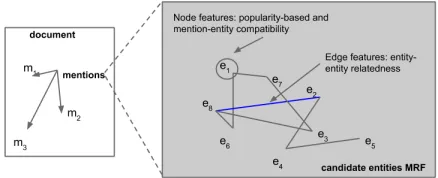
[image:3.612.79.298.600.689.2]A Markov Random Field (MRF) is an undi-rected graphical model that captures local cor-relations between random variables (Taskar and Koller, 2001). A node is instantiated in the MRF
Figure 1: Candidate entities MRF model
graph for each possible entity mapping of each
mention instance in a document. Edges capture entity-entity relatedness. Let xi be the node fea-ture vector of candidateiandxij be the edge fea-ture vector of the edge joining candidatesiandj.
Each candidate corresponds to a random variable that takes a binary label, yi ∈ {0,1}, based on whether or not it correctly disambiguates the un-derlying mention. Let C be the set of all cliques
in the MRF and each clique c ∈ C be associated
with a clique potentialφc(.). Cliques are restricted to nodes and edges and their potentials are param-eterized by log-linear functions of feature vectors;
i.e., log φc(.) = wc ·xc, where, xc is the fea-ture vector of a clique and wc, the correspond-ing weight vector. The potentials are assumed to be submodular (Taskar et al., 2004), that is, they are associated with assignments where variables in a clique have the same label. Let w0 andw1
be the node feature weights influencing node la-bels 0 and 1 respectively and w00 and w11 be
the associative edge weights influencing the con-nected nodes to take the same label. The proba-bility of a complete graph labeling y is given by P(y) = Z1 Qc∈Cφc(yc), whereZ is the partition function. Disambiguation is achieved by doing MAP inference on this graph.
L(y) = arg max y∈Y
X
i∈N
log φi(yi) +
X
ij∈E
log φij(yij)
= arg min y∈Y−(
X
i∈N
w0·xi(1−yi) +w1·xiyi
+X
ij∈E
w00·xij(1−yij) +w11·xijyij)
(1)
N is the set of nodes and E is the set of edges in the MRF, yi ∈ {0,1} and yij = yiyj. For an MRF with binary labeled nodes and associa-tive edge potentials, MAP inference can be com-puted exactly in polynomial time, by finding the min cut of an augmented flow graph (Boykov and Kolmogorov, 2004). The MRF is augmented by adding two special terminal nodes source, s and
sink, t that correspond to the two labels0/1. For each node i, we add terminal edges s → i with
weighthw0,xii andi → twith weighthw1,xii.
For each neighborhood edge i → j, we assign weighth(w00 + w11),xiji. We also add weight hw00,xiji to the edge s → i and hw11,xiji to
graph, with nodes on thesside of the cut getting
a label of0, and the nodes on thetside being
as-signed a label of1.
4 Learning Feature Weights
Algorithm 1:MRF Learning algorithm
Data: Training set{X,qˆ}, MRF graphg, Slack penaltyC, Iterations
T, Step sizeαt
Result: Weight vectorw
w←0
t←1
Nn←number of nodes ing
fopt← ∞
wopt←0
whilet≤Tdo
g←construct flow network fromg
˜
q←s/t mincut ofg
∇wξ(w)←2w+C(ˆq−q˜)TX w←w−αt∇wξ(w)
Projectwonto the positive orthant Compute function valuef
iff < foptthen
fopt←f wopt←w
end
t←t+ 1
end
returnwopt
The submodularity restriction and binary labels, make efficient implementation of learning possi-ble. We jointly learn both node and edge feature weights following the general max-margin frame-work described in (Taskar et al., 2004; Vernaza et al., 2008). Consider a graph with N nodes and E edges constructed as described above. Follow-ing Taskaret al., the learning problem can be for-mulated in terms of the cut vector, such that, we minimize the norm of the weight vector subject to the constraint that the desired labeling scores better than an arbitrary labeling by an amount that scales with the Hamming distance between the de-sired and incorrect labelings.
min
w≥0kwk
2 (2)
subject to
min
q∈Q
X
i,j∈E
w·xij(qij −qˆij)−(Nn−qˆTn·qn)≥0
Here,Qis the set of all valid cuts andqij ∈ {0,1} indicates if edgei → j is cut (qij = 1). qn is the cut vector for terminal edges with components
qsi and qit, where, qsi = 1 implies that iis la-beled1. ˆqis the cut vector corresponding to the desired labeling. The first component of the con-straint captures the difference in cost of the min cut induced by the weightswand the desired la-beling. The other component corresponds to the
number of labeling disagreements, Nn being the number of nodes in the graph (excludingsandt).
By rearranging terms, we obtain
min
w≥0kwk
2 (3)
subject to min
q∈Q
X
i,j∈E
(wT ·xij + ˆqij(δis+δjt))qij
≥Nn+
X
i,j∈E
(wT ·xij)ˆqij
Here,δij is the Kronecker delta. It can be shown that the left-hand-side and right-hand-side of the inequality in the constraint are equivalent (Vernaza et al., 2008). Moving the constraint to the objec-tive, we get,
min
w≥0kwk
2+C(N
n+
X
i,j∈E
(wT ·xij)ˆqij−
min
q∈Q
X
i,j∈E
(wT ·xij + ˆqij(δis+δjt))qij)
Summing over all the documents in the training set, we get the final objective,
min
w≥0kwk
2 + X
d∈D
(C(Nd + X i,j∈Ed
(wT ·xij)ˆqij −
min
q∈Q
X
i,j∈Ed
(wT ·xij + ˆqij(δis + δjt))qij))
(4)
Here, w = [wT0 wT1 wT00wT11]T,Ndis the num-ber of nodes (excludingsandt) andEdis the set of edges in the candidate entity MRF graph for a documentd∈D, the set of all training documents, sandtare special source and sink nodes, respec-tively. The termNd−qˆij(δis + δjt))qij gives the number of misclassified nodes and Pi,j∈EdwT · xijqˆij−wT ·xijqij is the total capacity of incor-rectly cut edges in the flow graph.Cis the penalty associated with the incorrect labeling. We solved the formulation (4) using the subgradient descent method as described in Algorithm 1.
4.1 Handling Unbalanced Training Data
learning algorithm and the accuracy of the non-dominant class suffers. We addressed this prob-lem by assigning separate misclassification penal-tiesC0andC1 for label0and1disagreements
re-spectively in equation 4, where, disagreements are defined as below.
Definition 1.Letli ∈ {0,1}andˆli ∈ {0,1}be the
predicted and actual labels of nodei. We say that a nodeihas label0disagreement if li 6= ˆli = 0.
Similarly it has label1disagreement ifli 6= ˆli= 1.
Proposition 1. For an edgei→jwithqij 6= ˆqij,
exactly one of the nodes agrees on the label i.e.
li = ˆli (orlj = ˆlj) and the other node disagrees
on the labeli.e.lj 6= ˆlj (li 6= ˆli).
Proof. Case 1: Letqij 6= ˆqij = 0. This implies that the edge is not cut in the actual labeling and thereforeˆli = ˆlj. However,qij = 1implies that
li 6=lj. It follows that eitherli= ˆli orlj = ˆlj. Case 2: Letqij 6= ˆqij = 1. Following a similar argument as that for case 1 above, we have that ˆli 6= ˆlj andli = lj. Again, it follows that either
li = ˆliorlj = ˆlj.
Definition 2. An edge i → j with qij 6= ˆqij, is
said to have a label0disagreement if eitherli 6= ˆli = 0orlj 6= ˆlj = 0. It is said to have a label1
disagreement if eitherli 6= ˆli = 1orlj 6= ˆlj = 1.
4.2 Active Learning
Our online annotation system presents an oppor-tunity to continuously update the model as more labeled data becomes available. The commonly used passive learning approach involves manual annotation of randomly and independently sam-pled data. Due to the time and cost associated with this process, often there is not enough train-ing data to meet certain level of performance. Ac-tive learning (Lewis and Catlett, 1994) aims to minimize the labeling effort, by requesting labels for the most informative samples, so as to achieve a desired level of accuracy. While there are several approaches to querying examples for labeling (Li and Sethi, 2006), we follow a pragmatic approach, that can be characterized asleast certain querying
method. The method samples examples with the smallest difference between two highest probabil-ity classes. Our binary labeled MRF model labels a node, based on the collective effect of the node potential and the edge potentials on the edges con-necting the node to its neighbors. We define
cer-taintyC(i)at a nodenias
C(i) =w0·xi+
X
(ij)∈E:j∈N(i)
w00·xij
(5)
−w1·xi+
X
(ij)∈E:j∈N(i)
w11·xij
whereN(i) is the set of all neighboring nodes of the node i. The certainty scoreC(d) for a docu-mentdis then computed as the average certainty
score across all nodes in that document.
C(d) = 1 |N |
X
i∈N
C(i) (6)
The active learning algorithm then queries for a document with the lowest C(d) and presents the document for labeling. It might be possible to fur-ther reduce the labeling effort by requesting labels for only top k entities in the selected document,
where the entities are ordered in increasing values of theirC(i).
5 Experiments and Results 5.1 Data Sets
We use W ikicur (created by (Kulkarni et al., 2014)) for training our model and present cross-validation results. We also evaluate on sev-eral other datasets from the entity linking litera-ture. (Kulkarni et al., 2009) had created a dataset (IIT Bpart) based on aggressive spotting but as-suming single attachment. We, therefore, used our annotation system to manually complete annota-tions (to createIIT Bcur) for the documents in this dataset.
5.2 Evaluation Measures
We follow thefuzzy evaluation measure(Cornolti et al., 2013) that accounts for slight syntactic and semantic variations in the match of a predicted and true annotation, where an annotation ais defined
as the mention-entity pair h m, e i. Using their notion of weak annotation match Mw(a1, a2)4,
we use as performance metrics, Recall,Precision
and F1 micro-averaged over all documents in a dataset. After factoring out spotter errors, we also separately report the accuracy of our disambigua-tion model alone (Referred to as “disambiguator only”).
4which is true iff mentionsm
1andm2overlap in the
Dataset Disambiguator
only Weak annota-tion match
P R F P R F
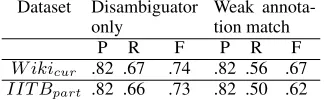
W ikicur .82 .67 .74 .82 .56 .67
[image:6.612.109.271.39.89.2]IIT Bpart .82 .66 .73 .82 .50 .62
Table 1: Non-collective results (only node fea-tures) onW ikicurset andIIT Bpartdatasets
5.3 Experiments with only Node Features 5.3.1 Is there merit in data curation?
The data curation process presents an opportunity for continuous training where our inference model periodically evolves, as more and more data gets curated. Optionally, in the absence of any curated data to start with (at timet= t0when our model
is yet untrained), one could use a Logistic Regres-sion model, trained on a large uncurated dataset, to warm-start the data curation process. As data gets curated and our model is trained, we switch to our trained model at timet=tk.
We trained binary label LR models using10000 randomly sampled Wikipedia documents, replac-ing an original Wikipedia document with its cu-rated version fromW ikicur, one at a time. Fig-ure 2 plots the training accuracies of these models for an increasing number of curated documents. The improvement in accuracy could be explained by the reduction in false negatives achieved by virtue of aggressive tagging and multiple attach-ments in the curated dataset. Based on this obser-vation, we claim (and verify it in section 5.4.3) that our MRF model too would benefit from data cura-tion. At the same time, the use of an LR model for warm-starting an online annotation system as ours is strongly recommended.
5.3.2 How does our model perform?
Thereafter, we trained our candidate entity MRF model onW ikicurdataset using the node features alone. We report two-fold cross-validation results on W ikicur and test results on IIT Bpart (Refer table 1). These serve as a baseline for our collec-tive approach.
5.4 Collective Disambiguation
Next, we trained our model using node features and one or more edge features. IterationsT were
fixed at600,Cwas tuned as described below, and step size (at iterationt), αt = K/√t, where K was empirically set to0.01.
5.4.1 Effect ofCon accuracy
TheCparameter in equation 4 acts as a regularizer and is indicative of the tolerance of disagreement between predicted and true labels. It was tuned on the training fold during two-fold cross-validation onW ikicur. Also, to account for the skew in label 0and1instances in the dataset, we penalized label 0 and label 1 disagreements separately, usingC0
andC1, respectively. A higherC1for instance,
im-proves the label 1 recall while adversely impacting the precision. It is this recall-precision tradeoff for varying values of C0, C1, that we capture in
Fig-ure 3. We chose the bestC0 andC1 from these for
all our experiments.
[image:6.612.318.531.395.532.2]5.4.2 Effect of Edge Features
Table 2 shows the effect of different edge fea-tures in a collective setting. The model seems to benefit the most from the inlink and outlink relat-edness features, while context overlap-based fea-tures seem to be noisy. This is understandable as context overlap-based signals are useful only for topically coherent entities, which might not hold true for an aggressively tagged corpus like ours (Kulkarni et al., 2009).
Edge feature Disambiguator
only Weakmatch annotation
P R F P R F
Category .72 .74 .73 .72 .63 .67 Outlink (O) .84 .67 .74 .84 .57 .68 Inlink (I) .80 .73 .76 .80 .62 .70
Frequent (F) .84 .64 .73 .84 .54 .66 Synopsis .69 .61 .65 .69 .52 .59 Syn. V/Adj. .69 .67 .68 .69 .57 .62 Full text .85 .63 .73 .85 .54 .66 All features .44 .50 .47 .44 .42 .43
I+O .85 .67 .74 .85 .56 .68
I+O+F .79 .74 .76 .79 .63 .70
Table 2: Effect of edge features: two-fold cross validation onW ikicur. Edge features that showed improvement over node features are shown in bold.
5.4.3 Does training help?
We sampled 50 documents from the W ikicur dataset,5at a time and used them for training, ap-plying both passive (PL) and active learning (AL). The F1 measure evaluated on an independent test
set of30documents is shown in the plot (Refer to figure 4). TheF1on training set seems to fluctuate,
more so for Train-AL(Chen et al., 2006), but the
F1on test set does show a steady improvement.
Figure 2: Effect of data cura-tion
Figure 3: Effect of varying C:
C0 andC1 Figure 4: Effect of training
IIT Bpart AQUAINT MSNBC
Annotator F P R F P R F P R
AIDA .07 .66 .04 .21 .35 .15 .47 .75 .35 Wikify! .37 .55 .28 .34 .29 .42 .41 .34 .51 TagMe .44 .45 .42 .51 .46 .57 .52 .48 .55 Wikipedia Miner .52 .57 .48 .47 .38 .63 .46 .55 .36 Illionis Wikifier .44 .58 .36 .34 .29 .42 .41 .34 .51
Our Model (Node+I) .67 .76 .60 .78 .81 .74 .67 .68 .66
Our Model
(Node+I+O+F) .65 .69 .61 .79 .82 .75 .66 .63 .69 Table 3: Comparison with publicly available sys-tems (as reported by (Cornolti et al., 2013)) on three datasets
5.4.4 Comparison with collective approaches
We compared our system against several other collective annotation approaches: AIDA (Hof-fart et al., 2011), Wikify! (Mihalcea and Cso-mai, 2007), TagMe (Ferragina and Scaiella, 2010), Wikipedia Miner (Milne and Witten, 2008) and Illionis Wikifier (Ratinov et al., 2011) on three datasets viz. IIT Bpart, AQUAINT (Wikipedia Miner) and MSNBC (Cucerzan, 2007). Our sys-tem consistently beats all these syssys-tems on all the three datasets (Table 3). Some of the other collec-tive annotation systems like Cucerzan (F1 :.45),
CSAW (Kulkarni et al., 2009) (F1 : .69), (Han
et al., 2011) (F1 : .73), and (Han and Sun, 2012)
(F1:.8) have used CSAW’s evaluation measure to
evaluate onIIT Bpart. We achieved anF1 of0.6
using the same measure. The relatively lowerF1
on this dataset could be attributed to inconsisten-cies between the ground truth and our knowledge base. During our manual annotation ofIIT Bpart, we came across over8000 annotations that were either added or removed5 to create theIIT B
cur dataset.
We evaluated our system on the ERD dataset and achieved R:.62, P:.66, F1 : .64. We
be-lieve that our system benefits from model training, thereby performing better than that of (Kulkarni
5due to erroneous annotations or newer Wikipedia dump
et al., 2014) (F1 : .61). While some of the other
systems (Cornolti et al., 2014) at ERD performed better, this could be attributed to their choice of features. Our system offers an end-end annotation framework that is interactive and jointly trains fea-ture weights.
5.5 Results onIIT Bcur
Section 6 shows some examples of incomplete an-notations in the IIT Bpart dataset. It is precisely such cases that we tried to correct during data preparation. Finally, we report the accuracy of our model on the IIT Bcur dataset - P : 77.4%,
R : 54.3%,F1 : 63.8%.
5.6 Performance Evaluation
While our model allows for efficient inference and learning, graph construction itself is an expen-sive operation. For a document with |Ed| can-didate entities, the graph construction complex-ity isO|Ed|2. For documents in theW ikicur set with 190 candidate entities on an average, the average graph construction time was about57 seconds. For the relatively larger documents in theIIT Bcur dataset, the average graph construc-tion time was around 1.5 minutes. The perfor-mance could be improved by (a) pre-computing the entity-entity features for all entities in the knowledge base (b) dividing input document into chunks and performing graph construction and in-ference in parallel.
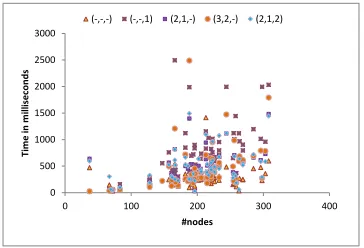
The running time for inference (Figure 5) shows a slightly quadratic behavior in the number of can-didate entities |Ed|of a document. Inference on most documents runs in under0.5seconds.On the relatively sparserInlink+Outlinkgraphs (Refer to Figure 6), training is much faster than the more dense Category graphs. The faster training hap-pens without trading off much on accuracy as can be seen in Table 2. For our experiments, the model was retrained at timetusing all the available
0 500 1000 1500 2000 2500 3000
0 100 200 300 400
Ti
m
e
in
m
ill
isec
o
n
d
s
#nodes
[image:8.612.99.281.50.174.2](-,-,-) (-,-,1) (2,1,-) (3,2,-) (2,1,2)
Figure 5: Running time for inference onW ikicur
ing data. While this might be acceptable for offline training, online systems might benefit from faster incremental training approaches.
0 10 20 30 40 50 60 70 80
5 10 15 20 25 30 35 40 45 50
Ti
m
e
(m
in
s.)
Size of training data
Time for 100 iterations (C) Time for 100 iterations (I+O)
Figure 6: Scalability of training
6 Challenges with data curation
Data curation is a tedious and challenging task. Its inherent ambiguity often introduces annotator bias leading to either incomplete or ambiguous annota-tions in the curated data.
1. There might be cases when two or more en-tities are correct as attachments for a men-tion. E.g., mention ‘Barack Obama’ can be tagged as Barack Obamaor President of United States, and both might seem correct in the context that it appeared. A ‘one entity per mention’ assumption makes it impossible to honor such cases.
2. Human annotators often limit their attention to the candidate entities retrieved by the spot-ter and very rarely search the catalog for any missed candidates. This results in a lot of
missed annotations and often many mentions getting no attachments (NA).
3. Annotators also seem biased towards entity names that match with the mention text. However, this is often not true. E.g. a men-tion of ‘cone snail’ disambiguates toConidae
andConus.
[image:8.612.95.285.301.418.2]4. Wikipedia contains many disambiguation pages that often show up in the candidate set for a mention. Tagging a mention with a dis-ambiguation page seems to beat the very pur-pose of a disambiguation system. Ideally, the mention should be annotated with one of the entities on the disambiguation page or NA if none of them is semantically right.
Table 4 shows some of these cases from the
IIT Bpart dataset. It is cases like these that we attempted to correct in coming up with the curated
IIT Bcurdataset.
7 Conclusion
We presented an approach to jointly train the node and edge features of a collective disambiguation model for the purpose of entity linking. Our sys-tem leverages active learning to bring down la-beling effort. Experiments show that the model benefits from training and improves with the avail-ability of more labeled data. We consistently per-formed better than many other systems on various datasets. It also scales reasonably well and with suggested tweaks can be used for large scale doc-ument annotation.
References
Indrajit Bhattacharya and Lise Getoor. 2006. A la-tent dirichlet model for unsupervised entity resolu-tion. In SIAM INTERNATIONAL CONFERENCE ON DATA MINING.
Y. Boykov and V. Kolmogorov. 2004. An experi-mental comparison of min-cut/max-flow algorithms for energy minimization in vision. Pattern Analy-sis and Machine Intelligence, IEEE Transactions on, 26(9):1124–1137.
Razvan Bunescu and M Pasca. 2006. Using encyclo-pedic knowledge for named entity disambiguation.
Proceedings of EACL, pages 9–16.
Soumen Chakrabarti, Kriti Puniyani, and Sujatha Das. 2006. Optimizing scoring functions and indexes for proximity search in type-annotated corpora. In
Ground Mention Ground Entity Predicted Entity Remarks
lifestyle Lifestyle NA Disambiguation page attachment
harsh reality NA Reality Incomplete data
effort NA Energy Incomplete data
self discipline Discipline self→Self, discipline→Discipline Overlapping mentions
god God (male deity) God Multiple correct entities
[image:9.612.114.506.40.111.2]intellect Intelligence Intellect Multiple correct entities
Table 4: Examples of predictions on theIIT Bparthighlighting the challenges in data curation
Proceedings of the 15th international conference on World Wide Web, WWW ’06, pages 717–726, New York, NY, USA. ACM.
Jinying Chen, Andrew Schein, Lyle Ungar, and Martha Palmer. 2006. An empirical study of the behav-ior of active learning for word sense disambigua-tion. InProceedings of the Main Conference on Hu-man Language Technology Conference of the North American Chapter of the Association of Computa-tional Linguistics, HLT-NAACL ’06, pages 120– 127, Stroudsburg, PA, USA. Association for Com-putational Linguistics.
Tao Cheng, Xifeng Yan, and Kevin C. Chang. 2007. Entityrank: searching entities directly and holisti-cally. InVLDB ’07: Proceedings of the 33rd inter-national conference on Very large data bases, pages 387–398. VLDB Endowment.
Marco Cornolti, Paolo Ferragina, and Massimiliano Ciaramita. 2013. A framework for benchmarking entity-annotation systems. In Proceedings of the 22nd international conference on World Wide Web, WWW ’13, pages 249–260, Republic and Canton of Geneva, Switzerland. International World Wide Web Conferences Steering Committee.
Marco Cornolti, Paolo Ferragina, Massimiliano Cia-ramita, Hinrich Sch¨utze, and Stefan R¨ud. 2014. The smaph system for query entity recognition and dis-ambiguation. In Proceedings of the First Interna-tional Workshop on Entity Recognition & Dis-ambiguation, ERD ’14, pages 25–30, New York, NY, USA. ACM.
Silviu Cucerzan. 2007. Large-scale named entity dis-ambiguation based on wikipedia data. In Proceed-ings of EMNLP-CoNLL, volume 6, pages 708–716.
Stephen Dill, Nadav Eiron, David Gibson, Daniel Gruhl, R. Guha, Anant Jhingran, Tapas Kanungo, Sridhar Rajagopalan, Andrew Tomkins, John A. Tomlin, and Jason Y. Zien. 2003. Semtag and seeker: bootstrapping the semantic web via auto-mated semantic annotation. InProceedings of the 12th international conference on World Wide Web, WWW ’03, pages 178–186, New York, NY, USA. ACM.
Angela Fahrni and Michael Strube. 2012. Jointly disambiguating and clustering concepts and entities with markov logic. InCOLING, pages 815–832.
Paolo Ferragina and Ugo Scaiella. 2010. Tagme: on-the-fly annotation of short text fragments (by wikipedia entities). InProceedings of the 19th ACM international conference on Information and knowl-edge management, CIKM ’10, pages 1625–1628, New York, NY, USA. ACM.
William A. Gale, Kenneth W. Church, and David Yarowsky. 1992. One sense per discourse. In Pro-ceedings of the workshop on Speech and Natural Language, HLT ’91, pages 233–237, Stroudsburg, PA, USA. Association for Computational Linguis-tics.
Xianpei Han and Le Sun. 2012. An entity-topic model for entity linking. InProceedings of the 2012 Joint Conference on Empirical Methods in Natural guage Processing and Computational Natural Lan-guage Learning, EMNLP-CoNLL ’12, pages 105– 115, Stroudsburg, PA, USA. Association for Com-putational Linguistics.
Xianpei Han and Jun Zhao. 2009. Named entity disambiguation by leveraging wikipedia semantic knowledge. InProceedings of the 18th ACM con-ference on Information and knowledge management, CIKM ’09, pages 215–224, New York, NY, USA. ACM.
Xianpei Han, Le Sun, and Jun Zhao. 2011. Collective entity linking in web text: a graph-based method. In
Proceedings of the 34th international ACM SIGIR conference on Research and development in Infor-mation Retrieval, pages 765–774. ACM.
Johannes Hoffart, Mohamed Amir Yosef, Ilaria Bor-dino, Hagen F¨urstenau, Manfred Pinkal, Marc Span-iol, Bilyana Taneva, Stefan Thater, and Gerhard Weikum. 2011. Robust disambiguation of named entities in text. InProceedings of the Conference on Empirical Methods in Natural Language Process-ing, EMNLP ’11, pages 782–792, Stroudsburg, PA, USA. Association for Computational Linguistics. Gjergji Kasneci, Fabian M. Suchanek, Georgiana Ifrim,
Shady Elbassuoni, Maya Ramanath, and Gerhard Weikum. 2008. Naga: harvesting, searching and ranking knowledge. In Proceedings of the 2008 ACM SIGMOD international conference on Man-agement of data, SIGMOD ’08, pages 1285–1288, New York, NY, USA. ACM.
Saurabh S. Kataria, Krishnan S. Kumar, Rajeev R. Ras-togi, Prithviraj Sen, and Srinivasan H. Sengamedu. 2011. Entity disambiguation with hierarchical topic
models. InProceedings of the 17th ACM SIGKDD international conference on Knowledge discovery and data mining, KDD ’11, pages 1037–1045, New York, NY, USA. ACM.
Sayali Kulkarni, Amit Singh, Ganesh Ramakrishnan, and Soumen Chakrabarti. 2009. Collective anno-tation of Wikipedia entities in web text. Proceed-ings of the 15th ACM SIGKDD international conference on Knowledge discovery and data mining -KDD ’09, page 457.
Ashish Kulkarni, Kanika Agarwal, Pararth Shah, Sunny Raj Rathod, and Ganesh Ramakrishnan. 2014. System for collective entity disambiguation. InProceedings of the First International Workshop on Entity Recognition & Disambiguation, ERD ’14, pages 111–118, New York, NY, USA. ACM.
David D. Lewis and Jason Catlett. 1994. Heteroge-neous uncertainty sampling for supervised learning. InIn Proceedings of the 11th International Confer-ence on Machine Learning (ICML, pages 148–156. Morgan Kaufmann.
Mingkun Li and Ishwar K. Sethi. 2006. Confidence-based active learning. IEEE Trans. Pattern Anal. Mach. Intell., 28(8):1251–1261, August.
Xiaonan Li, Chengkai Li, and Cong Yu. 2010. Enti-tyengine: answering entity-relationship queries us-ing shallow semantics. InProceedings of the 19th ACM international conference on Information and knowledge management, CIKM ’10, pages 1925– 1926, New York, NY, USA. ACM.
Thomas Lin, Mausam, and Oren Etzioni. 2012. En-tity linking at web scale. InProceedings of the Joint Workshop on Automatic Knowledge Base Construc-tion and Web-scale Knowledge ExtracConstruc-tion, AKBC-WEKEX ’12, pages 84–88, Stroudsburg, PA, USA. Association for Computational Linguistics.
Paul McNamee. 2009. Overview of the tac 2009 knowledge base population track.
Rada Mihalcea and Andras Csomai. 2007. Wikify!: linking documents to encyclopedic knowledge. In
Proceedings of the sixteenth ACM conference on Conference on information and knowledge manage-ment, pages 233–242. ACM.
David Milne and Ian H Witten. 2008. Learning to link with wikipedia. In Proceedings of the 17th ACM conference on Information and knowledge manage-ment, pages 509–518. ACM.
Lev Ratinov, Dan Roth, Doug Downey, and Mike Anderson. 2011. Local and global algorithms for disambiguation to wikipedia. In Proceedings of the 49th Annual Meeting of the Association for Computational Linguistics: Human Language Tech-nologies - Volume 1, HLT ’11, pages 1375–1384, Stroudsburg, PA, USA. Association for Computa-tional Linguistics.
Ben Taskar and Daphne Koller. 2001. Learning Asso-ciative Markov Networks.
B. Taskar, V. Chatalbashev, and D. Koller. 2004. Learning associative markov networks. In Proceed-ings of the twenty-first international conference on Machine learning, page 102. ACM.
P. Vernaza, B. Taskar, and D.D. Lee. 2008. Online, self-supervised terrain classification via discrimina-tively trained submodular markov random fields. In Robotics and Automation, 2008. ICRA 2008. IEEE International Conference on, pages 2750– 2757. IEEE.
Ben Wellner, Andrew McCallum, Fuchun Peng, and Michael Hay. 2004. An integrated, conditional model of information extraction and coreference with application to citation matching. In Proceed-ings of the 20th Conference on Uncertainty in Arti-ficial Intelligence, UAI ’04, pages 593–601, Arling-ton, Virginia, United States. AUAI Press.
Michael L. Wick, Aron Culotta, Khashayar Rohani-manesh, and Andrew McCallum. 2009. An entity based model for coreference resolution. InSDM, pages 365–376.
Yiping Zhou, Lan Nie, Omid Rouhani-Kalleh, Fla-vian Vasile, and Scott Gaffney. 2010. Resolving surface forms to wikipedia topics. InProceedings of the 23rd International Conference on Computa-tional Linguistics, COLING ’10, pages 1335–1343, Stroudsburg, PA, USA. Association for Computa-tional Linguistics.