Proceedings of the 10th Workshop on Multiword Expressions (MWE 2014), pages 82–88,
Contexts, Patterns, Interrelations - New Ways of Presenting Multi-word
Expressions
Kathrin Steyer
Institute for the German Language R 5, 6-13
D-68161 Mannheim, Germany
Annelen Brunner
Institute for the German Language R 5, 6-13
D-68161 Mannheim, Germany
Abstract
This contribution presents the newest version of our ’Wortverbindungsfelder’ (fields of multi-word expressions), an ex-perimental lexicographic resource that fo-cusses on aspects of MWEs that are rarely addressed in traditional descriptions: Con-texts, patterns and interrelations. The MWE fields use data from a very large corpus of written German (over 6 billion word forms) and are created in a strictly corpus-based way. In addition to tradi-tional lexicographic descriptions, they in-clude quantitative corpus data which is structured in new ways in order to show the usage specifics. This way of looking at MWEs gives insight in the structure of language and is especially interesting for foreign language learners.
1 Our concept of MWEs
We study MWEs from a linguistic perspective and are mainly interested in two questions: What can we learn about the nature of MWEs and their status in language by studying large corpora? And how can we present MWEs in novel lexicographic ways that reflect our findings? The MWE field presented in this contribution is a prototype that reflects our current ideas regarding these questions. It can be explored online free of charge at http://wvonline.ids-mannheim. de/wvfelder-v3/index.html.
Our approach is based on the concept ’Usuelle Wortverbindungen’ (UWV, Steyer 2000; Steyer 2004; Steyer 2013), which defines MWEs as con-ventionalized patterns of language use that man-ifest themselves in recurrent syntagmatic struc-tures. This includes not only idioms and idiosyn-cratic structures, but all multi-word units which have acquired a distinct function in
communica-tion. Our focus is on real-life usage, pragmat-ics and context. We work bottom-up in detecting and describing MWE units in a strongly corpus-driven way (Sinclair 1991; Tognini-Bonelli 2001; Hanks 2013), taking iterative steps to arrive at conclusions about language use. Methologi-cally, our approach bears some similarities to Stefanowitsch/Gries’ ’collostructions’ (Stefanow-itsch/Gries 2003) though we are less interested in syntactic and grammatical structures - as it is com-mon in construction grammar approaches - but see MWEs primarily as parts of the lexicon and feel closer to phraseology.
The basis of our research is DeReKo (Deutsches Referenzkorpus, Institut für Deutsche Sprache 2012), the largest collection of written German available today which has over six billion word to-kens and is located at the Institute for the German Language (IDS). In the current stage of our work, which is mainly explorative, we use DeReKo as it is. This means our text basis is dominated by newspaper texts from the last 10-15 years. Though this is surely not a ’balanced’ corpus, we argue that it still reflects much of contemporary written lan-guage use, as newspaper texts are a medium that is widely disseminated.
Though the interpretation and main analysis is done manually, automatic methods form an im-portant basis to our work. We use a sophisti-cated method of collocation analysis developed at the IDS (Belica 1995) to get indications which word combinations constitute MWEs and to ex-plore contexts in which an MWE is commonly used. In addition to that, we use a pattern matching tool developed in our project to explore and struc-ture corpus evidence and gain further insight into the behavior and variations of MWE candidates.
Our special interest lies in the fact that MWEs are not as fixed as is often assumed, but often be-have as patterns and show multiple interrelations. Therefore, we also describe MWE patterns - a
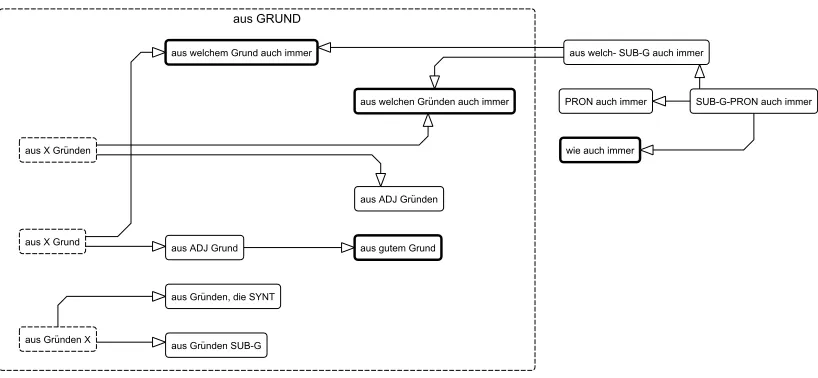
Figure 1: Part of the MWE field centered aroundGrundand prepositionaus.
more abstract form of MWEs which are only par-tially fixed. An example for a fixed MWE is Pi mal Daumen(pi times thumb - ’approximately’), a multi-word expression that is always used in ex-actly this form. MWE patterns on the other hand consist of fixed lexical components as well as slots that can be filled in different ways. In spite of this variability, the whole pattern has a holistic mean-ing and function. An example is the expression
wie NOUN in jemandes Ohren klingen(to sound like NOUN in someone’s ears- ’to be perceived in a certain way’ (specified by NOUN)). The NOUN slot can be filled with different words in order to specify the general meaning of the pattern. In sec-tion 2.3 we will go into further detail about how a slot in an MWE pattern can be filled.
The MWE field presented in this contri-bution centers around the word Grund ( rea-son/basis/foundation) combined with several prepositions. It is the newest of several versions of MWE fields which have been described elsewhere (cf. Brunner/Steyer 2009; Brunner/ Steyer 2010) and are available at our website
http://wvonline.ids-mannheim.de
as well. This newest version focusses more on hierarchies of MWEs and MWE patterns and incorporates additional resources like collocation analyses in its descriptive texts. In the following, we will highlight some features of the MWE field which illustrate our focus on interrelations, contexts and patterns.
2 MWE fieldGrund
2.1 Interrelations
Figure 1 shows a part of the MWE field, centered on the word Grund and preposition aus. Each node is linked to a lexicographic description. Fig-ure 2 presents a screenshot of one of those articles. In addition to narrative descriptions and manu-ally selected usage examples from our corpus, the articles also include components that are derived from quantitative corpus data. Specifically, these are collocation analyses as well as filler tables for MWE patterns. The function of these components will be explained in more detail in sections 2.2 and 2.3.
In Figure 1, you can observe the relations be-tween MWEs (thick border) and MWE patterns (regular border). The nodes with the dashed bor-der represent repeating surface structures which themselves have no common holistic meaning but show the lexical interconnectedness between the MWEs and MWE patterns.
Figure 2: MWE articleAus welchen Gründen auch immerfrom the MWE fieldGrund. The article parts are ’Frequency in the Corpus’, ’General description’, ’Context Analysis’, ’Contrast Analysis’ and ’Su-perordinated Nodes’. The part ’Context Analysis’ contains links to a filler table and to the corresponding KWIC lines.
In this example the core field contains the MWEsaus welchem Grund auch immerand aus welchen Gründen auch immer(’for whatever rea-son/s’). However, the lexical components auch immer are part of more general patterns as well. The word formGrundcan be substituted by differ-ent nouns in the MWE patternaus welch- SUB-G auch immer (e.g. Motiv (motive), Richtung (di-rection)). In the MWE pattern PRON auch im-merthe place is taken by an interrogative pronoun (e.g. was (what), wo (where), wer (who), warum (why)). One of those pronoun fillers, wie(how), is much more frequent than the others, which jus-tifies the definition of a separate MWEwie auch immer, which can be translated as ’howsoever’ or ’to whatever extent’ (see section 2.3 for more de-tails).
The basic structure of the MWE field thus highlights the different degrees of abstraction of MWEs and the functional use of lexical clusters likeauch immer. The lexicographic descriptions linked to the nodes explain the interrelations and the differences in usage and meaning.
2.2 Contexts
Another important aspect of our approach to MWEs is that we pay close attention to the con-texts in which they are commonly used. A good tool to explore this empirically is collocation anal-ysis. In addition to narrative descriptions and man-ually selected corpus examples we therefore in-clude the results of collocation analysis in our ar-ticles.
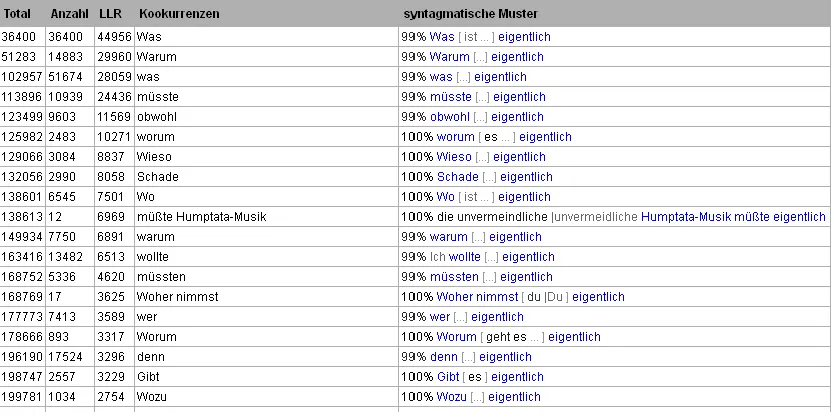
Figure 3: Highest ranking results of the collocation analysis foreigentlich(scope: 5 words in front).
MWEs and their single-lexeme quasi-synonyms. For example the meaning of the MWEim Grunde
is very close to the lexemeeigentlich (actually). Figures 3 and 4 show the highest ranking results of a collocation analysis that focusses on a window of five words in front of the unitseigentlichandim Grunde respectively and calculates the log likeli-hood ratio.1When comparing the results for these two units you can see that there are some con-texts that are strongly preferred byeigentlichbut are not highly ranked forim Grunde. Notable are the combination schade eigentlich (sad actually) as well as combinations with interrogative adverbs like wie (how), was (what), warum (why). The MWE im Grunde, on the other hand, has strong collocation partners that are capitalized conjunc-tions likeaber (but) ordenn (because). This in-dicates a clear tendency to appear near the begin-ning of a sentence in contexts where an argument is made, which is not prominent foreigentlich. So even if a quasi-synonymous single lexeme exists, the MWE shows differences in usage which be-come apparent when studying large quantities of data.
1For details on the collocation analysis used here see Perkuhn/Belica 2004. The settings were: Korpus: W-gesamt - alle Korpora des Archivs W (mit Neuakquisitionen); Archiv-Release: Deutsches Referenzkorpus (DeReKo-2013-II); Analyse-Kontext : 5. Wort links bis 0. Wort rechts; Gran-ularität: grob; Zuverlässigkeit: analytisch; Clusterzuord-nung: mehrfach; Auf 1 Satz beschränkt: ja; Lemmatisierung: nein; Funktionswörter: zugelassen; Autofokus: aus
2.3 Patterns
As mentioned before, MWE patterns are of special interest to us. When exploring MWEs, we use a pattern matching tool that allows us to search large quantities of keyword in context lines (KWICs) for combinations of fixed strings and slots. The lexi-cal fillers of these slots can also be counted and presented in the form of frequency tables. This al-lows us to explore which kinds of variations are possible and typical for an MWE. The filler tables can show quite different ’profiles’ for a slot. In the following, we will give some examples.
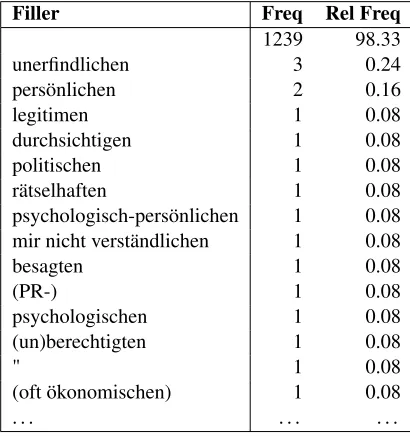
For the MWEaus welchen Gründen auch im-mer (for whatever reasons) we checked whether the elementGründencan be modified by searching for the pattern aus welchen #* Gründen auch immer (#* stands for a slot that can be filled by any number of words). Table 1 shows the absolute and relative frequencies that where calcu-lated from KWIC lines of our corpus. In the vast majority of cases, the slot is empty, which means that the MWE is used exactly in the form cited above: aus welchen Gründen auch immer. It is thus very stable, though not completely inflexible, as there is also evidence of adjectives that are used to further specify the reasons in question, e.g. per-sönlichen Gründen (personal reasons).
Figure 4: Highest ranking results of the collocation analysis forim Grunde(scope: 5 words in front).
Filler Freq Rel Freq
1239 98.33
unerfindlichen 3 0.24
persönlichen 2 0.16
legitimen 1 0.08
durchsichtigen 1 0.08
politischen 1 0.08
rätselhaften 1 0.08
psychologisch-persönlichen 1 0.08
mir nicht verständlichen 1 0.08
besagten 1 0.08
(PR-) 1 0.08
psychologischen 1 0.08
(un)berechtigten 1 0.08
" 1 0.08
(oft ökonomischen) 1 0.08
. . . .
Table 1: Fillers of the patternaus welchen #* Gründen auch immer.
is filled bywie(capitalized or non-capitalized) in nearly 18 percent of the matches. In this case, a single lexical filler is very dominant. This was a strong indication for us that the patternwie auch immer functions as an MWE while at the same time being a prototypical realization of the pat-ternPRON auch immer. Also quite frequent is the filler Gründen, which indicates the pattern [aus welchen] Gründen auch immer, and other inter-rogative pronouns and adverbs like was (what),
Filler Freq Rel Freq
Wie 9611 10.08
wie 7389 7.75
was 5289 5.55
aber 3397 3.56
Gründen 3157 3.31
es 2288 2.40
Was 1953 2.05
Wer 1825 1.91
sich 1677 1.76
warum 1529 1.60
wo 1486 1.56
wer 1446 1.52
ja 1333 1.40
wem 1292 1.35
ist 1276 1.34
[image:5.612.96.301.315.535.2]. . . .
Table 2: Fillers of the pattern# auch immer.
wer (who), wem (whom)etc. This lead us to de-fine the MWE hierarchies as shown in figure 1 and explained in section 2.1.
[image:5.612.353.479.319.531.2]Label Aus|aus # Gründen
SOZ07_10 weshalb das
Orato-rium aus akustischen Gründen auch nicht in einerKirche aufgeführt WPD11_4133 werden, deren
Aus-bau aus unerfindlichen Gründen gestoppt wurde, dieBrutalität BRZ11_258 dem sie sich bisher aus finanziellen Gründen immer zurückhiel-ten. Um sich auch M07_208 Oliver Kahn aus disziplinarischen Gründen für das
Hertha-Spiel an Schärfe E98_409 möglicherweise aus wirtschaftlichen Gründen zurückgehalten.
Schliesslich ist Epo WDD11_305 schlage diesen
[image:6.612.116.498.59.202.2]Ar-tikel aus folgenden Gründen als lesenswert vor:fachlich NUN11_144 die Polizei aus ermittlungstaktischen Gründen nicht mitteilen. . . . .
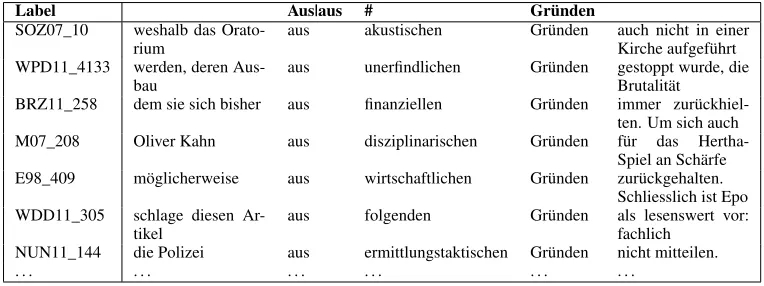
Table 4: KWIC lines of the patternaus # Gründen.
Filler Freq Rel Freq
gesundheitlichen 7355 10.03
beruflichen 6311 8.60
finanziellen 4708 6.42
persönlichen 2660 3.63
organisatorischen 2585 3.52
politischen 2499 3.41
wirtschaftlichen 2180 2.97
privaten 1941 2.65
welchen 1849 2.52
verschiedenen 1779 2.43
diesen 1494 2.04
anderen 1381 1.88
technischen 1260 1.72
zwei 1237 1.69
familiären 1219 1.66
[image:6.612.116.282.242.458.2]. . . .
Table 3: Fillers of the patternaus # Gründen.
none of these is so dominant and striking that a separate MWE needs to be considered. However, the fillers can be grouped into functional groups, like type of the reasons (e.g. politisch (political), persönlich (personal), finanziell (financial)), va-lidity of the reasons (e.g. nachvollziehbar (under-standable), gut (good), triftig (valid)) or relevance of the reasons (e.g.wichtig (important), zwingend (imperative)).
You can see that filler tables are very useful for different purposes: To confirm the fixedness of an MWE and explore occasional variations, to con-ceptualize lexical units in order to build up hierar-chies, and to further describe and understand the behavior of MWE patterns. Not only do we work with such patterns and filler tables when building
the MWE field, we also include them in our de-scriptions - another way to give a user access to original corpus data structured in an informative way.
Additionally, we provide access to the KWIC lines that were used to calculate the filler tables. Table 4 shows some of the lines that match the patternaus # Gründen. These lines are struc-tured in fields according to the search pattern and the different columns can be sorted. In this way, you can explore the use of specific MWE struc-tures yourself.
3 Conclusion
We believe that our MWE fields allow a different way to look at MWEs which is very useful to un-derstand the structure of language. As they are strictly based on data from a large modern lan-guage corpus, our findings also reflect real, con-temporary language use. This is especially useful for foreign language learners who struggle to nav-igate the complexities of fixedness and variability in the German language. In continuing our MWE research, we strive to refine our strategies for de-scription and visualization and also plan to add contrastive studies in the future.
References
Belica, Cyril: Statistische Kollokationsanal-yse und Clustering. Korpusanalytische Analysemethode, 1995 hURL: http: //www1.ids-mannheim.de/kl/ projekte/methoden/ur.htmli – visited on 28.01.2014.
Levická, Jana/Garabík, Radovan, edi-tors: NLP, Corpus Linguistics, Corpus Based Grammar Research (= Proceedings of SLOVKO 2009, held 25-27.11.2009 in Smolenice, Slovakia), 2009, pp. 54–64.
Brunner, Annelen/Steyer, Kathrin:
Wortverbindungsfelder: Fields of Multi-Word Expressions, in: Granger, Silviane/
Paquot, Magali, editors: eLexicography in the 21st century: New challenges, new applications. Proceedings of the eLex 2009. Louvaine-la-Neuve: Presses universitaires de Louvain, 2010, Cahiers du CENTAL, pp. 23–31.
Hanks, Patrick:Lexical Analysis: norms and ex-ploitations, Cambridge [u.a.]: MIT Press, 2013.
Institut für Deutsche Sprache: Deutsches Referenzkorpus/Archiv der Korpora geschriebener Gegenwartssprache (DeReKo 2012-II), Webseite, 2012 hURL:
http://www.ids-mannheim.de/ DeReKoi– visited on 28.01.2014.
Perkuhn, Rainer/Belica, Cyril: Eine kurze Einführung in die Kookkurrenzanalyse und syntagmatische Muster. Institut für Deutsche Sprache, Mannheim, 2004hURL:
http://www1.ids-mannheim.de/ kl/misc/tutorial.htmli – visited on 28.01.2014.
Sinclair, John: Corpus, Concordance, Collo-cation, Oxford: Oxford University Press, 1991.
Stefanowitsch, Anatol/Gries, Stephan Th.: Col-lostructions: Investigating the interaction of words and constructions, in: International Journal of Corpus Linguistics, 8 2003, Nr. 2, pp. 209–243.
Steyer, Kathrin: Usuelle Wortverbindungen des Deutschen. Linguistisches Konzept und lexikografische Möglichkeiten, in: Deutsche Sprache, 28 2000, Nr. 2, pp. 101– 125.
Steyer, Kathrin: Kookkurenz. Korpusmethodik, linguistisches Modell, lexikographische Persepektiven, in:Steyer, Kathrin, editor:
Wortverbindungen - mehr oder weniger fest, Berlin/New York: de Gruyter, 2004, Jahrbuch des Instituts für Deutsche Sprache, pp. 87–116.
Steyer, Kathrin: Usuelle Wortverbindungen. Zentrale Muster des Sprachgebrauchs aus korpusanalytischer Sicht, Tübingen: Narr, 2013.