Proceedings of the 5th Workshop on Speech and Language Processing for Assistive Technologies (SLPAT), pages 29–37, Baltimore, Maryland USA, August 26 2014. c2014 Association for Computational Linguistics
Individuality-preserving Voice Conversion for Articulation Disorders
Using Dictionary Selective Non-negative Matrix Factorization
Ryo Aihara, Tetsuya Takiguchi, Yasuo Ariki
Graduate School of System Informatics, Kobe University 1-1, Rokkodai, Nada, Kobe, 6578501, Japan [email protected],
[email protected], [email protected]
Abstract
We present in this paper a voice conver-sion (VC) method for a person with an ar-ticulation disorder resulting from athetoid cerebral palsy. The movements of such speakers are limited by their athetoid symptoms, and their consonants are of-ten unstable or unclear, which makes it difficult for them to communicate. In this paper, exemplar-based spectral con-version using Non-negative Matrix Factor-ization (NMF) is applied to a voice with an articulation disorder. In order to pre-serve the speaker’s individuality, we use a combined dictionary that was constructed from the source speaker’s vowels and tar-get speaker’s consonants. However, this exemplar-based approach needs to hold all the training exemplars (frames), and it may cause mismatching of phonemes between input signals and selected ex-emplars. In this paper, in order to re-duce the mismatching of phoneme align-ment, we propose a phoneme-categorized sub-dictionary and a dictionary selec-tion method using NMF. The effective-ness of this method was confirmed by comparing its effectiveness with that of a conventional Gaussian Mixture Model (GMM)-based and conventional NMF-based method.
1 Introduction
In this study, we focused on a person with an articulation disorder resulting from the athetoid type of cerebral palsy. About two babies in 1,000 are born with cerebral palsy (Hollegaard et al., 2013). Cerebral palsy results from damage to the central nervous system, and the damage causes movement disorders. Cerebral palsy is classified
into the following types: 1)spastic, 2)athetoid, 3)ataxic, 4)atonic, 5)rigid, and a mixture of these types (Canale and Campbell, 2002).
Athetoid symptoms develop in about 10-15% of cerebral palsy sufferers (Hollegaard et al., 2013). In the case of a person with this type of articulation disorder, his/her movements are sometimes more unstable than usual. That means their utterances (especially their consonants) are often unstable or unclear due to the athetoid symptoms. Athetoid symptoms also restrict the movement of their arms and legs. Most people suffering from athetoid cerebral palsy cannot communicate by sign lan-guage or writing, so there is great need for voice systems for them.
In this paper, we propose a voice conversion (VC) method for articulation disorders. Regard-ing speech recognition for articulation disorders, the recognition rate using a speaker-independent model which is trained by well-ordered speech, is 3.5% (Matsumasa et al., 2009). This result im-plies that the utterance of a person with an artic-ulation disorder is difficult to understand for peo-ple who have not communicated with them before. In recent years, people with an articulation dis-order may use slideshows and a previously syn-thesized voice when they give a lecture. How-ever, because their movement is restricted by their athetoid symptoms, to make slides or synthesize their voice in advance is hard for them. Peo-ple with articulation disorders desire a VC sys-tem that converts their voice into a clear voice that preserves their voice’s individuality. Rudz-icz et al. (RudzRudz-icz, 2011; RudzRudz-icz, 2014) proposed speech adjustment method for people with articu-lation disorders based on the observations from the database.
In (Aihara et al., 2014), we proposed individuality-preserving VC for articulation
disorders. In our VC, source exemplars and
training data, having the same texts uttered by the source and target speakers. The input source signal is expressed with a sparse representation of the source exemplars using Non-negative Matrix Factorization (NMF). By replacing a source speaker’s exemplar with a target speaker’s exemplar, the original speech spectrum is replaced with the target speaker’s spectrum. People with articulation disorders wish to communicate by their own voice if they can; therefore, we pro-posed a combined-dictionary, which consists of a source speaker’s vowels and target speaker’s well-ordered consonants. In the voice of a person with an articulation disorder, their consonants are often unstable and that makes their voices unclear. Their vowels are relatively stable compared to their consonants. Hence, by replacing the articulation-disordered basis of consonants only, a voice with an articulation disorder is converted into a non-disordered voice that preserves the individuality of the speaker’s voice.
In this paper, we propose advanced
individuality-preserving VC using NMF. In order to avoid a mixture of the source and target spectra in a converted phoneme, we applied a phoneme-categorized dictionary and a dictionary selection method to our VC using NMF. In conventional NMF-based VC, the number of dictionary frames becomes large because the dictionary holds all the training exemplar frames. Therefore, it may cause phoneme mismatching between input signals and selected exemplars and some frames of converted spectra might be mixed with the source and target spectra. In this paper, a training exemplar is divided into a phoneme-categorized sub-dictionary, and an input signal is converted by using the selected sub-dictionary. The effectiveness of this method was confirmed by comparing it with a conventional NMF-based method and a conventional Gaussian Mixture Model (GMM)-based method.
The rest of this paper is organized as follows: In Section 2, related works are introduced. In Sec-tion 3, the basic idea of NMF-based VC is scribed. In Section 4, our proposed method is de-scribed. In Section 5, the experimental data are evaluated, and the final section is devoted to our conclusions.
2 Related Works
Voice conversion (VC) is a technique for convert-ing specific information in speech while maintain-ing the other information in the utterance. One of the most popular VC applications is speaker version (Stylianou et al., 1998). In speaker con-version, a source speaker’s voice individuality is changed to a specified target speaker’s so that the input utterance sounds as though a specified target speaker had spoken it.
There have also been studies on several tasks that make use of VC. Emotion conversion is a technique for changing emotional information in input speech while maintaining linguistic informa-tion and speaker individuality (Veaux and Robet, 2011). In recent years, VC has been used for auto-matic speech recognition (ASR) or speaker adap-tation in text-to-speech (TTS) systems (Kain and Macon, 1998). These studies show the varied uses of VC.
Many statistical approaches to VC have been studied (Valbret et al., 1992). Among these ap-proaches, the Gaussian mixture model (GMM)-based mapping approach (Stylianou et al., 1998) is widely used. In this approach, the conversion function is interpreted as the expectation value of the target spectral envelope. The conversion parameters are evaluated using Minimum Mean-Square Error (MMSE) on a parallel training set. A number of improvements in this approach have been proposed. Toda et al. (Toda et al., 2007) introduced dynamic features and the global vari-ance (GV) of the converted spectra over a time sequence. Helander et al. (Helander et al., 2010) proposed transforms based on partial least squares (PLS) in order to prevent the over-fitting problem associated with standard multivariate regression. There have also been approaches that do not re-quire parallel data that make use of GMM adapta-tion techniques (Lee and Wu, 2006) or eigen-voice GMM (EV-GMM) (Toda et al., 2006).
changed to the source speaker’s individuality. Peo-ple with articulation disorders wish to communi-cate by their own voice if they can and there is a needs for individuality-preserving VC.
Text-to-speech synthesis (TTS) is a famous voice application that is widely researched. Veaux et al. (Veaux et al., 2012) used HMM-based speech synthesis to reconstruct the voice of individu-als with degenerative speech disorders resulting from Amyotrophic Lateral Sclerosis (ALS). Ya-magishi et al. (YaYa-magishi et al., 2013) proposed a project named “Voice Banking and Reconstruc-tion”. In that project, various types of voices are collected and they proposed TTS for ALS using that database. The difference between TTS and VC is that TTS needs text input to synthesize speech, whereas VC does not need text input. In the case of people with articulation disorders re-sulting from athetoid cerebral palsy, it is difficult for them to input text because of their athetoid symptoms.
Our proposed NMF-based VC (Takashima et al., 2012) is an exemplar-based method using sparse representation, which is different from the conventional statistical method. In recent years, approaches based on sparse representations have gained interest in a broad range of signal process-ing. In approaches based on sparse representa-tions, the observed signal is represented by a lin-ear combination of a small number of bases. In some approaches for source separation, the atoms are grouped for each source, and the mixed sig-nals are expressed with a sparse representation of these atoms. By using only the weights of the atoms related to the target signal, the target sig-nal can be reconstructed. Gemmeke et al. (Gem-meke et al., 2011) also propose an exemplar-based method for noise-robust speech recognition. In that method, the observed speech is decomposed into the speech atoms, noise atoms, and their weights. Then the weights of the speech atoms are used as phonetic scores (instead of the likelihoods of hidden Markov models) for speech recognition. In (Takashima et al., 2012), we proposed noise-robust VC using NMF. The noise exemplars, which are extracted from the before- and after-utterance sections in an observed signal, are used as the noise-dictionary, and the VC process is combined with an NMF-based noise-reduction method. On the other hand, NMF is one of the clustering methods. In our exemplar-based VC, if
the phoneme label of the source exemplar is given, we can discriminate the phoneme of the input sig-nal by using NMF. In this paper, we proposed a dictionary selection method using this property of NMF.
3 Voice Conversion Based on
Non-negative Matrix Factorization
3.1 Basic Idea
In the exemplar-based approach, the observed sig-nal is represented by a linear combination of a small number of bases.
xl≈∑Jj=1ajhj,l =Ahl (1)
xl represents the l-th frame of the observation.
aj and hj,l represent the j-th basis and the
weight, respectively. A = [a1. . .aJ]and hl = [h1,l. . . hJ,l]T are the collection of the bases and
the stack of weights. In this paper, each basis de-notes the exemplar of the spectrum, and the col-lection of exemplarAand the weight vectorhlare
called the ‘dictionary’ and ‘activity’, respectively. When the weight vectorhlis sparse, the observed
signal can be represented by a linear combination of a small number of bases that have non-zero weights. Eq. (1) is expressed as the inner product of two matrices using the collection of the frames or bases.
X ≈ AH (2)
X = [x1, . . . ,xL], H= [h1, . . . ,hL].(3)
Lrepresents the number of the frames.
Fig. 1 shows the basic approach of our
exemplar-based VC, whereD, L,andJ represent
the numbers of dimensions, frames, and bases, respectively. Our VC method needs two dictio-naries that are phonemically parallel. As
repre-sents a source dictionary that consists of the source
speaker’s exemplars and At represents a target
dictionary that consists of the target speaker’s ex-emplars. These two dictionaries consist of the same words and are aligned with dynamic time warping (DTW) just as conventional GMM-based VC is. Hence, these dictionaries have the same number of bases.
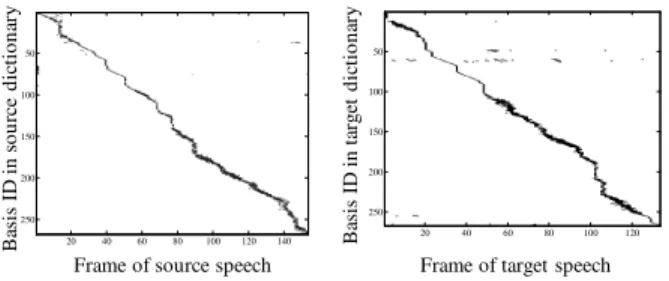
tained activity matrices are approximately equiv-alent. Fig. 2 shows an example of the activity matrices estimated from a Japanese word “ikioi” (“vigor” in English), where one is uttered by a male, the other is uttered by a female, and each dictionary is structured from just one word “ikioi” as the simple example.
As shown in Fig. 2, these activities have high energies at similar elements. For this reason, we assume that when there are parallel dictionaries, the activity of the source features estimated with the source dictionary may be able to be substi-tuted with that of the target features. Therefore, the target speech can be constructed using the tar-get dictionary and the activity of the source signal as shown in Fig. 1. In this paper, we use Non-negative Matrix Factorization (NMF), which is a sparse coding method in order to estimate the ac-tivity matrix.
s
X D
L
s
A
t
A
Parallel data
J
Copy s
H
s
H t
Xˆ
Source spectral features
(D x L)
Source and target dictionaries
(Dx J)
Converted spectral features
(Dx L) Activity of
source signal
(Jx L)
Activity estimation
Construction
Figure 1: Basic approach of NMF-based voice conversion
B
as
is
I
D
i
n
s
o
u
rc
e
d
ic
ti
o
n
ar
y
Frame of source speech
B
as
is
I
D
i
n
t
ar
g
et
d
ic
ti
o
n
ar
y
Frame of target speech
20 40 60 80 100 120 140 50
100
150
200
250
20 40 60 80 100 120 50
100
150
200
250
Figure 2: Activity matrices for parallel utterances
3.2 Individuality-preserving Voice
Conversion Using Combined Dictionary In order to make a parallel dictionary, some pairs of parallel utterances are needed, where each pair consists of the same text. One is spoken by a per-son with an articulation disorder (source speaker),
and the other is spoken by a physically
unim-paired person (target speaker). Spectrum
en-velopes, which are extracted from parallel utter-ances, are phonemically aligned by using DTW. In order to estimate activities of source features precisely, segment features, which consist of some consecutive frames, are constructed. Target fea-tures are constructed from consonant frames of the target’s aligned spectrum and vowel frames of the source’s aligned spectrum. Source and target dic-tionaries are constructed by lining up each of the features extracted from parallel utterances.
The vowels voiced by a speaker strongly indi-cate the speaker’s individuality. On the other hand, consonants of people with articulation disorders are often unstable. Fig. 3(a) shows an example of the spectrogram for the word “ikioi” (“vigor” in English) of a person with an articulation dis-order. The spectrogram of a physically unim-paired person speaking the same word is shown in Fig. 3(b). In Fig. 3(a), the area labeled “k” is not clear, compared to the same region in to Fig. 3(b). These figures indicate that consonants of people with articulation disorders are often unstable and this deteriorates their voice intelligibility. In or-der to preserve their voice individuality, we use a “combined-dictionary” that consists of a source speaker’s vowels and target speaker’s consonants. We replace the target dictionary As in Fig. 1 with the “combined-dictionary”. Input source
features Xs, which consist of an
articulation-disordered spectrum and its segment features, are decomposed into a linear combination of bases
from the source dictionary As by NMF. The
weights of the bases are estimated as an activity Hs. Therefore, the activity includes the weight
in-formation of input features for each basis. Then, the activity is multiplied by a combined-dictionary in order to obtain converted spectral featuresXˆt,
which are represented by a linear combination of bases from the source speaker’s vowels and tar-get speaker’s consonants. Because the source and target are parallel phonemically, the bases used in the converted features are phonemically the same as that of the source features.
3.3 Problems
signal comes to be represented by a linear com-bination of a large number of bases rather than a small number of bases. When the number of bases that represent the input signal becomes large, the assumption of similarity between source and tar-get activities may be weak due to the influence of the mismatch between the input signal and the se-lected bases. Moreover, in the case of a combined-dictionary, the input articulation-disordered spec-trum may come to be represented by a combi-nation of vowels and consonants. We assume that this problem degrades the performance of our exemplar-based VC. Hence, we use a phoneme-categorized sub-dictionary in place of the large dictionary in order to reduce the number of the bases that represent the input signal and avoid the mixture of vowels and consonants.
0.1 0.2 0.3 0.4 0.5 0.6 0.7 0.8 0.9 0
1000 2000 3000 4000 5000 6000
F
re
q
u
en
cy
[
H
z]
Time [Sec]
i k i oi
(a) Spoken by a person with an articulation disorder
0.2 0.4 0.6 0.8 1
0 1000 2000 3000 4000 5000 6000
F
re
q
u
en
cy
[
H
z]
Time [Sec]
i k i oi
(b) Spoken by a physically unimpaired person
0.1 0.2 0.3 0.4 0.5 0.6 0.7 0.8 0.9 0
1000 2000 3000 4000 5000 6000
F
re
q
u
en
cy
[
H
z]
Time [Sec]
i k i oi
(c) Converted by NMF-based VC
Figure 3: Examples of spectrogram //i k i oi
4 Non-negative Matrix Factorization Using a Phoneme-categorized Dictionary
4.1 Phoneme-categorized Dictionary
Fig. 4 shows how to construct the sub-dictionary. AsandAtimply the source and target dictionary which hold all the bases from training data. These
dictionaries are divided into K dictionaries. In
this paper, the dictionaries are divided into 10 cat-egories according to the Japanese phoneme cate-gories shown in Table 1.
In order to select the sub-dictionary, a “categorizing-dictionary”, which consists of the representative vector from each sub-dictionary, is constructed. The representative vectors for each phoneme category consist of the mean vectors of the Gaussian Mixture Model (GMM).
p(x(nk)) = Mk
∑
m=1
α(mk)N(x(nk),µ(mk),Σ(mk)) (4)
Mk, α(mk), µm(k) and Σ(mk) represent the number
of the Gaussian mixture, the weights of mixture,
mean and variance of the m-th mixture of the
Gaussian, in thek-th sub-dictionary, respectively. Each parameter is estimated by using an EM algo-rithm.
The basis of the categorizing-dictionary, which corresponds to thek-th sub-dictionaryΦsk, is rep-resented using the estimated phoneme GMM as follows:
θk = [µ(1k), . . . ,µ (k)
Mk] (5)
Φsk = [x(1k), . . . ,x(Nk)
k] (6)
Nk represents the number of frames of the k-th
sub-dictionary. The categorizing-dictionaryΘis
given as follows:
Θ = [θ1, . . . ,θK] (7)
4.2 Dictionary Selection and Voice Conversion
Fig. 5 shows the flow of the dictionary selection
and VC. The input spectral features Xs are
...
...
Sourcetraining speech
Target training speech
Spectral envelope
s
A
t
A
Parallel Dictionaries
s
1
Φ
Φ
skDP-matching
...
...
Θ
Categorizing Dictionary
STRAIGHT
STRAIGHT
Categorization
phoneme categorized sub-dictionaries
t k+1
Φ
s k+1
Φ
t K
Φ
s K
Φ
s
1
Φ
Φ
skVowel sub-dictionaries Consonant sub-dictionaries Representative
vectors
Articulation-disordered spectrum
Well-ordered spectrum
Vowels are replaced with source speaker’s spectrum
Figure 4: Making a sub-dictionary
bases are represented as activitiesHsΘ.
Xs ≈ ΘHsΘ s.t. HsΘ ≥0 (8)
Xs = [xs1, . . . ,xsL] (9)
HsΘ = [hsΘ1, . . . ,hsΘL] (10)
hsΘl = [hsθ1l, . . . ,hsθKl]T (11)
hsθkl = [hsθ1l, . . . , hsθM kl]T (12)
Then, thel-th frame of input featurexsl is rep-resented by a linear combination of bases from the dictionary of the source speaker. The sub-dictionary Φsˆ
k, which corresponds to xl, is
se-lected as follows:
ˆ
k = arg max k
11×Mkhs
θkl
= arg max k
Mk
∑
m=1
hsθml (13)
xl = Φsˆkhˆk,l (14)
The activityhl,ˆkin Eq. (14) is estimated from the selected source speaker sub-dictionary.
If the selected sub-dictionary Φsˆ
k is related to
consonants, thel-th frame of the converted spec-tral featureyˆlis constructed by using the activity
and the sub-dictionary of the target speakerΦtˆ
k.
ˆ
yl = Φtkˆhk,lˆ (15)
On the other hand, if the selected sub-dictionary Φs
ˆ
kis related to vowels, thel-th frame of the
con-verted spectral featureyˆl is constructed by using
the activity and the sub-dictionary of the source speakerΦs
ˆ
k.
ˆ
yl = Φsˆkhk,lˆ (16)
Table 1: Japanese phoneme categories
Category phoneme
a a
e e
vowels i i
o o
u u
plosives Q, b, d, dy, g, gy, k, ky, p, t fricatives ch, f, h, hy, j, s, sh, ts, z
consonants nasals m, my ny, N
semivowels w,y
liquid r, ry
s l Θ
h
s
1
Φ
Categorizing Dictionary
l
x
Select the sub-dictionary
Copy
l-th frame of input spectral features
l-th frame of converted spectral features
Θ
l
y
ˆ
s l 1
θ
h
s l K
θ
h
s l k
θ
h
Activity
t K Φ
s K Φ s
k+1
Φ
t k+1
Φ
s l M
k k
k
k 1 hθ ×
=argmax 1 ˆ
…
…
…
…
l
x
…
…
Activity
l kˆ, h
phoneme-categorized sub-dictionaries
s
1
Φ
Figure 5: NMF-based voice conversion using cat-egorized dictionary
5 Experimental Results
5.1 Experimental Conditions
database (Kurematsu et al., 1990). The speech sig-nals were sampled at 12 kHz and windowed with a 25-msec Hamming window every 10 msec. A physically unimpaired Japanese male in the ATR Japanese speech database, was chosen as a target speaker.
In the proposed and sample-based methods, the number of dimensions of the spectral fea-ture is 2,565. It consists of a 513-dimensional STRAIGHT spectrum (Kawahara et al., 1999) and its consecutive frames (the 2 frames com-ing before and the 2 frames comcom-ing after). The Gaussian mixture, which is used to construct a categorizing-dictionary, is 1/500 of the ber of bases of each sub-dictionary. The num-ber of iterations for estimating the activity in the proposed and sample-based methods was 300. In the conventional GMM-based method,
MFCC+∆MFCC+∆∆MFCC is used as a spectral
feature. Its number of dimensions is 74. The num-ber of Gaussian mixtures is set to 64, which is ex-perimentally selected.
In this paper, F0 information is converted using a conventional linear regression based on the mean and standard deviation (Toda et al., 2007). The other information such as aperiodic components, is synthesized without any conversion.
We conducted a subjective evaluation of 3 top-ics. A total of 10 Japanese speakers took part in the test using headphones. For the “listening intelligibility” evaluation, we performed a MOS (Mean Opinion Score) test (”INTERNATIONAL TELECOMMUNICATION UNION”, 2003). The opinion score was set to a 5-point scale (5: excel-lent, 4: good, 3: fair, 2: poor, 1: bad). Twenty-two words that are difficult for a person with an artic-ulation disorder to utter were evaluated. The sub-jects were asked about the listening intelligibility in the articulation-disordered voice, the voice con-verted by our proposed method, and the GMM-based converted voice.
On the “similarity” evaluation, the XAB test was carried out. In the XAB test, each subject lis-tened to the articulation-disordered voice. Then the subject listened to the voice converted by the two methods and selected which sample sounded most similar to the articulation-disordered voice. On the “naturalness” evaluation, a paired com-parison test was carried out, where each subject listened to pairs of speech converted by the two methods and selected which sample sounded more
natural.
0.1 0.2 0.3 0.4 0.5 0.6 0.7 0.8 0.9 0
1000 2000 3000 4000 5000 6000
F
re
q
u
en
cy
[
H
z]
Time [Sec]
i k i oi
(a) Converted by proposed method
0.1 0.2 0.3 0.4 0.5 0.6 0.7 0.8 0.9 0
1000 2000 3000 4000 5000 6000
F
re
q
u
en
cy
[
H
z]
Time [Sec]
i k i oi
(b) Converted by GMM-based VC
Figure 6: Examples of converted spectrogram //i k i oi
5.2 Results and Discussion
Fig. 6(a) and 6(b) show examples of converted spectrograms using our proposed method and the conventional GMM-based method, respectively. In Fig. 6(a), there are fewer misconversions in the vowel part compared to Fig. 3(c). Moreover, by using GMM-based conversion, the area labeled “oi” becomes unclear compared to NMF-based conversion.
Fig. 7 shows the results of the MOS test for lis-tening intelligibility. The error bars show a 95%
confidence score; thus, our proposed VC method is shown to be able to improve the listening intel-ligibility and clarity of consonants. On the other hand, GMM-based conversion can improve the clarity of consonants, but it deteriorates the lis-tening intelligibility. This is because GMM-based conversion has the effect of noise resulting from measurement error. Our proposed VC method also has the effect of noise, but it is less than that cre-ated by GMM-based conversion.
Fig. 8 shows the results of the XAB test on the similarity to the source speaker and natural-ness of the converted voice. The error bars show a 95% confidence score. Our proposed VC method obtained a higher score than Sample-based and
GMM-based conversion on similarity. Fig. 9
shows the preference score on the naturalness. The error bars show a 95% confidence score. Our pro-posed VC also method obtained a higher score than Sample-based and GMM-based conversion methods in regard to naturalness.
2 2.1 2.2 2.3 2.4 2.5 2.6 2.7
Proposed GMM source
M O S M O S M O S M O S
Figure 7: Results of MOS test on listening intelli-gibility 0 0.1 0.2 0.3 0.4 0.5 0.6 0.7 0.8 0.9 1 NMF GMM P re fe re nc e S co re P re fe re nc e S co re P re fe re nc e S co re P re fe re nc e S co re 0 0.1 0.2 0.3 0.4 0.5 0.6 0.7 0.8 0.9 1 Proposed NMF 0 0.1 0.2 0.3 0.4 0.5 0.6 0.7 0.8 0.9 1 Proposed GMM
Figure 8: Preference scores for the individuality
0 0.1 0.2 0.3 0.4 0.5 0.6 0.7 0.8 0.9 1 NMF GMM P re fe re nc e S co re P re fe re nc e S co re P re fe re nc e S co re P re fe re nc e S co re 0 0.1 0.2 0.3 0.4 0.5 0.6 0.7 0.8 0.9 1 Proposed NMF 0 0.1 0.2 0.3 0.4 0.5 0.6 0.7 0.8 0.9 1 Proposed GMM
Figure 9: Preference scores for the naturalness
6 Conclusion
We proposed a spectral conversion method based on NMF for a voice with an articulation disorder. Our proposed method introduced a dictionary-selection method for conventional NMF-based VC. Experimental results demonstrated that our VC method can improve the listening intelligibil-ity of words uttered by a person with an articu-lation disorder. Moreover, compared to conven-tional GMM-based VC and convenconven-tional NMF-based VC, our proposed VC method can preserve the individuality of the source speaker’s voice and
the naturalness of the voice. In this study, there was only one subject person, so in future experi-ments, we will increase the number of subjects and further examine the effectiveness of our method.
References
R. Aihara, R. Takashima, T. Takiguchi, and Y. Ariki. 2014. A preliminary demonstration of exemplar-based voice conversion for articulation disor-ders using an individuality-preserving dictionary.
EURASIP Journal on Audio, Speech, and Music Processing, 2014:5, doi:10.1186/1687-4722-2014-5.
S. T. Canale and W. C. Campbell. 2002. Campbell’s operative orthopaedics. Technical report, Mosby-Year Book.
J. F. Gemmeke, T. Viratnen, and A. Hurmalainen. 2011. Exemplar-based sparse representations for
noise robust automatic speech recognition. IEEE
Trans. Audio, Speech and Language Processing, vol. 19, no. 7, pages 2067–2080.
E. Helander, T. Virtanen, J. Nurminen, and M. Gab-bouj. 2010. Voice conversion using partial least
squares regression. IEEE Trans. Audio, Speech,
Lang. Process., vol. 18, Issue:5, pages 912–921.
Mads Vilhelm Hollegaard, Kristin Skogstrand, Poul Thorsen, Bent Norgaard-Pedersen, David Michael Hougaard, and Jakob Grove. 2013. Joint analysis of SNPs and proteins identifies regulatory IL18 gene variations decreasing the chance of spastic cerebral
palsy. Human Mutation, Vol. 34, pages 143–148.
INTERNATIONAL TELECOMMUNICATION
UNION. 2003. Methods for objective and
subjec-tive assessment of quality. ITU-T Recommendation
P.800.
A. Kain and M. W. Macon. 1998. Spectral voice
con-version for text-to-speech synthesis.in ICASSP, vol.
1, pages 285–288.
H. Kawahara, I. Masuda-Katsuse, and A.de Cheveigne. 1999. Restructuring speech representations using a pitch-adaptive time-frequency smoothing and an instantaneous-frequencybased F0 extraction:
possi-ble role of a repetitive structure in sounds. Speech
Communication, 27(3-4):187–207.
A. Kurematsu, K. Takeda, Y. Sagisaka, S. Katagiri, H. Kuwabara, and K. Shikano. 1990. ATR Japanese speech database as a tool of speech recognition and
synthesis.Speech Communication, 9:357–363.
C. H. Lee and C. H. Wu. 2006. Map-based adaptation for speech conversion using adaptation data
selec-tion and non-parallel training. in Interspeech, pages
2254–2257.
H. Matsumasa, T. Takiguchi, Y. Ariki, I. Li, and T. Nakabayachi. 2009. Integration of metamodel and acoustic model for dysarthric speech
recogni-tion. Journal of Multimedia, Volume 4, Issue 4,
pages 254–261.
K. Nakamura, T. Toda, H. Saruwatari, and K. Shikano. 2006. Speaking aid system for total laryngectomees using voice conversion of body transmitted artificial
speech. in Interspeech, pages 148–151.
K. Nakamura, T. Toda, H. Saruwatari, and K. Shikano.
2012. Speaking-aid systems using
GMM-based voice conversion for electrolaryngeal speech.
Speech Communication, 54(1):134–146.
F. Rudzicz. 2011. Acoustic transformations to
im-prove the intelligibility of dysarthric speech. in
proc. the Second Workshop on Speech and Language Processing for Assistive Technologies.
F. Rudzicz. 2014. Adjusting dysarthric speech
sig-nals to be more intelligible.in Computer Speech and
Language, 27(6), September, pages 1163–1177.
Y. Stylianou, O. Cappe, and E. Moilines. 1998. Con-tinuous probabilistic transform for voice
conver-sion. IEEE Trans. Speech and Audio Processing,
6(2):131–142.
R. Takashima, T. Takiguchi, and Y. Ariki. 2012.
Exemplar-based voice conversion in noisy
environ-ment.in SLT, pages 313–317.
T. Toda, Y. Ohtani, and K. Shikano. 2006. Eigenvoice
conversion based on Gaussian mixture model. in
In-terspeech, pages 2446–2449.
T. Toda, A. Black, and K. Tokuda. 2007. Voice con-version based on maximum likelihood estimation of
spectral parameter trajectory. IEEE Trans. Audio,
Speech, Lang. Process., 15(8):2222–2235.
H. Valbret, E. Moulines, and J. P. Tubach. 1992. Voice
transformation using PSOLA technique. Speech
Communication, vol. 11, no. 2-3, pp. 175-187.
C. Veaux and X. Robet. 2011. Intonation conversion
from neutral to expressive speech. in Interspeech,
pages 2765–2768.
C. Veaux, J. Yamagishi, and S. King. 2012. Us-ing HMM-based speech synthesis to reconstruct the voice of individuals with degenerative speech
disor-ders.in Interspeech, pages 1–4.
J. Yamagishi, Christophe Veaux, Simon King, and Steve Renals. 2013. Speech synthesis technolo-gies for individuals with vocal disabilities: Voice
banking and reconstruction.Acoustical Science and
Technology, Vol. 33 (2012) No. 1, pages 1–5.