Online Word Alignment for Online Adaptive Machine Translation
M. Amin Farajian
FBK-irst, University of Trento
Trento, Italy
Nicola Bertoldi
FBK-irst Trento, Italy
Marcello Federico
FBK-irst Trento, Italy
Abstract
A hot task in the Computer Assisted Translation scenario is the integration of Machine Translation (MT) systems that adapt sentence after sentence to the post-edits made by the translators. A main role in the MT online adaptation process is played by the information extracted from source and post-edited sentences, which in turn depends on the quality of the word alignment between them. In fact, this step is particularly crucial when the user corrects the MT output with words for which the system has no prior infor-mation. In this paper, we first discuss the application of popular state-of-the-art word aligners to this scenario and reveal their poor performance in aligning un-known words. Then, we propose a fast procedure to refine their outputs and to get more reliable and accurate alignments for unknown words. We evaluate our enhanced word-aligner on three language pairs, namely Italian, English-French, and English-Spanish, showing a consistent improvement in aligning un-known words up to 10% absolute F-measure.
1 Introduction
In the adaptive MT the goal is to let the MT system take as soon and as much as possible advantage of user feedback, in order to learn from corrections and to hence avoid repeating the same mistakes in future sentences.
A typical application scenario is the usage by a professional translator of a Computer Assisted Translation (CAT) tool enhanced with a SMT sys-tem. For each input sentence, first the translator receives one or more translation suggestions from
either a Translation Memory or a SMT system, then (s)he chooses which suggestion is more use-ful, and finally (s)he creates an approved transla-tion by post-editing. The pair of input sentence and post-edit is a valuable feedback to improve the quality of next suggestions. While the sentence pair is trivially added to the Translation Memory, how to exploit it for improving the SMT system is far to be a solved problem, but rather is a hot and quite recent topic in the MT community.
In online MT adaptation specific issues have to be addressed, which distinguish it from the more standard and investigated task of domain adapta-tion. First of all, the SMT system should adapt very quickly, because the time between two con-secutive requests are usually short, and very pre-cisely, because the translator is annoyed by cor-recting the same error several time. Then, a crucial point is which and how information is extracted from the feedback, and how it is exploited to up-date the SMT system. Finally, model updating re-lies on a little feedback consisting of just one sen-tence pair.
In this work we focus on the word alignment task which is the first and most important step in extracting information from the given source and its corresponding post-edit. In particular, we are interested in the cases where the given sentence pairs contain new words, for which no prior infor-mation is available. This is an important and chal-lenging problem in the online scenario, in which the user interacts with the system and expects that it learns from the previous corrections and does not repeat the same errors again and again.
Unfortunately, state-of-the-art word-aligners show poor generalization capability and are prone to errors when infrequent or new words occur in the sentence pair. Word alignment errors at this stage could cause the extraction of wrong phrase pairs, i.e. wrong translation alternatives, which can lead in producing wrong translations for those
words, if they appear in the following sentences. Our investigation focuses on how to quickly build a highly precise word alignment from a source sentence and its translation. Moreover, we are interested in improving the word alignment of unknown terms, i.e. not present in the training data, because they are one of the most important source of errors in model updating.
Although we are working in the online MT adaptation framework, our proposal is worthwhile per se; indeed, having an improved and fast word aligner can be useful for other interesting tasks, like for instance terminology extraction, transla-tion error detectransla-tion, and pivot translatransla-tion.
In Section 2 we report on some recent ap-proaches aiming at improving word alignment. In Section 3, we describe three widely used toolk-its, highlight their pros and cons in the online MT adaptation scenario, and compare their per-formance in aligning unknown terms. In Section 4 we propose a standalone module which refines the word alignment of unknown words; moreover, we present an enhanced faster implementation of the best performing word aligner, to make it usable in the online scenario. In Section 5 we show exper-imental results of this module on three different languages. Finally, we draw some final comments in Section 6.
2 Related works
Hardt et al. (2010) presented an incremental re-training method which simulates the procedure of learning from post-edited MT outputs (refer-ences), in a real time fashion. By dividing the learning task into word alignment and phrase ex-traction tasks, and replacing the standard word-alignment module, which is a variation of EM algorithm (Och and Ney, 2003), with a greedy search algorithm, they attempt to find a quick ap-proximation of the word alignments of the newly translated sentence. They also use some heuris-tics to improve the obtained alignments, without supporting it with some proofs or even providing some experimental results. Furthermore, the run-ning time of this approach is not discussed, and it is not clear how effective this approach is in online scenarios.
Blain et al. (2012) have recently studied the problem of incremental learning from post-editing data, with minimum computational complexity and acceptable quality. They use the MT
out-put (hypothesis) as a pivot to find the word align-ments between the source sentence and its corre-sponding reference. Similarly to (Hardt and Elm-ing, 2010), once the word alignment between the source and post-edit sentence pair is generated, they use the standard phrase extraction method to extract the parallel phrase pairs. This work is based on an implicit assumption that MT out-put is reliable enough to make a bridge between source and reference. However, in the real world this is not always true. The post-editor sometimes makes a lot of changes in the MT output, or even translates the entire sentence from scratch, which makes the post-edit very different from the auto-matic translation. Moreover, in the presence of new words in the source sentence, the MT system either does not produce any translation for the new word, or directly copies it in the output. Due to the above two reasons, there will be missing align-ments between the automatic translation and post-edit, which ultimately results in incomplete paths from source to post-edit. But, the goal here is to accurately align the known words, as well as learn-ing the alignments of the new words, which is not feasible by this approach.
In order to improve the quality of the word alignments McCarley et al. (2011) proposed a trainable correction model which given a sentence pair and their corresponding automatically pro-duced word alignment, it tries to fix the wrong alignment links. Similar to the hill-climbing ap-proach used in IBM models 3-5 (Brown et al., 1993), this approach iteratively performs small modifications in each step, based on the changes of the previous step. However, the use of addi-tional sources of knowledge, such as POS tags of the words and their neighbours, helps the system to take more accurate decisions. But, requiring manual word alignments for learning the align-ment moves makes this approach only applicable for a limited number of language pairs for which manual aligned gold references are available.
the alignment refinement task in which given a set of automatic word alignments, the system tries to find the best word alignment points. Similar to (McCarley et al., 2011), this approach relies on the manually annotated training corpora which is not available for most of the language pairs.
3 Word Alignment
Word alignment is the task of finding the corre-spondence among the words of a sentence pair (Figure 1). From a mathematical point of view, it is a relation among the words, because any word in a sentence can be mapped into zero, one or more words of the other, and vice-versa; in other words, any kind of link is allowed, namely one-to-one, many-to-one-to-one, many-to-many, as well as leav-ing words unaligned. So called IBM models 1-5 (Brown et al., 1993) as well as the HMM-based alignment models (Vogel et al., 1996), and their variations are extensively studied and widely used for this task. They are directional alignment mod-els, because permit only many-to-one links; but often the alignments in the two opposite directions are combined in a so-called symmetrized align-ment, which is obtained by intersection, union or other smart combination.
Nowadays, word-aligners are mostly employed in an intermediate step of the training procedure of a SMT system; In this step, the training cor-pus is word aligned as a side effect of the es-timation of the alignment models by means of the Expectation-Maximization algorithm. For this task, they perform sufficiently well, because the training data are often very large, and the limited amount of alignment errors do not have strong im-pact on the estimation of the translation model.
Instead, the already trained word-aligners are rarely applied for aligning new sentence pairs. In this task their performance are often not satisfac-tory, due to their poor generalization capability; they are especially prone to errors when infrequent or new words occur in the sentence pair.
This is the actual task to be accomplished in the online adaptive scenario: as soon as a new source and post-edited sentence pair is available, it has to be word aligned quickly and precisely. In this scenario, the sentence pair likely does not belong to the training corpus, hence might contain infre-quent or new words, for which the aligner has little or no prior information.
3.1 Evaluation Measures
A word aligner is usually evaluated in terms of Precision, Recall, andF-measure (or shortly F), which are defined as follows (Fraser and Marcu, 2007):
P recision= |A
T
P|
|A| , Recall=
|ATS|
|S|
F−measure= α 1
P recision+Recall1−α where A is the set of automatically computed alignments, and S and P refer to the sure (un-ambiguous) and possible (ambiguous) manual alignments; note thatS ⊆ P. In this paper, αis set to0.5for all the experiments, in order to have a balance between Precision and Recall.
In this paper we are mainly interested how the word-aligner performs on the unknown words; hence, we define a version of Precision, Recall, and F metrics focused on theoov-alignmentonly, i.e. the alignments for which either the source or the target word is not included in the training cor-pus. The subscriptallidentifies the standard met-rics; the subscript oov identifies their oov-based versions.
In Figure 1 we show manual and automatic word alignments between an English-Italian sen-tence pair. A sure alignment, likeare-sono, is rep-resented by a solid line, and a possible alignment, like than-ai, by a dash line. An oov-alignment, like that linking the unknown English word de-ployable to the Italian word attivabili, is identi-fied by a dotted line. According to this example, Precision and Recall will be about 0.85 (=11/13) and 0.91 (=10/11), respectively, and the corre-sponding F is hence about 0.88. Focusing on the oov-alignment only, Precisionoov is 1.00 (=1/1), Recalloovis 0.50 (=1/2), and Foov is 0.67.
3.2 Evaluation Benchmark
In this paper, we compare word-alignment perfor-mance of three word-aligners introduced in Sec-tion 3.3 on three distinct tasks, namely English-Italian, English-French, and English-Spanish; the training corpora, common to all word-aligners, are subset of the JRC-legal corpus1 (Steinberger et
al., ), of the Europarl corpus V7.0 (Koehn, 2005), and of the Hansard parallel corpus2, respectively.
1langtech.jrc.it/JRC-Acquis.html
2www.isi.edu/natural-language/
financial assistance mechanisms are less rapidly deployable than conventional budgetary mechanisms
i meccanismi di assistenza finanziaria sono attivabili meno rapidamente rispetto ai meccanismi di bilancio convenzionali
financial assistance mechanisms are less rapidly deployable than conventional budgetary mechanisms
[image:4.595.78.521.71.221.2]i meccanismi di assistenza finanziaria sono attivabili meno rapidamente rispetto ai meccanismi di bilancio convenzionali
Figure 1: Example of manual (above) and automatic (below) word alignments between an English-Italian sentence pair. Sure and possible alignments are identified by solid and dash lines, respectively, and the oov-alignments by a dotted line. The OOV words, likedeployable(English) andfinanziaria(Italian), are printed in italics.
Statistics of the three training corpora are reported in Table 1.
En-It En-Fr En-Es Segments 940K 1.1M 713K Tokenssrc 19.8M 19.8M 19.8M Tokenstrg 20.3M 23.3M 20.4M
Table 1: Statistics of the training corpora for Italian, French, and English-Spanish tasks.
Three evaluation data sets are also available, which belong to the same domains of the cor-responding training corpora. The English-Italian test set was built by two professional translators by correcting an automatically produced word-alignment. The English-French test set is the man-ually aligned parallel corpus introduced in (Och and Ney, 2000)3. The English-Spanish test set was
provided by (Lambert et al., 2005)4. Statistics of
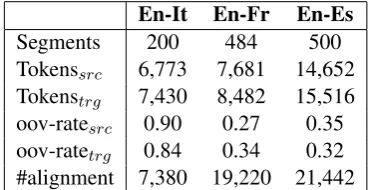
the three test sets are reported in Table 2.
To have a better understanding of the behavior of the word aligners on the unknown words, we created new test sets with an increasing ratio of the unknown words (oov-rate), for each task. Starting from each of the original test set, we replaced an increasing portion of randomly chosen words by strings which do not exist in the training corpus; the oov-noise artificially introduced ranges from
3www.cse.unt.edu/˜rada/wpt/data/
English-French.test.tar.gz
4www.computing.dcu.ie/˜plambert/data/
epps-alignref.html
[image:4.595.322.508.315.410.2]En-It En-Fr En-Es Segments 200 484 500 Tokenssrc 6,773 7,681 14,652 Tokenstrg 7,430 8,482 15,516 oov-ratesrc 0.90 0.27 0.35 oov-ratetrg 0.84 0.34 0.32 #alignment 7,380 19,220 21,442
Table 2: Staticts of the test corpora for English-Italian, English-French, and English-Spanish tasks. oov-ratesrc and oov-ratetrg are the ratio of the new words in the source and target side of the test corpus, respectively.
1% to 50%. For each value of the artificial oov-noise (m = 1, ...,50), we randomly selectedm% words in both the source and target side indepen-dently, and replaced them by artificially created strings. For selecting the words to be replaced by artificially created strings, we do not differenti-ate between the known and unknown words; hence the actual oov-rate in the test corpus, used in the plots, might be slightly larger.
[image:4.595.86.273.350.409.2]3.3 State-of-the-art Word Aligners
We consider three widely-used word aligners, namely berkeley, fast-align, and mgiza++. We analyze their performance in aligning an held-out test corpora; in particular, we compare their capa-bility in handling the unknown words. For a fair comparison, all aligners are trained on the same training corpora described in Section 3.2.
berkeleyaligner (Liang et al., 2006) applies the co-training approach for training the IBM model 1 and HMM. We trained berkeley aligner using 5 iterations of model 1 followed by 5 iterations of HMM. When applied to new sentence pairs, the system produces bi-directional symmetrized alignment.
fast-align is a recently developed unsuper-vised word aligner that uses a log-linear re-parametrization of IBM model 2 for training the word alignment models (Dyer et al., 2013). We exploited the default configuration with 5 itera-tions for training. As the system is directional, we trained two systems (source-to-target and target-to-source). When applied to new sentence pairs, we first produced the two directional alignments, and then combined them into a symmetrized align-ment by using the grow-diag-final-and heuristic (Och and Ney, 2003).
mgiza++ (Gao and Vogel, 2008) and its an-cestors, i.e. giza, andgiza++, implement all the IBM models and HMM based alignment models. mgiza++ is a multithreaded version of giza++, which enables an efficient use of multi-core plat-forms. We trained the system using the follow-ing configuration for model iterations: 15h53343.
mgiza++ also produces directional alignment; hence, we followed the same protocol to create a symmetrize alignment of sentence pairs as we did forfast-align.
Differently from berkeley and fast-align, mgiza++ somehow adapts its models when applied to new sentence pairs. According to the so-called “forced alignment”, it essentially proceeds with the training procedure on these new data starting from pre-trained and pre-loaded models, and produces the alignment as a by-product. In preliminary experiments, we observed that performing 3 iterations of model 4 is the best configuration for mgiza++ to align the new sentence pairs.
These word aligners are designed to work in of-fline mode; they load the models and align the
whole set of available input data in one shot. How-ever, in the online scenario where a single sen-tence pair is provided at a time, they need to reload the models every time which is very expensive in terms of I/O operations. In this paper we first were interested in measuring the quality of the word aligners to select the best one. Therefore, we mimic the online modality by forcing them to align one sentence pair at a time.
Precision Recall F-measure
all oov all oov all oov
English-Italian
fast-align 82.6 33.3 82.8 19.6 82.7 24.7
berkeley 91.9 – 81.0 – 86.1 –
mgiza++ 86.2 84.6 89.4 30.8 87.8 45.2 English-French
fast-align 81.5 47.2 91.8 19.5 86.3 27.6
berkeley 87.9 – 92.9 – 90.3 –
mgiza++ 89.0 88.2 96.0 17.2 92.4 28.8 English-Spanish
fast-align 81.5 31.3 71.8 12.7 76.3 18.1
berkeley 88.7 – 71.2 – 79.0 –
mgiza++ 89.2 95.5 80.6 35.6 84.7 51.9
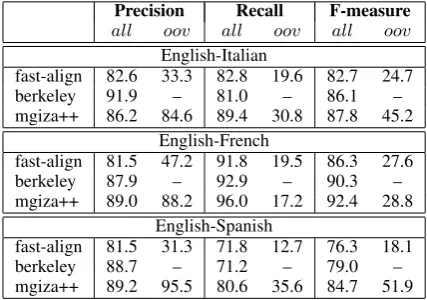
Table 3: Comparison of different widely-used word aligners in terms of precision, recall, and F-measure on English-Italian, English-French, and English-Spanish language pairs. Columnsall re-port the evaluation performed on all alignments, while columns oov the evaluation performed on the oov-alignments.
The three word aligners were evaluated on the three tasks introduced in Section 3.2. Table 3 shows their performance on the full set of align-ments (all) and on the subset of oov-alignments (oov) in terms of Precision, Recall, and F-measure. The figures show that all aligners perform well on the whole test corpus. mgiza++is definitely su-perior to fast-align; it also outperforms berkeley in terms of F-measure, but they are comparable in terms of Precision.
[image:5.595.308.522.199.349.2]30 40 50 60 70 80 90
1 2 4 8 16 32
F-measure
OOV rate English-Italian
mgiza berkeley
fast-align 30
40 50 60 70 80 90
0.5 1 2 4 8 16 32
F-measure
OOV rate English-French
mgiza berkeley
fast-align 30
40 50 60 70 80 90
0.5 1 2 4 8 16 32
F-measure
OOV rate
English-Spanish
mgiza berkeley fast-align
10 15 20 25 30 35 40 45 50
1 2 4 8 16 32
F-measure-oov
OOV rate English-Italian
mgiza fast-align
10 15 20 25 30 35 40 45 50
0.5 1 2 4 8 16 32
F-measure-oov
OOV rate English-French
mgiza fast-align
10 15 20 25 30 35 40 45 50
0.5 1 2 4 8 16 32
F-measure-oov
OOV rate
English-Spanish
[image:6.595.77.522.65.258.2]mgiza fast-align
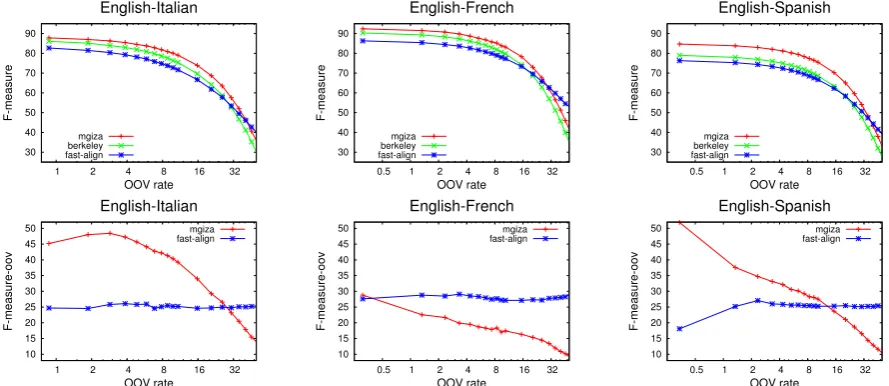
Figure 2: Performance in terms of standard F-measure (above) and oov-based F-measure (below) of the word aligners on test sets with increasing oov-rate, for all language pairs. The oov-based F-measure for berkeleyis not reported because it is undefined.
agree, and this hardly occurs for unknown words. To further investigate the behavior of the word aligners on the unknown words, we evaluated their performance on the artificially created test sets, described in Section 3.2. The performance of the word aligners in terms of standard and oov-based F-measure is shown in Figure 2. As expected, the overall F-measure decreases by introducing un-known words. mgiza++is more accurate than the other aligners up to oov-rate of 16%.
We observe thatmgiza++outperforms the oth-ers in terms of the oov-based F-measure on the English-Italian and English-Spanish language pairs up to oov-noise of 32% and 16%, respec-tively. fast-align instead performs better in the English-French task. fast-align always show a better quality when the oov-rate is very high. oov-based F-measure is not reported for berke-leybecause this aligner is not able to detect oov-alignments as explained above.
4 Enhancement to Word Alignment
4.1 Refinement of oov-alignments
To address the problem of unaligned new words, we present a novel approach, in which the word alignments of the source and target segment pair are induced in two-steps. First, a standard word aligner is applied; most of the words in the source and target sentence pair will be aligned, but most of the unknown words will not. It is worth men-tioning that aligning unknown words in this step
depends on the quality of the employed word aligner. Once the alignments are computed and symmetrized (if required), phrase extraction pro-cedure is applied to extract all valid phrase-pairs. Note that un-aligned words are included in the ex-tracted phrase pairs, if their surrounding words are aligned.
It has been shown that inclusion of un-aligned words in the phrase-pairs, generally, has neg-ative effects on the translation quality and can produce errors in the translation output (Zhang et al., 2009). Nevertheless, the overlap among phrase-pairs, which contain un-aligned unknown words, can be considered as a valuable source of knowledge for inducing the correct alignment of these words. To get their alignments from the extracted phrase-pairs we follow an approach similar to (Espl´a-Gomis et al., 2012) in which the word alignment probabilities are determined by the alignment strength measure. Given the source and target segments (S = {s1, . . . , sl}
andT = {t1, . . . , sm}), and the set of extracted
parallel phrase-pairs (Φ), the alignment strength
Ai,j(S, T,Φ)of thesiandtj can be calculated as
follows:
Ai,j(S, T,Φ) =
X
(σ,τ)∈Φ
cover(i, j, σ, τ)
|σ|.|τ|
cover(i, j, σ, τ) =
1 ifsi ∈σandtj ∈τ
cover(i, j, σ, τ) simply spots whether the word-pair(si, tj)is covered by the phrase pair(σ, τ).
The alignment strengths are then used to pro-duce the a directional source-to-target word align-ments;si is aligned totj ifAi,j > 0andAi,j ≥
Ai,k, ∀k ∈ [1,|T|]. One-to-many alignment is allowed in cases that multiple target words have equal probabilities to be aligned to i-th source word (Ai,j = Ai,k). The directional word align-ments are then symmetrized.
The new set of symmetrized alignments can be used in different ways: (i) as a replacement of the initial word alignments as in (Espl´a-Gomis et al., 2012), or (ii) as additional alignment points to be added to the initial set. According to a prelim-inary investigation, we choose the latter option: only a subset of the new word alignments is used for updating the initial alignments. More specifi-cally, we add only the alignments of the new words which are not already aligned.
Moreover, our approach differs from that pro-posed by Espl´a-Gomis et al. (2012) in the proce-dure to collect the original set of phrase pairs from the source and target sentence pair. They rely on the external sources of information such as online machine translation systems (e.g. Google Trans-late, and Microsoft Translator). Communicating with external MT systems imposes some delays to the pipeline, which is not desired for the on-line scenario. Furthermore, the words that are not known by the machine translation systems are not covered by any phrase-pair, hence the refinement module is not able to align them.
We instead employ thephrase-extractsoftware5
provided by the Moses toolkit, which relies on the alignment information of the given sentence pair, and allows the inclusion of un-aligned unknown words in the extracted phrase pairs; hence, the re-finement module has the potential to find the cor-rect alignment for those words.
Note that there is no constraint on the word alignment and phrase extraction modules used in the first step, hence, any word aligner and phrase extractor can be used for computing the initial alignments and extracting the parallel phrase pairs from the given sentence pairs. But, since the out-puts of the first aligner make the ground for obtain-ing the alignments of the second level, they need to be highly accurate and precise.
5The “grow-diag-final-and” heuristic was set for the
sym-metrization.
4.2 onlineMgiza++
The experiments to compare state-of-the-art word aligners, reported and discussed in Section 3, are carried out offline. This is because the aforemen-tioned word aligners are not designed to work on-line, and need to load the models every time re-ceives a new sentence pair. Loading the models is very time consuming, and depending on the size of the models might take several minutes, which is not desired for the online scenario.
To overcome this problem, we decided to im-plement an online version of mgiza++ which provides the best performance as shown in Sec-tion 3.3. This new version, called onlineM-giza++, works in client-server mode. It con-sists of two main modulesmgizaServerand mgiza-Client. mgizaServeris responsible for computing the alignment of the given sentence pairs. To avoid unnecessary I/O operations,mgizaServerloads all the required models once at the beginning of the alignment session, and releases them at the end. mgizaClient communicates with the client appli-cations through the standard I/O channel.
In our final experiments we observed some unexpected differences between the results of mgiza++andonlineMgiza++. Therefore, we do not present the results of onlineMgiza++ in this paper. However, we expect the two systems pro-duce the same results.
5 Experimental Results
In this section we evaluate the effectiveness of the proposed refinement module. Each consid-ered word aligner was equipped by our refinement module, and compared to its corresponding base-line. Figure 3 shows the oov-based F-measure achieved by the baseline and enhanced word align-ers on all test sets and all tasks. We observe that the refinement module consistently improves the F-measure of all aligners on all language pairs;
0 10 20 30 40 50 60 70 80
1 2 4 8 16 32
F-measure-oov
OOV rate English-Italian
mgiza + enh berkeley + enh fast-align + enh mgiza fast-align
0 10 20 30 40 50 60 70 80
0.5 1 2 4 8 16 32
F-measure-oov
OOV rate English-French
mgiza + enh berkeley + enh fast-align + enh mgiza fast-align
0 10 20 30 40 50 60 70 80
0.5 1 2 4 8 16 32
F-measure-oov
OOV rate English-Spanish
[image:8.595.80.520.63.161.2]mgiza + enh berkeley + enh fast-align + enh mgiza fast-align
Figure 3: Performance in terms of oov-based F-measure of the baseline and enhanced word aligners on test sets with increasing oov rate, for all language pairs. The oov-based F-measure forberkeleyis not reported because it is undefined.
0 0.5 1 1.5 2
1 2 4 8 16 32
Delta F-measure
OOV rate English-Italian
mgiza + enh berkeley + enh fast-align + enh
0 0.5 1 1.5 2
0.5 1 2 4 8 16 32
Delta F-measure
OOV rate English-French
mgiza + enh berkeley + enh fast-align + enh
0 0.5 1 1.5 2
0.5 1 2 4 8 16 32
Delta F-measure
OOV rate
English-Spanish
mgiza + enh berkeley + enh fast-align + enh
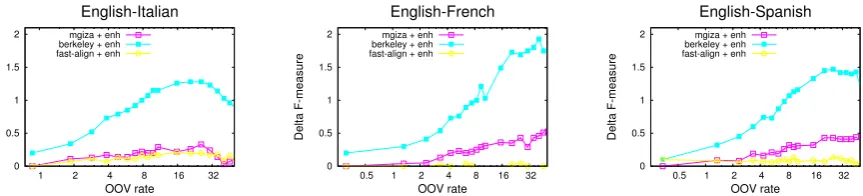
Figure 4: Difference of performance in terms of standard F-measure of the enhanced word aligners from their corresponding baselines on test sets with increasing OOV rate, for all language pairs.
many oov-alignments, which the baseline system can not find most of them.
Furthermore, Figure 4 reports the F-measure differences achieved by the enhanced word-aligners from their corresponding baselines on the full data sets. The refinement module slightly but consistently improves the overall F-measure as well, especially for high oov-rates. The highest improvement is achieved by the enhanced berke-leyaligner, mainly because its baseline performs worse in this condition.
6 Conclusion
In this paper we discussed the need of having a fast and reliable online word aligner in the online adap-tive MT scenario that is able to accurately align the new words. The quality of three state-of-the-art word aligners, namelyberkeley,mgiza++, and fast-align, were evaluated on this task in terms of Precision, Recall, and F-measure. For this purpose we created a benchmark in which an increasing amount of the words of the test corpus are ran-domly replaced by new words in order to augment the oov-rate. The results show that the quality of the aligners on new words is quite low, and sug-gest that new models are required to effectively ad-dress this task. As a first step, we proposed a fast and language independent procedure for aligning
the unknown words which refines any given au-tomatic word alignment. The results show that the proposed approach significantly increases the word alignment quality of the new words.
In future we plan to evaluate our approach in an end-to-end evaluation to measure its effect on the final translation. We also plan to investigate the exploitation of additional features such as linguis-tic and syntaclinguis-tic information in order to further improve the quality of the word alignment mod-els as well as the proposed refinement procedure. However, this requires other policies of introduc-ing new words, rather than just randomly selectintroduc-ing the words and replacing them by artificial strings.
Acknowledgments
This work was supported by the MateCat project, which is funded by the EC under the7th Frame-work Programme.
References
F. Blain, H. Schwenk, and J. Senellart. 2012. In-cremental adaptation using translation information and post-editing analysis. In International Work-shop on Spoken Language Translation, pages 234– 241, Hong-Kong (China).
[image:8.595.88.520.221.319.2]mathematics of statistical machine translation: Pa-rameter estimation. Computational Linguistics, 19(2):263–312.
Chris Dyer, Victor Chahuneau, and Noah A. Smith. 2013. A simple, fast, and effective reparameteriza-tion of ibm model 2. In Proceedings of the 2013 Conference of the North American Chapter of the Association for Computational Linguistics: Human Language Technologies, pages 644–648, Atlanta, Georgia, June. Association for Computational Lin-guistics.
Miquel Espl´a-Gomis, Felipe S´anchez-Mart´ınez, and Mikel L. Forcada. 2012. A simple approach to use bilingual information sources for word alignment. Procesamiento del Lenguaje Natural, (49):93–100. Alexander Fraser and Daniel Marcu. 2007. Measuring
word alignment quality for statistical machine trans-lation. Comput. Linguist., 33(3):293–303.
Qin Gao and Stephan Vogel. 2008. Parallel implemen-tations of word alignment tool. In Software Engi-neering, Testing, and Quality Assurance for Natural Language Processing, SETQA-NLP ’08, pages 49– 57, Stroudsburg, PA, USA. Association for Compu-tational Linguistics.
Daniel Hardt and Jakob Elming. 2010. Incremental re-training for post-editing smt. In9th Conference of the Association for Machine Translation in the Americas (AMTA), Denver, United States.
Philipp Koehn. 2005. Europarl: A parallel corpus for statistical machine translation. InProceedings of the Tenth Machine Translation Summit (MT Summit X), pages 79–86, Phuket, Thailand.
Patrik Lambert, Adri`a de Gispert, Rafael E. Banchs, and Jos´e B. Mari˜no. 2005. Guidelines for word alignment evaluation and manual alignment. Lan-guage Resources and Evaluation, 39(4):267–285. Percy Liang, Ben Taskar, and Dan Klein. 2006.
Align-ment by agreent. InProceedings of the Human Lan-guage Technology Conference of the NAACL, Main Conference, pages 104–111, New York City, USA, June. Association for Computational Linguistics. J. Scott McCarley, Abraham Ittycheriah, Salim
Roukos, Bing Xiang, and Jian-ming Xu. 2011. A correction model for word alignments. In Proceed-ings of the Conference on Empirical Methods in Nat-ural Language Processing, EMNLP ’11, pages 889– 898, Stroudsburg, PA, USA. Association for Com-putational Linguistics.
Franz Josef Och and Hermann Ney. 2000. Improved statistical alignment models. InProceedings of the 38th Annual Meeting of the Association of Compu-tational Linguistics (ACL).
F.J. Och and H. Ney. 2003. A systematic comparison of various statistical alignment models. Computa-tional Linguistics, 29(1):19–51.
Ralf Steinberger, Bruno Pouliquen, Anna Widiger, Camelia Ignat, Tomaˇz Erjavec, Dan Tufis¸, and D´aniel Varga. The jrc-acquis: A multilingual aligned parallel corpus with 20+ languages. In In Proceedings of the 5th International Conference on Language Resources and Evaluation (LREC), pages 2142–2147, Genoa, Italy.
Nadi Tomeh, Alexandre Allauzen, Guillaume Wis-niewski, and Franois Yvon. 2010. Refining word alignment with discriminative training. In Proceed-ings of the ninth Conference of the Association for Machine Translation in the America (AMTA). S. Vogel, H. Ney, and C. Tillmann. 1996. HMM-based
word alignment in statistical translation. In Pro-ceedings of COLING, pages 836–841, Copenhagen, Denmark.