Correction Annotation for Non-Native Arabic Texts:
Guidelines and Corpus
Wajdi Zaghouani1, Nizar Habash2, Houda Bouamor1, Alla Rozovskaya3,
Behrang Mohit4, Abeer Heider5and Kemal Oflazer1
1Carnegie Mellon University in Qatar
{wajdiz,hbouamor}@cmu.edu, [email protected]
2New York University Abu Dhabi
3Center for Computational Learning Systems, Columbia University
4Ask.com
5Qatar University
Abstract
We present our correction annotation guide-lines to create a manually corrected non-native (L2) Arabic corpus. We develop our approach by extending an L1 large-scale Ara-bic corpus and its manual corrections, to in-clude manually corrected non-native Arabic learner essays. Our overarching goal is to use the annotated corpus to develop components for automatic detection and correction of lan-guage errors that can be used to help Stan-dard Arabic learners (native and non-native) improve the quality of the Arabic text they produce. The created corpus of L2 text man-ual corrections is the largest to date. We evalu-ate our guidelines using inter-annotator agree-ment and show a high degree of consistency.
1 Introduction
Learner corpora (or L2 corpora) are collections of texts written by non-native learners of the languages of the texts. They are generally marked by a high er-ror rate, i.e., orthographic, lexical, and grammatical errors (Granger, 2003; Hammarberg and Grigonyté, 2014). Learners of Arabic as second language of-ten struggle to produce fluent Arabic text. In addi-tion to the significant structural and conceptual dif-ferences between Arabic and other languages (En-glish, French, etc.), vocabulary learning is one of the biggest challenges. Apart from content selection
and planning, the writer should find the appropriate words/expressions to express her ideas. Finding the best formulation to integrate within the stylistic con-text of a discourse, or using the terminology that is more adapted to the context might be more compli-cated. Learners of Arabic as a second language have to adapt to a different script and different grammat-ical rules. These factors contribute to the propaga-tion of errors made by L2 speakers that are of dif-ferent nature than those produced by native speakers (L1 speakers). Hence, in order to model learner lan-guage and produce highly efficient error detection and correction methods, it is extremely important to collect a large learner corpus, annotate it and analyze the errors contained in it.
Annotated L2 corpora can provide teachers, learners, second language acquisition researchers, lexicographers and language materials writers, with a valuable data resource. For instance, the anno-tated corpora can be used for Contrastive Interlan-guage Analysis (CIA), since it enables researchers to observe a wide range of instances of under-use, overuse, and misuse of various aspects of the learner language at different levels. Moreover, L2 corpora can be used to compile or improve learner dictionary contents, particularly by identifying the most com-mon errors learners make while providing immedi-ate access to detailed error statistics. This can pro-vide learners with a very useful feedback and help them improve their proficiency level.
These errors may take place in words, phrases, language structures, and the ways words or ex-pressions are used (Granger, 2003). For Arabic, there are few projects that aim at developing Ara-bic learner corpora and annotating them but most of them are not freely available for users or re-searchers (Abuhakema et al., 2008; Hassan and Daud, 2011).
In this paper, we present our annotation method and our efforts for extending an L1 large scale Ara-bic language corpus and its manually edited correc-tions to include annotated non-native Arabic learner text (L2). This work is part of the Qatar Ara-bic Language Bank (QALB) project (Zaghouani et al., 2014b), a large-scale error annotation effort that aims to create a manually corrected corpus of er-rors for a variety of Arabic texts (the target size is 2 million words).1 Our overarching goal is to use
our annotated corpus to develop components for au-tomatic detection and correction of language errors that can be used to help Standard Arabic learners (native and non-native) improve the quality of the Arabic text they produce. The previous version of our annotation guidelines focused on native speaker text. Our extended L2 guidelines are built on the ex-isting L1 guidelines (Zaghouani et al., 2014a) with a focus on the types of errors usually found in the L2 writing style and how to deal with problematic am-biguous cases.2 Annotated examples are provided
in the guidelines to illustrate the various annotation rules and their exceptions. As with the L1 guide-lines, the L2 texts should be corrected with a mini-mum number of edits that produce semantically co-herent (accurate) and grammatically correct (fluent) Arabic. The guidelines also devise a priority order for corrections that prefer less intrusive edits starting with inflection, then cliticization, derivation, prepo-sition correction, word choice correction, and finally word insertion. The corpus of L2 text manual cor-rections we create is the largest to date. We evaluate our guidelines using inter-annotator agreement and show a high degree of consistency.
The remainder of this paper is organized as fol-lows. First, we give an overview of related work in
1http://nlp.qatar.cmu.edu/qalb/ 2The L1 guidelines are available at
http://reports-archive.adm.cs.cmu.edu/ anon/qatar/CMU-CS-QTR-124.pdf
Section 2; then we describe the corpus and the an-notation guidelines in Sections 3 and 4. Afterwards, we present our annotation tool and pipeline in Sec-tions 5 and 6. Finally, we present an evaluation of the annotation quality and discuss the L2 annotation challenges in Section 7.
2 Related Work
Currently available manually corrected learner cor-pora are generally limited when it comes to the lan-guage, size and the genre of data. Several corpora of learners of English annotated for errors are pub-licly available (Rozovskaya and Roth, 2010; Yan-nakoudakis et al., 2011; Dahlmeier et al., 2013), ranging in size between 60K words and more than one million words. Dickinson and Ledbetter (2012) annotated errors in student essays written by learn-ers of Hungarian at three proficiency levels at Indi-ana University. The annotation was performed us-ing EXMARaLDA, a freely available tool that al-lows multiple and concurrent annotations (Schmidt, 2010). Student errors were marked according to var-ious categories of phonological, spelling, agreement and derivation errors.
For Arabic, very few learner corpora annotation project have been built. Abuhakema et al. (2008) annotated a small corpus of 9K words of Arabic written materials produced by native speakers of En-glish in the US who learned Arabic as a foreign language. Part of the learners’ texts were written while the learners were studying Arabic in the US, while others were produced when they went to study abroad in Arab countries. A tagset of error anno-tation based on the FRIDA (French Interlanguage Database) tagset (Granger, 2003) was developed to mark-up the learners’ errors.
The Corpus of Malaysian Arabic Learners is an-other project mainly designed to investigate the in-correct use of Arabic conjunctions among learn-ers. It includes 240K words, produced by various Malaysian university students during their first and second year of Arabic major degree. The corpus in-cludes descriptive and comparative essays produced using Microsoft Word without any help from native speakers (Hassan and Daud, 2011). This corpus is currently not publicly available.
introduced The Arabic Learners Written Corpus (ALWC). This corpus includes around 51K words written by non-native Arabic speakers in the United States and were collected over a period of 15 years. ALWC covers three levels (beginner, intermediate and advanced), and three text styles (descriptive, narrative and instructional). Another notable work in progress has been initiated by Alfaifi and Atwell (2012) aiming at building a ∼282K word Arabic learner corpus. The corpus consists of written and spoken materials produced by native and non-native learners of Arabic from pre-university and univer-sity levels. Unfortunately, the authors plan to an-notate and correct only 10k words of errors in the corpus according to a labeling system inspired by Abuhakema et al. (2008).
3 Corpus Description
Since it was costly to compile our own corpus, we use two freely available L2 Arabic Corpora repre-senting a total of 189K words:
• 51K words from the Arabic Learners Writ-ten Corpus (ALWC) (Farwaneh and Tamimi, 2012);
• 139K words from the Arabic Learner Corpus (ALC) (Alfaifi and Atwell, 2012).
The original files of ALWC were in a PDF format. In order to get raw data, we first export the PDF to text, then we manually verified the extracted text to ensure that the data was preserved.
The version of ALC we use is a collection of texts (narrative and discussion) produced by 92 learners of Arabic as a second language in Saudi Arabia and captured in November and December 2012. The cor-pus is divided according to students’ level (beginner, intermediate, advanced).3
4 L2 Annotation Guidelines
Essays produced by learners of a Arabic as second language differ from those of natives, not only quan-titatively but also qualitatively. Their writings dis-play very different frequencies of words, phrases,
3A more detailed description of ALC is given at: http://www.arabiclearnercorpus.com/
and structures, with some items overused and oth-ers significantly underused. They also contain vary-ing degrees of grammatical, orthographic and lexical errors. Moreover, sentences written by Arabic L2 speaker have often a different structure and are not as fluent as sentences produced by a native speaker even when no clear mistakes can be found. There-fore, the correction task is complicated by the fact that the acceptability level of a given sentence differs widely within the native speaker annotators as stated by Tetreault and Chodorow (2008). These issues can be related to linguistic factors such as inter-language (L1 interference), the student’s teaching and learn-ing methodology, and to the translation effect (con-scious interference). Thus, correcting the Arabic L2 essays can be a very challenging task that requires a lot of interpretation efforts by the annotators. This will likely lead to lower inter-annotator agreement as there is often many possible ways to correct the L2 errors.
In order to annotate the L2 corpus, we use our annotation guidelines designed for L1 (Zaghouani et al., 2014b) and add specific L2 annotation rules. Annotation guidelines typically describe the core of the annotation policy. Our annotation guidelines scribe the types of errors that are targeted and de-tail how to correct them, including how to deal with borderline cases. Many annotated examples are pro-vided in the guidelines to illustrate the various anno-tation rules and exceptions.
As with the L1 guidelines, we adopt an iterative approach to write and improve the L2 guidelines by evaluating various rounds of annotation. The goal is to reach a clear and consistent set of directions for the annotators. For instance, several changes to the guidelines were needed to address the correction of dialectal words and whether or not to correct or ignore certain word categories.
In the following subsections we briefly review the main error types corrected and presented in the guidelines. Then, we detail the L2 specific errors and the L2 correction strategies adopted.
4.1 Guidelines for Error Correction
omis-sion, addition, or substitution errors; or in terms of word order and grammatical form errors. In order to help the annotators understand the types of errors to be corrected, we document them in the annotation guidelines. Furthermore, to reduce over-correction and improve annotation consistency, we instructed the annotators to avoid modifications of any infor-mal or colloquial writing style, which is considered by some to be less acceptable than formal style.
We group the errors to be corrected into seven cat-egories and define them in the guidelines as follows.
Spelling Errors: These occur when at least one of the characters in a word is deleted or substituted by another character, or when an extra character is inserted. Some of these errors result in non-words and some result in other correct words which can not be used in that context.
Word Choice Errors: These include the use of
an incorrect word. It was made clear in the guide-lines that only wrong word choices are considered for correction, while style changes should not be made since the goal is not to correct or improve the writing style of the text. Word choice errors are par-ticularly frequent in the L2 Arabic student essays.
Morphology Errors: These are usually related to an incorrect derivation or inflection, or incorrect templatic or concatenative morphology. The anno-tator should be aware of the Arabic morphological inflection rules and their exceptions in order to be able to correct this type of errors.
Syntactic Errors: These include wrong
agree-ment in gender, number, definiteness or case as well as wrong case assignment, wrong tense use, wrong word order, and missing word or redundant/extra words.
Proper Name Errors: These occur in the spelling of persons, organizations, and locations, especially those of foreign origin which could be incorrectly transliterated. If the text uses one of multiple widely acceptable transliterations, the annotators should not modify the word.
Punctuation Errors: Punctuation errors should be corrected according to the commonly accepted Arabic punctuation rules.
Dialectal Usage Errors: In comparison to Stan-dard Arabic, where there are clear spelling stanStan-dards and conventions, Arabic dialects do not have offi-cial orthographic standards partly since they were not commonly written until recently. Today, Ara-bic dialects are often seen in social media, but also in published novels (and there is even an Egyptian Arabic Wikipedia). Habash et al. (2012) proposed a Conventional Orthography for Dialectal Arabic (or CODA) targeting Egyptian Arabic for computa-tional modeling purposes and demonstrated how to map to it in (Eskander et al., 2013) and (Pasha et al., 2014; Habash et al., 2013). CODAs for other dialects have also been proposed (Zribi et al., 2014; Jarrar et al., 2014). In our current annotation task we neither address dialectal Arabic spelling normal-ization (Eskander et al., 2013), nor do we system-atically translate dialectal words into Standard Ara-bic (Salloum and Habash, 2013). We recognize that the Arabic language is in a diglossic situation and borrowing is frequent. Most of the texts provided for annotation are in Standard Arabic, but dialectal words are sometimes mistakenly used. We are in-terested in reducing various spelling inconsistencies that frequently occur. So, as was done in the L1 an-notation effort (Zaghouani et al., 2014b), we asked annotators to flag the highly dialectal cases to be re-viewed later by the annotation manager. The guide-lines classify dialectal word issues into five cate-gories inspired by Habash et al. (2008): dialectal lexical choice, pseudo-dialectal lexical choice, mor-phological choice, phonological choice and closed class dialectal words. Only the last three categories are considered for correction. For more details, see (Zaghouani et al., 2014a; Zaghouani et al., 2014b).
For more information on Arabic in the context of natural language processing, see (Habash, 2010).
4.2 Additional L2 Annotation Rules
4.2.1 General Correction Rules
First, non-native speaker texts should be corrected with a minimum number of edits.4 However,
cor-recting errors and making the text semantically co-herent and grammatically correct is more important than minimizing the number of edits. Hence, anno-tators were asked to pay attention to the following three aspects :
• Accuracy: The accuracy of the text is very important and any missing meaning observed according to the sentence context should be added to ensure the coherence of the sentence. • Fluency: Spelling, grammatical and
agree-ment errors occur frequently in L2 texts and they should be always corrected. Word reorder-ing is only permitted when it is needed to cor-rect the meaning or the syntax.
• Style: L2 texts may be written in a style that is unfamiliar or unnatural to native speakers al-though the word order is acceptable, and the sentence conveys the meaning correctly. In such cases, the writing style should not be mod-ified to match that of a native speaker.
4.2.2 Correction Priority Order
In order to abide by Arabic’s grammatical and spelling rules, it is sometimes necessary to insert new words or do a major correction to unsuitable words selected by the non-native speakers. As the Arabic language is known to have a complex mor-phology, there is often many ways to correct errors, e.g., by changing the derivation or changing the in-flection. To minimize the number of edits and cor-rection, and to avoid any disagreement between an-notators, we provide them with the following correc-tion priority guidelines when a correccorrec-tion involving word edits is needed. By following the following predefined correction order, the annotators are more likely to produce a consistent annotation.
1. Correct inflection errors. 2. Correct cliticization errors.
3. Correct derivation errors; but keep root intact.
4The minimum edits approach in error correction have
al-ready been used in the Error-tagged Learner Corpus of Czech project (Hana et al., 2010)
4. Correct preposition errors (by adding, deleting or substituting a preposition).
5. Correct lexical errors.
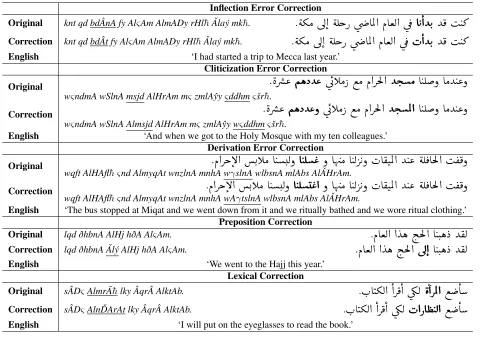
Inflection Correction: If the correction is not re-lated to a preposition, the annotator should first try to correct the error by limiting the change to the inflec-tion level (e.g., correcinflec-tion of gender and number). An example of inflection correction is shown in Ta-ble 1 in which the verb
A K@YK.
bdÂnA5‘we started’ wasreplaced by its correct form
H@YK.
bdÂt‘I started’.Cliticization Correction: Adding or changing the clitics.6 In the example given in Table 1, two clitic
corrections are made. In the first case, the annota-tor added the definite article +
È@
Al+‘the’ toYj.Ó
msjd ‘mosque’. In the second case, the annotator added the missing conjunction +ð
w+‘and’.Derivation Correction: Here we change the
derivation while keeping the same root when possi-ble. The example given in Table 1 shows the deriva-tion of the correct form
A JÊ «@
AγtslnA‘to do a rit-ual wash’ from the the same root of the contextrit-ually incorrect wordA JÊ «
γslnA– the root isÈ ¨
γs l ‘washing-related’.Preposition Correction or Insertion: Here we
add missing prepositions or correct misused prepo-sitions. An example is shown in Table 1. Prepo-sitions are addressed specifically because they ap-pear often as errors in the preliminary analyses we conducted. Errors in prepositions are not unique to Arabic L2; they are rather common for non-native speakers of other languages such as English (Lea-cock et al., 2010; Rozovskaya and Roth, 2010).
Lexical Correction: Finally, if it is impossible to fully correct the word using the previous four steps, there is a clear case of word choice errors and the an-notator may have to replace the word used. This can be employed to especially correct inadequate lexical choices or unknown words. In the example given in
5Arabic transliteration is presented in the
Habash-Soudi-Buckwalter scheme (Habash et al., 2007): (in alphabetical or-der)AbtθjHxdðrzsšSDT ˇDςγfqklmnhwyand the additional sym-bols: ’
Z
, Â@
, ˇA@
, ¯A@
, ˆwð'
, ˆyZø'
,¯hè
, ýø
.6A clitic is a linguistic unit that is pronounced and written
Inflection Error Correction
Original knt qd bdÂnA fy AlςAm AlmADy rHl¯h ˇAlaý mk¯h.
. éºÓ úÍ@ éÊgP úæ AÖÏ@ ÐAªË@ ú ¯
A K@YK.
Y¯ I J»
Correction knt qd bdÂt fy AlςAm AlmADy rHl¯h ˇAlaý mk¯h.
. éºÓ úÍ@ éÊgP úæ AÖÏ@ ÐAªË@ ú ¯
H@YK.
Y¯ I J»
English ‘I had started a trip to Mecca last year.’
Cliticization Error Correction
Original
. èQå«
ÑëXY«
úGCÓ P ©Ó Ð@QmÌ'@
Yj.Ó
A JÊð AÓY J«ð
wςndmA wSlnA msjd AlHrAm mςzmlAˆyyςddhmςšr¯h.
Correction
. èQå«
ÑëXY«ð
úGCÓ P ©Ó Ð@QmÌ'@
Yj.ÖÏ@
A JÊð AÓY J«ð
wςndmA wSlnA Almsjd AlHrAm mςzmlAˆyy wςddhmςšr¯h.
English ‘And when we got to the Holy Mosque with my ten colleagues.’
Derivation Error Correction
Original wqft AlHAfl¯h ςnd AlmyqAt wnzlnA mnhA w
.Ð@QkB@ .CÓ A J.Ëð
γslnA wlbsnA mlAbs Al ˇAHrAm.A JÊ «
ð Aî DÓ A JË Q Kð HA®JÖÏ@ Y J« éÊ ¯AmÌ'@ I ®¯ð
Correction wqft AlHAfl¯h ςnd AlmyqAt wnzlnA mnhA wA
.Ð@QkB@ .CÓ A J.Ëð
γtslnA wlbsnA mlAbs Al ˇAHrAm.A JÊ «@
ð Aî DÓ A JË Q Kð HA®JÖÏ@ Y J« éÊ ¯AmÌ'@ I ®¯ð
English ‘The bus stopped at Miqat and we went down from it and we ritually bathed and we wore ritual clothing.’Preposition Correction
Original lqd ðhbnA AlHj hðA AlςAm.
.ÐAªË@ @ Yë i.mÌ'@ A JJ.ë X Y®Ë
Correction lqd ðhbnA ˇAlý AlHj hðA AlςAm.
.ÐAªË@ @ Yë i.mÌ'@
úÍ@
A JJ.ë X Y®Ë
English ‘We went to the Hajj this year.’
Lexical Correction
Original sÂDςAlmr ¯A¯hlky Âqr AlktAb.
.H.AJºË@
@Q¯@ ú
¾Ë
è@QÖÏ@
© A
Correction sÂDςAln ˇDArAt lky Âqr AlktAb.
.H.AJºË@
@Q¯@ ú
¾Ë
H@PA ¢ JË@
© A
[image:6.612.72.552.62.401.2]English ‘I will put on the eyeglasses to read the book.’
Table 1: Examples of the different parts of the correction priority order
Table 1, the word
è@QÖÏ@
Almr ¯A¯h‘mirror’ was replaced by the wordH@PA ¢ JË@
Aln ˇDArAt‘eyeglasses’.5 The Annotation Tool
In order to ensure the speed and efficiency of the an-notation process, as well as better management, we provide the annotators with a web-based annotation framework, originally developed to manually cor-rect errors in L1 texts (Obeid et al., 2013). The an-notation interface allows annotators to perform dif-ferent actions corresponding to the following types of corrections: (a) editmisspelled words; (b) move words that are not in the right location; (c)add miss-ing words; (d) delete extraneous words; (e) merge words that have been split erroneously; and (f)split words that have been merged erroneously.
In our final corpus output format, we record for each annotated file the list of actions taken by the annotator. These actions operate on one or two to-kens depending on the action. We also supply token
alignments starting from document tokenization to after human annotation.
6 The Annotation Pipeline
The annotation of a large scale corpus requires the involvement of multiple annotators. In our project, the annotation effort is led by an annotation man-ager, and the team consists of six annotators com-ing from three Arab countries (Egypt, Palestine and Tunisia) and a programmer. All annotators hold at least a university level degree and they have a strong Arabic language background.
programmer.
The annotation manager assigns tasks to annota-tors and controls the quality of produced annotations collected. Note that, we give the annotator the possi-bility to flag a word if he is not certain about its cor-rection. This alerts the annotation manager to check it and correct it.
The annotation manager selects and uploads the text files into the annotation system to create a new annotation project task. Once uploaded, the files are automatically tokenized and processed us-ing MADAMIRA (Pasha et al., 2014), a morpho-logical disambiguation tool that automatically cor-rects common spelling errors as a side effect of disambiguation. MADAMIRA uses a morphologi-cal analyzer to produce, for each input word, a list of analyses specifying every possible morphologi-cal interpretation of that word, covering all morpho-logical features of the word. MADAMIRA then ap-plies a set of models to produce a prediction, per word in-context, for different morphological fea-tures, such as POS, lemma, gender, number or per-son. The robust design of MADAMIRA allows it to consider different possible spellings of words, espe-cially relating to Ya/Alif-Maqsura, Ha/Ta-Marbuta and Hamzated Alif forms, which are very common error sources. MADAMIRA selects the correct form in context, thus correcting for these errors which are often connected to lemma choice or morphology.
7 Evaluation
7.1 Inter-Annotator Agreement
Our annotation effort consists of a single annotation pass as commonly done in many annotation projects due to time and budget constraints (Rozovskaya and Roth, 2010; Gamon et al., 2008; Izumi et al., 2004; Nagata et al., 2006). In order to evaluate the quality of our correction annotations, we frequently mea-sure the inter-annotator agreement (IAA) to enmea-sure that the annotators are following the guidelines pro-vided consistently. A high level of agreement be-tween the annotators indicates that the annotation is reliable and the guidelines are useful in producing homogeneous and consistent data. We measure the IAA by averaging WER (Word Error Rate) over all pairs of annotations to compute the AWER (Average
Word Error Rate).7 For the purpose of this
evalua-tion, the WER refers to an annotation error and it is measured against all words in the text. The higher the WER between two annotations, the lower is their agreement.
Table 2 compares the L1 and L2 portions of our corpus in two dimensions. First, we consider the amount of changes done over the whole corpus mea-sured as WER between raw and corrected text. And secondly, we present the IAA numbers in terms of AWER. The IAA results are computed over 200 files (10,288 words) for the L1 corpus and 20 files (3,188 words) for the L2 corpus. Each of these files is cor-rected by at least three different annotators. We ob-serve that the number of changes in L2 text is 50% more than that in L1, which is consistent with pre-vious studies and our expectation of the complexity of the task. Furthermore, the IAA in L2 is over 10% absolute points worse than in L1. This is particu-larly disconcerting, but can be explained by the fact that the correction space for L2 text is larger as many different corrections are possible. In order to verify this hypothesis, we performed a second IAA round in which we provide the first IAA round text output to a second pool of three annotators and we mea-sure how much they agree with the correction done by the first round annotator in term of IAA. The low average WER of 3.35 obtained show that there is a high agreement with the corrections done in the first round. We did not do the same second round for our L1 corpus annotations.
We perform a deeper analysis of the annotated corpus. Results are given in Table 3 and show again that there is a correlation between the number of changes and the level of annotators disagreement. It is clear that ALC is less challenging than ALWC as shown in the IAA of the first round and second rounds.
Overall, the high-level of agreement obtained in the second round shows that the annotators duced consistently similar results under the pro-posed guidelines; and their differences are all within acceptable variation. This of course makes the eval-uation of automatic correction harder.8
7The annotation manager is excluded from this evaluation. 8This problem might be solved by considering multiple
Unfortu-Original
.ZAKCJË@ ÉJ.¯ àA B@ ÐA« ú ¯ éËA®ÖÏ@ úæîD KA à@ øñ K@
Anwy An sAnthy AlmqAl¯hfyςAm AlAnsAn qbl AlθlAθA’.
‘I plan I will be-done the article in the year of humanity before Tuesday.’
Annotator 1
.ZAKCJË@ ÉJ.¯ àA B@ ÐA« á« éËA®ÖÏ@ úæî E
@ à@ ø
ñ
K@
Ânwy Ân Ânhy AlmqAl¯h ςnςAm Al ˇAnsAn qbl AlθlAθA’.
‘I plan to finish-off the article about the year of humanity before Tuesday.’
Annotator 2
.ZAKCJË@ ÉJ.¯ àA B@ ÕËA« á« éËA®ÖÏ@ úæî E
@ à@ ø
ñ
K@
Ânwy Ân Ânhy AlmqAl¯h ςnςAlm Al ˇAnsAn qbl AlθlAθA’.
‘I plan to finish-off the article about the human world before Tuesday.’
Annotator 3
.ZAKCJË@ ÉJ.¯ àA B@ ÕËA« ú ¯ éËA®ÖÏ@ áÓ úæîD K
@ à@ ø
ñ
K@
Ânwy Ân Ânthy mn AlmqAl¯hfyςAlm Al ˇAnsAn qbl AlθlAθA’.
[image:8.612.105.517.61.255.2]‘I plan to be-done with the article in The Human World before Tuesday.’
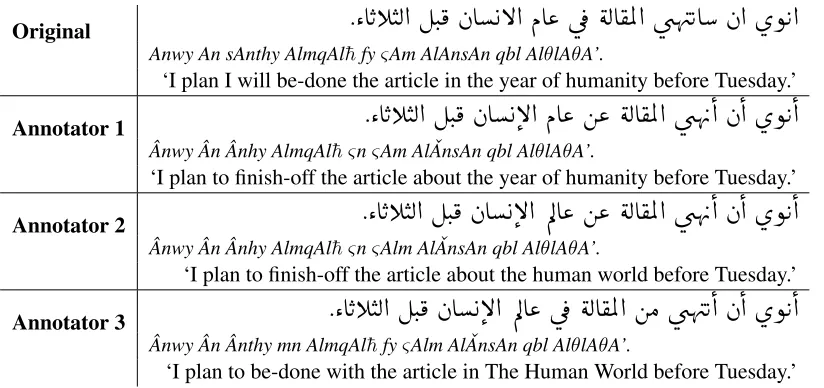
Table 4: Example of multiple annotator corrections of an L2 erroneous sentence.
Changes IAARound1 IAARound2
L1 corpus 24.45% 3.80% N/A
[image:8.612.83.289.314.355.2]L2 corpus 37.64% 14.67% 3.35%
Table 2: Comparison between the L1 and the L2 corpus with the percentage of changes from the RAW source corpus and the inter-annotator agreement (IAA) on “all words” in terms of average WER (Punctuation is ig-nored). Round1 is basic IAA comparing two annotations starting from raw text. Round2 starts with the output of Round1.
Changes IAARound1 IAARound2
ALC corpus 32.65% 13.56% 3.13%
ALWC corpus 51.39% 19.12% 4.20%
Table 3: The percentage of changes from the RAW source corpus and the inter-annotator agreement on “all words” in terms of average WER in the two parts of our L2 cor-pus (Punctuation is ignored). Round1 is basic IAA com-paring two annotations starting from raw text. Round2 starts with the output of Round1.
An analysis of the intannotator agreement er-rors shows that in some cases the annotators did not follow the correction priority order specified in the guidelines (Section 4.2.2) or disagreed on how to ap-ply it. They also either did not pay attention or failed to correct spelling mistakes. In other cases, the dis-agreement is due to multiple possible interpretations nately, such a solution requires more annotations.
of typos or wrong lexical choices.
In Table 4, we show some examples of disagree-ment among the annotators. The erroneous L2 sen-tence has multiple Alif-Hamza errors, an incorrect verb clitic and a confusing phrase
àA B@ ÐA« ú ¯
fyςAm AlAnsAn‘in the year of humanity’. All the annotators corrected the Alif-Hamza errors and the verb clitic. However, they disagreed on how to cor-rect the problematic phrase ‘in the year of human-ity’ as (a) ‘about the year of humanhuman-ity’, (b) ‘about the human world’, and (c) ‘in the human world’. The different corrections interacted with the form of the main verb after clitic correctionúæîD K@
An-thy‘be-done’ producing two corrections:úæî E
@
Ânhy ‘finish-off’ (derivation change) oráÓ úæîD K
@
Ânthy mn ‘be-done with’ (add a preposition). In conver-sations with the annotators about this case, they ex-pressed strong opinions about what they considered to be the acceptable interpretation that justified their corrections.7.2 L1 vs L2: Similarities and Differences
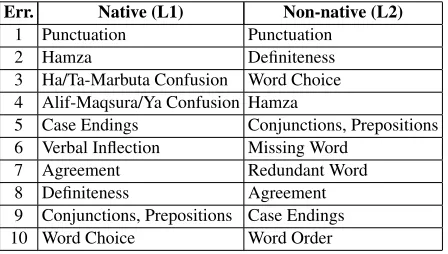
and the missing word error are mostly present in the L2 corpus. In contrast, errors such as punctuation errors, incorrect Hamza spelling, and nominal gen-der/number agreement are present in both corpora.
Err. Native (L1) Non-native (L2)
1 Punctuation Punctuation
2 Hamza Definiteness
3 Ha/Ta-Marbuta Confusion Word Choice 4 Alif-Maqsura/Ya Confusion Hamza
5 Case Endings Conjunctions, Prepositions 6 Verbal Inflection Missing Word
[image:9.612.76.300.131.258.2]7 Agreement Redundant Word 8 Definiteness Agreement 9 Conjunctions, Prepositions Case Endings 10 Word Choice Word Order
Table 5: Most frequent errors observed in a sample of the L1 and L2 Corpus. The errors are sorted from the most frequent to the least frequent.
8 Conclusion and Future Directions
In this paper, we presented our Arabic L2 correc-tion guidelines and a manually corrected L2 cor-pus that is the largest to date. We discussed the challenges inherent in learner corpus annotation and we presented our method for efficiently creating an Arabic L2 error corrected corpus. The results ob-tained in the evaluation suggest that the annotators produced consistently similar results under the pro-posed guidelines. We believe that publishing this corpus will give researchers a common development and test set for developing related natural language processing applications. A subset of our L2 corpus will be used as part of the Second QALB Shared Task on Automatic Arabic Error Correction in con-junction with the ACL-2015 Workshop on Arabic NLP.9 This shared task follows the success of the
First QALB Shared Task held in conjunction with EMNLP-2014 Workshop on Arabic NLP (Mohit et al., 2014). In the future, we will extend our anno-tation guidelines to address machine translation out-put correction (i.e., manual post-editing). We also plan to extend our systems for automatic correction of Arabic language errors (Jeblee et al., 2014; Ro-zovskaya et al., 2014) to handle L2 data, using the corpus discussed here for training and test purposes.
9http://www.arabic-nlp.net/wanlp
Acknowledgements
We thank anonymous reviewers for their valuable comments and suggestions. We also thank all our dedicated annotators: Noor Alzeer, Hoda Fathy, Hoda Ibrahim, Anissa Jrad, Samah Lakhal, Jihene Wafi. We thank Ossama Obeid for his continuous technical support during this project. This publica-tion was made possible by grants NPRP-4-1058-1-168 from the Qatar National Research Fund (a mem-ber of the Qatar Foundation).
References
Ghazi Abuhakema, Reem Faraj, Anna Feldman, and Eileen Fitzpatrick. 2008. Annotating an Arabic Learner Corpus for Error. InProceedings of The sixth international conference on Language Resources and
Evaluation, LREC 2008, Marrakech, Morocco.
Abdullah Alfaifi and Eric Atwell. 2012. Arabic Learner Corpora (ALC): A Taxonomy of Coding Errors. In
The 8th International Computing Conference in Ara-bic (ICCA 2012), Cairo, Egypt.
Daniel Dahlmeier, Hwee Tou Ng, and Mei Wu Wu. 2013. Building a Large Annotated Corpus of Learner En-glish: The NUS Corpus of Learner English. In Pro-ceedings of the Eighth Workshop on Innovative Use of NLP for Building Educational Applications, pages 22–31, Atlanta, Georgia.
Markus Dickinson and Scott Ledbetter. 2012. Annotat-ing Errors in a Hungarian Learner Corpus. In Pro-ceedings of the Eighth International Conference on
Language Resources and Evaluation (LRECâ ˘A ´Z12),
Istanbul, Turkey.
Ramy Eskander, Nizar Habash, Owen Rambow, and Nadi Tomeh. 2013. Processing Spontaneous Orthogra-phy. InProceedings of the 2013 Conference of the North American Chapter of the Association for Com-putational Linguistics: Human Language
Technolo-gies (NAACL-HLT), Atlanta, GA.
Samira Farwaneh and Mohammed Tamimi. 2012. Ara-bic Learners Written Corpus: A Resource for Research and Learning. The Center for Educational Resources in Culture, Language and Literacy.
Michael Gamon, Jianfeng Gao, Chris Brockett, Alexan-dre Klementiev, William B. Dolan, Dmitriy Belenko, and Lucy Vanderwende. 2008. Using Contextual Speller Techniques and Language Modeling for ESL Error Correction. InThird International Joint
Confer-ence on Natural Language Processing, IJCNLP, pages
449–456, Hyderabad, India.
Nizar Habash, Abdelhadi Soudi, and Tim Buckwalter. 2007. On Arabic Transliteration. In A. van den Bosch and A. Soudi, editors, Arabic Computational
Mor-phology: Knowledge-based and Empirical Methods.
Springer.
Nizar Habash, Owen Rambow, Mona Diab, and Reem Kanjawi-Faraj. 2008. Guidelines for Annotation of Arabic Dialectness. InProceedings of the LREC
Workshop on HLT & NLP within the Arabic world,
Marrakech, Morocco.
Nizar Habash, Mona Diab, and Owen Rabmow. 2012. Conventional Orthography for Dialectal Arabic. In
Proceedings of the Eighth International Conference on
Language Resources and Evaluation (LRECâ ˘A ´Z12),
Istanbul, Turkey.
Nizar Habash, Ryan Roth, Owen Rambow, Ramy Eskan-der, and Nadi Tomeh. 2013. Morphological Analysis and Disambiguation for Dialectal Arabic. In Proceed-ings of the 2013 Conference of the North American Chapter of the Association for Computational
Linguis-tics: Human Language Technologies (NAACL-HLT),
Atlanta, GA.
Nizar Habash. 2010. Introduction to Arabic Natural Language Processing. Morgan & Claypool Publish-ers.
Björn Hammarberg and Gintaré Grigonyté. 2014. Non-Native Writers’ Errors a Challenge to a Spell-Checker. In1st Nordic workshop on evaluation of spellchecking
and proofing tools (NorWEST2014), Uppsala,
Swe-den.
Jirka Hana, Alexandr Rosen, Svatava Škodová, and Barbora Štindlová. 2010. Error-tagged Learner Cor-pus of Czech. InProceedings of The Fourth Linguistic
Annotation Workshop (LAW IV), Uppsala.
Haslina Hassan and Nuraihan Mat Daud. 2011. Cor-pus Analysis of Conjunctions: Arabic Learners Dif-ficulties with Collocations. In Proceedings of the
Workshop on Arabic Corpus Linguistics (WACL),
Lan-caster, UK.
Emi Izumi, Kiyotaka Uchimoto, and Hitoshi Isahara. 2004. The NICT JLE Corpus Exploiting the Language Learners’ Speech Database for Research and Educa-tion. International Journal of The Computer, the
In-ternet and Management, 12(2):119–125, May.
Mustafa Jarrar, Nizar Habash, Diyam Akra, and Nasser Zalmout. 2014. Building a Corpus for Palestinian Arabic: a Preliminary Study. InProceedings of the EMNLP 2014 Workshop on Arabic Natural Language
Processing (ANLP), pages 18–27, Doha, Qatar.
Serena Jeblee, Houda Bouamor, Wajdi Zaghouani, and Kemal Oflazer. 2014. Cmuq@ qalb-2014: An smt-based system for automatic arabic error correction.
ANLP 2014, page 137.
Claudia Leacock, martin Chodorow, Michael Gamon, and Joel Tetreault. 2010. Automated Grammatical Er-ror Detection for Language Learners. Synthesis
Lec-tures on Human Language Technologies, 3(1):1–134.
Behrang Mohit, Alla Rozovskaya, Nizar Habash, Wa-jdi Zaghouani, and Ossama Obeid. 2014. The First QALB Shared Task on Automatic Text Correction for Arabic. InProceedings of EMNLP Workshop on Ara-bic Natural Language Processing, Doha, Qatar, Octo-ber.
Ryo Nagata, Atsuo Kawai, Koichiro Morihiro, and Naoki Isu. 2006. A Feedback-Augmented Method for De-tecting Errors in the Writing of Learners of English.
In Proceedings of the 21st International Conference
on Computational Linguistics and 44th Annual Meet-ing of the Association for Computational LMeet-inguistics, pages 241–248, Sydney, Australia.
Ossama Obeid, Wajdi Zaghouani, Behrang Mohit, Nizar Habash, Kemal Oflazer, and Nadi Tomeh. 2013. A Web-based Annotation Framework For Large-Scale Text Correction. In The Companion Volume of the Proceedings of IJCNLP 2013: System Demonstra-tions, Nagoya, Japan, October.
Kishore Papineni, Salim Roukos, Todd Ward, and Wei-Jing Zhu. 2002. BLEU: a Method for Automatic Eval-uation of Machine Translation. InProceedings of the 40th Annual Meeting of the Association for Computa-tional Linguistics, pages 311–318, Philadelphia, PA. Arfath Pasha, Mohamed Al-Badrashiny, Ahmed El
Kholy, Ramy Eskander, Mona Diab, Nizar Habash, Manoj Pooleery, Owen Rambow, and Ryan Roth. 2014. MADAMIRA: A Fast, Comprehensive Tool for Morphological Analysis and Disambiguation of Ara-bic. InIn Proceedings of the 9th International
Confer-ence on Language Resources and Evaluation,
Reyk-javik, Iceland.
Alla Rozovskaya and Dan Roth. 2010. Annotating ESL Errors: Challenges and Rewards. InNAACL Workshop on Innovative Use of NLP for Building Educational Applications, Los Angeles, CA.
Alla Rozovskaya, Nizar Habash, Ramy Eskander, Noura Farra, and Wael Salloum. 2014. The columbia system in the qalb-2014 shared task on arabic error correction.
InWorkshop on Arabic Natural Language Processing,
EMNLP, page 160.
Wael Salloum and Nizar Habash. 2013. Dialectal Ara-bic to English Machine Translation: Pivoting through Modern Standard Arabic. InProceedings of the 2013 Conference of the North American Chapter of the As-sociation for Computational Linguistics: Human
Lan-guage Technologies (NAACL-HLT), Atlanta, GA.
Lan-guage Resource and LanLan-guage Technology Standards State of the Art, Emerging Needs, and Future Devel-opments.
Joel Tetreault and Martin Chodorow. 2008. Native Judg-ments of Non-Native Usage: ExperiJudg-ments in Prepo-sition Error Detection. InColing 2008: Proceedings of the workshop on Human Judgements in Computa-tional Linguistics, pages 24–32, Manchester, UK. Helen Yannakoudakis, Ted Briscoe, and Ben Medlock.
2011. A New Dataset and Method for Automatically Grading ESOL Texts. InProceedings of the 49th An-nual Meeting of the Association for Computational Linguistics, pages 180–189, Portland, Oregon, USA. Wajdi Zaghouani, Nizar Habash, and Behrang Mohit.
2014a. The Qatar Arabic Language Bank Guide-lines. Technical Report CMU-CS-QTR-124, School of Computer Science, Carnegie Mellon University, Pittsburgh, PA, September.
Wajdi Zaghouani, Behrang Mohit, Nizar Habash, Os-sama Obeid, Nadi Tomeh, Alla Rozovskaya, Noura Farra, Sarah Alkuhlani, and Kemal Oflazer. 2014b. Large Scale Arabic Error Annotation: Guidelines and Framework. InProceedings of the Ninth International Conference on Language Resources and Evaluation (LREC’14), Reykjavik, Iceland, May.
Inès Zribi, Rahma Boujelbane, Abir Masmoudi, Mariem Ellouze, Lamia Belguith, and Nizar Habash. 2014. A Conventional Orthography for Tunisian Arabic. In
Proceedings of the Ninth International Conference
on Language Resources and Evaluation (LREC’14),