Second position clitics and monadic second-order transduction
Neil Ashton 203 Morrill Hall Cornell University Ithaca, NY 14853-4701 [email protected]
Abstract
The simultaneously phonological and syn-tactic grammar of second position clitics is an instance of the broader problem of ap-plying constraints across multiple levels of linguistic analysis. Syntax frameworks ex-tended with simple tree transductions can make efficient use of these necessary ad-ditional forms of structure. An analysis of Sahidic Coptic second position clitics in a context-free grammar extended by a monadic second-order transduction exem-plifies this approach.
1 Introduction
Second position (2P) clitics are ubiquitous in the world’s languages, found in genetically and typo-logically diverse languages (e.g. Serbo-Croatian, Warlpiri, O’odham) from all documented periods (e.g. Hittite, spoken ca. 1600–1300 BC). They present a persistent challenge for syntactic anal-ysis, inducing a peculiar form of crossing depen-dency which is not easily expressed in any stan-dard restrictive grammar framework.
2P clitics are emblematic of a wider class of problematic phenomena which existing frame-works can address by incorporating a notion of prosodic constituency. The transductive perspec-tive on mildly context-sensiperspec-tive grammar for-malisms, which treats them as monadic second-order transductions of regular tree languages, suggests how this can be done: by transduc-ing prosodic constituency from syntactic phrase structure.
The prosodic conditioning of 2P clisis is partic-ularly salient in Sahidic Coptic (Reintges, 2004).1
1
“Coptic” refers to the latest form of the Egyptian
lan-A context-free phrase structure grammar ex-tended by a monadic second-order transduction is able to make use of the phonological structure necessary to give a linguistically plausible analy-sis to a fragment of Coptic clitic syntax.
2 Second position clitics and prosodic constituency
2.1 Second position
An intuitive account of the syntax of 2P clitics2 has been known since Wackernagel (1892). The 2P clitic, which is an immediate functional de-pendent of a clause, e.g. a sentential adverb, dis-course particle, pronominal argument, etc., ap-pears after the first word of that clause, poten-tially interrupting whatever constituent contains that word as its leftmost member, as the chain of 2P clitics interrupts the NP in the following Serbo-Croatian sentence.3
(1) [Taj
that
=joj=ga=je
=her=it=AUX
ˇcovek]N P
man
poklonio.
presented ‘That man presented her with it.’ (B¨ogel et al., 2010)
guage. Sahidic Coptic, the major literary dialect of Coptic from the 4th to the 10th centuries AD, is survived by a rich corpus of Greek-alphabet texts. The only extant computa-tional model of Sahidic Coptic grammar is apparently that of Orlandi (2004). This work is unfortunately not available to the author, and so no comparison of approaches has been possible.
2A “clitic” is, descriptively, a word-like element with
affix-like phonological dependence (“clisis”) on other words. Proclitics and enclitics are dependent on right- and left-adjacent words, respectively, and 2P clitics are a special case of enclitics. For more on clitics, see Zwicky (1977), Aikhen-vald (2003), and Anderson (2005).
3Clitic boundaries are marked with an equals sign, after
the Leipzig glossing conventions.
This constituency-breaking word order pattern alone poses a descriptive challenge. The difficulty is exacerbated by the fact that the “word” targeted by the 2P clitic is not in general syntactically char-acterizable. It is rather a phonological constituent that may include incorporated clitics (Inkelas and Zec, 1990; Zec, 2005). The alternation in the po-sition of the 2P cliticde in the Coptic sentences (2) and (3) illustrates this well.
(2) a=t=ef=sone
AUX.PF=the=3SG=sister
=de
=and
ol
gather
en=n=ef=kees
ACC=the=3SG=bones
‘and his sister gathered his bones’ (Mena, Martyrd. 4a:1-2)
(3) a=w=tamio
AUX.PF=3PL=make
=de
=and
en=u=taive
ACC=a=coffin ‘and they made a coffin’ (Mena, Martyrd. 5a:27-28)
In both sentences,defunctions as a clausal con-junction. But its position varies, appearing tween the main verb and its subject in (2) and be-tween the verb and its object in (3). This alterna-tion is most plausibly phonological. The 2P clitic appears after the first independently pronounce-able word, including its attached clitics, such as the pronominal subject w- in (3) and the tense auxiliary a- in both sentences. The behavior of 2P clitics when the verb itself or its direct object are clitics is consistent with this analysis.
Phonological properties alone, however, do not suffice to describe the syntax of 2P clitics. They are constrained to appear within a syntactically determined subpart of their host clause, typically ignoring topicalized or otherwise left-dislocated elements and thus appearing quite far from strict phonological second position. Describing 2P cli-sis thus requires reference to both syntactic and phonological structure.
2.2 Prosodic constituency via tree transduction
The notion of prosodic constituency (Nespor and Vogel, 1986; Selkirk, 1986) provides the key to a perspicuous account of the multiple factors at play in the grammar of 2P clitics. Prosodic constituency is a tree structure that defines the “words” and “phrases” relevant to phonology,
C
•
S
Word
Clitic 7→
C
S
•
[image:2.595.326.496.74.213.2]Clitic Word
Figure 1: Lowering 2P clitics.
which are in general distinct from yet closely re-lated to their syntactic equivalents.
Both the distinctness of and the relationship be-tween syntactic and prosodic constituency can be captured by transducing the latter from the for-mer. This transduction in effect interprets syn-tactic trees as terms over a signature of phono-logical operations and normalizes the result. The yield function is a prosodically naive example of such a transduction.
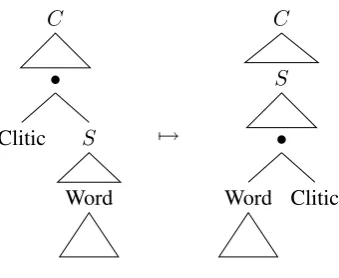
Once this independently necessary transduc-tion has been taken into account, the syntax of 2P clitics is straightforward. The 2P clitic sim-ply has a non-concatenative mode of phonologi-cal combination. The clitic and its host clause are siblings in syntactic constituency, and their parent node is interpreted as an operation that wraps the latter around the former—alternatively, lowers the former into the latter.
This analysis, which captures in essence both the “wrapping” (Bach, 1987) and “prosodic inver-sion” (Halpern, 1995) analyses of 2P clitics, can be schematized as in Figure 1, where “Word” is constrained to be the leftmost node with that label inS.
depen-dencies (Maletti, 2011).
The more powerful automata that can be spec-ified using monadic second-order logic (MSO), which include syntactically restricted classes of macro tree transducers (Engelfriet and Maneth, 1999) and deterministic tree-walking transducers (Bloem and Engelfriet, 2000), can perform this transduction. Section 3 defines the transduction in MSO, and Section 4 reflects briefly on its imple-mentation.
3 Sahidic Coptic 2P clitics via CFG+MST
The following context-free grammar and se-quence of MSO transductions formalizes, for a fragment of Sahidic Coptic, the analysis of 2P cli-sis sketched in Section 2.2.
Section 3 breaks the interpretation of a syntac-tic parse tree as a phonological term into a series (f1−f7) of simple composed MSO transductions. A “redex” phonological term is derived (Section 3.3), and its reducible subterms are then evaluated separately (Section 3.4). An algorithmic imple-mentation of the transduction is sketched in Sec-tion 3.5.
3.1 Formal preliminaries
The following definitions and assertions rehearse material from Courcelle and Engelfriet (2012), which should be consulted for full details. 3.1.1 Relational structures and tree graphs
A relational signature is a finite setR of rela-tion symbols with associated arityρ(r) ∈N∗ for
each r ∈ R. A relational structure over R is a tupleR = hDR,(rR)r∈Ri, whereDR is a finite
domain of entities and rR, for eachr ∈ R, is a
ρ(r)-ary relation onDR.
A bijection exists between binary relational structures and labelled graphs, with unary and bi-nary relations corresponding to node and edge la-bels, respectively. Ordered binary trees can be represented as labelled directed graphs, and hence as relational structures, in the obvious way. 3.1.2 Monadic second-order logic
The monadic second-order (MSO) formulas over a relational signature R are as first-order predicate logic, with the addition of monadic second-order variables X, Y, X0, . . . denoting sets of entities, second-order quantification, and
a primitive operator for set membership. The sub-stitution ofnfree variables in a formulaφby en-titiesd1, . . . , dnis writtenφ(d1, . . . , dn).
An MSO formula overRis interpreted in a re-lational signature overR. A formula with no free variables is called a sentence. If a sentenceψ is true in a relational structureR, we writeR |=ψ, pronounced “Rmodelsψ”.
3.1.3 MSO transduction
An MSO transduction defines a relational structure in terms of another by taking a finite number of copies of nodes from the source do-main, keeping those that satisfy particular formu-las in the source structure, and defining the rela-tions that hold in the target structure by means of formulas modeled by the source structure. The generalization of MSO transduction tok-copying MSO transduction (Courcelle, 1991) allows the target domain to be larger than its source. MSO transductions whose formulas do not refer to pa-rameters define deterministic functions.
A (parameterless, k-copying) MSO transduc-tion over a relatransduc-tional signatureRis specified by a triplehk,∆,Θi, wherek∈Nand∆ ={δi|0≤
i≤k}andΘ ={θw|w∈W}are sets of MSO
formulas with free variables, andW is the set of all tuples(r, i1, . . . , iρ(r))forr ∈ R. This triple is called a definition scheme.
A definition scheme specifies a target relational structure T with respect to a source relational structure S as follows. The domain DT ofT is
the set(D0 × {0})∪. . .∪(Dk × {k}), where
eachDi = {d ∈ DS |S |= δi(d)}. For eachn
-ary relationrin the relational signature of T, an
n-ary relation onDT is defined as:
[
i0,...,in∈[k]
{((d0, i0), . . . ,(dn, in))|
d0 ∈Di0, . . . , dn∈Din,
S |=θr,i0,...,in(d0, . . . , dn)}
Intuitively, a formulaδispecifies conditions on
the existence of theith copy of a node in the target structure. A formulaθ(r,i0,...,jρ(r))specifies
condi-tions on the relationrholding between copies of nodes indexedi, . . . , jin the target structure. 3.2 Definitions and abbreviations
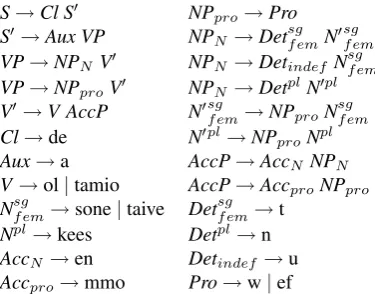
3.2.1 Base CFG
S→Cl S0 NPpro→Pro
S0→Aux VP NPN →Detsgf emN0sgf em
VP→NPN V0 NPN →Detindef N sg f em
VP→NPproV0 NPN →DetplN0pl
V0→V AccP N0sgf em→NPproN
sg f em
Cl→de N0pl→NPproNpl
Aux→a AccP→AccN NPN
V→ol|tamio AccP→AccproNPpro
Nsgf em→sone|taive Detsgf em→t
Npl→kees Detpl→n
AccN →en Detindef →u
[image:4.595.85.273.71.218.2]Accpro→mmo Pro→w|ef
Figure 2: Base CFG fragment of Coptic.
Figure 2. Its parse trees define a recognizable lan-guage of binary trees, members of which can be represented as relational structures, as explained in Section 3.1.1. This CFG fragment, in combi-nation with the transductions detailed below, suf-fices to generate sentences (2) and (3) from Sec-tion 2.1.
This grammar encodes several claims, already alluded to in Section 2.1, about the syntactic structure of Coptic. Syntactic dependencies are represented by constituency in the usual way. The immediate dependence of the 2P clitic de on a host clause is expressed by the siblinghood ofCl
andS0underS.
Features of lexical items relevant for agree-ment and allomorphy are encoded as diacritics on nonterminals, allowing determiners to agree with nouns in gender and the accusative case prepo-sition to covary with the nominal or pronominal status of its complement.
3.2.2 Encoding of nodes with unbounded branching
Syntactic trees are interpreted into prosodic trees, which may contain prosodic word con-stituents that branch unboundedly wide. To fix a binary encoding for such constituents, a “cons
cell”-like variant of the extension operator encod-ing (Comon et al., 2007, p. 210) is adopted, in which a term of the form@(x, y)is interpreted as extending the interpretation of y by addingx to its root as its leftmost child. An example of this encoding is given in Figure 3.
Only the fragment of prosodic constituency rel-evant to the alternation shown in sentences (2)
ω
µ3
µ2
µ1
'
@
@
@
ω µ3
µ2
µ1
Figure 3: Encoding ofn-ary trees.
_ concatenation •p proclisis
•e enclisis
•2p 2P clisis •id identity
ω prosodic word
@ extension operator Table 1: Interpretation of labels.
and (3) is derived. The output tree therefore contains operator-encoded prosodic constituents as subtrees of unencoded trees containing unan-alyzed phonological combination operators. 3.2.3 Relational signature and abbreviations
All MSO transductions presented below are de-fined over a binary relational signatureR=R1∪
R2. The set of node labels R1 is given by the union of the set of all non-terminal and terminal node names in the grammar of Figure 2 and the set{_,•p,•e,•2p,•id, ω,@}. The interpretation of these predicates is given in Table 1. The set of binary predicatesR2 is simply{0,1}, the left and right child relations, written as infix operators as a notational convenience.
It will be useful to define several new binary predicates as syntactic abbreviations. I assume re-flexive and irrere-flexive transitive closures r∗ and
r+ of relations r ∈ R2, as well as immediate domination and precedence ,≺, as abbrevia-tions of MSO formulas over primitive predicates.4 Recurring structural properties of lexical items in the base CFG are given by the unary syntactic abbreviations defined below.5 These include
pro-4On the MSO-definability of these, see Courcelle and
En-gelfriet (2012).
5
[image:4.595.322.498.76.181.2]clitic and 2P clitic status (Pc(x),2P(x)), indepen-dent pronounceability (Str(x)), and the property of being a leaf (Leaf(x)).
Pc(x) :=a(x)∨en(x)∨t(x)∨n(x)
2P(x) :=de(x)
Str(x) :=ol(x)∨sone(x)
∨kees(x)∨mmo(x)
Leaf(x) :=de(x)∨a(x)∨. . .
MSO transductions are given by transduction schemes, as defined in Section 3.1.3. In the case thatk= 0, irrelevant subscripts are omitted. Un-less otherwise specified, all formulasδican be
as-sumed to be the constantTrue. 3.3 Transducing a reducible term
A syntactic constituency tree can be interpreted as a term in a phonological algebra, with non-leaf nodes interpreted as operations effecting phono-logical combination in various modes. Pro-nounceable utterances, which consist of concate-nations of prosodic constituents (i.e. terms over leaves from the base CFG,@,ω, and_), are nor-mal forms.
This complex interpretation is broken into smaller transductions, the first set of which lays the foundation for the reduction of the “clitic” modes of combination. Non-leaf nodes are first replaced by appropriate combination operators (Section 3.3.1). Unary nodes are then eliminated (Section 3.3.2). Finally, the prosodic structure necessary for the next phase of interpretation is generated (Section 3.3.3).
3.3.1 Relabeling
Non-terminal leaves in the syntactic tree are re-placed by operators indicating modes of phono-logical combination, as presented in Table 1.
The transduction to unreduced phonological terms is sensitive to the structure of the syntac-tic tree. Some leaves, e.g. clisyntac-tic pronouns, are not strictly proclitic or enclitic but vary by context: the pronominal subject of a verb or possessor of a noun is proclitic, whereas the pronominal com-plement of an accusative preposition or pronoun-selecting verb is enclitic. The relevant syntactic context is the child status ofNPpronodes. Hence
the parent of an NPpro node is replaced by•p if NPpro is its left child, by •e if NPpro its right
child.
All non-pronominal clitics are phonologically combined with the sibling of their phonologically vacuous unary parent node. Thus the grandpar-ents of all such clitic leaves are replaced by the ap-propriate clitic combination operator,•p for pro-clitics and•2p for 2P clitics. Unary nodes are
re-placed by•id, and all other non-leaf nodes are re-placed by_. Leaf node labels are left unchanged. The definition scheme f1 = h0,∆,Θi, where Θis defined as the union of the formulas given be-low, specifies this transduction. The body of the
θ_formula, which consists largely of the
disjunc-tion of the negadisjunc-tions of the preceding formulas, is omitted, as signaled by[etc]; and theθw formula
which reasserts leaf labels is omitted altogether.
θ•e(x) =∃x
0(
NPpro(x0)∧x1x0)
θ•p(x) =∃x
0(NP
pro(x0)∧x0x0)
∨ ∃x0, x00(x0x0∧x00x00∧Pc(x00))
θ•2p(x) =∃x
0
, x00(x0x0∧x00x00∧2P(x00))
θ•id(x) =∃x
0(x
0x0)∧ ¬∃x00(x1x00)
θ_(x) = [etc]
3.3.2 Eliminating unary nodes
Before any further interpretation takes place, unary •id nodes, which are phonologically
vac-uous, can be eliminated.
The definition schemef2 =h0,∆,Θi, withΘ defined as the union of the following formulas (for
i∈ {0,1}), eliminates unary nodes by connecting a non-•idnode dominated by a path of•idnodes to the parent of the topmost•idin the path. Again, [etc]stands for the omitted “elsewhere condition”, which here reasserts edges from the source.
θi(x, y) =¬ •id(x)∧ ¬ •id(y)
∧ ∃x0(xix0∧x0+y
∧ ∀y0(x0∗y0∧y0+y
→ •id(y0)))∨[etc]
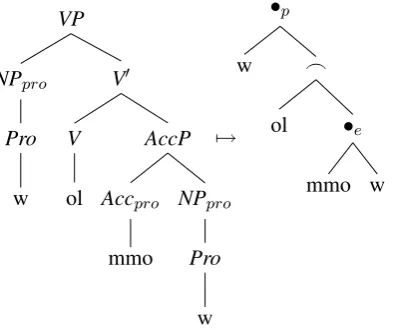
An example of the composed transductionf2◦
f1is given in Figure 4.
3.3.3 Base prosodic words
VP
V0
AccP
NPpro
Pro
w
Accpro
mmo
V
ol
NPpro
Pro
w
7→ •p
_
•e
[image:6.595.317.502.76.178.2]w mmo ol w
Figure 4: Relabeling and•id-elimination.
words are encoded by the scheme given in Sec-tion 3.2.
The definition schemef3 =h2,∆,Θi, with∆ andΘ the union of theδ andθ formulas below, specifies a transduction that takes two additional copies of all nodes, relabels the copies of strong leaf nodes as@andω, and draws edges as appro-priate.
δ1(x) =δ2(x) =
θ(@,1)(x) =θ(ω,2)(x) =Str(x)
θ(1,0,0)(x, y) =¬Str(y)∧x1y
θ(1,0,1)(x, y) =Str(y)∧x1y
θ(0,1,0)(x, y) =
θ(1,1,2)(x, y) =Str(x)∧x=y
θ(0,0,0)(x, y) =True
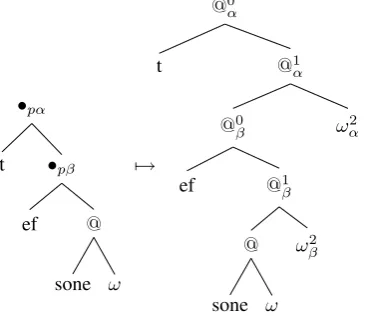
An example of the tree transduction given by
f3 is shown in Figure 5, with identity of copies indicated by subscript letters and the number of the copy by superscript numerals.
3.4 Interpreting clitic combination modes
The composed transduction f3 ◦ f2 ◦ f1 pro-duces reducible phonological terms in which the prosodic structure necessary to interpret the clitic modes of combination (•p,•e, and•2p) is present.
The interpretation of the clitic modes proceeds in three steps. “Local” clitics, siblings of prosodic words, are amalgamated into their hosts (Section 3.4.1). “Long-distance” clitics, which are not
•p
•p
soneα
ef
t 7→
•p
•p
@1
α
ωα2
sone0α
[image:6.595.85.282.78.243.2]ef t
Figure 5: Prosodic word insertion.
thus locally attached, are lowered to their hosts (Section 3.4.2) and then attached as local clitics. Second-position clitics are finally lowered and at-tached by the same means, as a special case (Sec-tion 3.4.3).
3.4.1 Local clisis
Locally connected clitics can be directly in-corporated into their hosts. The word con-stituent so derived is the recursive structure (e.g.
[ωclitic[ωhost]]) generally assumed for cliticized
words (cf. Inkelas and Zec, 1990; Zec, 2005). Proclitics and enclitics can be interpreted sepa-rately. For proclitics, the relevant notion of “local-ity” can be expressed by a predicate◦p(x), which
identifies•pnodes connected to@nodes by a path of•pnodes.
◦p(x) := •p(x)∧ ∃y(@(y)
∧x+1 y∧ ∀z(x∗z
∧z+y→ •p(x)))
The 2-copying MS transduction specified by the definition scheme f4 = h2,∆,Θi, with ∆ andΘgiven by the union of theδ andθ formu-las below, produces the appropriate bracketing by projecting a new word above each proclitic and relocating each proclitic’s sibling to the new word constituent.
δ1(x) =δ2(x) =θ(@,0)(x) =
θ(@,1)(x) =θ(ω,2)(x) = ◦p(x)
θ(1,0,1)(x, y) =θ(1,1,2)(x, y) = ◦p(x)∧x=y
θ(0,1,0)(x, y) = ◦p(x)∧x1y
•pα
•pβ
@
ω
sone ef
t 7→
@0
α
@1
α
ω2
α @0
β
@1β
ω2β
@
ω
[image:7.595.90.273.81.239.2]sone ef t
Figure 6: Local proclisis.
Figure 6 gives an example of a tree transfor-mation effected byf4, again with subscripts and superscripts indicating copies.
The interpretation of local enclitics proceeds similarly. A predicate ◦e(x) defines the relevant
notion of locality.
◦e(x) := •e(x)∧ ∃y(@(y)
∧x+0 y∧ ∀z(x∗z
∧z+y → •e(x)))
The transductionf5 = h2,∆,Θi, with∆and Θgiven by the union of theδ andθformulas be-low, produces the appropriate bracketing. This transduction is more complicated than the pro-clitic transformation in that enpro-clitics, right chil-dren in the source tree, must be relocated to left branches of@nodes.
δ1(x) =δ2(x) =
θ(@,0)(x) =θ(@,1)(x) =
θ(ω,2)(x) = ◦e(x)
θ(0,1,0)(x, y) = ◦e(x)∧x0y
θ(1,1,0)(x, y) =
θ(1,0,2)(x, y) = ◦e(x)∧x=y
θ(0,0,0)(x, y) = ◦e(x)∧x1y∨[etc]
θ(1,0,0)(x, y) = [etc]
Figure 7 gives an example of the tree transduc-tion specified byf5.
•eα
w @
ω
mmo
7→
@1
α
@0
α
ω2
α w @
ω
mmo
Figure 7: Local enclisis.
3.4.2 Long-distance proclisis
Long-distance clitics, which are not locally combined with their hosts, incorporate into them in the same manner as local clitics (i.e. by trans-ductionsf4 andf5) but must be lowered to them to do so.
Only long-distance proclisis is relevant to the grammar fragment under consideration. A long-distance proclitic is a non-local proclitic (see Sec-tion 3.4.1 for the noSec-tion of “locality”) adjacent to a word in the yield, ignoring other proclitics. Pronouns count as proclitics for this purpose, so a predicatePc0(x)including pronouns is defined. The predicateAdj(x, y)expresses adjacency ofx
andy, and the predicate Lp(x), which identifies
the parents of long-distance proclitics, is defined in terms ofAdj(x, y).
Pc0(x) :=Pc(x)∨w(x)∨ef(x)
Adj(x, y) :=x≺y∧ ∀x0(x≺x0
∧x0 ≺y∧Leaf(x0)
→Pc0(x0))
Lp(x) := •p(x)∧ ∃x0, y(@(y)
∧x0x0∧Adj(x0, y))
The parents of long-distance proclitics get at-tached to “goal” nodes—that is,@nodes or other parents of long-distance proclitics—by the right child relation. The predicate G(x) identifies goals, and NG(x, y) identifies node x’s nearest goaly.
G(x) := •p(x)∨@(x)
NG(x, y) :=x+y∧G(y)∧ ∀y0(x+y0
∧G(y0)→y≺y0)
The parent of the topmost in a path of•pnodes
con-nects that parent node to that path, to the right child of the lowest node in the path. The higher-order syntactic abbreviation PC[i;x, y] specifies the relevant relation, whereby a path of•p nodes begins with theith child ofxand leads toy.
PC[i;x, y] :=¬ •p(x)∧ ¬ •p(y)
∧ ∃x0(•p(x0)∧xix0
∧x0+1 y∧ ∀y0(x0∗y0
∧y0+1 y→ •p(y0)))
The parent of a @ node targeted by a set of long-distance clitics gets attached to the highest parent of a clitic in that set. The predicateHip(x)
identifies such highest proclitic parents. Only “maximal”@nodes, those that are highest in the right-recursive path of@nodes leading to an ω, are relevant; these are identified by the predicate
Max@p(x). The abbreviation WC[i;x, y] identi-fies a highest•p nodeyadjacent to a maximal@
node that is theith child ofx.
Hip(x) :=Lp(x)∧ ∃x0(x0x0
∧ ∀y(y ≺x0 → ¬Pc0(y)))
Max@p(x) := @(x)∧ ¬∃y(y1x∧@(y))
∧ ∃z(x+1 z∧ω(z))
WC[i;x, y] :=∃x0, y0(Max@p(x0)
∧xix0∧y0y0
∧Adj(y0, x0)∧Hip(y))
Once these auxiliary predicates are defined, a simple MSO transductionf6 =h0,∆,Θimeeting the specifications given above can be defined by the union of the following formulas.
θ1(x, y) = •p(x)∧NG(x, y)
∨PC[1;x, y]∨WC[1;x, y]∨[etc]
[image:8.595.308.502.76.259.2]θ0(x, y) =PC[0;x, y]∨WC[0;x, y]∨[etc]
Figure 8 gives an example of the transduction specified byf6. The transductionf4can be com-posed with f6 to produce the appropriate con-stituency for the lowered proclitics.
3.4.3 Second-position clisis
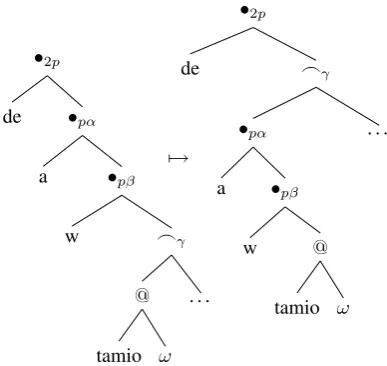
There is little substantive difference between long-distance proclitics and 2P clitics—both ar-rive in their position by a “lowering” transfor-mation that targets @ nodes. The transductions
•2p
•pα
•pβ
_γ
. . . @
ω
tamio w a de
7→
•2p
_γ
. . .
•pα
•pβ
@
ω
[image:8.595.342.481.476.557.2]tamio w a de
Figure 8: Long-distance proclisis, part 1: lowering.
already defined can be recycled, essentially un-changed, to derive 2P clisis.
Assume a lowering transductionf60 identical to
f6 except operating on •2p nodes. The resulting
lowered 2P clitics, which are in a “proclitic” con-figuration, can then be “rotated” and relabeled as enclitics. The MSO transductionf7 = h0,∆,Θi given by the union of the following formulas pro-duces this transformation.
θ•e(x) = •2p(x)
θ0(x, y) =¬ •2p(x)∧x0y
∨ •2p(x)∧x1y
θ1(x, y) =¬ •2p(x)∧x1y
∨ •2p(x)∧x0y
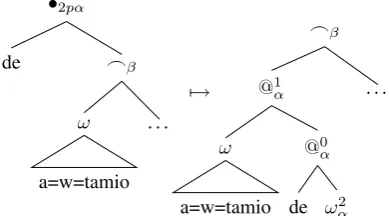
The local enclisis transduction f5 is then ap-plied to incorporate the 2P clitics into their hosts. An example transformation effected by the trans-ductionf5◦f7◦f60 is shown in Figure 3.4.3.
3.5 Algorithmic implementation
•2pα
_β
. . .
ω
a=w=tamio de
7→
_β
. . . @1
α
@0
α
ω2
α de
ω
[image:9.595.78.273.79.187.2]a=w=tamio
Figure 9: Second position clisis.
Second-order Abstract Categorial Grammar (Kanazawa, 2009b) is one such framework, equivalent to MSO in tree-transforming power (Kanazawa, 2009a). ACG tree transductions, which are expressed as linear λ-term homo-morphisms and thus have the same complexity as linear λ-term normalization, can be imple-mented in Haskell in the manner of Kiselyov and Shan (2010). A function extensionally equivalent to that defined logically above can be defined in a simple ACG consisting of a composed pair of homomorphisms and implemented in Haskell in a pair of type classes.
4 Discussion and conclusion
The analysis of Sahidic Coptic 2P clitics in terms of prosodic constituency and tree transformation given above successfully accounts for the alterna-tion shown in sentences (2) and (3). It promises to scale to a larger fragment of Coptic grammar, ac-commodating the addition of clitic main verbs and direct objects without further ado. The general ap-proach also promises to extend straightforwardly to other languages with 2P clitics, such as Russian and Hittite. Since the general technique of MSO transduction underlying the analysis applies to all tree-deriving grammar formalisms, richer gram-matical backbones than CFG can be deployed as necessary.
This transductive analysis is in line with a nascent convergence in perspectives on restrictive formal syntax. The mildly context-sensitive lan-guages, polynomially parseable languages con-taining limited cross-serial dependencies such as those induced by 2P clitics, have received a new logical characterization in light of the past
decade’s surge of interest in disentangling deriva-tions from their interpretaderiva-tions.6 Mildly context-sensitive languages are the images of recogniz-able tree languages under monadic second-order transductions.7 This generalizes not only string-generating formalisms like linear context-free rewriting systems (Vijay-Shanker et al., 1987; Weir, 1992) but also context-free languages of graphs (Engelfriet and Maneth, 2000) and linear
λ-terms (Kanazawa, 2009a; Kanazawa, 2010).8 This perspective suggests a modular approach to framework revision in the face of problematic natural language phenomena. Transductive inter-pretations are an integral, if not universally recog-nized, component of restrictive grammar frame-works. Hence, to meet new descriptive challenges such as those posed by 2P clitics, it is natural to extend those frameworks’ interpretive compo-nents by means of MSO rather than rebuilding them from scratch.
No software toolkit for MSO transduction com-parable to the XFST toolkit for regular ex-pressions (Beesley and Karttunen, 2003) or the MONA toolkit for MSO (Henriksen et al., 1995) presently exists, however. Nevertheless, MSO is an excellent candidate for a high-level specifica-tion language for tree transformaspecifica-tions, promising to play the same role for tree transduction that lan-guages such as XFST play for string transduction. MSO meanwhile serves the useful purpose of pro-viding a denotational check on the complexity of tree transformation algorithms.
Acknowledgments
Many thanks to John Hale, Sarah Murray, Michael Weiss, and three anonymous reviewers for their valuable comments. Thanks also to Chung-chieh Shan, Chris Barker, Greg Kobele, Makoto Kanazawa, and Zolt´an Varj´u for their conversation and inspiration. This research was supported by the Social Sciences and Humanities Research Council.
6
See for instance Michaelis et al. (2000), de Groote (2001), Ranta (2002), Morawietz (2003), Muskens (2003), and Pollard (2008), among many others.
7
See Kolb et al. (2003) for an application of this perspec-tive to the purely syntactic crossing dependencies of Dutch and Swiss German noted by a reviewer.
8Closely related perspectives can be found in the
References
Alexandra Y. Aikhenvald. 2003. Typological parame-ters for the study of clitics, with special reference to Tariana. In Robert M. W. Dixon and Alexandra Y. Aikhenvald, editors, Word: a Cross-Linguistic
Ty-pology, pages 42–78. Cambridge University Press,
Cambridge.
Stephen R. Anderson. 2005. Aspects of the Theory of Clitics. Oxford University Press, Oxford.
Emmon Bach. 1987. Some generalizations of cat-egorial grammars. In Walter J. Savitch, Emmon Bach, William Marsh, and Gila Safran-Naveh, ed-itors,The Formal Complexity of Natural Language, pages 251–279. D. Reidel, Dordrecht.
Kenneth R. Beesley and Lauri Karttunen. 2003.Finite State Morphology. CSLI Publications, Stanford. Roderick Bloem and Joost Engelfriet. 2000. A
com-parison of tree transductions defined by monadic second order logic and by attribute grammars. Jour-nal of Computer and System Sciences, 6(1):1–50. Tina B¨ogel, Miriam Butt, Ronald M. Kaplan,
Tracy Holloway King, and John T. Maxwell. 2010. Second position and the prosody-syntax interface. In Miriam Butt and Tracy Holloway King, editors,
Proceedings of the LFG10 Conference, pages 107–
126.
Hubert Comon, Max Dauchet, Remi Gilleron, Christof L¨oding, Florent Jacquemard, Denis Lugiez, So-phie Tison, and Marc Tommasi. 2007. Tree au-tomata techniques and applications. Available at: http://www.grappa.univ-lille3.fr/tata.
Bruno Courcelle and Joost Engelfriet. 2012. Graph structure and monadic second-order logic: a lan-guage theoretic approach. In press.
Bruno Courcelle. 1991. The monadic second-order logic of graphs V: on closing the gap between defin-ability and recognizdefin-ability. Theoretical Computer Science, 80:153–202.
Philippe de Groote. 2001. Towards abstract categorial grammars. InAssociation for Computational Lin-guistics, 39th Annual Meeting, pages 148–155. Joost Engelfriet and Sebastian Maneth. 1999. Macro
tree transducers, attribute grammars, and MSO de-finable tree translations. Information and Computa-tion, 154:34–91.
Joost Engelfriet and Sebastian Maneth. 2000. Tree languages generated by context-free graph gram-mars. In Hartmut Ehrig, editor,Graph Transforma-tion, pages 15–29, Berlin and Heidelberg. Springer Verlag.
Joost Engelfriet, Eric Lilin, and Andreas Maletti. 2009. Extended multi bottom-up tree transducers: Composition and decomposition. Acta Informatica, 46:561–590.
Zolt´an F¨ul¨op, Armin K¨uhnemann, and Heiko Vogler. 2004. A bottom-up characterization of
determin-istic top-down tree transducers with regular look-ahead.Information Processing Letters, 91:57–67. Aaron Halpern. 1995. On the Placement and
Mor-phology of Clitics. CSLI Publications, Stanford. Jesper G. Henriksen, Jakob Jensen, Michael
Jørgensen, Nils Klarlund, Robert Paige, Theis Rauhe, and Anders Sandholm. 1995. MONA: Monadic second-order logic in practice. Lecture
Notes in Computer Science, 1019:89–110.
Sharon Inkelas and Draga Zec. 1990. Prosodi-cally constrained syntax. In Sharon Inkelas and Draga Zec, editors,The phonology–syntax connec-tion, pages 365–378. University of Chicago Press, Chicago.
Makoto Kanazawa. 2009a. A lambda calculus char-acterization of MSO definable tree transductions. Talk given at the 10th Asian Logic Conference. Makoto Kanazawa. 2009b. Second-order abstract
cat-egorial grammars. Manuscript.
Makoto Kanazawa. 2010. Second-order abstract cat-egorial grammars as hyperedge replacement gram-mars. Journal of Language, Logic, and Informa-tion, 19(2):137–161.
Oleg Kiselyov and Chung-chieh Shan. 2010. Lambda: the ultimate syntax-semantics interface. NASSLLI 2010 course notes.
Hans-Peter Kolb, Jens Michaelis, Uwe M¨onnich, and Frank Morawietz. 2003. An operational and deno-tational approach to non-context-freeness.
Theoret-ical Computer Science, 293:261–289.
Alexander Koller and Marco Kuhlmann. 2011. A gen-eralized view on parsing and translation. In Pro-ceedings of the 12th International Conference on Parsing Technologies, pages 2–11.
Andreas Maletti. 2011. Tree transformations and de-pendencies. Lecture Notes in Computer Science, 6878:1–20.
Jens Michaelis, Uwe M¨onnich, and Frank Morawietz. 2000. Derivational minimalism in two regular and logical steps. InProceedings of TAG+ 5.
Frank Morawietz. 2003.Two-Step Approaches to
Nat-ural Language Formalisms. Mouton de Gruyter,
Berlin and New York.
Reinhard Muskens. 2003. Language, lambdas, and logic. In Richard T. Oehrle and Geert-Jan Krui-jff, editors, Resource sensitivity in binding and
anaphora, pages 23–54. Kluwer, Dordrecht.
Marina Nespor and Irene Vogel. 1986. Prosodic Phonology. Foris, Dordrecht.
Tito Orlandi. 2004. Towards a computational gram-mar of Sahidic Coptic. In Jacques van der Vliet and Mat Immerzeel, editors,Coptic studies on the
threshold of a new millennium, pages 125–130,
Leuven. Peeters.
Aarne Ranta. 2002. Grammatical Framework.
Jour-nal of FunctioJour-nal Programming, 14:145–189.
Chris Reintges. 2004. Coptic Egyptian (Sahidic Di-alect). R¨udiger K¨oppe Verlag, K¨oln.
Elisabeth Selkirk. 1986. On derived domains in sen-tence phonology. Phonology Yearbook, 3:371–405. K. Vijay-Shanker, David J. Weir, and Aravind K. Joshi. 1987. Characterizing structural descriptions pro-duced by various grammatical formalisms. In Pro-ceedings of the 25th annual meeting on Association for Computational Linguistics.
Jacob Wackernagel. 1892. Uber ein Gesetz der¨ indogermanischen Wortstellung. Indogermanische
Forschungen, 1:333–436.
David J. Weir. 1992. Linear context-free rewriting systems and deterministic tree-walking transducers.
InProceedings of the 30th annual meeting on
Asso-ciation for Computational Linguistics.
Draga Zec. 2005. Prosodic differences among func-tion words. Phonology, 22:77–112.