Measuring Comparability of Documents in Non-Parallel Corpora for
Efficient Extraction of (Semi-)Parallel Translation Equivalents
Fangzhong Su
Centre for Translation Studies University Of Leeds LS2 9JT, Leeds, UK [email protected]
Bogdan Babych Centre for Translation Studies
University Of Leeds LS2 9JT, Leeds, UK [email protected]
Abstract
In this paper we present and evaluate three approaches to measure comparability of documents in non-parallel corpora. We de-velop a task-oriented definition of compa-rability, based on the performance of auto-matic extraction of translation equivalents from the documents aligned by the pro-posed metrics, which formalises intuitive definitions of comparability for machine translation research. We demonstrate ap-plication of our metrics for the task of automatic extraction of parallel and semi-parallel translation equivalents and discuss how these resources can be used in the frameworks of statistical and rule-based machine translation.
1 Introduction
Parallel corpora have been extensively exploited in different ways in machine translation (MT) — both in Statistical (SMT) and more recently, in Rule-Based (RBMT) architectures: in SMT aligned parallel resources are used for building translation phrase tables and calculating transla-tion probabilities; and in RBMT, they are used for automatically building bilingual dictionaries of translation equivalents and automatically deriv-ing bilderiv-ingual mappderiv-ings for frequent structural pat-terns. However, large parallel resources are not always available, especially for under-resourced languages or narrow domains. Therefore, in re-cent years, the use of cross-lingual comparable corpora has attracted considerable attention in the MT community (Sharoff et al., 2006; Fung and Cheung, 2004a; Munteanu and Marcu, 2005; Babych et al., 2008).
Most of the applications of comparable cor-pora focus on discovering translation equivalents to support machine translation, such as bilingual lexicon extraction (Rapp, 1995; Rapp, 1999; Morin et al., 2007; Yu and Tsujii, 2009; Li and Gaussier, 2010; Prachasson and Fung, 2011), par-allel phrase extraction (Munteanu and Marcu, 2006), and parallel sentence extraction (Fung and Cheung, 2004b; Munteanu and Marcu, 2005; Munteanu et al., 2004; Smith et al., 2010).
Comparability between documents is often un-derstood as belonging to the same subject domain, genre or text type, so this definition relies on these vague linguistic concepts. The problem with this definition then is that it cannot be exactly bench-marked, since it becomes hard to relate automated measures of comparability to such inexact and un-measurable linguistic concepts. Research on com-parable corpora needs not only good measures for comparability, but also a clearer, technologically-grounded and quantifiable definition of compara-bility in the first place.
In this paper we relate comparability to use-fulness of comparable texts for MT. In particu-lar, we propose a performance-based definition of comparability, as the possibility to extract parallel or quasi-parallel translation equivalents – words, phrases and sentences which are translations of each other. This definition directly relates compa-rability to texts’ potential to improve the quality of MT by adding extracted phrases to phrase ta-bles, training corpus or dictionaries. It also can be quantified as the rate of successful extraction of translation equivalents by automated tools, such as proposed in Munteanu and Marcu (2006).
Still, successful detection of translation equiv-alents from comparable corpora very much
pends on the quality of these corpora, specifically on the degree of their textual equivalence and suc-cessful alignment on various text units. There-fore, the goal of this work is to provide compa-rability metrics which can reliably identify cross-lingual comparable documents from raw corpora crawled from the Web, and characterize the de-gree of their similarity, which enriches compara-ble corpora with the document alignment infor-mation, filters out documents that are not useful and eventually leads to extraction of good-quality translation equivalents from the corpora.
To achieve this goal, we need to define a scale to assess comparability qualitatively, met-rics to measure comparability quantitatively, and the sources to get comparable corpora from. In this work, we directly characterize comparability by how useful comparable corpora are for the task of detecting translation equivalents in them, and ultimately to machine translation. We focus on document-level comparability, and use three cat-egories for qualitative definition of comparability levels, defined in terms of granularity for possible alignment:
• Parallel: Traditional parallel texts that are translations of each other or approximate translations with minor variations, which can be aligned on the sentence level.
• Strongly-comparable: Texts that talk about the same event or subject, but in different languages. For example, international news about oil spill in the Gulf of Mexico, or linked articles in Wikipedia about the same topic. These documents can be aligned on the document level on the basis of their ori-gin.
• Weakly-comparable: Texts in the same sub-ject domain which describe different events. For example, customer reviews about hotel and restaurant in London. These documents do not have an independent alignment across languages, but sets of texts can be aligned on the basis of belonging to the same subject domain or sub-domain.
In this paper, we present three different ap-proaches to measure the comparability of cross-lingual (especially under-resourced languages) comparable documents: a lexical mapping based
approach, a keyword based approach, and a ma-chine translation based approach. The experimen-tal results show that all of them can effectively predict the comparability levels of the compared document pairs. We then further investigate the applicability of the proposed metrics by measur-ing their impact on the task of parallel phrase ex-traction from comparable corpora. It turns out that, higher comparability level predicted by the metrics consistently lead to more number of paral-lel phrase extracted from comparable documents. Thus, the metrics can help select more compara-ble document pairs to improve the performance of parallel phrase extraction.
The remainder of this paper is organized as fol-lows. Section 2 discusses previous work. Section 3 introduces our comparability metrics. Section 4 presents the experimental results and evaluation. Section 5 describes the application of the metrics. Section 6 discusses the pros and cons of the pro-posed metrics, followed by conclusions and future work in Section 7.
2 Related Work
The term “comparability”, which is the key con-cept in this work, applies to the level of corpora, documents and sub-document units. However, so far there is no widely accepted definition of com-parability. For example, there is no agreement on the degree of similarity that documents in com-parable corpora should have or on the criteria for measuring comparability. Also, most of the work that performs translation equivalent extraction in comparable corpora usually assumes that the cor-pora they use are reliably comparable and focuses on the design of efficient extraction algorithms. Therefore, there has been very little literature dis-cussing the characteristics of comparable corpora (Maia, 2003). In this section, we introduce some representative work which tackles comparability metrics.
The work which deals with comparability measures in cross-lingual comparable corpora is closer to our work. Saralegi et al. (2008) measure the degree of comparability of comparable cor-pora (English and Basque) according to the dis-tribution of topics and publication dates of docu-ments. They compute content similarity for all the document pairs between two corpora. These sim-ilarity scores are then input as parameters for the EMD (Earth Mover’s Distance) distance measure, which is employed to calculate the global com-patibility of the corpora. Munteanu and Marcu (2005; 2006) select more comparable document pairs in a cross-lingual information retrieval based manner by using a toolkit called Lemur1. The retrieved document pairs then serve as input for the tasks of parallel sentence and sub-sentence ex-traction. Smith et al. (2010) treat Wikipedia as a comparable corpus and use “interwiki” links to identify aligned comparable document pairs for the task of parallel sentence extraction. Li and Gaussier (2010) propose a comparability met-ric which can be applied at both document level and corpus level and use it as a measure to se-lect more comparable texts from other external sources into the original corpora for bilingual lex-icon extraction. The metric measures the propor-tion of words in the source language corpus trans-lated in the target language corpus by looking up a bilingual dictionary. They evaluate the met-ric on the met-rich-resourced English-French language pair, thus good dictionary resources are available. However, this is not the case for under-resourced languages in which reliable language resources such as machine-readable bilingual dictionaries with broad word coverage or word lemmatizers might be not publicly available.
3 Comparability Metrics
To measure the comparability degree of document pairs in different languages, we need to translate the texts or map lexical items from the source lan-guage into the target lanlan-guages so that we can compare them within the same language. Usually this can be done by using bilingual dictionaries (Rapp, 1999; Li and Gaussier, 2010; Prachasson and Fung, 2011) or existing machine translation tools. Based on this process, in this section we present three different approaches to measure the
1
Available at http://www.lemurproject.org/
comparability of comparable documents.
3.1 Lexical mapping based metric
It is straightforward that we expect a bilingual dic-tionary can be used for lexical mapping between a language pair. However, unlike the language pairs in which both languages are rich-resourced (e.g., English-French, or English-Spanish) and dictio-nary resources are relatively easy to obtain, it is likely that bilingual dictionaries with good word coverage are not publicly available for under-resourced languages (e.g., English-Slovenian, or English-Lithuanian). In order to address this problem, we automatically construct dictionaries by using word alignment on large-scale parallel corpora (e.g., Europarl and JRC-Acquis2).
Specifically, GIZA++ toolkit (Och and Ney, 2000) with default setting is used for word align-ment on the JRC-Acquis parallel corpora (Stein-berger et al., 2006). The aligned word pairs to-gether with the alignment probabilities are then converted into dictionary entries. For example, in Estonian-English language pair, the alignment example “kompanii company 0.625” in the word alignment table means the Estonian word “kom-panii” can be translated as (or aligned with) the English candidate word “company” with a prob-ability of 0.625. In the dictionary, the transla-tion candidates are ranked by translatransla-tion proba-bility in descending order. Note that the dictio-nary collects inflectional form of words, but not only base form of words. This is because the dic-tionary is directly generated from the word align-ment results and no further word lemmatization is applied.
Using the resulting dictionary, we then per-form lexical mapping in a word-for-word map-ping strategy. We scan each word in the source language texts to check if it occurs in the dic-tionary entries. If so, the first translation candi-date are recorded as the corresponding mapping word. If there are more than one translation can-didate, the second candidate will also be kept as the mapping result if its translation probability is higher than 0.33. For non-English and English
2
The JRC-Acquis covers 22 European languages and provides large-scale parallel corpora for all the 231 language pairs.
3
language pair, the non-English texts are mapped into English. If both languages are non-English (e.g., Greek-Romanian), we use English as a pivot langauge and map both the source and target language texts into English4. Due to the lack of reliable linguistic resources in non-English languages, mapping texts from non-English lan-guage into English can avoid lanlan-guage process-ing in non-English texts and allows us to make use of the rich resources in English for further text processing, such as stop-word filtering and word lemmatization5. Finally, cosine similarity measure is applied to compute the comparability strength of the compared document pairs.
3.2 Keyword based metric
The lexical mapping based metric takes all the words in the text into account for comparability measure, but if we only retain a small number of representative words (keywords) and discard all the other less informative words in each docu-ment, can we judge the comparability of a doc-ument pair by comparing these words? Our in-tuition is that, if two document share more key-words, they should be more comparable. To validate this, we then perform keyword extrac-tion by using a simple TFIDF based approach, which has been shown effective for keyword or keyphrase extraction from the texts (Frank et al., 1999; Hulth, 2003; Liu et al., 2009).
More specifically, the keyword based metric can be described as below. First, similar to the lexical mapping based metric, bilingual dictionar-ies are used to map non-English texts into En-glish. Thus, only the English resources are ap-plied for stop-word filtering and word lemmatiza-tion, which are useful text preprocessing steps for keyword extraction. We then use TFIDF to mea-sure the weight of words in the document and rank the words by their TFIDF weights in descending order. The top n (e.g., 30) words are extracted as keywords to represent the document. Finally, the comparability of each document pair is deter-mined by applying cosine similarity to their
key-4Generally in JRC-Acquis, the size of parallel corpora
for most of non-English langauge pairs is much smaller than that of language pairs which contain English. Therefore, the resulting bilingual dictionaries which contain English have better word coverage as they have many more dictionary en-tries.
5We use WordNet (Fellbaum, 1998) for word
lemmatiza-tion.
word lists.
3.3 Machine translation based metrics
Bilingual dictionary is used for word-for-word translation in the lexical mapping based metric and words which do not occur in the dictionary will be omitted. Thus, the mapping result is like a list of isolated words and information such as word order, syntactic structure and named entities can not be preserved. Therefore, in order to im-prove the text translation quality, we turn to the state-of-the-art SMT systems.
In practice, we use Microsoft translation API6 to translate texts in under-resourced languages (e.g, Lithuanian and Slovenian) into English and then explore several features for comparability metric design, which are listed as below.
• Lexical feature: Lemmatized bag-of-word representation of each document after stop-word filtering. Lexical similarity (denoted by WL) of each document pair is then
ob-tained by applying cosine measure to the lex-ical feature.
• Structure feature: We approximate it by the number of content words (adjectives, ad-verbs, nouns, verbs and proper nouns) and the number of sentences in each document, denoted byCD andSDrespectively. The
in-tuition is that, if two documents are highly comparable, their number of content words and their document length should be similar. The structure similarity (denoted byWS) of
two documentsD1andD2is defined as bel-low.
WS= 0.5∗(CD1/CD2) + 0.5∗(SD1/SD2)
suppose thatCD1<=CD2, andSD1<=SD2.
• Keyword feature: Top-20 words (ranked by TFIDF weight) of each document. keyword similarity (denoted by WK) of two
docu-ments is also measured by cosine.
• Named entity feature: Named entities of each document. If more named entities co-occur in two documents, they are very likely to talk about the same event or subject and
6Available at
thus should be more comparable. We use Stanford named entity recognizer7to extract named entities from the texts (Finkel et al., 2005). Again, cosine is then applied to mea-sure the similarity of named entities (denoted byWN) between a document pair.
We then combine these four different types of score in an ensemble manner. Specifically, a weighted average strategy is applied: each indi-vidual score is associated with a constant weight, indicating the relative confidence (importance) of the corresponding type of score. The overall com-parability score (denoted by SC) of a document pair is thus computed as below:
SC=α∗WL+β∗WS+γ∗WK+δ∗WN
whereα,β,γ, andδ∈[0, 1], andα+β+γ+δ= 1. SC should be a value between 0 and 1, and larger SC value indicates higher comparability level.
4 Experiment and Evaluation
4.1 Data source
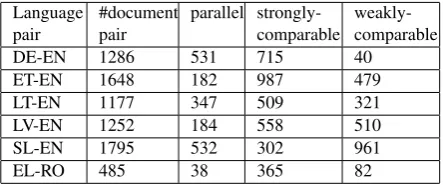
To investigate the reliability of the proposed comparability metrics, we perform experiments for 6 language pairs which contain under-resoured languages: German-English (DE-EN), Estonian-English (ET-EN), Lithuanian-English (LT-EN), Latvian-English (LV-EN), Slovenian-English (SL-EN) and Greek-Romanian (EL-RO). A comparable corpus is collected for each lan-guage pair. Based on the definition of compa-rability levels (see Section 1), human annota-tors fluent in both languages then manually anno-tated the comparability degree (parallel, strongly-comparable, and weakly-comparable) at the doc-ument level. Hence, these bilingual comparable corpora are used as gold standard for experiments. The data distribution for each language pair, i.e., number of document pairs in each comparability level, is given in Table 1.
4.2 Experimental results
We adopt a simple method for evaluation. For each language pair, we compute the average scores for all the document pairs in the same com-parability level, and compare them to the gold
7Available at
http://nlp.stanford.edu/software/CRF-NER.shtml
Language pair
#document pair
parallel strongly-comparable
weakly-comparable
DE-EN 1286 531 715 40
ET-EN 1648 182 987 479
LT-EN 1177 347 509 321
LV-EN 1252 184 558 510
SL-EN 1795 532 302 961
EL-RO 485 38 365 82
Table 1: Data distribution of gold standard corpora
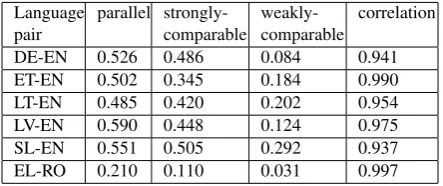
standard comparability labels. In addition, in or-der to better reveal the relation between the scores obtained from the proposed metrics and compara-bility levels, we also measure the Pearson correla-tion between them8. For the keyword based met-ric, top 30 keywords are extracted from each text for experiment. For the machine translation based metric, we empirically setα= 0.5,β =γ = 0.2, and δ = 0.1. This is based on the assumption that, lexical feature can best characterize the com-parability given the good translation quality pro-vided by the powerful MT system, while keyword and named entity features are also better indica-tors of comparability than the simple document length information.
The results for the lexical mapping based met-ric, the keyword based metric and the machine translation based metric are listed in Table 2, 3, and 4, respectively.
Language pair
parallel strongly-comparable
weakly-comparable
correlation
[image:5.595.302.524.72.165.2]DE-EN 0.545 0.476 0.182 0.941 ET-EN 0.553 0.381 0.228 0.999 LT-EN 0.545 0.461 0.225 0.964 LV-EN 0.625 0.494 0.179 0.973 SL-EN 0.535 0.456 0.314 0.987 EL-RO 0.342 0.131 0.090 0.932
Table 2: Average comparability scores for lexical map-ping based metric
Overall, from the average scores for each comparability level presented in Table 2, 3, and 4, we can see that, the scores obtained from the three comparability metrics can
reli-8
Language pair
parallel strongly-comparable
weakly-comparable
correlation
[image:6.595.71.293.72.165.2]DE-EN 0.526 0.486 0.084 0.941 ET-EN 0.502 0.345 0.184 0.990 LT-EN 0.485 0.420 0.202 0.954 LV-EN 0.590 0.448 0.124 0.975 SL-EN 0.551 0.505 0.292 0.937 EL-RO 0.210 0.110 0.031 0.997
Table 3: Average comparability scores for keyword based metric
Language pair
parallel strongly-comparable
weakly-comparable
correlation
DE-EN 0.912 0.622 0.326 0.999 ET-EN 0.765 0.547 0.310 0.999 LT-EN 0.755 0.613 0.308 0.984 LV-EN 0.770 0.627 0.236 0.966 SL-EN 0.779 0.582 0.373 0.988 EL-RO 0.863 0.446 0.214 0.988
Table 4: Average comparability scores for machine translation based metric
ably reflect the comparability levels across dif-ferent language pairs, as the average scores for higher comparable levels are always sig-nificantly larger than those of lower compara-ble levels, namely SC(parallel)>SC (strongly-comparable)>SC(weakly-comparable). In addi-tion, in all the three metrics, the Pearson correla-tion scores are very high (over 0.93) across dif-ferent language pairs, which indicate that there is strong correlation between the comparability scores obtained from the metrics and the corre-sponding comparability level.
Moreover, from the comparison of Table 2, 3, and 4, we also have several other findings. Firstly, the performance of keyword based metric (see Table 3) is comparable to the lexical mapping based metric (see Table 2) as their comparability scores for the corresponding comparability levels are similar. This means it is reasonable to deter-mine the comparability level by only comparing a small number of keywords of the texts. Secondly, the scores obtained from the machine translation based metric (see Table 4) are significantly higher than those in both the lexical mapping based met-ric and the keyword based metmet-ric. Clearly, this is due to the advantages of using the state-of-the-art MT system. In comparison to the approach of using dictionary for word-for-word mapping, it can provide much better text translation which allows detecting more proportion of lexical
over-lapping and mining more useful features in the translated texts. Thirdly, in the lexical mapping based metric and keyword based metric, we can also see that, although the average scores for EL-RO (both under-resourced languages) conform to the comparability levels, they are much lower than those of the other 5 language pairs. The reason is that, the size of the parallel corpora in JRC-Acquis for these 5 language pairs are significantly larger (over 1 million parallel sentences) than that of EL-EN, RO-EN9, and EL-RO, thus the result-ing dictionaries of these 5 language pairs also con-tain many more dictionary entries.
5 Application
The experiments in Section 4 confirm the reli-ability of the proposed metrics. The compara-bility metrics are thus useful for collecting high-quality comparable corpora, as they can help filter out weakly comparable or non-comparable doc-ument pairs from the raw crawled corpora. But are they also useful for other NLP tasks, such as translation equivalent detection from comparable corpora? In this section, we further measure the impact of the metrics on parallel phrase extraction (PPE) from comparable corpora. Our intuition is that, if document pairs are assigned higher com-parability scores by the metrics, they should be more comparable and thus more parallel phrases can be extracted from them.
The algorithm of parallel phrase extraction, which develops the approached presented in Munteanu and Marcu (2006), uses lexical over-lap and structural matching measures (Ion, 2012). Taking a list of bilingual comparable document pairs as input, the extraction algorithm involves the following steps.
1. Split the source and target language docu-ments into phrases.
2. Compute the degree of parallelism for each candidate pair of phrases by using the bilin-gual dictionary generated from GIZA++ (base dictionary), and retain all the phrase pairs with a score larger than a predefined parallelism threshold.
9Remember that in our experiment, English is used as the
3. Apply GIZA++ to the retained phrase pairs to detect new dictionary entries and add them to the base dictionary.
4. Repeat Step 2 and 3 for several times (empir-ically set at 5) by using the augmented dic-tionary, and output the detected phrase pairs.
Phrases which are extracted by this algorithm are frequently not exact translation equivalents. Below we give some English-German examples of extracted equivalents with their corresponding alignment scores:
1. But a successful mission — seiner ¨uberaus erfolgreichen Mission abgebremst — 0.815501989333333
2. Former President Jimmy Carter — Der ehemalige US-Pr¨asident Jimmy Carter — 0.69708324976825
3. on the Korean Peninsula — auf der koreanis-chen Halbinsel — 0.8677432145
4. across the Muslim world — mit der muslim-ischen Welt erm¨oglichen — 0.893330864
5. to join the United Nations — der Weg in die Vereinten Nationen offensteht — 0.397418711927629
Even though some of the extracted phrases are not exact translation equivalents, they may still be useful resources both for SMT and RBMT if these phrases are passed through an extra pre-processing stage, of if the engines are modified specifically to work with semi-parallel translation equivalents extracted from comparable texts. We address this issue in the discussion section (see Section 6).
For evaluation, we measure how the metrics af-fect the performance of parallel phrase extraction algorithm on 5 language pairs (DE-EN, ET-EN, LT-EN, LV-EN, and SL-EN). A large raw compa-rable corpus for each language pair was crawled from the Web, and the metrics were then applied to assign comparability scores to all the docu-ment pairs in each corpus. For each language pair, we set three different intervals based on the com-parability score (SC) and randomly select 500 document pairs in each interval for evaluation. For the MT based metric, the three intervals are
(1) 0.1<=SC<0.3, (2) 0.3<=SC<0.5, and (3)
SC>=0.5. For the lexical mapping based metric and keyword based metric, since their scores are lower than those of the MT based metric for each comparability level, we set three lower intervals at (1) 0.1<=SC<0.2, (2) 0.2<=SC<0.4, and (3)
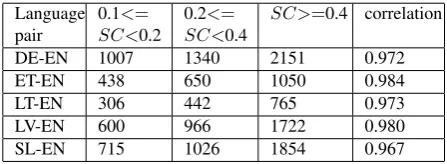
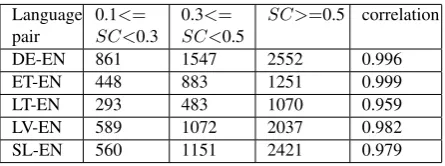
SC>=0.4. The experiment focuses on counting the number of extracted parallel phrases with par-allelism score>=0.410, and computes the average number of extracted phrases per 100000 words (the sum of words in the source and target lan-guage documents) for each interval. In addition, the Pearson correlation measure is also applied to measure the correlation between the interval11of comparability scores and the number of extracted parallel phrases. The results which summarize the impact of the three metrics to the performance of parallel phrase extraction are listed in Table 5, 6, and 7, respectively.
Language pair
0.1<= SC<0.2
0.2<= SC<0.4
SC>=0.4 correlation
DE-EN 728 1434 2510 0.993
ET-EN 313 631 1166 0.989
LT-EN 258 419 894 0.962
LV-EN 470 859 1900 0.967
[image:7.595.302.524.341.422.2]SL-EN 393 946 2220 0.975
Table 5: Impact of the lexical mapping based metric to parallel phrase extraction
Language pair
0.1<= SC<0.2
0.2<= SC<0.4
SC>=0.4 correlation
DE-EN 1007 1340 2151 0.972
ET-EN 438 650 1050 0.984
LT-EN 306 442 765 0.973
LV-EN 600 966 1722 0.980
SL-EN 715 1026 1854 0.967
Table 6: Impact of the keyword based metric to parallel phrase extraction
From Table 5, 6, and 7, we can see that for all the 5 language pairs, based on the aver-age number of extracted aligned phrases, clearly we have interval (3)>(2)>(1). In other words, in any of the three metrics, a higher comparability level always leads to significantly more number
10
A manual evaluation of a small set of extracted data shows that parallel phrases with parallelism score>=0.4 are more reliable.
11
[image:7.595.301.525.481.563.2]Language pair
0.1<= SC<0.3
0.3<= SC<0.5
SC>=0.5 correlation
DE-EN 861 1547 2552 0.996
ET-EN 448 883 1251 0.999
LT-EN 293 483 1070 0.959
LV-EN 589 1072 2037 0.982
[image:8.595.72.295.71.154.2]SL-EN 560 1151 2421 0.979
Table 7: Impact of the machine translation based met-ric to parallel phrase extraction
of aligned phrases extracted from the comparable documents. Moreover, although the lexical map-ping based metric and the keyword based metric produce lower comparability scores than the MT based metric (see Section 4), they have similar impact to the task of parallel phrase extraction. This means, the comparability score itself does not matter much, as long as the metrics are re-liable and proper thresholds are set for different metrics.
In all the three metrics, the Pearson correla-tion scores are very close to 1 for all the language pairs, which indicate that the intervals of compa-rability scores obtained from the metrics are in line with the performance of equivalent extrac-tion algorithm. Therefore, in order to extract more parallel phrases (or other translation equivalents) from comparable corpora, we can try to improve the corpus comparability by applying the rability metrics beforehand to add highly compa-rable document pairs in the corpora.
6 Discussion
We have presented three different approaches to measure comparability at the document level. In this section, we will analyze the advantages and limitations of the proposed metrics, and the feasi-bility of using semi-parallel equivalents in MT.
6.1 Pros and cons of the metrics
Using bilingual dictionary for lexical mapping is simple and fast. However, as it adopts the word-for-word mapping strategy and out-of-vocabulary (OOV) words are omitted, the linguistic structure of the original texts is badly hurt after mapping. Thus, apart from lexical information, it is diffi-cult to explore more useful features for the com-parability metrics. The TFIDF based keyword ex-traction approach allows us to select more repre-sentative words and prune a large amount of less informative words from the texts. The keywords
are usually relevant to subject and domain terms, which is quite useful in judging the comparabil-ity of two documents. Both the lexical mapping based approach and the keyword based approach use dictionary for lexical translation, thus rely on the availability and completeness of the dictionary resources or large scale parallel corpora.
For the machine translation based metric, it provides much better text translation than the dictionary-based approach so that the comparabil-ity of two document can be better revealed from the richer lexical information and other useful features, such as named entities. However, the text translation process is expensive, as it depends on the availability of the powerful MT systems12 and takes much longer than the simple dictionary based translation.
In addition, we use a translation strategy of translating texts from under-resourced (or less-resourced) languages into rich-resourced lan-guage. In case that both languages are under-resourced languages, English is used as the pivot langauge for translation. This can compensate the shortage of the linguistic resources in the under-resourced languages and take advantages of vari-ous resources in the rich-resourced languages.
6.2 Using semi-parallel equivalents in MT systems
We note that modern SMT and RBMT sys-tems take maximal advantage of strictly parallel phrases, but they still do not use full potential of the semi-parallel translation equivalents, of the type that is illustrated in the application section (see Section 5). Such resources, even though they are not exact equivalents contain useful informa-tion which is not used by the systems.
In particular, the modern decoders do not work with under-specified phrases in phrase tables, and do not work with factored semantic features. For example, the phrase:
But a successful mission — seiner ¨uberaus er-folgreichen Mission abgebremst
The English side contains the wordbut, which pre-supposes contrast, and on the Greman side words¨uberaus erfolgreichen(“generally success-ful”) and abgebremst (“slowed down”) – which taken together exemplify a contrast, since they
12
have different semantic prosodies. In this example the semantic feature of contrast can be extracted and reused in other contexts. However, this would require the development of a new generation of decoders or rule-based systems which can suc-cessfully identify and reuse such subtle semantic features.
7 Conclusion and Future work
The success of extracting good-quality translation equivalents from comparable corpora to improve machine translation performance highly depends on “how comparable” the used corpora are. In this paper, we propose three different comparability measures at the document level. The experiments show that all the three approaches can effectively determine the comparability levels of comparable document pairs. We also further investigate the impact of the metrics on the task of parallel phrase extraction from comparable corpora. It turns out that higher comparability scores always lead to significantly more parallel phrases extracted from comparable documents. Since better quality of comparable corpora should have better applica-bility, our metrics can be applied to select highly comparable document pairs for the tasks of trans-lation equivalent extraction.
In the future work, we will conduct more com-prehensive evaluation of the metrics by capturing its impact to the performance of machine transla-tion systems with extended phrase tables derived from comparable corpora.
Acknowledgments
We thank Radu Ion at RACAI for providing us the toolkit of parallel phrase extraction, and the three anonymous reviewers for valuable com-ments. This work is supported by the EU funded ACCURAT project (FP7-ICT-2009-4-248347) at the Centre for Translation Studies, University of Leeds.
References
Bogdan Babych, Serge Sharoff and Anthony Hartley. 2008. Generalising Lexical Translation Strategies for MT Using Comparable Corpora. Proceedings of LREC 2008, Marrakech, Morocco.
Yun-Chuang Chiao and Pierre Zweigenbaum. 2002.
Looking for candidate translational equivalents in specialized, comparable corpora. Proceedings of COLING 2002, Taipei, Taiwan.
Christiane Fellbaum. 1998. WordNet: An Electronic Lexical Database. MIT Press, Cambridge, MA, USA.
Jenny Finkel, Trond Grenager, and Christopher Man-ning. 2005. Incorporating Non-local Information into Information Extraction Systems by Gibbs Sam-pling. Proceedings of ACL 2005, University of Michigan, Ann Arbor, USA.
Eibe Frank, Gordon Paynter and Ian Witten. 1999.
Domain-specific keyphrase extraction. Proceedings of IJCAI 1999, Stockholm, Sweden.
Pascale Fung and Percy Cheung. 2004a. Mining very non-parallel corpora: Parallel sentence and lexicon extraction via bootstrapping and EM. Proceedings of EMNLP 2004, Barcelona, Spain.
Pascale Fung and Percy Cheung. 2004b. Multi-level bootstrapping for extracting parallel sentences from a quasicomparable corpus. Proceedings of COL-ING 2004, Geneva, Switzerland.
Anette Hulth. 2003. Improved Automatic Keyword Extraction Given More Linguistic Knowledge. Pro-ceedings of EMNLP 2003, Sapporo, Japan. Radu Ion. 2012. PEXACC: A Parallel Data Mining
Algorithm from Comparable Corpora. Proceedings of LREC 2012, Istanbul, Turkey.
Adam Kilgarriff and Tony Rose. 1998. Measures for corpus similarity and homogeneity. Proceedings of EMNLP 1998, Granada, Spain.
Bo Li and Eric Gaussier. 2010. Improving cor-pus comparability for bilingual lexicon extraction from comparable corpora. Proceedings of COL-ING 2010, Beijing, China.
Feifan Liu, Deana Pennell, Fei Liu and Yang Liu. 2009. Unsupervised Approaches for Automatic Keyword Extraction Using Meeting Transcripts. Proceedings of NAACL 2009, Boulder, Colorado, USA.
Belinda Maia. 2003. What are comparable corpora?
Proceedings of the Corpus Linguistics workshop on Multilingual Corpora: Linguistic requirements and technical perspectives, 2003, Lancaster, U.K. Anthony McEnery and Zhonghua Xiao. 2007.
Par-allel and comparable corpora? In Incorporating Corpora: Translation and the Linguist. Translating Europe. Multilingual Matters, Clevedon, UK. Emmanuel Morin, Beatrice Daille, Korchi Takeuchi
and Kyo Kageura. 2007. Bilingual terminology mining — using brain, not brawn comparable cor-pora. Proceedings of ACL 2007, Prague, Czech Re-public.
Dragos Munteanu and Daniel Marcu. 2006. Ex-tracting parallel sub-sentential fragments from non-parallel corpora. Proceedings of ACL 2006, Syn-dey, Australia.
Dragos Munteanu, Alexander Fraser and Daniel Marcu. 2004. Improved machine translation performance via parallel sentence extraction from comparable corpora. Proceedings of HLT-NAACL 2004, Boston, USA.
Franz Och and Hermann Ney. 2000. Improved Statis-tical Alignment Models. Proceedings of ACL 2000, Hongkong, China.
Emmanuel Prochasson and Pascale Fung. 2011. Rare Word Translation Extraction from Aligned Compa-rable Documents. Proceedings of ACL-HLT 2011, Portland, USA.
Reinhard Rapp. 1995. Identifying Word Translation in Non-Parallel Texts. Proceedings of ACL 1995, Cambridge, Massachusetts, USA.
Reinhard Rapp. 1999. Automatic identification of word translations from unrelated English and Ger-man corpora. Proceedings of ACL 1999, College Park, Maryland, USA.
Xabier Saralegi, Inaki Vicente and Antton Gurrutxaga. 2008. Automatic Extraction of Bilingual Terms from Comparable Corpora in a Popular Science Domain. Proceedings of the Workshop on Compa-rable Corpora, LREC 2008, Marrakech, Morocco. Serge Sharoff. 2007. Classifying Web corpora into
domain and genre using automatic feature identifi-cation. Proceedings of 3rd Web as Corpus Work-shop, Louvain-la-Neuve, Belgium.
Serge Sharoff, Bogdan Babych and Anthony Hartley. 2006. Using Comparable Corpora to Solve Prob-lems Difficult for Human Translators. Proceedings of ACL 2006, Syndey, Australia.
Jason Smith, Chris Quirk and Kristina Toutanova. 2010. Extracting Parallel Sentences from Compa-rable Corpora using Document Level Alignment. Proceedings of NAACL 2010, Los Angeles, USA. Ralf Steinberger, Bruno Pouliquen, Anna Widiger,
Camelia Ignat and Dan Tufis. 2006. The JRC-Acquis: A multilingual aligned parallel corpus with 20+ languages. Proceedings of LREC 2006, Genoa, Italy.