From ranked words to dependency trees: two-stage unsupervised
non-projective dependency parsing
Anders Søgaard
Center for Language Technology University of Copenhagen [email protected]
Abstract
Usually unsupervised dependency parsing tries to optimize the probability of a corpus by modifying the dependency model that was presumably used to generate the corpus. In this article we explore a different view in which a dependency structure is among other things a partial order on the nodes in terms of centrality or saliency. Under this assumption we model the partial order directly and derive dependency trees from this order. The result is an approach to unsupervised dependency pars-ing that is very different from standard ones in that it requires no training data. Each sentence induces a model from which the parse is read off. Our approach is evaluated on data from 12 different languages. Two scenarios are consid-ered: a scenario in which information about part-of-speech is available, and a scenario in which parsing relies only on word forms and distributional clusters. Our approach is com-petitive to state-of-the-art in both scenarios.
1 Introduction
Unsupervised dependency parsers do not achieve the same quality as supervised or semi-supervised parsers, but in some situations precision may be less important compared to the cost of producing manu-ally annotated data. Moreover, unsupervised depen-dency parsing is attractive from a theoretical point of view as it does not rely on a particular style of an-notation and may potentially provide insights about the difficulties of human language learning.
Unsupervised dependency parsing has seen rapid progress recently, with error reductions on English
(Marcus et al., 1993) of about 15% in six years (Klein and Manning, 2004; Spitkovsky et al., 2010), and better and better results for other languages (Gillenwater et al., 2010; Naseem et al., 2010), but results are still far from what can be achieved with small seeds, language-specific rules (Druck et al., 2009) or using cross-language adaptation (Smith and Eisner, 2009; Spreyer et al., 2010).
The standard method in unsupervised dependency parsing is to optimize the overall probability of the corpus by assigning trees to its sentences that cap-ture general patterns in the distribution of part-of-speech (POS). This happens in several iterations over the corpus. This method requires clever initial-ization, which can be seen as a kind of minimal su-pervision. State-of-the-art unsupervised dependency parsers, except Seginer (2007), also rely on manu-ally annotated text or text processed by supervised POS taggers. Since there is an intimate relationship between POS tagging and dependency parsing, the POS tags can also be seen as a seed or as partial an-notation. Inducing a model from the corpus is typi-cally a very slow process.
This paper presents a new and very different ap-proach to unsupervised dependency parsing. The parser does not induce a model from a big corpus, but with a few exceptions only considers the sen-tence in question. It does use a larger corpus to induce distributional clusters and a ranking of key words in terms of frequency and centrality, but this is computationally efficient and is only indirectly re-lated to the subsequent assignment of dependency structures to sentences. The obvious advantage of not relying on training data is that we do not have to
worry about whether the test data reflects the same distribution as the target data (domain adaptation), and since our models are much smaller, parsing will be very fast.
The parser assigns a dependency structure to a se-quence of words in two stages. It first decorates the n nodes of what will become our dependency structure with word forms and distributional clus-ters, constructs a directed acyclic graph from the nodes inO(n2), and ranks the nodes using iterative graph-based ranking (Page and Brin, 1998). Subse-quently, it constructs a tree from the ranked list of words using a simpleO(nlogn)parsing algorithm. Our parser is evaluated on the selection of 12 dependency treebanks also used in Gillenwater et al. (2010). We consider two cases: parsing raw text and parsing text with information about POS.
Strictly unsupervised dependency parsing is of course a more difficult problem than unsupervised dependency parsing of manually annotated POS se-quences. Nevertheless our strictly unsupervised parser, which only sees word forms, performs signif-icantly better than structural baselines, and it outper-forms the standard POS-informed DMV-EM model (Klein and Manning, 2004) on 3/12 languages. The full parser, which sees manually annotated text, is competitive to state-of-the-art models such as E-DMV PR AS 140 (Gillenwater et al., 2010).1
1.1 Preliminaries
The observed variables in unsupervised dependency parsing are a corpus of sentences s = s1, . . . , sn
where each wordwj insi is associated with a POS tagpj. The hidden variables are dependency struc-turest = t1, . . . , tn wheresi labels the vertices of
ti. Each vertex has a single incoming edge, possibly except one called the root of the tree. In this work and in most other work in dependency parsing, we introduce an artificial root node so that all vertices decorated by word forms have an incoming edge.
A dependency structure such as the one in Fig-ure 1 is thus a tree decorated with labels and aug-mented with a linear order on the nodes. Each edge
(i, j) is referred to as a dependency between a head word wi and a dependent wordwj and sometimes
1Naseem et al. (2010) obtain slightly better results, but only
evaluate on six languages. They made their code public, though: http://groups.csail.mit.edu/rbg/code/dependency/
written wi → wj. Let w0 be the artificial root of
the dependency structure. We use→+to denote the
transitive closure on the set of edges. Both nodes and edges are typically labeled. Since a dependency structure is a tree, it satisfies the following three constraints: A dependency structure over a sentence
s:w1, . . . , wnis connected, i.e.:
∀wi∈s.w0→+wi
A dependency structure is also acyclic, i.e.:
¬∃wi ∈s.wi →+wi
Finally, a dependency structure is single-headed, i.e.:
∀wi.∀wj.(w0 →wi∧w0→wj)⇒wi =wj
If we also require that each vertex other than the artificial root node has an incoming edge we have a complete characterization of dependency structures. In sum, a dependency structure is a tree with a lin-ear order on the leaves where the root of the tree for practical reasons is attached to an artificial root node. The artificial root node makes it easier to im-plement parsing algorithms.
Finally, we define projectivity, i.e. whether the linear order is projective wrt. the dependency tree, as the property of dependency trees that ifwi→wj it also holds that all words in betweenwi and wj are dominated by wi, i.e. wi →+ wk. Intuitively, a projective dependency structure contains no cross-ing edges. Projectivity is not a necessary property of dependency structures. Some dependency struc-tures are projective, others are not. Most if not all previous work in unsupervised dependency pars-ing has focused on projective dependency parspars-ing, building on work in context-free parsing, but our parser is guaranteed to produce well-formed non-projective dependency trees. Non-non-projective pars-ing algorithms for supervised dependency parspars-ing have, for example, been presented in McDonald et al. (2005) and Nivre (2009).
1.2 Related work
POS-tagged English above a right-branching base-line.
DMV is a generative model in which the sentence root is generated and then each head recursively gen-erates its left and right dependents. For eachsi ∈s,
ti is assumed to have been built the following way: The arguments of a headh in direction dare gen-erated one after another with the probability that no more arguments ofhshould be generated in direc-tiondconditioned onh,dand whether this would be the first argument ofhin directiond. The POS tag of the argument ofhis generated givenhandd. Klein and Manning (2004) use expectation maximization (EM) to estimate probabilities with manually tuned linguistically-biased priors.
Smith and Eisner (2005) use contrastive es-timation instead of EM, while Smith and Eis-ner (2006) use structural annealing which penal-izes long-distance dependencies initially, gradually weakening the penalty during training. Cohen et al. (2008) use Bayesian priors (Dirichlet and Logis-tic Normal) with DMV. All of the above approaches to unsupervised dependency parsing build on the linguistically-biased priors introduced by Klein and Manning (2004).
In a similar way Gillenwater et al. (2010) try to penalize models with a large number of dis-tinct dependency types by using sparse posteriors. They evaluate their system on 11 treebanks from the CoNLL 2006 Shared Task and the Penn-III treebank and achieve state-of-the-art performance.
An exception to using linguistically-biased priors is Spitkovsky et al. (2009) who use predictions on sentences of length n to initialize search on sen-tences of lengthn+ 1. In other words, their method requires no manual tuning and bootstraps itself on increasingly longer sentences.
A very different, but interesting, approach is taken in Brody (2010) who use methods from unsuper-vised word alignment for unsuperunsuper-vised dependency parsing. In particular, he sees dependency parsing as directional alignment from a sentence (possible dependents) to itself (possible heads) with the mod-ification that words cannot align to themselves; fol-lowing Klein and Manning (2004) and the subse-quent papers mentioned above, Brody (2010) con-siders sequences of POS tags rather than raw text. Results are below state-of-the-art, but in some cases
better than the DMV model.
2 Ranking dependency tree nodes
The main intuition behind our approach to unsuper-vised dependency parsing is that the nodes near the root in a dependency structure are in some sense the most important ones. Semantically, the nodes near the root typically express the main predicate and its arguments. Iterative graph-based ranking (Page and Brin, 1998) was first used to rank webpages according to their centrality, but the technique has found wide application in natural language process-ing. Variations of the algorithm presented in Page and Brin (1998) have been used in keyword extrac-tion and extractive summarizaextrac-tion (Mihalcea and Ta-rau, 2004), word sense disambiguation (Agirre and Soroa, 2009), and abstractive summarization (Gane-san et al., 2010). In this paper, we use it as the first step in a two-step unsupervised dependency parsing procedure.
The parser assigns a dependency structure to a se-quence of words in two stages. It first decorates the n nodes of what will become our dependency structure with word forms and distributional clus-ters, constructs a directed acyclic graph from the nodes inO(n2), and ranks the nodes using iterative graph-based ranking. Subsequently, it constructs a tree from the ranked list of words using a sim-pleO(nlogn) parsing algorithm. This section de-scribes the graph construction step in some detail and briefly describes the iterative graph-based rank-ing algorithm used.
The first step, however, is assigning distributional clusters to the words in the sentence. We use a hi-erarchical clustering algorithm to induce 500 clus-ters from the treebanks using publicly available soft-ware.2 This procedure is quadratic in the number of clusters, but linear in the size of the corpus. The cluster names are bitvectors (see Figure 1).
2.1 Edges
The text graph is now constructed by adding dif-ferent kinds of directed edges between nodes. The edges are not weighted, but multiple edges between nodes will make transitions between these nodes in
2
http://www.cs.berkeley.edu/∼
iterative graph-based ranking more likely. The dif-ferent kinds of edges play the same role in our model as the rule templates in the DMV model, and they are motivated below.
Some of the edge assignments discussed below may seem rather heuristic. The edge template was developed on development data from the English Penn-III treebank (Marcus et al., 1993). Our edge selection was incremental considering first an ex-tended set of candidate edges with arbitrary param-eters and then considering each edge type at a time. If the edge type was helpful, we optimized any pos-sible parameters (say context windows) and went on to the next edge type: otherwise we disregarded it.3 Following data set et al. (2010), we apply the best setting for English to all other languages.
Vine edges. Eisner and Smith (2005) motivate a vine parsing approach to supervised dependency parsing arguing that language users have a strong prefer-ence for short dependencies. Reflecting preferprefer-ence for short dependencies, we first add links between all words and their neighbors and neighbors’ neigh-bors. This also guarantees that the final graph is con-nected.
Keywords and closed class words. We use a key-word extraction algorithm without stop key-word lists to extract non-content words and the most important content words, typically nouns. The algorithm is a crude simplification of TextRank (Mihalcea and Ta-rau, 2004) that does not rely on linguistic resources, so that we can easily apply it to low-resource lan-guages. Since we do not use stop word lists, highly ranked words will typically be non-content words, followed by what is more commonly thought of as keywords. Immediate neighbors to top-100 words are linked to these words. The idea is that non-content words may take neighboring words as ar-guments, but dependencies are typically very local. The genuine keywords, ranked 100–1000, may be heads of dependents further away, and we therefore add edges between these wordswi and their neigh-boring wordswj if|i−j| ≤4.
Head-initial/head-final. It is standard in unsuper-vised dependency parsing to compare against a
3
The search was simplified considerably. For example, we only considered symmetric context windows, where left context length equals length of right context, and we binned this length considering only values 1, 2, 4, 8 and all.
structural baseline; either left-attach, i.e. all words attach to their left neighbor, or right-attach. Which structural baseline is used depends on the language in question. It is thus assumed that we know enough about the language to know what structural baseline performs best. It is therefore safe to incorporate this knowledge in our unsupervised parsers; our parsers are still as ”unsupervised” as our baselines. If a lan-guage has a strong left-attach baseline, like Bulgar-ian, the first word in the sentence is likely to be very central for reasons of economy of processing. The language is likely to be head-initial. On the other hand, if a language has a strong right-attach base-line, like Turkish, the last word is likely to be cen-tral. The language is likely to be head-final. Some languages like Slovene have strong (< 20%) left-attach and right-left-attach baselines, however. We in-corporate the knowledge that a language has a strong left-attach or right-attach baseline if more than one third of the dependencies are attachments to a im-mediate left, resp. right, neighbor. Specifically, we add edges from all nodes to the first element in the sentence if a language has a strong left-attach base-line; and from all edges to the last (non-punctuation) element in the sentence if a language has a strong right-attach baseline.
Word inequality. An edge is added between two words if they have different word forms. It is not very likely that a dependent and a head have the same word form.
Cluster equality. An edge is added between two words if they are neighbors or neighbors’ neighbors and belong to the same clusters. If so, the two words may be conjoined.
Morphological inequality. If two words wi, wj in the same context (|i−j| ≤ 4) share prefix or suf-fix, i.e. the first or last three letters, we add an edge between them.
2.2 Edges using POS
Verb edges. All words are attached to all words with a POS tag beginning with ”V. . . ”.
2.3 Ranking
Given the constructed graph we rank the nodes using the algorithm in Page and Brin (1998), also known as PageRank. The input to this algorithm is any di-rected graphG = hE, Vi and the output is an as-signmentPR :V → Rof a score, also referred to as PageRank, to each vertex in the graph such that all scores sum to 1. A simplified version of PageRank can be defined recursively as:
PR(v) = Σw∈Bv
PR(w)
L(w)
whereBv is the set of vertices such that(w, v) ∈
E, andL(w)is the number of outgoing links from
w, i.e. |{(u, u′)|(u, u′) ∈ E, u = w}|. In addi-tion to this, Page and Brin (1998) introduces a so-called damping factor to reflect that fact that Internet users do not continue crawling web sites forever, but restart, returning to random web sites. This influ-ences centrality judgments and therefore should be reflected in the probability assignment. Since there is no obvious analogue of this in our case, we sim-plify the PageRank algorithm and do not incorpo-rate damping (or equivalent, set the damping factor to 1.0).
Note, by the way, that although our graphs are non-weighted and directed, like a graph of web pages and hyperlinks (and unlike the text graphs in Mihalcea and Tarau (2004), for example), several pairs of nodes may be connected by multiple edges, making a transition between them more probable. Multiple edges provide a coarse weighting of the un-derlying minimal graph.
2.4 Example
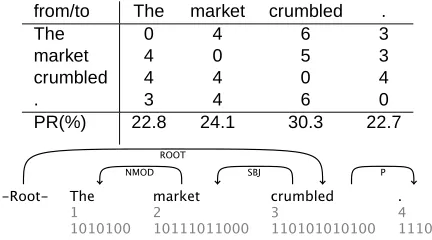
In Figure 1, we see an example graph of word nodes, represented as a matrix, and a derived dependency structure.4 We see that there are four edges from The to market and six from The to crumbles, for example. We then compute the PageRank of each node using the algorithm described in Page and Brin (1998); see also Figure 1. The PageRank val-ues rank the nodes or the words. In Sect. 3, we de-scribe a method for building a dependency tree from
4
The dependency structure in Figure 1 contains dependency labels such as ’SBJ’ and ’ROOT’. These are just included for readability. We follow the literature on unsupervised depen-dency parsing and focus only on unlabeled dependepen-dency parsing.
from/to The market crumbled .
The 0 4 6 3
market 4 0 5 3
crumbled 4 4 0 4
. 3 4 6 0
[image:5.612.315.531.52.172.2]PR(%) 22.8 24.1 30.3 22.7
Figure 1: Graph, pagerank (PR) and predicted depen-dency structure for sentence 5, PTB-III Sect. 23.
a ranking of the nodes. This method will produce the correct analysis of this sentence; see Figure 1. This is because the PageRank scores reflect syntac-tic superiority; the root of the sentence typically has the highest rank, and the least important nodes are ranked lowly.
3 From ranking of nodes to dependency trees
Consider the example in Figure 1 again. Once we have ranked the nodes in our dependency structure, we build a dependency structure from it using the parsing algorithm in Figure 2. The input of the graph is a list of ranked wordsπ = hn1, . . . , nmi, where each nodeni corresponds to a sentence posi-tionnpr2ind(i)decorated by a word form wpr2ind(i),
where pr2ind : {1, . . . , m} → {1, . . . , m} is a mapping from rank to sentence position.
The interesting step in the algorithm is the head selection step. Each word is assigned a head taken from all the previously used heads and the word to which a head was just assigned. Of these words, we simply select the closest head. If two possible heads are equally close, we select the one with high-est PageRank.
1: π=hn1, . . . , nmi# the ranking of nodes
2: H=hn0i# possible heads 3: D=∅# dependency structure
4: pr2ind :{1, . . . , m} → {1, . . . , m}# a mapping from rank to sentence position
5: forni ∈πdo
6: if|H|=1 then
7: c= 0# used to ensure single-headedness
8: else
9: c= 1 10: end if
11: nj′ = arg minnj∈H[c:]|pr2ind(i)−pr2ind(j)|# select head ofwj
12: H=ni∪H# makenia possible head
13: D={(wpr2ind(i)←wpr2ind(j′))} ∪D# add new edge toD
14: end for
15: return D
Figure 2: Parsing algorithm.
the fact that each node is assigned a head (line 11). Furthermore, the dependency tree must be acyclic. This follows immediately from the fact that a word can only attach to a word with higher rank than it-self. Connectivity follows from the fact that there is an artificial root node and that all words attach to this node or to nodes dominated by the root node. Finally, we ensure single-headedness by explicitly disregarding the root node once we have attached the node with highest rank to it (line 6–7). Our parsing algorithm does not guarantee projectivity, since the iterative graph-based ranking of nodes can permute the nodes in any order.
4 Experiments
We use exactly the same experimental set-up as Gillenwater et al. (2010). The edge model was developed on development data from the English Penn-III treebank (Marcus et al., 1993), and we eval-uate on Sect. 23 of the English treebanks and the test sections of the remaining 11 treebanks, which were all used in the CoNLL-X Shared Task (Buchholz and Marsi, 2006). Gillenwater et al. (2010) for some reason did not evaluate on the Arabic and Chinese treebanks also used in the shared task. We also fol-low Gillenwater et al. (2010) in only evaluating our parser on sentences of at most 10 non-punctuation words and in reporting unlabeled attachment scores excluding punctuation.
4.1 Strictly unsupervised dependency parsing
We first evaluate the strictly unsupervised parsing model that has no access to POS information. Since we are not aware of other work in strictly unsuper-vised multi-lingual dependency parsing, so we com-pare against the best structural baseline (left-attach or right-attach) and the standard DMV-EM model of Klein and Manning (2004). The latter, however, has access to POS information and should not be thought of as a baseline. Results are presented in Figure 3.
It is interesting that we actually outperform DMV-EM on some languages. On average our scores are significantly better (p < 0.01) than the best struc-tural baselines (3.8%), but DMV-EM with POS tags is still 3.0% better than our strictly unsupervised model. For English, our system performs a lot worse than Seginer (2007).
4.2 Unsupervised dependency parsing (standard)
pro-baseline EM ours Bulgarian 37.7 37.8 41.9
Czech 32.5 29.6 28.7
Danish 43.7 47.2 43.7
Dutch 38.7 37.1 33.1
English 33.9 45.8 36.1 German 27.2 35.7 36.9 Japanese 44.7 52.8 56.5 Portuguese 35.5 35.7 35.2 Slovene 25.5 42.3 30.0 Spanish 27.0 45.8 38.4 Swedish 30.6 39.4 34.5 Turkish 36.6 46.8 45.9
[image:7.612.103.264.51.222.2]AV 34.5 41.3 38.3
Figure 3: Unlabeled attachment scores (in %) on raw text. (EM baseline has access to POS.)
posal we are aware of that departs significantly from the DMV model. The results are presented in Fig-ure 4.
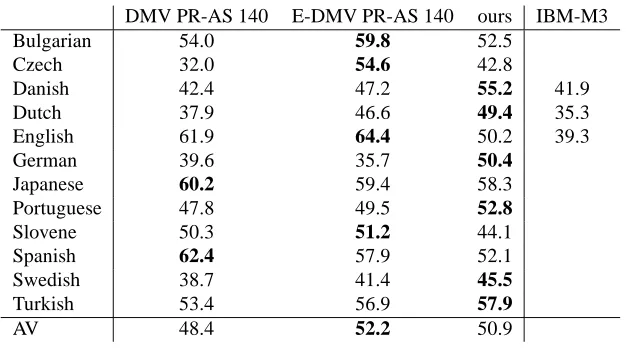
Our results are on average significantly better than DMV PR-AS 140 (2.5%), and better than DMV PR-AS 140 on 8/12 languages. E-DMV PR-PR-AS 140 is slightly better than our model on average (1.3%), but we still obtain better results on 6/12 languages. Our results are a lot better than IBM-M3. Naseem et al. (2010) report better results than ours on Por-tuguese, Slovene, Spanish and Swedish, but worse on Danish.
5 Error analysis
In our error analysis, we focus on the results for German and Turkish. We first compare the results of the strictly unsupervised model on German with the results on German text annotated with POS. The main difference between the two models is that more links to verbs are added to the sentence graph prior to ranking nodes when parsing text annotated with POS. For this reason, the latter model improves con-siderably in attaching verbs compared to the strictly unsupervised model:
acc strict-unsup unsup
NN 43% 48%
NE 41% 39%
VVFIN 31% 100%
VAFIN 9% 86%
VVPP 13% 53%
While the strictly unsupervised model is about as
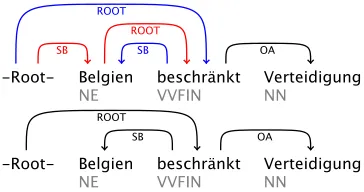
Figure 5: Predicted dependency structures for sentence 4 in the German test section; strictly unsupervised (above) and standard (below) approach. Red arcs show wrong decisions.
good at attaching nouns as the model with POS, it is much worse attaching verbs. Since more links to verbs are added, verbs receive higher rank, and this improves f-scores for attachments to the artifi-cial root node:
f-score strict-unsup unsup to root 39.5% 74.0%
1 62.3% 69.6%
2 7.4% 24.4%
3–6 0 22.4%
7 0 0
This is also what helps the model with POS when parsing the example sentence in Figure 5. The POS-informed parser also predicts longer dependencies.
The same pattern is observed in the Turkish data, but perhaps less dramatically so:
acc strict-unsup unsup
Noun 43% 42%
Verb 41% 51%
The increase in accuracy is again higher with verbs than with nouns, but the error reduction was higher for German.
f-score strict-unsup unsup to root 57.4% 90.4%
1 65.7% 69.6%
2 32.1% 26.5%
3–6 11.6% 24.7%
7 0 12.5%
The parsers predict more long dependencies for Turkish than for German; precision is generally good, but recall is very low.
6 Conclusion
[image:7.612.333.515.52.148.2]depen-DMV PR-AS 140 E-DMV PR-AS 140 ours IBM-M3
Bulgarian 54.0 59.8 52.5
Czech 32.0 54.6 42.8
Danish 42.4 47.2 55.2 41.9
Dutch 37.9 46.6 49.4 35.3
English 61.9 64.4 50.2 39.3
German 39.6 35.7 50.4
Japanese 60.2 59.4 58.3
Portuguese 47.8 49.5 52.8
Slovene 50.3 51.2 44.1
Spanish 62.4 57.9 52.1
Swedish 38.7 41.4 45.5
Turkish 53.4 56.9 57.9
[image:8.612.148.463.50.224.2]AV 48.4 52.2 50.9
Figure 4: Unlabeled attachment scores (in %) on text annotated with POS.
dency structure also expresses centrality or saliency, so by modeling centrality directly, we obtain infor-mation that we can use to build dependency struc-tures. Our unsupervised dependency parser thus works in two stages; it first uses iterative graph-based ranking to rank words in terms of central-ity and then constructs a dependency tree from the ranking. Our parser was shown to be competitive to state-of-the-art unsupervised dependency parsers.
References
Eneko Agirre and Aitor Soroa. 2009. Personalizing pagerank for word sense disambiguation. In EACL. Samuel Brody. 2010. It depends on the translation:
un-supervised dependency parsing via word alignment. In EMNLP.
Sabine Buchholz and Erwin Marsi. 2006. CoNLL-X shared task on multilingual dependency parsing. In CoNLL.
Shay Cohen, Kevin Gimpel, and Noah Smith. 2008. Un-supervised bayesian parameter estimation for depen-dency parsing. In NIPS.
Gregory Druck, Gideon Mann, and Andrew McCal-lum. 2009. Semi-supervised learning of dependency parsers using generalized expectation criteria. In ACL-IJCNLP.
Jason Eisner and Noah A. Smith. 2005. Parsing with soft and hard constraints on dependency length. In IWPT. K Ganesan, C Zhai, and J Han. 2010. Opinosis: a
graph-based approach to abstractive summarization of highly redudant opinions. In COLING.
Jennifer Gillenwater, Kuzman Ganchev, Joao Graca, Fer-nando Pereira, and Ben Taskar. 2010. Sparsity in de-pendency grammar induction. In ACL.
Dan Klein and Christopher Manning. 2004. Corpus-based induction of syntactic structure: models of de-pendency and constituency. In ACL.
Mitchell Marcus, Mary Marcinkiewicz, and Beatrice Santorini. 1993. Building a large annotated corpus of English: the Penn Treebank. Computational Lin-guistics, 19(2):313–330.
Ryan McDonald, Fernando Pereira, Kiril Ribarov, and Jan Hajiˇc. 2005. Non-projective dependency parsing using spanning tree algorithms. In HLT-EMNLP. Rada Mihalcea and Paul Tarau. 2004. Textrank: bringing
order into texts. In EMNLP.
Tahira Naseem, Harr Chen, Regina Barzilay, and Mark Johnson. 2010. Using universal linguistic knowledge to guide grammar induction. In EMNLP.
Joakim Nivre. 2009. Non-projective dependency parsing in expected linear time. In ACL-IJCNLP.
Larry Page and Sergey Brin. 1998. The anatomy of a large-scale hypertextual web search engine. In Inter-national Web Conference.
Yoav Seginer. 2007. Fast unsupervised incremental pars-ing. In ACL.
Noah Smith and Jason Eisner. 2005. Contrastive estima-tion: training log-linear models on unlabeled data. In ACL.
Noah Smith and Jason Eisner. 2006. Annealing struc-tural bias in multilingual weighted grammar induction. In COLING-ACL.
David Smith and Jason Eisner. 2009. Parser adaptation and projection with quasi-synchronous grammar fea-tures. In EMNLP.
Valentin Spitkovsky, Hiyan Alshawi, Daniel Jurafsky, and Christopher Manning. 2010. Viterbi training im-proves unsupervised dependency parsing. In CoNNL. Kathrin Spreyer, Lilja Øvrelid, and Jonas Kuhn. 2010.