A SOLVENT-FREE AND
FORMALIN-FREE ESCHWEILER-CLARKE
METHYLATION FOR AMINES
Thomas Rosenau,1 Antje Potthast,1 Ju¨rgen Ro¨hrling,1 Andreas Hofinger,1 Herbert Sixta,2 and Paul Kosma1,*
1
Institute of Chemistry, Christian-Doppler-Laboratory, University of Agricultural Sciences, Vienna,
Muthgasse 18, A – 1190 Vienna, Austria 2
R&D Lenzing AG, A – 4860 Lenzing, Austria
ABSTRACT
Primary and secondary amines areN-methylated by a mixture of paraformaldehyde and oxalic acid dihydrate in good to excellent yields. The reaction proceeds without involvement of organic solvents and toxic formalin. Reaction temperatures of 100C are required for the decomposition of oxalic acid into the intermediate formic acid which acts as the actual reductant. The reaction conditions have been optimized, and the mechanism has been elucidated by means of deuteration experiments.
457
Copyright&2002 by Marcel Dekker, Inc. www.dekker.com
INTRODUCTION
N-Methylation of nucleophilic nitrogen in amines is a common procedure in both lab-scale and bulk-scale organic synthesis. The use of alkylating agents, such as methyl iodide or methyl tosylate, has often the disadvantage of competing quaternization of the amine, so that the Eschweiler-Clarke methylation procedure1,2 is applied instead. This approach, in principle a variant of the well-knownLeuckart-Wallach reac-tion,3,4 uses aqueous formaldehyde solution (formalin) together with con-centrated formic acid. TheN-methylation is effected in two steps: formation of N-(methylene)iminium cation intermediates via the N-hydroxymethyl derivatives, and subsequent reduction by formic acid, which is oxidized to carbon dioxide in turn.
Practical application of the Eschweiler-Clarke methylation follows a well-established protocol that ensures its wide applicability. In this paper, a
N-methylation approach is presented, which differs from the conventional practice and includes some distinct improvements over the existing method-ology in terms of simplicity of the work-up and use of hazardous chemicals: The use of toxic formaldehyde and organic solvents is avoided, and rather time-consuming and tedious purification steps, such as column chromato-graphy purification or steam distillation, which were hitherto required in most cases, are not required.
RESULTS AND DISCUSSION
During our investigations on deoxygenative demethylations of
N-methylmorpholine-N-oxide (1),5 we observed that N-methylmorpholine (2) was found in addition to the expected products morpholine (3) and formaldehyde (4), if traces of oxalic acid (5) were present. Increasing the amount of oxalic acid in the reaction mixture shifted the product distri-bution towards higher yields of N-methylmorpholine. This was evidently due to a reduction of intermediate N-(methylene)morpholinium cations (6), so that the formation mechanism resembled a Leuckart-Wallach reac-tion. This result was intriguing insofar as oxalic acid is well-known as a reductant, but not as a cryptobase or hydride transfer reagent6as needed for these reductions to proceed.
of formalin provided a distinct improvement. The yields were significantly increased, so that further optimization towards synthetic usability seemed to be justified.
Finally, a clean methylation of secondary amines in yields above 90% was achieved with an equimolar ratio of secondary amine and paraform-aldehyde along with the fivefold molar amount of oxalic acid dihydrate (5a) within one hour. The same good result was obtained for the bismethylation of primary amines, now employing amine, 4a and 5a in the molar ratio 1 : 2 : 10. Carried out at 100–120C, the reaction is a solvent-free process that proceeds in the molten state. The formaldehyde required is generated
in situfrom paraformaldehyde by thermal or acid-catalyzed decomposition. The primary product obtained is the corresponding ammonium oxa-late. The free base can be conveniently obtained by treatment of the product mixture with aqueous calcium hydroxide followed by extraction, or by treatment with a suspension of calcium oxide in ethyl acetate or ethanol. One advantage of the presentedN-methylation procedure is the purity of the amine obtained which is indicative of an almost complete absence of side reactions. No quaternization of the amines was observed.
due to condensation processes. The molar ratio of amine and 4a was conse-quently kept constant at 1/1 throughout the experiments.
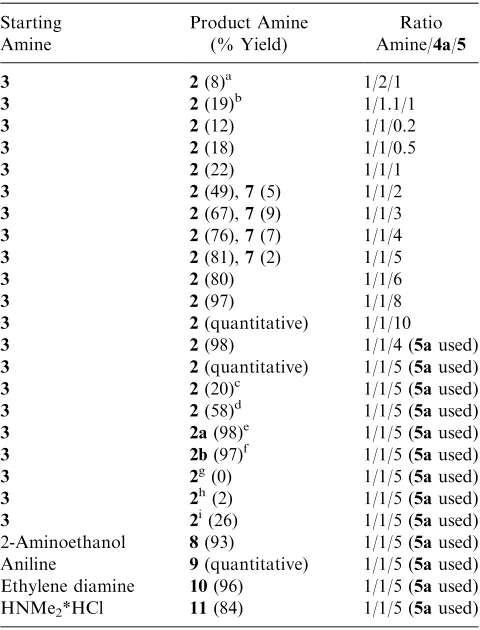
The stoichiometric amount of oxalic acid (5) employed proved to be a crucial issue in terms of conversion of the starting material and purity of the methylated product. At a ratio below 1, relative to the amine 3 and para-formaldehyde (4a), mainly unreacted starting amine besides small amounts of the methylated amine were found. Formation of byproducts was not observed. At increasing ratios up to 5, the product yield increased accord-ingly up to about 80%. Interestaccord-ingly, small amounts (<10%) ofN -formyl-morpholine (7) were found, traces of several unidentified reaction products, in sum less than 3%, were also detected. The highest yield of byproduct 7 was obtained at a molar ratio 3/4a/5¼1/1/3. The occurrence of such for-mylated compounds is a strong indication of the intermediate occurrence of formic acid from the decomposition of oxalic acid. This is in complete agreement with experimental and theoretical studies on the thermal decom-position of oxalic acid.7,8
Experimental studies have firmly established that the major decompo-sition products of pure oxalic acid over the temperature range 400–430 K are equimolar quantities of formic acid and carbon dioxide7if other reaction routes, such as metal ion catalysis, catalysis by strong acids or decomposi-tion at the walls of the reacdecomposi-tion vessel, which lead to formadecomposi-tion of equimolar amounts of CO2, CO and water, can be excluded. High-level quantum mechanical calculations8indicate that this reaction is a bimolecular process: in a first step oxalic acid fragments into carbon dioxide and dihydroxy-carbene. In the rate determining step dihydroxycarbene reacts with oxalic acid or water to be rearranged to formic acid. The unimolecular channel to produce CO2, CO and water becomes more prominent only with increasing temperature. At higher molar ratios, above 5, formation of both7and trace byproducts was completely suppressed, but up to an eightfold excess of 5 conversion of 3 to the product was incomplete. A ratio of 1/1/10 reliably allowed for a complete consumption of starting amine and neatN -methyla-tion in quantitative or nearly-quantitative yields.
Both oxalic acid (dihydrate) and paraformaldehyde are required to causeN-methylation of the amines, only one single component shows no effect. Paraformaldehyde proved to be inert towards the amine under the applied reaction conditions. However, upon prolonged reaction times a
Table 1. Products and Reaction Conditions
Starting Amine
Product Amine (% Yield)
Ratio Amine/4a/5
3 2(8)a 1/2/1
3 2(19)b 1/1.1/1
3 2(12) 1/1/0.2
3 2(18) 1/1/0.5
3 2(22) 1/1/1
3 2(49),7(5) 1/1/2
3 2(67),7(9) 1/1/3
3 2(76),7(7) 1/1/4
3 2(81),7(2) 1/1/5
3 2(80) 1/1/6
3 2(97) 1/1/8
3 2(quantitative) 1/1/10
3 2(98) 1/1/4 (5aused)
3 2(quantitative) 1/1/5 (5aused)
3 2(20)c 1/1/5 (5aused)
3 2(58)d 1/1/5 (5aused)
3 2a(98)e 1/1/5 (5aused)
3 2b(97)f 1/1/5 (5aused)
3 2g(0) 1/1/5 (5aused)
3 2h(2) 1/1/5 (5aused)
3 2i(26) 1/1/5 (5aused) 2-Aminoethanol 8(93) 1/1/5 (5aused) Aniline 9(quantitative) 1/1/5 (5aused) Ethylene diamine 10(96) 1/1/5 (5aused) HNMe2*HCl 11(84) 1/1/5 (5aused)
aDiscoloration, complex mixture. b
Discoloration, byproducts.
cReaction temperature 60C.
d
Reaction temperature 80C.
e
Deuterated oxalic acid dihydrate ((COOD)2*2D2O) was used. f
Deuterated paraformaldehyde ((CD2O)n) was used. g
Oxalic acid diethylester.
hOxalic acid diethylesterþ2H 2O. i
gradually increasing formation of chromophoric condensation products was observed. Oxalic acid and amine produced the corresponding oxalate with-out further reactions.
By addition ofa-tocopherol org-tocopherol, respectively, to the reac-tion mixture it was shown that the formareac-tion of theN-methylated products does not proceed according to a free radical process. Typical dimeric coup-ling products of the tocopherols, which are a sensitive indicator of homo-lytic processes,9,10 were not observed. The absence of those coupling products in the reaction mixture allowed to reliably rule out the occurrence of homolytic reactions during theN-methylation.
To establish the reaction mechanism, cross deuteration experiments were employed. With deuterated oxalic acid dihydrate (5a-D) and para-formaldehyde (4a), neat N-(monodeuteromethyl)morpholine (2a) was obtained. Using perdeuterated paraformaldehyde (4a-D) and 5a, isotopi-cally pureN-(dideuteromethyl)morpholine (2b) was produced, a 1/1 mixture of 4a and 4a-D together with 5a afforded a 1/1 mixture of 2 and 2b. Interestingly, the system oxalic acid dihydrate/paraformaldehyde does not cause proton exchange at the methylene positions of HCHO, and can thus be used for selective monodeutero-, bisdeutero-, or trideuteromethylation. This constitutes an interesting synthetic application of the novel reaction system, since in the system formic acid/formalin, conventionally used in
Eschweiler-Clarke procedures, the isotopic integrity of HCHO is impaired, so that selective monodeuteromethylation or bisdeuteromethylation with this system was hitherto difficult.
The labeling experiments demonstrated that the N-methylation reac-tion proceeds via transfer of hydrogen to an intermediate which is formed by the reaction between amine and formaldehyde, probably the
With diethyl oxalate being used instead of oxalic acid dihydrate, no reaction was observed. The same result was obtained with a mixture of diethyl oxalate and two equivalents of water. This outcome proves the role of oxalic acid dihydrate in the reaction system as both acidic catalyst and hydrogen donor. With diethyl oxalate instead of5aand amine hydro-chloride instead of the free base, the methylated product was produced at rather low yield, indicating that the ester had been partly hydrolyzed to oxalic acid which acted as the reductant in turn.
EXPERIMENTAL
1
H NMR spectra were recorded at 300 MHz, 13C NMR spectra at 75.47 MHz, with CDCl3 as the solvent and TMS as the internal standard for amines, and D2O as the solvent with DSS as the internal standard for aminium hydrochlorides.13C peaks were assigned by means of HMQC and HMBC spectra. Chemical shift values are given in ppm. Chemicals were obtained from commercial sources or synthesized according to standard procedures. Even though theN-methylamines obtained are standard sub-stances, their NMR data are listed in the following since literature values11,12 are inconsistent and difficult to compare.
General Procedure for the Methylation of Primary or Secondary Amines
A flask was charged with primary amine (10 mmol), paraformaldehyde (4a, 20 mmol) and oxalic acid dihydrate (5a, 0.1 mol) and briefly flushed with nitrogen. In the case of secondary amines, 10 mmol of 4a and 50 mmol of 5a were used. For amines with multiple amino functions, 10 mmol of 4a and 50 mmol of 5a were applied per methyl group to be introduced. The vessel was closed and heated to 100C for 1 h, and to 120C for 10 min. The reaction mixture was cooled to room temperature. The white, crystalline mass obtained was crushed, and calcium oxide (0.1 mol) suspended in 50 ml of ethanol was added. The mixture was stirred vigorously for 30 min, solids were removed by filtration, and the solvent was removedin vacuoto produce the pure amine.
added. The resulting precipitate, the corresponding aminium hydrochloride, was separated by filtration, washed with ethyl acetate (5 ml) and liberated from residual solventin vacuo.
N-Methylmorpholine (2). M¼101.14 g/mol, yield: 1.02 g (100%). 1
H NM R:d2.27 (s, 3H,N-CH3), 2.39 (t, 4H,N-CH2), 3.70 (t, 4H,O-CH2).
N-(Monodeuteromethyl)morpholine (2a). M¼102.15 g/mol, yield: 1.00 g (98%).1H NM R (D2O):d2.90 (t, 1H,N-CDH2), 3.21 (dt, 2H), 3.49 (dd, 2H), 3.82 (dt, 2H), 4.12 (dd, 2H). 13C NM R: d 43.6 (t, N-CDH2,
J¼21.9 Hz), 53.6 (N-CH2), 64.3 (O-CH2).
N-(Bisdeuteromethyl)morpholine (2b). M¼103.16 g/mol, yield: 1.00 g (97%). 1H NM R (D2O):d 2.92 (t, 1H, N-CD2H), 3.20 (dt, 2H), 3.49 (dd, 2H), 3.80 (dt, 2H), 4.12 (dd, 2H). 13C NM R: d 43.6 (pentett, N-CD2H,
J¼21.9 Hz), 54.0 (N-CH2), 64.7 (O-CH2).
2-(Dimethylamino)-ethanol (8). M¼89.13 g/mol, yield: 0.83 g (93%). 1
H NM R:d2.27 (s, 6H,N-(CH3)2), 2.46 (t, 2H,J¼5.4 Hz,N-CH2), 3.61 (t, 2H,J¼5.4 Hz,O-CH2).13C NM R: d 45.6 (N-(CH3)2), 58.5 (N-CH2), 61.2 (O-CH2).
N,N-Dimethylaniline (9). M¼121.18 g/mol, yield: 1.22 g (100%). 1
H NM R: d 2.93 (s, 6H, N-(CH3)2), 6.63 (m, 3H, ArCH), 7.24 (m, 2H, Ar
CH). 13C NM R: d 41.0 (N-CH3), 113.1 (C2, C6), 117.1 (C4), 129.5 (C3, C5), 151.1 (C1).
N,N,N0,N0-Tetramethylethylene diamine (10). M¼116.20 g/mol, yield: 1.11 g (96%). 1H NM R: d 2.18 (s, 12H, N-(CH3)2), 2.36 (s, 4H, N-CH2). 13
C NM R:d 41.2 (N-(CH3)2), 57.7 (N-CH2).
Trimethylamine hydrochloride (11). M¼95.57 g/mol, yield: 0.80 g (84%).1H NM R (D2O):d2.88 (s, 9H,N-(CH3)3).13C NM R:d 42.4.
CONCLUSION
A mixture of paraformaldehyde and oxalic acid dihydrate in the molar ratio 1/5 can be used for neat N-methylation of primary or secondary amines, paraformaldehyde and amine must be employed in equimolar ratios. As the reaction proceeds in the molten state, reaction temperatures of 100–120C must be applied. No solvents are required, the toxic formalin and concentrated formic acid, as used in the conventional
paraformaldehyde or deuterated oxalic acid a selective N -bisdeutero-methylation, respectivelyN-monodeuteromethylation, of amines is possible which could not be accomplished by the traditional Eschweiler-Clarke
procedures.
ACKNOWLEDGMENT
The authors are grateful to the Christian-Doppler-Forschungsge-sellschaft, Vienna, Austria, and to Lenzing AG, Lenzing, Austria, for financial support.
REFERENCES
1. Eschweiler, W. Ersatz von an Stickstoff gebundenen Wasserstoffato-men durch die Methylgruppe mit Hu¨lfe von Formaldehyd. Chem. Ber. 1905,38, 880–892.
2. Clarke, H.T.; Gillespie, H.B.; Weisshaus, S.Z. The action of formaldehyde on amines and amino acids. J. Am. Chem. Soc. 1933,
55, 4571–4587.
3. Leuckardt, R. Ueber eine neue Bildungsweise von Tribenzylamin. Ber. Dtsch. Chem. Ges. 1885,18, 2341–2344.
4. Lukasiewicz, A. Reduction of Schiff bases by formic acid. Tetrahedron 1963,19, 1789–1799.
5. Rosenau, T.; Potthast, A.; Kosma, P.; Chen, C.L.; Gratzl, J.S. Autocatalytic decomposition ofN-methylmorpholine-N-oxide induced byMannichintermediates. J. Org. Chem.1999,64, 2166–2167. 6. Holleman, A.E.; Wiberg, N. XIII. Die Gruppe der Halogene. In
Lehrbuch der anorganischen Chemie; 91–100 Ed., De Gruyter: Berlin, New York, 1985, pp. 439, 657.
7. Lapidus, G.; Barton, D.; Yankwich, P.E. J. Kinetics and stoichiometry of the gas-phase decomposition of oxalic acid. Phys. Chem. 1964,68, 1863–1865. Lapidus, G.; Barton, D.; Yankwich, P.E.J. Reversing hydrogen isotope effects on the rate of the gas-phase decomposition of oxalic acid. Phys. Chem. 1966,70, 407–411. Lapidus, G.; Barton, D.; Yankwich, P.E.J. Intramolecular kinetic carbon isotope effect in the gas-phase decomposition of deuteriooxalic acid. Phys. Chem.1966,
8. Higgins, J.; Zhou, X.; Liu, R.; Huang, T.T.S.J. Theoretical study of thermal decomposition mechanism of oxalic acid. Phys. Chem. A1997,
101, 2702–2708.
9. Machlin, L.J. Vitamin E: A Comprehensive Treatise, Marcel Dekker Inc.: New York, 1980.
10. Niki, E.; Matsuo, M. Peroxyl radical trapping reactions of a -toco-pherol in biomimetic systems. In Vitamin E in Health and Diseases; Packer, L.; Fuchs, J., Eds.; Marcel Dekker Inc.: New York, 1993. 11. Pouchert, C.J.; Behnke, J.The Aldrich Library of13C and1H FT NMR
Spectra; 1st Ed.; Aldrich Chemical Company Inc., 1993, 1.597A, 1.597C, 1.1250C.
12. Kalinowski, H.O.; Berger, S.; Braun, S. 13C-NMR-Spektroskopie, Thieme: Stuttgart, New York, 1984, 318.