Strategy and Policy Learning for Non-Task-Oriented Conversational
Systems
Zhou Yu, Ziyu Xu, Alan W Black and Alex I. Rudnicky School of Computer Science
Carnegie Mellon University
{zhouyu,awb,air}@cs.cmu.edu, [email protected]
Abstract
We propose a set of generic conversa-tional strategies to handle possible sys-tem breakdowns in non-task-oriented di-alog systems. We also design policies to select these strategies according to dialog context. We combine expert knowledge and the statistical findings derived from data in designing these policies. The pol-icy learned via reinforcement learning out-performs the random selection policy and the locally greedy policy in both simu-lated and real-world settings. In addition, we propose three metrics for conversation quality evaluation which consider both the local and global quality of the conversa-tion.
1 Introduction
Non-task-oriented conversational systems do not have a stated goal to work towards. Nevertheless, they are useful for many purposes, such as keep-ing elderly people company and helpkeep-ing second language learners improve conversation and com-munication skills. More importantly, they can be combined with task-oriented systems to act as a transition smoother or a rapport builder for com-plex tasks that require user cooperation. There are a variety of methods to generate responses for non-task-oriented systems, such as machine translation (Ritter et al., 2011), retrieval-based response se-lection (Banchs and Li, 2012), and sequence-to-sequence recurrent neural network (Vinyals and Le, 2015). However, these systems still pro-duce utterances that are incoherent or inappropri-ate from time to time. To tackle this problem, we propose a set of conversational strategies, such as switching topics, to avoid possible inappropriate responses (breakdowns). After we have a set of strategies, which strategy to perform according to
the conversational context is another critical prob-lem to tackle. In a multi-turn conversation, the user experience will be affected if the same strat-egy is used repeatedly. We experimented on three policies to control which strategy to use given the context: a random selection policy that randomly selects a policy regardless of the context, a locally greedy policy that focuses on local context, and a reinforcement learning policy that considers con-versation quality both locally and globally. The strategies and policies are applicable for non-task-oriented systems in general. The strategies can prevent a possible breakdown, and the probabil-ity of possible breakdowns can be calculated using different metrics according to different systems. For example, a neural network generation system (Vinyals and Le, 2015) can use the posterior prob-ability to decide if the generated utterance is pos-sibly causing a breakdown, thus replacing it with a designed strategy. In this paper, we implemented the strategies and policies in a keyword retrieval-based non-task-oriented system. We used the re-trieval confidence as the criteria to decide whether a strategy needed to be triggered or not.
Reinforcement learning was introduced to the dialog community two decades ago (Biermann and Long, 1996) and has mainly been used in task-oriented systems (Singh et al., 1999). Re-searchers have proposed to design dialogue sys-tems in the formalism of Markov decision pro-cesses (MDPs) (Levin et al., 1997) or partially observable Markov decision processes (POMDPs) (Williams and Young, 2007). In a stochastic envi-ronment, a dialog system’s actions are system ut-terances, and the state is represented by the dialog history. The goal is to design a dialog system that takes actions to maximize some measure of sys-tem reward, such as task completion rate or dia-log length. The difficulty of such modeling lies in the state representation. Representing the dialog by the entire history is often neither feasible nor
conceptually useful, and the so-called belief state approach is not possible, since we do not even know what features are required to represent the belief state. Previous work (Walker et al., 1998) has largely dealt with this issue by imposing prior limitations on the features used to represent the ap-proximate state. In this paper, instead of focus-ing on task-oriented systems, we apply reinforce-ment learning to design a policy to select designed conversation strategies in a non-task-oriented di-alog systems. Unlike task-oriented didi-alog sys-tems, non-task-oriented systems have no specific goal that guides the interaction. Consequently, evaluation metrics that are traditionally used for reward design, such as task completion rate, are no longer appropriate. The state design in rein-forcement learning is even more difficult for non-task-oriented systems, as the same conversation would not occur more than once; one slightly dif-ferent answer would lead to a completely difdif-ferent conversation; moreover there is no clear sense of when such a conversation is “complete”. We sim-plify the state design by introducing expert knowl-edge, such as not repeating the same strategy in a row, as well as statistics obtained from conversa-tional data analysis.
We implemented and deployed a non-task-oriented dialog system driven by a statistical pol-icy to avoid possible system breakdowns using de-signed general conversation strategies. We evalu-ated the system on the Amazon Mechanical Turk platform with metrics that consider both the local and the global quality of the conversation. In ad-dition, we also published the system source code and the collected conversations1.
2 Related Work
Many generic conversational strategies have been proposed in previous work to avoid generating in-coherent utterances in non-task-oriented conversa-tions, such as introducing new topics (e.g. “Let’s talk about favorite foods!” ) in (Higashinaka et al., 2014), asking the user to explain missing words (e.g. “What is SIGDIAL?”) (Maria Schmidt and Waibel, 2015). In this paper, we propose a set of generic strategies that are inspired by previous work, and test their usability on human users. No researcher has investigated thoroughly on which strategy to use in different conversational contexts. Compared to task-oriented dialog systems,
non-1www.cmuticktock.org
task-oriented systems have more varied conversa-tion history, which are thus harder to formulate as a mathematical problem. In this work, we pro-pose a method to use statistical findings in con-versational study to constrain the dialog history space and to use reinforcement learning for sta-tistical policy learning in a non-task-oriented con-versation setting.
To date, reinforcement learning is mainly used for learning dialogue policies for slot-filling task-oriented applications such as bus information search (Lee and Eskenazi, 2012), restaurant rec-ommendations (Jurˇc´ıˇcek et al., 2012), and sight-seeing recommendations (Misu et al., 2010). Re-inforcement learning is also used for some more complex systems, such as learning negotiation policies (Georgila and Traum, 2011) and tutoring (Chi et al., 2011). Reinforcement learning is also used in question-answering systems (Misu et al., 2012). Question-answering systems are very sim-ilar to non-task-oriented systems except that they do not consider dialog context in generating re-sponses. They have pre-existing questions that the user is expected to go through, which limits the content space of the dialog. Reinforcement learn-ing has also been applied to a non-task-oriented system for deciding which sub-system to choose to generate a system utterance (Shibata et al., 2014). In this paper, we used reinforcement learning to learn a policy to sequentially decide which con-versational strategy to use to avoid possible system breakdowns.
gainis automatically quantifiable. We use super-vised machine learning methods to built automatic detectors forturn level appropriatenessand con-versational depth. All three of the metrics are gen-eral enough to be applied to any non-task-oriented system.
3 Conversational Strategy Design
We implemented ten strategies in total for re-sponse generation. The system only selects among Strategy 1-5 if their trigger conditions are meet. If more than one strategy is eligible, the system selects the higher ranked strategy. The rank of the strategies, shown in the following list, is de-termined via expert knowledge. The system only selects among Strategy 6-10 if Strategy 1-5 can-not be selected. This rule reduces the design space of all policies. We design three different versions of the surface form for each strategy, so the user would get a slightly different version every time, thus making the system seem less robotic.
We implemented these strategies in TickTock (Yu et al., 2015). TickTock is a non-task-oriented dialog system that takes typed text as the input and produces text as output. It performs anaphora detection and candidate re-ranking with respect to history similarity to track conversation history. For a detailed system description, please refer to (Yu et al., 2016). This version of TickTock took the form of a web-API, which we put on Amazon Mechanical Turk platform to collect data from a large number of users. The system starts the con-versation by proposing a topic to discuss. The topic is randomly selected from five designed top-ics: movies, music, politics, sports and board games. We track the topic of the conversation throughout the interaction. Each conversation has more than 10 turns. Table 1 is an example conver-sation of TickTock talking with a human user. We describe the ten strategies with their ranking order in the following.
1. Match Response(continue): In a keyword-based system, the retrieval confidence is the weighted score of all the matching keywords from the user input and the chosen utterance from the database. When the retrieval con-fidence score is higher than a threshold (0.3 in our experiment), we use the retrieved re-sponse as the system’s output. If the system is a sequence-to-sequence neural networks sys-tem, then we select the output of the system
when the posterior probability of the gener-ated response is higher than a certain thresh-old.
2. Don’t Repeat (no repeat): When users re-peat themselves, the system confronts them by saying:“You already said that!”.
3. Ground on Named Entities(named entity) A lot of raters assume that TickTock can answer factual questions, so they ask ques-tions such as “Which state is Chicago in?” and “Are you voting for Clinton?”. We use the Wikipedia knowledge base API to tackle such questions. We first perform a shallow parsing to find the named entity in the sen-tence, and then we search the named entity in a knowledge base, and retrieve the cor-responding short description of it. Finally we design several templates to generate sen-tences using the obtained short description of the named entity. The resulting output can be “Are you talking about the city in Illi-nois?” and “Are you talking about Bill Clin-ton, the 42rd president of the United States, or Hillary Clinton, a candidate for the Demo-cratic presidential nomination in the 2016 election?”. This strategy is considered one type of grounding strategy in human conver-sations. Users feel like they are understood when this strategy is triggered correctly. In addition, we make sure we never ground the same named-entity twice in single conversa-tion.
4. Ground on Out of Vocabulary Words(oov) If we find that the user utterance contains a word that is out of our vocabulary, such as “confrontational”. Then TickTock will ask: “What is confrontational?”. We expand our vocabulary with the new user-defined words continuously, so we will not ask for ground-ing on the same word twice.
5. React to Single-word Sentence (short an-swer) We found that some users type in meaningless single words such as ‘d’, ‘dd’, or equations such as ‘1+2=’. TickTock will reply: “Can you be serious and say things in a complete sentence?” to deal with such con-dition.
as “sports” or “music”. For example: “Let’s talk about sports.” If this strategy is executed, we will update the tracked topic to the new topic introduced.
7. Initiate Activities (initiation) TickTock in-vites the user to do an activity together. Each invitation is designed to match the topic of the current conversation. For example, the system would ask: “Do you want to see the latest Star Wars movie together?” when it is talking about movies with a user.
8. End topics with an open question (end): TickTock closes the current topic and asks an open question, such as “ Sorry I don’t know. Could you tell me something interesting?”.
9. Tell A Joke(joke): TickTock tells a joke such as: “Politicians and diapers have one thing in common. They should both be changed reg-ularly, and for the same reason”. The jokes are designed with respect to different topics as well. The example joke is related to the topic “politics”.
10. Elicit More Information(more): TickTock asks the user to say more about the current topic, using utterances such as “ Could we talk more about that?”.
4 Strategy Design
As a baseline policy, we use a random selection policy that randomly chooses among Strategies 6-10 whenever Strategies 1-5 are not applicable. In the conversations collected using the baseline, we found that the sentiment polarity of the utterance has an influence on which strategy to select. Peo-ple tend to rate theswitchstrategy more favorably if there is negative sentiment in the previous utter-ances. For example:
TickTock: Hello, I really like politics. Let’s talk about politics.
User: No, I don’t like politics. TickTock: Why is that? User: I just don’t like politics.
TickTock: OK, how about we talk about movies?
In another scenario, when all the previous three utterances are positive, the more strategy (e.g.
Do you want to talk more about that?) is pre-ferred over theswitchstrategy (e.g. Do you like movies?).
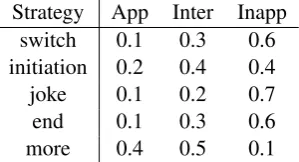
We set out to find the optimum strategy given the context which is the sentiment polarity of the previous three utterances. We found all the scenar-ios when Strategy 6-10 are triggered, then we gen-erate five different versions of the conversations by replacing the original used strategy with Strategies 6-10. We asked workers on Amazon Mechanical Turk to rate the strategy’s appropriateness given three previous utterances. For each conversation, we collected ratings from three different raters and used the majority vote as the final rating. Then we constructed a table of a distribution of the proba-bility of each strategy with respect to the context. We collected 10 ratings for each strategy under each context. We use the Vader (Hutto and Gilbert, 2014) sentiment predictor for automatic sentiment prediction. The output of the sentiment predictor is a label with three categories: positive (pos), neg-ative(neg) and neutral (neu).
Turn Participant TickTock
1 I am not sure. What’s on your mind? Well, you know, I’m not sure. Let me tell you something, politicians and diapers have one thing in common. They should both be changed regularly, and for the same reason. 2 Wow. That’s funny and insightful. Uhh, I can’t answer this. Can we talk about something
else?
3 How about movies. Have you seen any good movies? Of course. What do you think?
4 I love super hero movies. Have you seen Deadpool? Are you talking about Deadpool,the animation character? 5 Yes, exactly. They made a movie of him. That sounds really interesting.
Table 1: An example conversation with TickTock in the real-world setting
Turn A.L.I.C.E. TickTock
1 When do I do it? I don’t know.
2 That is interesting. Do you want to go to my friend’s party tonight? 3 Sure, just download me to your notebook or PDA and
take me along. Sounds great. Do you want to play board games togethersome time. 4 I like to play the Turing Game. I don’t know how to play it. Is it difficult to play? 5 Interesting gossip. It could be. Possibly.
Table 2: An example conversation of TickTock in the simulated setting
tested one condition: the previous three utterances are all positive. We provide the complete conver-sation history of that dialog to the raters. We found that strategies used most recently are rated less fa-vorably if used again. This motivates us to include information that relates to the previous strategy us-age and a longer history to design policy in the re-inforcement learning setting.
Strategy App Inter Inapp switch 0.1 0.3 0.6 initiation 0.2 0.4 0.4
joke 0.1 0.2 0.7
end 0.1 0.3 0.6
[image:5.595.107.257.429.510.2]more 0.4 0.5 0.1
Table 3: Appropriateness rating distribution when the recent three utterances are positive.
5 Reinforcement Learning
We model the conversation process as a Markov Decision Process (MDP)-based problem, so we can use reinforcement learning to learn a con-versational policy that makes sequential decisions by considering the entire context. We used Q-learning, a model-free method to learn the conver-sational policy for our non-task-oriented conversa-tional system.
In reinforcement learning, the problem is de-fined as(S, A, R, γ, α), whereSis the set of states that represents the system’s environment, in this case the conversational context. Ais a set of ac-tions available per state. In our setting, the acac-tions
are strategies available. By performing an action, the agent can move from one state to another. Ex-ecuting an action in a specific state provides the agent with a reward (a numerical score),R(s, a). The goal of the agent is to maximize its total re-ward. It does this by learning which action is timal to take for each state. The action that is op-timal for each state is the action that has the high-est long-term reward. This reward is a weighted sum of the expected values of the rewards of all future steps starting from the current state, where the discount factorγ is a number between 0 and 1 that trades off the importance of sooner versus later rewards. γ may also be interpreted as the likelihood to succeed (or survive) at every step. The algorithm therefore has a function that cal-culates the quantity of a state-action combination, Q : S×A → R. The core of the algorithm is a simple value iteration update. It assumes the old value and makes a correction based on the new in-formation at each time step, t. See Equation (1) for details of the iteration function.
The critical part of the modeling is to design appropriate states and the corresponding reward function. We reduce the number of the states by incorporating expert knowledge and the statistical findings in our analysis. We used another chatbot, A.L.I.C.E.2as a user simulator in the training
pro-cess. We include features: turn index, times each strategy was previously executed, and the senti-ment polarity of previous three utterances. We constructed the reward table based on the
Qt+1(st, at)←Qt(st, at) +αt(st, at)·
Rt+1+γmaxa Qt(st+1, a)−Qt(st, at)
(1)
Turn-level appropriateness∗10 +Conversational depth∗100 +round(Information gain,5)∗30 (2)
tics collected from the previous experiment. In or-der to make the reward table tractable, we imposed some of the rules we constructed based on expert knowledge. For example, if certain strategies have been used before, then the reward of using it again is reduced. If the trigger condition of Strategy 1-5 is meet, the system chooses them over Strat-egy 6-10. This may result in some less optimum solutions, but reduces the state space and action space considerably. During the training process, we constrained the conversation to be 10 turns. The reward function is only given at the end of the conversation, it is a combination of the auto-matic predictions of the three metrics that consider the conversation quality both locally and globally, discussed them in detail in the next section. It took 5000 conversations for the algorithm to converge. We looked into the learned Q table and found that the policy prefers the strategy that uses less fre-quently if the context is fixed.
6 Evaluation Metrics
In the learning process of the reinforcement learn-ing, we use a metric which is a combination of three metrics: turn-level appropriateness, conver-sational depth and information gain. Conversa-tional depth and information gain measure the quality of the conversation across multiple turns. Since we use another chatbot as the simulator, making sure the overall conversation quality is ac-cessed is critical. All three metrics are related to each other but cover different aspects of the con-versation. We used a weighted score of the three metrics for the learning process, which is shown in Equation (2). The coefficients are chosen based on empirical heuristics. We built automatic pre-dictors forturn-level appropriatenessand conver-sation depthbased on annotated data as well.
6.1 Turn-Level Appropriateness
Turn-level appropriateness reflects the coherence of the system’s response in each conversational turn. See Table 4 for the annotation scheme. The inter-annotator agreement between the two experts is relatively high (kappa = 0.73). We collapse
the “Appropriate” and “Interpretable” labels into one class and formulate the appropriateness detec-tion as a binary classificadetec-tion problem. Our de-signed policies and strategies intend to avoid sys-tem breakdowns (the inappropriate responses), so we built this detector to tell whether a system re-sponse is appropriate or not.
We annotated the appropriateness for 1256 turns. We balance the ratings by generating more inappropriate examples by randomly pairing two utterances. In order to reduce the variance of the detector, we use five-fold cross-validation and a Z-score normalizer to scale all the features into the same range. We use early fusion, which sim-ply concatenates all feature vectors. We use a v-Support Vector (Chang and Lin, 2011) with a RBF Kernel to train the detector. The performance of the automatic appropriateness detector is 0.73 in accuracy while the accuracy of the majority vote is 0.5.
We use three sets of features: the strategy used in the response, the word counts of both the user’s and TickTock’s utterances, and the utterance similarity features. The utterance similarity fea-tures consist of a feature vector obtained from a word2vec model (Mikolov et al., 2013), the co-sine similarity score between the user utterance and the system response, and the similarity scores between the user response and all the previous system responses. For the word2vec model, we trained a 100-dimension model using the collected data.
6.2 Conversational Depth
Label Definition Example
Inappropriate (Inapp) Not coherent with the user utterance ParticipantTickTock: Apple.: How old are you?.
[image:7.595.94.271.201.256.2]Interpretable (Inter) Related and can be interpreted ParticipantTickTock: That’s too big a question for me to answer.: How old are you? Appropriate (App) Coherent with the user utterance ParticipantTickTock: Very good.: How is the weather today?
Table 4: Appropriateness rating scheme.
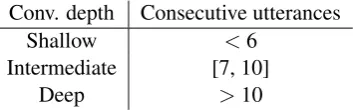
Conv. depth Consecutive utterances
Shallow <6
Intermediate [7, 10]
Deep >10
Table 5: Conversational depth annotation scheme
problem as a binary classification problem. We use the same machine learning setting as the turn level appropriateness predictor. The performance of the automatic conversational depth detector has a 72.7% accuracy, while the majority vote base-line accuracy is 63.6%. The conversational depth detector has three types of features:
1. The number of dialogue exchanges between the user and TickTock and the number of times TickTock uses thecontinue,switchand endstrategy.
2. The count of a set of keywords in the con-versation. The keywords are “sense”, “some-thing” and interrogative pronouns, such as “when”, “who”, “why”, etc. “Sense” often occurs in sentence, such as “You are not mak-ing any sense” and “somethmak-ing” often oc-curs in sentence, such as “Can we talk about something else?” or “Tell me something you are interested in.”. Both of them indicate a possible change of a topic. Interrogative pro-nouns are usually involved in questions that probe users to go deep into the current topic. 3. We convert the entire conversation into a vec-tor using doc2vec and also include the cosine similarity scores between adjacent responses of the conversation.
6.3 Information Gain
Information gain reflects the number of unique words that are introduced into the conversation from both the system and the user. We believe
that the more information the conversation has, the better the conversational quality is. This metric is calculated automatically by counting the number of unique words after the utterance is tokenized.
7 Results and Analysis
We evaluate the three policies with respect to three evaluation metrics: turn-level appropriate-ness, conversational depth andinformation gain. We show the results in the simulated setting in Table 6 and the real-world setting in Table 7. In the simulated setting, users are simulated using a chatbot, A.L.I.C.E.. We show an example sim-ulated conversion in Table 2. In the real-world setting, the users are people recruited on Amazon Mechanical Turk. We collected 50 conversations for each policy. We computeturn-level appropri-atenessandconversational depthusing automatic predictors in the simulated setting and use manual annotations in the real-world setting.
Policy Appropriateness Conversational depth Info gain
Random Selection 62% 32% 50.2
Locally Greedy 72% 34% 62.4
[image:8.595.115.479.61.118.2]Reinforcement Learning 82% 45% 68.2
Table 6: Performance of different policies in the simulated setting
Policy App Inter Inapp Conversational depth Info gain
Random Selection 30% 36% 32% 30% 56.3
Locally Greedy 30% 42% 27% 52% 71.7
Reinforcement Learning 34% 43% 23% 58% 73.2
Table 7: Performance of different policies in the real-world setting.
avoid system breakdowns, so some times they are not “Appropriate”, but only “Interpretable”.
Both the reinforcement learning policy and the locally greedy policy outperform the random se-lection policy with a huge margin in conversa-tional depth. The reason is that they take context into consideration in selecting strategies, while the random selection policy uses the switch strategy randomly without considering the context. As a result, it cannot keep the user on the same topic for long. However, the reinforcement learning policy only outperforms the locally greedy policy with a small margin. Because there are cases when the user has very little interest in a topic, the reinforce-ment learning policy will switch the topic to sat-isfy the turn-level appropriateness metric, while the locally greedy policy seldom selects theswitch strategy according to the learned statistics.
The reinforcement learning policy has the best performance in terms of information gain. We be-lieve the improvement mostly comes from using themorestrategy appropriately. Themorestrategy elicits more information from the user compared to other strategies in general.
In Table 2, we can see that the simulated user is not as coherent as a human user. In addition, the simulated user is less expressive than a real user, so the depth of the conversation is generally lower in the simulated setting than in the real-world set-ting.
8 Conclusion and Future Work
We design a set of generic conversational strate-gies, such as switching topics and grounding on named-entities, to handle possible system break-downs in any non-task-oriented system. We also learn a policy that considers both the local and global context of the conversation for strategy
selection using reinforcement learning methods. The policy learned by reinforcement learning out-performs the locally greedy policy and the ran-dom selection policy with respect to three evalu-ation metrics: turn-level appropriateness, conver-sational depth and information gain.
In the future, we wish to consider user’s engage-ment in designing the strategy selection policy in order to elicit high quality responses from human users.
References
Rafael E Banchs and Haizhou Li. 2012. Iris: a chat-oriented dialogue system based on the vector space model. In Proceedings of the ACL 2012 System Demonstrations, pages 37–42. Association for Com-putational Linguistics.
Alan W Biermann and Philip M Long. 1996. The com-position of messages in speech-graphics interactive systems. InProceedings of the 1996 International Symposium on Spoken Dialogue, pages 97–100.
Chih-Chung Chang and Chih-Jen Lin. 2011. LIB-SVM: a library for support vector machines. ACM Transactions on Intelligent Systems and Technology (TIST), 2(3):27.
Min Chi, Kurt VanLehn, Diane Litman, and Pamela Jordan. 2011. Empirically evaluating the ap-plication of reinforcement learning to the induc-tion of effective and adaptive pedagogical strategies. User Modeling and User-Adapted Interaction, 21(1-2):137–180.
Kallirroi Georgila and David R Traum. 2011. Rein-forcement learning of argumentation dialogue poli-cies in negotiation. InINTERSPEECH, pages 2073– 2076.
Sugiyama, Toru Hirano, Toshiro Makino, and Yoshi-hiro Matsuo. 2014. Towards an open-domain con-versational system fully based on natural language processing. InCOLING, pages 928–939.
Clayton J Hutto and Eric Gilbert. 2014. Vader: A par-simonious rule-based model for sentiment analysis of social media text. In Eighth International AAAI Conference on Weblogs and Social Media.
Filip Jurˇc´ıˇcek, Blaise Thomson, and Steve Young. 2012. Reinforcement learning for parameter esti-mation in statistical spoken dialogue systems. Com-puter Speech & Language, 26(3):168–192.
Sungjin Lee and Maxine Eskenazi. 2012. Pomdp-based let’s go system for spoken dialog challenge. In Spoken Language Technology Workshop (SLT), 2012 IEEE, pages 61–66. IEEE.
Esther Levin, Roberto Pieraccini, and Wieland Eck-ert. 1997. Learning dialogue strategies within the markov decision process framework. InAutomatic Speech Recognition and Understanding, 1997. Pro-ceedings., 1997 IEEE Workshop on, pages 72–79. IEEE.
Jan Niehues Maria Schmidt and Alex Waibel. 2015. Towards an open-domain social dialog system. In Proceedings of the 6th International Workshop Se-ries on Spoken Dialog Systems, pages 124–129. Tomas Mikolov, Kai Chen, Greg Corrado, and
Jef-frey Dean. 2013. Efficient estimation of word representations in vector space. arXiv preprint arXiv:1301.3781.
Teruhisa Misu, Komei Sugiura, Kiyonori Ohtake, Chiori Hori, Hideki Kashioka, Hisashi Kawai, and Satoshi Nakamura. 2010. Modeling spoken deci-sion making dialogue and optimization of its dia-logue strategy. In Proceedings of the 11th Annual Meeting of the Special Interest Group on Discourse and Dialogue, pages 221–224. Association for Com-putational Linguistics.
Teruhisa Misu, Kallirroi Georgila, Anton Leuski, and David Traum. 2012. Reinforcement learning of question-answering dialogue policies for virtual mu-seum guides. In Proceedings of the 13th Annual Meeting of the Special Interest Group on Discourse and Dialogue, pages 84–93. Association for Com-putational Linguistics.
Alan Ritter, Colin Cherry, and William B Dolan. 2011. Data-driven response generation in social media. In Proceedings of the conference on empirical methods in natural language processing, pages 583–593. As-sociation for Computational Linguistics.
Tomohide Shibata, Yusuke Egashira, and Sadao Kuro-hashi. 2014. Chat-like conversational system based on selection of reply generating module with rein-forcement learning. In Proceedings of the 5th In-ternational Workshop Series on Spoken Dialog Sys-tems, pages 124–129.
Satinder P Singh, Michael J Kearns, Diane J Litman, and Marilyn A Walker. 1999. Reinforcement learn-ing for spoken dialogue systems. In Nips, pages 956–962.
Oriol Vinyals and Quoc Le. 2015. A neural conver-sational model. ICML Deep Learning Workshop 2015.
Marilyn A Walker, Jeanne C Fromer, and Shrikanth Narayanan. 1998. Learning optimal dialogue strate-gies: A case study of a spoken dialogue agent for email. In Proceedings of the 36th Annual Meet-ing of the Association for Computational LMeet-inguis- Linguis-tics and 17th International Conference on Computa-tional Linguistics-Volume 2, pages 1345–1351. As-sociation for Computational Linguistics.
Jason D Williams and Steve Young. 2007. Partially observable markov decision processes for spoken dialog systems. Computer Speech & Language, 21(2):393–422.
Zhou Yu, Alexandros Papangelis, and Alexander Rud-nicky. 2015. TickTock: A non-goal-oriented mul-timodal dialog system with engagement awareness. InProceedings of the AAAI Spring Symposium. Zhou Yu, Ziyu Xu, Alan Black, and Alexander