Aggregating Continuous Word Embeddings for Information Retrieval
St´ephane Clinchant Xerox Research Centre Europe [email protected]
Florent Perronnin Xerox Research Centre Europe [email protected]
Abstract
While words in documents are generally treated as discrete entities, they can be embedded in a Euclidean space which reflects an a priori notion of similarity between them. In such a case, a text document can be viewed as a bag-of-embedded-words (BoEW): a set of real-valued vectors. We propose a novel document representation based on such continuous word embeddings. It con-sists in non-linearly mapping the word-embeddings in a higher-dimensional space and in aggregating them into a document-level representation. We report retrieval and clustering experiments in the case where the word-embeddings are computed from standard topic models showing sig-nificant improvements with respect to the original topic models.
1 Introduction
For many tasks such as information retrieval (IR) or clustering, a text document is represented by a vector, where each dimension corresponds to a given word and where each value encodes the word importance in the document (Salton and McGill, 1983). This Vector Space Model (VSM) or bag-of-words (BoW) representation is at the root of topic models such as Latent Semantic In-dexing (LSI) (Deerwester, 1988), Probablistic La-tent Semantic Analysis (PLSA) (Hofmann, 1999) or Latent Dirichlet Allocation (LDA) (Blei et al., 2003). All these topic models consist in “pro-jecting” documents on a set of topics generally learned in an unsupervised manner. During the learning stage, as a by-product of the projec-tion of the training documents, one also obtains an embedding of the words in a typically small-dimensional continuous space. The distance
be-tween two words in this space translates the mea-sure of similarity between words which is captured by the topic models. For LSI, PLSA or LDA, the implicit measure is the number of co-occurrences in the training corpus.
In this paper, we raise the following question: if we were provided with an embedding of words in a continuous space, how could we best use it in IR/clustering tasks? Especially, could we develop probabilistic models which would be able to bene-fit from thisa prioriinformation on the similarity between words? When the words are embedded in a continuous space, one can view a document as a Bag-of-Embedded-Words (BoEW). We there-fore draw inspiration from the computer vision community where it is common practice to rep-resent an image as a bag-of-features (BoF) where each real-valued feature describes local proper-ties of the image (such as its color, texture or shape). We model the generative process of em-bedded words using a mixture model where each mixture component can be loosely thought of as a “topic”. To transform the variable-cardinality BoEW into a fixed-length representation which is more amenable to comparison, we make use of the Fisher kernel framework of Jaakkola and Haussler (Jaakkola and Haussler, 1999). We will show that this induces a non-linear mapping of the embed-ded words in a higher-dimensional space where their contributions are aggregated.
We underline that our contribution is not the application of the FK to text analysis (see (Hof-mann, 2000) for such an attempt). Knowing that words can be embedded in a continuous space, our main contribution is to show that we can consequently represent a document as a bag-of-embedded-words. The FK is justone possible way to subsequently transform this bag representation into a fixed-length vector which is more amenable to large-scale processing.
The remainder of the article is organized as
lows. In the next section, we review related works. In section 3, we describe the proposed framework based on embedded words, GMM topic models and the Fisher kernel. In section 4, we report and discuss experimental results on clustering and re-trieval tasks before concluding in section 5.
2 Related Works
We provide a short review of the literature on those topics which are most related to our work: topic models, word embeddings and bag-of-patches rep-resentations in computer vision.
Topic models.Statistical topic models build on
the idea of Latent Semantic Indexing (LSI) in a probabilistic way. The PLSA model proposed by Hoffman (Hofmann, 1999) can be thought of as a constrained matrix factorization problem equiva-lent to NMF (Lee and Seung, 1999; Gaussier and Goutte, 2005). Latent Dirichlet Allocation (LDA) (Blei et al., 2003) , the generative counterpart of PLSA, has played a major role in the development of probabilistic models for textual data. As a re-sult, it has been extended or refined in a count-less studies (Griffiths et al., 2004; Eisenstein et al., 2011; Hoffman et al., 2010). Statistical topic mod-els are often evaluated with the perplexity mea-sure on a held-out dataset but it has been shown that perplexity only correlates weakly with human preference (Chang et al., 2009). Moreover, sev-eral studies reported that LDA does not gensev-erally outperform LSI in IR or sentiment analysis tasks (Wang et al., 2011; Maas et al., 2011).
Nevertheless, LSI has known a resurging inter-est. Supervised Semantic Indexing (SSI) (Bai et al., 2009) learns low-rank projection matrices on query-document pairs so as to minimize a rank-ing loss. Similarly, (Wang et al., 2011) studies the influence of `1 and`2 regularization on the
pro-jection matrices and shows how to distribute the algorithm using Map-Reduce.
Word embeddings.Parrallel to the large
devel-opment of statistical topic models, there has been an increasing amount of literature on word em-beddings where it has been proposed to include higher-level dependencies between words, either syntactic or semantic. We note that topic mod-els such as LSI, PLSA or LDA implicitly perform such an embedding (jointly with the embedding of documents) and that the measure of similarity is the co-occurrence of words in the training corpus. A seminal work in this field is the one by
Col-lobert and Weston (ColCol-lobert and Weston, 2008) where a neural network is trained by stochastic gradient descent in order to minimize a loss func-tion on the observed n-grams. This work has later then been refined in (Bengio et al., 2009). Proba-bilistic methods have also been proposed to learn language models such as the HLBL embedding (Mnih and Hinton, 2007).
Similarly, (Maas et al., 2011) parametrizes a probabilistic model in order to capture word repre-sentations, instead of modeling individually latent topics, which lead to significant improvements over LDA in sentiment analysis. Furthermore, (Dhillon et al., 2011) uses the Canonical Correla-tion Analysis technique between the left and right context vectors of a word to learn word embed-dings. Lastly, (Turian et al., 2010) proposes an empirical comparison of several word embedding techniques in a named entity recognition task and provides an excellent state-of-the-art of word rep-resentation. Except (Maas et al., 2011) , there has been very little work to your knowledge bridging the statistical topic models with the word embed-ding techniques.
Computer vision. In modern computer vision,
an image is usually described by a set of local de-scriptors extracted from small image patches such as SIFT. This local representation provides some invariance to changes in viewpoint, lighting or occlusion. The local descriptors characterize the low-level properties of the image such as its color, texture or shape. Since it is computationally in-tensive to handle (e.g. to match) sets of descrip-tors of variable cardinality, it has been proposed to aggregate the local descriptors into a global vector which is more amenable to retrieval and classifica-tion.
The most popular aggregation mechanism was directly inspired by the work in text analysis. It makes use of an intermediate representation – the visual vocabulary– which is a set of prototypical descriptors – thevisual words– obtained through a clustering algorithm such as k-means (Leung and Malik, 1999; Sivic and Zisserman, 2003; Csurka et al., 2004). Given an image, each of its de-scriptors is assigned to its closest visual word and the image is described by the histogram of visual words frequencies. This representation is referred to as theBag-of-Visual-words(BoV).
re-trieval, Sivic and Zisserman proposed to use a tf-idf weighting of the BoV vector and an inverted file for efficient matching (Sivic and Zisserman, 2003). As another example, pLSA, LDA and their many variations have been extensively applied to problems such as image classification (Quelhas et al., 2005) or object discovery (Russell et al., 2006). However, it has been noted that the quan-tization process mentioned above incurs a loss of information since acontinuous descriptoris trans-formed into adiscrete value(the index of the clos-est visual word). To overcome this limitation, sev-eral improvements have been proposed which de-part from the pure discrete model. These improve-ments include the soft assignment of descriptors to visual words (Farquhar et al., 2005; Philbin et al., 2008; Gemert et al., 2008) or the use of more advanced coding techniques than vector quanti-zation such as sparse coding (Yang et al., 2009) or locality-constrained linear coding (Wang et al., 2010).
All the previous techniques can be understood (with some simplifications) as simple counting mechanisms (computation of 0-order statistics). It has been proposed to take into account higher-order statistics (first and second higher-order for instance) which encode more descriptor-level information and therefore incur a lower loss of information. This includes the Fisher vector (Perronnin and Dance, 2007; Perronnin et al., 2010), which was directly inspired by the Fisher kernel of Jaakkola and Haussler (Jaakkola and Haussler, 1999). In a nutshell, the Fisher vector consists in modeling the distribution of patches in any image with a Gaus-sian mixture model (GMM) and then in describing an image by its deviation from this average prob-ability distribution. In a recent evaluation (Chat-field et al., 2011), it has been shown experimen-tally that the Fisher vector was the state-of-the-art representation for image classification. However, in this work we question the treatment of words as discrete entities. Indeed, intuitvely some words are closer to each other from a semantic standpoint and words can be embedded in a continuous space as is done for instance in LSA.
3 The Bag-of-Embedded-Words (BoEW)
In this work, we draw inspiration from the work in the computer vision community: we model the generation process of words with continuous mix-ture models and use the FK for aggregation.
The proposed bag-of-embedded-words pro-ceeds as follows: Learning phase. Given an un-labeled training set of documents:
1. Learn an embedding of words in a low-dimensional space, i.e. lower-dimensional than the VSM. After this operation, each wordwis then represented by a vector of size
e:
w→Ew = [Ew,1, . . . , Ew,e]. (1)
2. Fit a probabilistic model – e.g. a mixture model – on the continuous word embeddings.
Document representation. Given a document
whose BoW representation is{w1, . . . , wT}:
1. Transform the BoW representation into a BoEW:
{w1, . . . , wT} → {Ew1, . . . , EwT} (2)
2. Aggregate the continuous word embeddings
Ewt using the FK framework.
Since the proposed framework is independent of the particular embedding technique, we will first focus on the modeling of the generation process and on the FK-based aggregation. We will then compare the proposed continuous topic model to the traditional LSI, PLSA and LDA topic models.
3.1 Probabilistic modeling and FK
aggregation
We assume that the continuous word embeddings in a document have been generated by a “univer-sal” (i.e. document-independent) probability den-sity function (pdf). As is common practice for continuous features, we choose this pdf to be a Gaussian mixture model (GMM) since any con-tinuous distribution can be approximated with ar-bitrary precision by a mixture of Gaussians. In what follows, the pdf is denoted uλ where λ =
{θi, µi,Σi, i = 1. . . K} is the set of parameters
of the GMM. θi, µi and Σi denote respectively
the mixture weight, mean vector and covariance matrix of Gaussiani. For computational reasons, we assume that the covariance matrices are diag-onal and denote σ2
i the variance vector of
Likelihood (ML) criterion using the Expectation-Maximization (EM) algorithm.
Let us assume that a document contains T
words and let us denote byX ={x1, . . . , xT}the
set of continuous word embeddings extracted from the document. We wish to derive a fixed-length representation (i.e. a vector whose dimensionality is independent ofT) that characterizesXwith re-spect touλ. A natural framework to achieve this
goal is the FK (Jaakkola and Haussler, 1999). In what follows, we use the notation of (Perronnin et al., 2010).
Givenuλone can characterize the sampleX
us-ing the score function:
GXλ =∇Tλloguλ(X). (3)
This is a vector whose size depends only on the number of parameters inλ. Intuitively, it describes in which direction the parametersλof the model should be modified so that the modeluλbetter fits
the data. Assuming that the word embeddingsxt
are iid (a simplifying assumption), we get:
GXλ = T
X
t=1
∇λloguλ(xt). (4)
Jaakkola and Haussler proposed to measure the similarity between two samplesXandY using the FK:
K(X, Y) =GXλ0Fλ−1GYλ (5)
whereFλ is the Fisher Information Matrix (FIM)
ofuλ:
Fλ =Ex∼uλ
∇λloguλ(x)∇λloguλ(x)0
. (6)
As Fλ is symmetric and positive definite, it
has a Cholesky decomposition Fλ = L0λLλ and
K(X, Y) can be rewritten as a dot-product be-tween normalized vectorsGλwith:
GX
λ =LλGXλ. (7)
(Perronnin et al., 2010) refers toGX
λ as theFisher
Vector(FV) of X. Using a diagonal approxima-tion of the FIM, we obtain the following formula for the gradient with respect toµi1:
GiX = √1 θi
T
X
t=1
γt(i)
xt−µi
σi
. (8)
1
we only consider the partial derivatives with respect to the mean vectors since the partial derivatives with respect to the mixture weights and variance parameters carry little ad-ditional information (we confirmed this fact in preliminary experiments).
where the division by the vectorσi should be
un-derstood as a term-by-term operation andγt(i) =
p(i|xt, λ)is the soft assignment ofxtto Gaussiani
(i.e.the probability thatxtwas generated by
Gaus-sian i) which can be computed using Bayes’ for-mula. The FVGX
λ is the concatenation of theGiX,
∀i. Letebe the dimensionality of the continuous word descriptors and K be the number of Gaus-sians. The resulting vector ise×Kdimensional.
3.2 Relationship with LSI, PLSA, LDA
Relationship with LSI. Let n be the number of
documents in the collection andt be the number of indexing terms. LetAbe thet×ndocument matrix. In LSI (or NMF),Adecomposes as:
A≈UΣV0 (9)
where U ∈ Rt×e, Σ ∈ Re×e is diagonal, V ∈ Rn×eandeis the size of the embedding space. If
we choose VΣ as the LSI document embedding matrix – which makes sense if we accept the dot-product as a measure of similarity between docu-ments since A0A ≈ (VΣ)(VΣ)0 – then we have
VΣ ≈ A0U. This means that the LSI embedding of a document is approximately the sum of the em-bedding of the words, weighted by the number of occurrences of each word.
Similarly, from equations (4) and (7), it is clear that the FVGX
λ is a sum of non-linear mappings:
xt→Lλ∇λloguλ(xt) =
γ√t(1)
θ1
xt−µ1
σ1
, . . . ,γ√t(K) θK
xt−µK
σK ]
(10)
computed for each embedded-wordxt. When the
number of GaussiansK = 1, the mapping simpli-fies to a linear one:
xt→
xt−µ1
σ1
(11)
Another advantage is that the proposed framework is rotation and scale invariant. Indeed, while it “makes sense” to use VΣ as the document em-bedding, in practice better results can be obtained when using simplyV. Our framework is indepen-dent of such an arbitrary choice.
Relationship with PLSA and LDA. There is
also a strong parallel between topic models on dis-crete word occurrences such as PLSA/LDA and the proposed model for continuous word embed-dings. Indeed, both generative models include a latent variable which indicates which mixture gen-erates which words. In the LDA case, each topic is modeled by a multinomial distribution which indi-cates the frequency of each word for the particu-lar topic. In the mixture model case, each mixture component can be loosely understood as a “topic”.
Therefore, one could wonder if the proposed framework is not somehow equivalent to topic models such PLSA/LDA. The major difference is that PLSA, LDA and other topic models on word counts jointly perform the embedding of words and the learning of the topics. A major deficiency of such approaches is that they cannot deal with words which have not been seen at training time. In the proposed framework, these two steps are de-coupled. Hence, we can cope with words which have not been seen during the training of the prob-abilistic model. We will see in section 4.3.1 that this yields a major benefit: the mixture model can be trained efficiently on a small subset of the cor-pus and yet generalize to unseen words.
In the same manner, our work is significantly different from previous attempts at applying the FK framework to topic models such as PLSA (Hofmann, 2000; Chappelier and Eckard, 2009) or LDA (Chandalia and Beal, 2006) (we will refer to such combinations as FKPLSA and FKLDA). Indeed, while FKPLSA and FKLDA can improve over PLSA and LDA respectively, they inherit the deficiencies of the original PLSA and LDA ap-proaches, especially their unability to deal with words unseen at training time. We note also that FKPLSA is extremely computationally intensive: in the recent (Chappelier and Eckard, 2009), the largest corpus which could be handled contained barely 7,466 documents. In contrast, we can eas-ily handle on a single machine corpora containing hundreds of thousands of documents (see section 4.2).
Collection #docs #terms #classes 20NG 19,995 32,902 20
TDT 4,214 8,978 18
(a) Clustering
Collection #docs #terms #queries ROBUST 490,779 87,223 250 TREC1&-3 741,856 108,294 150 CLEF03 166,754 79,008 60
[image:5.595.310.517.62.187.2](b) IR
Table 1: Characteristics of the clustering and IR collections
4 Experiments
The experiments aim at demonstrating that the proposed continuous model is competitive with existing topic models ondiscretewords. We focus our experiments on the case where the embedding of the continuous words is obtained by LSI as it enables us to compare the quality of the document representation obtained originally by LSI and the one derived by our framework on top of LSI. In what follows, we will refer to the FV on the LSI embedding simply as the FV.
We assessed the performance of the FV on clustering and ad-hoc IR tasks. We used two datasets for clustering and three for IR. Using the Lemur toolkit (Ogilvie and Callan, 2001), we ap-plied a standard processing pipeline on all these datasets including stopword removal, stemming or lemmatization and the filtering of rare words to speed up computations. The GMMs were trained on 1,000,000 word occurences, which represents roughly 5,000 documents for the collections we have used. In what follows, the cosine similar-ity was used to compare FVs and LSI document vectors.
4.1 Clustering
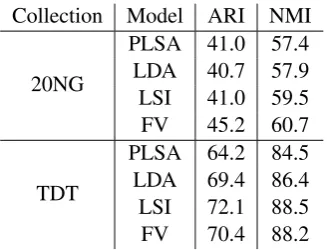
Collection Model ARI NMI
20NG
PLSA 41.0 57.4 LDA 40.7 57.9 LSI 41.0 59.5 FV 45.2 60.7
TDT
[image:6.595.100.264.61.186.2]PLSA 64.2 84.5 LDA 69.4 86.4 LSI 72.1 88.5 FV 70.4 88.2
Table 2: Clustering experiments on 20NG and the WebKB TDT Corpus: Mean performance over 20 runs (in %).
1 (a) gives the general statistics of the two datasets after preprocessing.
We use 2 standard evaluation metrics to assess the quality of the clusters, which are the Adjusted Rand Index (ARI) (Hubert and Arabie, 1985) and Normalized Mutual Information (NMI) (Manning and Sch¨utze, 1999). These measures compare the clusters with respect to the partition induced by the category information. The ARI and NMI range between 0 and 1 where 1 indicates a perfect match with the categories. For all the clustering methods, the number of clusters is set to the true number of classes of the collections and the performances were averaged over 20 runs.
We compared spherical k-means on the FV doc-ument representations to topic models such as PLSA and LDA2. We choose a priori an embed-ding of sizee= 20for both datasets for LSI and therefore for the FV. LDA and PLSA were trained on the whole dataset. For the FV, we varied the number of Gaussians (K) to analyze the evolution of performances. Table 2 shows the best results for the FV and compares them to LSI, PLSA and LDA. First, LDA has lower performance than LSI in our experiments as reported by several stud-ies which showed that LDA does not necessarily outperform LSI (Wang et al., 2011; Maas et al., 2011). Overall, the FV outperforms all the other models on 20NG and probabilistic topic models on TDT.
2We use Blei’s implementation available at
http://www.cs.princeton.edu/ blei/lda-c/
4.2 Retrieval
We used three IR collections, from two evalua-tion campaigns: TREC3 and CLEF4: Table 1 (b)
gives the statistics of the collections we retained: (i) ROBUST (TREC), (ii) the English subpart of CLEF03 AdHoc Task and (iii) the TREC 1&2 col-lection, with 150 queries corresponding to topics 51 to 200. For the ROBUST and TREC 1&2 col-lections, we used standard Porter stemming. For CLEF, words were lemmatized. We removed rare words to speed up the computation of LSI. Per-formances were measured with the Mean Aver-age Precision (MAP) over the top 1,000 retrieved documents. All the collections have more than 80,000 unique words and approximately 166,000 documents for CLEF, 500,000 for ROBUST and 741,000 for TREC. LSI was computed on the whole dataset and the GMMs were trained on a random subset of 5,000 documents. We then com-puted the FVs for all documents in the collection. Note that we did not compute topic models with LDA on these datasets as LSI provides similar per-formances to LDA (Wang et al., 2011; Bai et al., 2009).
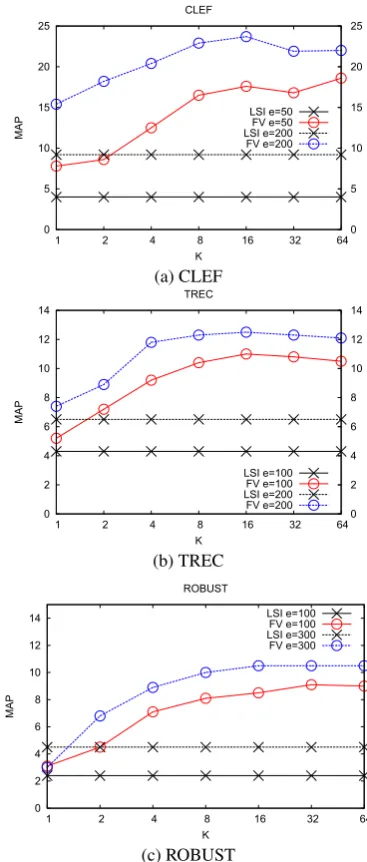
Table 3 shows the evolution of the MAP for the LSI baseline with respect to the size of the latent space. Note that we use Matlab to compute sin-gular valued decompositions and that some num-bers are missing in this table because of the mem-ory limitations of our machine. Figure 1 shows the evolution of the MAP for different numbers of Gaussians (K) for respectively the CLEF, TREC and ROBUST datasets. For all these plots, FV per-formances are displayed with a circle and LSI with crosses. We tested an embedding of sizee = 50
ande= 200for the CLEF dataset, an embedding
of sizee= 100ande= 200for the TREC dataset
ande= 100ande= 300for ROBUST. All these
figures show the same trend: a) the performance of the FV increases up to 16 Gaussians and then reaches a plateau and b) the FV significantly out-performs LSI (since it is able to double LSI’s per-formance in several cases). In addition, the LSI results in table 3 (a) indicate that LSI with more dimensions will not reach the level of performance obtained by the FV.
3
trec.nist.gov
e 50 100 200 300 400 500 CLEF 4.0 6.7 9.2 11.0 13.0 13.9 TREC-1 &2 2.2 4.3 6.5 8.3 -
-ROBUST 1.3 2.4 3.6 4.5 -
-Table 3: LSI MAP (%) for the IR datasets for sev-eral sizes of the latent subspace.
4.3 Discussion
In the previous section we validated the good be-havior of the proposed continuous document rep-resentation. In the following parts, we conduct ad-ditional experiments to further show the strengths and weaknesses of the proposed approach.
IR Baselines.If the FV based on LSI word
em-beddings significantly outperforms LSI, it is out-performed by strong IR baselines such as Diver-gence From Randomness (DFR) models (Amati and Rijsbergen, 2002) or Language Models (Ponte and Croft, 1998). This is what we show in table 4 with the PL2 DFR model compared to standard TFIDF, the best FV and LSI.
[image:7.595.322.506.60.492.2]Collection PL2 TFIDF FV LSI CLEF’03 35.7 16.4 23.7 9.2 TREC-1&2 22.6 12.4 10.8 6.5 ROBUST 24.8 12.6 10.5 4.5
Table 4: Mean Average Precision(%) for the PL2 and TFIDF model on the three IR Collections compared to Fisher Vector and LSI
These results are not surprising as it has been shown experimentally in many studies that latent-based approaches such as LSI are generally out-performed by state-of-the-art IR models in Ad-Hoc tasks. There are a significant gap in per-formances between LSI and TFIDF and between TFIDF and the PL2 model. The first gap is due to the change in representation, from a vector space model to latent based representation, while the second one is only due to a ’better’ similarity as both methods operate in a similar space. In a way, the FV approach offers a better similarity for latent representations even if several improve-ments could be further proposed (pivoted docu-ment length normalization, combination with ex-act representation).
0 5 10 15 20 25
1 2 4 8 16 32 64
0 5 10 15 20 25
MAP
K CLEF
LSI e=50 FV e=50 LSI e=200 FV e=200
(a) CLEF
0 2 4 6 8 10 12 14
1 2 4 8 16 32 64
0 2 4 6 8 10 12 14
MAP
K TREC
LSI e=100 FV e=100 LSI e=200 FV e=200
(b) TREC
0 2 4 6 8 10 12 14
1 2 4 8 16 32 64
MAP
K ROBUST
LSI e=100 FV e=100 LSI e=300 FV e=300
(c) ROBUST
Figure 1: MAP(%) for the FV with different num-bers of Gaussians against LSI on the CLEF, TREC and ROBUST datasets
4.3.1 Influence of Training Set Size and
Unseen Words.
[image:7.595.71.316.63.123.2]0.78 0.8 0.82 0.84 0.86 0.88 0.9 0.92
1 2 4 8 16 32 64 0.78 0.8 0.82 0.84 0.86 0.88 0.9 0.92
NMI
K TDT
[image:8.595.305.464.61.130.2]FV e=50 Yule Linear
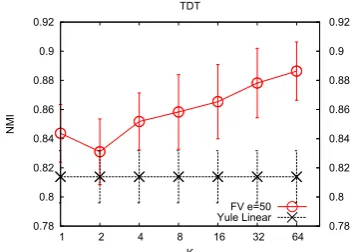
Figure 2: NMI for the FV with different Number of Gaussians against averaging word embeddings on TDT with the Yule measure
time. We show in figure 5 that our model is robust to the number of word occurences used for train-ing the GMM. We illustrate this point ustrain-ing the TREC 1-&2 collection with an embedding of size
e = 100. We varied the number of documents to
train the GMM. Figure 5 shows that increasing the number of documents does not lead to improve-ments and the performance remains stable. There-fore, these empirical results indeed confirm that we can adress large-scale collections as we can re-strict the learning step on a small subset of a col-lection of documents.
4.3.2 Beyond LSI Embedding
While we focused in the experimental section on word embeddings obtained with LSI, we now show that the proposed framework can be ap-plied to other word embeddings. To do so, we use a word embedding based on the Yule associ-ation measure (Jagarlamudi et al., 2011) which is closely related to the Mutual Information but relies on the raw frequencies rather than on probabilities. We use this measure to compute a similarity ma-trix between words. Then, we applied a spherical kmeans on this matrix to finde= 50word clusters and used the cluster centroids as the word embed-ding matrix. A simple baseline is to use as docu-ment representation the average word embedding as is the case of LSI. The baseline gets 82% NMI wherease the FV with 32 Gaussians reaches 88%. The non-linear mapping induced by the FV always outperforms the simple averaging. Therefore, it is worthwhile to learn non-linear mappings.
5 Conclusion
In this work, we proposed to treat documents as bags-of-embedded-words (BoEW) and to learn
M # docs MAP TREC 0.5M ≈2,700 11.0
[image:8.595.92.268.62.188.2]1M ≈5,400 11.0 5M ≈27,000 10.6 10M ≈54,000 10.6
Table 5: Model performance for different subsets used to train the GMM. M refers to a million word occurences
probabilistic mixture modelsoncewords were em-bedded in a Euclidean space. This is a signifi-cant departure from the vast majority of the works in the machine learning and information retrieval communities which deal with words as discrete entities. We assessed our framework on several clustering and ad-hoc IR collections and the exper-iments showed that our model is able to yield ef-fective descriptors of textual documents. In partic-ular, the FV based on LSI embedding was shown to significantly outperform LSI for retrieval tasks. There are many possible applications and gen-eralizations of our framework. In this study, we fo-cused on the LSI embedding and showed prelim-inary results with the Yule embedding. Since we believe that the word embedding technique is of crucial importance, we would like to experiment with recent embedding techniques such as the Col-lobert and Weston embedding (ColCol-lobert and We-ston, 2008) which has been shown to scale well in several NLP tasks.
Moreover, another significant advantage of the proposed framework is that we could deal seam-lessly with collections of multilingual documents. This requires the ability to embedd the words of different languages and techniques exist to per-form such an embedding including Canonical Cor-relation Analysis. Finally, the GMM still has sev-eral theoretical limitations to model textual docu-ments appropriately so that one could design a bet-ter statistical model for bags-of-embedded-words.
References
Gianni Amati and Cornelis Joost Van Rijsbergen. 2002. Probabilistic models of information retrieval based on measuring the divergence from random-ness. ACM Trans. Inf. Syst., 20(4):357–389.
B. Bai, J. Weston, D. Grangier, R. Collobert, K. Sadamasa, Y. Qi, O. Chapelle, and K. Wein-berger. 2009. Supervised semantic indexing. In
Y. Bengio, J. Louradour, R. Collobert, and J. Weston. 2009. Curriculum learning. InICML.
David M. Blei, Andrew Y. Ng, and Michael I. Jordan. 2003. Latent dirichlet allocation. JMLR.
Gaurav Chandalia and Matthew J. Beal. 2006. Using fisher kernels from topic models for dimensionality reduction.
Jonathan Chang, Jordan Boyd-graber, Sean Gerrish, Chong Wang, and David M. Blei. 2009. Reading tea leaves: How humans interpret topic models. In
NIPS.
Jean-C´edric Chappelier and Emmanuel Eckard. 2009. Plsi: The true fisher kernel and beyond. In
ECML/PKDD (1).
K. Chatfield, V. Lempitsky, A. Vedaldi, and A. Zisser-man. 2011. The devil is in the details: an evaluation of recent feature encoding methods. InBMVC.
R. Collobert and J. Weston. 2008. A unified architec-ture for natural language processing: Deep neural networks with multitask learning. InICML.
G. Csurka, C. Dance, L Fan, J. Willamowski, and C. Bray. 2004. Visual categorization with bags of keypoints. InProc. of ECCV Workshop on Statisti-cal Learning for Computer Vision.
Scott Deerwester. 1988. Improving Information Re-trieval with Latent Semantic Indexing. In Proceed-ings of (ASIS ’88).
Paramveer S. Dhillon, Dean Foster, and Lyle Ungar. 2011. Multi-view learning of word embeddings via cca. InNIPS, volume 24.
Jacob Eisenstein, Amr Ahmed, and Eric P. Xing. 2011. Sparse additive generative models of text. In Lise Getoor and Tobias Scheffer, editors, ICML, pages 1041–1048. Omnipress.
Jason Farquhar, Sandor Szedmak, Hongying Meng, and John Shawe-Taylor. 2005. Improving ”bag-of-keypoints” image categorisation: Generative mod-els and pdf-kernmod-els. Technical report, University of Southampton.
´
Eric Gaussier and Cyril Goutte. 2005. Relation be-tween PLSA and NMF and implications. InSIGIR.
Jan Van Gemert, Jan-Mark Geusebroek, Cor Veenman, and Arnold Smeulders. 2008. Kernel codebooks for scene categorization. In European Conference on Computer Vision (ECCV).
Thomas L. Griffiths, Mark Steyvers, David M. Blei, and Joshua B. Tenenbaum. 2004. Integrating top-ics and syntax. InNIPS.
Matthew D. Hoffman, David M. Blei, and Francis Bach. 2010. Online learning for latent dirichlet al-location. InIn NIPS.
Thomas Hofmann. 1999. Probabilistic latent semantic indexing. InSIGIR. ACM.
T. Hofmann. 2000. Learning the similarity of docu-ments: An information geometric approach to doc-ument retrieval and categorization. InNeural Infor-mation Processing Systems.
http://www.ldc.upenn.edu/ProjectsTDT2004. 2004. TDT: Annotation manual - version 1.2.
Lawrence Hubert and Phipps Arabie. 1985. Compar-ing partitions. Journal of Classification.
Tommi S. Jaakkola and David Haussler. 1999. Ex-ploiting generative models in discriminative classi-fiers. InNIPS, Cambridge, MA, USA. MIT Press.
Jagadeesh Jagarlamudi, Raghavendra Udupa,
Hal Daum´e III, and Abhijit Bhole. 2011. Im-proving bilingual projections via sparse covariance matrices. InEMNLP, pages 930–940.
D. D. Lee and H. S. Seung. 1999. Learning the parts of objects by non-negative matrix factorization. Na-ture, 401(6755):788–791, October.
T. Leung and J. Malik. 1999. Recognizing surfaces using three-dimensional textons. In IEEE Interna-tional Conference on Computer Vision (ICCV).
Andrew L. Maas, Raymond E. Daly, Peter T. Pham, Dan Huang, Andrew Y. Ng, and Christopher Potts. 2011. Learning word vectors for sentiment analysis. InACL, pages 142–150.
Christopher D. Manning and Hinrich Sch¨utze. 1999.
Foundations of statistical natural language process-ing. MIT Press, Cambridge, MA, USA.
Andriy Mnih and Geoffrey E. Hinton. 2007. Three new graphical models for statistical language mod-elling. In Zoubin Ghahramani, editor, ICML, vol-ume 227 ofACM International Conference Proceed-ing Series, pages 641–648. ACM.
Paul Ogilvie and James P. Callan. 2001. Experiments Using the Lemur Toolkit. InTREC.
Florent Perronnin and Christopher R. Dance. 2007. Fisher kernels on visual vocabularies for image cat-egorization. InCVPR.
Florent Perronnin, Yan Liu, , Jorge S´anchez, and Herv´e Poirier. 2010. Large-scale image retrieval with compressed fisher vectors. InCVPR.
James Philbin, Ondrej Chum, Michael Isard, Josef Sivic, and Andrew Zisserman. 2008. Lost in quanti-zation: Improving particular object retrieval in large scale image databases. InIEEE International Con-ference on Computer Vision and Pattern Recognition (CVPR).
P. Quelhas, F. Monay, J.-M. Odobez, D. Gatica-Perez, T. Tuytelaars, and L. Van Gool. 2005. Modeling scenes with local descriptors and latent aspects. In
IEEE International Conference on Computer Vision (ICCV).
B. Russell, A. Efros, J. Sivic, W. Freeman, and A. Zis-serman. 2006. Using multiple segmentations to dis-cover objects and their extent in image collections. InIEEE International Conference on Computer Vi-sion and Pattern Recognition (CVPR).
R. Salakhutdinov and A. Mnih. 2007. Probabilistic matrix factorization. InNIPS.
G. Salton and M. J. McGill. 1983. Introduction to Modern Information Retrieval. McGraw-Hill, Inc., New York, NY, USA.
J. Sivic and A. Zisserman. 2003. Video google: A text retrieval approach to object matching in videos. In
IEEE International Conference on Computer Vision (ICCV).
Joseph P. Turian, Lev-Arie Ratinov, and Yoshua Ben-gio. 2010. Word representations: A simple and gen-eral method for semi-supervised learning. In ACL, pages 384–394.
J. Wang, J. Yang, K. Yu, F. Lv, T. Huang, and Y. Gong. 2010. Locality-constrained linear coding for image classification. InIEEE International Conference on Computer Vision and Pattern Recognition (CVPR).
Quan Wang, Jun Xu, Hang Li, and Nick Craswell. 2011. Regularized latent semantic indexing. In SI-GIR’11.